


Report Overview
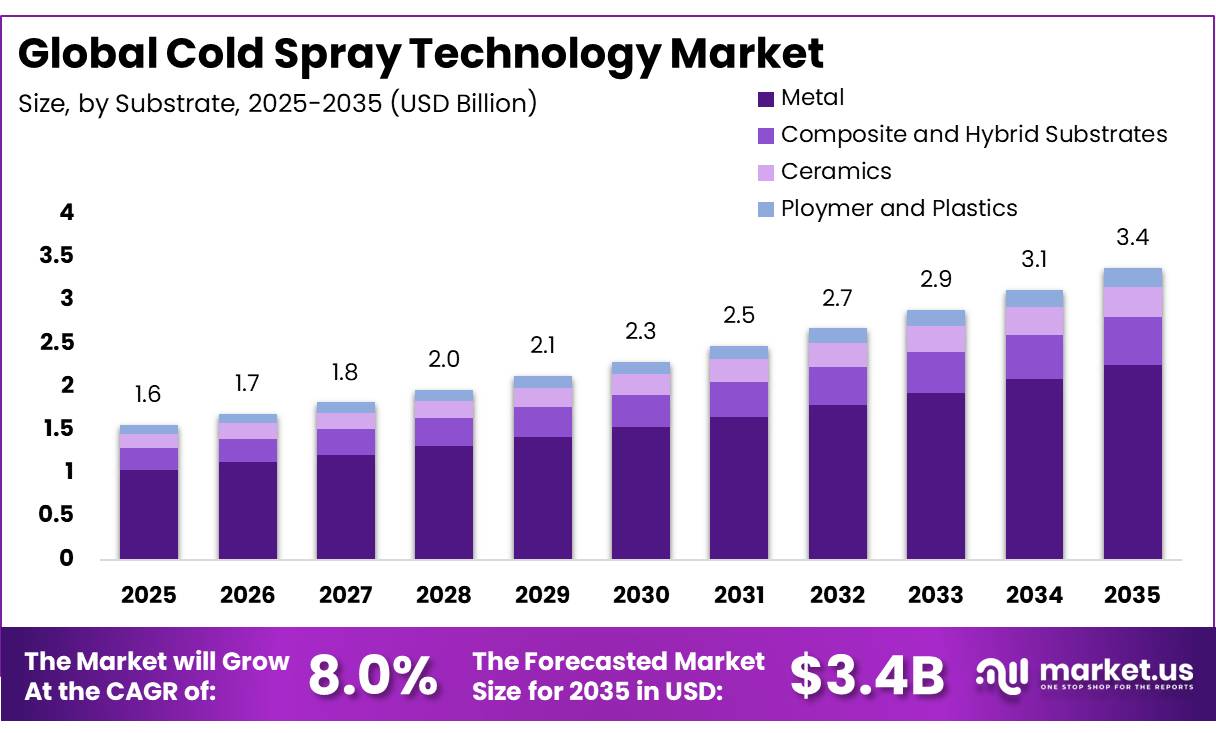
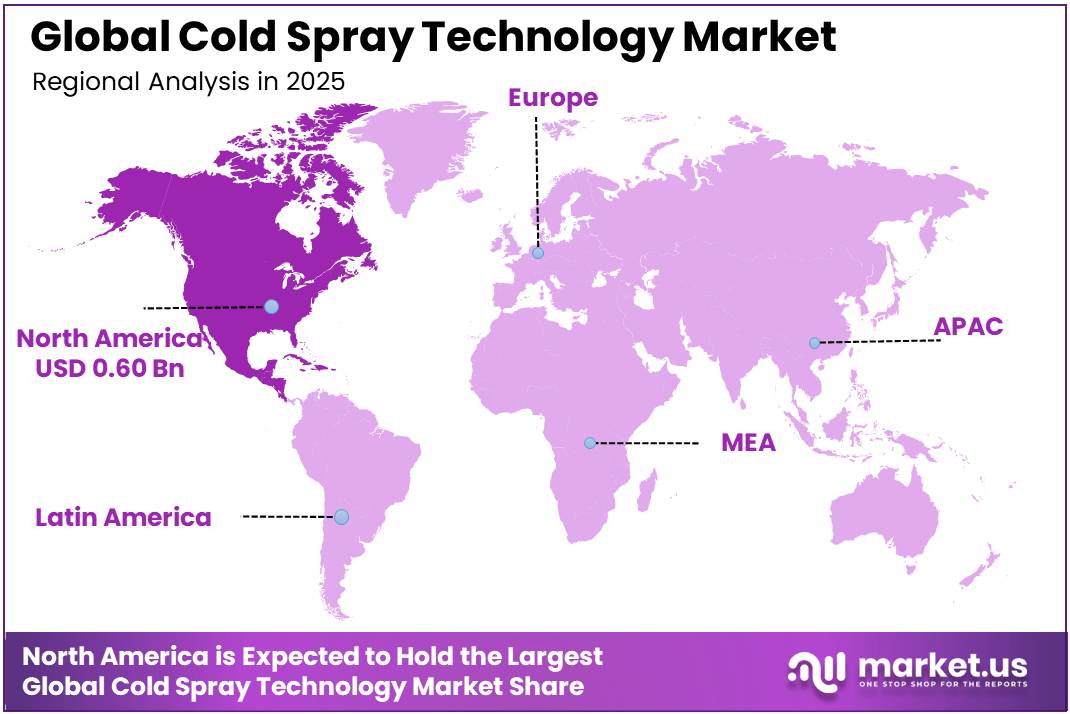
In 2025, the Global Cold Spray Technology Market was valued at USD 1.6 billion, and between 2026 and 2035, this market is estimated to register a CAGR of 8.0%, reaching about USD 3.4 billion by 2035. North America held a dominant market position, capturing more than a 38.56% share, holding USD 0.60 billion in revenue.
Cold spray technology deposits powdered metals, ceramics, composites or polymers onto surfaces by accelerating particles through a high-velocity gas stream without melting them. The solid-state process limits oxidation, thermal distortion and phase changes, making it suitable for corrosion protection, dimensional restoration, structural reinforcement and additive manufacturing. Aerospace, defense, automotive, energy, electronics, marine and medical users increasingly examine cold spray for repairing valuable components and producing functional coatings.
- In February 2025, the Naval Air Systems Command reported that Fleet Readiness Center Southwest had received USD 50,000 in in-kind support from the National Center for Manufacturing Sciences after winning the People’s Choice Award in December 2024.
Key Takeaways
- The global cold spray technology market was valued at USD 1.6 billion in 2025.
- The global market is projected to grow at a CAGR of 8.0% and is estimated to reach USD 3.4 billion by 2035.
- On the basis of substrate, metal dominated the cold spray technology market, constituting 66.78% of the total market share.
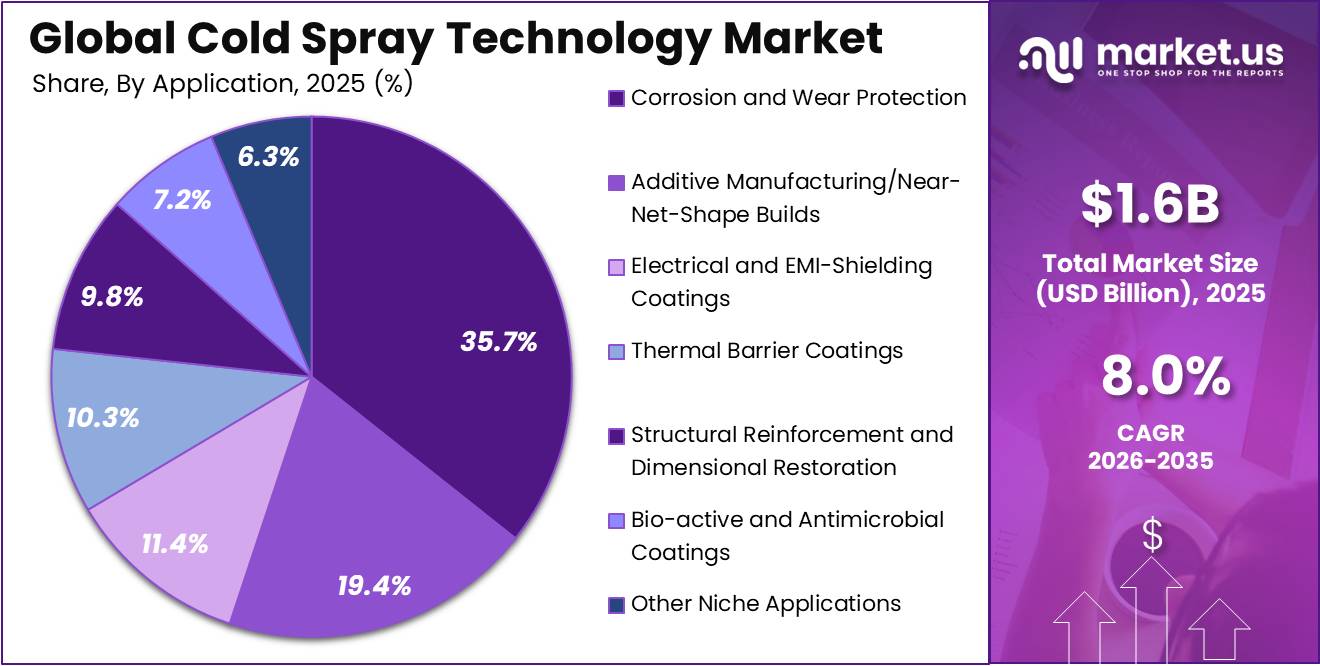
- Based on application, corrosion and wear protection dominated the cold spray technology market, with a substantial market share of around 35.67%.
- Among the end users, aerospace and defense held a major share in the cold spray technology market, accounting for 45.78% of the total market share.
- In 2025, North America was the most dominant region in the cold spray technology market, accounting for 38.56% of the total market and generating approximately US$0.60 billion in revenue.
The industrial scenario is moving from laboratory validation toward qualified production and depot-level repair. In January 2025, the United States Army completed operator training for a new cold spray unit at Sierra Army Depot, expanding its ability to restore costly and difficult-to-source components. In January 2026, the National Aeronautics and Space Administration updated a completed project focused on high-pressure cold spray additive manufacturing for GRCop-42 components, demonstrating continued interest in solid-state deposition for demanding aerospace materials.
Growth is driven by aging equipment, supply-chain pressure, material conservation and the need to shorten repair cycles. Cold spray can rebuild worn surfaces, deposit dissimilar materials and avoid many defects associated with melting and resolidification.
Government-backed research is widening future opportunities. The European Union’s MADECOLD project carries EUR 3.46 million in funding and runs from June 2024 to May 2028. Its first reporting period examined metal powders sized around 10 to 60 micrometres, while project documents state that widely used laser powder bed fusion can consume almost 4 times more energy than conventional manufacturing.
Substrate Analysis
Metal Leads with 66.78% Due to Broad Repair and Coating Applications
In 2025, metal held a dominant market position, capturing more than a 66.78% share of the cold spray technology market. Its leadership was supported by the compatibility of aluminium, copper, nickel, titanium, steel, and their alloys with high-velocity particle deposition. Metal substrates are used in aerospace, defence, automotive, energy, marine, and industrial repair because cold spray can restore worn surfaces without melting the base component.
- For instance, in February 2026, according to the United States Army Engineer Research and Development Center, researchers released a study on nickel and chromium-carbide nickel-chromium metal-matrix composites deposited by cold spray, examining how annealing affected bonding, microstructure, strength, ductility, and interface performance.
Composite and hybrid substrates are the fastest-growing segment as manufacturers seek lightweight structures that combine metals with polymers, ceramics, or fibre-reinforced materials. Cold spray enables localized coating and repair while limiting thermal damage to sensitive layers. Growing use in aircraft structures, electronic housings, mobility components, and advanced tooling is supporting process qualification and adoption.
Application Analysis
Corrosion and Wear Protection Leads with 35.67% by Extending Component Life
In 2025, corrosion and wear protection held a dominant market position, capturing more than a 35.67% share of the cold spray technology market. Its leadership was supported by the need to protect valuable components from abrasion, erosion, oxidation, and harsh operating conditions. Cold spray forms dense coatings without melting feedstock or heavily heating the substrate, helping preserve material properties and reduce distortion.
- For instance, in October 2025, according to the European Commission’s Community Research and Development Information Service, the ArcHIDep project reported progress in cold spray shape prediction and automation for additive manufacturing, repair, and restoration.
Additive manufacturing and near-net-shape builds are the fastest-growing application as manufacturers seek rapid deposition, reduced machining, and design flexibility. Cold spray can build thick structures, combine dissimilar materials, and repair complex parts without fusion-related defects. Its use across aerospace, energy, automotive, and biomedical production is supporting broader process qualification and industrial adoption.
End User Analysis
Aerospace and Defense Leads with 45.78% Through Component Repair and Performance Needs
In 2025, aerospace and defense held a dominant market position, capturing more than a 45.78% share of the cold spray technology market. Its leadership was supported by the need to repair costly components, restore worn surfaces, and apply protective coatings without exposing sensitive parts to excessive heat. Cold spray is suitable for aircraft structures, engine parts, landing systems, military vehicles, and maintenance operations because it limits oxidation, distortion, and material degradation. It also helps extend component life and reduce dependence on replacement parts.
- For instance, in March 2025, according to the European Commission’s Community Research and Development Information Service, the PARASOL project advanced cold spray formulations for polymer-based electromagnetic shielding and improved shielding solutions for electronic systems and chip packaging.
Electronics and semiconductors are the fastest-growing end-user segment as manufacturers require conductive coatings, electromagnetic interference shielding, thermal management, and localized material deposition. Cold spray supports copper and composite layers on sensitive substrates without conventional high-temperature processing, encouraging its use in electronic housings, circuits, connectors, sensors, and semiconductor packaging.
Key Market Segments
By Substrate
- Metal
- Composite and Hybrid Substrates
- Ceramics
- Ploymer and Plastics
By Application
- Corrosion and Wear Protection
- Additive Manufacturing/Near-Net-Shape Builds
- Electrical and EMI-Shielding Coatings
- Thermal Barrier Coatings
- Structural Reinforcement and Dimensional Restoration
- Bio-active and Antimicrobial Coatings
- Other Niche Applications
By End User
- Aerospace and Defense
- Automotive and Mobility
- Oil, Gas, and Energy
- Power Generation
- Medical Devices and Implants
- Electronics and Semiconductors
- Marine and Shipbuilding
- Other Industries
Driver Analysis
Aerospace MRO backlog lifting cold spray repair demand
Commercial aviation maintenance intensity has strengthened the repair case for cold spray because operators are keeping older assets in service for longer while delivery delays and engine bottlenecks inflate the value of component salvage. FAA data show the U.S. commercial fleet is projected to rise from 7,387 aircraft in 2024 to 10,607 by 2045, while IATA-linked supply-chain analysis indicates global aircraft order backlogs exceeded 17,000 units in 2024 and MRO spending is nearing $120 billion in 2025; the same body also highlighted more than $11 billion of 2025 airline cost exposure from supply-chain frictions, including $3.1 billion in extra maintenance expense and 648 grounded GTF-powered aircraft at the March 2025 peak.
In that environment, cold spray gains share because it shifts operator economics away from full part replacement toward localized restoration of high-value aluminum, magnesium, and nickel-based components, cutting scrap, shortening turnaround windows, and preserving fleet availability. The CAGR uplift estimate of about +2.2 percentage points is justified because repair urgency converts directly into system utilization, service outsourcing, and consumable powder demand across engine-adjacent hardware, landing systems, and structural repair workflows.
Drivers Impact Analysis
| Driver | (~) % Impact on CAGR | Geographic Relevance | Impact Timeline |
|---|---|---|---|
| Aerospace MRO backlog lifting cold spray repair demand | +2.2% | North America core, EU, Middle East MRO hubs, APAC aviation corridors | Short term (≤ 2 years) |
| Defense qualification and depot adoption expanding certified use cases | +1.9% | U.S. core, NATO Europe, Australia spill-over, select Asian defense hubs | Medium term (2-4 years) |
| Cold spray additive manufacturing scaling for large metal rebuilds | +1.6% | North America core, EU advanced manufacturing belt, Japan-South Korea-China corridors | Medium term (2-4 years) |
| Corrosion mitigation and asset life-extension economics improving ROI | +1.4% | North America, EU, Gulf industrial clusters, offshore APAC | Short term (≤ 2 years) |
| Process standardization and repeatability reducing buyer adoption friction | +1.1% | U.S. core, EU, Canada, developed APAC | Medium term (2-4 years) |
| Portable and lower-operating-cost systems widening field deployment | +0.9% | North America, Australia, Middle East, India and ASEAN spill-over | Long term (≥ 4 years) |
Restraint Analysis
Tariffs, metals inflation, and logistics volatility
Trade policy shifts and logistics volatility have created a volatile cost base and supply risk profile for the cold spray value chain, discouraging aggressive footprint expansion and global sourcing strategies that would otherwise support faster growth. U.S. Section 301 actions have pushed tariffs on targeted Chinese tungsten products to about 25 percent and higher rates up to 50 percent on selected solar-related upstream materials, while Section 232 duties of roughly 25 percent continue to apply on a range of steel and aluminum products, many of which are critical for cold spray equipment frames, fixtures, and raw-material carriers; in parallel, the EU has maintained carbon-related and safeguard measures on metals, and China has periodically adjusted export policies for strategic metals.
These measures, layered over post‑2020 freight disruptions and port congestion, have driven significant variance in landed costs, forcing suppliers to hold more inventory tying up working capital in the 10–15 percent of revenue range for some smaller OEMs and to diversify sourcing away from their lowest-cost suppliers, reducing gross margin headroom.
Strategically, this discourages aggressive price cuts needed to accelerate adoption in price-sensitive segments, introduces 4–8 week swings in lead times for critical powders and spare parts, and increases contract-pricing risk; the aggregate effect is a roughly 0.9 percentage-point drag on the global CAGR as some projects are postponed, especially in North America and Europe, and APAC importers reassess capital allocations under uncertain tariff and shipping regimes.
Restraint Impact Analysis
| Restraint | (~) % Impact on CAGR | Geographic Relevance | Impact Timeline |
|---|---|---|---|
| High capex and gas/powder operating costs | -1.3% | Global, sharper in developing APAC, Latin America, MEA | Medium term (2-4 years) |
| Tariffs, metals inflation, and logistics volatility | -0.9% | North America core, EU, APAC trade corridors | Short term (≤ 2 years) |
| Slow qualification and certification cycles | -0.8% | North America, EU, regulated APAC (Japan, Korea) | Long term (≥ 4 years) |
| Skills and process-complexity constraints | -0.7% | Global, acute in emerging markets | Medium term (2-4 years) |
| Competition from established thermal and welding methods | -0.6% | Global, especially automotive and general industrial | Long term (≥ 4 years) |
| Limited awareness and fragmented standards for CSAM | -0.5% | North America, EU, advanced manufacturing hubs in APAC | Long term (≥ 4 years) |
Opportunity Analysis
Green-tech catalytic and decarbonization coatings
Technical work shows that cold spray can deposit dense, oxide-free coatings and catalytic surfaces with deposition efficiencies in the 70–95 percent range and energy consumption approximately 30–50 percent lower than plasma or HVOF, while also cutting cooling-water use by 60–75 percent, which materially reduces lifecycle CO₂ and operating cost for green-tech manufacturing lines.
By 2030, the broader green-technology equipment market is expected to run in the hundreds of billions of dollars, and even a modest 1–2 percent penetration of cold spray-enabled catalytic surfaces in segments such as low-NOx exhaust treatment, fuel-cell plates, electrolyzer components, and direct air-capture sorbent structures could yield an incremental TAM of USD 1–3 billion, with gross margins 5–10 percentage points higher than traditional wear coatings due to the functional performance premium and reduced precious-metal content enabled by better material utilization.
Strategically, unlocking this opportunity requires targeted R&D investment into catalyst architectures, co-development with green-tech OEMs, and standardization of performance metrics, but if executed over the next 2–4 years while regulatory pressure on emissions and lifecycle carbon footprints intensifies in Europe, North America, and North Asia, the segment could contribute roughly +1.8 percentage points of CAGR upside above the current repair-heavy baseline between 2028 and 2035.
Opportunity Impact Analysis
| Opportunity | (~) % Potential CAGR | Geographic Relevance | Execution Window |
|---|---|---|---|
| Green-tech catalytic and decarbonization coatings | +1.8% | EU, North America core, China, Japan, South Korea | Medium term (2-4 years) |
| Service-led cold spray MRO platforms | +1.6% | North America, EU, Middle East hubs, APAC aviation | Short term (≤ 2 years) |
| Cold spray functionalization for e-mobility and electronics | +1.4% | APAC manufacturing belts, EU, North America | Medium term (2-4 years) |
| APAC-localized systems and powder ecosystems | +1.3% | China, India, ASEAN, Middle East spill-over | Long term (≥ 4 years) |
| Integrated CSAM cells for large-structure rebuilding | +1.2% | North America, EU, advanced APAC (Japan, Korea) | Long term (≥ 4 years) |
| M&A roll-ups and IP-backed platform consolidation | +1.0% | Global, with focus on OECD markets | Medium term (2-4 years) |
Challenges Analysis
Helium and process-gas volatility
Global reporting indicates that approximately 27–30 percent of helium supply has been knocked offline due to Qatar’s Ras Laffan disruption and Strait of Hormuz closure, driving spot price spikes of 40–100 percent within weeks, while healthcare and semiconductors together consuming roughly 45–55 percent of global helium are being prioritized, leaving industrial users such as cold spray subject to allocation and lead-time extensions from a typical 4–6 weeks to 8–12 weeks or more.
Because helium is a byproduct of natural gas and cannot be ramped independently, and because liquid helium in ISO containers effectively has a 45‑day usable window before boil-off, cold spray operators must overlay recycling investments, nitrogen-substitution engineering where feasible, and flexible scheduling, which can lift gas cost per job by 20–50 percent and depress margins by 2–4 percentage points during tight periods without stopping production entirely.
Strategically, OEMs and job shops are forced into multi-year mitigation programs installing recovery systems that can capture 60–80 percent of helium used in high-pressure lines, redesigning processes to use more nitrogen where deposition physics allow, and signing multi-year take-or-pay gas contracts to stabilize pricing which collectively constrain how aggressively they can discount or expand capacity; this persistent friction is estimated to drag roughly 1.2 percentage points off the market’s theoretical maximum CAGR until alternative gas strategies and regional helium capacity additions normalize conditions, a process that is unlikely to complete before the early 2030s
Challenges Impact Analysis
| Challenge | (~) % CAGR Friction Drag | Geographic Relevance | Mitigation Horizon |
|---|---|---|---|
| Helium and process-gas volatility | -1.2% | North America, EU, APAC chip and industrial hubs | Medium term (2-4 years) |
| Semiconductor-linked equipment supply risk | -1.0% | APAC logistics corridors, North America, EU | Medium term (2-4 years) |
| Fragmented standards and qualification creep | -0.9% | North America, EU regulatory hubs, advanced APAC | Long term (≥ 4 years) |
| Data, modeling, and talent scarcity | -0.8% | Global, sharper in emerging markets | Long term (≥ 4 years) |
| Interest-rate and capex-cycle volatility | -0.7% | Global, especially capital-intensive industries | Medium term (2-4 years) |
| ESG, emissions, and reporting complexity | -0.6% | EU, North America core, export-oriented APAC | Long term (≥ 4 years) |
Geopolitical Impact Analysis
Metal Tariffs and Critical-Mineral Dependence Reshape Cold Spray Supply Chains
Current geopolitical tensions are reshaping the cold spray technology market through metal tariffs, critical-mineral concentration, defense localization, and fragmented equipment supply chains. Cold spray systems depend on aluminium, copper, nickel, titanium, steel, and specialty alloy powders, together with high-pressure gas equipment, nozzles, robotic controls, and powder-feeding systems. Restrictions affecting these inputs can increase material costs, delay qualification, and reduce flexibility for aerospace, defense, electronics, and energy users.
- In April 2026, the United States imposed a 50% tariff on aluminium, steel, and certain copper products, while selected derivative products received different rates. These measures can increase the cost of powder feedstocks, machine structures, pressure vessels, and replacement components used in cold spray installations. They are also encouraging manufacturers to source domestically produced metals and establish regional service and powder-processing capacity.
Critical-mineral dependence adds further uncertainty. In February 2026, the United States Geological Survey reported that China remained a major source for 14 of the 33 critical minerals on which the United States was most import-dependent. The report also identified 14 mineral commodities subject to Chinese export restrictions affecting the United States. These conditions can influence alloy availability and lead times for specialized cold spray powders.
Broader trade fragmentation is reinforcing localization. The World Trade Organization reported that new tariffs and import measures affected USD 2,640 billion of global goods imports between October 2024 and October 2025. Cold spray suppliers are therefore expanding multi-source procurement, regional powder qualification, recycling, and local repair capacity to reduce exposure to cross-border disruption.
Regional Analysis
North America Leads with 38.46% Share and USD 0.60 Billion Revenue
In 2025, North America held a dominant position in the cold spray technology market, accounting for 38.46% of global revenue and generating approximately USD 0.60 billion. Regional leadership was supported by established aerospace, defense, energy, automotive, and advanced manufacturing industries, together with strong repair capabilities. In 2025, foreign investors directed USD 121.8 billion into United States manufacturing, representing 52.5% of new foreign direct investment expenditures. This industrial base supports wider use of cold spray for component restoration, protective coatings, and near-net-shape production.
Asia-Pacific is the fastest-growing region, supported by expanding electronics, automotive, aerospace, and metal-processing activity. Regional manufacturers are investing in automated production, localized repair, and advanced surface engineering to reduce material waste and component replacement. Growing demand for conductive coatings, electromagnetic interference shielding, lightweight structures, and precision repair is strengthening adoption across China, Japan, South Korea, Australia, and Southeast Asia, while investment improves access to equipment, powders, and expertise.
Key Regions and Countries Covered
- North America
- The US
- Canada
- Europe
- Germany
- France
- The UK
- Spain
- Italy
- Russia & CIS
- Rest of Europe
- APAC
- China
- Japan
- South Korea
- India
- ASEAN
- Rest of APAC
- Latin America
- Brazil
- Mexico
- Rest of Latin America
- Middle East & Africa
- GCC
- South Africa
- Rest of MEA
Key Players Analysis
Cold spray technology providers focus on deposition efficiency, powder utilization, coating density, equipment reliability, and process qualification to strengthen their competitive position. Key participants include ASB Industries, Bodycote, Carpenter Additive, CenterLine (Windsor) Limited, Curtiss-Wright Corporation, Dycomet Europe, EWI, Flame Spray Technologies B.V., and Impact Innovations GmbH.
In 2026, competition increasingly centred on regional capacity, technical support, advanced surface engineering, and closer relationships with original equipment manufacturers. In July 2026, Bodycote announced investments to expand aerospace and defense processing capacity across the eastern United States, strengthening support for heat treatment, additive manufacturing, and specialist component services. Curtiss-Wright Corporation also announced an USD 80 million multi-year investment in July 2026 to expand its operations in Pennsylvania.
Market Key Players
- ASB Industries
- Bodycote
- Carpenter Additive
- Castolin Eutectic
- CenterLine (Windsor) Limited
- Curtiss-Wright Corporation
- Dycomet Europe
- EWI
- Flame Spray Technologies B.V.
- GE Additive
- Heraeus Amloy
- Impact Innovations GmbH
- Other Key Players
Key Development
- In January 2026, Bodycote acquired Spectrum Thermal Processing in Rhode Island, expanding its heat-treatment capacity and strengthening its support for aerospace, defense, space, and industrial customers across the northeastern United States.
- In June 2026, EWI supported the Cold Spray and Large Scale Additive Action Team event, bringing manufacturers and technical specialists together to discuss cold spray, large-scale additive manufacturing, process development, and industrial adoption.
- In May 2026, Flame Spray Technologies announced its participation in ASME Turbo Expo 2026, held in Milan from June 15 to June 19, where it presented its coating technologies for turbine and power-generation applications.
Report Scope
| Report Features | Description |
|---|---|
| Market Value (2025) | USD 1.6 Bn |
| Forecast Revenue (2035) | USD 3.4 Bn |
| CAGR (2026-2035) | 8.0% |
| Base Year for Estimation | 2025 |
| Historic Period | 2020-2024 |
| Forecast Period | 2026-2035 |
| Report Coverage | Revenue Forecast, Market Dynamics, Competitive Landscape, Recent Developments |
| Segments Covered | By Substrate (Metal, Composite and Hybrid Substrates, Ceramics, and Ploymer and Plastics), By Application (Corrosion and Wear Protection, Additive Manufacturing/Near-Net-Shape Builds, Electrical and EMI-Shielding Coatings, Thermal Barrier Coatings, Structural Reinforcement and Dimensional Restoration, Bio-active and Antimicrobial Coatings, and Other Niche Applications), By End User (Aerospace and Defense, Automotive and Mobility, Oil, Gas, and Energy, Power Generation (Gas and Steam Turbines), Medical Devices and Implants, Electronics and Semiconductors, Marine and Shipbuilding, and Other Industries) |
| Regional Analysis | North America – The US & Canada; Europe – Germany, France, The UK, Spain, Italy, Russia & CIS, Rest of Europe; APAC– China, Japan, South Korea, India, ASEAN & Rest of APAC; Latin America– Brazil, Mexico & Rest of Latin America; Middle East & Africa– GCC, South Africa, & Rest of MEA |
| Competitive Landscape | ASB Industries, Bodycote, Carpenter Additive, Castolin Eutectic, CenterLine (Windsor) Limited, Curtiss-Wright Corporation, Dycomet Europe, EWI, Flame Spray Technologies B.V., GE Additive, Heraeus Amloy, Impact Innovations GmbH, Other Key Players. |
| Customization Scope | Customization for segments, region/country-level will be provided. Moreover, additional customization can be done based on the requirements. |
| Purchase Options | We have three licenses to opt for: Single User License, Multi-User License (Up to 5 Users), Corporate Use License (Unlimited Users and Printable PDF) |





































