


Report Overview
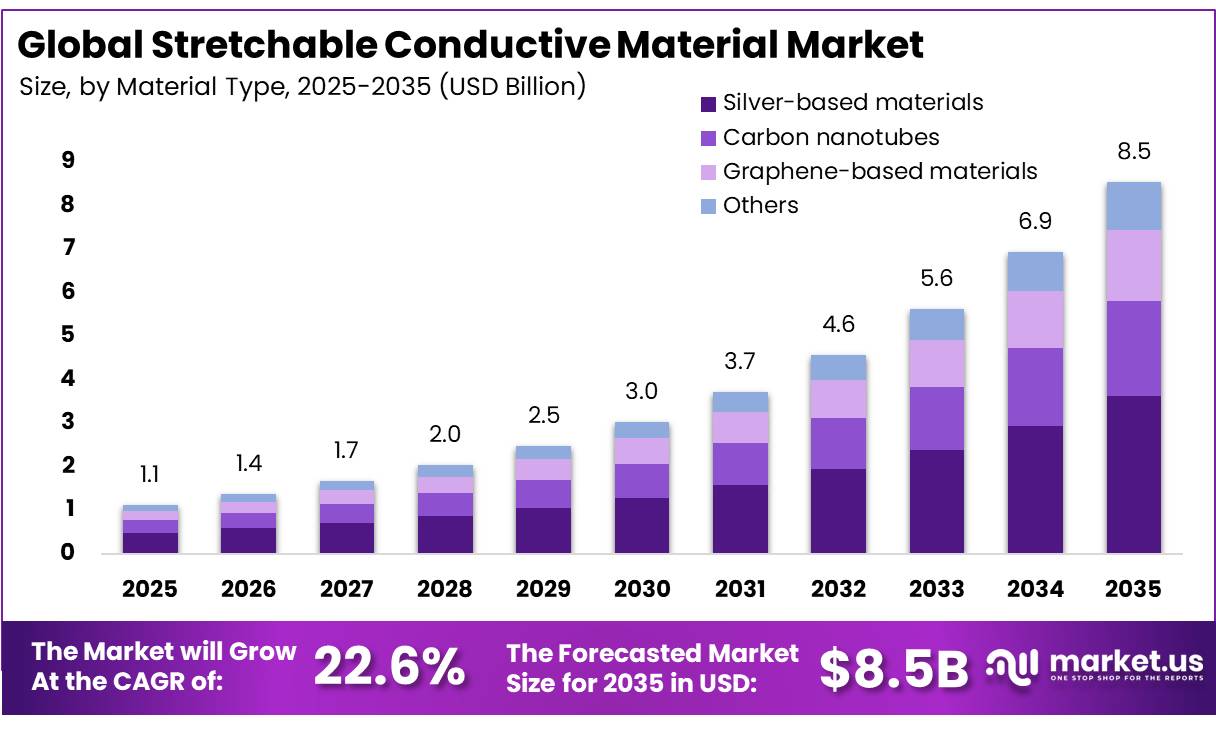
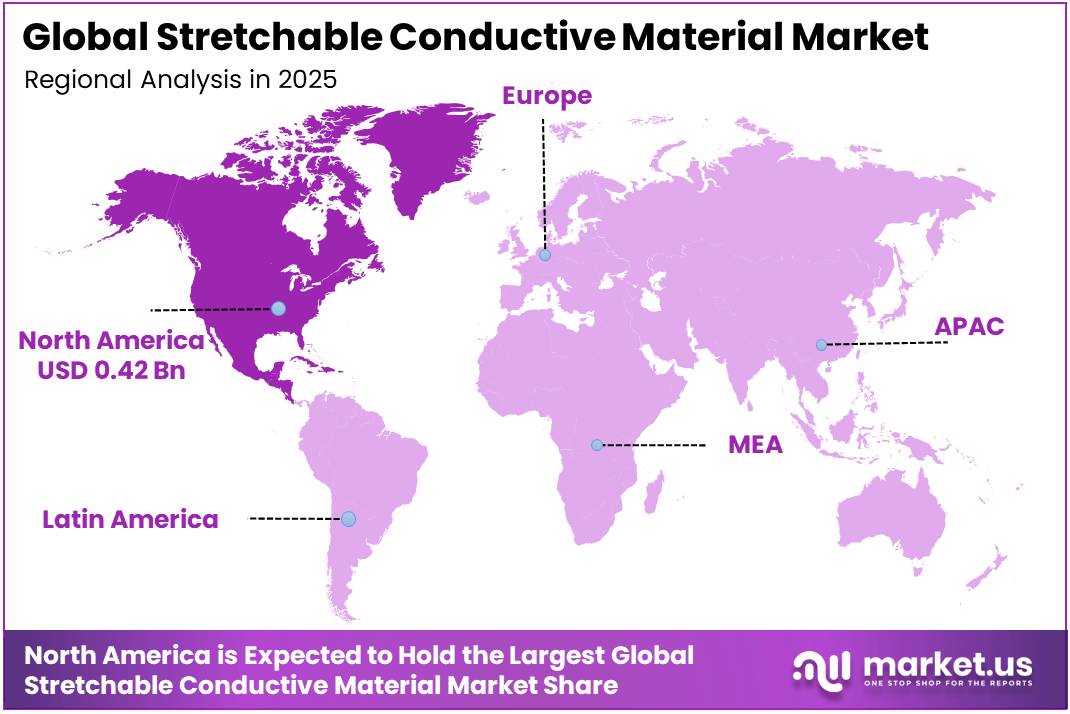
In 2025, the Global Stretchable Conductive Material Market was valued at USD 1.1 billion, and between 2026 and 2035, this market is estimated to register a CAGR of 22.6%, reaching about USD 8.5 billion by 2035. In 2025, North America led the market, achieving over 37.5% share with a revenue of USD 0.42 billion.
Stretchable conductive materials are engineered to carry electrical signals while bending, twisting or extending without losing their functional performance. This material group includes silver nanowires, carbon nanotubes, graphene, conductive polymers, metallic particles, liquid metals and conductive elastomer composites. These materials are increasingly used in wearable sensors, electronic skin, flexible displays, smart textiles, medical patches, soft robotics and automotive electronics.
- Producers are developing conductive inks, stretchable electrodes and embedded circuits that can be applied to fabrics, plastics and elastomeric surfaces. In September 2025, the International Federation of Robotics reported that approximately 542,000 industrial robots were installed worldwide in 2024. The global operational stock reached 4.664 million units, representing an annual increase of 9%.
This expansion in automation supports opportunities for pressure-sensitive robotic skins, flexible wiring, strain sensors and motion-detection components made with stretchable conductive materials. Automotive electrification is also widening the application base. Stretchable conductors can be incorporated into smart seats, heating elements, touch-sensitive controls, flexible lighting, battery-monitoring systems and curved interior surfaces.
Key Takeaways
- The Global Stretchable Conductive Material Market was valued at USD 1.1 billion in 2025.
- The market is projected to grow at a CAGR of 22.56% and is estimated to reach USD 8.5 billion by 2035.
- On the basis of material type, Silver-based materials dominated the market, constituting 42.4% of the total market share.
- Based on the form, Conductive inks dominated the market, with a substantial market share of around 51.5%.
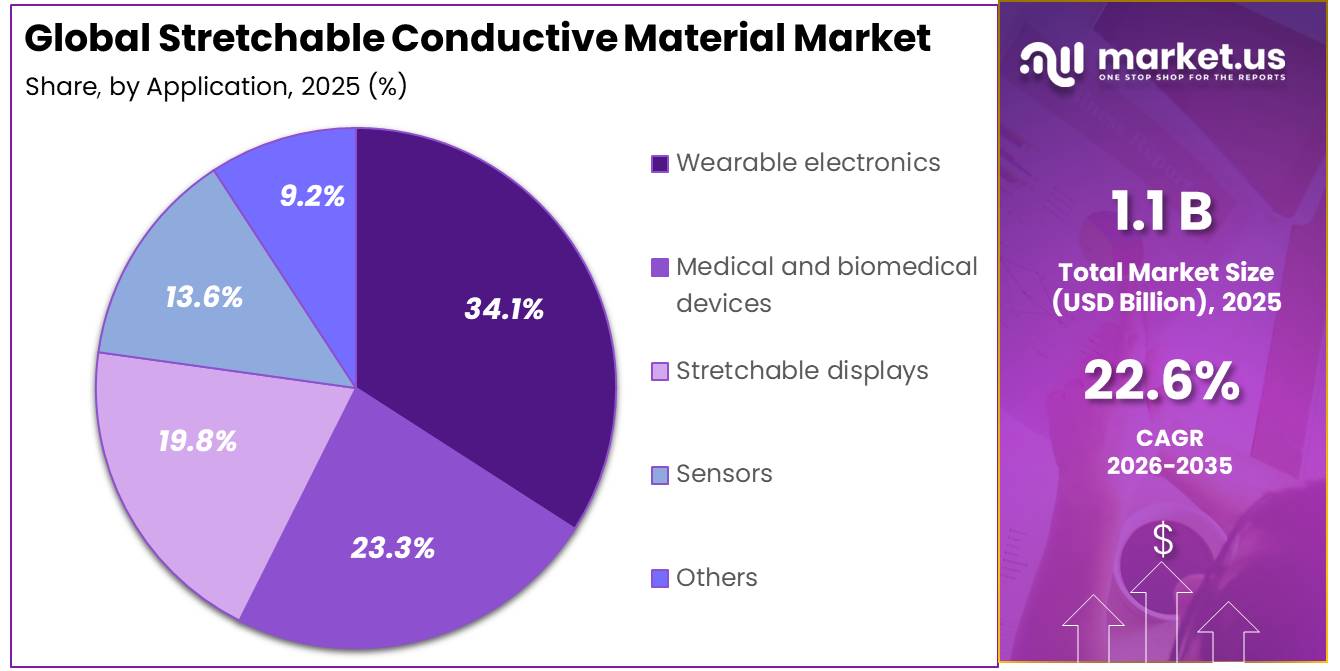
- Based on the application, Wearable electronics led the market, comprising 34.1% of the total market.
- On the basis of end-use industry, Consumer electronics dominated the market, constituting 38.4% of the total market share.
- In 2025, North America was the most dominant region in the market, accounting for 37.5% of the total global consumption.
Government-supported research is helping address high production costs, limited durability, power consumption and the environmental impact of flexible electronics. The European Union-funded GRASP project is developing a natively flexible microcontroller for healthcare wearables and fast-moving consumer goods. In January 2024, the European Commission-supported GRASP project began developing flexible microcontroller technology targeting a 100-fold reduction in power consumption per transistor and a 100-to-1,000-fold reduction in the environmental impact of fabrication.
- According to the International Energy Agency’s Global EV Outlook 2026, global electric car sales increased by 20% in 2025 and exceeded 20 million units. Electric models represented 25% of all new cars sold worldwide during the year. Nearly 22 million electric cars were also manufactured globally in 2025, an increase of more than 25% compared with 2024.
Future growth opportunities are expected in washable electronic textiles, rehabilitation equipment, sports-monitoring devices, human-machine interfaces, soft robots, connected packaging and remote healthcare systems. Further commercial adoption will depend on improvements in electrical resistance stability, adhesion, washability, biocompatibility and recyclability.
Material Type Analysis
Silver-based materials dominate with a 42.4% share due to their strong electrical performance.
In 2025, silver-based materials held a dominant market position, capturing more than a 42.4% share of the Stretchable Conductive Material Market. Their leadership was supported by excellent electrical conductivity, easy formulation into conductive inks and pastes, and stable performance under repeated bending and stretching. These materials remained widely used in wearable sensors, flexible circuits, medical patches, smart textiles and printed electronic components.
- In January 2025, the U.S. Geological Survey reported that U.S. mines produced approximately 1,100 metric tons of silver during 2024, with an estimated value of $960 million. These figures support the strong role of silver-based materials in conductive inks, flexible electrodes, printed circuits and stretchable electronic devices.
Carbon nanotubes are the fastest-growing segment in the Stretchable Conductive Material Market. Their hollow nanoscale structure provides a useful combination of electrical conductivity, mechanical strength and flexibility. Unlike rigid conductive fillers, carbon nanotubes can maintain connected conductive networks when a material is bent, twisted or stretched. This property is encouraging their use in electronic skin, flexible displays, pressure sensors, wearable health-monitoring devices and lightweight conductive composites.
Form Analysis
Conductive inks dominate with a 51.5% share due to their easy printing, strong conductivity and suitability for flexible electronic designs.
In 2025, conductive inks held a dominant market position, capturing more than a 51.5% share. Their leading position was supported by their ability to form lightweight electrical pathways on stretchable fabrics, polymers and thin substrates. These inks can be applied through screen, inkjet and roll-to-roll printing, helping manufacturers produce wearable sensors, flexible circuits, smart labels and medical patches with less material waste.
- According to the European Commission’s CORDIS platform, an EU-supported project reported in October 2025 that a newly developed graphite-based conductive ink achieved a sheet resistance of 16 ohms per square on a 30-micrometre printed layer. This development demonstrates the practical electrical performance of printable conductive materials in flexible electronic systems.
Films and foils are the fastest growing segment in the stretchable conductive material market. Their growth is driven by increasing use in flexible displays, touch-sensitive components, electronic skin, foldable devices and wearable healthcare equipment. These materials provide uniform conductivity across larger surfaces while maintaining low weight and mechanical flexibility. Films and foils can also be laminated, moulded or integrated directly into plastic and textile components, making them suitable for high-volume electronics manufacturing.
Application Analysis
Wearable electronics dominates with a 34.1% share as flexible health and activity tracking gains wider use.
In 2025, Wearable electronics held a dominant market position, capturing more than a 34.1% share of the Stretchable Conductive Material Market. The segment remained strong because stretchable conductors are increasingly used in smartwatches, fitness bands, electronic textiles and skin-mounted sensors. These materials maintain electrical performance while bending or moving with the human body, improving comfort and device reliability.
- In January 2025, the U.S. National Institutes of Health reported that its researchers studied 40 adults wearing commercially available smartwatches over several months. Each device generated more than 250,000 health measurements per person every day, demonstrating the growing ability of wearable electronics to support continuous heart-rate and health monitoring.
Medical and biomedical devices is the fastest growing segment in the Stretchable Conductive Material Market. Growth is supported by the increasing development of flexible diagnostic patches, electronic skin, soft electrodes and continuous patient-monitoring devices. Stretchable conductive materials can follow natural body movement without interrupting electrical signals, making them suitable for long-term health monitoring and rehabilitation applications.
End-Use Industry Analysis
Consumer electronics dominates with a 38.4% share as flexible circuits gain wider use in connected devices.
In 2025, Consumer electronics held a dominant market position, capturing more than a 38.4% share. The segment benefited from the rising use of stretchable conductive materials in smartwatches, fitness bands, foldable displays, electronic skin patches, touch sensors and flexible device connections. These materials maintain electrical performance while products are bent, folded or stretched, making them suitable for compact and lightweight electronics.
- In 2025, the International Telecommunication Union reported 9.2 billion mobile-cellular subscriptions worldwide. It also estimated that around 6 billion people were using the internet, supporting continued demand for connected consumer devices and flexible electronic components.
Healthcare and pharmaceuticals is the fastest growing segment. In 2026, the segment continued to gain attention as medical-device manufacturers increased the development of wearable monitors, flexible electrodes, smart wound dressings and skin-mounted diagnostic sensors. Stretchable conductive materials allow these products to remain in close contact with the body while supporting movement and continuous signal collection.
Key Market Segments
By Material Type
- Silver-based materials
- Carbon nanotubes
- Graphene-based materials
- Others
By Form
- Conductive inks
- Films and foils
- Elastomeric composites
- Others
By Application
- Wearable electronics
- Medical and biomedical devices
- Stretchable displays
- Sensors
- Others
By End-use Industry
- Consumer electronics
- Healthcare and pharmaceuticals
- Robotics
- Sports and fitness
- Cosmetics and personal care
- Education and research
- Others
Driver Analysis
EU device durability and repairability rules
The strongest near-term commercial driver is the EU’s smartphone and tablet ecodesign regime, which started applying from 20 June 2025 and requires higher drop, scratch, dust, and water resistance, batteries capable of at least 800 cycles with 80% capacity retention, spare-parts availability within 5–10 working days, and support for repair over at least 7 years after the model is no longer sold.
For stretchable conductive materials, that shifts OEM design logic away from brittle rigid interconnect architectures toward mechanically compliant conductors in fold-adjacent zones, cable-to-board transition areas, sensor laminates, and strain-bearing internal assemblies, because every percentage point improvement in flex life lowers warranty risk under a more repairable product architecture.
The revenue effect is not just unit volume; it is mix enrichment, as qualified silver-flake elastomers, CNT- or graphene-enhanced inks, and liquid-metal-adjacent conductive systems can command premium pricing when they help OEMs hit durability, ingress, and serviceability thresholds simultaneously, especially for EU-bound production that is largely fabricated in APAC export hubs.
Drivers Impact Analysis
| Driver | (~) % Impact on CAGR Forecast | Geographic Relevance | Impact Timeline |
|---|---|---|---|
| EU device durability and repairability rules lifting demand for stretch-tolerant interconnects | +1.9% | EU core, UK alignment spill-over, APAC export corridors | Short term (≤ 2 years) |
| PFAS reporting pressure accelerating reformulation toward safer conductive elastomer systems | +1.4% | North America core, EU parallel compliance, East Asia supplier base | Short term (≤ 2 years) |
| Public R&D funding for flexible and conformable electronics improving scale-up yields | +1.6% | U.S. core, EU programs, Japan-Korea-Taiwan innovation corridors | Medium term (2-4 years) |
| Medical wearable validation and biocompatibility requirements expanding premium material adoption | +1.8% | North America core, EU medtech hubs, APAC medical device manufacturing | Medium term (2-4 years) |
| Battery removability, charger interoperability, and power-efficiency rules raising flexible electronics redesign activity | +1.2% | EU core, North America follow-on, APAC OEM manufacturing clusters | Medium term (2-4 years) |
| Domestic manufacturing and resilient electronics supply-chain policy supporting localized advanced-material sourcing | +1.5% | U.S. core, EU strategic autonomy zones, selective APAC localization | Long term (≥ 4 years) |
Restraint Analysis
Critical-mineral export controls (Ga/Ge)
China’s export controls on gallium and germanium-related items implemented via Ministry of Commerce Announcement No. 23 of 2023 and effective from 1 August 2023 introduce structural friction into global supply chains for advanced optoelectronic and semiconductor materials that increasingly intersect with stretchable and flexible conductive architectures.
Under this regime, exporters of gallium and germanium metals, oxides, epitaxial substrates, and related compounds must obtain transaction-specific export licenses through provincial commerce authorities, with review timelines that can extend up to 45 working days, effectively lengthening replenishment cycles from the typical 6–8 weeks to potentially 12–14 weeks for downstream fabricators in the EU and North America.
Given that many high-performance stretchable conductive systems are co-developed with advanced semiconductor packaging, sensors, and optoelectronic modules, any disruption or delay in gallium/germanium-based supply particularly for epitaxial substrates and high-purity compounds can stall pilot projects and delay commercialization of next-generation stretchable devices by 1–2 years, translating into an estimated 1.8 percentage point downward adjustment to market CAGR in medium-term scenarios where license approvals are tightest and geopolitical tensions remain elevated.
Restraint Impact Analysis
| Restraint | (~) % Impact on CAGR Forecast | Geographic Relevance | Impact Timeline |
|---|---|---|---|
| High nanomaterial and silver input costs | -2.5% | APAC corridors, EU, North America core | Short term (≤ 2 years) |
| Critical-mineral export controls (Ga/Ge) | -1.8% | APAC exports, EU, North America importers | Medium term (2-4 years) |
| Medical biocompatibility and device approval drag | -1.6% | North America, EU, regulated APAC | Medium term (2-4 years) |
| Environmental and REACH-type chemicals constraints | -1.4% | EU core, spillover to OECD markets | Long term (≥ 4 years) |
| Performance fatigue and reliability under cyclic strain | -1.2% | Global automotive, medical, defense | Medium term (2-4 years) |
| Supply-chain lead times and logistics volatility | -1.0% | Global, APAC–EU/NA trade lanes | Short term (≤ 2 years) |
Opportunity Analysis
Roll-to-roll contract manufacturing
This is not a baseline driver because flexible-electronics demand alone is already embedded in market growth; the untapped opportunity is a business-model pivot in which material innovators vertically extend into roll-to-roll process recipes, toll manufacturing, and qualified design-transfer services, capturing value from throughput, yield engineering, and formulation lock-in rather than only from selling inks, films, or conductive composites.
The U.S. Department of Energy has already identified roll-to-roll production as relevant for RFID, sensors, displays, and flexible electronic components across medicine, agriculture, communication, and energy, so the incremental upside comes from industrialization: if producers raise line utilization from pilot-like 35% to 45% toward 65% to 75%, improve first-pass yield by 10 to 18 percentage points, and cut customer qualification cycles by 20% to 30% using standard process windows, they can unlock a modeled +2.2% CAGR uplift by broadening SOM into fab-light customers that cannot justify capex, with Asia manufacturing hubs and Germany/U.S. specialty lines positioned to benefit first from outsourced scale-up demand through 2030.
Opportunity Impact Analysis
| Opportunity | (~) % Potential CAGR Upside | Geographic Relevance | Execution Window |
|---|---|---|---|
| Clinical skin-patch platforms | +2.8% | North America core, EU, Japan, South Korea | Short term (≤ 2 years) |
| Roll-to-roll contract manufacturing | +2.2% | China, South Korea, Taiwan, U.S., Germany | Short term (≤ 2 years) |
| Battery-passport sensing layers | +1.6% | EU core, North America follow-on | Medium term (2-4 years) |
| Wound-care bioelectronics | +2.4% | U.S., EU5, China urban hospitals | Medium term (2-4 years) |
| Industrial soft-sensing wearables | +1.5% | North America, EU, GCC, Australia | Medium term (2-4 years) |
| Self-healing material IP licensing | +1.9% | U.S., EU, South Korea, Singapore | Long term (≥ 4 years) |
Challenges Analysis
High‑precision yield losses
Across stretchable conductive inks, elastomers, and films, the transition from laboratory-scale prototypes to 200–500 mm web or substrate production lines typically imposes yield penalties of 10–15 percentage points compared with mature rigid PCB or standard flexible circuit manufacturing, where high-volume lines often target yield levels in excess of 95 percent for high-tech electronics in the EU’s electronics–telecommunications category, which accounts for about 23 percent of sold high-tech production value in 2024.
This mismatch is amplified by the broader slowdown in EU industrial production, where total manufactured output decreased by about 2.0 percent in 2024 versus 2023, forcing many contract manufacturers to run at less than optimal utilization and to prioritize higher-yield products, which indirectly limits available line time and process tuning cycles for emerging stretchable materials and sustains per-unit cost premiums in the range of 8–12 percent relative to volume-flex circuits. These yield penalties create a friction drag on market CAGR of roughly 1.2 percentage points, as each 5 percentage point improvement in effective yield can reduce cost per functional unit by 4–6 percent and unlock incremental demand in cost-sensitive wearable and disposable medical segments without changing headline macro demand.
Strategically, leading suppliers need to invest in in-line metrology and closed-loop process control capable of reducing coating thickness variance to below 2–3 percent and conductivity variation to under 5 percent standard deviation across production runs, while also co-locating pilot and full-scale lines so that design-of-experiments cycles can be compressed from current 12–18 month windows toward 6–9 months; this requires capital reallocation into process analytics, closer integration with OEM design teams, and multi-year co-development agreements that share yield-learning curves and systematically move the segment toward yield levels above 90 percent, at which point this friction drag progressively collapses into baseline operational noise rather than an explicit strategic risk.
Challenges Impact Analysis
| Challenge | (~) % CAGR Friction Drag | Geographic Relevance | Mitigation Horizon |
|---|---|---|---|
| High-precision yield losses | -1.2% | North America, East Asia fabs | Medium term (2-4 years) |
| Volatile silver & polymer inputs | -0.9% | EU electronics hubs, APAC corridors | Medium term (2-4 years) |
| Reliability under cyclic strain | -1.0% | Global medtech & wearables | Long term (≥ 4 years) |
| Standards, testing, biocompatibility gaps | -0.7% | EU, US, Japan regulatory cores | Long term (≥ 4 years) |
| Skilled materials talent deficit | -0.6% | US, EU, Korea, Japan R&D clusters | Medium term (2-4 years) |
| Cross-border logistics & compliance drag | -0.5% | EU–Asia–US trade lanes | Short term (≤ 2 years) |
Geopolitical Impact Analysis
War-Driven Supply Risks Reshape the Stretchable Conductive Material Market
Conflict in the Middle East, Russia-Ukraine tensions, and insecurity around shipping routes are increasing pressure on the stretchable conductive material market. Producers depend on silver, copper, nickel, carbon materials, silicone, polyurethane, and feedstocks to manufacture conductive inks, films, fibers, and sensors. Disruption in the Strait of Hormuz has raised oil, gas, marine-fuel, insurance, and logistics costs.
- The International Energy Agency reported that the conflict reduced almost 20% of global liquefied natural gas supply and pushed crude oil above USD 100 per barrel. These changes increase production expenses for polymer substrates, adhesives, coatings, and packaging.
Red Sea insecurity is forcing vessels to travel around the Cape of Good Hope, extending delivery times and reducing shipping reliability. UN Trade and Development stated that maritime transport carries more than 80% of world merchandise trade, while longer routes create volatile freight costs. Manufacturers may face delayed metal powders, conductive fillers, electronic components, and specialty chemicals.
However, the conflict is encouraging sourcing, inventory expansion, material substitution, and investment in electronics supply chains. Demand from military wearables, remote health monitoring, robotics, and resilient communication devices may support growth, although higher costs could slow commercialization in price-sensitive applications.
Regional Analysis
North America Dominates the Stretchable Conductive Material Market.
North America held the dominant position in 2025, accounting for 37.5% of the stretchable conductive material market, equal to approximately USD 0.42 billion. The region benefits from strong demand for flexible sensors, wearable medical devices, smart textiles, soft robotics, and next-generation automotive electronics. Its leadership is supported by a mature semiconductor ecosystem and heavy research spending.
- In 2025, United States headquartered semiconductor companies generated USD 425 billion in sales and invested USD 76.8 billion in research and development. These capabilities strengthen regional material innovation, scalable printing processes, and overall commercial adoption across healthcare, defense, consumer electronics, and industrial monitoring applications.
Europe is identified as the fastest-growing regional market, supported by rising investment in flexible electronics, connected devices, energy-efficient systems, and advanced manufacturing. In 2024, 32% of European Union internet users used a smartwatch, fitness band, or similar wearable, indicating a broad user base for flexible sensing components. The European Chips Act has also triggered more than EUR 100 billion in planned public and private investment, strengthening semiconductor research, pilot production, and related material supply chains.
Key Regions and Countries Covered
- North America
- The US
- Canada
- Europe
- Germany
- France
- The UK
- Spain
- Italy
- Russia & CIS
- Rest of Europe
- APAC
- China
- Japan
- South Korea
- India
- ASEAN
- Rest of APAC
- Latin America
- Brazil
- Mexico
- Rest of Latin America
- Middle East & Africa
- GCC
- South Africa
- Rest of MEA
Key Players Analysis
CHASM Advanced Materials strengthens its market position through carbon nanotube-based conductive films, inks, and performance additives. Established in 2015, the company operates 2 major technology platforms: AgeNT for transparent antennas and heaters, and NTeC for batteries and cement. Its AgeNT-1 film provides 95% visible-light transmission at 1.0 Ω/□ or 85% transmission at 0.2 Ω/□. CHASM has expanded transparent-antenna capacity beyond 10 million units annually, supporting flexible electronics, automotive sensors, connectivity systems, and wearable-device applications globally.
Applied Nanotech, Inc. develops printable conductive inks, pastes, carbon foils, and nanomaterial processes for flexible and stretchable electronic products. Its conductive portfolio includes at least 5 metallic systems, covering copper, nickel, indium, indium-tin, and copper-nickel alloys. These materials support printed circuits, flexible sensors, smart clothing, automotive electronics, quantum-computing interconnects, and electronics packaging. Its graphene-based carbon stripper foils provide thermal conductivity of 1,480 W/mK, demonstrating strong performance across medical, industrial, cryogenic, high-vibration, and high-temperature operating environments worldwide.
Indium Corporation supports the stretchable conductive material market through specialty metals, compounds, solder products, thermal-interface materials, and thin-film solutions used in flexible electronics. Founded in 1934, the company has more than 90 years of materials-science experience, over 1,400 employees, and 16 facilities worldwide. It serves more than 20 essential markets, including displays, mobile devices, medical electronics, automotive systems, semiconductors, and 5G infrastructure.
The Major Players in The Industry
- DuPont de Nemours, Inc.
- 3M Company
- Henkel AG & Co. KGaA
- Nitto Denko Corporation
- Rogers Corporation
- CHASM Advanced Materials, Inc.
- Vorbeck Materials Corporation
- Dycotec Materials Ltd.
- Applied Nanotech, Inc.
- Indium Corporation
- ANP Corporation
- Toyobo Co., Ltd.
- Dow Inc.
- Covestro AG
- Premix Oy
- Other Key Players
Key Development
- In January 2025, 3M presented its collaboration with Lenovo at CES, where its advanced film technology supported a 20–30% reduction in display backlight energy use and around a 20% increase in laptop battery life.
- In July 2025, Nitto Denko Corporation signed a joint development agreement with BeammWave to create low-power antenna modules by combining newly developed low-dielectric materials with digital beamforming technology for frequencies above 24 GHz.
Report Scope
| Report Features | Description |
|---|---|
| Market Value (2025) | USD 1.1 Bn |
| Forecast Revenue (2035) | USD 8.5 Bn |
| CAGR (2026-2035) | 22.6% |
| Base Year for Estimation | 2025 |
| Historic Period | 2020-2024 |
| Forecast Period | 2026-2035 |
| Report Coverage | Revenue Forecast, Market Dynamics, Competitive Landscape, Recent Developments |
| Segments Covered | By Material Type (Silver-based materials, Carbon nanotubes, Graphene-based materials, and Others), By Form (Conductive inks, Films and foils, Elastomeric composites, and Others), By Application (Wearable electronics, Medical and biomedical devices, Stretchable displays, Sensors, and Others), By End-use Industry (Consumer electronics, Healthcare and pharmaceuticals, Robotics, Sports and fitness, Cosmetics and personal care, Education and research, and Others) |
| Regional Analysis | North America – The US & Canada; Europe – Germany, France, The UK, Spain, Italy, Russia & CIS, Rest of Europe; APAC– China, Japan, South Korea, India, ASEAN & Rest of APAC; Latin America– Brazil, Mexico & Rest of Latin America; Middle East & Africa– GCC, South Africa, & Rest of MEA |
| Competitive Landscape | DuPont de Nemours, Inc., 3M Company, Henkel AG & Co. KGaA, Nitto Denko Corporation, Rogers Corporation, CHASM Advanced Materials, Inc., Vorbeck Materials Corporation, Dycotec Materials Ltd., Applied Nanotech, Inc., Indium Corporation, ANP Corporation, Toyobo Co., Ltd., Dow Inc., Covestro AG, Premix Oy, Other Key Players |
| Customization Scope | Customization for segments, region/country-level will be provided. Moreover, additional customization can be done based on the requirements. |
| Purchase Options | We have three licenses to opt for: Single User License, Multi-User License (Up to 5 Users), Corporate Use License (Unlimited Users and Printable PDF) |





































