


Report Overview
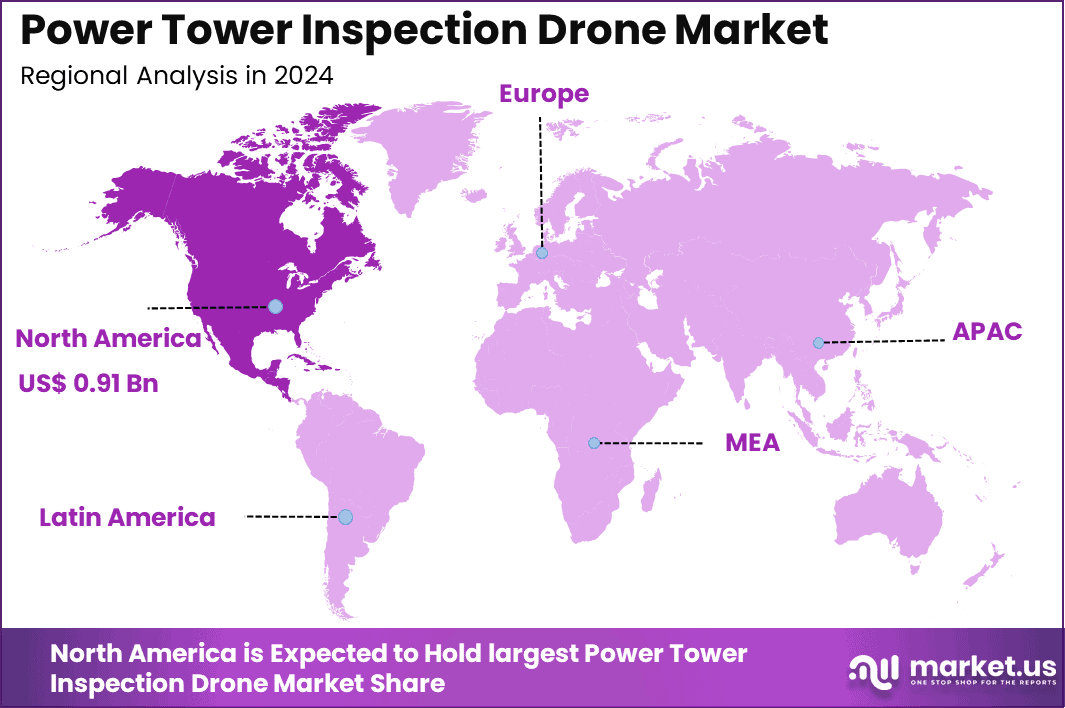
The Global Power Tower Inspection Drone Market generated USD 2.4 billion in 2024 and is predicted to register growth from USD 2.7 billion in 2025 to about USD 7.6 billion by 2034, recording a CAGR of 12.2% throughout the forecast span. In 2024, North America held a dominant market position, capturing more than a 38% share, with USD 0.91 billion in revenue.
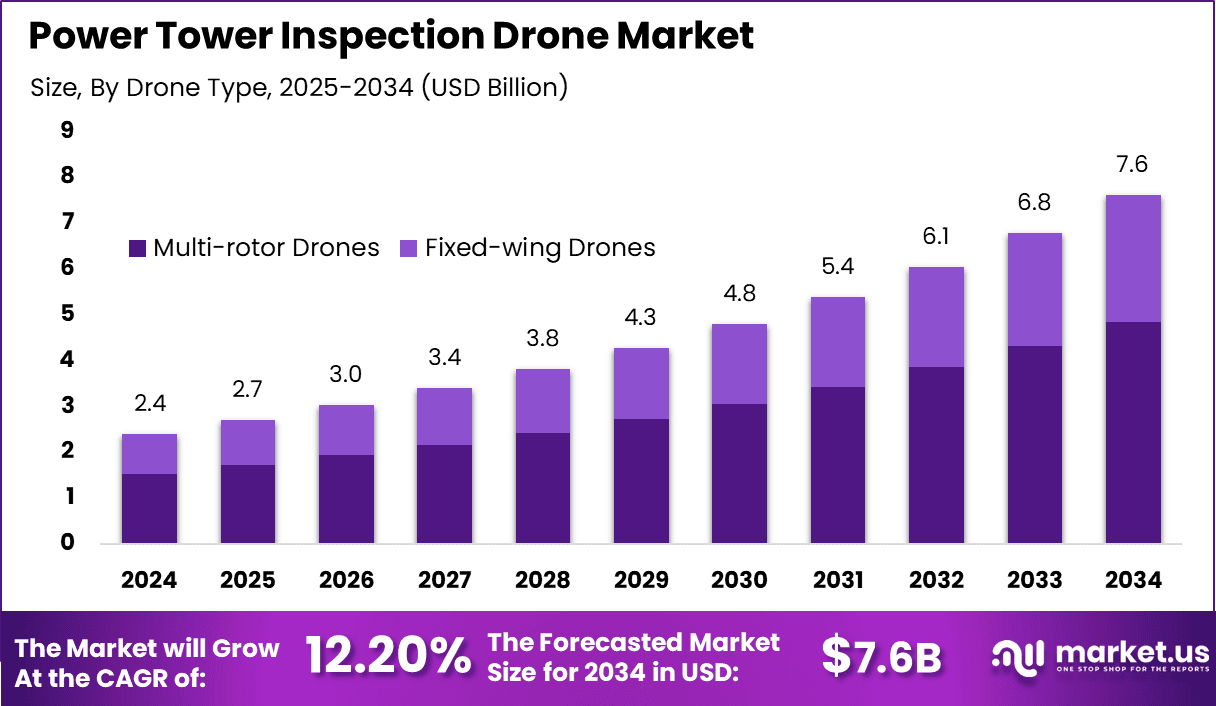
Key driving factors include the urgent need to improve worker safety by eliminating hazardous climbs to inspect high-voltage towers, alongside the pressure to reduce maintenance costs and outages. About 30-50 workers per 100,000 engaged in manual inspections sustain fatal accidents yearly, highlighting the critical safety advantage drones offer. Additionally, drone inspections are 5 times faster than traditional approaches, enabling utilities and telecom companies to maintain uptime and optimize operational budgets.
The Power Tower Inspection Drone market is growing significantly as industries increasingly leverage drone technology to ensure safer, faster, and more cost-effective inspection of power transmission and communication towers. The market exhibits a strong CAGR of about 16.7%, fueled by the rising demand for automating tower inspections to reduce manual risks and improve efficiency.
Drones equipped with advanced sensors, high-resolution cameras, and AI-powered analytics are rapidly replacing traditional labor-intensive methods, providing superior data quality while minimizing downtime in critical infrastructure maintenance. Demand analysis shows that energy and telecom sectors dominate drone usage, with power and communication towers accounting for over 70% of drone inspection activities.
The need for real-time, comprehensive fault detection using thermal, UV, and high-resolution RGB imaging pushes adoption further. Routine and fault inspections form over 80% of the market applications, ensuring early detection of defects like corrosion, loose bolts, and electrical anomalies, which significantly reduce costly failures.
Top Market Takeaways
- By drone type, multi-rotor drones dominate with a 63.7% share because of their superior maneuverability, hovering capability, and payload lifting capacity, ideal for detailed tower inspections.
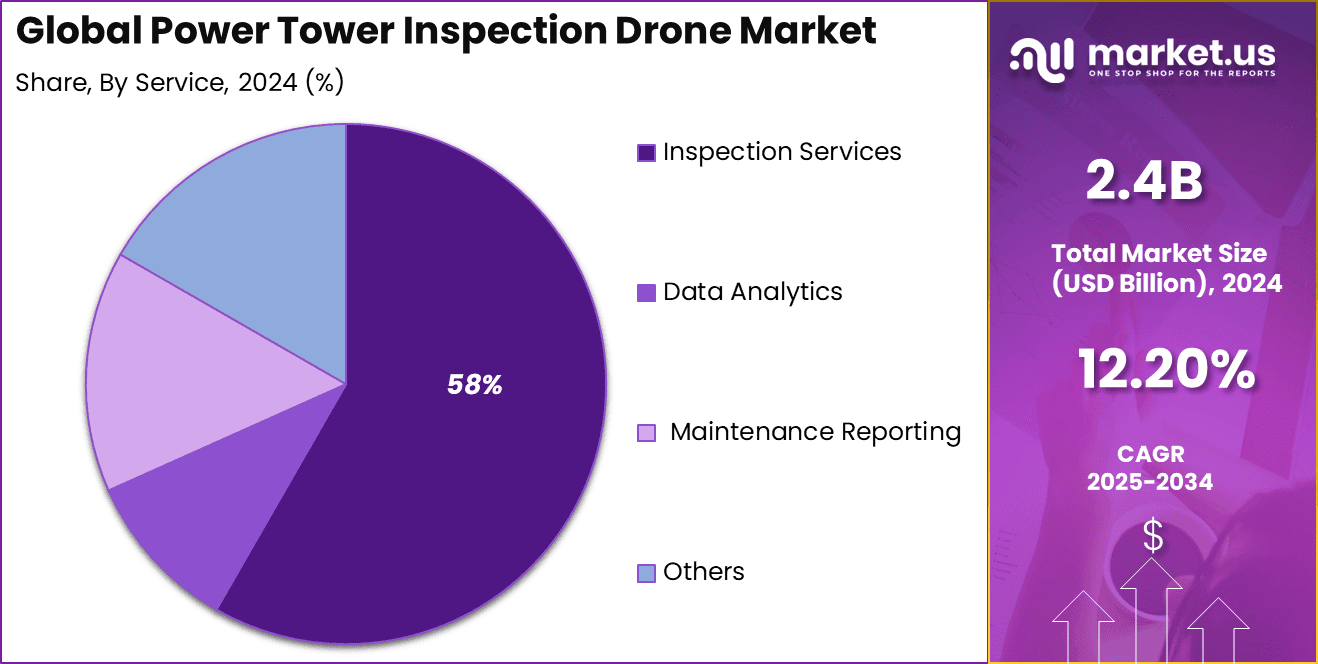
- By service, inspection services constitute 58.3% of the market, with drones used extensively for precise, cost-effective tower condition monitoring and fault detection.
- By application, routine inspection leads at 34.8%, reflecting regular maintenance schedules that use drones for preventative tower assessments to avoid outages or failures.
- By end-user, power utilities are the largest segment at 42.6%, driven by their need for efficient infrastructure management and regulatory compliance.
- Regionally, North America holds around 38% of the market, buoyed by advanced energy infrastructures and early adoption of drone-based inspection technology.
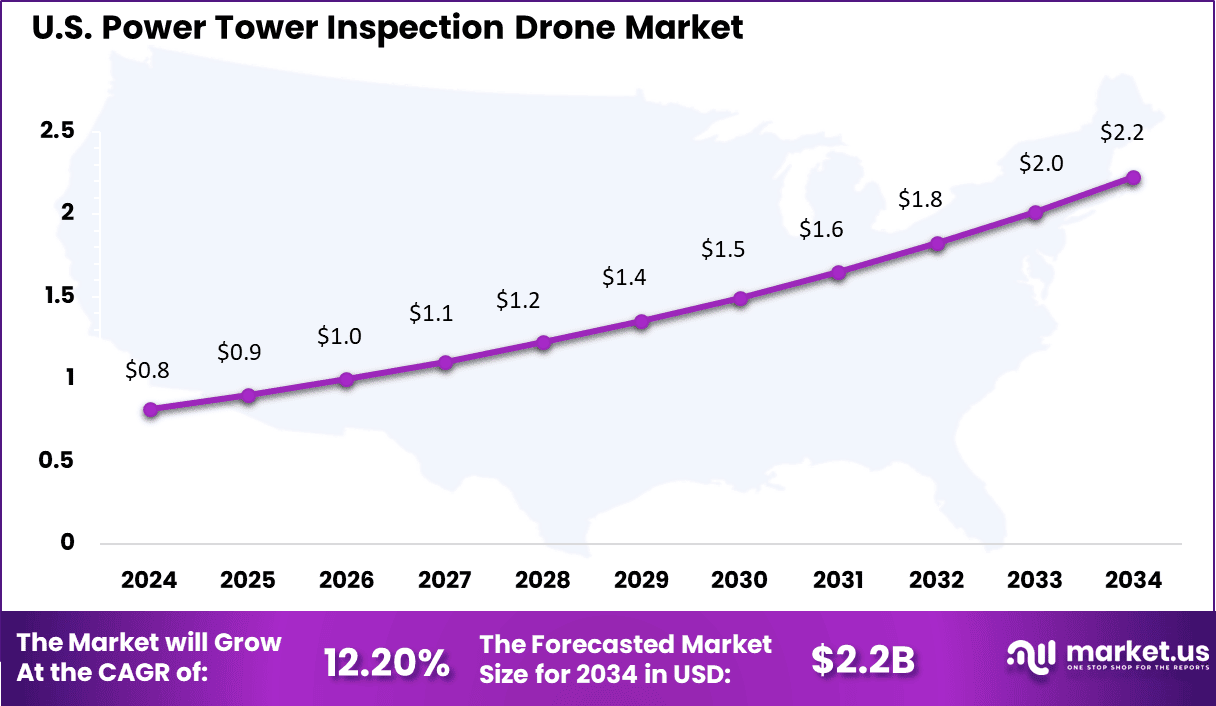
- The U.S. market size is estimated at approximately USD 0.82 billion in 2025.
By Drone Type
Multi-rotor drones hold a commanding share of 63.7% in the power tower inspection drone market. Their popularity stems from excellent maneuverability, stability, and precision, which are essential for inspecting complex power tower structures.
These drones are well-suited for close-range assessments requiring detailed imaging and sensor data, giving them an edge in routine inspections and fault detection. Their versatility and easier deployment compared to fixed-wing drones make them the preferred option among industries requiring frequent and thorough power grid inspections.
By Service
Inspection services dominate with a 58% market share, reflecting the core use of drones in power infrastructure management. These services include visual inspections, thermal imaging, LiDAR scanning, and fault detection to maintain equipment health and prevent outages.
Using drones reduces safety risks for personnel and cuts inspection time significantly compared to manual methods. Providers increasingly integrate AI analytics with inspection services to offer predictive maintenance insights, enhancing decision-making and operational efficiency.
By Application
Routine inspection accounts for 34.8% of applications. Frequent, scheduled checks are critical to ensure the reliability and safety of power transmission towers. Drones enable operators to monitor structural integrity, detect wear and tear early, and comply with regulatory maintenance standards without costly downtime. Routine drone inspections help utilities maintain continuous power delivery by catching issues before they escalate into failures.
By End-User
Power utilities are the largest end-user group, representing 42.6% of the market. They leverage drones for efficient upkeep of power grids, transmission lines, and substations. Drones support utilities in complying with safety regulations while improving inspection coverage and data accuracy. The adoption of drones by utilities is driven by the need to optimize maintenance budgets and increase operational safety around high-voltage assets.
Key Market Segments
By Drone Type
- Multi-rotor Drones
- Fixed-wing Drones
By Service
- Inspection Services
- Data Analytics
- Maintenance Reporting
- Others
By Application
- Routine Inspection
- Damage Assessment
- Pre-construction Survey
- Others
By End-User
- Power Utilities
- Renewable Energy Companies
- Telecommunication Companies
- Others
Regional Analysis
North America holds a significant 38% share in the global power tower inspection drone market. The U.S. market alone is valued at around USD 0.82 billion in 2025 and is projected to grow at a CAGR of 10.5%. This growth is driven by increasing investments in grid modernization and the adoption of drone technology for safer, faster, and more cost-effective inspection of power towers and transmission lines.
The U.S. is a major growth market within North America, benefiting from well-established FAA regulations that facilitate commercial drone operations including beyond visual line of sight (BVLOS) flights. The U.S. utility sector actively integrates drones to optimize inspection efficiency, reduce costs, and enhance worker safety.
Technological advances like AI-driven image analysis and improved sensor payloads boost inspection accuracy and speed. The expansion of 5G and IoT frameworks further supports the use of drones for real-time data transmission and remote monitoring. These factors collectively contribute to a robust growth outlook for the U.S. power tower inspection drone market, making it a key driver for the overall North American segment.
Key Regions and Countries
- North America
- US
- Canada
- Europe
- Germany
- France
- The UK
- Spain
- Italy
- Russia
- Netherlands
- Rest of Europe
- Asia Pacific
- China
- Japan
- South Korea
- India
- Australia
- Singapore
- Thailand
- Vietnam
- Rest of APAC
- Latin America
- Brazil
- Mexico
- Rest of Latin America
- Middle East & Africa
- South Africa
- Saudi Arabia
- UAE
- Rest of MEA
Market Dynamics
Driver - Enhanced Safety and Cost Efficiency
The power tower inspection drone market is driven strongly by the need for safer and more cost-effective inspection processes. Traditional manual inspections of power towers pose significant risks to human inspectors due to the height and electrical hazards involved.
Drones provide a safer alternative by remotely capturing detailed visuals and data, significantly reducing the risk of accidents. This shift towards automation not only enhances worker safety but also reduces overall inspection costs by minimizing the need for specialized personnel and heavy equipment.
In addition, drones enable faster inspection cycles, which helps utilities and telecom companies quickly identify and address faults, minimizing downtime. The demand for sustainable and efficient infrastructure maintenance further propels the adoption of drones in this sector, as companies look for eco-friendly methods that also deliver high accuracy and reliability.
Restraint - Regulatory and Airspace Restrictions
Regulatory hurdles and airspace restrictions remain important restraints limiting the widespread use of drones for power tower inspection. Different countries have varying rules regarding drone operation, especially concerning flights beyond the visual line of sight (BVLOS).
These regulations can restrict the operational range and increase compliance costs, complicating deployment for large-scale inspections. Additionally, the need to coordinate drone flights in congested or sensitive airspaces adds operational complexity.
Compliance with safety guidelines, obtaining necessary permissions, and integrating drones into existing aviation frameworks require significant effort and time. These barriers can slow down market growth despite technological readiness and demonstrated benefits.
Opportunity - Integration of AI and Advanced Sensor Technologies
The growing integration of artificial intelligence and advanced sensors like LiDAR, thermal imaging, and high-resolution cameras presents a major opportunity for the market. AI-powered analytics improve defect detection by automatically analyzing large volumes of captured data, identifying anomalies faster and more accurately than manual reviews.
Advanced sensors expand inspection capabilities by allowing detailed assessment of structural integrity, hot spots, and corrosion in various lighting and weather conditions. Combined with the rise of autonomous drone flights, these technologies enable scalable, real-time monitoring and predictive maintenance.
Challenge - Technical Complexity and Data Management
A key challenge facing the power tower inspection drone market involves managing the technical complexity and vast amounts of data generated. Operating drones with advanced sensors and AI algorithms requires skilled technicians and sophisticated software platforms to process, analyze, and securely store inspection data.
Balancing usability with advanced functionality is difficult, as customers demand intuitive solutions that integrate seamlessly with existing asset management systems. In addition, ensuring data privacy and protection from cyber threats is critical, especially when dealing with critical infrastructure information. Overcoming these challenges necessitates ongoing innovation, robust training programs, and collaboration among technology providers and end users.
Key Players Analysis
DJI remains the Tier-1 market leader, with an estimated 70–83% share of global drone units and group revenue of nearly USD 3.5 billion. Its large manufacturing base and capital strength support continued investment in the Matrice enterprise drone line used for transmission-tower inspections.
Skydio is the leading U.S. enterprise and defense challenger. Its annual recurring revenue reached approximately USD 295.1 million in 2025, compared with about USD 180 million in 2024, representing nearly 80% YoY growth. The company also raised USD 110 million in a Series F round at a USD 4.4 billion valuation and secured a USD 52 million U.S. Army contract for 2,500 X10D drones.
AgEagle, the parent company of senseFly and now branded as EagleNXT, reported FY2025 revenue of USD 12.8 million, down from USD 13.4 million in FY2024. However, Q2 2025 drone sales revenue reached USD 2.9 million, increasing 92% YoY, highlighting the limited scale of Tier-2 companies compared with DJI.
Tier-2 specialists remain focused on niche markets. Flyability has raised approximately USD 27 million, including CHF 22 million in a 2022 Series C round and an earlier USD 11 million round, while employing around 130 people. Delair has an estimated revenue base of USD 150 million. PrecisionHawk completed 5 acquisitions within 9 months in 2018, was acquired by Field in 2023, and filed for Chapter 7 bankruptcy in December 2023.
Top Key Players in the Market
- DJI
- Skydio
- PrecisionHawk
- Delair
- senseFly (AgEagle)
- Flyability
- Percepto
- Aerialtronics
- Microdrones
- Kespry
- Parrot
- Yuneec
- Autel Robotics
- Sharper Shape
- Others
Recent Developments
- November, 2024, DJI enhanced its powerline inspection drone offerings with the Matrice 30 Series, providing a portable yet powerful platform for transmission line inspections equipped with visible and infrared imaging to detect defects and ensure stable power operations.
- May, 2025, Skydio’s autonomous drones demonstrated superior proximity flying capabilities, allowing smaller cameras to capture higher-quality inspection data by flying closer to power infrastructure safely. Partnering with the Electric Power Research Institute (EPRI), Skydio drones were tested and confirmed to perform reliably in energized environments with strong electromagnetic interference.
Report Scope
| Report Features | Description |
|---|---|
| Market Value (2024) | USD 2.4 Bn |
| Forecast Revenue (2034) | USD 7.6 Bn |
| CAGR(2025-2034) | 12.2% |
| Base Year for Estimation | 2024 |
| Historic Period | 2020-2023 |
| Forecast Period | 2025-2034 |
| Report Coverage | Revenue forecast, AI impact on Market trends, Share Insights, Company ranking, competitive landscape, Recent Developments, Market Dynamics and Emerging Trends |
| Segments Covered | By Drone Type (Multi-rotor Drones, Fixed-wing Drones), By Service (Inspection Services, Data Analytics, Maintenance Reporting, Others), By Application (Routine Inspection, Damage Assessment, Pre-construction Survey, Others), By End-User (Power Utilities, Renewable Energy Companies, Telecommunication Companies, Others) |
| Regional Analysis | North America – US, Canada; Europe – Germany, France, The UK, Spain, Italy, Russia, Netherlands, Rest of Europe; Asia Pacific – China, Japan, South Korea, India, New Zealand, Singapore, Thailand, Vietnam, Rest of Latin America; Latin America – Brazil, Mexico, Rest of Latin America; Middle East & Africa – South Africa, Saudi Arabia, UAE, Rest of MEA |
| Competitive Landscape | DJI, Skydio, PrecisionHawk, Delair, senseFly (AgEagle), Flyability, Percepto, Aerialtronics, Microdrones, Kespry, Parrot, Yuneec, Autel Robotics, Sharper Shape, Others |
| Customization Scope | Customization for segments, region/country-level will be provided. Moreover, additional customization can be done based on the requirements. |
| Purchase Options | We have three licenses to opt for: Single User License, Multi-User License (Up to 5 Users), Corporate Use License (Unlimited Users and Printable PDF) |





























