Report Overview
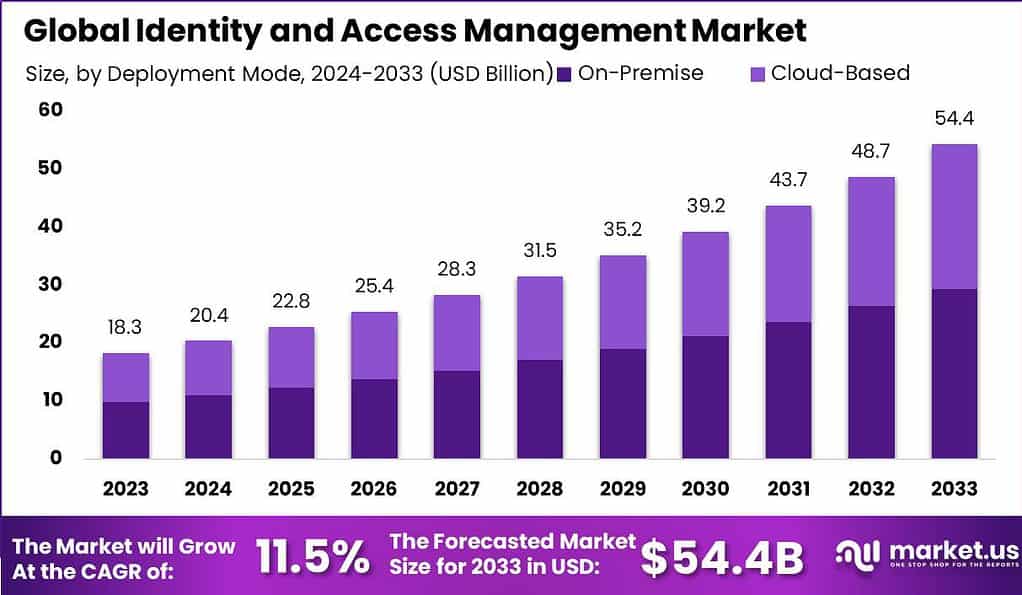
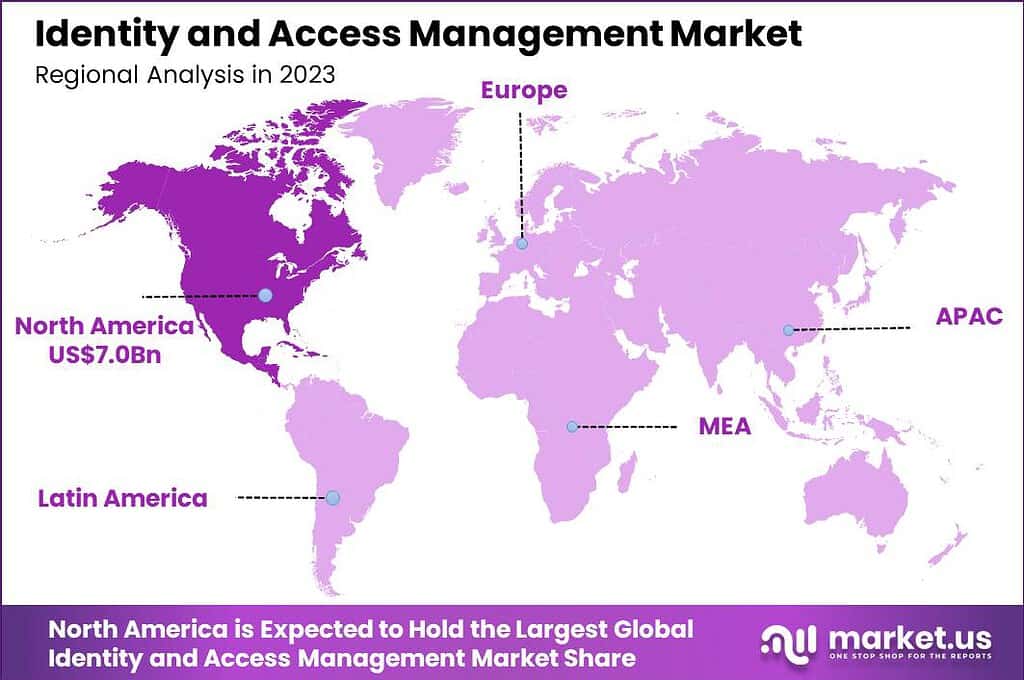
The Global Identity and Access Management Market size is expected to be worth around USD 54.4 billion by 2033, from USD 18.3 billion in 2023, growing at a CAGR of 11.5% during the forecast period from 2024 to 2033. In 2023, North America held a dominant market position, capturing more than a 38.3% share, with USD 7.0 billion in revenue.
According to Tenfold’s findings, 80% of cyberattacks now exploit identity-based methods, making identity management a critical area of concern. Additionally, 99% of security decision-makers expect to face an identity-related breach within the next year. This highlights a significant challenge, especially with the average cost of a data breach reaching $4.45 million, creating serious financial implications for businesses.
For instance, in May 2024, Microsoft announced a significant update regarding the security of its Azure platform. Starting in July 2024, multi-factor authentication (MFA) will become mandatory for all Azure users. This decision is part of Microsoft’s Secure Future Initiative, which is focused on strengthening security measures and reducing the risk of data breaches.
Ransomware remains a top threat, with 48% of organizations identifying it as their main concern for the coming year. Furthermore, 42% of organizations have already experienced a ransomware attack in the past year, emphasizing the need for stronger defense mechanisms. The situation is compounded by the increasing use of collaboration tools, which 75% of CISOs believe introduce new security risks. A striking 94% even find the built-in security features of Microsoft 365 inadequate for protecting their systems.
Finally, improving identity and access management could be a key solution. 80% of CISOs believe that enhanced identity management could have prevented some or all of the attacks they faced, making it a priority for future security strategies.
Key Takeaways
- The Global Identity and Access Management (IAM) Market is projected to reach USD 54.4 Billion by 2033, growing from USD 18.3 Billion in 2023 at a CAGR of 11.5% during the forecast period from 2024 to 2033.
- In 2023, North America led the market, accounting for over 38.3% of the global share, translating to approximately USD 7.0 billion in revenue.
- The Provisioning segment emerged as the largest within the IAM market, capturing more than 32.5% share in 2023.
- The On-Premise segment secured a significant portion of the market, holding over 54.1% share in 2023.
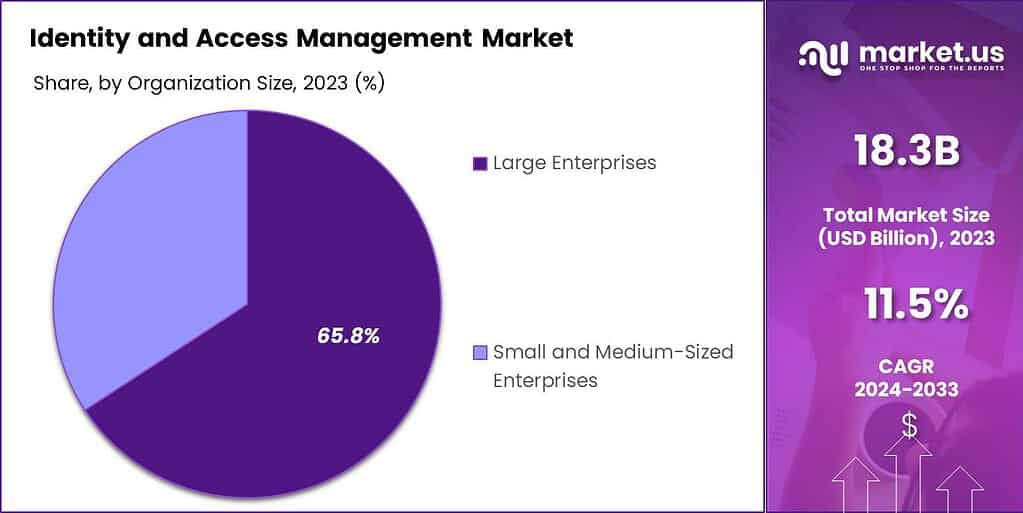
- In terms of enterprise size, Large Enterprises dominated the market with a commanding 65.8% share in 2023, as these organizations prioritize sophisticated identity management to secure vast amounts of sensitive data.
- Finally, the BFSI sector accounted for more than a 23% share of the IAM market in 2023, driven by the financial industry’s critical need for secure and compliant identity management systems.
Identity and Access Management (IAM) Statistics
- Based on data from llcbuddy, in 2023, 60% of medium-sized companies reported a hacking incident affecting 250 to 5000 employees, particularly those requesting remote work from their colleagues.
- A significant 56% of these companies experienced credential theft, while 48% faced social engineering attacks, including phishing.
- In 61% of all cybersecurity incidents, credentials were either stolen through social engineering or compromised via brute force attacks.
- Interestingly, 71% of firms that had experienced a data breach believed that improved security awareness training could have prevented the intrusion.
- A striking 89% of organizations disclosed they were targeted by ransomware in the past year.
- Among 1,700 IT professionals, 97% stated they were hit by phishing emails, highlighting the persistent threat of email-based attacks.
- When considering investment in an Identity and Access Management (IAM) solution, 72% of enterprises prioritized ease of integration, while 62% focused on user experience, followed closely by 61% who emphasized product performance and effectiveness.
- Only 34% of companies with a forward-thinking security culture experienced identity-related breaches last year.
- However, 80% of all cyberattacks now leverage identity-based techniques, showcasing the growing focus on exploiting user access.
- In 2023, cybercrime caused a staggering 8 trillion dollars in global losses. Despite this, 63% of IT decision-makers admitted that highly sensitive access within their organizations remains insufficiently secured.
By Component
Provisioning dominates with 32.5% due to automated user lifecycle management demand.
Provisioning tools lead this market because they handle a basic but heavy task: creating, updating, and removing user accounts across many systems. Companies add and remove staff often, and manual account setup wastes time and creates errors. The World Bank reports that small and medium businesses make up around 90% of all firms worldwide, and each of these firms needs simple, low-cost ways to manage user access as they grow.
Multifactor Authentication is the fastest-growing sub-segment because password theft keeps rising and regulators now push firms to add extra login checks. The European Union’s digital survey found that 61% of enterprises buying cloud services also buy security software as part of that purchase, showing how security features ride along with broader technology upgrades.
By Deployment Mode
On-Premise dominates with 54.1% due to strict data residency compliance needs.
On-Premise setups still lead because many large firms, especially in banking and government, must keep sensitive data inside their own walls to follow local laws. These firms built their systems years ago and face high switching costs, so they keep running local servers rather than move fast. Eurostat data shows that in 2023, only 45.2% of European Union enterprises bought any form of cloud computing service, meaning more than half still lean on other setups.
Cloud-Based deployment is the fastest-growing option because it needs no upfront hardware spending and scales up or down as a business changes size. The same Eurostat study found that large enterprises using cloud grew their purchases by 6 percentage points between 2021 and 2023, reaching 77.6%, showing strong movement toward cloud tools even among firms that once avoided them. Lower setup cost and faster rollout speed keep pulling new customers toward cloud options each year.
By Organization Size
Large Enterprises dominate with 65.8% due to complex multi-system identity needs.
Large Enterprises lead this segment because they manage many departments, offices, and software tools simultaneously, so they need robust identity systems to keep every login secure and organized. These firms also have larger budgets and dedicated IT teams that can manage complex security configurations.
Small and Medium-Sized Enterprises form the fastest-growing group because more of them now buy affordable, ready-made identity tools instead of building systems from scratch. Eurostat figures show that among firms buying cloud, small businesses using advanced security services still grew steadily, moving from 71.6% to 74.2% between 2021 and 2023, proving that smaller firms are closing the gap with larger rivals as tools become easier and cheaper to use.
By Industry Vertical
BFSI dominates with 23.0% due to strict financial data protection rules.
Banking, Financial Services, and Insurance firms lead this space because they hold sensitive money and personal data that regulators watch closely. Banks must prove strong access controls to avoid fines and to protect customer trust, so they spend heavily on identity tools every year.
The International Telecommunication Union reports that about 74% of the world’s population, nearly 6 billion people, now uses the internet in 2025, and much of that traffic touches banking apps and digital payment systems daily.
IT and Telecommunications ranks as the fastest-growing vertical because this sector builds and manages the very networks that carry all other digital traffic, making strong identity control a core need rather than an add-on. The same ITU data shows internet use jumped from 60% in 2020 to 74% in 2025, adding about 1.3 billion new users, and each new user needs safe, verified access to telecom and IT platforms, pushing this vertical’s identity spending up fast.
Key Market Segments
By Component
- Provisioning
- Password Management
- Multifactor Authentication
- Audit, Compliance, and Governance
- Single Sign-On
- Directory Services
- Other
By Deployment Mode
- Cloud-Based
- On-Premise
By Organization Size
- Small and Medium-Sized Enterprises
- Large Enterprises
By Industry Vertical
- IT and Telecommunication
- BFSI
- Manufacturing
- Healthcare
- Education
- Retail
- Other
Regional Analysis
In 2023, North America held a dominant market position in the Identity and Access Management (IAM) market, capturing more than a 38.3% share with revenues amounting to USD 7.0 billion. This leadership is largely attributed to the region’s strong focus on cybersecurity frameworks and advanced technological adoption across various sectors, including government, healthcare, and finance.
North America’s leading position is further bolstered by its robust regulatory landscape, which mandates stringent data protection measures. Regulations such as HIPAA for healthcare and the Sarbanes-Oxley Act for corporate governance drive the demand for comprehensive IAM solutions to ensure compliance and protect sensitive data.
In January 2024, Stack Identity, a Silicon Valley-based leader in identity security, took a major step forward by expanding its Identity Access Risk Management Platform. This update includes identity threat detection and response (ITDR) capabilities, specifically aimed at addressing growing concerns around shadow access and shadow identities.
Key Regions and Countries
North America
- US
- Canada
Europe
- Germany
- France
- The UK
- Spain
- Italy
- Rest of Europe
Asia Pacific
- China
- Japan
- South Korea
- India
- Australia
- Singapore
- Rest of Asia Pacific
Latin America
- Brazil
- Mexico
- Rest of Latin America
Middle East & Africa
- South Africa
- Saudi Arabia
- UAE
- Rest of MEA
Market Dynamics
Drivers
| Driver | (~) % CAGR | Geographic Relevance | Impact Timeline |
|---|---|---|---|
| Zero Trust mandate adoption in federal and enterprise networks | +2.8% | North America, Western Europe | Short term (2 years or less) |
| Cloud-native IAM migration from on-premise directories | +2.1% | Global | Short term (2 years or less) |
| Rising credential-based breach frequency driving MFA rollouts | +1.6% | North America, Asia Pacific | Short term (2 years or less) |
| Machine and non-human identity proliferation from API/IoT growth | +1.2% | Global | Medium term (2 to 4 years) |
| Privacy regulation enforcement (GDPR, CCPA-class statutes) requiring access governance | +0.9% | Europe, North America | Short term (2 years or less) |
| SaaS subscription model displacing perpetual licensing revenue streams | +0.7% | Global | Medium term (2 to 4 years) |
Zero Trust mandate adoption in federal and enterprise networks
The 2022 U.S. Office of Management and Budget Zero Trust strategy required federal agencies to implement phishing-resistant multi-factor authentication and centralized identity governance by fiscal year 2024.
Supported by NIST Special Publication 800-207, these requirements have also influenced private-sector vendors serving government supply chains. IAM technology refresh cycles have shortened from about 5 years to less than 3 years, while bundled identity contracts have increased in value by approximately 15% to 20%.
The mandate has shortened sales cycles for vendors with FedRAMP-authorized platforms and accelerated cloud migration among legacy directory providers. Identity vendors securing multi-year contracts in regulated sectors may achieve margin improvements of approximately 200 to 300 basis points, particularly ahead of the 2026 full compliance enforcement window.
Restraints
| Restraint | (~) % CAGR | Geographic Relevance | Impact Timeline |
|---|---|---|---|
| High-interest-rate-driven IT capex freeze among mid-market enterprises | -1.8% | North America, Europe | Short term (2 years or less) |
| Legacy system integration incompatibility blocking deployment | -1.3% | Global, concentrated in manufacturing and government | Short term (2 years or less) |
| Data localization laws restricting cross-border identity data flows | -0.9% | China, Russia, India | Short term (2 years or less) |
| Budget reallocation toward generative AI initiatives crowding out IAM spend | -0.6% | Global | Short term (2 years or less) |
High-interest-rate-driven IT capex freeze among mid-market enterprises
Restrictive interest rates through 2024 and into 2025 increased financing costs for mid-sized enterprises planning multi-year identity platform upgrades. Commercial borrowing costs of about 7% to 9% across several OECD economies caused many IT committees to delay large identity modernization projects by an average of 2 to 3 fiscal quarters.
This environment has placed pressure on IAM vendors that depend on new mid-market customers. Sales cycles have lengthened by approximately 20% to 30%, encouraging vendors to focus on existing-customer expansion, phased deployments, and usage-based pricing while buyers postpone full-suite IAM investments.
Challenges
| Challenge | (~) % CAGR | Geographic Relevance | Mitigation Horizon |
|---|---|---|---|
| Cybersecurity talent and identity skills shortage | -1.1% | Global, acute in North America and Europe | Medium term (2 to 4 years) |
| Fragmented multi-cloud identity federation complexity | -0.8% | Global | Medium term (2 to 4 years) |
| Identity sprawl across shadow SaaS applications | -0.6% | North America, Asia Pacific | Medium term (2 to 4 years) |
| Vendor consolidation fatigue and integration debt | -0.5% | Global | Long term (4 years or more) |
| Post-quantum cryptography readiness gap | -0.4% | Global | Long term (4 years or more) |
Cybersecurity talent and identity skills shortage
The global cybersecurity workforce shortage exceeded 4 million unfilled roles in 2024, with identity and access management among the most affected specializations. Limited availability of identity architects can extend enterprise IAM implementation and integration timelines by 30% to 40%, while senior identity engineering positions may remain vacant for more than 90 days.
To address this gap, IAM vendors are expanding managed and professional services, but this can reduce services gross margins by an estimated 3 to 5 percentage points compared with pure-software delivery. Vendors are also investing in low-code administration and AI-assisted policy configuration to reduce the specialized workforce required for each deployment.
Opportunities
| Opportunity | (~) % CAGR | Geographic Relevance | Execution Window |
|---|---|---|---|
| Non-human and machine identity governance as a distinct monetization layer | +2.2% | Global | Medium term (2 to 4 years) |
| SME and mid-market IAM-as-a-service white space | +1.5% | Southeast Asia, Latin America, Africa | Medium term (2 to 4 years) |
| Decentralized and verifiable digital identity credentialing | +1.1% | Europe, Asia Pacific | Long term (4 years or more) |
| Embedded identity APIs for fintech and healthtech platforms | +0.8% | North America, Asia Pacific | Medium term (2 to 4 years) |
| M&A roll-up of point-solution identity vendors into unified platforms | +0.6% | Global | Short term (2 years or less) |
Non-human and machine identity governance as a distinct monetization layer
Machine-identity governance represents untapped white space because current growth from APIs and IoT devices has not yet been matched by dedicated governance products. Existing human-identity pricing of USD 3 to USD 8 per user per month could be supplemented by consumption-based pricing linked to certificate, secret, and workload rotation volumes, which are growing faster than employee headcount.
The margin opportunity is also attractive. Machine-identity governance products can achieve gross margins of 75% to 80%, compared with blended company averages of about 65% to 70%, due to lower help-desk and password-reset costs. However, this opportunity depends on platform redesign, specialized pricing, and focused go-to-market execution rather than automatic market growth.
Key Players Analysis
The IAM competitive landscape is divided between diversified Tier-1 technology companies and Tier-2 identity specialists. Microsoft integrates Entra ID across its enterprise technology portfolio of approximately USD 245 billion+. Its security business, including IAM solutions, has exceeded an annualized run rate of USD 20 billion, supported by the large installed base of Active Directory and Entra customers.
IBM’s Software segment generated USD 29.96 billion in FY2025, compared with USD 27.09 billion in FY2024, while its software gross margin reached 83.5%. Its hybrid cloud and security consulting operations contributed USD 21.06 billion in FY2025. Oracle recorded Cloud Services and License Support revenue of USD 44.03 billion in FY2025, up from USD 39.38 billion in FY2024, while cloud revenue reached USD 24.51 billion. Broadcom’s Software segment has historically generated more than USD 20 billion in revenue.
CyberArk leads the Tier-2 specialist group, with revenue increasing by 36% from USD 1.00 billion in FY2024 to USD 1.36 billion in FY2025. Research and development spending rose from USD 243.1 million, or 24.3% of revenue, to USD 343.9 million, or 25.3%, during the same period. This investment supports the expansion of machine identity, privileged access, and AI-agent security capabilities.
| Tier | Companies | Differentiator |
|---|---|---|
| Tier-1: Platform-Embedded Scale | Microsoft, IBM, Oracle, Broadcom | IAM solutions are integrated into cloud and software portfolios exceeding USD 20 billion, supported by large installed enterprise customer bases. |
| Tier-2: Identity Specialists | CyberArk, BeyondTrust, Zoho | Revenue is concentrated in IAM and PAM solutions, with stronger specialization, higher R&D focus, acquisition potential, and competitively priced offerings for SMBs. |
Top Key Players in the Market
- Microsoft Corporation
- IBM Corporation
- Oracle Corporation
- Broadcom Inc.
- BeyondTrust Corporation
- CyberArk Software Ltd.
- Zoho Corporation
- One Identity LLC
- Thales Group
- Fortinet, Inc.
- Other Key Players
Recent Developments
- In 2026, Microsoft expanded Entra Agent ID into public preview at Ignite 2025 (rolled out through 2026), adding permission, ownership, and lifecycle governance for AI agent identities alongside Conditional Access and identity-protection safeguards across Security Copilot and Microsoft 365 Copilot.
- In June 2026, One Identity announced that it will operate as an independent company separate from Quest Software, designating Cork, Ireland as its new global headquarters, with over 80% of its engineering organization based in the region as it targets the unified identity governance and non-human identity market.
- In October 2025, IBM launched Verify Identity Protection (VIP), adding identity observability and AI-driven threat detection capabilities purpose-built to secure agentic AI workloads within hybrid enterprise environments.
- In July 2025, Palo Alto Networks announced a definitive agreement to acquire CyberArk Software for approximately $25 billion in a cash-and-stock deal, with CyberArk shareholders set to receive $45.00 in cash plus 2.2005 Palo Alto Networks shares per CyberArk share, representing a 26% premium to CyberArk’s unaffected 10-day average VWAP.
Report Scope
| Report Features | Description |
|---|---|
| Market Value (2023) | USD 18.3 Bn |
| Forecast Revenue (2033) | USD 54.4 Bn |
| CAGR (2023-2032) | 11.5% |
| Base Year for Estimation | 2023 |
| Historic Period | 2019-2022 |
| Forecast Period | 2024-2033 |
| Report Coverage | Revenue Forecast, Market Dynamics, COVID-19 Impact, Competitive Landscape, Recent Developments |
| Segments Covered | By Component (Password Management, Multifactor Authentication, Audit, Compliance, and Governance, Provisioning, Single Sign-On, Directory Services, Other Components), By Deployment Mode (On-Premise and Cloud-Based), By Organization Size (Small and Medium-Sized Enterprises, Large Enterprises), By Industry Vertical (IT & Telecommunication, BFSI, Manufacturing, Healthcare, Education, Retail, Other Industry Verticals) |
| Regional Analysis | North America – US, Canada; Europe – Germany, France, The UK, Spain, Italy, Russia, Netherlands, Rest of Europe; Asia Pacific – China, Japan, South Korea, India, New Zealand, Singapore, Thailand, Vietnam, Rest of APAC; Latin America – Brazil, Mexico, Rest of Latin America; Middle East & Africa – South Africa, Saudi Arabia, UAE, Rest of MEA |
| Competitive Landscape | Microsoft Corporation, IBM Corporation, Oracle Corporation, Broadcom Inc., BeyondTrust Corporation, CyberArk Software Ltd., Zoho Corporation, One Identity LLC, Thales Group, Fortinet Inc., Other Key Players |
| Customization Scope | Customization for segments, region/country-level will be provided. Moreover, additional customization can be done based on the requirements. |
| Purchase Options | We have three licenses to opt for: Single User License, Multi-User License (Up to 5 Users), Corporate Use License (Unlimited Users and Printable PDF) |