


Report Overview
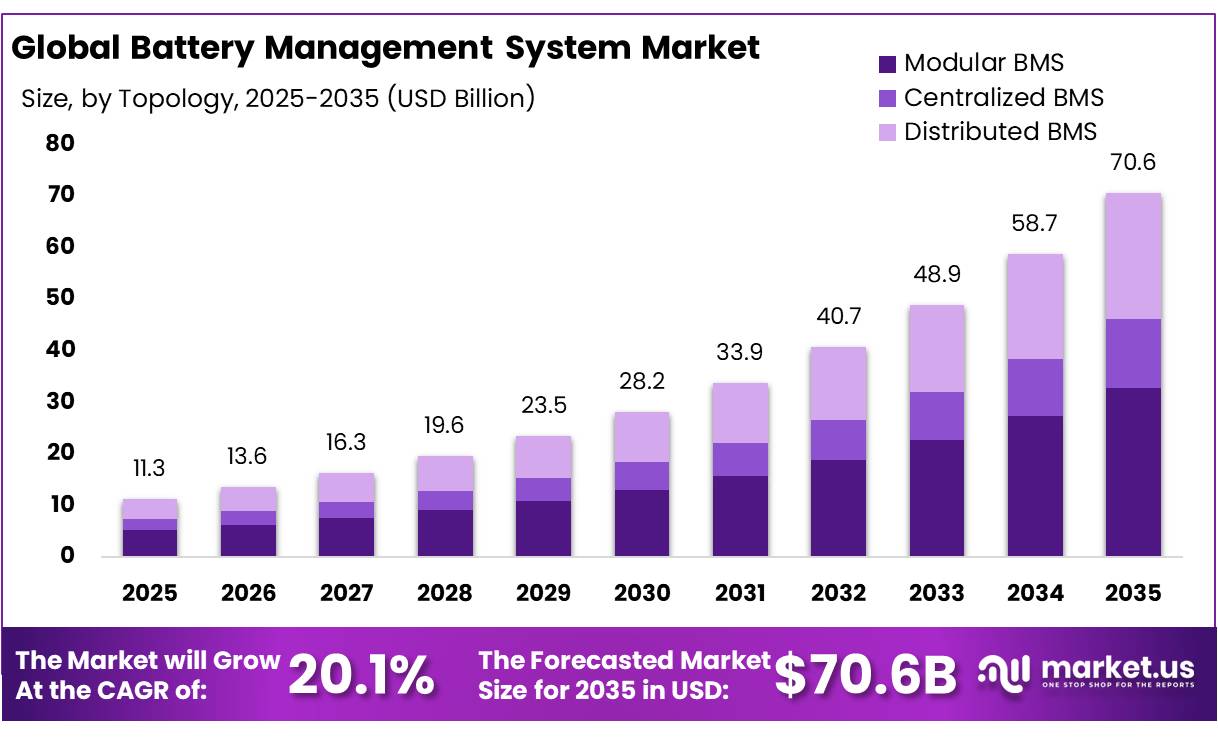
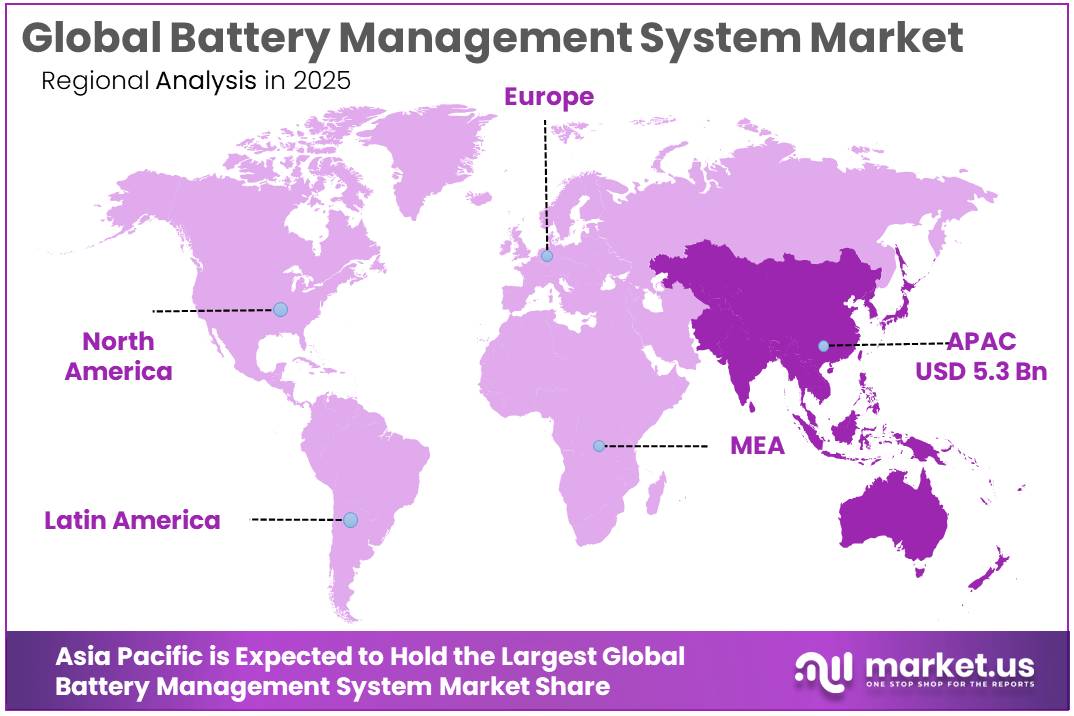
In 2025, the Global Battery Management System Market was valued at USD 11.3 billion, and between 2026 and 2035, this market is estimated to register a CAGR of 20.1%, reaching about USD 70.6 billion by 2035. Asia Pacific held a dominant market position, capturing more than a 47.1% share, holding USD 5.3 billion in revenue.
Battery Management System is becoming a core control layer in modern electric vehicles, stationary energy storage, industrial batteries, and renewable power systems. It monitors battery condition, balances cells, controls charging and discharging, supports safety protection, and helps estimate state of charge and state of health. The International Energy Agency reported that global electric car sales exceeded 20 million units in 2025, equal to around one-quarter of all new cars sold, creating strong demand for advanced battery monitoring and protection systems.
- IEA stated that battery storage must deliver 90% of required storage growth in the Net Zero pathway, rising 14-fold to 1,200 GW by 2030. It also said battery storage deployment must grow by about 25% per year to 2030. These figures make BMS critical for grid-scale and commercial storage, where operators need safe charging, fire-risk control, cycle-life optimization, and remote performance monitoring.
Key Takeaways
- The Global Battery Management System market was valued at USD 11.3 billion in 2025.
- The Global market is projected to grow at a CAGR of 20.1% and is estimated to reach USD 70.6 billion by 2035.
- Modular BMS dominated the market with a 46.5% share.
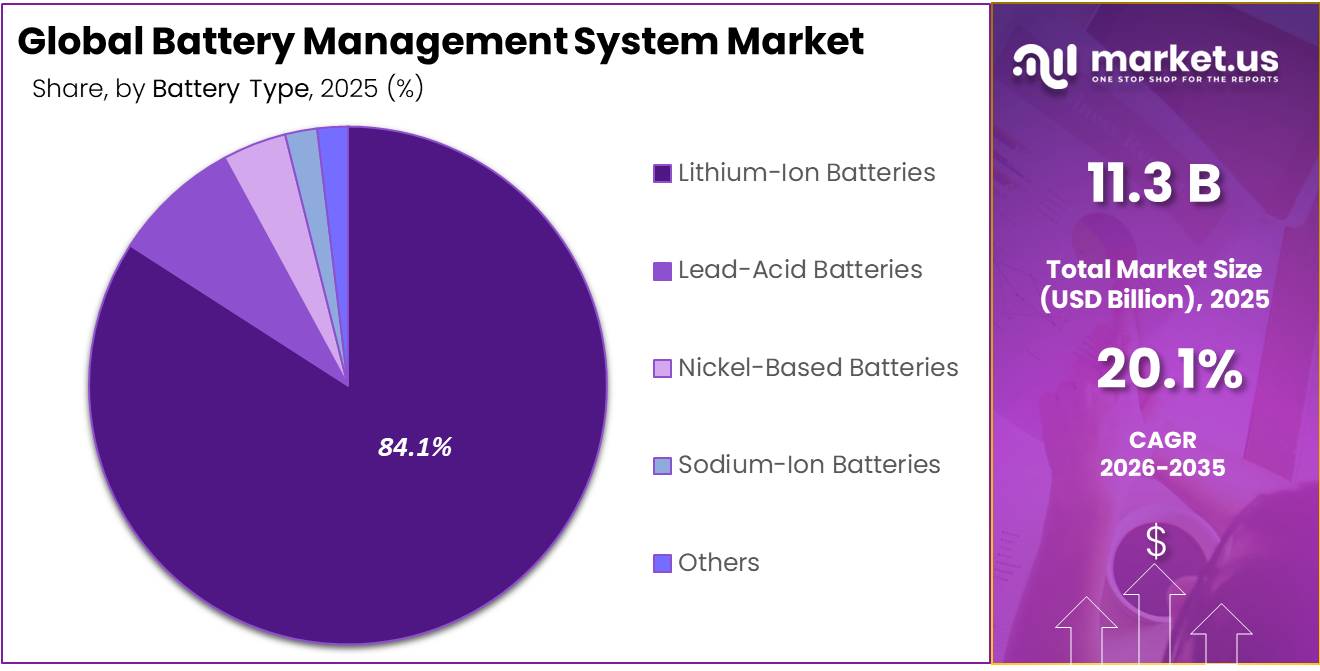
- Lithium-Ion Batteries led the market with an 84.1% share.
- Battery Management Units accounted for a 72.1% share.
- Based on Application, Automotive dominated with a 58.6% market share.
- In 2025, Asia Pacific was the most dominant region in the Battery Management System market, accounting for 47.1% of total global revenue.
Key driving factors include EV adoption, lower lithium-ion battery costs, higher LFP battery usage, stricter safety standards, and renewable energy integration. IEA reported that lithium-ion battery prices fell from about USD 1,400/kWh in 2010 to less than USD 140/kWh in 2023, while LFP batteries accounted for around 40% of EV battery sales and 80% of new battery storage in 2023. As pack sizes increase, manufacturers require better BMS accuracy to avoid overcharging, thermal runaway, capacity loss, and downtime.
Government and standards activity is also creating future growth opportunities. The EU Sustainable Batteries Regulation is in force and sets lifecycle rules covering sustainability, safety, labelling, end-of-life management, lithium recovery of 50% by 2027 and 80% by 2031, and lithium battery recycling efficiency of 65% by end-2025. In February 2025, IEEE Std 2686-2024 for Battery Management Systems in stationary energy storage was published, covering BMS architecture, functions, communication structures, interoperability, cybersecurity, safety, and battery longevity.
In March 2025, LG Energy Solution signed an agreement with Poland’s PGE to supply 981 MWh of grid-scale ESS batteries from 2026 to 2027, including LFP long-cell batteries, liquid cooling, containerized systems, and EPC services. In March 2025, CATL and NIO signed a strategic partnership to build the world’s largest battery swapping network, support unified battery standards, and improve battery lifecycle management.
By Topology Analysis
Modular BMS Represents the Key Revenue-Generating Topology in the Global Battery Management System Market.
Modular BMS dominated the global Battery Management System market, accounting for 46.5% of total market revenue. Its dominance is primarily driven by its ability to support scalable battery architectures required in modern electric vehicles and large energy storage systems. As battery pack sizes and complexity increase, modular systems provide a structured approach that allows manufacturers to expand capacity without redesigning the entire battery management framework.
The leadership of modular BMS is further reinforced by its ability to simplify system integration while supporting long-term lifecycle efficiency across diverse battery platforms. Manufacturers value its flexibility in accommodating different pack configurations and its ability to maintain stable performance under varying load conditions. Companies such as Samsung SDI operate in this environment where advanced and scalable battery management solutions are critical to supporting next-generation battery development.
Battery Type Analysis
Lithium-Ion Batteries Represent the Dominant Battery Type in the Global Battery Management System Market.
Lithium-ion batteries dominate the global Battery Management System market, accounting for 84.1% of total demand, driven by their widespread adoption across electric vehicles, energy storage systems, and consumer electronics. Their dominance is underpinned by high energy density, long cycle life, and strong charging efficiency, making them the most commercially viable chemistry for modern electrified applications.
- In 2024, CATL expanded its lithium-ion battery production footprint to support growing global demand from electric vehicle and energy storage markets, strengthening its position as a key enabler of lithium-ion ecosystem scale-up.
While lithium-ion remains the clear leader, lead-acid and nickel-based batteries continue to serve cost-sensitive and legacy applications, and sodium-ion technologies are gradually emerging in early-stage commercialization efforts.
Component Analysis
Battery Management Units Represent the Dominant Component in the Global Battery Management System Market.
The Battery Management Units segment dominates the global Battery Management System market, accounting for 72.1% of total demand, driven by its critical role as the core intelligence layer of battery architectures. These units enable real-time monitoring, protection, and control of battery packs, executing essential functions such as cell balancing, state-of-charge estimation, thermal regulation, and fault detection.
This dominance is further supported by continuous advancements in semiconductor integration and embedded control technologies that enhance precision, processing efficiency, and system responsiveness. In 2024, Texas Instruments expanded its automotive-grade battery monitoring and sensing portfolio, strengthening its capabilities for next-generation electric vehicle and energy storage applications.
- In June 2026, Texas Instruments launched its BQ79826Z-Q1 automotive battery monitor, an advanced IC designed for high-cell-count monitoring and featuring a built-in Electrochemical Impedance Spectroscopy (EIS) engine, reflecting the industry’s shift toward deeper diagnostic intelligence and next-level battery health assessment.
Application Analysis
Automotive Represents the Dominant Application Segment in the Global Battery Management System Market.
The automotive segment dominates the global Battery Management System market, accounting for 58.6% of total demand, driven by the rapid expansion of electric vehicle production and the increasing integration of high-capacity battery packs in modern mobility platforms. The dominance of this segment is strongly linked to the critical role BMS plays in ensuring battery safety, optimizing performance, and extending battery lifecycle in electric and hybrid vehicles.
The strength of the automotive segment is further reinforced by continuous investments in EV platforms and battery system innovation by leading industry players. In February 2024, Tesla expanded its battery management and energy optimization capabilities across its electric vehicle lineup, strengthening its focus on improving range efficiency and battery longevity. This reflects the increasing reliance on advanced BMS technologies to support vehicle performance and cost efficiency.
Key Market Segments
By Topology
- Modular BMS
- Distributed BMS
- Centralized BMS
By Battery Type
- Lithium-Ion Batteries
- Lead-Acid Batteries
- Nickel-Based Batteries
- Sodium-Ion Batteries
- Others
By Component
- Battery Management Units
- Communication Units
By Application
- Automotive
- Energy Storage Systems (ESS)
- Consumer Electronics
- Aerospace & Defense
- Healthcare Devices
- Others
Driver Analysis
EV battery deployment scale-up lifting high-voltage BMS content
The strongest 2026 demand driver is simple volume expansion in battery-bearing platforms, especially electric vehicles. Global EV battery deployment reached 1.2 TWh in 2025, almost 30% above 2024 levels, creating a larger installed base that requires cell monitoring, balancing, thermal supervision, and state-estimation electronics at pack level and increasingly at module or cell level.
Commercially, this shifts the market from a hardware-controller sale toward a mixed hardware-software content model. OEMs and pack integrators pursuing longer warranties, faster charging, and higher usable depth of discharge need better state-of-charge and state-of-health accuracy because even a 1–2 percentage-point improvement in estimation can translate into tighter range prediction, lower reserve buffers, and better residual-value management over fleet life; that improves the monetization case for premium BMS silicon, firmware, and cloud-linked analytics even when cell prices continue to decline.
Drivers Impact Analysis
| Driver | (~) % Impact on CAGR | Geographic Relevance | Impact Timeline |
|---|---|---|---|
| EV battery deployment scale-up lifting high-voltage BMS content | +2.8% | China core, EU, North America, Korea-Japan supply chain | Medium term (2-4 years) |
| EU battery passport and lifecycle compliance digitizing BMS architectures | +1.9% | EU core, UK/Turkey exporters, Asia-based battery exporters to Europe | Short term (≤ 2 years) |
| Grid-scale storage expansion widening non-automotive BMS demand | +1.7% | North America, China, EU, Australia, Middle East spill-over | Medium term (2-4 years) |
| Battery manufacturing localization and public funding expanding design wins | +1.5% | U.S. core, EU strategic projects, India and ASEAN spill-over | Short term (≤ 2 years) |
| Shift to software-defined diagnostics and predictive controls raising ASPs | +1.4% | North America, EU premium OEM base, APAC advanced cell makers | Medium term (2-4 years) |
| Chemistry complexity and safety thresholds increasing sensing density | +1.2% | Global, with strongest pull in EV and industrial packs above 2 kWh | Long term (≥ 4 years) |
Restraint Analysis
Regulatory uncertainty & compliance cost overhang
Regulation (EU) 2023/1542 on batteries and waste batteries, combined with the upcoming battery passport mandate from February 2027 for EV, light transport, and industrial batteries above 2 kWh, creates a substantial compliance overhang that restrains BMS investment and rollout in the near term.
Strategically, this slows BMS innovation cycles and market entry by smaller players that lack regulatory and IT bandwidth, concentrating share with large incumbents and delaying the monetization of advanced software-defined features because engineering teams must first harden traceability, documentation, and audit trails to avoid future fines or product recalls under the EU framework.
Restraint Impact Analysis
| Restraint | (~) % Impact on CAGR | Geographic Relevance | Impact Timeline |
|---|---|---|---|
| BMS semiconductor shortages & lead times | -2.6% | Global; strongest in Asia-Pacific and EU OEM corridors | Short term (≤ 2 years) |
| Regulatory uncertainty & compliance cost overhang | -2.1% | EU core, exporters in China/Korea/Japan/Turkey | Medium term (2-4 years) |
| OEM price pressure & margin compression | -1.9% | North America, EU, China automotive bases | Medium term (2-4 years) |
| System integration complexity & qualification delays | -1.7% | Global tier-1s, EV and storage pack integrators | Medium term (2-4 years) |
| Cybersecurity and data-liability risk in connected BMS | -1.5% | North America, EU, advanced APAC ecosystems | Long term (≥ 4 years) |
| Skilled engineering talent shortages | -1.3% | Global; acute in India, ASEAN, Eastern Europe | Long term (≥ 4 years) |
Opportunity Analysis
BMS for charging, swap & second-life infrastructure
High-power DC fast chargers, swapping depots, and large-scale second-life warehouses all need intelligent monitoring and control of battery state, temperature, and safety, yet much of this infrastructure still uses relatively simple monitoring rather than full BMS-grade analytics; as EV charging sessions scale into billions annually by the early 2030s, embedding richer BMS logic into chargers and swap modules could unlock a new segment that grows at least as fast as charging infrastructure spend, potentially adding mid-single-digit billions of TAM by 2035 in APAC corridors, Europe, and emerging Indian urban hubs.
Crucially, these are not baseline drivers yet because current BMS integration into chargers and second‑life systems is patchy and often bespoke; building standardized, scalable BMS modules and service offerings for these infrastructure layers over the next 2–4 years could lift global BMS CAGR by 2–3 percentage points above trajectories tied only to onboard EV and storage deployments.
Opportunity Impact Analysis
| Opportunity | (~) % Potential CAGR | Geographic Relevance | Execution Window |
|---|---|---|---|
| SaaS analytics & fleet optimization on top of BMS | +2.6% | North America core, EU, China large fleets | Short term (≤ 2 years) |
| BMS for charging, swap & second-life infrastructure | +2.3% | APAC EV corridors, EU, India emerging hubs | Medium term (2-4 years) |
| Battery data marketplaces & passport-linked services | +2.1% | EU core, global exporters into Europe | Medium term (2-4 years) |
| Integrated BMS–EMS solutions for industrial & grid | +1.9% | North America, EU, Middle East, Australia | Medium term (2-4 years) |
| Roll-up platforms consolidating fragmented BMS vendors | +1.8% | Global; strongest in APAC and Europe | Long term (≥ 4 years) |
| AI-driven design tools & virtual validation for BMS | +1.5% | Global engineering hubs; U.S., EU, India | Long term (≥ 4 years) |
Challenges Analysis
Fragmented global supply chain
Mixed-signal ICs, isolation devices, and communication transceivers are often fabricated in concentrated APAC corridors and shipped through complex routes into EU import hubs and North American assembly plants, and post‑pandemic volatility means transit times for critical components can swing from 25–30 days door‑to‑door in a stable quarter to 45–60 days when port congestion, container imbalances, or regional disruptions occur, with standard deviation on lead times doubling versus pre‑2020 norms in some lanes.
Strategically, this friction pushes BMS vendors and OEMs to diversify sourcing, invest in more sophisticated supply‑chain risk analytics, and negotiate long‑term capacity reservations with key fabs; however, these mitigations take 2–4 years to fully normalize because they require qualification of second‑source components, renegotiation of contracts, and sometimes regionalization of manufacturing footprints.
Challenges Impact Analysis
| Challenge | (~) % CAGR Friction | Geographic Relevance | Mitigation Horizon |
|---|---|---|---|
| Fragmented global supply chain | -1.4% | APAC logistics corridors, EU import hubs, North America | Medium term (2-4 years) |
| Multi-chemistry platform complexity | -1.3% | Global OEM bases, China cell manufacturing belt | Long term (≥ 4 years) |
| Evolving safety & compliance stack | -1.2% | EU regulatory hubs, global exporters to Europe | Medium term (2-4 years) |
| Cyber-physical risk and liability | -1.1% | North America core, EU, advanced APAC ecosystems | Long term (≥ 4 years) |
| Persistent talent and tooling gaps | -1.0% | India, ASEAN, Eastern Europe, mid-tier OEM clusters | Long term (≥ 4 years) |
| Data interoperability & legacy integration | -0.9% | Global; strongest in brownfield industrial sites | Medium term (2-4 years) |
Geopolitical Impact Analysis
Geopolitical Realignment Reshaping the Battery Management System Market.
The Battery Management System market is becoming increasingly shaped by geopolitical realignment in global electrification supply chains, particularly across semiconductors, battery materials, and EV manufacturing ecosystems. Rising trade restrictions, export controls on advanced chip technologies, and national industrial policies are pushing governments to treat battery systems and their control electronics as strategic infrastructure rather than purely commercial components.
As a result, countries are actively localizing production of critical inputs such as power management ICs, sensing modules, and automotive-grade semiconductors that form the core intelligence layer of BMS architectures. This is gradually reducing dependence on cross-border supply chains and accelerating the shift toward regionally self-contained EV and energy storage ecosystems.
At the same time, geopolitical competition between Asia, North America, and Europe is intensifying as each region attempts to secure leadership in electrification value chains through subsidies, tax incentives, and domestic manufacturing mandates. This is strengthening vertically integrated ecosystems where battery producers and OEMs are expanding local capacity to align with policy-driven sourcing requirements. .
Regional Analysis
Asia Pacific Dominated the Global Battery Management System Market.
Asia Pacific dominated the global Battery Management System market with a 47.1% share, driven by its large-scale concentration of electric vehicle manufacturing, battery production capacity, and vertically integrated supply chains. The region’s leadership is anchored by strong ecosystem control across cell manufacturing, pack assembly, and vehicle integration, enabling faster adoption of advanced BMS architectures.
The dominance is further supported by aggressive electrification policies, rapid EV penetration, and continuous expansion of energy storage deployments across China, South Korea, and Japan. The presence of key ecosystem leaders such as BYD reinforces strong regional integration between vehicle production and battery systems.
Key Regions and Countries
- North America
- The US
- Canada
- Europe
- Germany
- France
- The UK
- Spain
- Italy
- Russia & CIS
- Rest of Europe
- APAC
- China
- Japan
- South Korea
- India
- ASEAN
- Rest of APAC
- Latin America
- Brazil
- Mexico
- Rest of Latin America
- Middle East & Africa
- GCC
- South Africa
- Rest of MEA
Key Players Analysis
The Battery Management System market is not monopolistic, because no single company controls battery packs, semiconductor chips, software, thermal control, and energy storage integration together. It is better described as a moderately consolidated and technology-led market, with some oligopolistic behavior in high-volume EV battery supply.
CATL remains one of the strongest global battery players, with 661 GWh lithium battery sales in 2025 and 39.2% global power battery share, which gives it strong influence over embedded BMS requirements. Tesla also has strong internal BMS capability, supported by 46.7 GWh of energy storage deployments in 2025. LG Energy Solution, Panasonic Energy, Samsung SDI, and BYD Company compete strongly through EV battery packs, ESS batteries, and integrated safety-control systems.
At the component and electronics level, the market becomes more fragmented, because several semiconductor and automotive technology suppliers compete in BMS ICs, sensors, microcontrollers, power devices, and control platforms. NXP Semiconductors, Texas Instruments, Analog Devices, Renesas Electronics, and Infineon Technologies are important global players in battery monitoring and power management.
Infineon reported EUR 14.66 billion revenue in FY2025, with Automotive contributing EUR 7.40 billion, showing its strong position in vehicle electronics. Texas Instruments also highlights battery-management solutions within its broad power portfolio. Continental AG, Eberspächer, Hitachi Energy, and Johnson Matthey add system-level, thermal, grid, and engineering capability. Overall, the market is fragmented across technologies but moderately consolidated among leading battery and semiconductor suppliers.
The Major Players in The Industry
- LG Energy Solution
- CATL
- Panasonic Energy
- Samsung SDI
- BYD Company
- Tesla
- Johnson Matthey
- NXP Semiconductors
- Texas Instruments
- Analog Devices
- Renesas Electronics
- Infineon Technologies
- Continental AG
- Ebersprächer
- Hitachi Energy
- Other Key Players
Key Development
- In 2025, Tesla produced 1,654,667 vehicles and delivered 1,636,129 vehicles. Its energy storage deployments reached 46.7 GWh, including a record 14.2 GWh in Q4 2025. Tesla’s position is strengthened by software-led pack management, over-the-air updates, and large-scale stationary storage deployment.
- In 2025, LG Energy Solution signed a 981 MWh grid-scale ESS supply agreement with Poland’s PGE for delivery during 2026–2027, strengthening its battery software and monitoring capabilities.
- In 2025, CATL reported RMB 423.7 billion in revenue, RMB 72.2 billion net profit, 661 GWh lithium-ion battery sales, and 772 GWh global production capacity.
- JM Battery Systems has processed over 70 million cells per year for electric and hybrid vehicles, e-bikes, power tools, and mobile technologies. In FY2025/26, Johnson Matthey reported £12.57 billion revenue, £2.56 billion sales excluding precious metals, and around 2,400 R&D and engineering colleagues.
Report Scope
| Report Features | Description |
|---|---|
| Market Value (2025) | USD 11.3 Bn |
| Forecast Revenue (2035) | USD 70.6 Bn |
| CAGR (2026-2035) | 20.1% |
| Base Year for Estimation | 2025 |
| Historic Period | 2020-2024 |
| Forecast Period | 2026-2035 |
| Report Coverage | Revenue Forecast, Market Dynamics, Competitive Landscape, Recent Developments |
| Segments Covered | By Topology (Modular BMS, Distributed BMS, Centralized BMS); By Battery Type (Lithium-Ion Batteries, Lead-Acid Batteries, Nickel-Based Batteries, Sodium-Ion Batteries, Others); By Component (Battery Management Units, Communication Units); By Application (Automotive, Energy Storage Systems [ESS], Consumer Electronics, Aerospace & Defense, Healthcare Devices, Others) |
| Regional Analysis | North America – The US & Canada; Europe – Germany, France, The UK, Spain, Italy, Russia & CIS, Rest of Europe; APAC– China, Japan, South Korea, India, ASEAN & Rest of APAC; Latin America– Brazil, Mexico & Rest of Latin America; Middle East & Africa– GCC, South Africa, & Rest of MEA |
| Competitive Landscape | LG Energy Solution, CATL, Panasonic Energy, Samsung SDI, BYD Company, Tesla, Johnson Matthey, NXP Semiconductors, Texas Instruments, Analog Devices, Renesas Electronics, Infineon Technologies, Continental AG, Ebersprächer, Hitachi Energy, Other Key Players |
| Customization Scope | Customization for segments, region/country-level will be provided. Moreover, additional customization can be done based on the requirements. |
| Purchase Options | We have three licenses to opt for: Single User License, Multi-User License (Up to 5 Users), Corporate Use License (Unlimited Users and Printable PDF) |





































