Report Overview
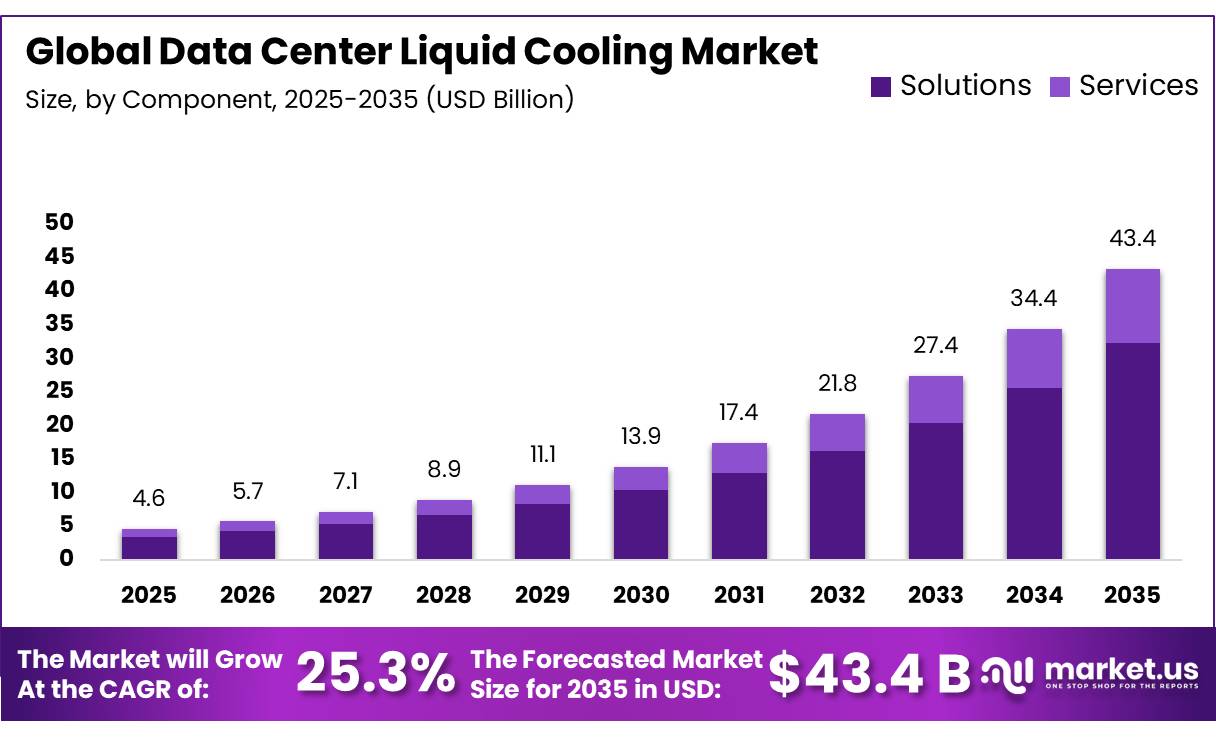
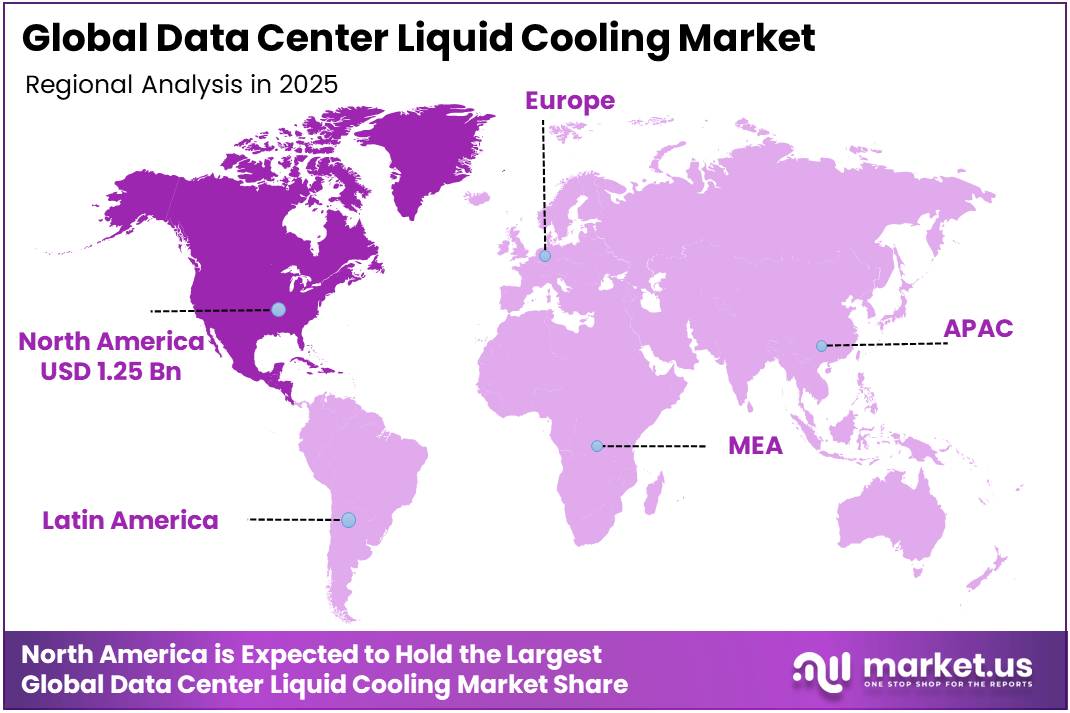
In 2025, the Global Data Center Liquid Cooling Market was valued at US$4.6 billion, and between 2026 and 2035, this market is estimated to register a CAGR of 25.3%, reaching about US$43.4 billion by 2035. In 2025, North America led the market, achieving over 27.2% share with a revenue of US$1.25 Billion.
Key Takeaways
- The Global Data Center Liquid Cooling Market was valued at US$4.6 billion in 2025.
- The market is projected to grow at a CAGR of 25.3% and is estimated to reach US$43.4 billion by 2035.
- On the basis of component, Solutions dominated the market, constituting 74.5% of the total market share.
- Based on the cooling type, Direct-to-Chip Cooling led the market, comprising 42.9% of the total market.
- On the basis of immersion cooling type, Single-Phase Immersion Cooling dominated the market, constituting 68.0% of the total market share.
- Based on the solution component, Coolant Distribution Units dominated the market, with a substantial market share of around 25.0%.
- Based on the application, High-Performance Computing dominated the market, with a substantial market share of around 27.0%.
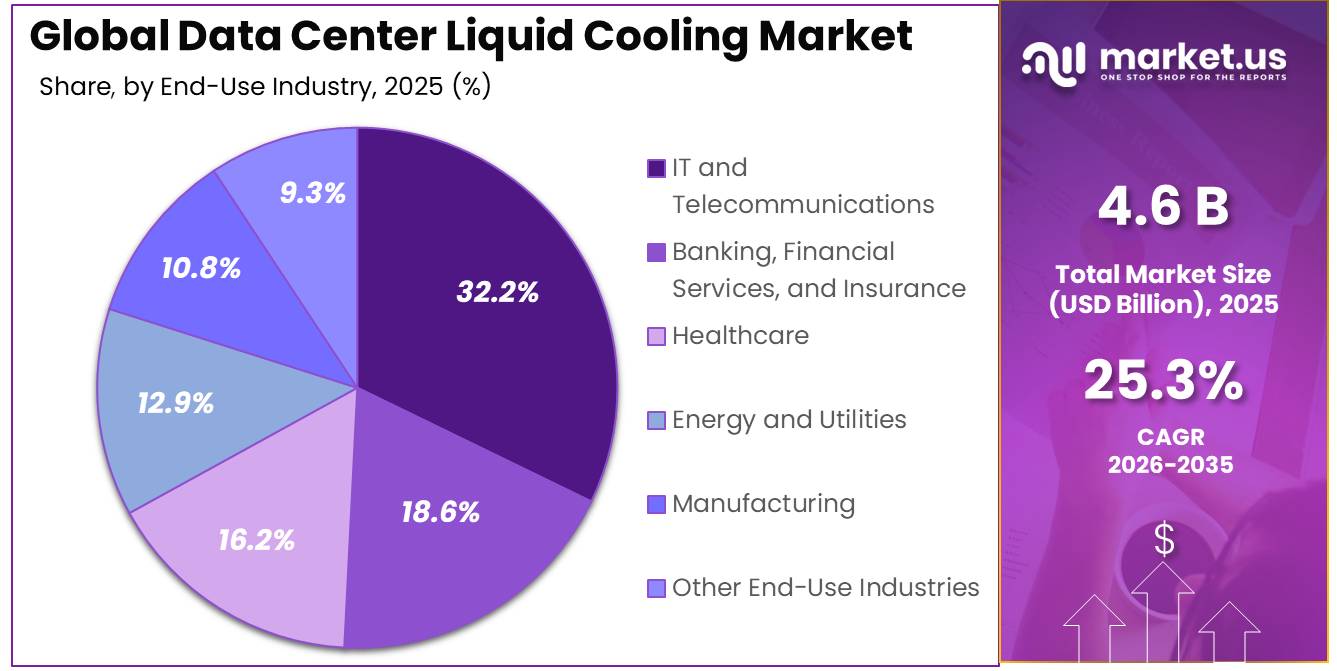
- Based on the end-use industry, IT and Telecommunications led the market, comprising 32.2% of the total market.
- In 2025, North America was the most dominant region in the market, accounting for 27.2% of the total global consumption.
Data center liquid cooling is becoming a critical thermal-management solution for artificial intelligence, high-performance computing, cloud platforms, and large-scale digital services. The technology transfers heat through liquids using direct-to-chip cold plates, coolant distribution units, rear-door heat exchangers, or immersion systems. It is increasingly replacing or supporting air cooling because modern processors generate concentrated heat that conventional airflow cannot remove efficiently. The International Energy Agency reported that global data-center electricity consumption reached approximately 485 TWh in 2025 and is projected to approach 950 TWh by 2030. Electricity use by AI-focused facilities is expected to triple during the same period, creating a strong industrial requirement for higher-capacity cooling infrastructure.
The current industrial scenario is shaped by rapid investment in accelerated computing. According to the IEA capital expenditure by five major technology companies exceeded USD 400 billion in 2025 and is expected to increase by a further 75% in 2026. Hardware design is also increasing cooling intensity. NVIDIA’s system contains 72 GPUs and 36 CPUs in one liquid-cooled rack. Such configurations encourage hyperscale operators, colocation providers, and enterprises to install direct liquid cooling at the server level rather than depend only on room-based air conditioning.
Energy efficiency, rack density, water management, and available floor space are major driving factors. In the United States, Lawrence Berkeley National Laboratory estimates that data centers could account for 11.8% of national electricity consumption by 2030, with scenarios ranging from 9.5% to 15.3%. These pressures support demand for efficient pumps, heat exchangers, dielectric fluids, sensors, monitoring controls, and modular coolant distribution units.
Future growth opportunities are expected in retrofit-ready direct-to-chip systems, single-phase and two-phase immersion cooling, warm-water cooling, waste-heat recovery, and prefabricated AI data centers. Vendors providing standardized, leak-resistant, fluid-compatible, and easily maintainable systems should benefit as operators seek higher computing output per rack, lower cooling energy consumption, and more flexible infrastructure deployment.
Component Analysis
Solutions Dominate the Component Segment with a 74.5% Share in 2025
In 2025, Solutions held a dominant market position, capturing more than a 74.5% share of the Data Center Liquid Cooling Market. The segment benefited from the increasing installation of coolant distribution units, cold plates, pumps, manifolds, heat exchangers, immersion tanks, leak-detection systems, and cooling control software. These solutions transfer heat closer to processors, helping facilities operate high-density computing equipment without depending entirely on room-level air cooling.
- In November 2025, the U.S. Department of Energy’s ARPA-E stated that its COOLERCHIPS program targets total cooling energy use of less than 5% of a typical data center’s IT load, highlighting the need for more efficient cooling equipment in high-density facilities.
Services is the fastest growing segment of the Data Center Liquid Cooling Market. Its expansion is supported by the technical complexity involved in designing, installing, commissioning, and maintaining liquid-cooled infrastructure. Data center operators increasingly require professional support for cooling-system design, fluid selection, equipment compatibility, pressure testing, leak prevention, performance monitoring, and the conversion of existing air-cooled facilities. In January 2026, the U.S. Department of Energy highlighted facility optimization support covering energy auditing, commissioning, and ISO 50001 Ready assistance.
Cooling Type Analysis
Direct-to-Chip Cooling leads with a 42.9% share as high-density computing requires efficient chip-level heat removal.
In 2025, Direct-to-Chip Cooling held a dominant market position, capturing more than a 42.9% share. The segment remained widely preferred because cold plates remove heat directly from processors and graphics chips, reducing dependence on energy-intensive server fans and room-level air conditioning. It also fits existing rack designs more easily than full-server immersion systems, supporting faster deployment across AI and high-performance computing facilities. In December 2025, Lawrence Berkeley National Laboratory reported that NERSC’s Perlmutter supercomputer and its Doudna system, scheduled for late 2026, use direct-to-chip liquid cooling combined with ambient air cooling. At the same facility, efficiency improvements reduced non-IT electricity consumption by 42%, saving more than 2 million kWh of electricity, half a million gallons of water and approximately USD 200,000 annually. These operating benefits strengthened the segment’s position in the market.
Immersion Cooling is the fastest-growing segment. In 2025, its adoption accelerated because servers can be placed directly inside electrically non-conductive fluids, allowing heat to be removed from processors, memory, power supplies and other components at the same time. This approach is gaining attention for extremely dense AI and high-performance computing environments where traditional airflow becomes difficult to manage. The technology can also reduce fan requirements, improve temperature consistency and support compact server configurations.
Immersion Cooling Type Analysis
Single-Phase Immersion Cooling Dominates with a 68.0% Share Due to Simpler Operation and Maintenance
In 2025, Single-Phase Immersion Cooling held a dominant market position, capturing more than a 68.0% share. Single-phase immersion cooling gained preference because servers are fully submerged in a non-conductive liquid that remains in its liquid state throughout the cooling process. The setup is comparatively simple, as it does not require fluid boiling, vapor management, or a condensation system. Easier installation, stable coolant behavior, lower maintenance complexity, and suitability for existing server hardware continue to support adoption across high-density data centers. In 2025, the U.S. Department of Energy’s ARPA-E highlighted single-phase immersion cooling as an important approach for managing megawatt-scale computing racks.
Two-Phase Immersion Cooling is the fastest growing segment. Its growth is supported by the increasing heat produced by artificial intelligence servers, accelerators, and high-performance computing systems. In this method, server components are submerged in a dielectric fluid that boils after absorbing heat. In 2025, Oak Ridge National Laboratory evaluated next-generation dielectric fluids for two-phase immersion systems under typical and off-design data center operating conditions.
Solution Component Analysis
Coolant Distribution Units dominate with a 25.0% share as high-density computing increases cooling needs.
In 2025, Coolant Distribution Units held a dominant market position, capturing more than a 25.0% share. These units remained a central part of direct liquid cooling systems because they control coolant circulation, maintain pressure and separate the facility water loop from sensitive server equipment. In March 2026, the U.S. Department of Energy’s Lawrence Berkeley National Laboratory reported the first U.S. deployment of Rittal’s in-row V3.5 coolant distribution unit at NERSC. The system supports a direct-liquid-cooled rack containing 72 NVIDIA Grace CPUs and 144 NVIDIA Blackwell GPUs. This installation shows how CDUs are becoming essential for managing heat in dense AI and high-performance computing environments.
Cold Plates are the fastest growing segment within the solution component category. Their growth is supported by the increasing use of powerful CPUs, GPUs and memory systems that generate concentrated heat loads which cannot always be managed efficiently through air cooling. Cold plates are attached directly to these components, allowing the circulating liquid to collect heat close to its source. In January 2025, the U.S. Department of Energy’s ARPA-E recorded an active data center cooling project using two-phase cold plates designed to achieve thermal resistance as low as 0.0025°C/W. This technical capability supports the wider installation of cold plates in AI servers, supercomputers and other high-density computing systems.
Application Analysis
High-Performance Computing leads the application segment with more than a 27.0% share
In 2025, High-Performance Computing held a dominant market position, capturing more than a 27.0% share. The segment remained the largest user of liquid cooling because supercomputers operate thousands of processors at high utilization levels, creating concentrated heat inside server racks. Liquid cooling helps HPC facilities maintain stable temperatures while supporting complex scientific modelling, national security simulations and engineering research. In November 2025, Lawrence Livermore National Laboratory reported that the liquid-cooled El Capitan supercomputer achieved 1.809 exaFLOPs. Its cooling infrastructure includes cooling towers, pumps, chillers, heat exchangers and more than 2,000 feet of pipes working together to handle rack densities reaching up to 400 kW.
Artificial Intelligence and Machine Learning is the fastest growing segment in the Data Center Liquid Cooling Market. The segment is expanding as data centers install more GPU-based servers for generative AI, model training, image processing and real-time analytics. In December 2025, Berkeley Lab stated that its Doudna supercomputer, scheduled for late 2026, would use direct-to-chip liquid cooling with ambient air cooling. This development reflects the growing use of liquid-based thermal systems for next-generation AI and scientific computing infrastructure.
End-Use Industry Analysis
IT and Telecommunications Leads with a 32.2% Share Due to Expanding Cloud and Network Workloads
In 2025, IT and Telecommunications held a dominant market position, capturing more than a 32.2% share of the Data Center Liquid Cooling Market. The segment’s leadership was supported by the expansion of mobile networks, cloud services, internet platforms and telecom data-processing infrastructure. In November 2025, Ofcom reported that UK mobile networks handled more than 1.2 billion gigabytes of data each month, representing an 18% increase from the previous year. Data carried through 5G networks also increased by 53% during the year. This rapid rise in network traffic requires telecom operators to deploy more high-density servers for network management, content delivery and real-time data processing.
Banking, Financial Services, and Insurance is the fastest growing segment in the Data Center Liquid Cooling Market. In 2025, banks, payment providers and insurance companies continued to expand digital banking, real-time transaction processing, fraud detection, risk modelling and artificial intelligence applications. These services require high-density computing systems that must operate continuously with minimal downtime. Liquid cooling is becoming more suitable for these facilities because it supports powerful servers while providing controlled and reliable heat removal.
Key Market Segments
By Component
- Solutions
- Services
By Cooling Type
- Direct-to-Chip Cooling
- Immersion Cooling
- Rear-Door Heat Exchangers
By Immersion Cooling Type
- Single-Phase Immersion Cooling
- Two-Phase Immersion Cooling
By Solution Component
- Coolant Distribution Units
- Cold Plates
- Heat Exchangers
- Pumps
- Piping and Manifolds
- Coolants and Dielectric Fluids
By Application
- High-Performance Computing
- Artificial Intelligence and Machine Learning
- Cloud Computing
- Cryptocurrency Mining
- Other Applications
By End-Use Industry
- IT and Telecommunications
- Banking, Financial Services, and Insurance
- Healthcare
- Energy and Utilities
- Manufacturing
- Other End-Use Industries
Driver Analysis
AI rack density forcing direct liquid cooling
The strongest 2026 demand driver is the rapid uplift in compute density associated with accelerated servers, because conventional air architectures struggle economically once facilities move into sustained high-density deployments. The U.S. DOE’s 2024 best-practice guide explicitly flags direct liquid cooling for high-density servers using GPUs and similar components, while NREL’s federal guidance highlights component-level liquid cooling in facilities operating racks above 60 kW and return-water temperatures of 35-40 degrees C that enable both thermal stability and downstream heat use. This matters commercially because liquid cooling is no longer an efficiency add-on; it is becoming an enabling infrastructure layer for premium AI capacity, shifting supplier revenue from room-level HVAC equipment toward cold plates, CDUs, manifolds, pumps, controls, leak detection, and service contracts.
The demand signal is reinforced by official electricity outlooks: EIA estimated server loads already represented 7% of U.S. commercial-sector electricity use in 2025, while IEA projected global data-centre, AI, and crypto electricity demand could exceed 800 TWh in 2026 in its base case, implying sustained pressure to remove more heat per rack with less parasitic power.
Drivers Impact Analysis
| Driver | (~) % Impact on CAGR Forecast | Geographic Relevance | Impact Timeline |
|---|---|---|---|
| AI rack density forcing direct liquid cooling | +3.2 pts | North America core, EU, APAC corridors | Short term (≤ 2 years) |
| Electricity intensity and cooling-energy reduction economics | +2.4 pts | North America core, EU, East Asia | Short term (≤ 2 years) |
| EU KPI reporting and efficiency compliance regime | +1.8 pts | EU core, UK spill-over, Nordics | Medium term (2-4 years) |
| Water-footprint pressure favoring low-WUE architectures | +1.6 pts | U.S. Southwest, Southern EU, Middle East, India spill-over | Medium term (2-4 years) |
| Hyperscale and colocation redesign toward high-density halls | +2.1 pts | U.S., Canada, Nordics, Japan, Singapore, India | Short term (≤ 2 years) |
| Waste-heat recovery and sustainability-linked siting economics | +1.2 pts | Nordics, Netherlands, Germany, France | Long term (≥ 4 years) |
Restraint Analysis
Metals and thermal hardware inflation
A second restraint is cost inflation in the metal-intensive thermal stack, because U.S. Bureau of Labor Statistics data show the producer price index annual average for metals and metal products rose from 329.525 in 2025 to 380.938 by May 2026, while iron and steel moved from a 2025 annual average of 314.440 to 357.108 by May 2026. That matters disproportionately for liquid cooling because cold plates, manifolds, CDU internals, microchannel heat exchangers, piping assemblies, valves, and rack-level distribution hardware are materially more exposed to copper, aluminum, stainless steel, and fabricated metal content than conventional air-only cooling architectures.
A realistic market model suggests that a 10% to 15% increase in these upstream metal inputs can translate into a 3% to 6% increase in finished liquid-cooling subsystem cost, and where contracts were signed on fixed-price terms, vendors absorb part of that inflation through 100 to 250 basis points of margin compression rather than fully passing it on immediately. The business consequence is slower conversion in colocation and enterprise segments with tighter payback hurdles, plus selective scope reduction in secondary geographies, supporting an estimated 1.4-point drag on 2026 CAGR across North America, Europe, and export-oriented APAC supply corridors.
Restraint Impact Analysis
| Restraint | (~) % Impact on CAGR Forecast | Geographic Relevance | Impact Timeline |
|---|---|---|---|
| Refrigerant transition compliance | -1.6% | North America core | Short term (≤ 2 years) |
| Metals and thermal hardware inflation | -1.4% | North America, EU, APAC corridors | Short term (≤ 2 years) |
| Grid and utility interconnection drag | -1.8% | North America core, EU | Medium term (2-4 years) |
| Large-project construction congestion | -1.2% | North America core, selective EU, APAC corridors | Short term (≤ 2 years) |
| Skilled installation and service shortage | -0.9% | North America, EU | Medium term (2-4 years) |
| Export-control and technology localization friction | -1.1% | APAC corridors, Middle East, emerging hubs | Medium term (2-4 years) |
Opportunity Analysis
Cooling-as-a-service
This is an untapped monetization model rather than a current driver because the market today is still sold primarily as equipment capex, yet many operators increasingly need thermal capacity on flexible commercial terms as AI hardware refresh cycles compress and power-density assumptions remain volatile. Government-backed evidence from Singapore shows server refresh cycles typically run every three to seven years and that software, hardware, and facility efficiency must be optimized jointly, which supports a shift from one-time product sales toward recurring thermal-capacity contracts tied to rack density, uptime SLA, energy savings, and water targets.
A cooling-as-a-service model can reduce customer upfront capex by 20% to 35%, pull adoption forward in uncertain demand environments, and lift supplier lifetime revenue through 10- to 15-year service tails that bundle CDUs, fluids, controls, maintenance, and performance guarantees; this is especially attractive where buyers hesitate to commit to full direct-to-chip architecture before workload mix stabilizes. Because the EU Code of Conduct and Singapore roadmap both emphasize operational best practice, monitoring, and efficiency verification, suppliers that can meter thermal performance and contract against PUE, WUE, or rack-density outcomes can convert engineering know-how into recurring ARR-like revenue, adding upside beyond baseline hardware shipment growth in North America, Europe, and developed APAC.
Opportunity Impact Analysis
| Opportunity | (~) % Potential CAGR Upside | Geographic Relevance | Execution Window |
|---|---|---|---|
| AI retrofit kits | +2.8% | North America core, EU, Singapore | Short term (≤ 2 years) |
| Edge liquid cooling | +1.9% | APAC emerging, EU, North America secondary metros | Medium term (2-4 years) |
| Cooling-as-a-service | +1.6% | North America, EU, developed APAC | Short term (≤ 2 years) |
| Water-lean architectures | +2.1% | Water-stressed U.S., EU, Singapore, Gulf | Medium term (2-4 years) |
| Grid-flex thermal storage | +1.4% | U.S. utility-constrained states, EU | Medium term (2-4 years) |
| M&A roll-up platforms | +1.7% | North America, EU, Japan, Singapore | Long term (≥ 4 years) |
Challenges Analysis
Grid & water stress coupling
The coupling of grid capacity constraints and rising water stress creates a structural friction for liquid-cooled data center build-outs, because liquid technologies shift a larger share of cooling load into electricity and, where indirect or hybrid systems are used, into local water networks that are already under pressure. In the United States, data centers account for roughly 2% of national electricity use and cooling can reach up to 40% of facility energy consumption, meaning that a high-density liquid-cooled site with 50–80 MW IT load can easily push total electrical draw to 70–120 MW once pumps, chillers and distribution are fully accounted for, and this level of demand often runs 15–25% above what legacy substation and transmission infrastructure was designed to host.
In parallel, large APAC metros such as Mumbai, Bengaluru, Delhi and Chennai are flagged in regional analyses as facing intensifying water stress, with municipal networks experiencing episodic deficits of hundreds of millions of liters per day, making it politically and operationally complex to allocate several hundred to over 1,000 cubic meters per day of cooling water to single campuses that are simultaneously ramping up AI workloads. This coupling typically adds 6–12 months to project lead times as operators renegotiate grid connections, invest in on‑site energy and redesign cooling schemes to reduce water usage, translating into a modelled friction drag of about 1.3 percentage points on achievable CAGR because 15–20% of planned capacity slips one or more years relative to demand curves.
Strategically, hyperscale and colocation providers are being forced to adopt multi‑site architectures with staggered capacity ramps, raise redundancy margins on electrical infrastructure by 20–30% above minimum thresholds, add dry or adiabatic options to reduce cooling water intensity below 0.4 L/kWh in water‑stressed regions, and deploy more aggressive load-shaping such as delaying non‑critical workloads during grid peaks to sustain growth without triggering community or regulator backlash.
Challenges Impact Analysis
| Challenge | (~) % CAGR Friction Drag | Geographic Relevance | Mitigation Horizon |
|---|---|---|---|
| Grid & water stress coupling | -1.3% | EU dense hubs, US metros, APAC Tier-1 | Long term (≥ 4 years) |
| Thermal regulations compression | -1.1% | EU regulatory hubs, UK, Nordics | Medium term (2-4 years) |
| Liquid cooling talent gap | -0.9% | North America core, EU cloud corridors | Long term (≥ 4 years) |
| Supply chain & tariff noise | -0.8% | North America, EU importers, ASEAN | Medium term (2-4 years) |
| Legacy retrofit complexity | -0.7% | Global brownfield clusters | Long term (≥ 4 years) |
| Metrology & reporting load | -0.6% | EU, UK, select APAC compliance hubs | Short term (≤ 2 years) |
Geopolitical Impact Analysis
Middle East War and Trade Disruption Reshape the Data Center Liquid Cooling Market
The Middle East war is raising costs across the data center liquid cooling market. Red Sea diversions send vessels around the Cape of Good Hope, adding weeks to deliveries for cold plates, pumps, heat exchangers, cooling distribution units and specialty fluids. Disruption in the Strait of Hormuz also pushed Brent oil to $118 per barrel in April 2026, raising freight, plastics, metals and factory energy costs. These conditions make imported cooling equipment more expensive and less predictable for data center builders.
However, market demand remains strong because AI servers generate far more heat than conventional computing systems. The IEA reported that data center electricity use increased about 17% in 2025 and could reach roughly 945 TWh by 2030. War-related energy insecurity is therefore encouraging operators to select efficient liquid cooling systems that reduce cooling power use and support higher rack densities. Buyers are also shifting toward regional suppliers, dual sourcing, larger spare-parts inventories and modular systems that can be installed quickly. At the same time, governments and cloud providers are expanding secure domestic data infrastructure, supporting new opportunities for local cooling manufacturers, maintenance companies and technology partners.
Regional Analysis
North America Dominates the Data Center Liquid Cooling Market.
In 2025, North America held the dominant position in the data center liquid cooling market, accounting for 27.2% of global revenue and USD 1.25 billion. Demand is supported by hyperscale cloud facilities, AI computing clusters, high-density racks, and infrastructure across the United States and Canada. In June 2026, Lawrence Berkeley National Laboratory estimated that data centers could account for 11.8% of total U.S. electricity consumption by 2030, with projected scenarios ranging from 9.5% to 15.3%. This rising power requirement is encouraging North American operators to adopt liquid cooling systems for AI servers and other high-density computing infrastructure.
Asia Pacific is expected to record the fastest growth as China, Japan, Singapore, Malaysia, South Korea, and Australia expand AI-ready data center capacity. Singapore operates more than 1.4 GW of data center capacity, and its government announced at least 200 MW of additional capacity in December 2025. These developments favor direct-to-chip and immersion cooling for high-density, space-constrained facilities.
Key Regions and Countries Covered
- North America
- The US
- Canada
- Europe
- Germany
- France
- The UK
- Spain
- Italy
- Russia and CIS
- Rest of Europe
- APAC
- China
- Japan
- South Korea
- India
- ASEAN
- Rest of APAC
- Latin America
- Brazil
- Mexico
- Rest of Latin America
- Middle East and Africa
- GCC
- South Africa
- Rest of MEA
Key Players Analysis
Green Revolution Cooling strengthens its role in immersion and direct liquid cooling through a broader product portfolio. In November 2025, it introduced the ReliaSys IR500 coolant distribution unit with 500 kW cooling capacity, followed by the 10U ICEraQ Nano delivering 13 kW for edge facilities. Earlier, Samsung Ventures joined its funding round, while Samsung C&T entered a strategic partnership.
Iceotope Technologies develops precision liquid cooling systems that protect processors, memory, storage, networking, and power components inside sealed server chassis. In May 2026, the company secured $26 million in Series B funding to accelerate engineering, partnerships, and product development. Its intellectual property portfolio reached 219 granted and pending patents, while its technology can reduce cooling energy use by up to 40% and water consumption by up to 96%.
Super Micro Computer expands its liquid cooling presence through integrated servers, racks, coolant distribution units, towers, software, and deployment services. In October 2025, it launched Data Center Building Block Solutions as a complete infrastructure business line. Its cold plates can remove up to 98% of system heat, in-rack CDUs support 250 kW, and in-row units reach 1.8 MW. The company states that its liquid cooling infrastructure can lower data center power consumption by up to 40% for dense AI workloads.
Modine Manufacturing is expanding its data center cooling business through the Airedale by Modine portfolio. In March 2025, it widened coolant distribution unit capacities from 400 kW to 2 MW for direct-to-chip and hybrid cooling projects. The company later announced a $100 million expansion program and opened a 155,000-square-foot Wisconsin facility. For fiscal 2026, Modine reported record net sales of $3.2 billion, supported partly by strong data center demand and rising production capacity across growing North American and European operations.
The Major Players in The Industry
- Vertiv Group Corp.
- Schneider Electric SE
- CoolIT Systems Inc.
- LiquidStack Holding B.V.
- Submer Technologies
- Green Revolution Cooling Inc. (GRC)
- Asetek Inc.
- Rittal GmbH & Co. KG
- STULZ GmbH
- DCX Liquid Cooling Systems
- Iceotope Technologies Ltd.
- Asperitas
- Super Micro Computer Inc.
- Modine Manufacturing Company
Key Development
- In November 2025, Vertiv agreed to acquire PurgeRite for approximately $1.0 billion in cash, with up to $250 million in additional payments linked to 2026 performance. The transaction was completed in December 2025, adding specialist flushing, filtration, and fluid-management services.
- In February 2025, Schneider Electric SE completed the purchase of a 75% controlling stake in Motivair, adding more than 15 years of specialized experience in coolant distribution units, cold plates, rear-door heat exchangers, and high-capacity chillers; the remaining 25% stake is expected to be acquired by 2028.
Report Scope
| Report Features | Description |
|---|---|
| Market Value (2025) | US$4.6 Bn |
| Forecast Revenue (2035) | US$43.4 Bn |
| CAGR (2026-2035) | 25.3% |
| Base Year for Estimation | 2025 |
| Historic Period | 2020-2024 |
| Forecast Period | 2026-2035 |
| Report Coverage | Revenue Forecast, Market Dynamics, Competitive Landscape, Recent Developments |
| Segments Covered | By Component (Solutions and Services), By Solution Component (Coolant Distribution Units, Cold Plates, Heat Exchangers, Pumps, Piping and Manifolds, and Coolants and Dielectric Fluids), By Cooling Type (Direct-to-Chip Cooling, Immersion Cooling, and Rear-Door Heat Exchangers), By Immersion Cooling Type (Single-Phase Immersion Cooling and Two-Phase Immersion Cooling), By Application (High-Performance Computing, Artificial Intelligence and Machine Learning, Cloud Computing, Cryptocurrency Mining, and Other Applications), By End-Use Industry (IT and Telecommunications, Banking, Financial Services, and Insurance, Healthcare, Energy and Utilities, Manufacturing, and Other End-Use Industries) |
| Regional Analysis | North America – The US and Canada; Europe – Germany, France, The UK, Spain, Italy, Russia and CIS, Rest of Europe; APAC– China, Japan, South Korea, India, ASEAN and Rest of APAC; Latin America– Brazil, Mexico and Rest of Latin America; Middle East and Africa– GCC, South Africa, and Rest of MEA |
| Competitive Landscape | Vertiv Group Corp., Schneider Electric SE, CoolIT Systems Inc., LiquidStack Holding B.V., Submer Technologies, Green Revolution Cooling Inc. (GRC), Asetek Inc., Rittal GmbH & Co. KG, STULZ GmbH, DCX Liquid Cooling Systems, Iceotope Technologies Ltd., Asperitas, Super Micro Computer Inc., Modine Manufacturing Company |
| Customization Scope | Customization for segments, region/country-level will be provided. Moreover, additional customization can be done based on the requirements. |
| Purchase Options | We have three licenses to opt for: Single User License, Multi-User License (Up to 5 Users), Corporate Use License (Unlimited Users and Printable PDF) |