Report Overview
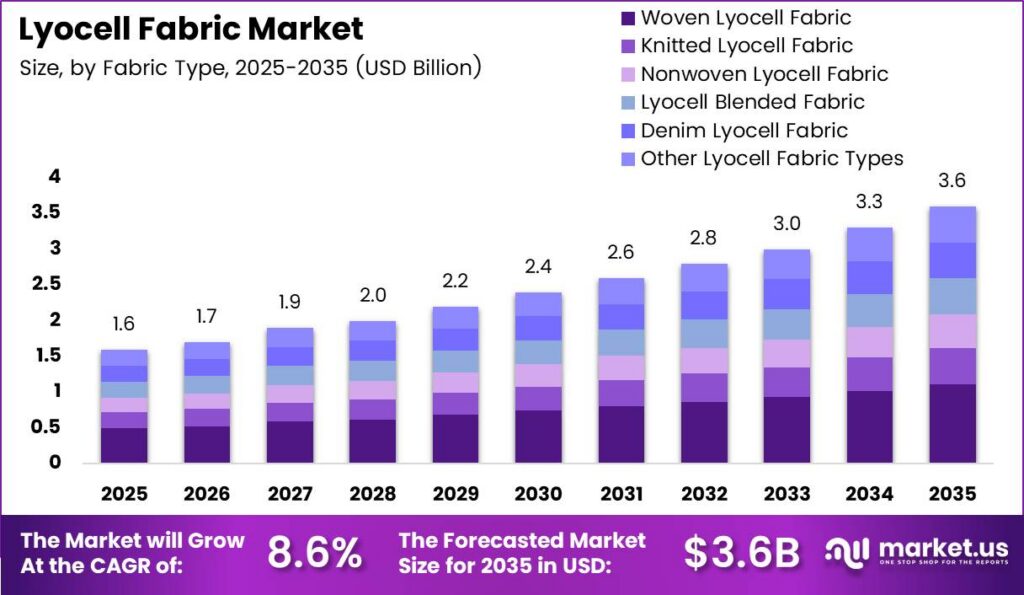
Global Lyocell Fabric Market size is expected to be worth around USD 3.6 Billion by 2035 from USD 1.6 Billion in 2025, growing at a CAGR of 8.6% during the forecast period 2026 to 2035. Lyocell fabric is a regenerated cellulosic textile produced by dissolving wood or plant pulp in an organic amine oxide solvent to regulate moisture and resist tearing.
The global cellulosic textile supply chain connects dissolving pulp mills with high-speed spinning plants and garment finishers across apparel, home bedding, and medical hygiene sectors. According to UNCTAD, global trade in man-made fibers reached USD 15.7 Billion in 2025, accounting for 41.6% of raw fiber trade and 70% of global fabric trade value. Therefore, fabric weavers are reallocating loom capacity away from water-intensive cotton toward closed-loop cellulosic textiles to capture higher export margins.
Key Takeaways
- The global Lyocell Fabric Market was valued at USD 1.6 Billion in 2025.
- Global market revenue will reach USD 3.6 Billion by 2035.
- The market expands at a compound annual growth rate (CAGR) of 8.6% during the forecast period 2026 to 2035.
- Under Fabric Type, Woven Lyocell Fabric led the market with a 31.00% share in 2025.
- By Fiber Form, Staple Fiber Lyocell captured the largest share at 65.00% in 2025.
- Within Raw Material Source, Wood Pulp-Based Lyocell held a dominant 68.00% share in 2025.
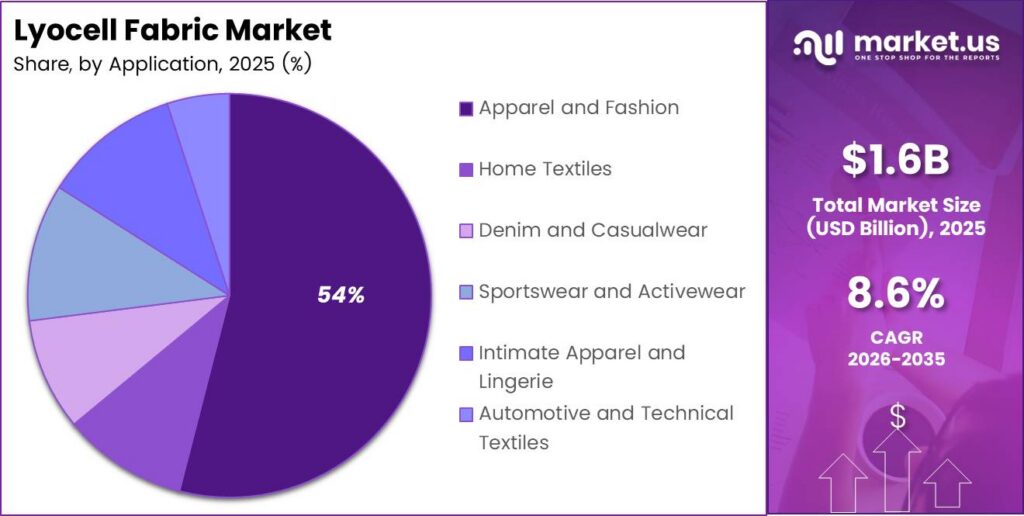
- By Application, Apparel and Fashion accounted for the leading share of 54.00% in 2025.
- Under End User, Textile and Apparel Manufacturers represented the top segment with a 48.00% share in 2025.
- By Distribution Channel, Direct Sales commanded a 46.00% share of total sales in 2025.
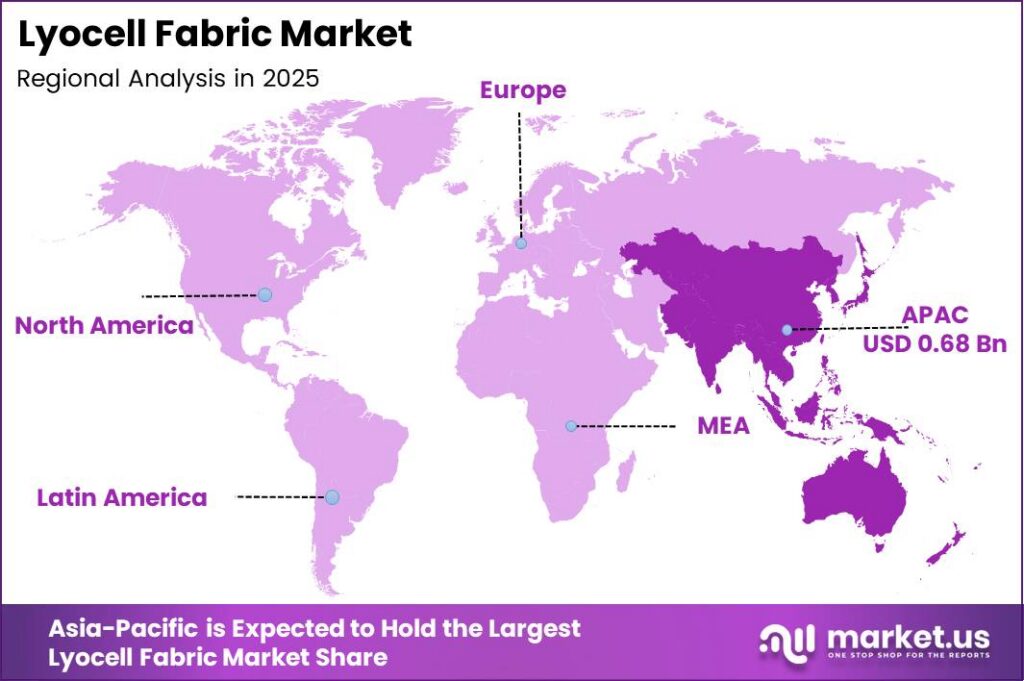
- Asia-Pacific dominated regional revenue in 2025, holding a 43.00% share valued at USD 0.68 Billion.
International forestry regulations and zero-deforestation trade laws strictly govern raw material sourcing for cellulosic fabric mills. As reported by the Food and Agriculture Organization (FAO), global exports of wood and paper products rose by 1.4% to reach USD 486 Billion in 2024, with primary wood and pulp products generating USD 268 Billion . Consequently, textile manufacturers must lock in certified wood pulp supply contracts early to avoid customs delays and carbon border penalties.
Major fiber producers are upgrading legacy European plants to meet strict medical and hygiene product standards. In November 2025, Austrian cellulosic producer Lenzing AG invested EUR 15 Million at its domestic manufacturing site to expand specialty hygiene fiber capacity under a broader EUR 100 Million modernization program running through 2027. This signals that upstream producers are prioritizing high-margin nonwoven and medical fabric grades over commodity staple lines to protect plant profitability.
Asia-Pacific dominates the global industry with a 43.00% market share valued at USD 0.68 Billion in 2025. Data from the World Trade Organization (WTO) shows that global merchandise apparel exports reached USD 557.50 Billion in 2024, with China capturing a 29.64% share valued at USD 165.24 Billion . Because Asian spinning and weaving hubs control downstream garment assembly, regional fabric mills secure lower logistics costs and faster order turnaround for global fashion buyers.
North American production facilities are simultaneously modernizing their energy systems to lower carbon intensity for domestic apparel brands. In March 2026, Lenzing AG completed a EUR 12 Million gas boiler replacement at its 51,000-ton Mobile, Alabama lyocell plant, cutting Scope 1 greenhouse gas emissions by 8,000 metric tons per year. As a result, western garment brands can source low-carbon lyocell greige fabrics regionally while meeting strict corporate emissions targets.
Fabric Type Analysis
Woven Lyocell Fabric dominates with 31.00% share in 2025 due to high wet tensile strength in apparel.
In 2025, Woven Lyocell Fabric held a 31.00% share in the Fabric Type segment of the Lyocell Fabric Market. The Office of Textiles and Apparel (OTEXA) found that U.S. textile and apparel imports rose by 15.23% to reach 106,636.79 Million square meter equivalents in 2024, while fabric imports climbed 16.2% in June 2025 . High crystalline fiber orientation prevents warp yarn breakage on high-speed air-jet looms during bulk weaving. Therefore, commercial weavers can run faster loom speeds with fewer fabric defects.
Knitted Lyocell Fabric provides high elasticity, breathability, and thermal comfort for next-to-skin activewear and circular jersey garments. Based on Eurostat data, European Union clothing production rebounded by 6.3% quarter-on-quarter and sector sales grew by 2.7% in Q4 2024 across 200,000 operating enterprises employing 1.3 Million workers . Low surface friction and high moisture regain allow circular knitting machines to form smooth loops without static buildup. Consequently, European knitters are expanding lyocell jersey lines to capture premium loungewear orders.
Nonwoven Lyocell Fabric serves as a biodegradable, plastic-free substrate for wet wipes, medical dressings, and personal hygiene products. Figures from Lenzing AG Annual Report show that its Fiber Division generated EUR 1.9 Billion in 2025 across 904,000 metric tons of volume, with 36% derived from nonwoven applications and 64% from textiles . Hydroentanglement water jets split lyocell fibers into fine micro-fibrils that lock webs together without synthetic chemical binders. This means hygiene converters can eliminate polyester plastics and meet strict single-use plastics bans.
Fiber Form Analysis
Staple Fiber Lyocell dominates with 65.00% share in 2025 due to compatibility with cotton ring-spinning lines.
In 2025, Staple Fiber Lyocell held a 65.00% share in the Fiber Form segment of the Lyocell Fabric Market. According to UN Comtrade, India’s imports of artificial staple fibers excluding viscose under HS Code 5504.90 rose by 180.78% year-on-year to reach USD 73.72 Million between September 2025 and August 2026 . Uniform crimp and cut lengths of 38 millimeters allow spinning mills to blend staple lyocell directly on existing cotton ring-spinning machinery. Therefore, spinning mills can upgrade yarn portfolios without buying new spinning frames.
Filament Lyocell delivers continuous, smooth yarns that replace silk and polyester filaments in luxury womenswear and technical linings. As reported by Acegreen Eco-Material Technology Corporate Filing, the company operates a filament plant in Changhua County, Taiwan producing 1,500 metric tons per year, while Lenzing AG launched the EU CELLFIL project 101135042 in March 2025 backed by a 320,000-ton Austrian base . Continuous spinneret extrusion eliminates protruding fiber ends, preventing fabric pilling and increasing tenacity. Consequently, luxury weavers can price filament lyocell fabrics at silk-tier margins.
Microfiber Lyocell features ultra-fine linear density below 1.0 decitex for lightweight shirts, fine drapes, and bacteriostatic medical textiles. Data from WIPO shows that global patent filings hit 3.7 Million in 2024, rising 4.9%, with textiles representing 16.7% of industrial designs, while Weiqiao Textile achieved 99.8% solvent recovery across 6 Million spindles and 720,000 tons of yarn capacity to launch 500-count lyocell fabrics in April 2025 . Finer fiber cross-sections pack more filaments per yarn cross-section, increasing capillary moisture wicking. This creates higher margin opportunities for high-count shirting mills.
Raw Material Source Analysis
Wood Pulp-Based Lyocell dominates with 68.00% share in 2025 due to consistent alpha-cellulose purity levels.
In 2025, Wood Pulp-Based Lyocell held a 68.00% share in the Raw Material Source segment of the Lyocell Fabric Market. The Food and Agriculture Organization (FAO) indicates that global wood pulp production reached 193 Million metric tons in 2023, while international wood pulp trade grew by 3% to hit a record 71 Million metric tons . Dissolving wood pulp offers alpha-cellulose purity above 92%, which prevents spinneret clogging and thermal degradation inside amine oxide dissolving reactors. Therefore, fabric mills rely on wood-derived grades for consistent dye uptake and uniform tensile strength.
Bamboo Pulp-Based Lyocell offers a fast-growing, non-wood cellulosic alternative for Asian textile mills seeking local raw material security. Based on Food and Agriculture Organization (FAO) data, global pulp production from non-wood fibers stood at 10 Million metric tons in 2024 with exports of 0.3 Million metric tons, while Baoding Swan Fiber invested RMB 2.5 Billion in June 2024 to scale its Shunping lyocell plant to 60,000 tons per year . Bamboo culms mature in 3 years and yield porous cellulose chains that retain natural bacteriostatic properties after solvent spinning. Consequently, regional mills can lower imported wood pulp exposure.
Eucalyptus Pulp-Based Lyocell utilizes short-fiber plantation timber to maximize cellulose yield per hectare with minimal irrigation or chemical bleaching. Figures from the Food and Agriculture Organization (FAO) show that eucalyptus plantation wood pulp accounts for 50% of all internationally traded short-fiber pulp, with over 95% of tropical pulp sourced from managed plantations . Short, uniform hemicellulose chains in eucalyptus wood dissolve rapidly in organic solvents at lower processing temperatures. This means fiber spinners can cut thermal energy expenses by sourcing plantation eucalyptus pulp.
Application Analysis
Apparel and Fashion dominates with 54.00% share in 2025 due to breathability and soft drape characteristics.
In 2025, Apparel and Fashion held a 54.00% share in the Application segment of the Lyocell Fabric Market. According to the Office of Textiles and Apparel (OTEXA), the average U.S. import unit price for man-made fiber apparel increased by 2.4% to USD 2.58 per square meter equivalent in 2025 compared to USD 3.59 for cotton, capturing 56.6% of import volume . Sub-micron pore structures inside lyocell fibers absorb 50% more moisture vapor than cotton while costing less to dye. Therefore, fashion brands blend lyocell into mass-market garments to control unit production costs.
Home Textiles incorporate high-thread-count lyocell sateen and twill weaves into luxury bed sheets, duvet covers, and mattress ticking. As reported by the U.S. Census Bureau, unadjusted U.S. retail trade sales for furniture and home furnishings stores climbed to USD 36,118 Million in Q4 2025, up from USD 34,379 Million in Q4 2024 . Smooth cylindrical fiber surfaces reduce skin friction and dissipate body heat faster than polyester or cotton bedding during sleep. Consequently, bedding manufacturers use lyocell fabrics to justify premium retail price points in department stores.
Denim and Casualwear manufacturers use lyocell warp and weft yarns to replace rigid cotton in soft, low-water-footprint jeans. In October 2026, Lenzing AG and Japanese denim mill Kaihara Corporation launched the REMOD Collection at Kingpins Amsterdam using dtex 2.2 fibers with 51-millimeter staple length, expanding their HV100 denim network to 50 mills across 13 countries . Controlled fiber swelling during indigo dyeing allows mills to achieve vintage denim fade effects without pumice stone washing. This allows casualwear brands to cut finishing water usage and chemical costs.
End User Analysis
Textile and Apparel Manufacturers dominates with 48.00% share in 2025 due to bulk greige fabric integration.
In 2025, Textile and Apparel Manufacturers held a 48.00% share in the End User segment of the Lyocell Fabric Market. Data from the International Labour Organization (ILO) shows that manufacturing supply chains support 467 Million jobs across 15 economies in the Asia-Pacific region, generating over 70% of global textile and garment exports . High dry and wet breaking tenacity allows garment factories to run automated laser cutting and high-speed overlock sewing without seam puckering. Therefore, contract apparel makers prioritize lyocell blends to minimize garment rejection rates.
Home Furnishing Manufacturers convert wide-width lyocell fabrics into upholstery coverings, curtains, and antimicrobial bedding sets for residential and hospitality buyers. Eurostat found that micro, small, and medium-sized enterprises represent 99.7% of all European Union textile manufacturers, operating below 80% factory capacity utilization due to elevated industrial energy prices . Because lyocell fibers absorb reactive dyes at lower bath temperatures than cotton, finishing mills consume less steam and natural gas per meter. Consequently, European furnishing producers adopt lyocell to protect operating margins against energy price spikes.
Healthcare and Hygiene Product Manufacturers alongside Retail and Fashion Brands procure certified cellulosic fabrics for medical dressings and branded apparel collections. Based on U.S. Census Bureau data, U.S. clothing store retail sales hit USD 75,904 Million in Q4 2025 with inventories of USD 10,323.86 Million, while OICA reported that global vehicle production rose 3.9% to 96.4 Million units in 2025 . High liquid absorption and zero chemical residues make non-linting lyocell gauze safe for surgical exudate management and interior linings. This enables suppliers to diversify revenue across medical and retail contracts.
Distribution Channel Analysis
Direct Sales dominates with 46.00% share in 2025 due to multi-year mill offtake agreements.
In 2025, Direct Sales held a 46.00% share in the Distribution Channel segment of the Lyocell Fabric Market. The World Trade Organization (WTO) indicates that South-South merchandise exports reached USD 7.2 Trillion in 2025, capturing 27.8% of total global merchandise exports compared to 14.3% two decades earlier . Integrated fiber and fabric mills use direct contracting to guarantee exact shade lot consistency, custom fibrillation treatments, and blockchain pulp traceability for major garment buyers. Therefore, direct producer-to-brand supply contracts eliminate middleman markups and secure predictable mill utilization.
Textile Distributors and Wholesalers aggregate fragmented greige and dyed fabric orders for small garment studios and regional upholstery workshops. Figures from UN Comtrade show that Canada accounted for 3.44% of total global exports of retail artificial staple fiber yarn in 2024, ranking as the 4th largest exporter worldwide . Regional wholesalers hold buffer stock of standard twill, poplin, and jersey lyocell fabrics to absorb 60-day maritime shipping lead times from Asian spinning mills. Consequently, mid-sized apparel labels rely on wholesale distributors to fulfill rapid in-season reorders.
Fabric Agents and Traders alongside Online Business-to-Business Platforms connect overseas weaving mills with international apparel sourcing teams through digital catalogs. According to the U.S. Census Bureau, total U.S. quarterly e-commerce sales reached USD 365,160 Million in Q4 2025 out of USD 1,999,440 Million in total retail trade, rising from USD 345,872 Million in Q4 2024 . Digital B2B sourcing portals automate fabric weight verification, digital swatch rendering, and customs documentation for cross-border spot buyers. This reduces sampling costs and shortens procurement cycles for independent fashion brands.
Key Market Segments
By Fabric Type
- Woven Lyocell Fabric
- Knitted Lyocell Fabric
- Nonwoven Lyocell Fabric
- Lyocell Blended Fabric
- Denim Lyocell Fabric
- Other Lyocell Fabric Types
By Fiber Form
- Staple Fiber Lyocell
- Filament Lyocell
- Microfiber Lyocell
- Other Fiber Forms
By Raw Material Source
- Wood Pulp-Based Lyocell
- Bamboo Pulp-Based Lyocell
- Eucalyptus Pulp-Based Lyocell
- Other Cellulosic Pulp-Based Lyocell
By Application
- Apparel and Fashion
- Home Textiles
- Denim and Casualwear
- Sportswear and Activewear
- Intimate Apparel and Lingerie
- Automotive and Technical Textiles
- Other Applications
By End User
- Textile and Apparel Manufacturers
- Home Furnishing Manufacturers
- Healthcare and Hygiene Product Manufacturers
- Automotive Manufacturers
- Retail and Fashion Brands
- Other End Users
By Distribution Channel
- Direct Sales
- Textile Distributors and Wholesalers
- Fabric Agents and Traders
- Online Business-to-Business Platforms
- Other Distribution Channels
Regional Analysis
Asia-Pacific Dominates the Lyocell Fabric Market with a Market Share of 43.00% in 2025, Valued at USD 0.68 Billion
In 2025, Asia-Pacific captured a 43.00% share of the global Lyocell Fabric Market, generating USD 0.68 Billion in revenue. As reported by the Office of Textiles and Apparel (OTEXA), Asian suppliers accounted for 73.6% of total U.S. man-made fiber apparel imports by value in 2025, while U.S. textile and apparel imports from India jumped 59.1% year-on-year to reach 15.52 Billion square meter equivalents . Vertically integrated spinning Parks in China and India co-locate pulp dissolving, solvent recovery, and high-speed weaving, slashing domestic fabric conversion costs for export garment factories.
Europe and North America represent high-value markets driven by eco-design mandates, patent licensing, and technical textile innovation. Data from the World Intellectual Property Organization (WIPO) shows that while Asian offices received 2.6 Million patent applications or 70.1% of the world total in 2024 led by China with 1.8 Million filings up 9%, European and North American innovators hold core solvent-spinning and cross-linking patents . Therefore, Western specialty mills focus on patented filament yarns, medical nonwovens, and circular recycled pulp licensing rather than competing on bulk commodity fabric volume.
Key Regions and Countries
North America
- US
- Canada
Europe
- Germany
- France
- The UK
- Spain
- Italy
- Rest of Europe
Asia Pacific
- China
- Japan
- South Korea
- India
- Australia
- Rest of APAC
Latin America
- Brazil
- Mexico
- Rest of Latin America
Middle East and Africa
- GCC
- South Africa
- Rest of MEA
Market Dynamics
Global macroeconomic shifts and regional trade realignments directly shape capacity utilization and pricing power across the cellulosic textile value chain. The Organisation for Economic Co-operation and Development (OECD) found that global GDP growth will moderate from 3.4% in 2025 to 2.8% in 2026 before reaching 3.1% in 2027, while export volumes in China and dynamic Asian economies will expand by over 6.5% in 2026 . Consequently, fabric producers are concentrating capital expenditure in low-cost Asian manufacturing hubs while targeting compliance-driven European retail brands to preserve operating margins.
Drivers
The European Union Ecodesign for Sustainable Products Regulation enacted in July 2024 and the Waste Framework Directive finalized in 2025 have reshaped textile procurement. Fashion retailers face Extended Producer Responsibility fees of 4% to 12% on conventional viscose and virgin polyester blends. Consequently, brands are switching to closed-loop lyocell fabrics that feature a 99.5% amine oxide solvent recovery rate and 50% lower carbon emissions, protecting retail profit margins from environmental penalties.
Between 2024 and 2026, tier-1 apparel brands shifted from spot greige purchasing to 36-month volume offtake agreements with integrated fiber spinners to secure Digital Product Passport compliance ahead of 2027 rules. This shift cut customer acquisition costs for certified mills by 18%, raised lyocell blend ratios in woven lines from 15% in 2024 to 35% in 2026, and lifted mill capacity utilization by 14%. Therefore, certified fabric weavers gain predictable multi-year cash flows.
| Driver | (~) % Impact on CAGR Forecast | Geographic Relevance | Impact Timeline |
|---|---|---|---|
| Mandatory Textile Eco-Design & EPR Compliance | +2.6% | Europe, North America | Short term (≤ 2 years) |
| Closed-Loop NMMO Solvent Recovery Economics | +1.9% | Global | Medium term (2–4 years) |
| Athleisure Moisture-Management Blending Shift | +1.6% | North America, Asia-Pacific | Short term (≤ 2 years) |
| Luxury Home Bedding Cotton Substitution | +1.3% | Global | Medium term (2–4 years) |
| Zero-Deforestation Pulp Traceability Mandates | +1.1% | Europe, Asia-Pacific | Long term (≥ 4 years) |
Restraints
Building a commercial lyocell fiber and fabric line requires explosion-proof pressure vessels, thin-film evaporators, and automated solvent recovery circuits that cost 2.4 times more per ton of capacity than viscose or polyester plants. With industrial borrowing rates between 5.2% and 6.8% through 2025 and 2026, the internal rate of return hurdle for a 100,000-ton greenfield plant rose by 320 basis points, stretching payback periods from 6.5 years to over 9.5 years.
As a result, mid-tier textile groups in India, Turkey, and Southeast Asia froze or delayed 28% of planned capacity expansions scheduled between 2025 and 2027. Persistent staple fiber supply bottlenecks compressed gross operating margins for non-integrated fabric weavers by 350 to 480 basis points. Furthermore, reliance on toll-manufacturing arrangements added 11% to landed fabric unit costs, restricting smaller weaving mills from competing on price in mass-market apparel segments.
| Restraint | (~) % Impact on CAGR Forecast | Geographic Relevance | Impact Timeline |
|---|---|---|---|
| Greenfield NMMO Spinning Plant CapEx Intensity | -1.8% | Global | Medium term (2–4 years) |
| Dissolving Wood Pulp Tariff & Supply Concentration | -1.4% | Asia-Pacific, North America | Short term (≤ 2 years) |
| Wholesale Unit Price Premium Over Viscose | -1.1% | Global | Short term (≤ 2 years) |
| Proprietary Cross-Linking Patent Licensing Barriers | -0.7% | Asia-Pacific, Europe | Long term (≥ 4 years) |
| Stringent Thermal Runaway Safety Permitting | -0.5% | Europe, North America | Medium term (2–4 years) |
Challenges
Standard lyocell fibers possess high crystalline alignment along the fiber axis with weak lateral hydrogen bonds, causing surface fibrillation, pilling, and frosting defects during jet dyeing and washing. Controlling this physical defect forces dyehouses to run multi-stage cellulase enzyme baths and reactive resin treatments. These extra steps extend wet-processing batch times by 22% to 30%, raise auxiliary chemical costs by 16% per linear meter, and cause a 6.5% shade rejection rate versus 2.1% for combed cotton.
Overcoming this technical bottleneck requires textile finishing mills to retrofit legacy overflow dyeing machines with low-liquor-ratio aerodynamic airflow systems at a 19% capital cost increase per dyeing line. In addition, mills must retrain wet-processing technicians across a 14-month qualification period. Consequently, onboarding tier-2 commission dyehouses in Bangladesh and Vietnam takes 8 to 12 months longer, slowing downstream fabric supply expansion for global garment exporters.
| Challenge | (~) % CAGR Friction Drag | Geographic Relevance | Mitigation Horizon |
|---|---|---|---|
| Wet Processing Fibrillation Control Complexity | -1.5% | Global | Medium term (2–4 years) |
| Dissolving Pulp Alpha-Cellulose Purity Variance | -1.1% | Asia-Pacific, South America | Short term (≤ 2 years) |
| Natural Gas & Steam Drying Volatility | -0.9% | Europe, Asia-Pacific | Short term (≤ 2 years) |
| Cellulose Polymer Chemical Engineering Shortage | -0.6% | Global | Long term (≥ 4 years) |
| Multi-Component Blend Post-Consumer Sorting Friction | -0.4% | Europe, North America | Long term (≥ 4 years) |
Opportunities
While baseline production relies on virgin wood dissolving pulp, commercializing lyocell fabrics made with 30% to 50% chemically recycled post-consumer cotton waste represents untapped white space accounting for under 3% of output in 2026. Scaling automated elastane-stripping and alkaline depolymerization lines lets producers convert garment rag waste into high-purity pulp. Therefore, early movers can capture premium circular fashion brands willing to pay a 15% to 24% wholesale price premium per square meter toward 2030 circularity targets.
Forming joint ventures between chemical textile recyclers and lyocell spinners to standardize recycled pulp viscosity can cut virgin wood pulp reliance by 35%. Once post-consumer collection sorting scales past the 50,000-ton operational threshold, raw material unit cost volatility drops by 19%. Consequently, fabric mills commercializing circular lyocell lines can expand EBITDA margins by 450 to 600 basis points above standard virgin lyocell fabrics.
| Opportunity | (~) % Potential CAGR Upside | Geographic Relevance | Execution Window |
|---|---|---|---|
| Post-Consumer Cotton Waste Pulp Feedstock | +2.2% | Europe, North America, Asia-Pacific | Medium term (2–4 years) |
| Plastic-Free Flushable Nonwoven Wet Wipes | +1.8% | Europe, North America | Short term (≤ 2 years) |
| Automotive Interior Bio-Composite Acoustic Fabrics | +1.3% | Europe, Asia-Pacific, North America | Long term (≥ 4 years) |
| Microbial & Agricultural Residue Cellulose Sourcing | +1.0% | Asia-Pacific, South America | Long term (≥ 4 years) |
| Medical Hydrogel & Exudate Wound Dressings | +0.8% | Global | Medium term (2–4 years) |
Key Company Insights
Lenzing AG
Lenzing AG leads the global specialty cellulosic fiber industry through its TENCEL textile and VEOCEL nonwoven brands across manufacturing plants in Austria, the United States, the United Kingdom, and Thailand. Based on Lenzing AG Annual Report data, the company generated consolidated revenue of EUR 2,602.4 Million and adjusted EBITDA of EUR 425.6 Million up 7.6% with a 15.9% EBITDA margin in 2025, operating 1,110,000 metric tons of fiber capacity with 7,738 employees. High backward integration into dissolving wood pulp shields its margins from raw material inflation.
Lenzing AG actively expands its high-margin performance fabric portfolio through co-development partnerships with downstream biomaterial innovators. According to Lenzing AG Annual and Sustainability Report, in March 2026 the company partnered with Swiss technology firm OceanSafe to commercialize a plastic-free performance yarn blending TENCEL Lyocell A100 staple fibers with biodegradable co-polyester, backed by 420,000 metric tons of greenhouse gas reductions across 7 renewable-powered mills. This enables Lenzing to capture market share from synthetic polyester in sportswear and home textiles.
Sateri Holdings Limited / The Lyocell Company
Sateri Holdings Limited is the world’s largest producer of regenerated cellulosic fibers, supplying staple lyocell and viscose to spinning and weaving mills across Asia-Pacific, Europe, and the Americas. Figures from the Shanghai Municipal Government Information Office and Sateri Corporate Report show that Sateri operates 15 cellulosic fiber mills in China exceeding 2.0 Million metric tons of annual capacity, driving China’s 49% jump in lyocell exports to 108,000 metric tons during the first 11 months of 2025 . Massive scale allows Sateri to price lyocell competitively against cotton.
Sateri is restructuring its corporate architecture to accelerate dedicated capital deployment into solvent-spun cellulosic fabrics. As reported by the Shanghai Municipal Government Information Office and Sateri Official Release, in August 2026 Sateri spun off its lyocell division into a standalone entity named The Lyocell Company while scaling its Jining, Shandong manufacturing base toward 600,000 metric tons of annual lyocell capacity . Operating an independent lyocell subsidiary allows the company to attract green financing and dominate bulk Asian greige fabric supply.
Key Players
- Lenzing AG
- Sateri Holdings Limited / The Lyocell Company
- Grasim Industries Ltd. / Birla Cellulose
- Acegreen Eco-Material Technology Co., Ltd.
- Baoding Swan Fiber Co., Ltd.
- Smartfiber AG
- Nien Foun Fiber Co., Ltd.
- China Populus Textile Ltd.
- Weiqiao Textile Company Limited
- Qingdao Textiles Group Fiber Technology Co., Ltd.
- Acelon Chemicals & Fiber Corporation
- Chonbang Co., Ltd.
- Zhejiang Yaojiang Industrial Group Co., Ltd.
- HerMin Textile Co., Ltd.
- DAKS India Industries Pvt. Ltd.
Recent Developments
2026
- October 2026: Lenzing AG completed a cash capital increase issuing new shares for gross proceeds of EUR 301.2 Million to fund its corporate transformation strategy and reduce net financial debt according to Lenzing AG Official Press Release .
- August 2026: Birla Cellulose signed an agreement with SADHAC in Odisha covering 150 micro-meets and 80 partners that trained 7,000 weavers and scaled Livaeco cellulosic yarn consumption to 3,500 metric tons annually according to Birla Cellulose Official Release .
- June 2026: Grasim Industries Ltd. approved a capital expenditure of INR 3,094 Crore or INR 30.9 Billion for Phase II at Harihar, Karnataka, adding 110,000 tons per year across 2 lines of 55,000 tons to reach 210,000 tons of total Lyocell capacity by 2030 according to Grasim Industries Official Press Release .
- March 2026: Sateri Holdings Limited commissioned its first 150,000 tons per annum single-site lyocell production line at its Sateri Shandong facility in Jining following its 360,000 tons per annum Changzhou investment agreement according to Sateri Official Announcement .
- March 2026: Lenzing AG expanded commercial production of VEOCEL Lyocell nonwoven fibers at its Prachinburi, Thailand plant, utilizing its 100,000 metric tons per annum capacity to supply Asian hygiene converters according to Lenzing AG Official Release .
- February 2026: Grasim Industries Ltd. advanced construction on Phase I of its 55,000 tons per annum closed-loop Lyocell project at Harihar under an initial 110,000-ton plan for 2027 commissioning while launching mechanically recycled Liva Reviva M fiber according to Grasim Industries Official Release .
- January 2026: Birla Cellulose and Circulose signed a commercial supply partnership under which Circulose will supply dissolving pulp manufactured from 100% recycled textile waste for circular cellulosic fiber production according to Birla Cellulose Official Release .
2024
- October 2024: Lenzing AG acquired a minority equity share in Swedish cellulosic innovator TreeToTextile AB alongside H&M Group, Inter IKEA Group, and Stora Enso, building on 85 years of cellulosic production expertise according to Lenzing AG Official Press Release .
- June 2024: Suzano S.A. completed the acquisition of a 15% minority equity stake in Lenzing AG from B&C Group for EUR 230 Million at EUR 39.70 per share, forming a syndicate controlling 52.25% of Lenzing according to Lenzing AG Official Press Release.
Geopolitical Impact Analysis
Maritime chokepoint disruptions and escalating tariff regimes directly inflate the landed cost of dissolving wood pulp, amine oxide solvents, and finished cellulosic greige fabrics. According to UNCTAD, global seaborne trade expanded by 2.2% in volume and 5.9% in ton-miles in 2024 due to Red Sea vessel rerouting around the Cape of Good Hope, which pushed the Shanghai Containerized Freight Index up 149% to an average of 2,496 points . Longer transit times delay shipments of Asian lyocell staple fiber and greige fabric to European garment finishers by 14 to 21 days. Data from the International Monetary Fund (IMF) shows that world trade volume growth will slow from 5.0% in 2025 to 3.5% in 2026 amid tariff drag, while global headline inflation rises from 4.1% in 2025 to 4.7% in 2026 . Higher petrochemical energy costs directly raise thermal evaporation expenses in solvent-spinning plants, forcing weavers to add energy surcharges to wholesale fabric contracts.
Trade fragmentation and Middle East shipping hazards also disrupt dissolving wood pulp trade flows between South American plantations and Asian spinning mills. As reported by the World Bank, global real GDP growth will decelerate from 2.9% in 2025 to 2.5% in 2026, while global goods and services trade growth slows from 4.8% in 2025 to 2.9% in 2026 due to tariff barriers and Strait of Hormuz disruptions . Furthermore, UNCTAD found that spot container freight rates on the Shanghai to South America route more than doubled to USD 9,026 per TEU while Shanghai to South Africa rates nearly tripled to USD 5,426 per TEU, lifting global consumer prices by 0.6% . Because South Africa and Brazil supply eucalyptus dissolving wood pulp to Asian spinners, surging freight rates inflate pulp input costs and compel fabric buyers to regionalize supply chains.
Report Scope
| Report Features | Description |
|---|---|
| Market Value (2025) | USD 1.6 Billion |
| Forecast Revenue (2035) | USD 3.6 Billion |
| CAGR (2026-2035) | 8.6% |
| Base Year for Estimation | 2025 |
| Historic Period | 2021-2025 |
| Forecast Period | 2026-2035 |
| Report Coverage | Revenue Forecast, Market Dynamics, Market Opportunity Analysis, Technology and Innovation Landscape, Competitive Landscape, Recent Developments |
| Segments Covered | By Fabric Type (Woven Lyocell Fabric, Knitted Lyocell Fabric, Nonwoven Lyocell Fabric, Lyocell Blended Fabric, Denim Lyocell Fabric, Other Lyocell Fabric Types), By Fiber Form (Staple Fiber Lyocell, Filament Lyocell, Microfiber Lyocell, Other Fiber Forms), By Raw Material Source (Wood Pulp-Based Lyocell, Bamboo Pulp-Based Lyocell, Eucalyptus Pulp-Based Lyocell, Other Cellulosic Pulp-Based Lyocell), By Application (Apparel and Fashion, Home Textiles, Denim and Casualwear, Sportswear and Activewear, Intimate Apparel and Lingerie, Automotive and Technical Textiles, Other Applications), By End User (Textile and Apparel Manufacturers, Home Furnishing Manufacturers, Healthcare and Hygiene Product Manufacturers, Automotive Manufacturers, Retail and Fashion Brands, Other End Users), By Distribution Channel (Direct Sales, Textile Distributors and Wholesalers, Fabric Agents and Traders, Online Business-to-Business Platforms, Other Distribution Channels) |
| Regional Analysis | North America (US and Canada), Europe (Germany, France, The UK, Spain, Italy, and Rest of Europe), Asia Pacific (China, Japan, South Korea, India, Australia, and Rest of APAC), Latin America (Brazil, Mexico, and Rest of Latin America), Middle East and Africa (GCC, South Africa, and Rest of MEA) |
| Competitive Landscape | Lenzing AG, Sateri Holdings Limited / The Lyocell Company, Grasim Industries Ltd. / Birla Cellulose, Acegreen Eco-Material Technology Co., Ltd., Baoding Swan Fiber Co., Ltd., Smartfiber AG, Nien Foun Fiber Co., Ltd., China Populus Textile Ltd., Weiqiao Textile Company Limited, Qingdao Textiles Group Fiber Technology Co., Ltd., Acelon Chemicals & Fiber Corporation, Chonbang Co., Ltd., Zhejiang Yaojiang Industrial Group Co., Ltd., HerMin Textile Co., Ltd., DAKS India Industries Pvt. Ltd. |
| Customization Scope | Customization for segments, region / country-level will be provided. Additional customization can be done based on requirements. |
| Purchase Options | We have three licenses to opt for: Single User License | Multi-User License (Up to 5 Users) | Corporate Use License (Unlimited User and Printable PDF) |