


Report Overview
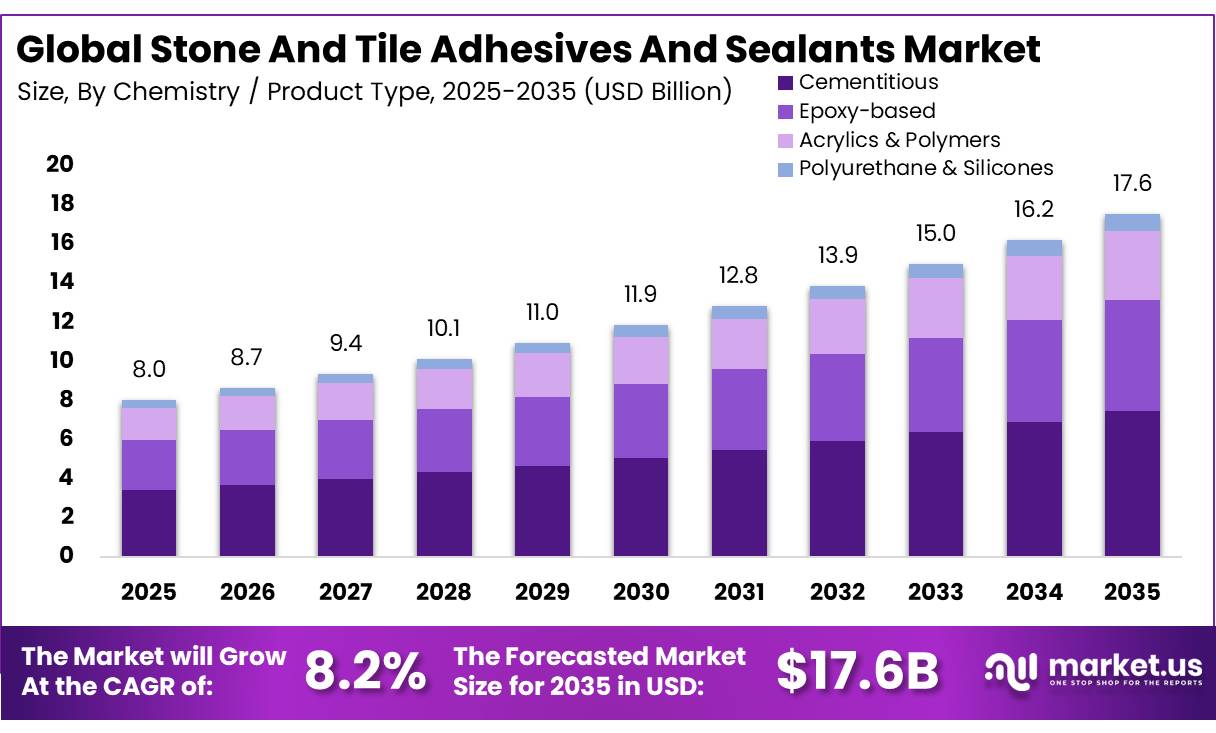
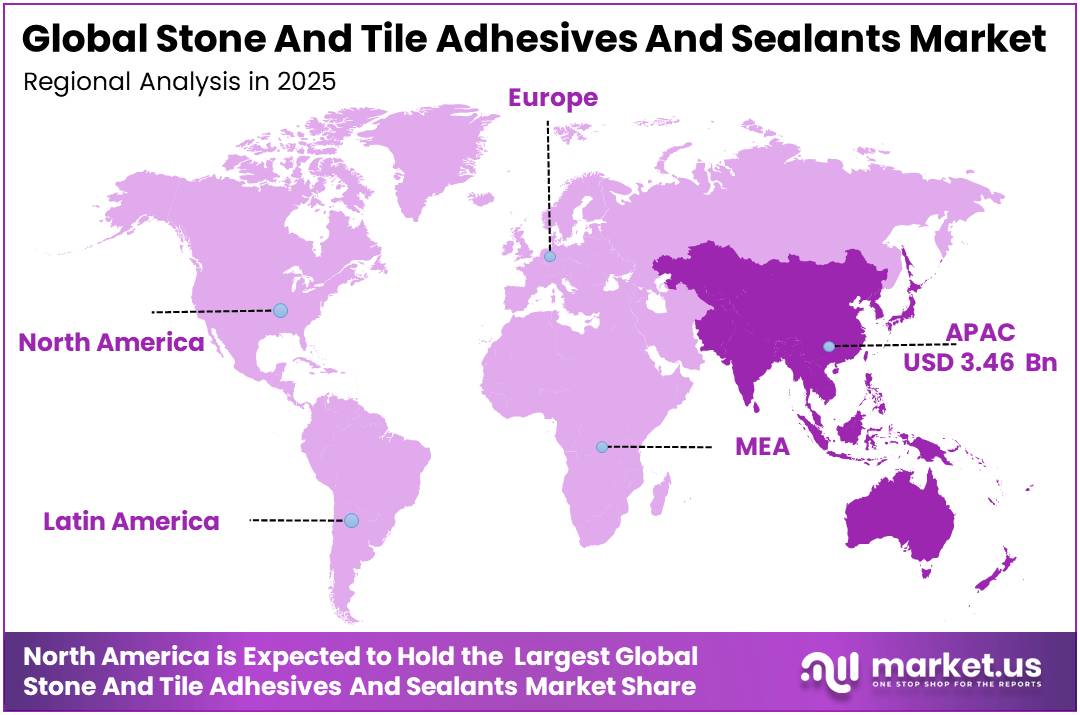
In 2025, the Global Stone and Tile Adhesives and Sealants Market was valued at USD 8.0 Billion, and between 2026 and 2035, this market is estimated to register a CAGR of 8.2%, reaching about USD 17.6 Billion by 2035. Asia Pacific held a dominant market position, capturing more than a 43.20% share, holding USD 3.46 Billion in revenue.
The stone and tile adhesives and sealants industry supports the installation, bonding, and joint-sealing of ceramic, porcelain, and natural stone surfaces across residential, commercial, and infrastructure construction. Demand for these formulations tracks overall construction activity, which the United States Census Bureau reported at a seasonally adjusted annual rate of 2,136.2 billion U.S. dollars for June 2025, with private construction spending at a seasonally adjusted annual rate of 1,621.9 billion U.S. dollars for the same month.
- The South Coast Air Quality Management District (SCAQMD), a California government air-quality authority, sets a volatile organic compound (VOC) content limit of 65 grams per liter for its Ceramic, Glass, Porcelain, and Stone Tile Adhesive category under Rule 1168, Adhesive and Sealant Applications, with the same 65 grams per liter limit also applied to cement-based grout used in tile installations.
In the European Union, construction production, a leading indicator of tile and stone installation activity, remained stable in the euro area and increased 0.5% across the wider EU in the 2025 annual average compared with 2024, according to Eurostat, the statistical office of the European Union.
Driving factors include worker-safety regulation shaping installation and formulation practices. The Occupational Safety and Health Administration (OSHA) enforces a permissible exposure limit of 50 micrograms per cubic meter for respirable crystalline silica, a dust generated during stone and tile cutting and installation, calculated as an 8-hour time-weighted average, with an action level of 25 micrograms per cubic meter, under 29 CFR 1926.1153. This standard is pushing formulators and installers toward safer, lower-dust bonding and cutting practices.
Growth opportunities center on continued emission-reduction pathways. SCAQMD’s proposed amendments to Rule 1168 target a further reduction of the ceramic tile adhesive VOC limit from its current 65 grams per liter down to 20 grams per liter, signaling sustained regulatory pressure toward low-emission bonding technologies across regulated regions.
Key Takeaways
- The Global Stone and Tile Adhesives and Sealants Market was valued at US$8.0 billion in 2025.
- The global stone and tile adhesives and sealants market is projected to grow at a CAGR of 2% and is estimated to reach US$17.6 billion by 2035.
- On the basis of chemistry / product type, Cementitious dominated the market, constituting 62% of the total market share.
- Based on the application, Ceramic & Porcelain dominated the market, accounting for 0% of the total market share.
- Based on the end-use sector, Residential dominated the market, accounting for 0% of the total market share.
- Based on the distribution channel, B2B / Direct Sales dominated the market, accounting for 0% of the total market share.
- In 2025, Asia Pacific was the most dominant region in the stone and tile adhesives and sealants market, accounting for 2% of the global market.
By Chemistry / Product Type
Cementitious dominates with 42.62% due to its strong compatibility with ceramic and stone installation across residential and commercial construction.
In 2025, Cementitious held a dominant market position, capturing more than a 42.62% share in the Stone and Tile Adhesives and Sealants Market. Its leading position was supported by its wide use in floor and wall tile installation, where reliable bonding, ease of application, and compatibility with cement-based construction materials remain essential. Cementitious adhesives are commonly used for ceramic, porcelain, and natural stone installations because they perform well across a variety of building environments and are suitable for both new construction and renovation projects.
- Industry guidance from organizations such as the Tile Council of North America (TCNA) and ANSI A118 standards continues to recognize cement-based adhesive systems for many tile installation applications, supporting their widespread adoption across the construction sector. In 2025, continued building renovation and infrastructure maintenance activities further sustained demand for cementitious products, helping them maintain their dominant position in the market.
Epoxy-based adhesives represented the growing segment of the market in 2025, supported by increasing demand for high-performance bonding solutions in environments where strong chemical resistance, moisture protection, and long-term durability are required. Their use has expanded in commercial kitchens, healthcare facilities, industrial flooring, and other demanding applications where conventional cement-based products may not provide sufficient performance.
Technical guidance from chemical safety authorities and building standards continues to support the use of epoxy systems in specialized installations requiring enhanced mechanical strength and resistance to harsh operating conditions. As construction projects increasingly focus on durability and lower maintenance requirements, epoxy-based adhesives are expected to witness steady growth in the coming years.
By Application
Ceramic & Porcelain dominates with 43.00% due to its extensive use in residential and commercial flooring and wall applications.
In 2025, Ceramic & Porcelain held a dominant market position, capturing more than a 43.00% share in the Stone and Tile Adhesives and Sealants Market. Its leading position was driven by the widespread use of ceramic and porcelain tiles in homes, commercial buildings, and public infrastructure because of their durability, low maintenance requirements, and design flexibility. These tiles require adhesive systems that provide reliable bonding and long-term performance, making them the preferred application for stone and tile adhesives and sealants.
Installation practices recommended by organizations such as the Tile Council of North America (TCNA) and standards developed under ANSI A108/A118 continue to support the use of suitable adhesive systems for ceramic and porcelain tile installations. In 2025, ongoing residential renovation activities and commercial construction projects continued to strengthen demand for adhesives designed specifically for ceramic and porcelain applications, helping this segment maintain its market leadership.
Natural Stone (Marble & Granite) represented the growing segment in 2025, supported by increasing demand for premium building finishes in residential, hospitality, and commercial projects. Marble and granite installations require specialized adhesives and sealants that can accommodate the weight, moisture sensitivity, and natural characteristics of stone materials while maintaining long-term bonding performance.
Industry installation guidelines and building standards continue to encourage the use of application-specific adhesive systems for natural stone to improve durability and reduce installation risks. As architects and property developers increasingly select natural stone for high-value construction and renovation projects, demand for advanced adhesive and sealing solutions in this segment is expected to continue growing.
By End-Use Sector
Residential dominates with 45.00% due to strong demand from new housing projects and home renovation activities.
In 2025, Residential held a dominant market position, capturing more than a 45.00% share in the Stone and Tile Adhesives and Sealants Market. Its leadership was supported by the continued use of ceramic tiles, porcelain tiles, and natural stone in kitchens, bathrooms, living spaces, and outdoor residential areas. Homeowners increasingly preferred durable and low-maintenance flooring and wall finishes, creating consistent demand for reliable adhesives and sealants.
Building practices and tile installation guidelines published by organizations such as the Tile Council of North America (TCNA) and adhesive application standards under ANSI A108/A118 continued to support the use of appropriate installation materials to improve long-term performance. In 2025, residential construction and home improvement activities remained key contributors to the steady consumption of stone and tile adhesives and sealants, helping this segment retain its leading market position.
The Commercial segment represented the growing category in 2025, driven by rising installation of tiles and stone surfaces across offices, retail spaces, hotels, healthcare facilities, and educational buildings. Commercial projects often require high-performance adhesive and sealing systems that can withstand heavy foot traffic, frequent cleaning, and demanding operating conditions.
Industry installation standards and construction best practices continue to encourage the use of specialized adhesive solutions to improve durability and reduce maintenance requirements in commercial buildings. As investments in commercial infrastructure and building modernization continue through 2026, demand for advanced stone and tile adhesives and sealants in this segment is expected to grow steadily.
By Distribution Channel
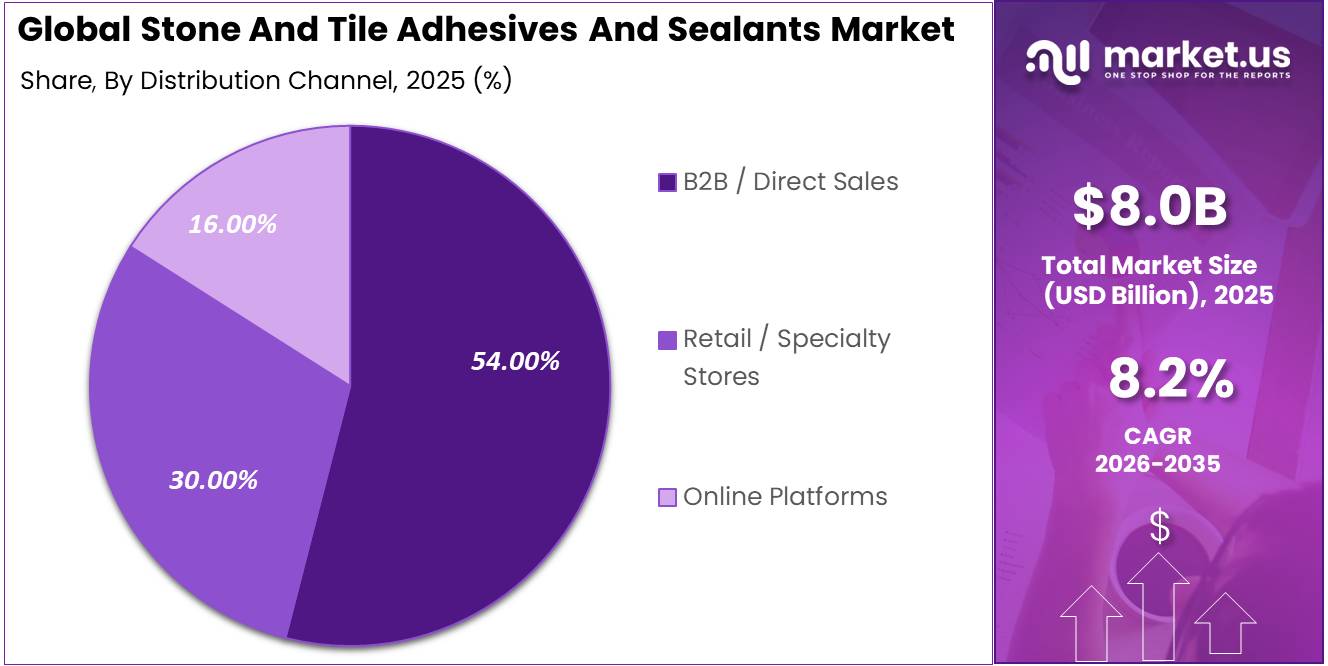
B2B / Direct Sales dominates with 54.00% due to strong procurement demand from contractors, builders, and construction projects.
In 2025, B2B / Direct Sales held a dominant market position, capturing more than a 54.00% share in the Stone and Tile Adhesives and Sealants Market. Its leading position was driven by the purchasing practices of construction companies, tile contractors, infrastructure developers, and commercial builders that procure adhesives and sealants directly from manufacturers or authorized distributors.
Industry organizations such as the Tile Council of North America (TCNA) and construction product standards continue to emphasize the correct selection and application of installation materials, encouraging close coordination between suppliers and professional installers. In 2025, the continued execution of residential, commercial, and infrastructure projects helped B2B and direct procurement remain the preferred distribution channel across the market.
The Retail / Specialty Stores segment represented the growing category in 2025, supported by increasing demand from individual homeowners, small contractors, and renovation professionals seeking convenient access to a wide range of tile adhesives and sealants. Specialty stores provide product selection, application guidance, and immediate availability, making them a preferred choice for repair, remodeling, and small construction projects.
As home improvement activities continued to expand and more consumers looked for professional-grade installation materials through organized retail networks, this distribution channel gained stronger momentum. The ongoing expansion of specialty building material outlets through 2026 is expected to further support growth in this segment.
Key Market Segments
By Chemistry / Product Type
- Cementitious
- Epoxy-based
- Acrylics & Polymers
- Polyurethane & Silicones
By Application
- Ceramic & Porcelain
- Natural Stone (Marble & Granite)
- Large Format Tiles & Panels
- Waterproofing & Joint Sealing
By End-Use Sector
- Residential
- Commercial
- Industrial & Infrastructure
By Distribution Channel
- B2B / Direct Sales
- Retail / Specialty Stores
- Online Platforms
Driver Analysis
Strain-to-Farm Translation Gap
The central growth challenge for the DFM industry is translating controlled-trial outcomes into repeatable commercial performance across farms whose baseline microbiomes, feed formulations, pathogen loads, climate exposure, genetics, and management practices vary materially, causing customers to treat strain efficacy as a probabilistic operating result rather than a guaranteed productivity input.
The consequence is that a formulation capable of generating a 1.5–3.0% feed-conversion improvement in a tightly controlled broiler trial may deliver only 0–1.0% improvement across heterogeneous commercial sites, and a dairy or beef DFM that improves rumen indicators may not generate a statistically clear dry-matter-digestibility gain under a different forage-quality profile; for example, a 2026 cattle study found that a Bacillus-based DFM changed early gas production but did not improve in-vitro dry matter or fiber digestibility.
The long-term response requires manufacturers to build species-specific strain libraries, execute multi-site trials across at least 8–20 farms per priority production system, use standard deviation and confidence-interval reporting rather than average-only claims, and embed technical-service teams within feed-mill and integrator accounts; until those capabilities are scaled, the translation gap is estimated to create a -1.4 percentage-point friction drag on the market’s maximum attainable CAGR.
Drivers Impact Analysis
| Driver | (~) % Impact on CAGR Forecast | Geographic Relevance | Impact Timeline |
|---|---|---|---|
| Renovation and Repair Spend | +1.6 pp | North America, EU, GCC, Japan | Medium term (2–4 years) |
| Large-Format Tile Shift | +1.3 pp | EU, North America, China, India | Medium term (2–4 years) |
| Waterproofing-Led Specification | +1.2 pp | APAC, GCC, LATAM, coastal markets | Long term (≥ 4 years) |
| Low-VOC Product Conversion | +1.0 pp | EU, North America, developed APAC | Medium term (2–4 years) |
| Public Infrastructure Build-Out | +1.1 pp | India, ASEAN, GCC, North America | Medium term (2–4 years) |
| Installer Productivity Technologies | +0.8 pp | North America, EU, urban APAC | Short term (≤ 2 years) |
Restraint Analysis
Private Construction Slowdown
In the U.S., the AIA Consensus Construction Forecast downgraded its 2026 outlook for non-residential building spending from a 1.0% increase anticipated in January to a 0.3% decline, following a 2% contraction in 2025 spending to USD 846 billion, as elevated interest rates, labor scarcity, and material-cost pressures weakened commercial activity.
The housing environment remains similarly constrained: U.S. single-family starts were estimated to have declined 5% to roughly 909,000 units in 2025, with only a 0.9% recovery to about 917,000 units projected for 2026, reducing near-term demand for floor, wall, bathroom, kitchen, terrace, and façade installation systems. For adhesive producers, a 5% reduction in housing starts can translate into a 2–4% decline in new-build tile adhesive volume because residential projects typically account for 40–60% of installed tile area in many markets, while slower office and retail fit-outs reduce demand for premium rapid-setting, large-format, and moisture-resistant systems.
The impact is magnified because developers facing high debt-service costs often defer non-essential finishes, simplify stone specifications, reduce tile coverage, substitute vinyl or paint for tiled surfaces, or split procurement packages to lower initial cash outflow; manufacturers then face lower plant utilization, distributor destocking, extended receivables of 15–45 days, and a potential 200–500-basis-point decline in gross margin when fixed production overhead is spread across lower volumes.
Consequently, the 2026 model assigns private-construction softness a -1.7 percentage-point drag on baseline CAGR across North America, Europe, and China, partially offset by renovation and infrastructure demand but not fully neutralized in the near term.
Restraint Impact Analysis
| Restraint | (~) % Impact on CAGR | Geographic Relevance | Impact Timeline |
|---|---|---|---|
| Private Construction Slowdown | -1.7 pp | North America, EU, China | Short term (≤ 2 years) |
| Polymer and Energy Inflation | -1.4 pp | EU, North America, APAC | Short term (≤ 2 years) |
| Tariff-Driven Cost Escalation | -1.0 pp | North America, EU–Asia trade | Medium term (2–4 years) |
| Low-VOC Reformulation Cost | -0.9 pp | EU, North America, Japan | Medium term (2–4 years) |
| Fragmented Installer Capability | -1.2 pp | India, ASEAN, LATAM, MEA | Medium term (2–4 years) |
| Low-Cost Substitution Pressure | -1.3 pp | APAC, LATAM, Africa | Long term (≥ 4 years) |
Opportunity Analysis
Waterproofing System Bundles
The most immediate white-space opportunity is to convert fragmented purchases of tile adhesive, grout, primer, waterproofing membrane, reinforcing tape, drainage components, and sanitary sealant into branded, warrantied wet-area and exterior-envelope installation systems, because many residential bathrooms, balconies, kitchens, swimming pools, terraces, façades, and hospitality projects still procure these materials separately and transfer failure risk to the installer rather than the material supplier.
This is an opportunity rather than a present baseline driver because the market currently monetizes most projects as single adhesive or sealant transactions, whereas a system-sale model can increase supplier revenue per square metre from an estimated USD 3–7 for commodity tile adhesive to USD 12–28 for a complete waterproofed assembly containing substrate preparation, membrane, bond coat, grout, joint treatment, and sealant.
The economic justification is strong: independent renovation guidance recommends 24–48-hour flood testing of shower pans and bathtub surrounds before tile installation, while post-installation water damage can require removal of finished surfaces, structural drying, plumbing work, and restoration, creating repair costs that are many times the original material spend.
A supplier that offers a 5–10 year system warranty, QR-based installation records, installer certification, and site inspection can create recurring material pull-through while lowering contractor concerns over callback costs; in a 1,000-room hotel or large residential project, this can shift USD 100,000–500,000 of otherwise unbranded adhesive, membrane, and sealant spend into a specified package.
Opportunity Impact Analysis
| Opportunity | (~) % Potential CAGR Upside | Geographic Relevance | Execution Window |
|---|---|---|---|
| Waterproofing System Bundles | +1.7 pp | APAC, GCC, LATAM, coastal markets | Short term (≤ 2 years) |
| Circular Low-Carbon Formulations | +1.4 pp | EU, North America, Japan, Korea | Medium term (2–4 years) |
| Digital Product Passport Services | +1.1 pp | EU core, UK, export suppliers | Medium term (2–4 years) |
| Installer-as-a-Service Networks | +1.3 pp | India, ASEAN, LATAM, MEA | Medium term (2–4 years) |
| Modular and Offsite Construction | +1.0 pp | North America, EU, GCC, urban APAC | Long term (≥ 4 years) |
| Strategic Distributor Roll-Ups | +0.9 pp | India, ASEAN, Africa, LATAM | Medium term (2–4 years) |
Challenges Analysis
Skilled Installer Capability Gap
The shortage is structural rather than temporary: the U.S. construction industry was estimated to require about 349,000 additional workers in 2026 and 456,000 in 2027, while approximately 41% of the existing workforce is expected to retire by 2031, intensifying competition for skilled trades across housing, infrastructure, power-grid, manufacturing, and data-center construction.
In tile and stone installation, the operational effect is disproportionately large because large-format porcelain and natural stone assemblies typically require 80–95% adhesive contact coverage, yet a contractor using inappropriate trowel geometry, incorrect mix water, insufficient back-buttering, or a poorly leveled substrate can create 10–25% voided contact area, leading to lippage, cracking, hollow spots, debonding, water ingress, and subsequent warranty disputes.
A project remediation event can consume 3–10 times the original adhesive and sealant value once demolition, labor, replacement tile, waterproofing repair, project delay, and occupancy disruption are included, so manufacturers increasingly absorb technical-service costs of roughly 1–3% of regional revenue in demonstrations, site audits, contractor training, and complaint resolution.
The long-term mitigation requirement is to build certified installer ecosystems, multilingual application modules, distributor-led training academies, jobsite QR guidance, and digital warranty registration capable of reaching thousands of contractors rather than a limited group of elite applicators; until adoption becomes standardized, installer capability gaps impose an estimated -1.3 percentage-point friction drag on attainable market CAGR across North America, Europe, India, and ASEAN.
Challenges Impact Analysis
| Challenge | (~) % CAGR Friction | Geographic Relevance | Mitigation Horizon |
|---|---|---|---|
| Skilled Installer Capability Gap | -1.3 pp | North America, EU, India, ASEAN | Long term (≥ 4 years) |
| Large-Format Installation Precision | -1.1 pp | EU, North America, China, India | Medium term (2–4 years) |
| Polymer Formulation Complexity | -1.0 pp | EU, North America, Japan, Korea | Medium term (2–4 years) |
| Product Data Traceability Burden | -0.8 pp | EU core, UK, export suppliers | Medium term (2–4 years) |
| Cross-Border Supply Volatility | -0.9 pp | Asia–EU, MEA, Africa, LATAM | Short term (≤ 2 years) |
| Fragmented Distribution Execution | -1.0 pp | India, ASEAN, LATAM, Africa | Medium term (2–4 years) |
Geopolitical Impact Analysis
Geopolitical Impact Analysis: Ongoing Middle East conflict is raising logistics costs and supply risks for stone and tile adhesives and sealants.
The ongoing conflict in the Middle East has increased uncertainty across the Stone and Tile Adhesives and Sealants Market by disrupting energy and shipping networks that support the production of cement, epoxy resins, acrylics, polyurethane, and silicone-based materials. These products rely on petrochemical feedstocks and energy-intensive manufacturing, making the industry sensitive to higher fuel and transportation costs.
- According to the International Energy Agency (IEA), about 20 million barrels per day of crude oil and oil products moved through the Strait of Hormuz during 2025, representing around 25% of the world’s seaborne oil trade. The IEA also states that around 19% of global LNG trade transited the same route in 2025, highlighting the importance of the region for industrial energy supplies.
During 2026, manufacturers have responded by strengthening inventory planning, diversifying sourcing, and increasing regional procurement to reduce dependence on high-risk shipping corridors. Contractors have also placed greater emphasis on securing adhesive and sealant supplies earlier in project cycles to avoid installation delays. While demand from residential and commercial construction has remained resilient, higher input costs have created pressure on project budgets and procurement decisions.
The broader construction chemicals industry is therefore focusing on supply chain resilience rather than rapid expansion until geopolitical conditions stabilize. International organizations, including the IEA, IMF, World Bank, and WTO, have jointly warned that the conflict is affecting energy availability, trade flows, and industrial activity across multiple regions.
Regional Analysis
Regional Analysis: Stone and Tile Adhesives and Sealants Market.
Asia Pacific stands as the dominating region in the stone and tile adhesives and sealants market, holding a 43.20% share valued at 3.46 billion U.S. dollars. This regional leadership is underpinned by sustained, large-scale building activity across the region’s major economies, particularly China, which remains the single largest driver of tile and stone installation demand in Asia Pacific despite a recent construction slowdown.
- According to the National Bureau of Statistics of China, the floor space of buildings completed by real estate development enterprises totaled 603.48 million square meters in 2025, a year-on-year decrease of 18.1%, while investment in real estate development reached 8,278.8 billion yuan for the year, down 17.2% on a comparable basis.
The region’s dominance is further supported by the scale of buildings still under construction, which the National Bureau of Statistics of China reported at 6,598.90 million square meters for 2025, a year-on-year decline of 10.0%, representing a large pipeline of projects that will require tile and stone adhesive and sealant applications as they progress toward completion. This combination of a still-substantial completed floor space base and an extensive under-construction pipeline supports Asia Pacific’s continued position as the leading regional market for stone and tile adhesives and sealants.
Key Regions and Countries Covered
- North America
- The US
- Canada
- Europe
- Germany
- France
- The UK
- Spain
- Italy
- Russia & CIS
- Rest of Europe
- APAC
- China
- Japan
- South Korea
- India
- ASEAN
- Rest of APAC
- Latin America
- Brazil
- Mexico
- Rest of Latin America
- Middle East & Africa
- GCC
- South Africa
- Rest of MEA
Key Players Analysis
Manufacturers in the Stone and Tile Adhesives and Sealants Market focus on improving product performance, expanding production capabilities, and strengthening distribution networks to remain competitive. A major priority is the development of advanced adhesive and sealant formulations with improved bonding strength, flexibility, moisture resistance, and durability for ceramic, porcelain, and natural stone applications.
Companies continue to invest in polymer-modified cementitious products, epoxy systems, polyurethane, and silicone technologies to meet evolving construction requirements and comply with building material standards. Production efficiency has also become a strategic focus, with manufacturers adopting automated mixing, quality control, and packaging processes to ensure consistent product performance.
Leading companies including MAPEI S.p.A., Sika AG, Henkel AG & Co. KGaA, Arkema S.A. (Bostik), Saint-Gobain (Weber), ARDEX Group, H.B. Fuller Company, LATICRETE International, Inc., Pidilite Industries Limited, Fosroc International Limited, Wacker Chemie AG, Soudal N.V., Terraco Holdings Limited, and RPM International Inc. continue to expand their presence through product innovation, manufacturing investments, and strategic partnerships.
Many companies are strengthening regional production facilities to improve delivery times and reduce supply chain risks while expanding their portfolios with low-VOC and environmentally responsible formulations that align with evolving environmental regulations. They also emphasize technical certification, application-specific product development, and digital support tools for installers, enabling better project execution and long-term customer retention.
The Major Players in The Industry
- MAPEI S.p.A.
- Sika AG
- Henkel AG & Co. KGaA
- Arkema S.A. – Bostik
- Saint-Gobain – Weber
- ARDEX Group
- B. Fuller Company
- LATICRETE International, Inc.
- 3M Company
- Pidilite Industries Limited
- Fosroc International Limited
- Wacker Chemie AG
- Soudal N.V.
- Terraco Holdings Limited
- RPM International Inc.
Key Development
- In June 2025, MAPEI S.p.A. opened a new production plant in the City of the Tenth Ramadan, northwest of Cairo, Egypt, covering a total area of 30,000 square metres and manufacturing adhesives for ceramic laying, mortars, and concrete admixtures for the local market. Following this opening, the Mapei Group’s turnover in Egypt reached 60 million euros, with 220 employees across its two Egyptian production sites.
- In October 2025, Sika AG acquired Marlon Tørmørtel A/S, a mortar manufacturer in Denmark, strengthening Sika’s presence in the mortar segment and creating a growth platform for the Nordic region through Marlon’s automated manufacturing facility and two warehouses.
- In November 2025, MAPEI S.p.A. opened a new Research and Development centre in Norway dedicated to sustainable concrete technology, representing a total investment of NOK 127 million (approximately 11 million euros), of which NOK 26.4 million was contributed by Innovation Norway, the Norwegian government body responsible for innovation and sustainable business development.
- In December 2025, Sika AG agreed to acquire Finja, a Swedish manufacturer of dry mortars, floor levelling compounds, and facade systems, with net sales of approximately CHF 60 million, further consolidating Sika’s coverage of the Nordic mortar segment alongside its Denmark acquisition; the transaction is expected to close in the first quarter of 2026.
Report Scope
| Report Features | Description |
|---|---|
| Market Value (2025) | USD 8.0 Bn |
| Forecast Revenue (2035) | USD 17.6 Bn |
| CAGR (2026 2035) | 8.2% |
| Base Year for Estimation | 2025 |
| Historic Period | 2020-2024 |
| Forecast Period | 2026-2035 |
| Report Coverage | Revenue Forecast, Market Dynamics, Competitive Landscape, Recent Developments |
| Segments Covered | By Chemistry / Product Type (Cementitious, Epoxy-based, Acrylics & Polymers, Polyurethane & Silicones), By Application (Ceramic & Porcelain, Natural Stone (Marble & Granite), Large Format Tiles & Panels, Waterproofing & Joint Sealing), By End-Use Sector (Residential, Commercial, Industrial & Infrastructure), By Distribution Channel (B2B / Direct Sales, Retail / Specialty Stores, Online Platforms) |
| Regional Analysis | North America The US & Canada; Europe Germany, France, The UK, Spain, Italy, Russia & CIS, Rest of Europe; APAC China, Japan, South Korea, India, ASEAN & Rest of APAC; Latin America Brazil, Mexico & Rest of Latin America; Middle East & Africa GCC, South Africa, & Rest of MEA |
| Competitive Landscape | MAPEI S.p.A., Sika AG, Henkel AG & Co. KGaA, Arkema S.A. – Bostik, Saint-Gobain – Weber, ARDEX Group, H.B. Fuller Company, LATICRETE International, Inc., 3M Company, Pidilite Industries Limited, Fosroc International Limited, Wacker Chemie AG, Soudal N.V., Terraco Holdings Limited, and RPM International Inc. |
| Customization Scope | Customization for segments, region/country level will be provided. Moreover, additional customization can be done based on the requirements. |
| Purchase Options | We have three licenses to opt for: Single User License, Multi User License (Up to 5 Users), Corporate Use License (Unlimited Users and Printable PDF) |





































