


Report Overview
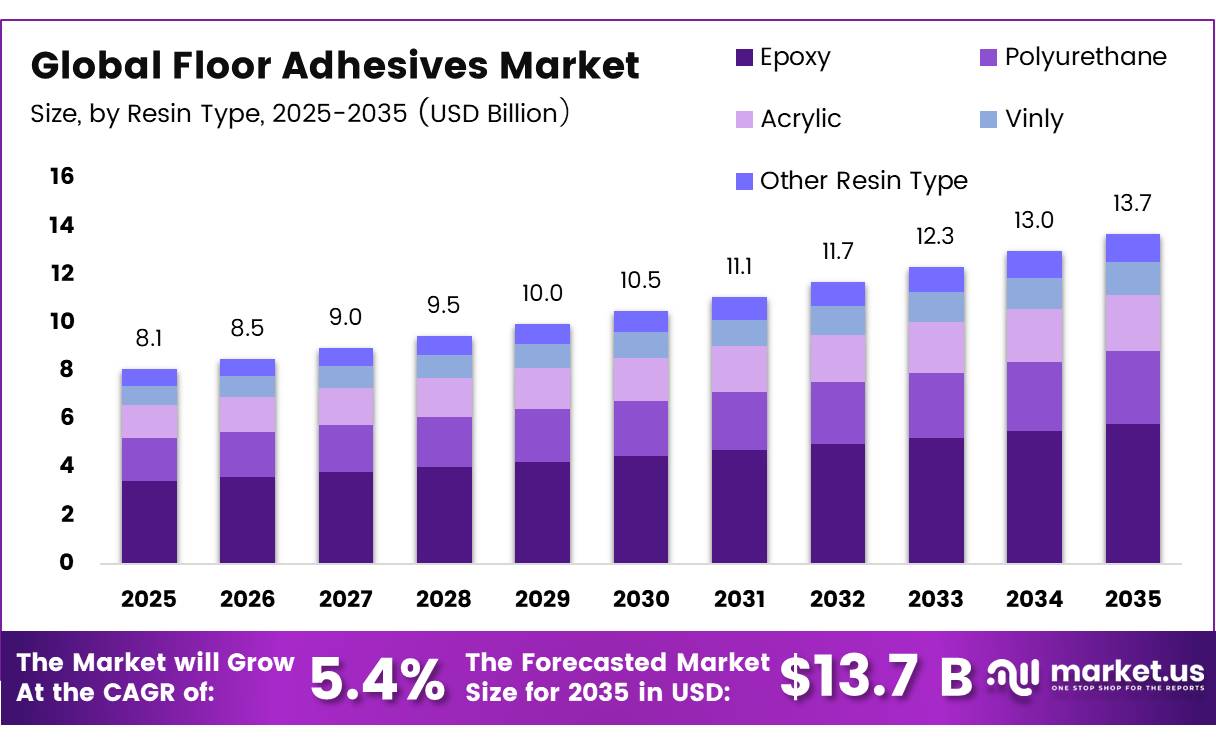
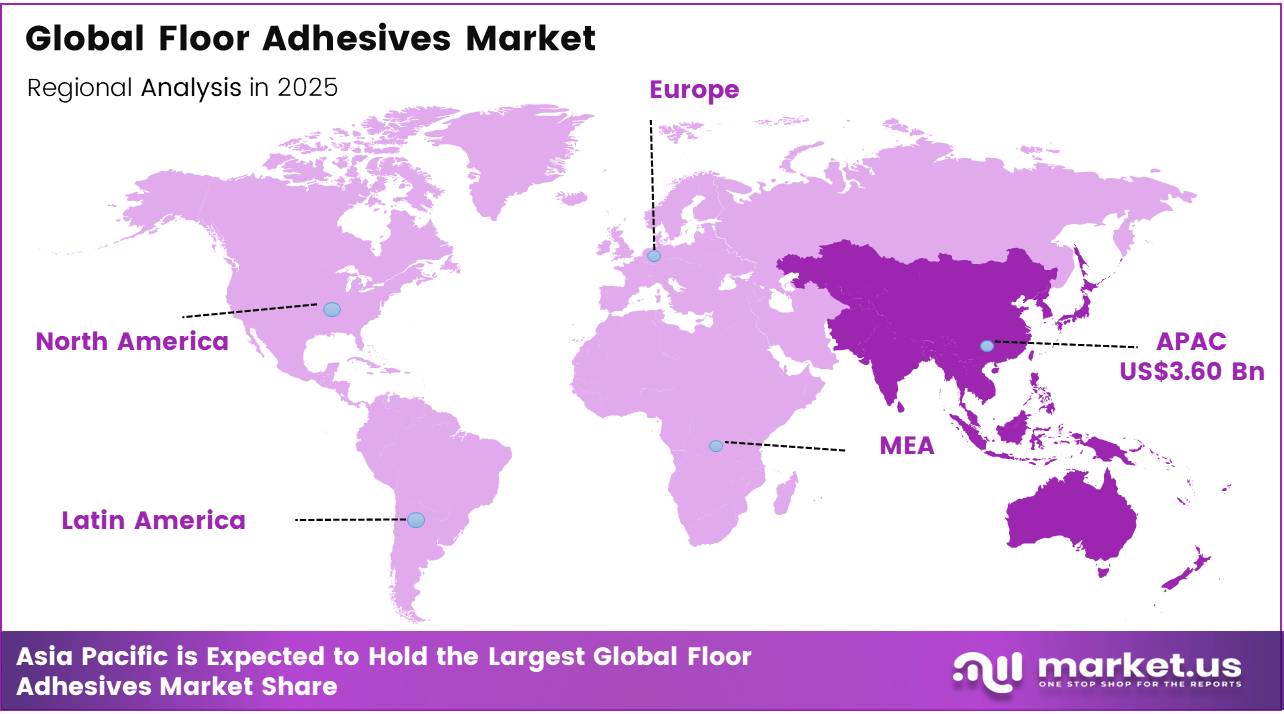
In 2025, the Global Floor Adhesives Market was valued at US$8.1 billion, and between 2026 and 2035, this market is estimated to register a CAGR of 5.4%, reaching about US$13.7 billion by 2035. In 2025, Asia Pacific held a dominant market position, capturing more than a 44.56% share, holding USD 3.60 Billion revenue.
Floor adhesives are materials used to bond vinyl, wood, carpet, rubber, laminate and tile flooring across offices, hospitals, factories and public buildings. The industry is moving toward water-based, moisture-resistant, fast-curing and low-emission formulations that improve installation speed, indoor air quality and long-term bonding performance. FEICA reports that Europe consumes around 5 million tonnes of adhesives and sealants annually, showing the scale of the downstream manufacturing base.
Construction and renovation activity supports consumption.
- In May 2026, EU construction production increased 1.8% year over year, while specialised construction activities rose 3.3%. In the United States, construction spending reached an annual rate of $2.210 trillion, including $930.2 billion for residential work and $738.7 billion for private non-residential construction. Housing permits reached a rate of 1.41 million units.
Key Takeaways
- The global Floor Adhesives market was valued at USD 8.1 billion in 2025.
- The global market is projected to grow at a CAGR of 5.4% and is estimated to reach USD 13.7 billion by 2035.
- On the basis of Resin Type, the Epoxy dominated the market, constituting 42.45% of the total market share.
- Based on the Technology, the Solvent-based dominated the Floor Adhesives market, with a substantial market share of around 44.56%.
- Based on the Application, Tile and Stone led the market, comprising 40.67% of the total market.
- Among the end-uses, the residential held a major share in the Floor Adhesives market, 51.45% of the market share.
- In 2025, the Asia Pacific was the most dominant region in the Floor Adhesives market, accounting for 44.56% of the total global consumption.
Future opportunities are linked to renovation, circular flooring and stricter indoor-air standards. The European Commission reports that 85% of EU buildings were built before 2000, 75% have poor energy performance and only 1% are renovated annually. The revised EPBD targets renovation of the worst-performing 16% of non-residential buildings by 2030. South Coast AQMD limits VOCs to 50 g/L for indoor floor-covering adhesives, 60 g/L for rubber-floor adhesives and 20 g/L for wood-floor adhesives.
Resin Type Analysis
Epoxy represents dominant Segment in the Market.
Epoxy held the leading position in the floor adhesives market with a 42.45% share. Its high bond strength, chemical resistance and ability to withstand heavy movement support its use in factories, warehouses, laboratories, hospitals and other demanding facilities. Demand is reinforced by continued building activity. In May 2026, U.S. private construction spending reached an annual rate of USD 1.669 trillion, while public construction reached USD 541.2 billion, creating a sizeable installation base for durable flooring and adhesive systems.
Polyurethane is emerging as the growing segment because its flexibility and moisture tolerance help flooring remain bonded when substrates expand, contract or experience vibration. Renovation programmes offer strong future opportunities. In June 2026, the European Commission reported that EU-supported projects were renovating more than 420 million square metres of residential floorspace and 76 million square metres of non-residential space, backed by EUR 66 billion in funding.
Technology Analysis
Solvent-based a significant technology.
Solvent-based technology led the floor adhesives market with a 44.56% share. Its strong initial tack, rapid drying and reliable bonding across concrete, wood and resilient flooring continue to support use in residential and heavy-duty projects. In June 2026, the U.S. Census Bureau and Department of Housing and Urban Development reported that new single-family home sales reached an annual rate of 628,000 units. Housing inventory included 485,000 new homes, representing 9.3 months of supply. This active pipeline creates continued flooring installation opportunities for established solvent-based products.
Water-based adhesives are expanding as builders seek products with lower odour, easier cleanup and safer indoor application. The broader movement toward cleaner formulations is visible in the U.S. EPA’s Safer Choice programme. During fiscal 2025, it covered 1,656 certified products with reported production volume of 2.4 billion pounds. The agency also added 26 chemicals to its safer ingredients list, while 38% of qualifying products required formulation changes to meet certification standards.
Application Analysis
Tile and Stone Are the Most Widely Used application.
Tile and Stone held the leading position in the floor adhesives market with a 40.67% share. The segment benefits from strong demand across kitchens, bathrooms, commercial entrances, hospitals and other areas requiring durable, moisture-resistant surfaces. In February 2026, the U.S. Geological Survey reported that domestic producers sold or used 2.3 million tons of dimension stone valued at USD 460 million during 2025. Production involved 215 quarries across 34 states, highlighting the established material base supporting stone installation and related adhesive consumption.
Carpet is emerging as the fastest-growing application due to its comfort, sound reduction and suitability for apartments, hotels and office spaces. Multifamily housing activity is creating new installation opportunities because carpet remains practical for bedrooms, corridors and rental properties. In June 2026, the U.S. Census Bureau reported that building permits for properties containing five or more housing units reached an annual rate of 445,000 units, supporting future demand for carpet adhesives in large residential developments.
End User Analysis
Residential Held a Major Share of the Floor Adhesives Market.
Residential held the leading position in the floor adhesives market with a 51.45% share. Demand remains strong because every completed home requires adhesives for tile, carpet, wood, vinyl or other finished flooring. The segment also benefits from kitchen upgrades, bathroom refurbishment and replacement of ageing floor coverings. The U.S. Census Bureau reported that 1,005,000 single-family homes were completed in 2025, with a median floor area of 2,142 square feet. In addition, 484,000 multifamily units were completed, creating a broad installation base for flooring materials across houses and apartments.
Commercial demand is expanding as offices, retail outlets, hotels, healthcare centres and entertainment facilities continue to invest in flooring upgrades to improve appearance, durability, and safety. Private commercial construction activity remains strong in the United States, with ongoing investment in office and other commercial spaces supporting steady demand for floor adhesives across both new developments and refurbishment projects.
Key Market Segments
By Resin Type
- Epoxy
- Polyurethane
- Acrylic
- Vinly
- Other Resin Type
By Technology
- Solvent-based
- Water-based
- Others
By Application
- Tile and Stone
- Carpet
- Wood
- Laminate
- Resilient Flooring
- Other Applications
By End User
- Residential
- Commercial
- Industrial
Driver Analysis
Sustainability certification and spec-driven procurement
The final structural driver is the rising role of sustainability certification in procurement, where project teams increasingly require documented emissions testing, health declarations, and green-label compliance before an adhesive can even enter the bid list. LEED-style requirements, FloorScore-type certifications, and CDPH-based emissions documentation are no longer niche; they are becoming default specifications in many institutional and premium commercial projects. This driver adds about +0.8% to CAGR because it raises barrier-to-entry, improves conversion rates for qualified suppliers, and makes certification a commercial weapon rather than just a compliance cost.
Drivers Impact Analysis
| Driver | (~) % Impact on CAGR Forecast | Geographic Relevance | Impact Timeline |
|---|---|---|---|
| Infrastructure-led flooring demand in non-residential construction | +1.6% | APAC corridors, Middle East, North America urban cores | Medium term (2-4 years) |
| Renovation and retrofit cycle in residential and commercial floors | +1.1% | North America core, EU, mature APAC metros | Short term (≤ 2 years) |
| Shift toward low-VOC and low-emission adhesive systems | +1.4% | EU, North America core, select APAC premium markets | Short term (≤ 2 years) |
| Preference shift from mechanical fixing to bonded flooring systems | +0.9% | Global, strongest in urban commercial and institutional projects | Medium term (2-4 years) |
| Growth in high-performance chemistry for resilient, engineered, and specialty floors | +1.0% | North America core, EU, industrial APAC clusters | Medium term (2-4 years) |
| Sustainability certification and spec-driven procurement | +0.8% | EU, North America, Gulf premium developments | Long term (≥ 4 years) |
Restraint Analysis
Diisocyanate restrictions
The diisocyanate rule set is a structural restraint on polyurethane-based floor adhesives because EU rules restrict industrial and professional use above 0.1% monomeric diisocyanates unless mandatory training and labeling requirements are met, raising both compliance friction and channel friction for multi-component systems. For manufacturers, the practical consequence is a narrower formulation window, slower customer onboarding, and more technical support intensity per project, with training administration and documentation often adding 1-2 extra touchpoints to every commercial sale and extending contractor qualification by several weeks.
That slows adoption in renovation-heavy commercial flooring, where jobsite labor is already constrained, and it also forces suppliers to invest in lower-free-monomer chemistries or alternative binder platforms, typically lifting R&D and QC cost by 4-7% on affected polyurethane lines. The CAGR hit is most visible in the EU core, with spillover into UK procurement standards and premium APAC export flows that mirror European technical specifications.
Restraint Impact Analysis
| Restraint | (~) % Impact on CAGR Forecast | Geographic Relevance | Impact Timeline |
|---|---|---|---|
| VOC/IAQ compliance | -0.8% | Europe core, North America core, urban APAC | Short term (≤ 2 years) |
| Petrochemical feedstock swings | -0.7% | Global; acute in import-dependent APAC, Europe, South America | Short term (≤ 2 years) |
| Diisocyanate restrictions | -0.5% | EU core, UK spillover, premium APAC exports | Medium term (2-4 years) |
| Skilled installer gap | -0.4% | North America core, Europe core, emerging APAC | Medium term (2-4 years) |
| Tariff-driven landed-cost inflation | -0.3% | North America core, Europe trade lanes, APAC export corridors | Short term (≤ 2 years) |
| Project deferrals in housing | -0.3% | North America core, Europe core, select urban APAC | Medium term (2-4 years) |
Opportunity Analysis
Smart acoustic & sensing adhesives
Positioning floor adhesives as smart, multifunctional layers that integrate acoustic damping, moisture/alkalinity monitoring, and basic occupancy sensing represents a white-space pivot beyond today’s focus on simple bonding and low-VOC compliance, and therefore constitutes an opportunity rather than a current driver. While global floor adhesive volumes are projected to rise from roughly 4.19 million tons in 2025 to nearly 7 million tons by 2035 at ~5.25% CAGR, less than an estimated 5–7% of installed adhesive mass currently contributes any functional intelligence, leaving a latent TAM of at least 1.5–2.0 million tons of “smart-capable” underlayment by 2035 if integrated into high-end commercial, healthcare, hospitality, and smart residential projects.
If even 20% of new-build and deep retrofit projects in North America, Western Europe, and tier-1 APAC cities adopt premium smart acoustic/sensing adhesives at price points 35–50% above traditional formulations and incremental gross margins of +8–12 percentage points, this could add USD 1.5–2.0 billion in incremental revenue by 2035, equivalent to 9–12% of projected global market value. Because this layer is not yet specified in building codes or mainstream BIM libraries, early movers can lock in specification-driven demand, bundle sensor data services into annual SaaS contracts priced at USD 0.05–0.10 per square meter per year, and drive a structural uplift of around +2.2 percentage points on top of the baseline 5.4–5.95% CAGR through 2035 via enhanced ASPs, recurring digital revenues, and platform stickiness with architects and facility managers.
Opportunity Impact Analysis
| Opportunity | (~) % Potential CAGR Upside | Geographic Relevance | Execution Window |
|---|---|---|---|
| Smart acoustic & sensing adhesives | +2.2% | North America, EU, Tier-1 APAC | Medium term (2–4 years) |
| Bio-based premium segment carve-out | +1.9% | EU core, North America, Japan | Short–medium term (≤ 4 years) |
| Contractor-centric platform & subscription models | +1.6% | North America, EU, India | Short term (≤ 2 years) |
| OEM co-engineered systems with flooring & robotics players | +2.0% | Global key metros, APAC manufacturing hubs | Medium–long term (≥ 3–5 years) |
| Emerging-market retrofit & informal segment formalization | +1.4% | India, ASEAN, LatAm, Middle East | Medium term (2–4 years) |
| M&A roll-up of regional formulators | +1.8% | Fragmented regional markets worldwide | Long term (≥ 4 years) |
Challenges Analysis
Raw-material volatility
Floor adhesives remain highly exposed to polymer resin, tackifier, solvent, and additive price swings, and the market’s dependence on petrochemical-linked inputs creates continuous unit-cost noise rather than a one-time restraint. In 2026, a 10–15% move in key inputs can translate into roughly 2–4% swings in finished adhesive gross margin because formulations are often optimized for bond strength, open time, and VOC thresholds simultaneously, leaving limited room for substitution without performance loss.
The issue is not that sales stop today; it is that every quarterly procurement cycle forces re-pricing, rebate renegotiation, and portfolio rebalancing, which can delay pass-through by 30–90 days and create 50–150 bps of margin erosion in volatile windows. The strategic response is multi-sourcing, higher safety-stock coverage for critical polymers, regional compounding closer to demand centers, and formula redesign that lowers dependence on a single monomer family; those adjustments typically take 12–24 months, but they are essential because the volatility directly suppresses the market’s ability to convert baseline demand growth into clean revenue expansion.
Challenges Impact Analysis
| Challenge | (~) % CAGR Friction Drag | Geographic Relevance | Mitigation Horizon |
|---|---|---|---|
| Raw-material volatility | -1.8% | Global, APAC import hubs, EU | Short term (≤ 2 years) |
| VOC compliance complexity | -1.3% | EU regulatory hubs, North America core, Japan | Medium term (2-4 years) |
| Subfloor variability | -1.4% | North America retrofit, EU renovation, India urban | Long term (≥ 4 years) |
| Installer quality gap | -1.1% | India, ASEAN, LatAm, tier-2 cities | Medium term (2-4 years) |
| Lead-time and logistics | -1.2% | APAC corridors, Middle East, Latin America | Short term (≤ 2 years) |
| Skilled chemist shortage | -0.9% | EU, North America, advanced APAC | Long term (≥ 4 years) |
Geopolitical Impact Analysis
Geopolitical Energy Realignment and Shipping Disruptions Reshaping Floor Adhesive Supply Chains.
Geopolitical shifts are increasing procurement risks for floor adhesive producers because resins and solvents depend heavily on petroleum and natural-gas feedstocks. The European Commission reported that Russian gas supplied 12% of EU gas imports in 2025, down from 45% in 2021, while imported volumes fell from 152 billion cubic metres to 36 billion cubic metres. This diversification may strengthen long-term energy security, but manufacturers must qualify new suppliers and manage changing feedstock costs.
Middle East tensions create an additional risk around oil-linked raw materials and freight. The U.S. Energy Information Administration stated that around 20 million barrels per day moved through the Strait of Hormuz in 2024, equal to about 20% of global petroleum-liquids consumption. Approximately one-fifth of global LNG trade also used the route. Any interruption can tighten chemical availability, raise transportation costs and encourage producers to hold larger inventories, source regionally and develop water-based formulations.
Beyond price and logistics pressure, geopolitical uncertainty is encouraging floor adhesive manufacturers to redesign procurement strategies. Producers are increasingly favoring regional suppliers, dual-sourcing arrangements and formulations that use fewer volatile raw materials. This shift is also supporting greater interest in water-based and lower-emission adhesives, as companies seek products that are easier to source, store and distribute during periods of trade disruption.
Regional Analysis
Asia Pacific Held the Largest Share of the Global Floor Adhesives Market.
Asia-Pacific led the floor adhesives market with a 44.56% share. Its position is supported by extensive residential development, commercial construction and urban renovation across major regional economies. China’s National Bureau of Statistics reported that 881.01 million square metres of newly built commercial property were sold during 2025. The country also started or made available 1.21 million units of subsidized, rental and public housing.
North America is emerging as the fastest-growing region as housing construction and property refurbishment create fresh demand for flooring installation materials. In June 2026, the Canada Mortgage and Housing Corporation reported that 375,469 housing units were under construction in urban centres with populations above 50,000. Monthly completions also increased by 8.4%, reaching 18,298 units. This active project pipeline supports greater use of floor adhesives across apartments, rental properties and newly completed homes, while renovation activity creates additional demand for low-emission and fast-curing products
Key Regions and Countries Covered
- North America
- The US
- Canada
- Europe
- Germany
- France
- The UK
- Spain
- Italy
- Russia & CIS
- Rest of Europe
- APAC
- China
- Japan
- South Korea
- India
- ASEAN
- Rest of APAC
- Latin America
- Brazil
- Mexico
- Rest of Latin America
- Middle East & Africa
- GCC
- South Africa
- Rest of MEA
Key Players Analysis
Floor adhesive manufacturers focus on strengthening formulation performance, production consistency, and distribution efficiency to remain competitive. A key priority is continuous product innovation, including the development of low-VOC, moisture-resistant, fast-curing, and high-bond-strength adhesives that improve installation quality across tile, carpet, wood, vinyl, and resilient flooring. Companies are also expanding water-based and hybrid polymer technologies, as these products offer easier application, lower odour, and better alignment with green-building requirements.
Closer integration with resin suppliers, flooring producers, and construction contractors helps improve raw material availability and control costs during periods of chemical price volatility. Strategic production and warehouse expansion near major construction markets enables manufacturers to respond faster to regional demand and reduce delivery delays.
In addition, producers emphasize automated mixing, digital quality monitoring, and standardized testing to maintain consistent viscosity, curing time, and adhesion strength at scale. Long-term partnerships with flooring installers, distributors, and building-material retailers further improve market access, strengthen customer retention, and support positioning in high-value residential, commercial, and industrial applications.
The Major Players In The Industry
- 3M
- Ardex Group
- Arkema
- Ashland
- BASF
- Dow
- Forbo Flooring
- B. Fuller Company
- Henkel AG & Co. KGaA
- Jowat
- LATICRETE International, Inc.
- MAPEI S.p.A.
- Other Key Players
Key Development
- In April 2025, MAPEI S.p.A. opened a 30,000-square-metre plant in Egypt to manufacture ceramic-installation adhesives and other construction products. The site became MAPEI’s second Egyptian production facility, strengthening regional supply and delivery capacity.
- In January 2026, Henkel AG & Co. KGaA agreed to acquire ATP Adhesive Systems, which employed around 700 people and generated approximately €270 million in 2025 sales. More than 90% of ATP’s portfolio used water-based technology, broadening Henkel’s sustainable bonding capabilities.
Report Scope
| Report Features | Description |
|---|---|
| Market Value (2025) | USD 8.1 Bn |
| Forecast Revenue (2035) | USD 13.7 Bn |
| CAGR (2026-2035) | 5.4% |
| Base Year for Estimation | 2025 |
| Historic Period | 2020-2024 |
| Forecast Period | 2026-2035 |
| Report Coverage | Revenue Forecast, Market Dynamics, Competitive Landscape, Recent Developments |
| Segments Covered | By Resin Type (Epoxy, Polyurethane, Acrylic, Vinly and Other Resin Type), By Technology (Water-based. Solvant-based and Others), By Application (Tile and Stone, Carpet, Wood, Laminate, Resilient Flooring and Other Applications),), By Technology (Dry Floor Adhesives and Wet Floor Adhesives), By End User (Residential, Commercial and Industrial)) |
| Regional Analysis | North America – The US & Canada; Europe – Germany, France, The UK, Spain, Italy, Russia & CIS, Rest of Europe; APAC– China, Japan, South Korea, India, ASEAN & Rest of APAC; Latin America– Brazil, Mexico & Rest of Latin America; Middle East & Africa– GCC, South Africa, & Rest of MEA |
| Competitive Landscape | 3M, Ardex Group, Arkema, Ashland, BASF, Dow, Forbo Flooring, H.B. Fuller Company, Henkel AG & Co. KGaA, Jowat, LATICRETE International, Inc., MAPEI S.p.A. and Other Key Players. |
| Customization Scope | Customization for segments, region/country-level will be provided. Moreover, additional customization can be done based on the requirements. |
| Purchase Options | We have three licenses to opt for: Single User License, Multi-User License (Up to 5 Users), Corporate Use License (Unlimited Users and Printable PDF) |





































