


Report Overview
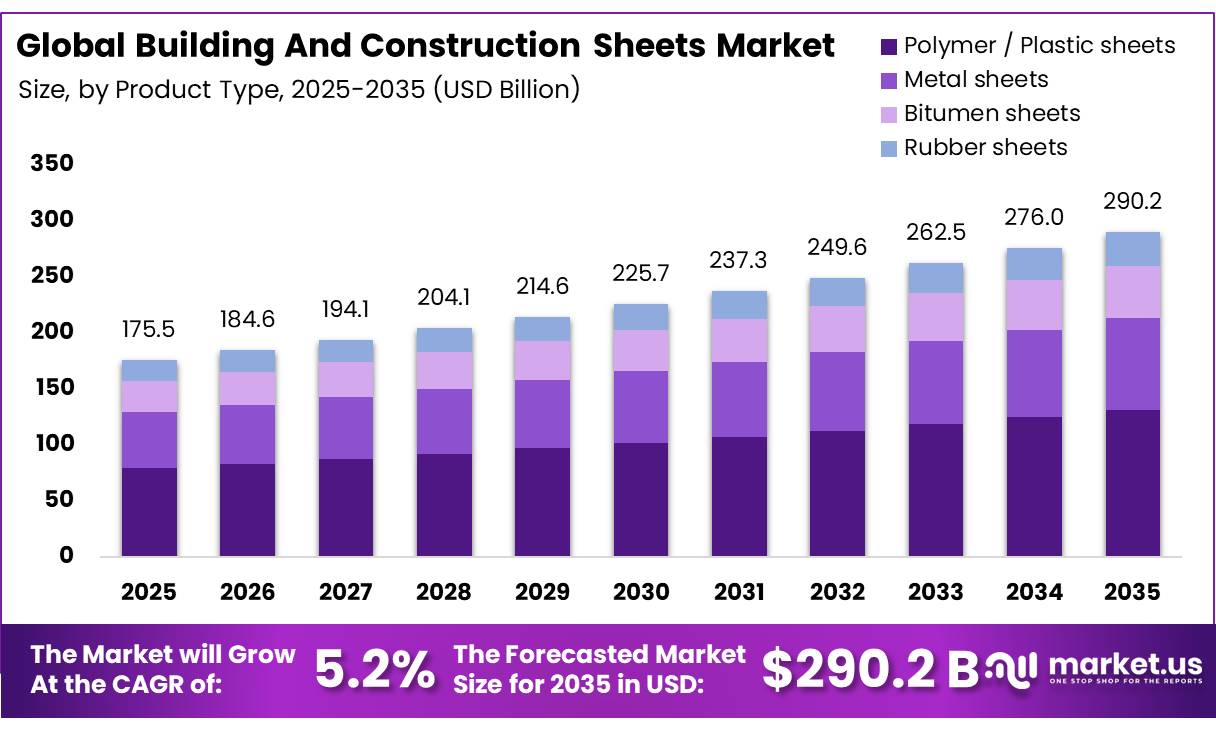
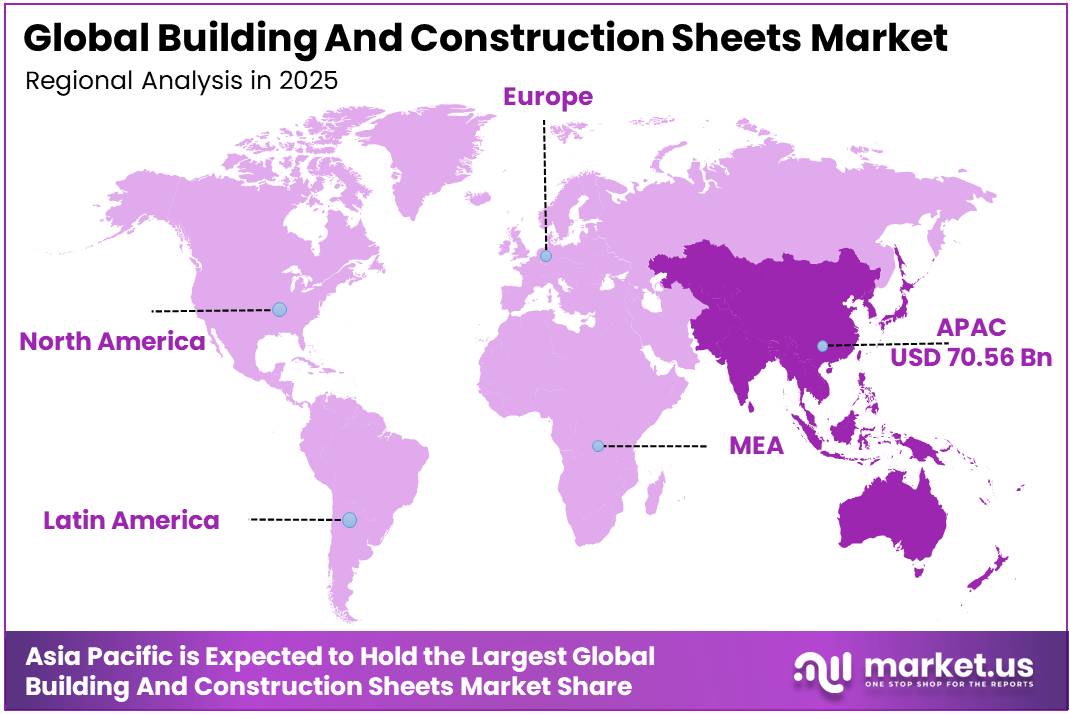
In 2025, the Global Building and Construction Sheets Market was valued at USD 175.5 billion, and between 2026 and 2035, this market is estimated to register a CAGR of 5.2%, reaching about USD 290.2 billion by 2035. Asia Pacific held a dominant market position, capturing more than a 40.2% share, holding USD 70.56 billion in revenue.
The building and construction sheets market covers polymer, metal, bitumen, and rubber products used across roofing, walls, ceilings, floors, windows, doors, plumbing, and building envelopes. These sheets provide weather protection, waterproofing, insulation, bonding, glazing support, and surface durability. Demand is linked to new construction, renovation, infrastructure spending, and replacement of ageing exterior and interior systems in residential, commercial, and industrial buildings across varied climates and building designs.
- In May 2026, the United States Census Bureau estimated total construction spending at an annual rate of 2,210.2 billion United States dollars. Residential construction reached 2 billion United States dollars, while private nonresidential construction stood at 738.7 billion United States dollars. This activity sustains demand for roofing membranes, wall panels, floor underlays, insulation boards, and moisture-control sheets. Manufacturers benefit from broad material demand.
Key Takeaways
- The global building and construction sheets market was valued at USD 175.5 billion in 2025.
- The global market is projected to grow at a CAGR of 5.2% and is estimated to reach USD 290.2 billion by 2035.
- On the basis of product, polymer / plastic sheets dominated the market, constituting 45.1% of the total market share.
- Based on the application, roofing dominated the building and construction sheets market, with a substantial market share of around 30.2%.
- Based on the function, insulation led the market, comprising 70.2% of the total market.
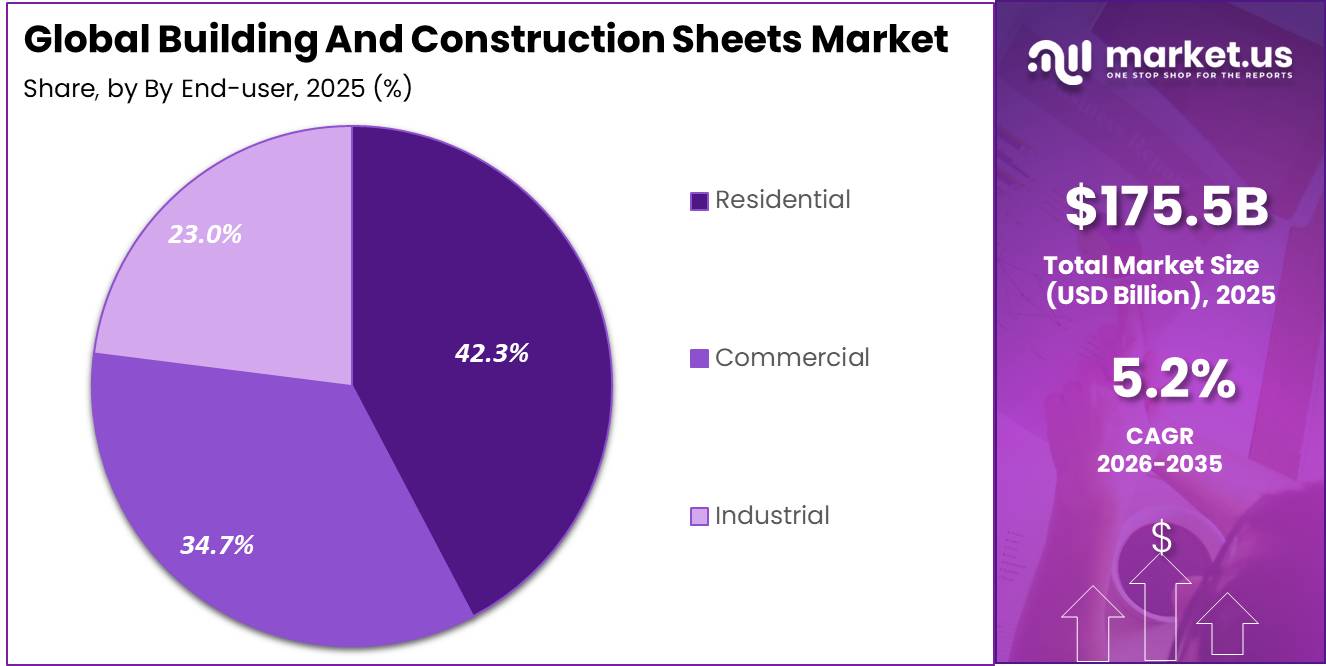
- Among the end users, the residential segment held a major share in the building and construction sheets market, accounting for 42.3% of the market share.
- Among the sales channels, direct sales were the most considerable within the market, accounting for around 74.4% of the revenue.
- In 2025, Asia Pacific was the most dominant region in the building and construction sheets market, accounting for 40.2% of the total market share.
Growth opportunities are strengthening through energy renovation and stricter building-performance requirements. The European Commission reports that roughly 75% of European Union buildings have poor energy performance, while the annual energy-renovation rate remains around 1%. It also states that deep renovation of a very low-performing building can reduce energy consumption by as much as 80%. These conditions support wider use of insulated panels, reflective sheets, vapour barriers, and high-performance envelope materials. Suppliers differentiate through thermal and moisture performance.
Government initiatives are creating longer-term demand for compliant sheet products. The revised Energy Performance of Buildings Directive requires renovation of the 16% worst-performing nonresidential buildings by 2030 and 26% by 2033. It also requires residential building energy use to fall 16% by 2030 compared with 2020. From January 2028, life-cycle global warming potential must be disclosed for new buildings above 1,000 square metres, extending to all new buildings from 2030, encouraging lower-carbon, recyclable, and durable sheet solutions. Policy direction favours verified environmental product information.
Product Type Analysis
Polymer / Plastic sheets dominate with a 45.1% share due to their lightweight and adaptable construction properties.
In 2025, Polymer / Plastic sheets held a dominant market position, capturing more than a 45.1% share. Their leadership was supported by low weight, corrosion resistance, design flexibility, and easy installation across roofing, walls, ceilings, glazing, insulation, and waterproofing applications. Builders use polycarbonate, acrylic, polyethylene, and other plastic sheets where moisture resistance, daylight transmission, chemical durability, and reduced structural load are important. Their adaptability to shapes, colours, and finishes supports demand across residential, commercial, and industrial projects.
- For instance, in October 2025, according to ArcelorMittal, the company launched Helioroof, an integrated insulated steel roofing solution that combines metal panels, thermal insulation, and solar cells in a ready-to-install system.
Metal sheets are the growing segment as contractors seek durable, recyclable, fire-resistant, and weather-resistant materials for roofs, façades, floors, and building envelopes. Their high strength supports large spans and demanding structural conditions, while coated and insulated formats improve corrosion protection, thermal performance, and installation speed. Growth is further supported by modular construction, industrial buildings, renovation activity, and rising interest in low-carbon steel products that provide long service life and easier end-of-life recovery.
Application Analysis
Roofing dominates with a 30.2% share due to its essential protective and waterproofing role.
In 2025, Roofing held a dominant market position, capturing more than a 30.2% share. Its leadership was supported by the need for weather protection, waterproofing, thermal control, and long service life across residential, commercial, and industrial buildings. Roofing sheets are used in new construction and renovation because they can combine structural coverage, moisture resistance, insulation, and rapid installation. Polymer, metal, bitumen, and rubber formats give contractors flexibility across different climates, roof designs, and budget requirements.
- For instance, in January 2025, according to ROCKWOOL, the company launched Prolit Lamella Mat, a stone-wool product designed to improve thermal and acoustic insulation in circular and rectangular ventilation ducts while reducing installation waste.
HVAC is the fastest-growing segment as buildings require efficient heating, ventilation, and air-conditioning systems, tighter energy performance, and indoor comfort. Sheet-based duct liners, wraps, insulation boards, and vapour-control materials help limit heat transfer, condensation, noise, and air leakage. Demand is also supported by commercial retrofits, data centres, hospitals, offices, and high-rise projects where reliable duct insulation and fire performance are important. Product innovation is improving handling, compliance, and long-term system efficiency.
Function Analysis
Insulation dominates with a 70.2% share due to its thermal efficiency and building-performance benefits.
In 2025, Insulation held a dominant market position, capturing more than a 70.2% share. Its leadership was supported by the need to control heat transfer, improve indoor comfort, reduce energy loss, and protect building systems from temperature changes. Insulation sheets and boards are used in roofs, walls, ceilings, floors, and building envelopes. Their lightweight construction, moisture resistance, fire performance, and ease of installation support demand across residential, commercial, and industrial projects.
- For instance, in May 2025, according to CertainTeed, the company introduced CertaSeam Roof Tape and SwiftStart SA Starter Shingle as part of a roofing system designed to strengthen weather resistance, seal roof-deck joints, and limit water intrusion during severe conditions.
Protection is the growing segment as builders place attention on weather resilience, fire safety, impact resistance, and moisture control. Protective sheets, membranes, underlayments, and sheathing help shield structures from wind, rain, ultraviolet exposure, mould, and physical damage. Demand is rising in renovation, disaster-resilient construction, and commercial projects where longer service life and lower maintenance needs are important. Product development is improving durability, installation speed, and compatibility with building-envelope systems.
End-user Analysis
Residential dominates with a 42.3% share due to steady housing construction and renovation demand.
In 2025, Residential held a dominant market position, capturing more than a 42.3% share. Its leadership was supported by demand for roofing, insulation, wall panels, flooring underlays, waterproofing membranes, and glazing sheets in new homes and renovation projects. Residential buyers favour materials that improve comfort, moisture control, energy efficiency, appearance, and installation speed. Broad product availability across polymer, metal, bitumen, and rubber formats also supports adoption across housing types and climates.
- For instance, in February 2025, according to GAF, the company made its full EnergyGuard NH TCPP-Free polyiso insulation line available at standard pricing, helping commercial roofing customers pursue thermal performance and sustainability goals without a pricing premium.
Commercial is the growing segment as offices, hospitals, hotels, retail centres, warehouses, schools, and data centres require durable sheet materials for roofs, façades, interiors, ducts, and building envelopes. Demand is supported by renovation activity, stricter energy codes, larger floor areas, and the need for fire, moisture, acoustic, and thermal performance. Commercial projects also favour standardized systems, faster installation, long service life, and products supported by technical documentation, warranties, and professional contractor networks.
Sales Channel Analysis
Direct sales dominate with a 74.4% share due to stronger project coordination and customer control.
In 2025, Direct held a dominant market position, capturing more than a 74.4% share. Direct sales remained preferred for construction projects because manufacturers can work closely with contractors, developers, architects, and procurement teams. This channel supports product specification, technical guidance, volume planning, customized dimensions, coordinated delivery, and warranty management. It also helps suppliers maintain pricing control, understand project requirements, and build long-term relationships across roofing, insulation, waterproofing, glazing, and building-envelope applications.
- For instance, in September 2025, according to GAF, the company created a Specialty Products and Services business unit that aligned roofing materials, transportation, and supply-chain operations to improve customer service and provide an integrated purchasing experience.
Third-party / Indirect is the growing segment as distributors, wholesalers, retailers, and building-material dealers expand product access across fragmented construction markets. These intermediaries help manufacturers reach smaller contractors, renovation specialists, and buyers that require local inventory and rapid delivery. Their warehouses, sales teams, credit support, and contractor relationships improve availability across product categories. Digital ordering, dealer portals, and stocking programmes are also strengthening convenience, particularly for routine replacement, repair, and small-scale construction projects.
Key Market Segments
By Product
- Polymer / Plastic sheets
- Metal sheets
- Bitumen sheets
- Rubber sheets
By Application
- Roofing
- HVAC
- Flooring
- Building envelope
- Windows
- Doors
- Electrical
- Walls & ceilings
- Plumbing
By Function
- Insulation
- Protection
- Water proofing
- Bonding
- Glazing
By End-user
- Residential
- Commercial
- Industrial
By Sales Channel
- Direct
- Third-party / Indirect
Driver Analysis
Tightening Building-Envelope Energy Codes
Regulatory tightening of thermal-performance thresholds is restructuring specification behavior across mature construction markets, compelling a shift from single-layer cladding toward multi-layer, insulated, and composite sheet assemblies. California’s Title 24 Energy Code cycle took effect for permits filed from January 1, 2026, raising prescriptive wall-cavity insulation floors and tightening cathedral-ceiling requirements to R-38 across all sixteen climate zones, a structural change that directly increases the bill-of-materials complexity for roofing and wall sheet products.
In parallel, the European Union’s revised Energy Performance of Buildings Directive obligates member states to move toward zero-emission building status by 2030, forcing specifiers to favor sheets that combine load-bearing strength with high thermal resistance or integrated photovoltaic layers rather than commodity-grade panels.
Drivers Impact Analysis
| Driver | (~) % Impact on CAGR | Geographic Relevance | Impact Timeline |
|---|---|---|---|
| Tightening building-envelope energy codes pushing insulated and multi-layer sheet adoption | +1.6% | EU-wide, North America (California Title 24), select APAC metros | Long term (≥ 4 years) |
| Expansion of retrofit and renovation-grade public funding programs for aging building stock | +1.3% | EU core (Germany, France, UK), North America municipal programs | Medium term (2-4 years) |
| Accelerated warehouse, logistics, and data-center construction lifting metal and composite decking demand | +1.1% | North America core, APAC industrial corridors, EU logistics belts | Short term (≤ 2 years) |
| Shift toward prefabricated and modular building methods standardizing sheet specifications | +0.9% | APAC (China, India, Southeast Asia), Nordics, North America | Medium term (2-4 years) |
| Rapid urbanization and infrastructure buildout across emerging APAC and South American economies | +1.0% | APAC core, South America spill-over, Middle East selective markets | Long term (≥ 4 years) |
Restraint Analysis
Skilled Labor Shortage and Installation Delays
The construction industry faces a persistent monthly shortfall of roughly 350,000-500,000 workers globally as of 2026, with the Associated General Contractors of America estimating the United States alone needed approximately 439,000 additional workers in 2025 rising to near 499,000 in 2026, while 92% of actively hiring firms report inability to find qualified candidates and 88% carry open craft positions; average U.S. construction hourly earnings reached $39.70 in mid-2025 and are projected to grow 8-12% in 2026 versus 3.5-4% economy-wide, directly inflating installation labor line-items for cladding, decking, and sheet-fixing crews, while the UK’s Chartered Institute of Building projects a structural shortfall exceeding 250,000 workers over the next five years driven by post-Brexit immigration constraints and an aging tradesperson base, collectively extending average project completion timelines and delaying the revenue-recognition point at which sheet manufacturers convert order backlogs into shipped, installed volume.
Restraint Impact Analysis
| Restraint | (~) % Impact on CAGR Forecast | Geographic Relevance | Impact Timeline |
|---|---|---|---|
| Section 232 metal tariffs inflating steel and aluminum sheet input costs | -1.8% | North America core, indirect EU/APAC export spillover | Short term (≤ 2 years) |
| Skilled labor shortage delaying installation and project completion | -1.1% | North America core, UK, EU | Medium term (2-4 years) |
| Polymer and PVC resin price volatility from geopolitical feedstock shocks | -0.9% | Global, most acute in APAC and EU | Short term (≤ 2 years) |
| Elevated interest rates suppressing new commercial and residential starts | -1.0% | North America, EU core | Medium term (2-4 years) |
| Fragmented recycling infrastructure limiting circular-economy compliance | -0.5% | EU core, select North America states | Long term (≥ 4 years) |
| Fire-safety and embodied-carbon compliance costs raising certification barriers to entry | -0.4% | EU, UK, North America selective states | Long term (≥ 4 years) |
Opportunity Analysis
Africa and Middle East Infrastructure White-Space Entry
The Middle East and Africa construction market, valued at roughly USD 555 billion in 2026 and tracking toward USD 822 billion by 2035, remains structurally underpenetrated by global sheet manufacturers who today service it primarily through arm’s-length exports rather than localized production, leaving a white space distinct from any current baseline driver because existing revenue capture in the region is disproportionately low relative to the scale of announced giga-project and urban infrastructure pipelines in the UAE and Saudi Arabia; establishing joint-venture manufacturing capacity in-region could reduce landed-cost freight and tariff exposure by an estimated 12-18% versus exported product, compress customer lead times from the current 8-14 week import cycle to under 3 weeks, and unlock direct participation in sovereign-backed tender pipelines that currently favor locally-manufactured content quotas, representing a long-horizon but structurally durable upside pool largely untouched by incumbent Western and Chinese sheet exporters today.
Opportunity Impact Analysis
| Opportunity | (~) % Potential CAGR | Geographic Relevance | Execution Window |
|---|---|---|---|
| Vertical integration into building-integrated photovoltaic (BIPV) sheet-cladding hybrids | +2.2% | EU core, North America, APAC (China, Japan) | Medium term (2-4 years) |
| Africa and Middle East infrastructure white-space entry via localized manufacturing JVs | +1.7% | Middle East (UAE, Saudi Arabia), Sub-Saharan Africa | Long term (≥ 4 years) |
| Monetizing sheet products as a materials-as-a-service (MaaS) leasing model for modular/temporary structures | +1.2% | North America, EU, APAC urban centers | Medium term (2-4 years) |
| Bio-based and agri-waste composite sheet roll-up of niche innovators via M&A | +1.5% | EU core, North America, emerging APAC | Short term (≤ 2 years) |
| Embedded IoT sensor sheets monetized as data-and-analytics subscription layer | +0.9% | North America, EU, APAC smart-city corridors | Long term (≥ 4 years) |
| Circular-economy take-back and resale of recycled sheet feedstock as a distinct revenue line | +0.8% | EU core, select North America states | Medium term (2-4 years) |
Challenges Analysis
Ocean Freight Rate Volatility and Transit Delays
Container spot rates on key sheet-import lanes have swung sharply through 2026, with the Drewry World Container Index climbing to roughly $3,549 per 40ft container by mid-June before subsequent easing, while transpacific Shanghai-to-New York rates spiked to approximately $5,870 per 40ft box in the same window and Asia-Europe legs into Rotterdam and Genoa rose 5% and 1% week-over-week respectively, reflecting Strait of Hormuz-linked capacity withdrawal and peak-season general rate increases layered on top of an already 92% year-over-year elevated freight index; this volatility, compounded by port congestion and rerouting around contested shipping lanes, is stretching typical import lead times for metal, polycarbonate, and composite sheet cargo by an estimated 7-12 days versus 2024 norms and forcing sheet distributors to carry 15-20% more buffer inventory, a working-capital drag that does not halt sales outright but structurally raises the cost-to-serve for import-dependent regional distributors and requires continuous freight-hedging and multi-carrier diversification to manage rather than a one-time fix.
Challenges Impact Analysis
| Challenge | (~) % CAGR Friction | Geographic Relevance | Mitigation Horizon |
|---|---|---|---|
| Ocean freight rate volatility and transit delays | -0.9% | APAC export corridors, EU import hubs, North America ports | Short term (≤ 2 years) |
| Fragmented certification and standards compliance lag | -0.6% | EU regulatory hubs, UK, North America state-level codes | Medium term (2-4 years) |
| Climate-driven extreme weather disruption to logistics and jobsites | -0.8% | APAC logistics corridors, North America Gulf/Sun Belt, Caribbean | Long term (≥ 4 years) |
| Persistent mid-career technical talent deficit in manufacturing and installation | -0.7% | North America core, EU, UK | Long term (≥ 4 years) |
| Multi-supplier procurement complexity from geopolitical trade-route rerouting | -0.5% | Middle East transit corridors, APAC-EU lanes | Medium term (2-4 years) |
| Quality-yield variability across new composite and bio-based product lines | -0.4% | EU core, North America, emerging APAC producers | Medium term (2-4 years) |
Geopolitical Impact Analysis
Geopolitical Realignment and Supply Chain Fragmentation Reshaping Building and Construction Sheet Manufacturing
Current geopolitical tensions are reshaping the building and construction sheets market through trade remedies, carbon-border rules, energy-route risks, and sourcing strategies. Manufacturers depend on traded coated steel, aluminium, polymers, bitumen, rubber, and chemicals. Changes in duties, shipping reliability, and feedstock availability can alter input costs, delivery schedules, policies, and overall pricing across roofing projects.
In August 2025, the United States Department of Commerce issued final determinations on corrosion-resistant steel products from ten trading partners. Dumping rates reached 191.26% for a Brazilian producer. These measures can increase the landed cost of coated metal sheets, encourage purchasing, and require manufacturers and distributors to qualify alternative mills and specifications.
Oil-route exposure affects polymer, bitumen, and rubber-based sheets. The United States Energy Information Administration reported that 20.9 million barrels per day moved through the Strait of Hormuz during the first half of 2025, equal to about 20% of global petroleum-liquids consumption. Any disruption may increase feedstock and freight volatility for oil-derived construction materials.
From January 2026, the European Union Carbon Border Adjustment Mechanism entered its definitive phase. Importers handling more than 50 tonnes of cement, iron, steel, or aluminium require authorization. This framework encourages carbon reporting, lower-emission sourcing, regional manufacturing, and closer supplier verification.
Regional Analysis
Asia Pacific dominates with a 40.2% share, supported by extensive regional construction activity.
In 2025, Asia Pacific held a dominant position in the building and construction sheets market, capturing 40.2% of global revenue and generating approximately USD 70.56 billion. Regional leadership was supported by extensive housing development, industrial construction, infrastructure expansion, urban renovation, and demand for durable roofing, insulation, waterproofing, and building-envelope materials. In February 2026, China’s National Bureau of Statistics reported that construction enterprises generated CNY 8,642.5 billion in value added during 2025, demonstrating the scale of regional building activity.
Australia also recorded sustained project demand. According to the Australian Bureau of Statistics, the value of approved residential buildings reached AUD 10.24 billion in May 2026, while approved non-residential buildings totalled AUD 10.83 billion. These conditions support consumption of polymer, metal, bitumen, and rubber sheets across homes, offices, factories, warehouses, and public facilities. Continued urbanization, energy-efficiency requirements, climate-resilient construction, and investment in infrastructure are expected to sustain Asia Pacific’s leading market position.
Key Regions and Countries Covered
- North America
- The US
- Canada
- Europe
- Germany
- France
- The UK
- Spain
- Italy
- Russia & CIS
- Rest of Europe
- APAC
- China
- Japan
- South Korea
- India
- ASEAN
- Rest of APAC
- Latin America
- Brazil
- Mexico
- Rest of Latin America
- Middle East & Africa
- GCC
- South Africa
- Rest of MEA
Key Players Analysis
Building and construction sheet manufacturers compete through product breadth, technical performance, manufacturing scale, and contractor support. Companies increasingly emphasized weather resistance, thermal efficiency, fire performance, lower-carbon materials, and faster installation. GAF also reported training more than 1,100 roofing professionals in resilient roof installation, showing how contractor education and certified networks support brand preference and specification influence.
Competitive positioning is also strengthened through capacity investment, regional production, and integrated distribution. Owens Corning planned approximately USD 800 million in 2026 capital additions, supporting its roofing, insulation, and doors businesses. United States Gypsum Company expanded its North American manufacturing network by opening a CAD 210 million wallboard plant in Alberta, while Fletcher Building Limited, Johns Manville Corporation, and National Gypsum Company continued competing through established product channels and technical support.
Market Key Players
- Paul Bauder GmbH & Co. KG
- GAF Materials Corporation (GAF)
- Atlas Roofing Corporation
- CertainTeed Corporation
- Owens Corning Corp.
- Etex Grou
- North American Roofing Services, Inc.
- Fletcher Building Limited
- Icopal ApS
- EURAMAX
- Johns Manville Corporation
- United States Gypsum Company (USG)
- National Gypsum Company
- Spartech Corporation
- Elasto Proxy Inc.
Key Development
- In January 2026, GAF Materials Corporation introduced the Bold Definition color collection for its Timberline HDZ shingles. The collection added four new colors while retaining LayerLock technology, algae protection, impact resistance, and fire-performance features.
- In April 2026, Atlas Roofing Corporation upgraded its Pinnacle Sun shingle portfolio with approximately 15% to 25% higher solar reflectivity, depending on the color, and introduced the Cool Oyster option with an initial Solar Reflectance Index rating of 25.
- In June 2026, Etex Group acquired a majority stake in Algeria-based Global Gypse, a producer of plasterboards and gypsum-related products. The transaction expanded Etex’s manufacturing presence in Algeria and strengthened its ability to serve construction markets across Africa and other regions.
Report Scope
| Report Features | Description |
|---|---|
| Market Value (2025) | USD 175.5 Bn |
| Forecast Revenue (2035) | USD 290.2 Bn |
| CAGR (2026-2035) | 5.2% |
| Base Year for Estimation | 2025 |
| Historic Period | 2020-2024 |
| Forecast Period | 2026-2035 |
| Report Coverage | Revenue Forecast, Market Dynamics, Competitive Landscape, Recent Developments |
| Segments Covered | By Product (Polymer / Plastic Sheets, Metal Sheets, Bitumen Sheets, and Rubber Sheets), By Application (Roofing, Walls & Ceilings, Flooring, Building Envelope, Windows, Doors, Electrical, HVAC, and Plumbing), By Function (Protection, Insulation, Waterproofing, Bonding, and Glazing), By End-user (Residential, Commercial, and Industrial), By Sales Channel (Direct and Third-party / Indirect) |
| Regional Analysis | North America – The US & Canada; Europe – Germany, France, The UK, Spain, Italy, Russia & CIS, Rest of Europe; APAC– China, Japan, South Korea, India, ASEAN & Rest of APAC; Latin America– Brazil, Mexico & Rest of Latin America; Middle East & Africa– GCC, South Africa, & Rest of MEA |
| Competitive Landscape | Paul Bauder GmbH & Co. KG, GAF Materials Corporation (GAF), Atlas Roofing Corporation, CertainTeed Corporation, Owens Corning Corp., Etex Group, North American Roofing Services, Inc., Fletcher Building Limited, Icopal ApS, EURAMAX, Johns Manville Corporation, United States Gypsum Company (USG), National Gypsum Company, Spartech Corporation, and Elasto Proxy Inc. |
| Customization Scope | Customization for segments, region/country-level will be provided. Moreover, additional customization can be done based on the requirements. |
| Purchase Options | We have three licenses to opt for: Single User License, Multi-User License (Up to 5 Users), Corporate Use License (Unlimited Users and Printable PDF) |





































