


Report Overview
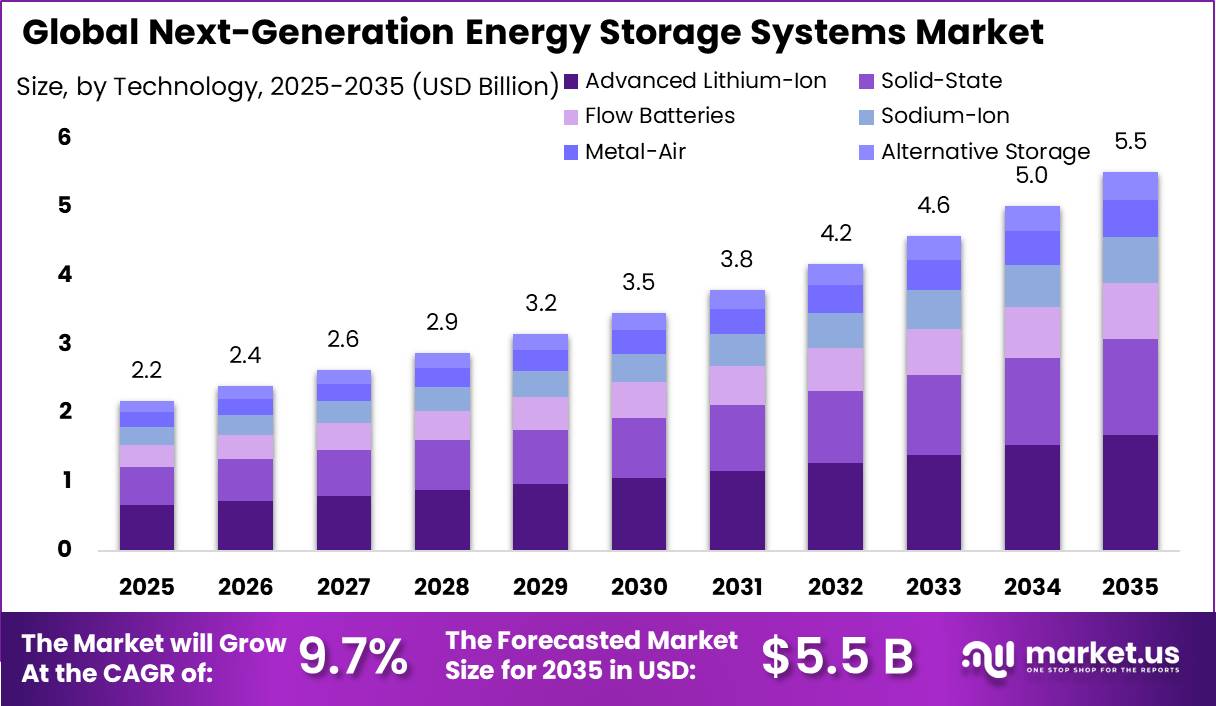
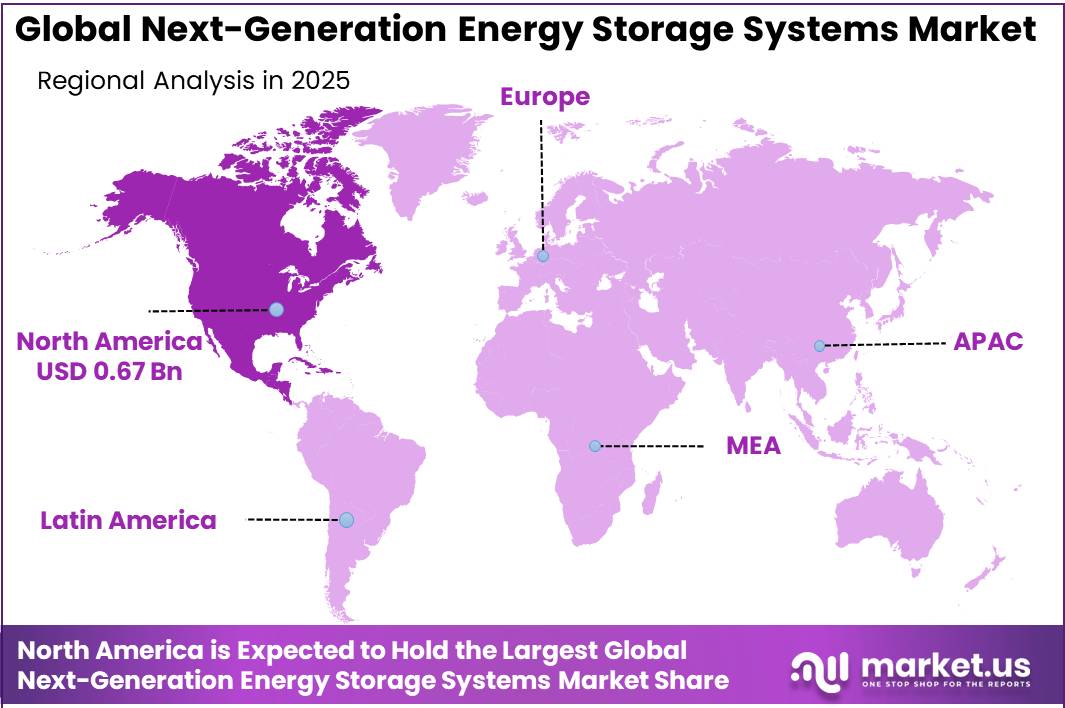
In 2025, the Global Next-Generation Energy Storage Systems Market was valued at USD 2.2 billion, and between 2026 and 2035, this market is estimated to register a CAGR of 9.7%, reaching about USD 5.5 billion by 2035. In 2025, North America led the market, achieving over 30.8% share with a revenue of USD 0.67 billion.
The next-generation energy storage systems industry is developing into an infrastructure segment for power networks, electric mobility, data centres and distributed energy systems. It includes advanced lithium-ion batteries, sodium-ion batteries, solid-state batteries, flow batteries, thermal storage, compressed-air systems and long-duration technologies designed to improve safety, operating life, charging speed and material efficiency.
- According to the International Energy Agency, 108 GW of new battery storage capacity was deployed worldwide in 2025, representing 40% growth over 2024, while installed capacity reached eleven times its 2021 level. Lithium-iron-phosphate technology accounted for around 90% of deployments, reflecting its lower cost and suitability for frequent cycling.
Key Takeaways
- The Global Next-Generation Energy Storage Systems Market was valued at US$2.2 billion in 2025.
- The market is projected to grow at a CAGR of 9.7% and is estimated to reach US$5.5 billion by 2035.
- On the basis of technology, the Advanced Lithium-Ion segment dominated the market, constituting 30.6% of the total market share.
- Based on the application, the Grid Services segment led the market, comprising 54.5% of the total market.
- In 2025, North America was the most dominant region in the market, accounting for 30.8% of the total global consumption.
The industrial scenario is increasingly led by utility-scale projects that provide renewable-energy shifting, grid balancing, congestion management and peak-capacity support. The IEA reported that utility-scale systems represented about 87 GW, or four-fifths, of global additions in 2025, including 24 GW directly co-located with renewable generation.
Battery costs declined by more than 90% between 2010 and 2025, while energy shifting became the primary application for more than 90% of new projects in 2025. Average duration for commissioned projects increased to three hours, compared with about two hours in 2023, showing a gradual movement toward longer discharge capability. Growth is being driven by solar and wind deployment, rising electricity demand, grid congestion, resilience requirements and the need for fast-build flexible capacity.
- The U.S. Energy Information Administration stated that the United States added a record 15 GW of utility-scale battery capacity in 2025, while developers planned another 24 GW for 2026. Battery storage represents 28% of the 86 GW of planned U.S. utility-scale generating additions in 2026. Globally, storage projects also benefit from modular construction, with the IEA estimating a median utility-scale battery construction period of about 275 days.
Transportation remains another major demand engine. The IEA Global EV Outlook 2026 recorded 1.2 TWh of electric-vehicle battery deployment in 2025, almost 30% above 2024 and more than seven times the 2020 level. Electric vehicles represented over 70% of total battery deployment, while average battery prices declined by 8% during 2025. These trends support manufacturing scale, chemistry improvements and cost reductions that can transfer into stationary storage, although lithium-price volatility and supply-chain concentration remain industrial risks.
- In June 2025, the U.S. Department of Energy selected three grid-scale storage projects to receive up to USD 5 million each, providing funding of USD 15 million for critical-facility resilience demonstrations.
In Europe, battery-waste rules entered into force on July 24, 2025, establishing methods for verifying recycling efficiency and material recovery. The IEA indicates that global storage capacity needs to reach 1,500 GW by 2030, including 1,200 GW of battery storage, requiring average annual battery deployment growth of about 25%.
Technology Analysis
Advanced Lithium-Ion Dominates with More Than 30.6% Share, Supported by Large-Scale Deployment.
In 2025, Advanced Lithium-Ion held a dominant market position, capturing more than a 30.6% share of the Next-Generation Energy Storage Systems Market. The segment maintained its lead because lithium-ion systems provide high energy density, faster charging, longer operating life and flexible use across electric vehicles, renewable energy storage, consumer electronics and data centres.
- In February 2026, the International Energy Agency reported that the global lithium-ion battery industry exceeded USD 150 billion in 2025, rising by more than 20% from 2024. Global lithium-ion battery deployment was also six times higher than in 2020. Electric vehicles represented more than 70% of total deployment, while battery energy storage systems accounted for over 15%.
- In January 2025, the U.S. Department of Energy announced funding of up to USD 88 million for advanced vehicle technologies, including improved lithium-ion cell safety, longer battery cycle life and lower-cost lithium production.
Solid-State is the fastest-growing segment in the Next-Generation Energy Storage Systems Market, supported by rising demand for safer batteries with greater energy density, longer driving range and improved thermal stability. Unlike conventional batteries using liquid electrolytes, solid-state systems use solid materials that can lower leakage and fire risks while supporting lithium-metal anodes. In 2025, the European Commission’s HELENA project continued developing Generation 4b solid-state cells for electric vehicles and aircraft using nickel-rich cathodes, lithium-metal anodes and halide solid electrolytes. The project was designed to improve charging speed, manufacturing scalability and energy performance.
Application Analysis
Grid Services dominates with a 54.5% share as utilities expand large-scale storage capacity.
In 2025, Grid Services held a dominant market position, capturing more than a 54.5% share. The segment remained ahead because power utilities increasingly used advanced storage systems to balance electricity supply, manage peak demand, support renewable power integration, and improve grid reliability. Large battery installations can respond quickly to changes in electricity demand, making them useful for frequency control, load shifting, backup supply, and energy trading. These grid-level functions strengthen the adoption of next-generation energy storage systems across utility and power-network applications.
- According to the U.S. Energy Information Administration, power providers were expected to add 18.2 GW of utility-scale battery storage capacity to the U.S. grid in 2025. The agency stated that this expansion highlights the importance of battery storage in balancing electricity supply and demand, supporting renewable energy integration, and improving grid stability.
Transportation is the fastest-growing segment in the Next-Generation Energy Storage Systems Market. Its rapid expansion is supported by rising electric car production, wider charging infrastructure, improving battery performance, and growing demand for longer vehicle ranges. Advanced lithium-ion, solid-state, sodium-ion, and other emerging storage technologies are becoming increasingly important for passenger cars, commercial vehicles, trucks, and two-wheelers.
- In 2025, global electric car sales increased by 20% and exceeded 20 million Electric truck sales also more than doubled during the year, while global electric car production reached almost 22 million units. These developments are creating stronger demand for high-energy-density batteries that offer faster charging, improved safety, longer operating life, and lower weight.
Key Market Segments
By Technology
- Advanced Lithium-Ion
- Silicon-anode
- Lithium-sulfur
- Solid-State
- Thin-film
- Bulk
- Flow Batteries
- Redox flow
- Hybrid flow
- Sodium-Ion
- Layered oxide
- Prussian blue
- Metal-Air
- Zinc-air
- Aluminium-air
- Iron-air
- Alternative Storage
- Flywheels
- Compressed Air
- Thermal
By Application
- Grid Services
- Peak shaving
- Frequency regulation
- Renewable integration
- Transportation
- Electric vehicles
- E-aviation
- Marine
- Heavy freight
- Backup & Telecom
- Data centers
- Telecom towers
- Microgrids
- Consumer Electronics
- Wearables
- Smartphones
- IoT
Driver Analysis
China’s NDRC 180 GW New-Energy-Storage Action Plan
China’s National Development and Reform Commission and National Energy Administration’s Special Action Plan for Large-Scale Construction of New Energy Storage targets growth of the national new-energy-storage fleet to 180 GW by 2027, backed by an estimated USD 35 billion in sector investment over three years. China’s installed base already exceeded 100 GW as of mid-2025 two years ahead of its original 30 GW target for 2025 with the National Energy Administration recording nationwide operational capacity of 73.76 million kW/168 million kWh by end-2024, roughly 20 times the level at the close of the 13th Five-Year Plan in 2020.
During the 15th Five-Year Plan (2026-2030), NDRC projections point to an additional 180 million kW of new storage capacity, with an effective capacity contribution of 160 million kW covering an estimated 27.4% of incremental power-generation demand growth. This regulatory pivot compels Chinese and multinational suppliers into vertically integrated, high-volume manufacturing strategies to defend margins as procurement shifts from subsidized fixed-price contracts to competitive, market-clearing tariff structures.
Drivers Impact Analysis
| Driver | (~) % Impact on CAGR Forecast | Geographic Relevance | Impact Timeline |
|---|---|---|---|
| U.S. federal ITC/48E tax-credit stacking for standalone storage | +2.8% | North America core, energy-community corridors | Short term (≤2 years) |
| India’s VGF-driven cost compression for grid-scale BESS | +2.2% | APAC corridors (India), South Asia spill-over | Medium term (2-4 years) |
| China’s NDRC 180 GW new-energy-storage action plan | +3.1% | APAC core (China), broader Asia-Pacific supply chain | Medium term (2-4 years) |
| EU Battery Regulation carbon-footprint and passport mandates | +1.6% | EU core, spill-over into UK/EEA-aligned markets | Long term (≥4 years) |
| DOE Energy Storage Grand Challenge cost-reduction roadmap | +2.0% | North America core, allied technology-transfer markets | Long term (≥4 years) |
| Domestic-content and localization mandates (India, U.S. FEOC rules) | +1.4% | APAC (India), North America core | Short term (≤2 years) |
Restraint Analysis
Fire Safety and Permitting Compliance Burden
The regulatory root cause is the tightening of US fire and building codes governing battery energy storage systems, including UL 9540A’s fifth-edition (2025) large-scale fire test revisions and NFPA 855’s 2026 edition requirement for explosion control systems compliant with NFPA 69, which mandates flammable-gas concentration be held below 25% of the lower flammable limit through active ventilation systems; the quantitative bottleneck is that International Residential Code and NFPA 855 spacing and capacity rules a minimum 3-foot unit separation, 20 kWh per-unit energy caps, and 40-80 kWh site capacity ceilings depending on installation location force redesigns and add UL 9540A large-scale fire testing cycles that typically run 8-16 weeks and cost testing labs mid-six-figure sums per SKU variant; the strategic business impact is a lengthened product-to-permit timeline of roughly 3-6 months for residential and commercial-scale systems, deferring revenue recognition and inflating pre-commercialization CapEx burn for manufacturers targeting US deployment in 2026-2027
Restraint Impact Analysis
| Restraint | (~) % Impact on CAGR Forecast | Geographic Relevance | Impact Timeline |
|---|---|---|---|
| US Section 301 tariff escalation on Chinese cells/materials | -2.2% | North America core (US import-dependent supply chains) | Short term (≤2 years) |
| Upstream critical mineral import dependency (lithium, graphite, cobalt) | -1.8% | Global, acute in US and EU | Medium term (2-4 years) |
| China graphite/anode export licensing controls | -1.4% | Global cathode/anode supply corridors, US/EU importers | Short to medium term |
| Fire safety & permitting compliance burden (UL 9540A/NFPA 855/IFC) | -1.1% | North America (US), increasingly EU/APAC codes | Short term (≤2 years) |
| Grid interconnection queue backlogs | -1.6% | US regional grids (ERCOT, CAISO, PJM, MISO) | Medium term (2-4 years) |
| Raw material price volatility (lithium carbonate spikes) | -1.0% | Global, transmitted via China-linked cell pricing | Short term (≤2 years) |
Opportunity Analysis
Long-Duration Storage (LDES) Non-Lithium Pivot
Baseline growth today is overwhelmingly lithium-ion and four-hour dispatch, but DOE’s own Storage Innovations 2030 analysis frames the $0.05/kWh LCOS target as achievable only through non-lithium chemistries that current baseline capex models do not price in, meaning the addressable long-duration segment above eight-hour discharge remains almost entirely uncaptured commercially as of 2026; this is a pivot rather than a driver because incumbents are structurally locked into lithium supply chains and cannot pivot without new capital stacks, and a first-mover capturing even 10-15% of the projected long-duration segment of the 1,500 GW 2030 global battery buildout could realize a 300-400 basis point gross margin premium over commodity lithium-ion due to lower per-cycle degradation costs and reduced dependence on critical mineral price volatility, with the DOE roadmap’s cost curve implying a potential 40-60% reduction in blended storage LCOS for operators who vertically integrate flow or iron-air manufacturing ahead of the 2030 cost-parity inflection.
Opportunity Impact Analysis
| Opportunity | (~) % Potential CAGR Upside | Geographic Relevance | Execution Window |
|---|---|---|---|
| Long-Duration Storage (LDES) Non-Lithium Pivot | +3.0% | US Southwest/Texas, EU, APAC emerging markets | Medium term (2-4 years) |
| Behind-the-Meter Data Center Colocated Storage | +4.2% | US (Virginia, Texas), EU core | Short term (≤2 years) |
| Battery-as-a-Service & Storage-as-a-Financial-Asset Models | +2.8% | North America core, India, EU | Medium term (2-4 years) |
| Domestic Critical Minerals & Recycling Vertical Integration (Roll-Up M&A) | +2.2% | North America core, EU | Long term (≥4 years) |
| Rural/Tribal Microgrid & Remote Electrification White Space | +1.5% | US rural/tribal, APAC emerging (India off-grid) | Short term (≤2 years) |
| India ACC Gigafactory Export Arbitrage | +2.5% | India, APAC emerging markets, EU (export) | Medium term (2-4 years) |
Challenges Analysis
Grid Interconnection Queue Backlog
The structural vulnerability is a saturated interconnection pipeline: Lawrence Berkeley National Laboratory data shows that as of year-end 2025, roughly 890 GW of storage capacity sat in U.S. interconnection queues, with total generation-plus-storage capacity seeking connection exceeding 2,060 GW more than 1.5 times the nation’s entire installed generation fleet. Quantitatively, this friction manifests as multi-year commissioning delays; historical DOE-linked LBNL data shows the typical completed project spent roughly five years in queue by 2022-2023, up from under two years in 2008, and even after 2025’s queue reform-driven 10% net capacity reduction (750 GW withdrawn versus roughly 600 GW of new requests added), effective wait times for storage-heavy interconnection requests remain in the 3-5 year band for projects above 20 MW.
Strategically, developers are shifting toward smaller sub-20 MW modular storage configurations that qualify for expedited fast-track review cycles (11-18 months versus 30+ months for larger projects), pursuing co-located storage-plus-generation hybrid interconnection applications to share a single queue position, and building 2-3 year capital buffers into project IRR models to absorb queue-driven schedule slippage without breaching offtake contract penalty clauses
Challenges Impact Analysis
| Challenge | (~) % CAGR Friction Drag | Geographic Relevance | Mitigation Horizon |
|---|---|---|---|
| Critical mineral import dependency | -1.8% | North America core, EU cell manufacturing hubs | Long term (≥4 years) |
| Grid interconnection queue backlog | -2.1% | North America core (ISO/RTO territories) | Medium term (2-4 years) |
| Battery recycling infrastructure gap | -0.9% | North America, EU regulatory hubs | Medium term (2-4 years) |
| Fire safety/code compliance retrofitting | -1.1% | North America, EU, APAC urban deployment zones | Short term (≤2 years) |
| Battery-sector technical talent deficit | -1.3% | North America core, EU manufacturing corridors | Long term (≥4 years) |
| Defense/dual-use materials competition | -0.7% | North America core, APAC logistics corridors | Long term (≥4 years) |
Geopolitical Impact Analysis
Ongoing Global Conflicts Reshape the Next-Generation Energy Storage Systems Market.
The ongoing geopolitical tensions, including the Russia-Ukraine war and the conflict in the Middle East, continue to influence the next-generation energy storage systems market by affecting supply chains, raw material availability, and investment decisions. Although battery manufacturing has become more geographically diversified, disruptions in global trade routes and higher shipping costs have increased procurement expenses for lithium, nickel, graphite, and rare earth materials used in advanced storage technologies. These pressures have led manufacturers to diversify sourcing strategies and expand local production to reduce dependence on imports.
At the same time, energy security has become a higher priority for governments. Many countries are accelerating investments in renewable energy and grid-scale storage to reduce reliance on imported fossil fuels and strengthen power system resilience. The United States and several European nations have increased financial support for domestic battery manufacturing, while strategic partnerships for critical mineral supply have expanded across Australia, Canada, and Latin America. Defense concerns have also increased interest in resilient microgrids and long-duration energy storage for critical infrastructure
Despite continued cost pressures and supply uncertainties, the market remains on a strong growth path. Ongoing policy support, investments in local manufacturing, and the development of alternative battery chemistries are helping reduce geopolitical risks while supporting long-term deployment of next-generation energy storage systems worldwide.
Regional Analysis
North America Dominates the Next-Generation Energy Storage Systems Market.
North America accounted for the largest share of the global next-generation energy storage systems market in 2025, representing 30.8% of total revenue, valued at approximately USD 0.67 billion. Market leadership is supported by rapid grid modernization, growing renewable energy integration, and strong investments in advanced battery technologies across the United States and Canada. According to the U.S. Energy Information Administration (EIA), utility-scale battery storage capacity in the United States exceeded 30 GW by early 2025, more than doubling within two years.
Asia-Pacific is projected to record the fastest growth during the forecast period, supported by large-scale renewable energy installations, expanding electric vehicle production, and significant government investments in advanced energy storage infrastructure. China remains the primary growth engine, accounting for the world’s largest battery manufacturing capacity and rapidly increasing grid-connected storage deployments.
According to the National Energy Administration of China, the country’s installed new-type energy storage capacity surpassed 70 GW in 2025, reflecting strong annual growth. Japan continues to invest in solid-state battery commercialization through public-private partnerships, while South Korea strengthens its position in high-performance battery technologies.
Key Regions and Countries Covered
- North America
- The US
- Canada
- Europe
- Germany
- France
- The UK
- Spain
- Italy
- Russia & CIS
- Rest of Europe
- APAC
- China
- Japan
- South Korea
- India
- ASEAN
- Rest of APAC
- Latin America
- Brazil
- Mexico
- Rest of Latin America
- Middle East & Africa
- GCC
- South Africa
- Rest of MEA
Key Players Analysis
Contemporary Amperex Technology Co., Limited (CATL) maintains a strong position in next-generation energy storage through large-scale battery manufacturing, system integration, and continuous research. In 2025, the company generated RMB 423.7 billion in revenue, sold 661 GWh of lithium-ion batteries, and invested RMB 22.1 billion in research and development. Its energy storage batteries supported approximately 2,300 projects worldwide, while system-integration shipments increased by more than 160%. CATL also operated 772 GWh of production capacity worldwide, with another 321 GWh under construction.
LG Energy Solution is strengthening its next-generation storage business by expanding lithium iron phosphate battery production and shifting existing electric-vehicle lines toward stationary applications. In 2025, the company recorded KRW 23.7 trillion in revenue and KRW 1.3 trillion in operating profit, representing a 5.7% operating margin. For 2026, it targets more than 90 GWh of new ESS orders and over 60 GWh of global ESS production capacity, with above 80% of total capacity planned for North America by year-end 2026.
Enphase Energy supports next-generation residential storage through integrated solar, battery, power-electronics, and energy-management software. In 2025, the company generated USD 1.47 billion in revenue, earned USD 172.1 million in GAAP net income, and achieved a 46.6% GAAP gross margin. During the fourth quarter, it shipped 150.1 MWh of IQ Batteries and reported USD 343.3 million in revenue. Its certified IQ Battery installer network exceeded 22,000, while Enphase-based systems operated across more than 160 countries worldwide, strengthening its international storage presence.
ESS Tech develops iron-flow batteries for long-duration commercial, industrial, and utility-scale energy storage. In 2025, the company generated USD 1.6 million in revenue from Energy Warehouse and Energy Center systems, engineering services, equipment, and warranties. Its net loss improved to USD 63.4 million from USD 86.2 million in 2024, while adjusted EBITDA improved 38% to a USD 44.3 million loss. Operating expenses declined 33% to USD 29.7 million, reflecting tighter cost controls during commercialization and preparation for larger commercial deployments.
The Major Players in The Industry
- Contemporary Amperex Technology Co., Limited (CATL)
- Tesla, Inc.
- BYD Company Limited
- LG Energy Solution Ltd.
- Samsung SDI Co., Ltd.
- Panasonic Energy Co., Ltd.
- Fluence Energy, Inc.
- Sungrow Power Supply Co., Ltd.
- Siemens Energy AG
- ABB Ltd.
- GE Vernova Inc.
- Enphase Energy, Inc.
- Eos Energy Enterprises, Inc.
- ESS Tech, Inc.
- QuantumScape Corporation
- Other Key Players
Key Development
- In October 2025, Tesla introduced Megablock, a next-generation, pre-engineered energy storage system designed for large utility projects. Each Megablock integrates 4 Megapack 3 units operating software and support services within one medium-voltage package. Tesla also announced that Megapack 3 production would begin at its new Houston Megafactory in 2026, with annual manufacturing capacity of up to 50 GWh, significantly strengthening the company’s ability to serve growing grid-storage and renewable-energy projects.
- In September 2025, Samsung SDI Co., Ltd. introduced the 6.14 MWh SBB 1.7, providing around 17% higher energy density, and the LFP-powered SBB 2.0, while its new U8A1 backup-power solution improved space efficiency by 33%. U.S. production of the new SBB models was scheduled to begin in 2026.
Report Scope
| Report Features | Description |
|---|---|
| Market Value (2025) | USD 2.2 Bn |
| Forecast Revenue (2035) | USD 5.5 Bn |
| CAGR (2026-2035) | 9.7% |
| Base Year for Estimation | 2025 |
| Historic Period | 2020-2024 |
| Forecast Period | 2026-2035 |
| Report Coverage | Revenue Forecast, Market Dynamics, Competitive Landscape, Recent Developments |
| Segments Covered | By Technology (Advanced Lithium-Ion, Solid-State, Flow Batteries, Sodium-Ion, Metal-Air, and Alternative Storage), By Application (Grid Services, Transportation, Backup & Telecom, and Consumer Electronics) |
| Regional Analysis | North America – The US & Canada; Europe – Germany, France, The UK, Spain, Italy, Russia & CIS, Rest of Europe; APAC– China, Japan, South Korea, India, ASEAN & Rest of APAC; Latin America– Brazil, Mexico & Rest of Latin America; Middle East & Africa– GCC, South Africa, & Rest of MEA |
| Competitive Landscape | Contemporary Amperex Technology Co., Limited (CATL), Tesla, Inc., BYD Company Limited, LG Energy Solution Ltd., Samsung SDI Co., Ltd., Panasonic Energy Co., Ltd., Fluence Energy, Inc., Sungrow Power Supply Co., Ltd., Siemens Energy AG, ABB Ltd., GE Vernova Inc., Enphase Energy, Inc., Eos Energy Enterprises, Inc., ESS Tech, Inc., QuantumScape Corporation, Other Key Players. |
| Customization Scope | Customization for segments, region/country-level will be provided. Moreover, additional customization can be done based on the requirements. |
| Purchase Options | We have three licenses to opt for: Single User License, Multi-User License (Up to 5 Users), Corporate Use License (Unlimited Users and Printable PDF) |





































