


Report Overview
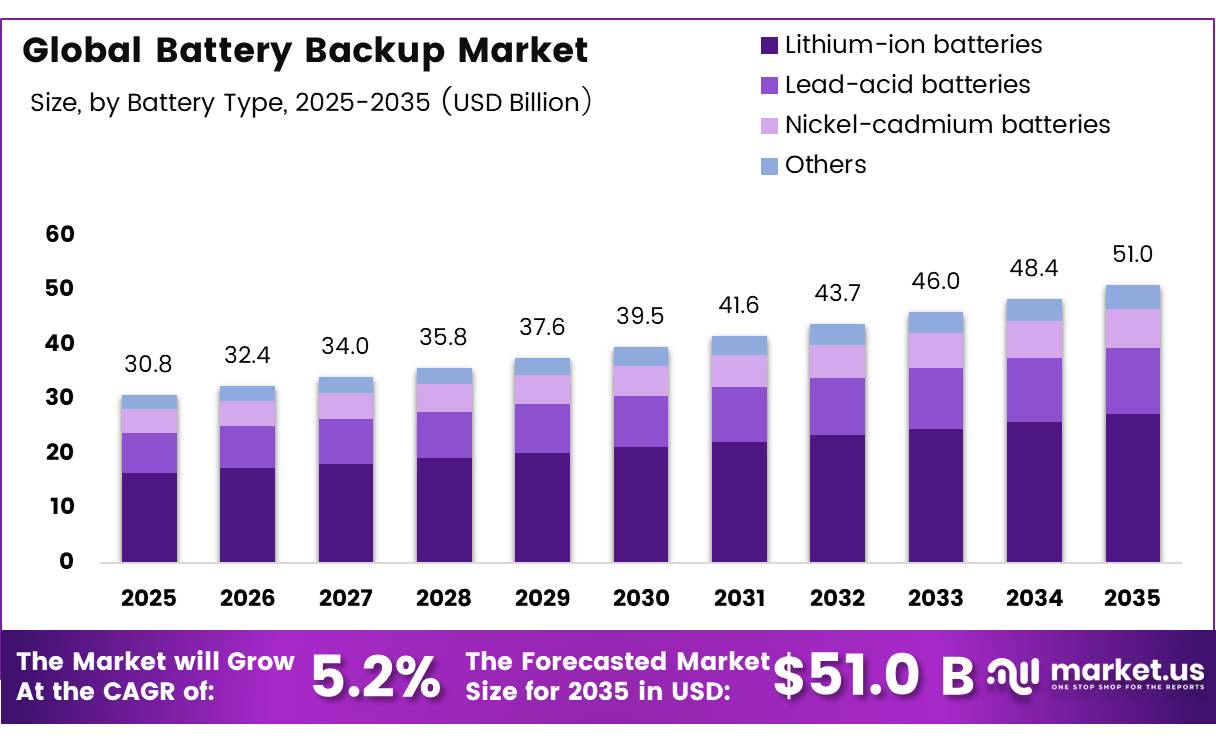
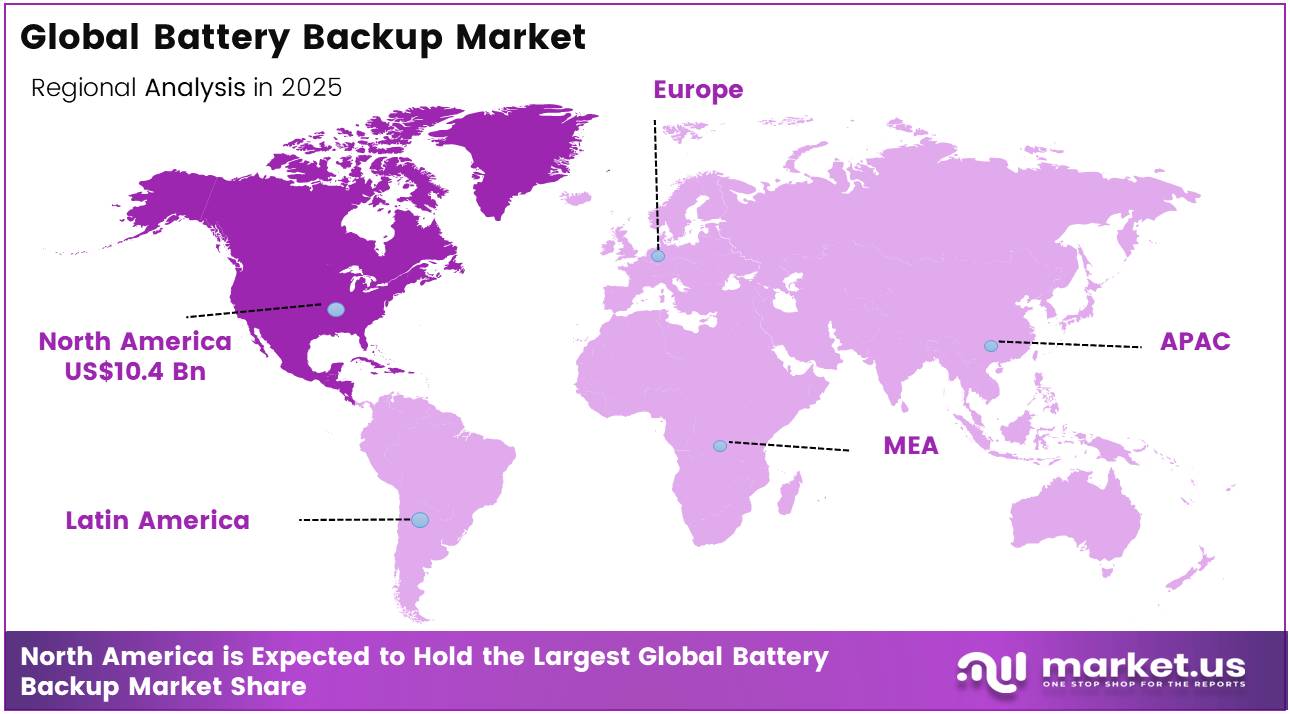
In 2025, the Global Battery Backup Market was valued at USD 30.8 billion, and between 2026 and 2035, this market is estimated to register a CAGR of 5.2%, reaching about USD 51.0 billion by 2035. In 2025, North America held a dominant market position, capturing more than a 34.0% share, holding USD 10.4 Billion revenue.
Battery backup systems provide stored electricity when the main grid or renewable source cannot maintain stable power. The category includes uninterruptible power supplies, stationary storage systems, battery banks, inverters, conversion equipment, monitoring software and transfer controls. These solutions protect data centres, telecommunications networks, hospitals, commercial and industrial facilities against outages and voltage disturbances.
- The International Energy Agency reported that 108 GW of battery storage was installed worldwide in 2025, representing 40% growth from 2024 and lifting installed capacity to eleven times its 2021 level. Lithium-iron-phosphate chemistry accounted for around 90% of deployments, while 80% of new capacity was utility-scale. Most projects still provide about two hours of storage, although four-hour systems are becoming more common as networks absorb more solar generation.
- In 2025, global data-centre electricity demand increased 17%, compared with 3% growth in total electricity demand, while five major technology companies invested more than $400 billion in capital expenditure. This expanding critical load is strengthening demand for UPS systems, modular batteries and intelligent backup controls.
The United States illustrates the speed of infrastructure expansion. The Energy Information Administration reported that utility-scale battery capacity exceeded 26 GW in 2024 after 10.4 GW was added during the year. A record 15 GW was commissioned in 2025. Demand is being reinforced by digital infrastructure: the Department of Energy estimated that data centres used 176 TWh, or 4.4% of national electricity, in 2023 and could consume 325–580 TWh, equal to 6.7–12%, by 2028. This creates stronger requirements for UPS systems, battery cabinets, microgrids and on-site resilience.
- Government support is strengthening supply and deployment. In January 2025, the U.S. Department of Energy announced its intention to provide up to $725 million for battery critical-material processing, components and advanced battery manufacturing. Such programmes can improve supply security and production scale.
Future growth opportunities will develop through microgrids, long-duration storage, telecom backup and behind-the-meter systems. European studies indicate storage capacity could exceed 200 GW by 2030 and reach 600 GW by 2050. The European Commission also states that the global storage pledge targets 1,500 GW by 2030. This outlook supports investment in safer chemistries, localized production and software-enabled energy management across residential, commercial and critical infrastructure applications worldwide.
Key Takeaways
- The global Battery Backup market was valued at USD 30.8 billion in 2025.
- The global market is projected to grow at a CAGR of 5.2% and is estimated to reach USD 51.0 billion by 2035.
- On the basis of battery type, the lithium-ion Battery Backup dominated the market, constituting 53.5% of the total market share.
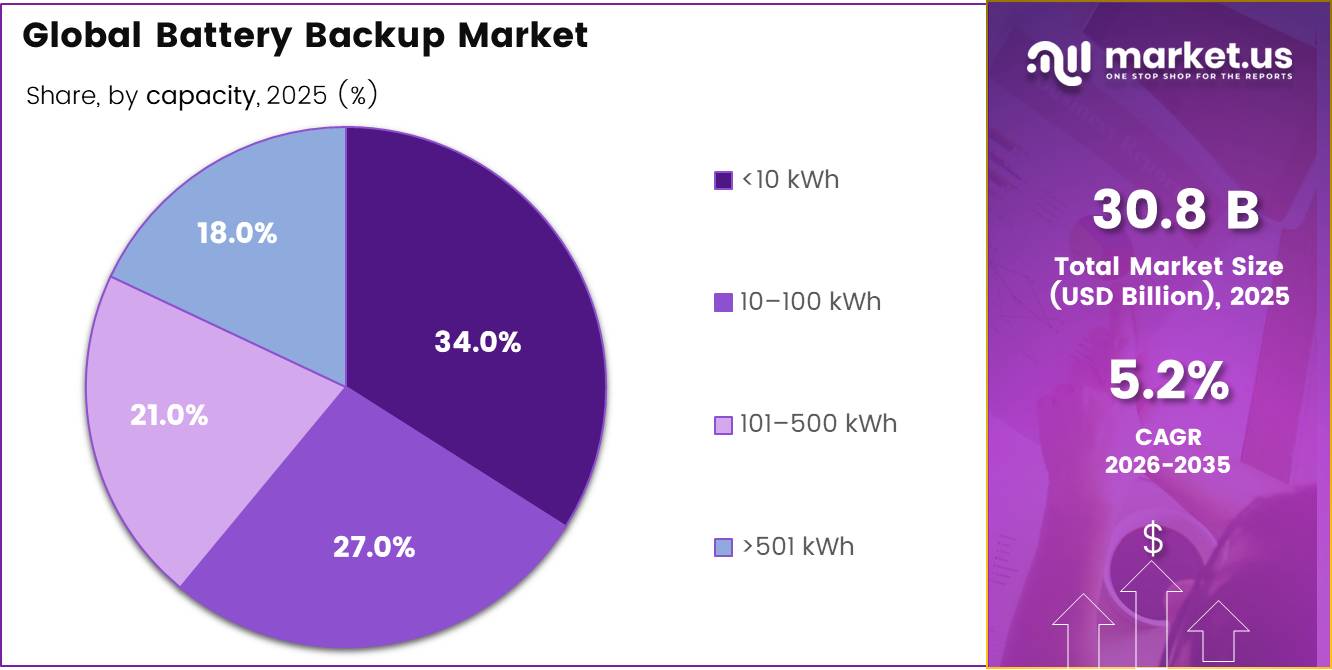
- Based on the capacity, the <10 kWh dominated the Battery Backup market, with a substantial market share of around 34.0%.
- Based on the end user, Commercial led the market, comprising 240% of the total market.
- Among the sales channel, the OEM/direct sales held a major share in the Battery Backup market, 35.0% of the market share.
- In 2025, the North America was the most dominant region in the Battery Backup market, accounting for 34.0% of the total global consumption.
Battery Type Analysis
Lithium-Ion (Li-Ion) Battery Backup represents dominant Segment in the Market.
Lithium-ion batteries held the leading position in the battery backup market with a 53.50% share. Their compact structure, quick charging and high energy density make them suitable for data centres, telecom facilities and commercial backup systems. In June 2026, the U.S. Geological Survey identified nearly 1.43 million metric tons of lithium oxide resources in the southern Appalachian region, potentially sufficient for around 1 million grid-scale batteries. This expanding resource base could strengthen future battery availability and support wider backup deployment.
Lead-acid batteries remain a growing segment because of their affordable cost, dependable performance and established recycling network. Under European battery rules, lead-acid batteries must achieve 75% recycling efficiency by the end of 2025. The required recovery rate for lead increases to 90% by 2027 and 95% by 2031, as outlined in the EU Batteries Regulation (Regulation (EU) 2023/1542), which sets progressive material recovery targets for battery recycling. These targets support closed-loop material use and help maintain lead-acid demand across emergency lighting, telecom backup and industrial standby systems.
Capacity Analysis
<10 kWh a significant type.
The below 10 kWh segment held the leading position with a 34.00% market share. These compact systems are widely used for household backup, small offices, security equipment and rooftop solar storage because they require less space and are easier to install. The UK government’s 2026 Warm Homes modelling uses a 4 kWh battery as a typical residential installation. The plan provides £15 billion in public investment and aims to upgrade up to 5 million homes with technologies including solar panels and batteries, creating a strong base for smaller backup systems.
The above 501 kWh segment is the growing category, supported by utility, industrial and renewable-energy projects requiring extended backup. In June 2026, Ofgem proposed investment support for 7.6 GW across 16 long-duration storage projects, representing 137 GWh of planned capacity. Such projects increase demand for high-capacity systems that can balance renewable generation, reduce grid pressure and maintain power during prolonged disruptions.
End user Analysis
Battery Backups Are Mostly Utilized in the Commercial Sector.
Commercial applications led the battery backup market with a 24.0% share. Offices, retail facilities, hospitals, warehouses and educational buildings increasingly require backup power to maintain lighting, security, communications and digital operations during outages. The U.S. Energy Information Administration identified approximately 5.9 million commercial buildings, covering 96.4 billion square feet and consuming nearly 6.8 quadrillion British thermal units of energy. This extensive building base supports continued demand for compact UPS units, distributed batteries and building-level energy storage.
Data centres represent the growing application as artificial intelligence and cloud computing increase electricity requirements. The U.S. Department of Energy reported that these facilities consumed 4.4% of U.S. electricity in 2023, equal to approximately 176 TWh. Their consumption could rise to between 6.7% and 12% by 2028, strengthening demand for high-capacity battery backup, microgrids and rapid-response power systems that protect servers from interruptions.
Sales channel Analysis
OEM/direct sales Held a Major Share of the Battery Backup Market.
OEM and direct sales led the battery backup market with a 35.00% share. This channel remains important because data centres, factories, utilities and telecom operators usually require customised systems, technical installation and long-term maintenance directly from manufacturers. In March 2026, the U.S. Department of Energy announced up to USD 500 million for battery-material processing, component manufacturing and recycling facilities. The program entered its third funding round and covered three project areas, supporting stronger domestic production and direct supplier relationships.
Online retail is the growing channel as households and small businesses increasingly compare capacities, prices and installation features digitally. The U.S. Census Bureau reported that retail e-commerce sales reached USD 326.7 billion in the first quarter of 2026, increasing 9.8% from the previous year and 2.7% from the preceding quarter. This digital momentum supports wider online availability of portable UPS units and compact residential backup batteries
Key Market Segments
By Battery Type
- Lithium-ion batteries
- Lead-acid batteries
- Nickel-cadmium batteries
- Others
By capacity
- Coated Separator
- Non-coated Separator
By end user
- Residential
- Commercial
- Offices
- Retail
- Hotels
- Educational institutions
- Healthcare facilities
- Industrial
- Manufacturing
- Oil and gas
- Mining
- Chemicals
- Food and beverage
- Data centers
- Telecommunications
- Utilities
- Others
By sales channel
- OEM/direct sales
- Distributors and dealers
- System integrators
- Online retail
- Aftermarket
Driver Analysis
AI-driven hyperscale data center expansion lifting UPS and backup demand
The buildout of AI training and inference infrastructure is the single largest near-term driver of battery backup demand because hyperscale and colocation operators cannot tolerate even brief power interruptions on GPU clusters, and this urgency is directly reflected in data center UPS market sizing that puts 2026 global value in a range of roughly $5.8-7.3 billion depending on segmentation, expanding toward $10.8-11.9 billion by the early 2030s at CAGRs clustering around 5.4-7.5%. Industry commentary attributes this growth explicitly to the escalating need for dependable power protection driven by cloud computing and AI workloads, with hyperscale facilities requiring high-density, reliable UPS units to mitigate costly service disruptions as compute density per rack rises sharply.
North America currently holds the largest share of this market at roughly 37% as of 2025, while Asia-Pacific is identified as the fastest-growing region, reflecting the concentration of AI data center capex in the US and China. Strategically, this driver is reshaping UPS business models from one-time equipment sales toward higher-margin service contracts bundling battery health monitoring, predictive replacement, and integration with on-site energy management software, since hyperscalers increasingly demand guaranteed uptime SLAs rather than standalone hardware; rising edge computing deployment is compounding this by creating demand for smaller, modular UPS systems distributed across micro-data centers rather than concentrated in centralized halls.
Drivers Impact Analysis
| Driver | (~) % Impact on CAGR Forecast | Geographic Relevance | Impact Timeline |
|---|---|---|---|
| AI-driven hyperscale data center expansion lifting UPS and backup demand | +2.0% | North America core, APAC (China), EU data hubs | Short term (≤ 2 years) |
| Sharp battery pack and BESS cost deflation improving backup unit economics | +1.6% | Global, APAC manufacturing core, EU adopters | Short term (≤ 2 years) |
| Rising grid outage frequency and aging infrastructure reliability gaps | +1.3% | North America core, EU legacy grids | Medium term (2-4 years) |
| Residential and commercial battery storage boom displacing generators | +1.2% | EU (Germany core), North America, APAC emerging | Medium term (2-4 years) |
| Lithium-ion displacement of lead-acid across UPS and backup fleets | +1.0% | North America, EU, APAC data center corridors | Medium term (2-4 years) |
| Grid-scale BESS integration creating adjacent backup and frequency-response revenue | +0.8% | China, US, Australia, EU grid operators | Long term (≥ 4 years) |
Restraint Analysis
Escalating US tariffs on Chinese lithium-ion batteries
Escalating US tariffs represent the single largest restraint on the battery backup market because the combined duty stack on Chinese-origin lithium-ion cells and packs has moved from roughly 11% before 2026 to approximately 82% as of January 1, 2026, comprising a 3.4% base MFN duty, a 54% reciprocal tariff, and a Section 301 surcharge that jumped from 7.5% to 25% specifically for non-EV lithium batteries, a category that explicitly captures grid-scale energy storage modules, power tool packs, and portable power stations under HTS code 8507.60.
This means a battery pack with a $100 factory price now carries roughly $82 in tariffs alone before customs clearance, and BloombergNEF separately estimated that broader 2025 tariff actions would raise storage battery prices by approximately 17.5% by 2026, compounding cost pressure already introduced under prior administration policy.
Restraint Impact Analysis
| Restraint | (~) % Impact on CAGR Forecast | Geographic Relevance | Impact Timeline |
|---|---|---|---|
| Escalating US tariffs on Chinese lithium-ion batteries | -2.0% | North America core, China-linked supply chains | Short term (≤ 2 years) |
| Recurring China graphite and battery material export controls | -1.3% | Global, North America and EU importers | Medium term (2-4 years) |
| Potential reversal of lithium price deflation | -1.1% | Global manufacturing hubs, APAC cell producers | Medium term (2-4 years) |
| Grid interconnection queue delays for BESS-linked backup projects | -1.0% | North America core, EU grid operators | Medium term (2-4 years) |
| Fire safety, code compliance and permitting friction | -0.8% | North America, EU regulatory hubs | Short term (≤ 2 years) |
| Anti-dumping and countervailing duties on active anode materials | -0.9% | North America core, China-sourced anode supply | Short term (≤ 2 years) |
Opportunity Analysis
Sodium-ion chemistry pivot for cost and safety-sensitive backup segments
Sodium-ion battery chemistry represents a forward strategic pivot rather than a current driver because as of 2026 it remains in the early stages of commercial scale-up, distinct from the lithium-ion cost deflation already embedded in baseline market growth. CATL confirmed full-scale sodium-ion mass production in 2026, with large-scale supply beginning in the fourth quarter, targeting energy density of 175 Wh/kg, cycle life exceeding 15,000 cycles at 80% capacity retention, and stable operation across a temperature range of -40°C to 70°C while retaining roughly 90% of nominal capacity at extreme cold, characteristics particularly valuable for backup applications in harsh climates where lithium-ion performance degrades.
Sodium-ion is targeted to reach roughly 30% lower cost than LFP within two years and a long-term cost target near $19/kWh compared with current LFP pricing around $55-60/kWh, while separate industry modeling projects a 143% ROI for sodium-based systems versus 22% ROI for legacy LFP systems in comparable use cases, reflecting both lower input costs and reduced fire-safety compliance burden given sodium-ion’s non-flammable chemistry profile. The IEA has flagged 2026 as a potentially pivotal year for sodium-ion scaling, noting that core manufacturing bottlenecks that constrained the technology for years have been resolved.
Opportunity Impact Analysis
| Opportunity | (~) % Potential CAGR Upside | Geographic Relevance | Execution Window |
|---|---|---|---|
| Virtual power plant aggregation monetizing idle backup capacity | +2.2% | North America core, EU (UK, Germany), Australia | Short term (≤ 2 years) |
| Sodium-ion chemistry pivot for cost and safety-sensitive backup segments | +1.7% | APAC (China), North America, EU emerging adopters | Medium term (2-4 years) |
| Vehicle-to-grid and vehicle-to-home backup integration | +1.5% | EU core (Germany, Netherlands, UK), APAC, North America | Long term (≥ 4 years) |
| Battery-as-a-Service subscription monetization model | +1.3% | North America, EU, APAC emerging middle-class markets | Medium term (2-4 years) |
| M&A roll-up of fragmented residential installer and integrator networks | +1.0% | North America, EU, APAC fragmented markets | Medium term (2-4 years) |
| Backup capacity resale into commercial/industrial demand-response markets | +0.9% | North America core, EU industrial corridors | Long term (≥ 4 years) |
Challenges Analysis
Chronic electrician and installer labor shortage
The Bureau of Labor Statistics counts 818,700 working electricians as of 2024 and projects roughly 81,000 job openings annually through 2034, with overall electrician employment growing 9% over the period, yet the trade is not producing new licensed workers fast enough to close this gap even before accounting for battery-specific installation demand layered on top of core electrical work.
The national median electrician salary of $62,350 annually is already climbing in tight regional markets, with some areas like New Jersey estimating a need for over 2,000 new electricians just to meet baseline 2026 demand, and this wage inflation directly raises installed cost per battery backup unit as installers pass higher labor costs through to customers.
Strategically, this challenge requires sustained multi-year investment in workforce development pipelines rather than a quick fix, and until vocational training capacity scales meaningfully, it will continue to impose a roughly 1.3-1.5 percentage-point drag on achievable CAGR by capping installation throughput capacity across North America and EU installer networks.
Challenges Impact Analysis
| Challenge | (~) % CAGR Friction Drag | Geographic Relevance | Mitigation Horizon |
|---|---|---|---|
| Chronic electrician and installer labor shortage | -1.4% | North America core, EU installer networks | Long term (≥ 4 years) |
| Grid transformer and distribution equipment scarcity | -1.2% | North America core, EU aging grid regions | Long term (≥ 4 years) |
| End-of-life battery recycling and second-life logistics | -0.9% | North America, EU, APAC manufacturing hubs | Medium term (2-4 years) |
| Cybersecurity vulnerabilities in grid-connected smart inverters | -0.8% | Global, APAC import-dependent markets (India) | Medium term (2-4 years) |
| Thermal management and performance degradation at scale | -0.7% | APAC humid/hot climates, North America, EU | Short term (≤ 2 years) |
| Supply chain diversification and requalification lag | -1.0% | North America, EU, non-China cell sourcing corridors | Medium term (2-4 years) |
Geopolitical Impact Analysis
Critical-Mineral Rivalry and Regional Industrial Policies Reshaping Battery Backup Supply Chains
Battery backup manufacturing is increasingly exposed to geopolitical pressure because lithium-ion systems depend on minerals concentrated in a limited number of countries. The European Commission reports that the Democratic Republic of Congo supplies 63% of global cobalt, creating vulnerability to political instability, trade restrictions and transport disruption. To reduce dependence, the EU requires that no more than 65% of any strategic raw material should come from one non-EU country. Its 2030 targets also call for domestic extraction equal to 10% of annual demand.
Government intervention is encouraging battery producers to regionalise sourcing, recycling and material processing. In May 2026, the U.S. Department of Energy allocated USD 45.7 million across 19 projects after reporting that foreign sources provide more than 50% of most critical minerals. These measures should support alternative graphite, lithium and battery-recycling technologies, but regional production may initially raise costs as manufacturers build new facilities, qualify suppliers and restructure long-established international supply routes.
Regional Analysis
North America Held the Largest Share of the Global Battery Backup Market.
North America led the battery backup market with a 34.00% share. Demand is supported by data infrastructure, remote microgrids and public investment in reliable electricity systems. In June 2026, the Canadian government announced CAD 21.6 million for Manitoba’s first integrated renewable microgrid combining solar power, battery storage and a microgrid controller. Canada’s Clean Energy for Rural and Remote Communities program has also invested CAD 453 million and supported more than 230 projects, strengthening backup-power deployment in isolated areas.
Asia Pacific is the growing regional market as governments expand renewable generation and dispatchable storage. Australia’s Capacity Investment Scheme targets 14 GW of clean dispatchable capacity by 2030. The program is expected to support around AUD 73 billion in electricity-sector investment while helping the country move toward 82% renewable electricity, creating strong opportunities for battery backup, grid-balancing and commercial storage systems.
Key Regions and Countries
- North America
- The US
- Canada
- Europe
- Germany
- France
- The UK
- Spain
- Italy
- Russia & CIS
- Rest of Europe
- APAC
- China
- Japan
- South Korea
- India
- ASEAN
- Rest of APAC
- Latin America
- Brazil
- Mexico
- Rest of Latin America
- Middle East & Africa
- GCC
- South Africa
- Rest of MEA
Key Players Analysis
Battery Backup manufacturers focus on improving system reliability, response speed, product scalability, and service integration to remain competitive. A major priority is continuous technology development, including modular lithium-ion systems, advanced battery management software, thermal protection, and high-efficiency power conversion that improve runtime, safety, and operating performance across critical applications. Companies also invest in automated assembly and flexible manufacturing lines, as these support consistent quality and faster customization for data centres, telecom networks, commercial facilities, and industrial users.
Closer integration with battery cell suppliers, inverter producers, and energy management platform providers helps reduce procurement risk and improve cost control during periods of material and component volatility. Strategic production expansion near major demand centres allows manufacturers to respond more quickly to regional requirements and shorten delivery times. In addition, companies emphasize predictive maintenance, remote monitoring, certification compliance, and lifecycle service contracts, while developing long-term supply relationships with utilities, infrastructure operators, and enterprise customers to strengthen retention and secure recurring revenue.
The Major Players In The Industry
- Schneider Electric SE
- Eaton Corporation plc
- Vertiv Holdings Co.
- Delta Electronics, Inc.
- Huawei Digital Power Technologies Co., Ltd.
- ABB Ltd.
- Cyber Power Systems, Inc.
- Tesla, Inc.
- Generac Holdings Inc.
- Enphase Energy, Inc.
- LG Energy Solution Ltd.
- Panasonic Energy Co., Ltd.
- Samsung SDI Co., Ltd.
- BYD Company Ltd.
- Exide Technologies
Key Development
- In July 2025, Eaton Corporation partnered with NVIDIA to develop power-management architectures for high-density AI data centres. The collaboration combines Eaton’s infrastructure, backup power expertise and capabilities to improve resilience from the grid to computing systems.
- In November 2025, Delta Electronics launched its C-Series all-in-one energy storage system for commercial and industrial users. The 125-kW, 261-kWh cabinet integrates LFP batteries, liquid cooling and energy management, while supporting backup power and multi-cabinet expansion.
Report Scope
| Report Features | Description |
|---|---|
| Market Value (2025) | USD 30.8 Bn |
| Forecast Revenue (2035) | USD 51.0 Bn |
| CAGR (2026-2035) | 5.2% |
| Base Year for Estimation | 2025 |
| Historic Period | 2020-2024 |
| Forecast Period | 2026-2035 |
| Report Coverage | Revenue Forecast, Market Dynamics, Competitive Landscape, Recent Developments |
| Segments Covered | By Battery type (Lithium-ion batteries, Lead-acid batteries, Nickel-cadmium batteries and Others), By capacity ( <10 kWh, 10–100 kWh, 101–500 kWh and >501 kWh), By end user (Residential, Commercial, Educational institutions, Industrial, Data centers, Telecommunications, Utilities and Others), By sales channel (OEM/direct sales, Distributors and dealers, System integrators, Online retail and Aftermarket) |
| Regional Analysis | North America – The US & Canada; Europe – Germany, France, The UK, Spain, Italy, Russia & CIS, Rest of Europe; APAC– China, Japan, South Korea, India, ASEAN & Rest of APAC; Latin America– Brazil, Mexico & Rest of Latin America; Middle East & Africa– GCC, South Africa, & Rest of MEA |
| Competitive Landscape | Schneider Electric SE — APC, Eaton Corporation plc — Tripp Lite, Vertiv Holdings Co., Delta Electronics, Inc., Huawei Digital Power Technologies Co., Ltd., ABB Ltd., Cyber Power Systems, Inc., Tesla, Inc., Generac Holdings Inc., Enphase Energy, Inc., LG Energy Solution Ltd., Panasonic Energy Co., Ltd., Samsung SDI Co., Ltd., BYD Company Ltd., Exide Technologies. |
| Customization Scope | Customization for segments, region/country-level will be provided. Moreover, additional customization can be done based on the requirements. |
| Purchase Options | We have three licenses to opt for: Single User License, Multi-User License (Up to 5 Users), Corporate Use License (Unlimited Users and Printable PDF) |





































