


Report Overview
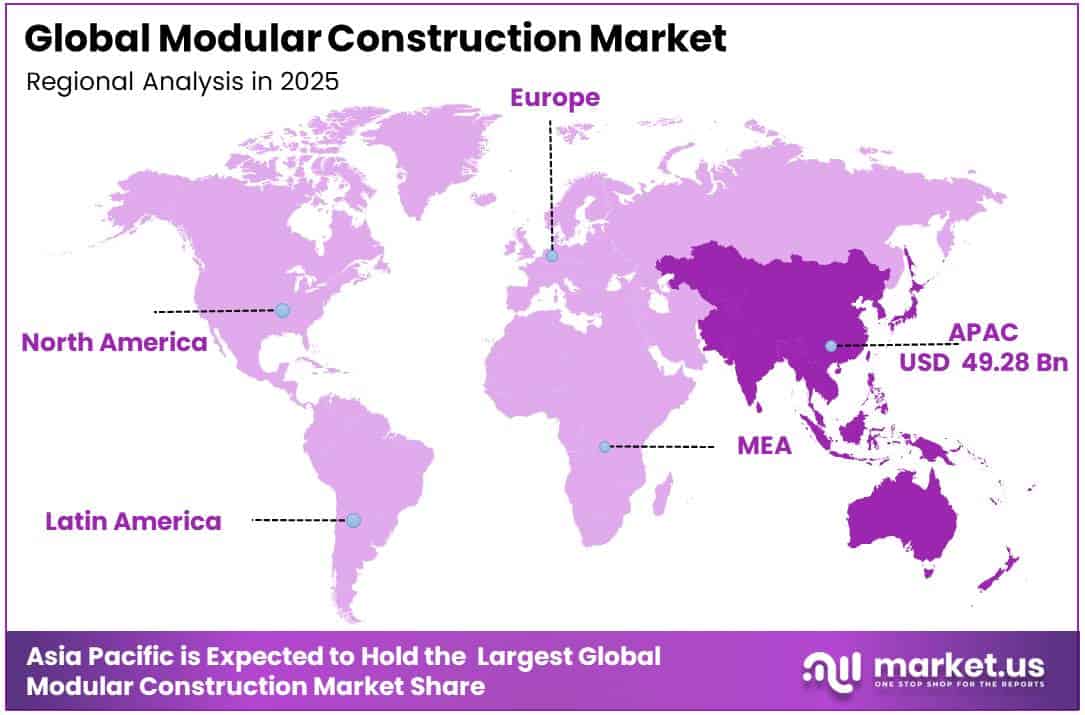
In 2025, the Global Modular Construction Market was valued at USD 109.0 Billion, and between 2026 and 2035, this market is estimated to register a CAGR of 6.8%, reaching about USD 210.8 Billion by 2035. Asia Pacific held a dominant market position, capturing more than a 45.2% share, holding USD 49.28 Billion in revenue.
Modular construction is a manufacturing-driven building method in which components, or modules, are fabricated in a factory and then transported to the final site for assembly. This approach spans permanent modular construction used for multifamily housing, healthcare, education and commercial buildings, as well as relocatable buildings used for temporary and flexible space needs.
- According to the Modular Building Institute (MBI), the United States permanent modular construction market reached 20.5 billion dollars in 2025, representing approximately 5.1% of construction activity in key segments, and is projected to expand at a compound annual growth rate of 6.5% through 2030.
- In Canada, the modular construction market represents approximately 5.5% of the overall national construction market and is forecast to outpace traditional construction growth by a full percentage point, with multifamily residential construction growing at 7.3%, the fastest rate among segments.
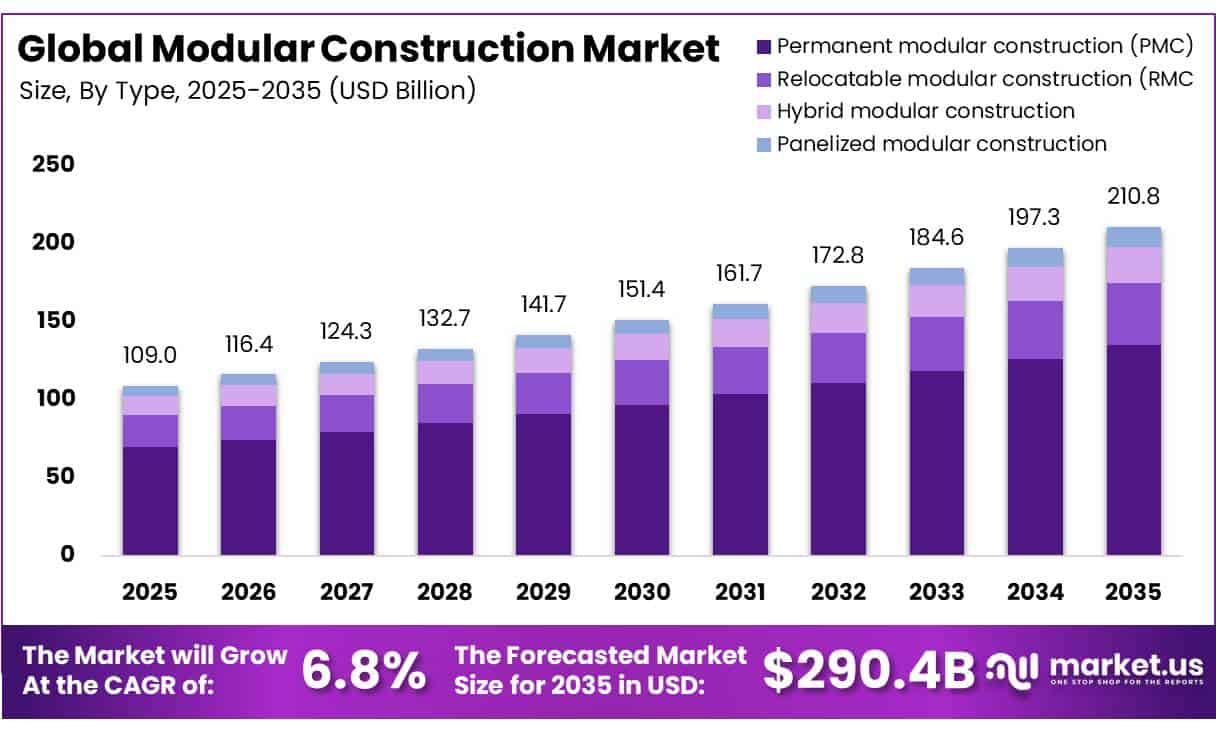
Growth is driven by persistent skilled labor shortages, compressed schedules and rising demand for cost certainty. The Modular Building Institute reports that factory-based production can reduce project timelines by 20 to 50% compared with conventional construction. Emerging opportunities include office buildings and data centers, alongside expansion in multifamily residential, healthcare and education facilities, supported by population growth and aging infrastructure across developed markets.
Government support continues to shape adoption. The United Kingdom’s Industrial Strategy identified modern methods of construction as central to reforming residential construction, targeting 300,000 new homes annually and 1 million homes between 2017 and 2020, according to the UK Parliament’s Housing, Communities and Local Government Committee.
Key Takeaways
- The Global Modular Construction Market was valued at USD 109.0 billion in 2025.
- The global modular construction market is projected to grow at a CAGR of 8% and is estimated to reach USD 210.8 billion by 2035.
- On the basis of type, Permanent Modular Construction (PMC) dominated the market, constituting 64.1% of the total market share.
- Based on the material, Steel dominated the market, accounting for 48.2% of the total market share.
- Based on the construction method, Volumetric Modules dominated the market, accounting for 32.2% of the total market share.
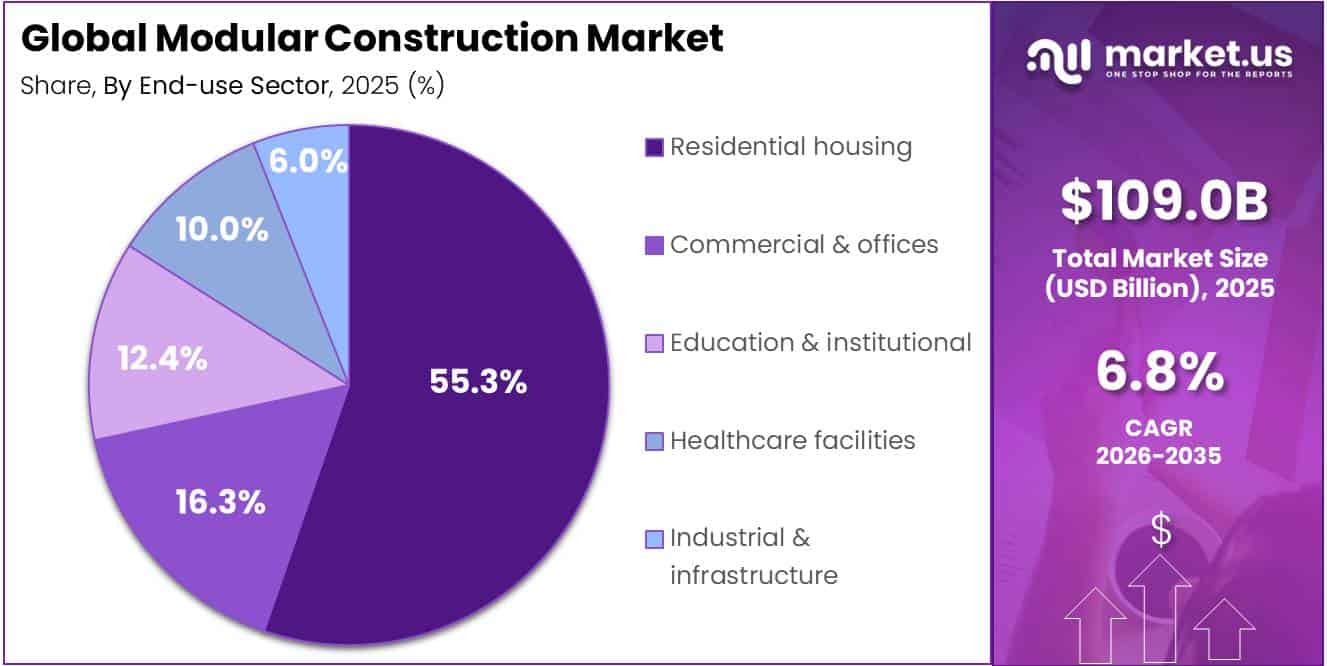
- Based on the end-use sector, Residential Housing dominated the market, accounting for 55.3% of the total market share.
- In 2025, Asia Pacific was the most dominant region in the modular construction market, accounting for 45.2% of the global market.
By Type
Permanent Modular Construction (PMC) dominates with 64.1% due to its widespread use in long-term building projects.
In 2025, Permanent modular construction (PMC) held a dominant market position, capturing more than a 64.1% share of the Modular Construction Market. Its leading position was supported by increasing adoption in permanent residential, commercial, healthcare, and educational buildings where long service life, consistent construction quality, and reduced on-site activity are important.
According to guidance and project information published by organizations such as the Modular Building Institute (MBI) and government construction agencies, permanent modular construction continues to be used for projects requiring durable, code-compliant structures that are intended to remain in place throughout their design life. This approach also supports improved scheduling and better coordination across large-scale construction projects.
Relocatable Modular Construction (RMC) is projected to be the fastest-growing segment during the forecast period due to rising demand for flexible and reusable building solutions across temporary and semi-permanent applications. These structures can be transported, installed, relocated, and reused at different sites, making them suitable for changing space requirements in sectors such as education, healthcare, construction, and industrial operations.
By Material
Steel dominates with 48.2% due to its high strength, durability, and suitability for factory-built modular structures.
In 2025, Steel held a dominant market position, capturing more than a 48.2% share of the Modular Construction Market. Its leading position was driven by its high structural strength, dimensional accuracy, and ability to support efficient off-site manufacturing. Steel is widely used in modular construction because it enables the production of standardized building modules with consistent quality while reducing material waste during fabrication.
Concrete / precast concrete is expected to be the fastest-growing material segment over the forecast period due to increasing demand for durable, low-maintenance, and high-performance building solutions. Precast concrete components are manufactured in controlled factory environments, allowing consistent quality and faster installation at construction sites.
By Construction Method
Volumetric modules dominate with 32.2% as they enable faster project completion through factory-built building units.
In 2025, Volumetric modules held a dominant market position, capturing more than a 32.2% share of the Modular Construction Market. Their strong position was supported by the ability to manufacture complete three-dimensional building units in controlled factory environments before transporting them to the construction site for installation. This approach helps improve construction efficiency, reduces on-site labor requirements, and allows better quality control throughout the manufacturing process
Panelized modules are expected to experience steady growth over the forecast period as developers continue to adopt flexible off-site construction methods for a wide range of building projects. Unlike complete volumetric units, panelized systems are manufactured as wall, floor, and roof sections that are assembled on-site, providing greater design flexibility and easier transportation.
By End-Use Sector
Residential housing dominates with 55.3% as modular construction helps deliver homes faster and more efficiently.
In 2025, Residential housing held a dominant market position, capturing more than a 55.3% share of the Modular Construction Market. Its leading position was supported by growing demand for faster housing delivery, improved construction efficiency, and better quality control through factory-based production.
Commercial & offices are expected to be the fastest-growing end-use segment during the forecast period as businesses seek quicker project completion and greater flexibility in building development.
Key Market Segments
By Type
- Permanent modular construction (PMC)
- Relocatable modular construction (RMC
- Hybrid modular construction
- Panelized modular construction
By Material
- Steel
- Concrete / precast concrete
- Wood / timber
- Plastics, composites, and other materials
By Construction Method
- Volumetric modules
- Panelized modules
- Mixed modules & floor cassettes
- Modules supported by a primary structure
By End-use Sector
- Residential housing
- Commercial & offices
- Education & institutional
- Healthcare facilities
- Industrial & infrastructure
Driver Analysis
Housing-Supply Deficit and Affordable-Home Programs
Housing undersupply is the most immediate volume catalyst because modular construction converts a traditionally sequential, site-dependent delivery model into a parallel manufacturing-and-site-preparation process, allowing foundations, utilities and factory production to proceed concurrently.
The United States alone is estimated to face an approximately 4.5 million-home supply shortfall, while Europe’s new Affordable Housing Plan is explicitly designed to improve construction-sector productivity, innovation and affordability through the European Strategy for Housing Construction, which identifies off-site and modular methods as priority tools for cutting cost and accelerating supply.
This improves developer internal rates of return by bringing rental cash flow forward, reduces weather-delay exposure, and makes large public housing programs more financeable where agencies prioritize unit completion dates rather than lowest initial tender price.
Drivers Impact Analysis
| Driver | (~) % Impact on CAGR Forecast | Geographic Relevance | Impact Timeline |
|---|---|---|---|
| Housing-supply deficit and affordable-home programs | +2.8% | North America core, EU, India, GCC | Medium term (2-4 years) |
| Skilled-trade shortages shifting work off-site | +2.3% | North America, EU, Japan, Australia | Short term (≤ 2 years) |
| Public procurement and code standardization | +1.9% | U.S., Singapore, EU, UK | Medium term (2-4 years) |
| Robotics-enabled microfactory expansion | +1.7% | North America core, EU, APAC hubs | Medium term (2-4 years) |
| Low-carbon building and circularity compliance | +1.5% | EU core, UK, Canada, Australia | Long term (≥ 4 years) |
| Industrial, data-center and workforce-housing demand | +1.6% | U.S., India, Southeast Asia, GCC | Short term (≤ 2 years) |
Restraint Analysis
Upfront Factory CapEx and Low Utilization Risk
Modular construction requires capital to be committed before sales are fully secured because manufacturers must invest in land, factory shells, lifting equipment, CNC cutting lines, welders, jigs, material-handling systems, quality-control stations, design software, working-capital inventories and trained labor, creating a fixed-cost structure that becomes uneconomic when plant utilization falls below roughly 60–70% of rated capacity; unlike conventional contractors that can reduce subcontractor volumes project by project, a modular producer continues to carry factory lease or depreciation, engineering, production supervision and quality costs during order gaps.
The economic consequence is severe because a facility designed for 1,000–2,000 housing modules annually may need a stable backlog of approximately 12–18 months to maintain production flow, yet developers often award contracts only after land, permits, debt financing and pre-sales are complete
This mismatch forces producers either to discount prices to keep lines active, compressing gross margins by an estimated 400–800 basis points, or retain capacity and absorb fixed overhead. The restraint is particularly relevant in emerging U.S., European, Australian and Indian markets where regional demand may be substantial but fragmented across too many designs, jurisdictions and developer types to support a standardized factory pipeline.
Restraint Impact Analysis
| Restraint | (~) % Impact on CAGR | Geographic Relevance | Impact Timeline |
|---|---|---|---|
| Upfront factory CapEx and low utilization risk | -2.4% | North America, EU, Australia, India | Medium term (2-4 years) |
| Misaligned construction finance and draw schedules | -2.1% | North America core, Australia, UK | Short term (≤ 2 years) |
| Steel, lumber and component tariff inflation | -1.8% | U.S., Canada, EU import markets | Short to medium term |
| Oversize transport and last-mile constraints | -1.5% | North America, EU, APAC corridors | Medium term (2-4 years) |
| Fragmented codes, approvals and inspections | -1.4% | U.S. states, India, EU markets | Medium term (2-4 years) |
| Insurance, warranty and liability gaps | -1.2% | North America, Australia, UK | Long term (≥ 4 years) |
Opportunity Analysis
Data-Center MEP Skid Platforms
The largest near-term white space is not the delivery of complete modular data centers, which is already an established adjacent segment, but the productization of standardized electrical, cooling and power-distribution skids for conventional hyperscale, colocation and enterprise facilities that remain structurally built on-site; these customers increasingly need prefabricated electrical rooms, UPS blocks, switchgear assemblies, chiller skids, liquid-cooling distribution units, generator enclosures and battery rooms that can be factory tested before delivery.
Modular data center revenue generated through on-site prefabricated components increased from approximately $2.3 billion in 2020 to $3.25 billion in 2023, while the segment was forecast to grow around 13% annually through 2026; importantly, demand is shifting from full containerized facilities toward subsystem modularity, where conventional buildings use factory-built power, cooling and white-space pods to accelerate phased capacity expansion.
A modular manufacturer that captures even 5–10% of a typical facility’s MEP package can access product values materially higher than standard apartment modules, because electrical and cooling systems can represent 30–45% of data-center construction cost; factory acceptance testing can remove weeks from commissioning, reduce site labor demand by 20–35%, and create repeat revenue through standardized 5–20 MW capacity blocks.
Opportunity Impact Analysis
| Opportunity | (~) % Potential CAGR Upside | Geographic Relevance | Execution Window |
|---|---|---|---|
| Data-center MEP skid platforms | +2.8% | North America core, EU, India, GCC | Short term (≤ 2 years) |
| Office-to-housing conversion kits | +2.3% | U.S. urban cores, UK, EU | Medium term (2-4 years) |
| Robotics microfactory networks | +2.5% | North America, EU, Australia, Japan | Medium term (2-4 years) |
| Disaster-recovery module leasing | +1.7% | U.S., Caribbean, APAC, LATAM | Short term (≤ 2 years) |
| Circular module buy-back platforms | +1.4% | EU, UK, Canada, Australia | Long term (≥ 4 years) |
| Affordable-housing public-private platforms | +2.1% | EU, India, Africa, Southeast Asia | Medium term (2-4 years) |
Challenges Analysis
Design-Freeze Coordination Gaps
Modular construction transfers an estimated 70–80% of project activity into factory production, which makes early design certainty commercially essential but difficult to achieve because developers, architects, structural engineers, MEP designers, lenders, local authorities, suppliers and site contractors must finalize module dimensions, interface details, rated-wall assemblies, plumbing stacks, electrical routing, façade penetrations and fixture selections before fabrication begins; unlike conventional construction, where many changes can be absorbed sequentially on site, a late alteration after factory release can affect multiple modules, disrupt component orders and create rework across structural, MEP and finishing lines.
A formal design-freeze process can take 30–60 days for standardized projects, but the absence of a clearly defined freeze date often creates 10–20% more design iteration, 5–15% additional factory rework exposure and 2–6 weeks of lost production-slot time; because factory output is tightly sequenced, these delays also reduce utilization and damage the economics of the next project in the line.
Challenges Impact Analysis
| Challenge | (~) % CAGR Friction | Geographic Relevance | Mitigation Horizon |
|---|---|---|---|
| Design-freeze coordination gaps | -1.4% | North America, EU, Australia | Medium term (2-4 years) |
| Factory workforce specialization deficit | -1.2% | North America core, EU, Japan | Long term (≥ 4 years) |
| Multi-tier component lead-time volatility | -1.1% | Global, APAC supply corridors | Medium term (2-4 years) |
| Site-factory schedule synchronization | -1.0% | North America, EU, India, GCC | Medium term (2-4 years) |
| Quality traceability and warranty control | -0.9% | North America, EU regulatory hubs | Long term (≥ 4 years) |
| Digital interoperability across stakeholders | -0.8% | Global, EU, APAC emerging markets | Medium term (2-4 years) |
Geopolitical Impact Analysis
Geopolitical tensions raise cost pressure across the Modular Construction Market.
The ongoing conflicts in Eastern Europe and the Middle East continue to influence the Modular Construction Market by disrupting global supplies of steel, construction materials, energy, and shipping services. Modular construction depends heavily on factory manufacturing, making it sensitive to fluctuations in raw material availability and transport costs.
According to the International Energy Agency (IEA), around 20 million barrels per day of crude oil and oil products moved through the Strait of Hormuz in 2025, representing about 25% of global seaborne oil trade, making any disruption a direct concern for manufacturing industries worldwide.
At the same time, governments and contractors are placing greater emphasis on regional manufacturing capacity and supply chain resilience to reduce dependence on overseas suppliers. This shift is encouraging more localized production of modular building components and stronger inventory planning.
Industry bodies and public infrastructure agencies are also prioritizing domestic sourcing where practical to improve project certainty. While geopolitical uncertainty continues to create short-term cost pressures, the modular construction sector remains supported by its factory-based production model, which offers better scheduling, quality control, and material management than many conventional construction methods.
Regional Analysis
Modular Construction Market – Regional Analysis
Asia Pacific dominates the global modular construction market, holding a 45.2% share valued at 49.28 billion dollars, driven by rapid urbanization, large-scale public housing programs and sustained government backing for offsite manufacturing across the region.
Singapore’s Building and Construction Authority (BCA) has mandated Prefabricated Prefinished Volumetric Construction (PPVC) for select non-landed residential developments under the Government Land Sales programme since 1 November 2014, embedding modular methods directly into public land tender requirements and reinforcing consistent institutional demand for factory-built modules within the city-state’s construction sector.
In Japan, the Japan Prefabricated Construction Suppliers and Manufacturers Association, operating under its Eco Action 2020 plan, has set a new-construction net zero energy house supply ratio target of 70% along with a target to cut residential-stage carbon dioxide emissions per unit by 60% compared with 2010 levels, linking prefabricated housing directly to national decarbonization goals and long-term energy policy.
Combined with the region’s dense urban centers, persistent housing demand, disaster-resilient construction needs and long-established prefabrication supply chains across Northeast and Southeast Asia, these government and trade-association-driven frameworks support the durability of Asia Pacific’s dominant 45.2% share and position the region for continued modular construction expansion relative to other global markets.
Key Regions and Countries Covered
- North America
- The US
- Canada
- Europe
- Germany
- France
- The UK
- Spain
- Italy
- Russia & CIS
- Rest of Europe
- APAC
- China
- Japan
- South Korea
- India
- ASEAN
- Rest of APAC
- Latin America
- Brazil
- Mexico
- Rest of Latin America
- Middle East & Africa
- GCC
- South Africa
- Rest of MEA
Key Players Analysis
Modular construction companies focus on expanding factory-based production, improving manufacturing efficiency, and strengthening integrated project delivery to remain competitive. A major priority is the adoption of advanced digital design tools, standardized building systems, and automated production lines that improve precision while reducing construction time and material waste.
Manufacturers continue to invest in volumetric and panelized building technologies that support consistent quality across residential, commercial, healthcare, and institutional projects. Companies also emphasize the use of durable materials such as structural steel and precast concrete to enhance building performance and simplify transportation and on-site installation.
Close collaboration with architects, engineering firms, component suppliers, and logistics providers helps improve project coordination, manage costs, and ensure timely delivery. Many participants are also increasing investments in sustainable manufacturing practices and energy-efficient production facilities to meet evolving building regulations and customer expectations.
The Major Players in The Industry
- Sekisui House Ltd.
- Laing O’Rourke
- Skanska AB
- Bouygues Construction
- Lendlease Corporation
- Red Sea International Company
- ATCO Ltd.
- Modulaire Group
- Guerdon Modular Buildings (Guerdon, LLC)
- Premier Modular Limited
- KLEUSBERG GmbH & Co. KG
- CIMC Modular Building Systems Holdings (CIMC‑MBS)
- Z Modular
- Clayton Homes
- Daiwa House Industry Co., Ltd.
Key Development
- January 2026 -Gurit Holding AG signed a long-term supply agreement for core material kits with a leading wind turbine OEM, its first major contract using the OptiCore core-kit technology.
- March 2026 -Gurit Holding AG secured a two-year, CHF 10 million contract for glass pultruded blade root reinforcements with a leading Asia-Pacific wind turbine manufacturer.
- February 2026 -Diab Group partnered with CompPair to combine Divinycell foam cores with HealTech repair technology, drawing on Diab’s 75 years of foam core expertise.
- March 2026 -Diab Group and Hankuk Carbon (South Korea) signed an MoU for marine technology R&D at JEC World 2026 in Paris.
Report Scope
| Report Features | Description |
|---|---|
| Market Value (2025) | USD 109.0 Bn |
| Forecast Revenue (2035) | USD 210.8 Bn |
| CAGR (2026 2035) | 6.8% |
| Base Year for Estimation | 2025 |
| Historic Period | 2020-2024 |
| Forecast Period | 2026-2035 |
| Report Coverage | Revenue Forecast, Market Dynamics, Competitive Landscape, Recent Developments |
| Segments Covered | By Type (Permanent Modular Construction (PMC), Relocatable Modular Construction (RMC), Hybrid Modular Construction, Panelized Modular Construction), By Material (Steel, Concrete / Precast Concrete, Wood / Timber, Plastics, Composites, and Other Materials), By Construction Method (Volumetric Modules, Panelized Modules, Mixed Modules & Floor Cassettes, Modules Supported by a Primary Structure), By End-use Sector (Residential Housing, Commercial & Offices, Education & Institutional, Healthcare Facilities, Industrial & Infrastructure) |
| Regional Analysis | North America The US & Canada; Europe Germany, France, The UK, Spain, Italy, Russia & CIS, Rest of Europe; APAC China, Japan, South Korea, India, ASEAN & Rest of APAC; Latin America Brazil, Mexico & Rest of Latin America; Middle East & Africa GCC, South Africa, & Rest of MEA |
| Competitive Landscape | Sekisui House Ltd., Laing O’Rourke, Skanska AB, Bouygues Construction, Lendlease Corporation, Red Sea International Company, ATCO Ltd., Modulaire Group, Guerdon Modular Buildings (Guerdon, LLC), Premier Modular Limited, KLEUSBERG GmbH & Co. KG, CIMC Modular Building Systems Holdings (CIMC-MBS), Z Modular, Clayton Homes, and Daiwa House Industry Co., Ltd. |
| Customization Scope | Customization for segments, region/country level will be provided. Moreover, additional customization can be done based on the requirements. |
| Purchase Options | We have three licenses to opt for: Single User License, Multi User License (Up to 5 Users), Corporate Use License (Unlimited Users and Printable PDF) |





































