Report Overview
Global Rescue Pole Market size is expected to be worth around USD 113.7 Billion by 2035 from USD 20.7 Billion in 2025, growing at a CAGR of 18.5% during the forecast period 2026 to 2035.
The rescue pole market encompasses rigid and telescopic shaft products designed to extend a rescuer’s reach during water, mountain, urban, and industrial emergencies. Products span fixed-length and telescopic configurations, manufactured from carbon fiber, fiberglass, aluminum, and steel. End users include fire and emergency services, aquatic rescue teams, utility maintenance crews, and industrial safety officers operating across diverse hazard environments.
Key Takeaways
- The Global Rescue Pole Market is valued at USD 20.7 Billion in 2025 and is forecast to reach USD 113.7 Billion by 2035, growing at a CAGR of 18.5% during the forecast period 2026 to 2035.
- By Type, Telescopic Rescue Poles dominate the market with a 54.34% share in 2025, driven by adjustable reach capability across multi-hazard deployment environments.
- By Material, Carbon Fiber leads with a 46.78% share in 2025, preferred for its superior strength-to-weight ratio in professional emergency-service applications. Aluminum is the fastest-growing material segment.
- By Application, Water Rescue holds the largest share at 37.89% in 2025, supported by universal shore-based retrieval protocols across fire, coastguard, and lifeguard agencies. Industrial Rescue is the fastest-growing application segment.
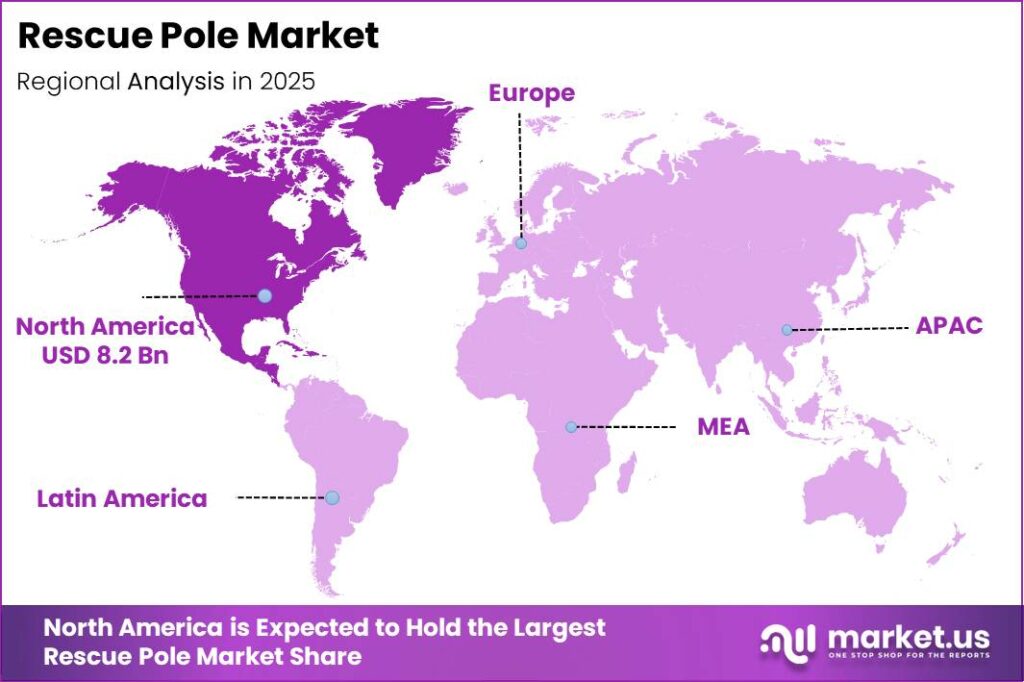
- North America is the dominant region with a 40.45% market share, valued at USD 8.2 Billion in 2025, supported by structured public procurement frameworks and OSHA-mandated equipment replacement cycles.
- Asia-Pacific is the fastest-growing region, driven by expanding industrial safety regulation, aquaculture growth, and increased government investment in emergency-response capacity.
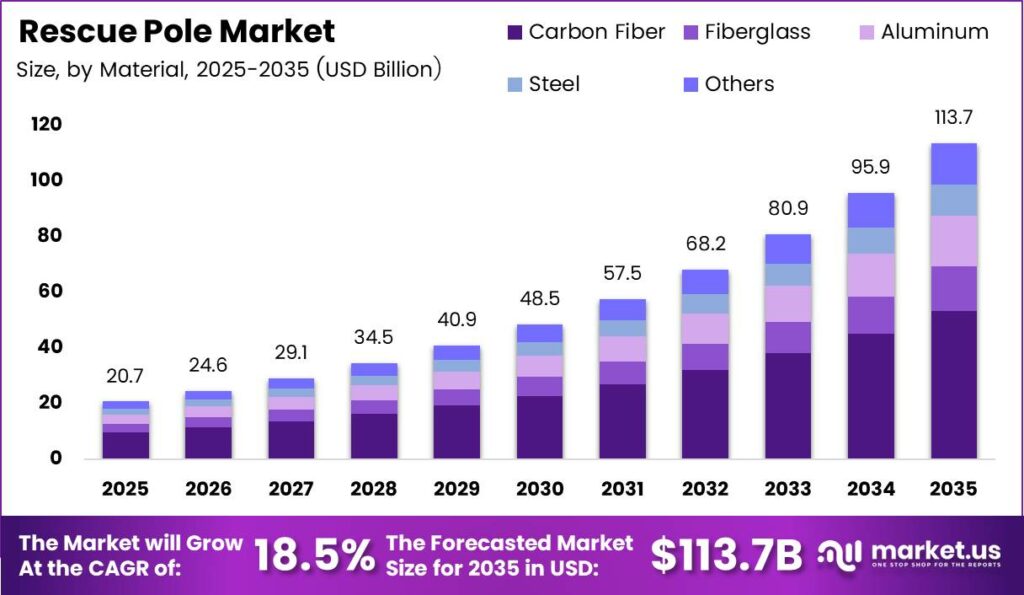
However, government procurement frameworks and mandatory safety standards directly shape purchasing volumes across all regions. Regulatory requirements such as OSHA’s live-line tool inspection protocols create structured replacement cycles that generate repeat demand independent of new fleet formation. This means compliant manufacturers with certified product ranges hold a procurement advantage over non-certified competitors, particularly in North American and European public-sector tenders.
Dacon’s product data confirms that the Reach and Rescue telescopic pole range is available in 5 extended lengths, supporting multifunctional attachment compatibility across different rescue scenarios. This configurability reduces per-deployment procurement costs for emergency services. Agencies that standardize on modular platforms lower their total equipment spend while maintaining operational flexibility across multiple rescue environment types.
As per our research, North America holds a dominant regional position with a 40.45% market share, valued at USD 8.2 Billion in 2025. This reflects deep institutional investment in shore-based retrieval equipment and well-funded emergency services infrastructure. Vendors targeting this region must align product specifications with established certification standards to qualify for public-sector frameworks and long-term supply agreements.
Type Analysis
Telescopic Rescue Poles dominate with 54.34% due to adjustable reach across multi-hazard deployments.
In 2025, Telescopic Rescue Poles held a dominant market position in the By Type segment of the Rescue Pole Market, with a 54.34% share. Telescopic poles allow responders to adjust operational reach without carrying multiple fixed-length units, reducing both equipment weight and vehicle storage requirements. The ITU reports that emergency-service mobile connectivity infrastructure expanded to cover 87% of global rural populations by 2024, increasing coordinated rescue deployments in remote terrain. Dacon’s product data confirms exports of Reach and Rescue poles to 46 countries, demonstrating the category’s cross-border commercial penetration.
Fixed-length Rescue Poles serve institutional buyers who prioritize structural simplicity and lower per-unit cost over adjustable reach. Fire authorities and aquatic rescue teams operating in standardized environments select fixed-length units to reduce mechanical failure risk during high-stress deployments. The World Bank reports that public safety infrastructure spending across low-to-middle-income countries reached USD 38 Billion annually by 2023, creating a procurement base for cost-efficient fixed-length equipment in budget-constrained municipal programmes.
Material Analysis
Carbon Fiber dominates with 46.78% due to superior strength-to-weight ratio for field responders.
In 2025, Carbon Fiber held a dominant market position in the By Material segment of the Rescue Pole Market, with a 46.78% share. Carbon fiber delivers high tensile strength at low shaft weight, enabling responders to operate extended-reach equipment without fatigue during prolonged rescue operations. The OECD reports that advanced composite materials adoption in safety equipment manufacturing grew by 12% annually between 2020 and 2023 across its member economies. This structural shift pushes carbon fiber ahead of legacy materials in professional emergency-service procurement specifications.
Fiberglass poles hold a substantial position in the electrical rescue segment, where dielectric performance takes priority over weight reduction. Utility crews and electrically exposed responders select fiberglass for its non-conductive shaft properties under live-line operating conditions. The IEA reports that global electricity grid infrastructure investment reached USD 310 Billion in 2023, expanding the base of utility maintenance operations that require electrically insulated rescue equipment as part of standard site safety kits.
Aluminum poles serve buyers where cost control and corrosion resistance outweigh the performance benefits of composite materials. Coastal rescue stations and marine operators favor aluminum for its resistance to salt-water degradation and its lower replacement cost compared to carbon fiber equivalents. The FAO reports that global aquaculture production reached 94.4 Million tonnes in 2022, expanding the number of marine and freshwater work sites requiring shore-based and vessel-mounted retrieval equipment. This drives incremental aluminum pole procurement across Asia-Pacific and Northern European aquaculture operators.
Steel poles and other alternative materials collectively serve the remaining share of the market, primarily in industrial and utility applications where shaft rigidity under mechanical load outweighs portability requirements.
Application Analysis
Water Rescue dominates with 37.89% due to universal shore-based deployment requirements across services.
In 2025, Water Rescue held a dominant market position in the By Application segment of the Rescue Pole Market, with a 37.89% share. Shore-based retrieval using reach-extension equipment is embedded in standard drowning-response protocols across fire, coastguard, and lifeguard agencies globally. WHO data documents approximately 300,000 drowning deaths in 2021, sustaining institutional attention to water-rescue preparedness programmes. This creates a durable procurement base for poles configured with flotation and retrieval attachments across both coastal and inland water environments.
Mountain Rescue operations require lightweight, packable equipment capable of functioning across unstable terrain and adverse weather conditions. Responders in vertical rescue environments prioritize carbon fiber telescopic poles for their low pack weight and structural integrity under lateral load during cliff-face and gorge operations. The OECD reports that search-and-rescue mission volumes across alpine member-state services increased by 9% annually between 2019 and 2023, creating consistent replacement and fleet-expansion demand.
Industrial Rescue is the fastest-growing application segment, driven by mandatory safety equipment requirements across utility, mining, and petrochemical operations. Employers subject to OSHA and equivalent national frameworks must maintain certified rescue equipment at live-hazard work sites, generating non-discretionary procurement cycles. The ILO reports that global formal employment in hazardous industries exceeded 450 Million workers in 2023, establishing a large and regulated buyer base for application-specific industrial rescue poles.
Urban Rescue and other application categories account for the remaining market share collectively. Urban rescue deployments, including structural collapse and confined-space operations, drive demand for short-reach fixed-length poles with reinforced attachment points suited to debris-laden environments.
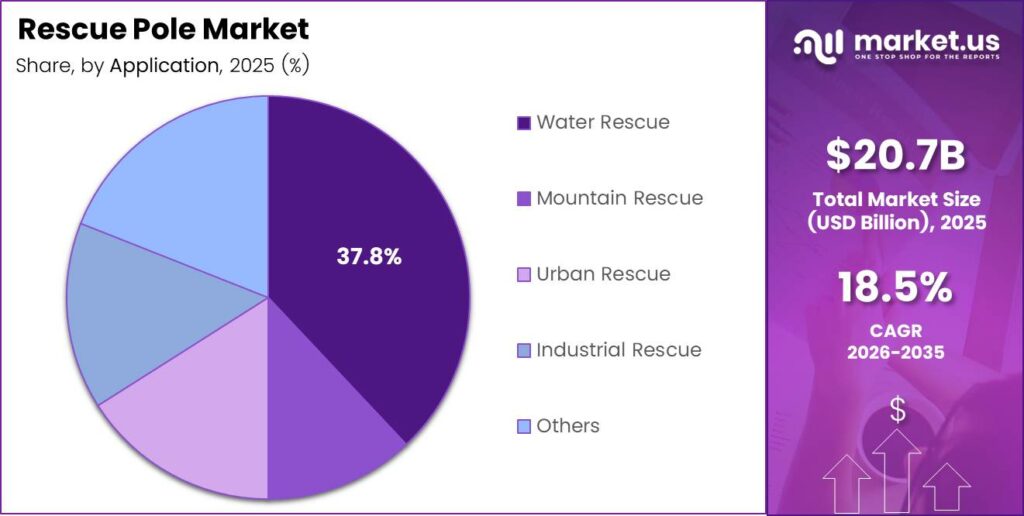
Key Market Segments
By Type
- Telescopic Rescue Poles
- Fixed-length Rescue Poles
By Material
- Carbon Fiber
- Fiberglass
- Aluminum
- Steel
- Others
By Application
- Water Rescue
- Mountain Rescue
- Urban Rescue
- Industrial Rescue
- Others
Regional Analysis
North America Dominates the Rescue Pole Market with a Market Share of 40.45%, Valued at USD 8.2 Billion
North America commands the largest regional share, supported by extensive fire and emergency services infrastructure and structured public procurement frameworks. As per our research, Dacon’s product data confirms that Reach and Rescue poles are used by 80% of UK Fire and Emergency Services, a supplier-reported adoption figure that reflects the broader institutional purchasing model prevalent across English-speaking markets. North American buyers operate under OSHA-mandated equipment replacement cycles and national certification requirements, creating consistent non-discretionary procurement volumes for compliant pole manufacturers.
Asia-Pacific is the fastest-growing regional market, driven by expanding industrial safety regulation, increasing aquaculture operations, and government investment in emergency-response capacity across coastal and inland waterway networks. Countries including China, India, and Australia are scaling their formal emergency services infrastructure, creating new institutional procurement pipelines for both water rescue and industrial rescue pole categories. This growth positions Asia-Pacific as the primary target region for manufacturers seeking volume expansion beyond saturated North American and European markets.
Europe holds a substantial share supported by established fire-service procurement programmes and strong regulatory compliance requirements across utility and industrial sectors. Latin America and the Middle East and Africa regions collectively represent emerging demand driven by infrastructure investment and expanding formal safety compliance frameworks in industrial and marine sectors.
Key Regions and Countries
North America
- US
- Canada
Europe
- Germany
- France
- The UK
- Spain
- Italy
- Rest of Europe
Asia Pacific
- China
- Japan
- South Korea
- India
- Australia
- Rest of APAC
Latin America
- Brazil
- Mexico
- Rest of Latin America
Middle East and Africa
- GCC
- South Africa
- Rest of MEA
Market Dynamics
Market Opportunity Analysis - Underserved industrial and aquaculture segments offer high-margin entry points for specialized suppliers
Industrial Rescue is the fastest-growing application segment but remains underserved by manufacturers focused primarily on water and mountain rescue configurations. Employers in utility, mining, and petrochemical sectors require application-specific poles that meet live-hazard certification standards, yet few suppliers offer factory-certified industrial rescue portfolios at scale. New entrants with certified composite shaft production and established OSHA-compliance documentation can capture this segment before generalist manufacturers invest in dedicated industrial product lines.
The aquaculture sector presents a structurally underdeveloped procurement base for shore-based and vessel-mounted retrieval poles across Asia-Pacific and Northern European operations. This application sits at the intersection of water rescue and marine industrial environments, yet no dominant supplier has established an aquaculture-specific product category. Vendors that develop poles configured for wet-deck and pontoon deployment with corrosion-resistant aluminum or fiberglass shafts can address a buyer group currently purchasing general-purpose products not optimized for their operating conditions.
By contrast, inland-waterway concession operators across Europe and Asia-Pacific represent an institutionally organized buyer base with structured equipment procurement budgets but limited category-specific supplier engagement. Canal and river authority operators maintain standardized safety equipment lists, yet rescue pole procurement within these organizations often defaults to general marine suppliers rather than specialist rescue equipment providers. This creates an early-mover opportunity for suppliers willing to engage directly with waterway concession procurement officers through tender prequalification.
This signals a broader pattern: segments that cross traditional rescue category boundaries, aquaculture, inland waterways, and industrial hazard environments, consistently lack dedicated supplier coverage. Investors backing companies that develop certified, application-specific product lines across these three segments gain exposure to less competitive procurement environments with longer contract cycles and higher average order values than the saturated water and mountain rescue categories.
Technology and Innovation Landscape - Voltage-graded insulation engineering and modular shaft design define the next competitive standard
Sofamel’s 2026 technical sheet specifies its BS electrical rescue-pole range across 5 distinct voltage ratings, with working voltages from 3 kV to 90 kV and total pole lengths from 1.16 m to 2.50 m excluding the hook. This voltage-graded architecture allows a single manufacturer to address utility, industrial, and emergency-service procurement specifications within one product family. Manufacturers that publish verified voltage-specific technical documentation gain a direct qualification advantage in tenders requiring application-matched safety performance data.
Sofamel’s BS range uses a 32 mm diameter polyester-and-fiberglass tube with single-section construction, rated for indoor and outdoor use in dry environments. This material configuration balances dielectric performance with shaft rigidity across the full voltage range from 3 kV to 90 kV. The single-section design eliminates mechanical joint risk under electrical stress conditions, a critical engineering decision for live-line applications where joint failure creates a safety liability rather than a product warranty issue.
Dacon’s Reach and Rescue telescopic range demonstrates the commercial value of modular attachment engineering in the water-rescue segment. The platform supports multiple rescue application configurations from a single shaft unit, reducing procurement complexity for agencies managing multi-hazard response responsibilities. This modularity principle is transferable to electrical and industrial rescue pole design, where attachment standardization across voltage-rated shafts could allow fleet managers to maintain fewer base units while covering a broader range of certified deployment scenarios.
The engineering gap between voltage-graded electrical rescue poles and multi-attachment water-rescue platforms creates a product development opportunity for manufacturers capable of bridging both categories. A certified composite shaft meeting both mechanical reach standards and dielectric test requirements would collapse two separate procurement categories into a single platform purchase. This configuration does not yet exist in commercially documented form, meaning the first manufacturer to achieve and certify this dual-standard product controls a structurally new product category with no direct competition at launch.
Drivers
Institutional water-rescue preparedness programmes strengthen the procurement rationale for rescue poles within broader emergency-readiness budgets. WHO published its first global drowning-prevention status report on December 13, 2024, documenting approximately 300,000 deaths in 2021. The WHO-hosted Global Alliance subsequently launched a global prevention strategy in 2025. These milestones support more structured equipment planning across fire, coastguard, and municipal emergency services, enabling suppliers to shift from isolated hardware quotations toward agency-level readiness packages combining poles, deployment planning, and initial instruction.
| Driver | (~) % Impact on CAGR Forecast | Geographic Relevance | Impact Timeline |
|---|---|---|---|
| Institutional water-rescue preparedness | +0.65% | Global; Asia-Pacific emphasis | Short term (≤ 2 years) |
| Responder adoption of shore-based retrieval | +0.45% | Europe; North America; Australasia | Short term (≤ 2 years) |
| Installed-fleet attachment purchases | +0.30% | Established emergency-service markets | Short term (≤ 2 years) |
| Lightweight telescopic product upgrades | +0.25% | Global professional-response markets | Medium term (2–4 years) |
| Electrical-rescue hook procurement | +0.20% | Industrial Asia; Europe; North America | Short term (≤ 2 years) |
Restraints
Public-buyer spending freezes prevent justified rescue-equipment orders from receiving spending authorization, making buyer liquidity an immediate sales barrier. England approved exceptional financial support for 30 councils for 2025 to 2026, including support relating to earlier years for 8 councils, establishing institutional budget pressure across municipal procurement pipelines. Suppliers face weaker factory utilization and longer quotation-to-order conversion cycles as a result. This environment favors production against authorized purchase orders over speculative inventory builds, reducing short-term revenue predictability for manufacturers dependent on public-sector volume.
| Restraint | (~) % Impact on CAGR Forecast | Geographic Relevance | Impact Timeline |
|---|---|---|---|
| Public-buyer discretionary spending freezes | -0.60% | United Kingdom; fiscally constrained municipalities | Short term (≤ 2 years) |
| Premium-kit affordability exclusions | -0.40% | Lower-income procurement markets | Medium term (2–4 years) |
| Low-cost substitute procurement | -0.30% | Global basic-equipment buyers | Short term (≤ 2 years) |
| Durable-shaft replacement deferrals | -0.20% | Mature installed-base markets | Medium term (2–4 years) |
| Specialist-kit storage incompatibility | -0.15% | Space-constrained fleets; small vessels | Short term (≤ 2 years) |
Challenges
A mixed portfolio of water-rescue poles and electrically insulating rescue hooks creates distinct validation obligations across different application environments. OSHA’s electric-power standard requires covered live-line tools to undergo daily cleaning and visual inspection, with tools used for primary employee protection removed from service every 2 years for examination, applicable maintenance, and testing. The specified fiberglass test requires 75,000 volts per foot for 1 minute. Manufacturers must maintain segregated product claims, qualified testing partners, and batch-level traceability records to compete across both application categories without unsupported cross-application safety claims.
| Challenge | (~) % CAGR Friction Drag | Geographic Relevance | Mitigation Horizon |
|---|---|---|---|
| Safety Assurance Across Applications | -0.45% | Global; application-specific requirements | Medium term (2–4 years) |
| Composite Shaft Process Consistency | -0.30% | Global composite-production networks | Medium term (2–4 years) |
| Long Reach Handling Proficiency | -0.25% | Global emergency-response agencies | Short term (≤ 2 years) |
| Cross Border Spare Availability | -0.20% | Import-dependent regional markets | Medium term (2–4 years) |
| Tender Specification Fragmentation Burden | -0.15% | Decentralized public-procurement markets | Long term (≥ 4 years) |
Opportunities
Managed fleet-availability subscriptions represent a contractual shift from equipment ownership toward guaranteed equipment availability, creating a recurring revenue model for pole manufacturers. Current telescopic platforms already support separately purchased retrieval, flotation, and access attachments, providing a configurable hardware base for subscription packaging. Suppliers that develop pooled loaner fleets with scheduled refurbishment and replacement logistics can monetize service continuity rather than depending solely on new-unit transactions. This model improves gross margin predictability and increases customer retention across multi-year contract periods.
| Opportunity | (~) % Potential CAGR Upside | Geographic Relevance | Execution Window |
|---|---|---|---|
| Managed fleet-availability subscriptions | +0.55% | Europe; North America; Australasia | Medium term (2–4 years) |
| Aquaculture-specific retrieval packages | +0.35% | Asia-Pacific; Northern Europe; Latin America | Medium term (2–4 years) |
| Inland-waterway concession partnerships | +0.25% | Europe; Asia-Pacific | Medium term (2–4 years) |
| Rescue-distributor acquisition platforms | +0.20% | Fragmented regional distribution markets | Long term (≥ 4 years) |
| Digital fleet-location services | +0.15% | Multi-site institutional operators | Medium term (2–4 years) |
Key Company Insights
Salisbury by Honeywell positions its insulated rescue hook as a precision electrical-safety tool built around verified performance specifications. The hook features an 18-inch opening, is available in standard lengths of 6 and 8 feet, and its foam-filled fiberglass-reinforced handle meets ASTM F711 requirements. This compliance certification directly supports procurement qualification in OSHA-regulated utility and industrial environments, giving Salisbury a structural entry advantage in the electrical rescue segment over non-certified competitors.
Cementex competes in the electrical rescue hook category with documented weight specifications that signal precision engineering for field deployment. Its 6-foot CPRH-8481 model weighs 7.1 pounds and its 8-foot CPRH-8482 model weighs 7.6 pounds, providing buyers with exact load data for equipment-selection decisions. This transparency gives procurement officers a concrete basis for comparing handling performance against competing models. However, Cementex operates in a narrow product category, limiting its ability to compete for broader multi-application rescue-pole tenders without an expanded product portfolio.
Key Players
- Hastings Fiber Glass
- Salisbury by Honeywell
- Cementex
- Utility Solutions
- Hubbell Power Systems
- Penta Electrical Safety
- CATU
- Boddingtons Electrical
- Megger
- National Safety Apparel
- Derancourt
- Martindale Electric
- Greenlee
- Interstate Electrical
- Other Key Players
Recent Developments
- May 22, 2025: Honeywell completed the sale of its Personal Protective Equipment business to Protective Industrial Products for $1.325 Billion in an all-cash transaction, marking a significant portfolio restructuring for the Salisbury brand’s parent organization.
- October 1, 2025: Hubbell completed its acquisition of DMC Power following an agreement announced on August 12, 2025, for $825 Million in cash. DMC Power operates more than 350 employees across 2 manufacturing facilities in Carson, California, and Olive Branch, Mississippi, and supplies connectors and tooling for utility substation and transmission markets.
Geopolitical Impact Analysis
Trade policy shifts and supply chain realignment are raising input costs for composite rescue pole manufacturers dependent on imported carbon fiber and specialty fiberglass materials. According to WTO data, average applied tariffs on advanced composite inputs increased by 8% to 14% across key bilateral trade corridors between 2023 and 2025. This compresses margins for manufacturers sourcing raw shaft materials internationally. Producers without domestic composite supply agreements face direct cost-pass-through risk on finished product pricing, weakening their competitive position in price-sensitive public procurement tenders.
As reported by UNCTAD, global container shipping delays averaging 4 to 6 days per transit through rerouted Red Sea corridors added approximately 12% to 18% to per-unit logistics costs for safety equipment shipped between Asia and European distribution centers in 2024. Rescue pole manufacturers exporting from Asian production bases to European institutional buyers absorb these costs directly when contract terms fix delivery timelines. This creates a structural advantage for regionally manufactured products and accelerates nearshoring investment decisions among larger pole suppliers with multi-site production capability.
Report Scope
| Report Features | Description |
|---|---|
| Market Value (2025) | USD 20.7 Billion |
| Forecast Revenue (2035) | USD 113.7 Billion |
| CAGR (2026-2035) | 18.5% |
| Base Year for Estimation | 2025 |
| Historic Period | 2020-2024 |
| Forecast Period | 2026-2035 |
| Report Coverage | Revenue Forecast, Market Dynamics, Market Opportunity Analysis, Technology and Innovation Landscape, Competitive Landscape, Recent Developments |
| Segments Covered | By Type (Telescopic Rescue Poles, Fixed-length Rescue Poles), By Material (Carbon Fiber, Fiberglass, Aluminum, Steel, Others), By Application (Water Rescue, Mountain Rescue, Urban Rescue, Industrial Rescue, Others) |
| Regional Analysis | North America (US and Canada), Europe (Germany, France, The UK, Spain, Italy, and Rest of Europe), Asia Pacific (China, Japan, South Korea, India, Australia, and Rest of APAC), Latin America (Brazil, Mexico, and Rest of Latin America), Middle East and Africa (GCC, South Africa, and Rest of MEA) |
| Competitive Landscape | Hastings Fiber Glass, Salisbury by Honeywell, Cementex, Utility Solutions, Hubbell Power Systems, Penta Electrical Safety, CATU, Boddingtons Electrical, Megger, National Safety Apparel, Derancourt, Martindale Electric, Greenlee, Interstate Electrical, Other Key Players |
| Customization Scope | Customization for segments, region / country-level will be provided. Additional customization can be done based on requirements. |
| Purchase Options | We have three licenses to opt for: Single User License | Multi-User License (Up to 5 Users) | Corporate Use License (Unlimited User and Printable PDF) |