Report Overview
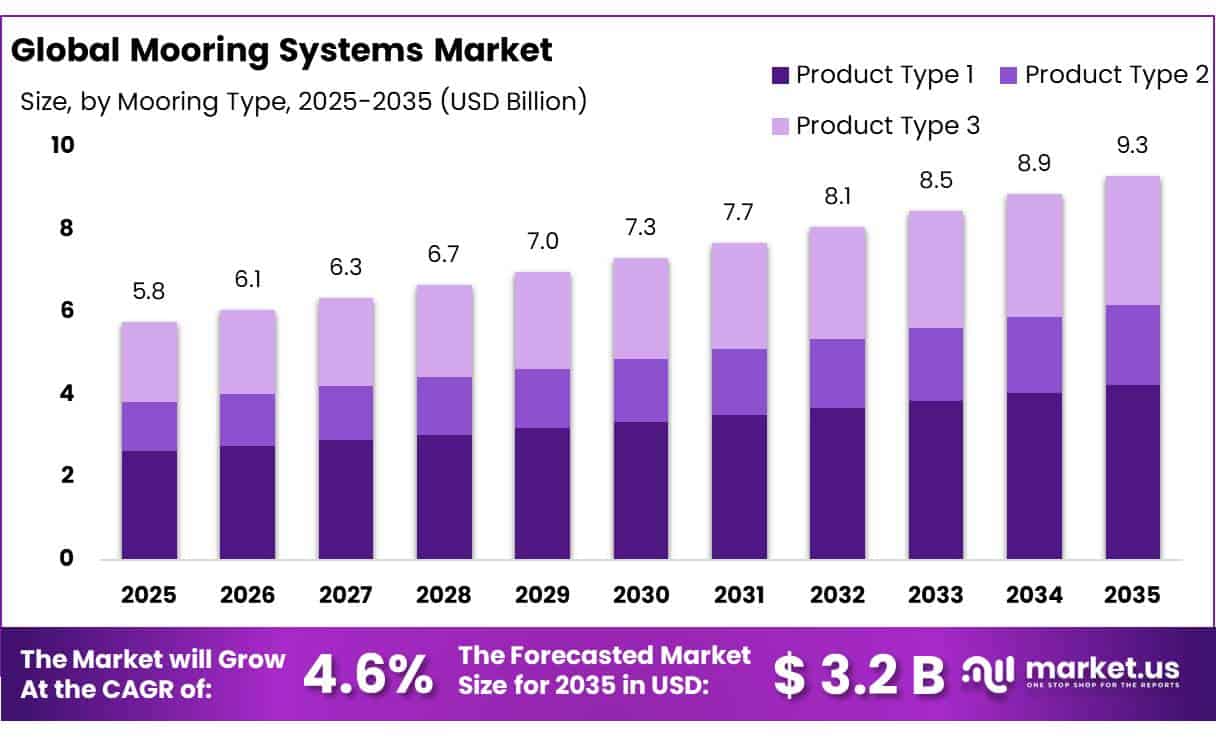
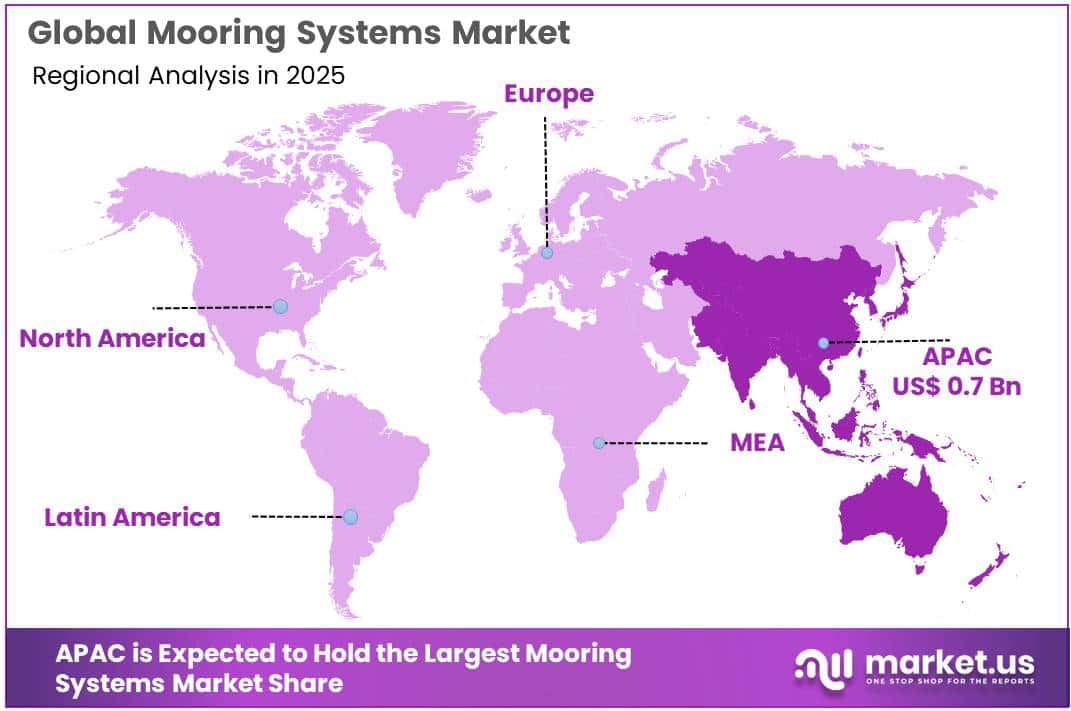
The Global Mooring Systems Market size is expected to be worth around USD 3.2 Billion by 2035, from USD 2.1 Billion in 2025, growing at a CAGR of 4.6% during the forecast period from 2026 to 2035. In 2025, Asia-Pacific held a dominant market position, capturing more than a 37.89% share, holding USD 0.7 Billion revenue.
Mooring systems are essential marine structures used to hold ships, offshore platforms, floating production units, and floating wind turbines securely in position. They generally consist of anchors, chains, wire ropes, synthetic ropes, connectors, and tension-control equipment. These systems help maintain stability under waves, currents, wind, and changing water levels. Demand is closely linked to maritime transport, offshore oil and gas operations, port infrastructure, and the development of floating renewable energy projects.
- According to the United Nations Conference on Trade and Development (UNCTAD), maritime transport carries more than 80% of world trade by volume. Its Review of Maritime Transport 2025 reported that global seaborne trade grew 2.2% in 2024, while growth was expected to slow to 0.5% in 2025. Although shipping growth remains uncertain, ports, vessels, and offshore facilities continue to require dependable mooring equipment for safe operations.
A major driving factor is the continued operation of offshore oil and gas facilities, where mooring systems secure floating production, storage, and offloading vessels and other structures. At the same time, floating offshore wind projects are creating demand for engineered mooring lines and anchors suitable for deeper waters. The United States National Renewable Energy Laboratory has examined shared mooring arrangements that could reduce the number of anchors and cables required across floating wind farms. Such designs may lower installation costs and improve project efficiency.
Technological improvements are also influencing product development. Manufacturers are working on corrosion-resistant chains, high-strength synthetic ropes, improved anchor designs, and monitoring systems that help operators assess tension, fatigue, and equipment condition. These solutions can reduce inspection requirements and improve operational reliability. However, high installation costs, harsh marine conditions, material price fluctuations, and strict safety requirements remain important challenges.
Future growth opportunities are expected in floating offshore wind, deepwater energy projects, port expansion, and the replacement of ageing mooring equipment. Standardized designs and scalable manufacturing could help reduce costs as offshore projects become larger. UNCTAD also reported that global container port throughput reached 920 million twenty-foot equivalent units in 2024, an increase of 6.9% from 2023, highlighting the continuing need for efficient port and vessel infrastructure. Overall, demand will depend on offshore investment, maritime infrastructure spending, equipment durability, and the pace of floating renewable energy development.
Key Takeaways
- Mooring Systems Market size is expected to be worth around USD 3.2 Billion by 2035, from USD 2.1 Billion in 2025, growing at a CAGR of 4.6%.
- Deep/Ultra Deep held a dominant market position, capturing more than a 62.67% share.
- FPSO held a dominant market position, capturing more than a 46.21% share.
- Single Point Mooring held a dominant market position, capturing more than a 42.90% share.
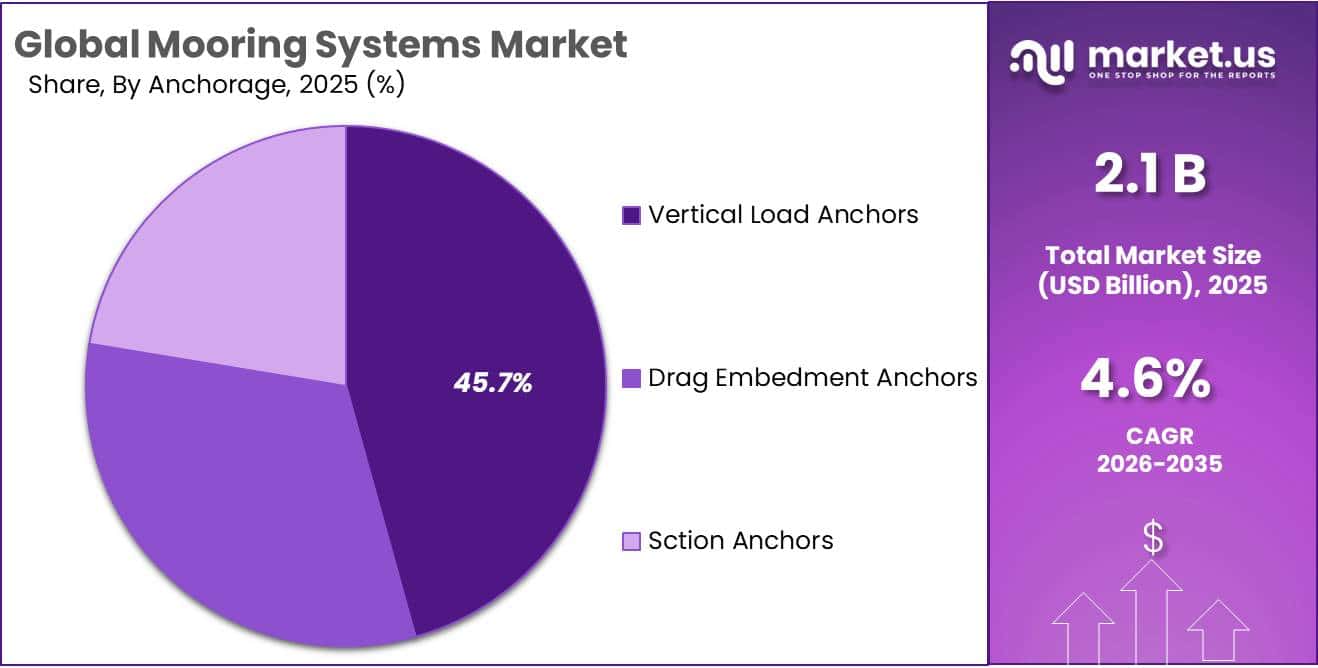
- Vertical Load Anchors held a dominant market position, capturing more than a 34.78% share.
- Asia-Pacific held a dominant market position in the Mooring Systems Market, accounting for 37.89% of the market, valued at USD 0.7 billion.
By Depth Analysis
Deep/Ultra-Deep mooring dominates due to its importance in offshore energy projects operating in challenging water conditions.
In 2025, “Deep/Ultra Deep” held a dominant market position, capturing more than a 62.67% share. These mooring systems are used to secure floating production vessels, offshore platforms, and floating wind structures in deep-water locations where strong currents, waves, and wind place greater demands on anchoring equipment. They often require high-strength chains, synthetic ropes, anchors, and reliable tension-control systems. The expansion of deepwater energy development and interest in floating offshore wind support demand for durable mooring solutions. The US National Renewable Energy Laboratory has researched mooring and anchoring designs for floating offshore wind, highlighting the importance of engineering systems that maintain stability in offshore environments.
Shallow mooring systems are used to secure vessels, floating structures, and offshore equipment in coastal and lower-depth waters. They typically use shorter mooring lines and suitable anchors designed for local seabed conditions. Demand is supported by port operations, nearshore oil and gas facilities, and marine construction projects. According to the US National Renewable Energy Laboratory, floating offshore wind technology is generally considered for water depths of 60 to 1,000 metres, while fixed-bottom foundations are often more competitive at lower depths. This creates a distinct role for shallow-water mooring solutions in suitable marine applications.
By Application Analysis
FPSO mooring dominates due to its role in keeping floating production vessels stable at offshore oil and gas fields.
In 2025, “FPSO” held a dominant market position, capturing more than a 46.21% share. Floating production, storage, and offloading (FPSO) vessels rely on mooring systems to maintain their position while oil and gas are produced, processed, stored, and transferred offshore. These systems must withstand waves, wind, and ocean currents while supporting safe operations in deepwater locations. Demand is linked to offshore field development and the need to operate production facilities far from shore. The US Bureau of Safety and Environmental Enforcement provides regulatory oversight of offshore oil and gas operations, including floating production facilities and associated safety requirements.
Tension Leg Platforms (TLPs) use vertical steel tendons connected to seabed foundations to keep floating offshore structures securely in position. These systems are used in deepwater oil and gas production, where platform stability is important for safe drilling and processing. According to the US Bureau of Safety and Environmental Enforcement, larger TLPs have been successfully deployed at water depths approaching 4,000 feet. Their design supports offshore operations while limiting vertical motion caused by waves. Demand depends on deepwater project investment, platform design requirements, and the need for reliable mooring equipment.
By Mooring Type Analysis
Single Point Mooring leads through its flexibility in handling offshore tankers and transferring oil in exposed marine locations.
In 2025, “Single Point Mooring” held a dominant market position, capturing more than a 42.90% share. Single Point Mooring (SPM) systems allow a vessel to connect to a fixed or floating offshore point and align naturally with wind, waves, and currents. This helps reduce environmental loads on the vessel while supporting offshore oil loading and unloading. SPM systems are widely used with floating storage and offloading vessels and oil tankers where direct access to shore terminals is limited. Their demand is supported by offshore petroleum logistics and the need for reliable transfer facilities. The US Bureau of Safety and Environmental Enforcement provides official information on offshore infrastructure and marine safety requirements.
Spread Mooring is used to hold floating offshore platforms, including semi-submersible units and spar platforms, in a fixed heading or designated position. The system uses several mooring lines connected to separate seabed anchors, helping distribute environmental loads across the structure. It can use chains, steel wire ropes, synthetic fibre ropes, or combinations of these materials. According to a technical report from the US Bureau of Safety and Environmental Enforcement, spread mooring can use catenary, taut-line, or semi-taut-line configurations. The report also notes that the mooring footprint can extend several times the water depth, making layout and anchor placement important design considerations.
By Anchorage Analysis
Vertical Load Anchors lead due to their ability to resist uplift forces and provide secure holding for demanding offshore mooring applications.
In 2025, “Vertical Load Anchors” held a dominant market position, capturing more than a 34.78% share. These anchors are designed to withstand both horizontal and vertical forces, making them suitable for mooring systems exposed to changing loads from waves, wind, and currents. They are used in offshore platforms and floating structures where strong holding capacity is important for safe operation. Their performance depends on seabed conditions, anchor design, and installation quality. The US Bureau of Safety and Environmental Enforcement provides technical information on offshore mooring and anchoring systems, supporting the importance of reliable anchor design in marine operations.
Drag Embedment Anchors are widely used to secure floating offshore drilling units and other marine structures. During installation, the anchor is pulled along the seabed so its flukes penetrate the soil and develop holding strength. Their performance depends on anchor size, seabed material, embedment depth, and the direction of the applied load. In a study published by the US Bureau of Safety and Environmental Enforcement, 17 mobile offshore drilling units lost station-keeping during Hurricanes Ivan, Katrina, and Rita, with anchor dragging suspected in several cases of pipeline damage. The findings highlight the importance of correct anchor selection, installation, and inspection for safe offshore operations.
Key Market Segments
By Depth
- Shallow
- Deep/Ultra Deep
By Application
- FPSO
- TLP
- SPAR
- Others
By Mooring Type
- Spread Mooring
- Single Point Mooring
- Others
By Anchorage
- Drag Embedment Anchors
- Vertical Load Anchors
- Sction Anchors
Driver Analysis
Floating Wind Build-Out
Floating offshore wind is the strongest incremental mooring-demand driver because every floating turbine requires a permanent station-keeping package, while fixed-bottom turbines require none: global offshore wind reached 92.5 GW at end-2025 after 9.3 GW of additions, more than 50 GW was under construction in 2026, and GWEC identified 327 GW of potential additions through 2035; the average offshore turbine commissioned in 2025 reached 10.3 MW, reducing turbine count per gigawatt but increasing line loads, chain diameter, anchor capacity and engineering content per unit.
Deployment is broadening beyond the five markets that held 90.3% of installed offshore capacity in 2025, while the January 2026 Hamburg Declaration set a North Sea ambition of 300 GW by 2050, including 100 GW of cross-border projects, supporting multi-country procurement for anchors, chains, fibre ropes and pre-lay installation. Equipment intensity remains substantial: representative floating systems use three to five lines per turbine; synthetic-rope requirements can range from roughly 200–1,600 metres per line, a three-line 15 MW reference system can weigh about 188 tonnes, and one 2024 cost model placed mooring procurement and installation at approximately $114/kW combined.
Applied to just 10 GW of floating capacity, that engineering benchmark implies an order pool near $1.1 billion before monitoring and maintenance, although actual cost varies by water depth, soil and configuration. The +2.1-point CAGR contribution assumes commercial projects move from demonstrators into repeatable 500 MW–1 GW arrays, shifting supplier economics from bespoke project sales toward qualified platform families, serial chain/rope production, framework agreements and shared-anchor designs; NREL analysis indicates shared-anchor layouts can reduce mooring-system and installation cost by about $33/kW at gigawatt scale, creating the cost-down pathway required for volume acceleration.
Drivers Impact Analysis
| Driver | (~) % Impact on CAGR Forecast | Geographic Relevance | Impact Timeline |
|---|---|---|---|
| Floating wind build-out | +2.1 pp | Europe, China, Japan, South Korea, U.S. | Medium term (2–4 years) |
| Deepwater FPSO expansion | +1.8 pp | Brazil, Guyana, West Africa, Gulf of Mexico | Short term (≤ 2 years) |
| Larger offshore assets | +1.2 pp | China, Europe, Brazil, Asia-Pacific | Medium term (2–4 years) |
| Integrity-service adoption | +1.0 pp | North Sea, Brazil, Gulf of Mexico, APAC | Short term (≤ 2 years) |
| Safety-standard tightening | +0.8 pp | Global; EU and North America core | Short term (≤ 2 years) |
| Floating LNG deployment | +0.7 pp | Asia, Europe, Africa, Middle East | Medium term (2–4 years) |
Restraint Analysis
Offshore Wind Permit Freeze
The U.S. offshore-wind permitting freeze is a direct demand restraint because it blocks conversion of leased acreage into construction-stage mooring procurement, rather than merely making projects harder to execute: President Trump’s January 2025 memorandum withdrew the entire Outer Continental Shelf from new or renewed wind-energy leasing until revoked and paused new approvals, rights-of-way, permits, leases, and loans pending federal review; BOEM subsequently rescinded more than 3.5 million acres of designated Wind Energy Areas in July 2025.
The effect reaches existing assets as well: BOEM issued 90-day December 2025 suspension orders affecting Revolution Wind, Vineyard Wind 1, Coastal Virginia Offshore Wind, Sunrise Wind, and Empire Wind 1, while Empire Wind had already been halted in April 2025 before that order was lifted in May. Each delayed floating-wind project removes demand for three to six permanent mooring lines per turbine, anchors, connectors, pre-lay vessel work, hook-up, and life-of-asset monitoring; for an indicative 1 GW floating project using 15 MW turbines, a 67-unit array could defer roughly 200–335 primary lines and 200–335 anchors.
This converts supplier backlog into low-certainty pipeline, forces manufacturers to hold specialized capacity without firm utilization, increases bid-risk contingencies, and limits U.S. localization economics; the modeled -2.2 percentage-point CAGR deduction reflects not a decline in technical need but a multi-year interruption in the largest prospective North American floating-wind order corridor.
Restraint Impact Analysis
| Restraint | (~) % Impact on CAGR Forecast | Geographic Relevance | Impact Timeline |
|---|---|---|---|
| Offshore Wind Permit Freeze | -2.2 pp | U.S. Atlantic, Pacific, Gulf | Medium term (2–4 years) |
| Project Finance Gap | -1.7 pp | Europe, U.S., India, Australia | Medium term (2–4 years) |
| Chain-Anchor Capacity Limits | -1.4 pp | APAC supply hubs; Brazil, Europe | Short term (≤ 2 years) |
| Installation Vessel Scarcity | -1.1 pp | Europe, U.S., APAC | Medium term (2–4 years) |
| Steel and Freight Volatility | -0.9 pp | Global; import-led markets | Short term (≤ 2 years) |
| Complex Site Consenting | -0.8 pp | U.S., EU, India, Australia | Long term (≥ 4 years) |
Opportunity Analysis
Floating Solar Moorings
Floating solar is an adjacent, largely unpenetrated station-keeping market rather than a current offshore-moored-asset driver: suppliers can adapt polymer-rope, chain, anchor, connector, tensioning and monitoring expertise for reservoirs, quarry lakes, hydropower impoundments, wastewater ponds and sheltered coastal sites, where each modular photovoltaic array requires anchoring despite substantially lower loads than offshore wind. The strategic catalyst is standardization: DNV issued ST-E309 in April 2026 as a dedicated design standard for floating-photovoltaic station keeping, specifying design loads, combinations, analysis methods and component requirements, alongside the broader DNV-RP-0584 lifecycle practice.
This lowers customer qualification uncertainty and permits suppliers to create repeatable, pre-engineered packages rather than execute bespoke marine EPC work; technical studies show a three-point taut system can experience 20–50 kN operational line tension and roughly 450 kN in a 50-year storm, while maintaining a 2.66 safety factor against a recommended minimum above 2.0.
Under an analyst scenario, a supplier that wins 15% of only 2 GW annually of large reservoir FPV projects at a $12–20/kW station-keeping content level would add $3.6–6.0 million of annual equipment revenue, before replacement lines, inspections and hydrological monitoring; China, India, Indonesia, South Korea and Middle Eastern water-constrained power markets are the most scalable entry zones.
The +1.8-point upside depends on vendors creating low-cost modular kits, hydrographic design tools and local installer partnerships, because a full offshore-chain cost structure would be uneconomic for FPV and this opportunity remains outside the baseline market’s conventional FPSO and floating-wind revenue base.
Opportunity Impact Analysis
| Opportunity | (~) % Potential CAGR Upside | Geographic Relevance | Execution Window |
|---|---|---|---|
| Floating Solar Moorings | +1.8 pp | China, India, ASEAN, Middle East | Short term (≤ 2 years) |
| CO2 Injection Floaters | +1.5 pp | North Sea, Australia, Southeast Asia | Medium term (2–4 years) |
| Digital Integrity Subscriptions | +1.3 pp | Brazil, North Sea, Gulf, APAC | Short term (≤ 2 years) |
| Shared-Anchor Wind Arrays | +1.1 pp | Europe, Japan, South Korea, U.S. | Medium term (2–4 years) |
| Automated Port Mooring | +1.0 pp | Asia, Europe, North America, India | Medium term (2–4 years) |
| Retrofit and Life Extension | +0.8 pp | Brazil, West Africa, Gulf, North Sea | Short term (≤ 2 years) |
Challenges Analysis
Coupled-Load Design Complexity
Mooring design for large floating assets is increasingly constrained by coupled wind, wave, current, platform-motion, dynamic-cable, riser and seabed-response interactions rather than by simple line-strength calculation, creating engineering iteration that slows bid conversion without stopping present sales.
A floating 15 MW turbine uses a 240-metre rotor and can require three to five lines, while its platform response must be evaluated across normal operating, 50-year extreme, accidental line-failure and fatigue load cases; published 15 MW reference studies show that individual-line tension, fairlead load, anchor holding capacity, turbine thrust and floater excursion must be optimized simultaneously rather than sequentially.
The design problem expands materially in deeper water: a representative synthetic line can extend to 1,600 metres, and a three-line system for a 15 MW turbine can contain around 188 tonnes of mooring material, making small changes in pretension, line diameter, anchor radius or fibre-chain proportion consequential for both dynamic response and installed cost. In an analyst case, a 5% increase in design-line load can force the next certified chain or rope diameter class, adding 8–15% to line-material cost and requiring anchor redesign, while a 3–5 metre increase in floater excursion may trigger dynamic-cable redesign or wider array spacing.
Suppliers must therefore fund integrated hydrodynamic, geotechnical and structural-analysis teams, maintain validated simulation libraries, and offer early-stage coupled-design support rather than quote components from static bill-of-materials; the -1.3-point drag persists beyond four years because turbine ratings, water depth and shared-array concepts are scaling faster than standardized design envelopes.
Challenges Impact Analysis
| Challenge | (~) % CAGR Friction Drag | Geographic Relevance | Mitigation Horizon |
|---|---|---|---|
| Coupled-Load Design Complexity | -1.3 pp | Europe, Japan, South Korea, U.S. | Long term (≥ 4 years) |
| Chain Fatigue Uncertainty | -1.1 pp | North Sea, Brazil, Gulf of Mexico | Long term (≥ 4 years) |
| Offshore Skills Shortage | -1.0 pp | Europe, U.S., APAC hubs | Long term (≥ 4 years) |
| Port Interface Constraints | -0.9 pp | Europe, U.S., Japan, South Korea | Medium term (2–4 years) |
| Standards Fragmentation | -0.8 pp | EU, U.S., Asia-Pacific | Medium term (2–4 years) |
| Digital Data Integration | -0.6 pp | Brazil, North Sea, Gulf, APAC | Medium term (2–4 years) |
Geopolitical Impact Analysis
Geopolitical Impact of Ongoing Wars on the Mooring Systems Market
Ongoing conflicts in the Middle East and the Russia–Ukraine war are affecting the Mooring Systems Market through higher shipping costs, rising insurance premiums, and uncertainty in offshore energy investments. In 2026, disruptions around the Strait of Hormuz have increased risks for oil tankers and offshore support vessels. The United Nations Conference on Trade and Development reported in April 2026 that ship transits through the strait had fallen by approximately 95%, while freight rates, marine fuel costs, and war-risk insurance premiums rose sharply.
These conditions can increase the cost of transporting heavy mooring chains, anchors, ropes, and offshore equipment. Delays in vessel movement and equipment delivery may also affect installation schedules for floating production, storage, and offloading vessels and offshore platforms. According to the US Energy Information Administration, Brent crude oil prices reached USD 118 per barrel on April 29, 2026, amid disruptions to oil flows through the strait.
Although security risks may delay new offshore projects, energy producers still require reliable mooring equipment for existing facilities, maintenance, and replacement work. Over the longer term, investment in energy security and alternative offshore supply routes may support demand. Market growth will depend on conflict duration, shipping stability, material costs, and the recovery of offshore project investment.
Regional Insights
Dominating Region: Asia-Pacific
In 2025, Asia-Pacific held a dominant market position in the Mooring Systems Market, accounting for 37.89% of the market, valued at USD 0.7 billion. Regional demand is supported by extensive maritime trade, offshore oil and gas operations, port development, and growing offshore wind investment. China, South Korea, and Japan have strong shipbuilding and marine engineering industries that support demand for anchors, chains, synthetic ropes, and offshore station-keeping systems.
- According to UN Trade and Development (UNCTAD), developing economies in Asia handled 60% of global container port traffic in 2024, demonstrating the region’s importance in maritime logistics. This large port and shipping network creates continued requirements for reliable mooring infrastructure.
Asia-Pacific also offers strong growth opportunities as offshore energy projects and floating renewable technologies develop. China has led offshore wind installation, while Taiwan, Japan, and South Korea are expanding their offshore wind industries. The Global Wind Energy Council reported that 8 gigawatts (GW) of new offshore wind capacity was connected to the grid worldwide in 2024, with China leading new installations for the seventh consecutive year.
Key Regions and Countries Insights
- North America
- US
- Canada
- Europe
- Germany
- France
- The UK
- Spain
- Italy
- Rest of Europe
- Asia Pacific
- China
- Japan
- South Korea
- India
- Australia
- Rest of APAC
- Latin America
- Brazil
- Mexico
- Rest of Latin America
- Middle East & Africa
- GCC
- South Africa
- Rest of MEA
Key Players Analysis
National Oilwell Varco supplies engineered mooring equipment for offshore drilling and production vessels, including fairleads, chain jacks, windlasses, chain stoppers, and tensioning equipment. Its integrated systems are designed to meet customer load requirements and support safe offshore operations. NOV’s BLM group has manufactured deck machinery since 1841, giving it more than 180 years of experience in marine equipment. Its offshore product range also serves deepwater projects, where dependable station-keeping equipment is essential.
TIMM AS, known through its TIMM ROPES business, supplies ropes and mooring solutions for shipping, offshore operations, lifting, and fisheries. The company traces its rope-making history to 1772, giving it more than 250 years of industry experience. Its portfolio includes over 250 specialized rope products, supported by services such as installation, inspection, testing, splicing, and onboard maintenance. These offerings help vessel operators select suitable ropes and maintain equipment reliability in demanding marine conditions.
Cargotec Corporation has historically participated in marine equipment through MacGregor, a business supplying cargo-handling and offshore solutions. MacGregor became an independent company following its separation from Cargotec in 2025. For the financial period from August to December 2025, MacGregor reported approximately EUR 830 million in sales for the year and around 2,000 employees across 30 countries. Its maritime and offshore technologies support vessel operations and offshore infrastructure, making the business relevant to the wider marine equipment sector.
Top Key Players Outlook
- National Oilwell Varco
- Timm AS
- Cargotec Corporation
- SBM Offshore
- Trellborg India Private Limited
- BW Offshore Limited
- MacGregor
- Lamprell ENERGY LIMITED
- Usha Martin Limited
- BMT Group Ltd
- InterMoor
- Cavotec S.A.
- Other Key Players
Recent Developments
- In February 2026, SBM Offshore completed the sale of FPSO ONE GUYANA to ExxonMobil Guyana and reported a baseline revenue outlook of around USD 6.5 billion for 2026.
- In April 2026, Trelleborg highlighted its AutoMoor automated vacuum mooring technology, which can secure a vessel in around 30 seconds and release it in under 15 seconds, reducing manual line handling and improving berth efficiency. Its mooring portfolio also includes quick-release hooks with safe working loads of 40 to 200 metric tons.
- In February 2026, BW Offshore reported full-year 2025 EBITDA of USD 240.1 million, operating cash flow of USD 409.2 million, and available liquidity of USD 634.5 million. The company also guided for 2026 EBITDA of USD 340 million to USD 370 million as BW Opal ramps up production.
Report Scope
| Report Features | Description |
|---|---|
| Market Value (2025) | USD 2.1 Bn |
| Forecast Revenue (2035) | USD 3.2 Bn |
| CAGR (2026-2035) | 4.6% |
| Base Year for Estimation | 2025 |
| Historic Period | 2020-2024 |
| Forecast Period | 2026-2035 |
| Report Coverage | Revenue Forecast, Market Dynamics, Competitive Landscape, Recent Developments |
| Segments Covered | By Depth (Shallow, Deep/Ultra Deep), By Application (FPSO, TLP, SPAR, Others), By Mooring Type (Spread Mooring, Single Point Mooring, Others), By Anchorage (Drag Embedment Anchors, Vertical Load Anchors, Sction Anchors) |
| Regional Analysis | North America – US, Canada; Europe – Germany, France, The UK, Spain, Italy, Rest of Europe; Asia Pacific – China, Japan, South Korea, India, Australia, Singapore, Rest of APAC; Latin America – Brazil, Mexico, Rest of Latin America; Middle East & Africa – GCC, South Africa, Rest of MEA |
| Competitive Landscape | National Oilwell Varco, Timm AS, Cargotec Corporation, SBM Offshore, Trellborg India Private Limited, BW Offshore Limited, MacGregor, Lamprell ENERGY LIMITED, Usha Martin Limited, BMT Group Ltd, InterMoor, Cavotec S.A., Other Key Players |
| Customization Scope | Customization for segments, region/country-level will be provided. Moreover, additional customization can be done based on the requirements. |
| Purchase Options | We have three licenses to opt for: Single User License, Multi-User License (Up to 5 Users), Corporate Use License (Unlimited User and Printable PDF) |