Report Overview
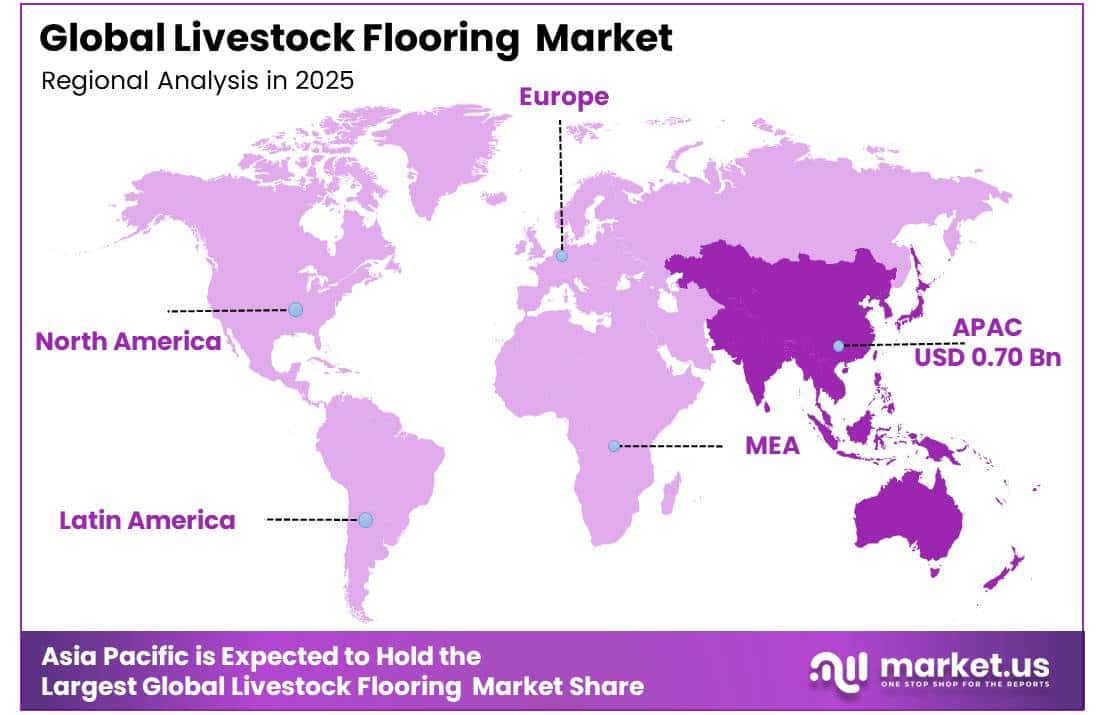
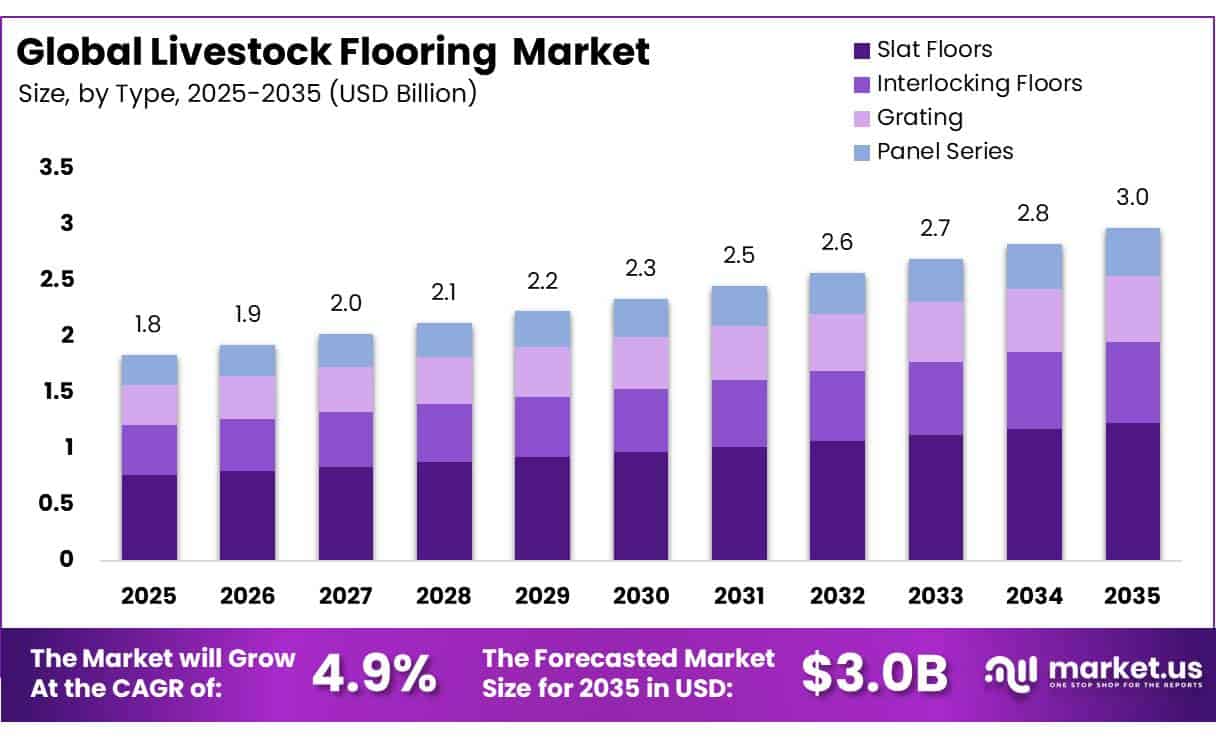
In 2025, the Global Livestock Flooring Market was valued at USD 1.8 billion, and between 2026 and 2035, this market is estimated to register a CAGR of 4.9%, reaching about USD 3.0 billion by 2035. Asia Pacific held a dominant market position, capturing more than a 37.8% share, holding USD 0.70 billion in revenue.
The Livestock Flooring Market serves a core role in modern animal housing by providing durable, hygienic, slip-resistant surfaces for cattle, swine, poultry, and other farm animals. Demand is closely tied to livestock population, housing upgrades, and welfare-focused farm investment. In January 2026, the United States Department of Agriculture National Agricultural Statistics Service reported 86.2 million cattle and calves, including 27.6 million beef cows and 9.57 million milk cows. These numbers underline the extensive infrastructure required for housed livestock.
- The industrial scenario is also supported by Europe’s large livestock base, where intensive farming requires flooring systems that can withstand continuous animal movement, moisture, cleaning, and manure handling. In June 2026, Eurostat reported that the European Union had 131.5 million pigs, 71.6 million bovine animals, and 55.3 million sheep in 2025. This operating scale sustains demand for concrete, rubber, plastic, steel, and composite flooring across livestock facilities, especially in commercial production environments.
Key Takeaways
- The global Livestock Flooring Market was valued at USD 1.8 billion in 2025.
- The global Market is projected to grow at a CAGR of 4.9% and is estimated to reach USD 3.0 billion by 2035.
- On the basis of type, slat floors dominated the market, constituting 41.5% of the total market share.
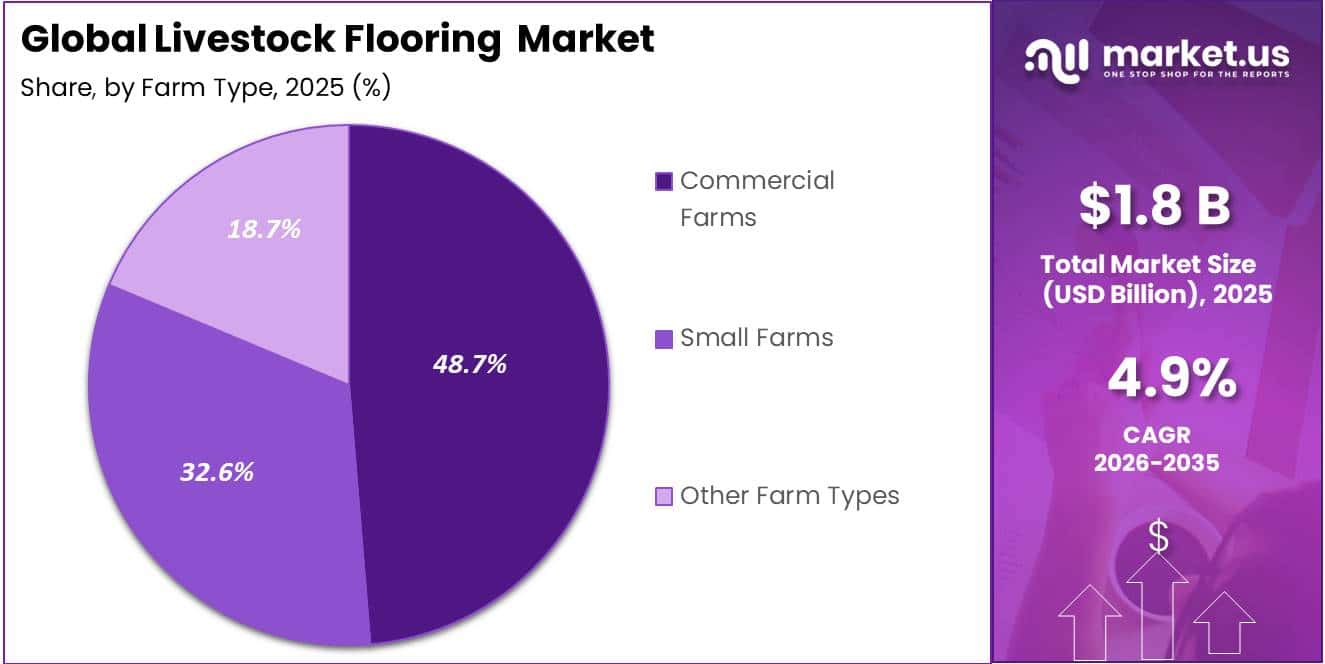
- Based on the farm type, commercial farms dominated the Livestock Flooring Market, with a substantial market share of around 48.7%.
- Based on the material type, concrete led the market, comprising 38.1% of the total market.
- Among the livestock, cattle flooring held a major share in the Livestock Flooring Market, accounting for 36.9% of the market share.
- In 2025, Asia Pacific was the most dominant region in the Livestock Flooring Market, accounting for 37.8% of the total market.
Government support is encouraging farmers to invest in welfare-oriented housing equipment. United Kingdom Farming Investment Fund statistics published in July 2026 showed that 49,800 rubber flooring mats for cattle and 31,810 cow mattresses had been funded. Under the Farming Equipment and Technology Fund 2025, eligible cattle rubber mats carried an expected average cost of £41, a grant amount of £20, and a minimum required thickness of 19 millimetres with an anti-slip surface.
Growth opportunities remain strong in swine housing, farm modernization, and replacement of worn flooring with safer materials. In March 2026, the United States Department of Agriculture reported 74.3 million hogs and pigs on domestic farms, including 68.4 million market hogs and 5.89 million breeding animals. This substantial livestock base supports continued demand for slatted, interlocking, rubber, and composite systems that improve drainage, cleaning efficiency, animal footing, durability, and long-term housing performance across modern intensive farming operations and biosecurity.
Type Analysis
Slat Floors dominate with 41.5% due to efficient drainage and durable livestock housing, while Interlocking Floors gain through flexible installation
In 2025, Slat Floors held a dominant market position, capturing more than a 41.5% share in the Livestock Flooring Market. Their leadership reflects use in cattle and swine housing, where open-slot designs support manure movement, drainage, cleaning, and use of housing space. Slat floors also suit intensive farm layouts because they can be integrated with manure collection systems and withstand animal traffic across commercial facilities.
- In July 2026, according to the German Agricultural Society, an elastic livestock flooring test completed 10,000 abrasion cycles and recorded an abrasion depth of 1.5 mm, equal to about 2.3% of the rubber thickness. The tested surface also achieved friction coefficients ranging from 0.5 to 0.7 under dry and wet conditions.
Interlocking Floors are emerging as the Fastest growing type as livestock operators seek modular flooring that can be installed, replaced, and maintained with less disruption to housing areas. Their sectional design supports easier renovation of zones and offers flexibility across pens, walkways, and resting spaces. Growing attention to animal footing, hygiene, and practical farm maintenance is supporting wider consideration of interlocking systems in livestock facilities.
Farm Type Analysis
Commercial Farms dominate with 48.7% due to larger housing requirements, while Small Farms gain through flexible flooring upgrades
In 2025, Commercial Farms held a dominant market position, capturing more than a 48.7% share in the Livestock Flooring Market. Their leadership reflects larger animal populations, purpose-built housing, frequent cleaning cycles, and greater need for durable flooring across barns, pens, alleys, and feeding areas. Commercial operators also tend to replace damaged surfaces systematically, supporting demand for slatted, rubber, concrete, plastic, and composite flooring solutions.
- In July 2026, according to the UK Department for Environment, Food and Rural Affairs, the United Kingdom had 212 thousand agricultural holdings in 2025, including 103 thousand holdings under 20 hectares and 40 thousand holdings of 100 hectares or more.
Small Farms are the fastest growing farm type as owners increasingly upgrade livestock housing with safer, easier-to-clean flooring. Modular and interlocking products suit smaller facilities because sections can be installed or replaced without rebuilding an entire floor. Rising attention to animal comfort, hygiene, drainage, and maintenance is encouraging gradual adoption of rubber, plastic, and other practical flooring systems. These upgrades allow smaller livestock operations to improve housing quality while managing installation complexity and routine maintenance requirements.
Material Type Analysis
Concrete dominates with 38.1% due to durability and heavy-duty performance, while Plastic gains through modular livestock flooring
In 2025, Concrete held a dominant market position, capturing more than a 38.1% share in the Livestock Flooring Market. Concrete remains widely used across cattle, swine, and other livestock facilities because it provides load-bearing capacity, service life, and compatibility with intensive cleaning. It is also suitable for alleys, feeding areas, holding zones, and other high-traffic spaces where flooring must withstand animals, equipment, moisture, and repeated washing.
- In May 2026, according to the UK Department for Environment, Food and Rural Affairs, eligible plastic slats carried an expected average cost of £34 per square metre and a grant amount of £17, while qualifying tiles required a minimum depth of 15 millimetres and a floor height no greater than 450 millimetres.
Plastic is the fastest growing material segment as livestock producers look for lighter, corrosion-resistant, and easy-to-install flooring. Modular plastic systems can support drainage and simplify replacement of damaged sections without structural work. Their non-slip designs are suited to temporary housing and isolation areas, while easier cleaning and lower handling weight support adoption in farms seeking practical flooring upgrades and flexible housing layouts.
Livestock Analysis
Cattle Flooring dominates with 36.9% due to heavy-duty housing needs, while Swine Flooring gains through welfare-focused upgrades
In 2025, Cattle Flooring held a dominant market position, capturing more than a 36.9% share in the Livestock Flooring Market. Its strong position reflects the flooring needs of dairy and beef facilities, including alleys, feeding zones, holding areas, and resting spaces. Cattle flooring must support heavy animal loads, regular washing, drainage, and secure footing, which encourages farms to invest in durable concrete, rubber-covered, and slatted systems.
- In March 2026, according to the UK Department for Environment, Food and Rural Affairs, rubber coverings for slatted floors in pig buildings carried an expected average cost of £65 per square metre and an eligible grant amount of £32 per square metre.
Swine Flooring is the growing livestock segment as producers improve pen surfaces to support comfort, drainage, hygiene, and efficient manure removal. Rubber coverings and purpose-designed slatted systems can make pig housing easier to manage while maintaining drainage openings. Greater focus on housing quality, sanitation, and replacement of worn surfaces is supporting investment in practical flooring systems across commercial pig facilities, particularly where producers are modernizing older barns and improving animal movement areas.
Key Market Segments
By Type
- Slat Floors
- Interlocking Floors
- Grating
- Panel Series
By Farm Type
- Commercial Farms
- Small Farms
- Other Farm Types
By Material Type
- Concrete
- Plastic
- Rubber
- Steel
- Hybrid & Composite
By Livestock
- Cattle Flooring
- Swine Flooring
- Poultry Flooring
- Equine Flooring
- Others (Sheep & Goats etc.)