


Report Overview
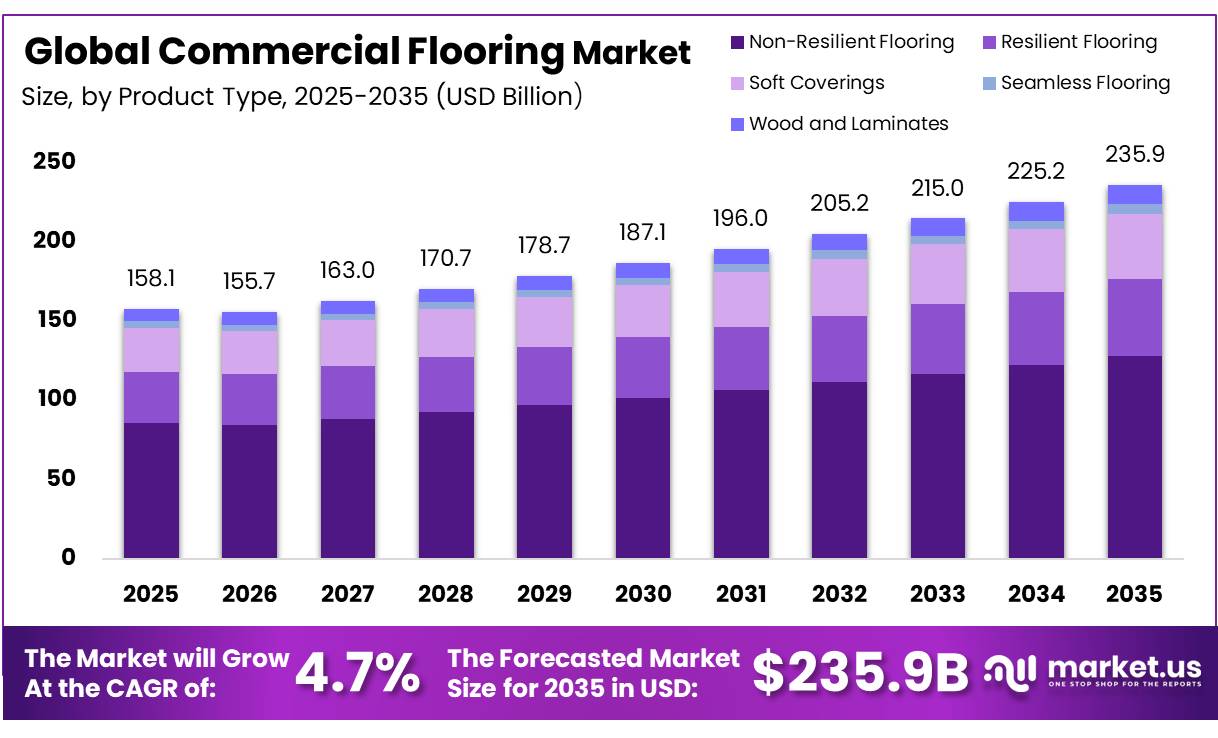
In 2025, the Global Commercial Flooring Market was valued at USD 158.1 billion, and between 2026 and 2035, this market is estimated to register a CAGR of 4.7%, reaching about USD 235.9 billion by 2035. Asia Pacific held a dominant market position, capturing more than a 42.5% share, holding USD 67.18 billion in revenue.
The commercial flooring industry supplies non-resilient, resilient, soft covering, seamless, wood, and laminate systems for offices, retail spaces, hospitals, schools, hotels, warehouses, and public facilities. Demand is tied closely to new construction and renovation activity.
- In May 2026, United States private nonresidential construction spending reached a seasonally adjusted annual rate of USD 738.7 billion, while public educational construction reached USD 113.4 billion, supporting broad requirements for durable interior surfaces.
Key Takeaways
- The global commercial flooring market was valued at USD 158.1 billion in 2025.
- The global market is projected to grow at a CAGR of 4.7% and is estimated to reach USD 235.9 billion by 2035.
- On the basis of product type, the non-resilient flooring segment dominated the market, constituting 54.3% of the total market share.
- Based on application, offices & corporate dominated the commercial flooring market, with a substantial market share of around 25.4%.
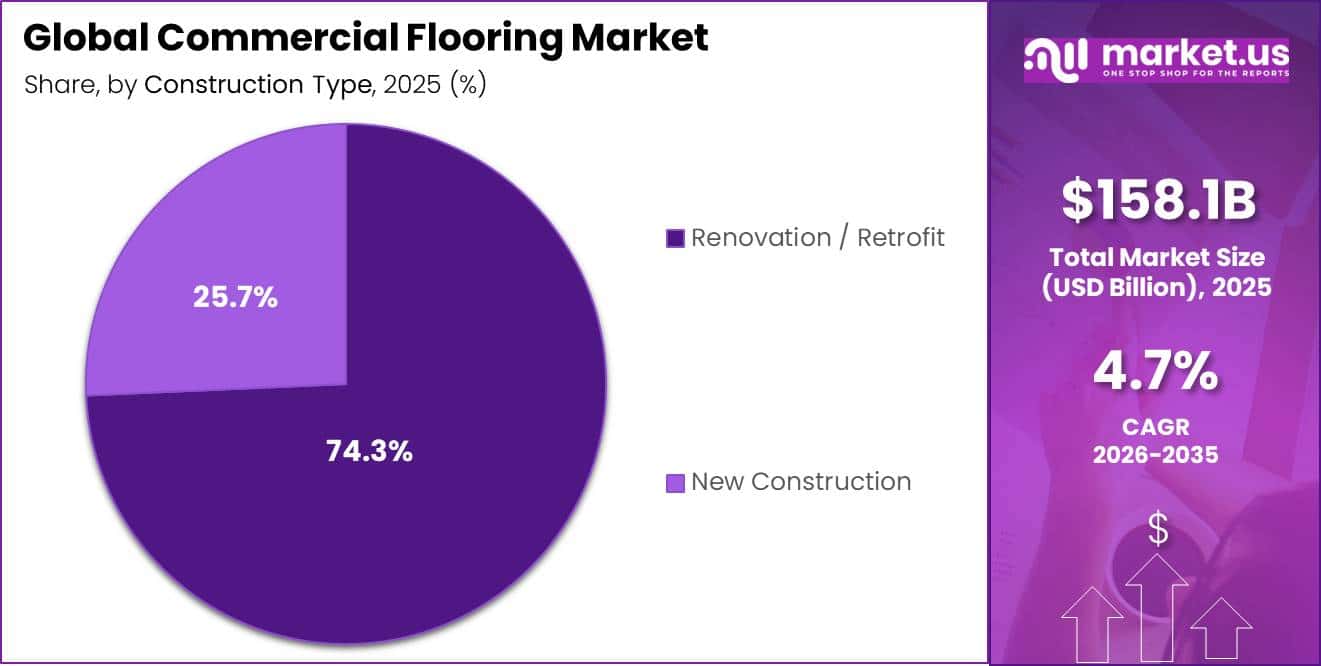
- Based on construction type, renovation / retrofit dominated the market, comprising 74.3% of the total market.
- Among the distribution channels, indirect sales held a major share in the commercial flooring market, accounting for 68.4% of the market share.
- In 2025, Asia Pacific was the most dominant region in the commercial flooring market, accounting for 42.5% of the total global market revenue.
The industrial scenario is increasingly shaped by refurbishment of ageing buildings. The European Commission reports that 85% of European Union buildings were constructed before 2000, 75% have poor energy performance, and the annual renovation rate remains only 1%. These conditions create opportunities for flooring replacement during upgrades involving offices, healthcare facilities, education buildings, hospitality properties, and public infrastructure, where buyers seek durability, acoustic comfort, easier maintenance, and compatibility with modern building systems.
Performance, safety, and indoor environmental quality are major purchasing drivers. The United States Environmental Protection Agency states that resilient flooring, adhesives, cleaners, and finishes can emit volatile organic compounds after installation. It recommends selecting tested low-emission products and airing spaces for at least 72 hours. This supports demand for certified flooring, low-emission adhesives, modular installation formats, recycled materials, slip-resistant surfaces, and products designed for faster maintenance and reduced disruption in occupied commercial buildings.
Government renovation policies are widening long-term growth opportunities. European Union countries must renovate 3% of buildings owned by public bodies each year, covering properties with more than 250 square metres of useful floor area. The revised framework also sets a 1.9% annual energy-consumption reduction target for the public sector. These measures can stimulate flooring demand through public building upgrades, while digital specification, circular material recovery, renovation services, and application-specific products create additional opportunities for manufacturers and distributors across mature and expanding construction markets worldwide over time.
Product Type Analysis
Non-Resilient Flooring dominates with 54.3% because durability and design flexibility support commercial projects.
In 2025, Non-Resilient Flooring held a dominant market position, capturing more than a 54.3% share. Its leadership was supported by extensive use of ceramic tile, stone, concrete, and related hard-surface materials across offices, retail stores, hotels, public buildings, and industrial facilities. Buyers value these products for long service life, resistance to heavy foot traffic, easy cleaning, and suitability for areas requiring a permanent finish. Their compatibility with new construction and renovation projects also strengthens demand across high-use commercial environments.
- For instance, in September 2025, according to Interface, Inc., the company expanded its resilient flooring portfolio with new luxury vinyl tile styles and refreshed rubber flooring products designed for demanding commercial spaces.
Resilient Flooring is expected to be the fastest-growing segment. Its growth is supported by demand for quieter interiors, underfoot comfort, faster installation, and easier replacement in occupied buildings. Luxury vinyl tile, rubber, and linoleum products also give designers flexibility across healthcare, education, hospitality, and workplace projects while helping facility managers balance appearance, maintenance, and performance requirements.
Application Analysis
Offices & Corporate dominates with 25.4% because workplace renewal supports regular flooring demand.
In 2025, Offices & Corporate held a dominant market position, capturing more than a 25.4% share. Its leadership was supported by office construction, workplace refurbishment, tenant improvements, and demand for interiors that combine appearance with daily performance. Corporate buyers commonly select flooring that supports acoustic comfort, simple maintenance, modular replacement, and coordinated design across meeting rooms, corridors, reception areas, and shared workspaces. Flexible layouts and branding requirements also encourage the use of carpet tiles, luxury vinyl tile, wood finishes, and other commercial systems.
- For instance, in January 2025, according to Interface, Inc., the company unveiled a carbon-negative nora rubber flooring prototype designed for commercial interiors, with healthcare identified as a priority application.
Healthcare is expected to be the fastest-growing segment. Growth is supported by hospital expansion, clinic renovation, and stricter requirements for hygiene, slip resistance, acoustics, and uninterrupted maintenance. Healthcare facilities favour durable flooring that can withstand rolling equipment, frequent cleaning, heavy movement, and room-specific performance needs while supporting safer, calmer clinical environments across modern care settings.
Construction Type Analysis
Renovation / Retrofit dominates with 74.3% because existing commercial spaces require regular interior renewal.
In 2025, Renovation / Retrofit held a dominant market position, capturing more than a 74.3% share. Its leadership was supported by ageing offices, hospitals, schools, hotels, retail sites, and public buildings that require flooring replacement without full structural redevelopment. Facility owners often renovate occupied properties to improve appearance, safety, acoustics, maintenance, and space utilization. Modular flooring, loose-lay systems, and quick-installation products are especially valuable because they can reduce closure time, simplify phased work, and allow damaged sections to be replaced without removing the entire surface.
- For instance, in May 2025, according to the European Commission, a Horizon Europe call opened to support renovation of the built environment through adaptable design and easier material disassembly.
New Construction is expected to be the fastest-growing segment. Its growth is supported by expanding commercial facilities, modern healthcare buildings, logistics centres, educational campuses, and hospitality projects. New developments allow flooring systems to be specified early, coordinated with building services, and selected according to traffic, hygiene, acoustic, design, and maintenance requirements globally.
Distribution Channel Analysis
Indirect Sales dominates with 68.4% because dealer networks provide broad market reach and local project support.
In 2025, Indirect Sales held a dominant market position, capturing more than a 68.4% share. Its leadership was supported by established relationships between flooring manufacturers, distributors, dealers, retailers, contractors, and design professionals. Commercial buyers often depend on channel partners for product samples, technical guidance, local inventory, installation coordination, and after-sales assistance. These networks help suppliers serve offices, hospitals, schools, hotels, warehouses, and public facilities without maintaining their own sales teams in every market.
- For instance, in July 2025, according to Forbo, the company continued investing in sales initiatives while supporting its Flooring Systems business during a challenging operating environment.
Direct Sales is expected to be the fastest-growing segment. Its expansion is supported by demand for customized specifications, larger project contracts, direct technical consultation, and closer coordination with architects, facility managers, and contractors. Manufacturers can use this channel to manage complex orders, strengthen customer relationships, and provide faster support throughout commercial projects at scale.
Key Market Segments
By Product Type
- Non‑Resilient Flooring
- Resilient Flooring
- Soft Coverings
- Seamless Flooring
- Wood and Laminates
By Application
- Offices & Corporate
- Retail
- Healthcare
- Education
- Hospitality
- Industrial & Warehousing
- Public Infrastructure
- Others
By Construction Type
- New Construction
- Renovation / Retrofit
By Distribution Channel
- Direct Sales
- Indirect Sales
- Distributors / Dealers
- Retailers / Home‑improvement Stores
- Online Channels
Driver Analysis
Commercial refurbishment cycle
The largest near-term value pool is not greenfield office construction but replacement-led renovation of offices, hotels, education facilities, retail units, and public buildings, where flooring can be upgraded without a full structural rebuild. This shifts supplier economics from large, bid-driven new-build packages toward specification-led, repeatable renovation programs: manufacturers with broad local inventory, color continuity, fast sample approval, and contractor networks can convert shorter project windows into higher share-of-wallet.
The macro basis is material: buildings and construction account for roughly 11–13% of global GDP and around 9% of employment, while commercial owners increasingly prioritize asset repositioning over disruption-heavy redevelopment. In the U.S., commercial real-estate investment activity is projected to increase 16% in 2026 to about $562 billion, supporting fit-out and upgrade budgets even where new construction remains financing-constrained.
Flooring suppliers gain when they sell a system surface, moisture mitigation, adhesive, installation and warranty rather than commodity square metres; the modeled contribution is +1.4 percentage points because renovation demand is geographically diversified and projects can proceed at smaller ticket sizes than new developments.
Drivers Impact Analysis
| Driver | (~) % Impact on CAGR | Geographic Relevance | Impact Timeline |
|---|---|---|---|
| Commercial refurbishment cycle | +1.4 pp | North America, EU, Japan, Australia | Short term (≤ 2 years) |
| Data-centre and logistics build-out | +1.2 pp | U.S. Sun Belt, Europe, India, SEA | Medium term (2-4 years) |
| Low-carbon, verified materials | +1.0 pp | EU core, UK, North America, APAC metros | Medium term (2-4 years) |
| Healthcare and hygiene specifications | +0.9 pp | North America, EU, GCC, China | Short term (≤ 2 years) |
| Modular installation and downtime reduction | +0.8 pp | North America, EU, APAC corridors | Short term (≤ 2 years) |
| Digital compliance and traceability | +0.6 pp | EU core, UK, North America | Long term (≥ 4 years) |
Restraint Analysis
Project-finance constraints
Commercial flooring is typically installed near practical completion, making it highly exposed to delayed or cancelled non-residential projects when lending costs, tenant uncertainty, or developer equity gaps interrupt construction before interior fit-out is released. Global growth is expected to slow to 3.0% in 2026 from a 3.5% average in 2024–2025, while U.S. private non-residential construction spending excluding data centres declined 7.9% year over year by mid-2026; this combination disproportionately suppresses discretionary office, retail, hospitality, and mixed-use flooring packages despite relative resilience in healthcare and data centres.
The operational effect is a longer conversion cycle from specification to purchase order, lower factory-load visibility, and intensified competition for the remaining funded projects; manufacturers then discount to protect volume, distributors hold slower-moving inventory, and installers face fragmented site schedules. The model deducts 1.3 percentage points from CAGR because the constraint reduces both new-build square-metre demand and renovation appetite where owners defer capital expenditure, although essential facilities and publicly funded projects partially offset the loss.
Restraint Impact Analysis
| Restraint | (~) % Impact on CAGR Forecast | Geographic Relevance | Impact Timeline |
|---|---|---|---|
| Project-finance constraints | -1.3 pp | North America, EU, China | Short term (≤ 2 years) |
| Tariff and freight volatility | -1.1 pp | U.S., EU, APAC import hubs | Short term (≤ 2 years) |
| Installer scarcity | -0.9 pp | North America, EU, Australia | Medium term (2-4 years) |
| Input-cost inflation | -0.8 pp | Global, import-dependent markets | Short term (≤ 2 years) |
| Compliance reformulation burden | -0.7 pp | EU core, UK, North America | Medium term (2-4 years) |
| Substrate and warranty risk | -0.6 pp | Global renovation markets | Long term (≥ 4 years) |
Opportunity Analysis
Flooring-as-a-Service
Flooring-as-a-service is an unexploited monetization pivot not a baseline driver because most commercial flooring is still sold as a one-time material-and-installation transaction, leaving manufacturers with limited recurring revenue after project completion. Under a service model, suppliers would bundle material, installation, scheduled inspection, localized tile or plank replacement, cleaning compatibility, moisture testing, and end-of-life take-back into 5–10-year contracts priced per square metre per month; an illustrative $25–$45 per m² installed modular system could generate 15–25% higher lifetime revenue than a single sale if replacement, maintenance, and financing are retained in-house.
A supplier achieving 10% service-contract penetration among its modular commercial installations could raise customer retention from a typical project-cycle relationship of 7–12 years to annual account engagement, lower sales acquisition cost through centralized portfolio contracts, and expand gross-margin mix by an estimated 300–600 basis points once installed-base density supports field-service routing.
The +1.2 percentage-point upside assumes suppliers finance only creditworthy portfolios, retain residual-value rights, and use standardized modular products rather than attempting to convert every project into a capital-intensive lease.
Opportunity Impact Analysis
| Opportunity | (~) % Potential CAGR | Geographic Relevance | Execution Window |
|---|---|---|---|
| Flooring-as-a-service | +1.2 pp | North America, EU, Japan, Australia | Medium term (2-4 years) |
| Circular take-back platforms | +1.0 pp | EU core, UK, North America | Medium term (2-4 years) |
| Data-centre performance systems | +0.9 pp | U.S., Europe, India, Southeast Asia | Short term (≤ 2 years) |
| Adaptive-reuse conversion kits | +0.8 pp | North America core, EU, China | Medium term (2-4 years) |
| Digital warranty data layer | +0.7 pp | EU core, North America, GCC | Long term (≥ 4 years) |
| Installer-network roll-ups | +0.6 pp | North America, EU, Australia | Short term (≤ 2 years) |
Challenges Analysis
Skilled Installer Pipeline
The structural installer challenge is not an immediate sales prohibition but a long-duration throughput constraint: advanced commercial systems require trained labor for substrate preparation, moisture mitigation, welding, pattern alignment, resin curing, electrostatic-control installation, and warranty documentation, yet the physical intensity and fragmented career path limit new entry. U.S. construction and extraction occupations alone are projected to generate roughly 649,300 annual openings, with a May 2024 median wage of $58,360, illustrating the scale of competition for trade labor against other construction activities; at the macro level, the U.S. had 7.4 million job openings in June 2026.
For flooring contractors, a 10–15% labor-capacity shortfall can create 2–6-week scheduling displacement on complex fit-outs, push overtime and subcontractor premiums into the 8–18% range, and increase callback risk when inexperienced crews handle moisture-sensitive or technically specified surfaces. The -1.0 percentage-point friction drag reflects delayed project completion and lost premium-product conversion rather than lost demand; mitigation requires 3–5-year apprenticeship pipelines, manufacturer-certified installation academies, ergonomic tooling, prefabricated components, and product redesign that lowers kneeling, cutting, adhesive, and seam-welding labor intensity.
Challenges Impact Analysis
| Challenge | (~) % CAGR Friction | Geographic Relevance | Mitigation Horizon |
|---|---|---|---|
| Skilled Installer Pipeline | -1.0 pp | North America, EU, Australia | Long term (≥ 4 years) |
| Multi-Origin Supply Traceability | -0.8 pp | U.S., EU, APAC corridors | Medium term (2-4 years) |
| Substrate Failure Diagnosis | -0.8 pp | Global renovation markets | Long term (≥ 4 years) |
| Specification Data Fragmentation | -0.7 pp | EU hubs, North America, GCC | Medium term (2-4 years) |
| Operational Downtime Coordination | -0.6 pp | North America, EU, APAC metros | Medium term (2-4 years) |
| Circular Material Quality Control | -0.5 pp | EU core, UK, North America | Long term (≥ 4 years) |
Geopolitical Impact Analysis
Trade Defence Measures Reshape Commercial Flooring Material Sourcing
Trade tensions are changing the competitive position of engineered wood flooring suppliers. In July 2025, according to the European Commission, the European Union imposed anti-dumping duties ranging from 21.3% to 36.1% on multilayered wood flooring imported from China. The measure covers products commonly installed in offices, hotels, shops, restaurants, and museums. The EU multilayered flooring industry was valued at EUR 1.3 billion and supported 10,500 jobs. Higher import duties may encourage commercial contractors and distributors to source more flooring from European manufacturers.
- In July 2025, according to the European Commission, anti-dumping duties on epoxy resin imports ranged from 17.3% to 33% for China, 10.8% to 11% for Taiwan, and reached 29.9% for Thailand. Epoxy resins are widely used in construction coatings, paints, and adhesives. These measures can influence procurement costs for seamless flooring, primers, protective finishes, and installation materials used in industrial and commercial buildings
Wood-based flooring supply chains also face uncertainty from new trade investigations. In June 2025, according to the U.S. Department of Commerce, antidumping and countervailing duty investigations were initiated into hardwood and decorative plywood imported from China, Indonesia, and Vietnam. The alleged dumping margins were 504.07% for China, 84.94% for Indonesia, and between 138.04% and 152.41% for Vietnam. Because plywood is used in flooring substrates and interior construction systems, possible future duties may influence supplier selection and contract pricing.
Regional Analysis
Asia Pacific dominated the commercial flooring market with a 42.5% share, valued at US$67.18 billion in 2025
In 2025, Asia Pacific held a dominant position in the global commercial flooring market, accounting for 42.5% of total market revenue and reaching a value of US$67.18 billion. The region’s leadership was supported by extensive commercial construction activity, large-scale urban development projects, and continuous investments in business infrastructure across major economies. Growing demand for office buildings, retail complexes, educational facilities, healthcare institutions, hospitality establishments, and mixed-use developments contributed significantly to flooring consumption across the region.
China remained a major contributor to regional demand due to its substantial commercial building stock and ongoing infrastructure development. According to the National Bureau of Statistics of China, construction output exceeded CNY 31.4 trillion in 2024, highlighting the scale of building activity supporting demand for commercial interior materials.
Key Regions and Countries Covered
- North America
- The US
- Canada
- Europe
- Germany
- France
- The UK
- Spain
- Italy
- Russia & CIS
- Rest of Europe
- APAC
- China
- Japan
- South Korea
- India
- ASEAN
- Rest of APAC
- Latin America
- Brazil
- Mexico
- Rest of Latin America
- Middle East & Africa
- GCC
- South Africa
- Rest of MEA
Key Players Analysis
Commercial flooring manufacturers compete by strengthening product portfolios, expanding distribution reach, and improving manufacturing efficiency. Major companies such as Forbo International SA, Gerflor, Interface, Inc., Mannington Mills, Inc., Amtico, and James Halstead Plc. focus on flooring solutions that provide durability, design flexibility, easy maintenance, and compliance with environmental requirements.
Market participants such as Flowcrete, Congoleum, IVC Group, NOX Corp., Toli Flooring, and Nora also strengthen their market presence through distributors, dealers, retailers, and direct customer relationships. Collaboration with architects, contractors, designers, and facility managers helps manufacturers improve project visibility and product specification rates.
Companies further invest in regional production, supply-chain planning, technical support, and quality-control systems to improve delivery performance and customer satisfaction. The ability to provide consistent product quality, application-specific solutions, installation guidance, and dependable after-sales service continues to influence competitiveness within the commercial flooring market.
Market Key Players
- Amtico
- The Armstrong Flooring, Inc.
- Congoleum
- Flowcrete (RPM)
- Forbo International SA
- Gerflor
- Interface, Inc.
- IVC Group
- James Halstead Plc.
- Mannington Mills, Inc.
- NOX Corp.
- Tkflor
- Nora
- Toli Flooring
Key Development
- In February 2026, Interface, Inc. launched noravant, a PVC-free resilient rubber flooring platform. Its first product, noravant timber, introduced a woodgrain design for rubber flooring and became available across the Americas and selected European, Middle Eastern, and African markets.
- In May 2026, Amtico completed a major investment in a state-of-the-art water bath annealing system for its lamination process. Developed internally by its engineering and research teams, the system replaced air cooling to improve manufacturing efficiency, product quality, and long-term production capability.
- In May 2026, Forbo Flooring Systems showcased its latest low-embodied-carbon floor-covering collections during Clerkenwell Design Week in London. The company also sponsored a Future Materials seminar covering material transparency, performance standards, ethical sourcing, scalability, and sustainable commercial specifications.
Report Scope
| Report Features | Description |
|---|---|
| Market Value (2025) | USD 158.1 Bn |
| Forecast Revenue (2035) | USD 235.9 Bn |
| CAGR (2026-2035) | 4.7% |
| Base Year for Estimation | 2025 |
| Historic Period | 2020-2024 |
| Forecast Period | 2026-2035 |
| Report Coverage | Revenue Forecast, Market Dynamics, Competitive Landscape, Recent Developments |
| Segments Covered | By Product Type (Non-Resilient Flooring, Resilient Flooring, Soft Coverings, Seamless Flooring, and Wood & Laminates), By Application (Offices & Corporate, Retail, Healthcare, Education, Hospitality, Industrial & Warehousing, Public Infrastructure, and Others), By Construction Type (New Construction and Renovation/Retrofit), By Distribution Channel (Direct Sales, Indirect Sales (Distributors/Dealers, Retailers/Home-Improvement Stores, and Online Channels)) |
| Regional Analysis | North America – The US & Canada; Europe – Germany, France, The UK, Spain, Italy, Russia & CIS, Rest of Europe; APAC– China, Japan, South Korea, India, ASEAN & Rest of APAC; Latin America– Brazil, Mexico & Rest of Latin America; Middle East & Africa– GCC, South Africa, & Rest of MEA |
| Competitive Landscape | Amtico, The Armstrong Flooring, Inc., Congoleum, Flowcrete (RPM), Forbo International SA, Gerflor, Interface, Inc., IVC Group, James Halstead Plc., Mannington Mills, Inc., NOX Corp., Tkflor, Nora, and Toli Flooring. |
| Customization Scope | Customization for segments, region/country-level will be provided. Moreover, additional customization can be done based on the requirements. |
| Purchase Options | We have three licenses to opt for: Single User License, Multi-User License (Up to 5 Users), Corporate Use License (Unlimited Users and Printable PDF) |





































