


Report Overview
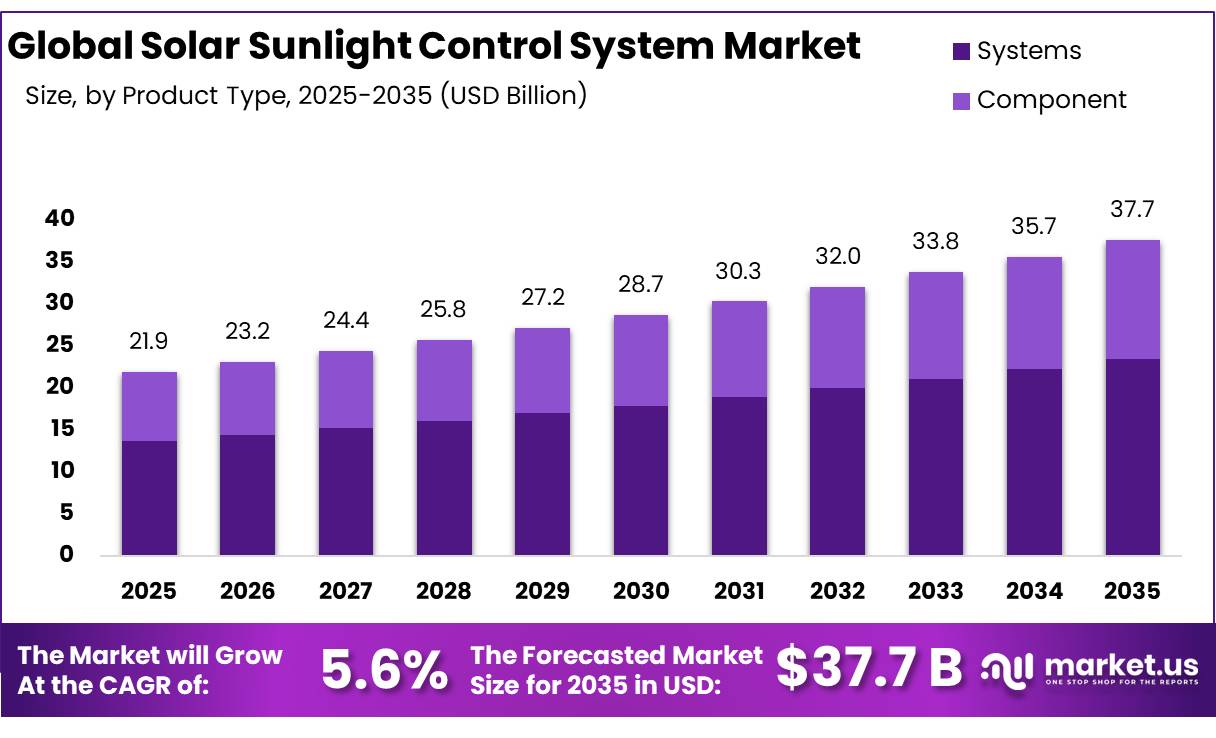
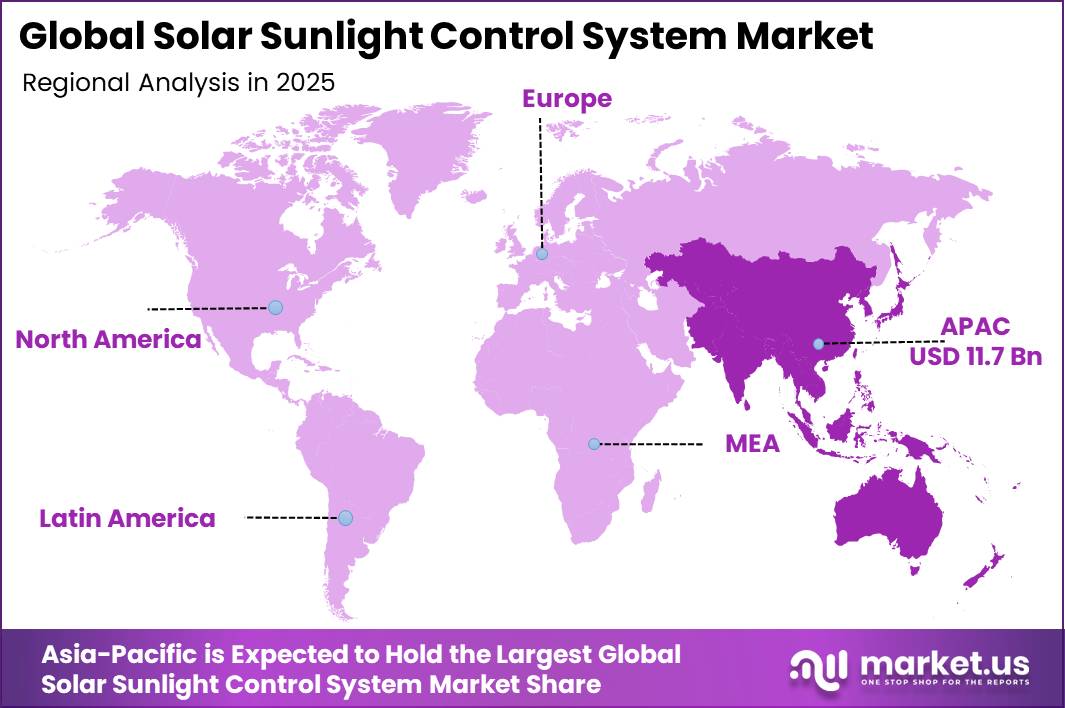
In 2025, the Global Solar Sunlight Control System Market was valued at USD 21.9 billion, and between 2026 and 2035, this market is estimated to register a CAGR of 5.6%, reaching about USD 37.7 billion by 2035. In 2025, Asia-Pacific led the market, achieving over 53.5% share with a revenue of USD 11.7 Billion.
Solar sunlight control systems are integrated building solutions designed to regulate daylight, glare and solar heat entering through windows, façades, and skylights. The industry covers automated blinds, external louvers, solar-control films, low-emissivity glass, electrochromic windows, daylight sensors and building-management controls. These systems adjust sunlight according to solar position, indoor temperature, occupancy, and lighting requirements.
- The industrial scenario remains closely connected with the wider energy performance of buildings. According to the International Energy Agency (IEA), in 2023, buildings accounted for around 30% of global energy demand, with residential properties representing approximately 70% of building energy consumption and commercial and public buildings contributing the remaining 30%.
- According to the United Nations Environment Programme (UNEP) Global Status Report for Buildings and Construction 2025–2026, based on the latest available global data, the buildings and construction sector is responsible for around 37% of global carbon dioxide emissions, contributes approximately 11%–13% of global GDP, and provides employment for nearly 9% of the global workforce. These figures demonstrate the large addressable base for solar-control technologies across new construction and renovation projects.
Key Takeaways
- The Global Solar Sunlight Control System Market was valued at USD 21.9 billion in 2025.
- The market is projected to grow at a CAGR of 5.6% and is estimated to reach USD 37.7 billion by 2035.
- On the basis of product type, systems dominated the market, constituting 62.3% of the total market share.
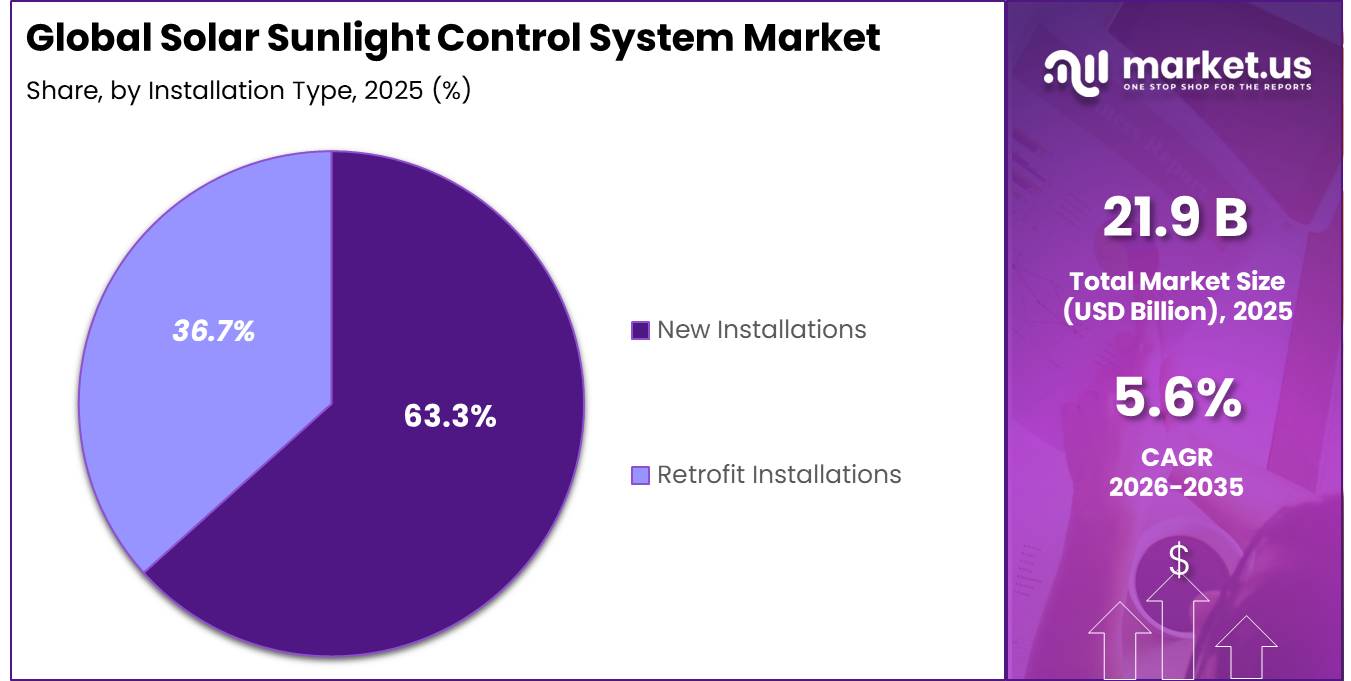
- Based on the installation type, new installations dominated the market, with a substantial market share of around 63.3%.
- Based on the application, commercial led the market, comprising 43.2% of the total market.
- In 2025, Asia-Pacific was the most dominant region in the market, accounting for over 53.5% of the total global consumption.
Rising cooling requirements are becoming a major industry driver. According to the International Energy Agency (IEA), published in the World Energy Outlook 2024, global space-cooling energy demand is projected to increase by nearly 4% per year through 2035 if current policy settings remain in place and income-led air-conditioner adoption could add approximately 330 GW to global peak electricity demand by 2035, while higher temperatures may add another 170 GW.
Window-related energy losses also support technology adoption. According to the U.S. Department of Energy (DOE), as of 2024, windows account for approximately 10% of total building energy use and influence energy-consuming activities that represent around 40% of a building’s overall energy consumption, making high-performance window technologies an important factor in improving energy efficiency. Integration with occupancy sensors, weather forecasting, wireless controls and artificial intelligence is expected to make sunlight management more responsive and measurable.
- According to the revised European Energy Performance of Buildings Directive (EPBD), which entered into force in May 2024, the European Union aims to reduce overall energy consumption by 11.7% by 2030 compared with projected energy use, supporting greater adoption of energy-efficient building technologies and renovations.
European renovation guidance also targets a 16% reduction in average residential primary energy use by 2030 and approximately 20%–22% by 2035. Consequently, future opportunities are expected in retrofit-friendly automated blinds, dynamic glass, façade-integrated photovoltaics, cloud-based energy controls and systems capable of balancing daylight, occupant comfort and cooling efficiency. Demand will increasingly favour interoperable products that can connect with smart-building platforms and provide verifiable energy-performance data.
Product Type Analysis
Manual Solar Control Systems dominate with a 62.3% share due to their simple operation and cost-effective design.
In 2025, Systems held a dominant market position, capturing more than a 62.3% share. Their leadership was supported by simple installation, easy operation and lower dependence on electrical components. These systems allow users to adjust blinds, curtains, shutters and other shading devices according to changing sunlight conditions. They are widely used in residential buildings, small offices and retrofit projects where affordability and straightforward control remain important. Manual systems also require less technical maintenance because they do not depend on motors, sensors or connected controllers.
Components are the fastest-growing segment in the Solar Sunlight Control System Market. Their growth is supported by the increasing use of automated shading, smart façades and connected building-management systems. These components detect sunlight intensity, indoor brightness, temperature and occupancy conditions, allowing shading systems to respond automatically. Sensors help improve visual comfort, reduce excessive heat gain and support efficient use of artificial lighting.
Installation Type Analysis
New Installations dominate with 63.3% as integrated shading helps control cooling energy demand
In 2025, New Installations held a dominant market position, capturing more than a 63.3% share of the Solar Sunlight Control System Market by installation type. New construction allows automated blinds, exterior shading, daylight sensors, and centralized controls to be planned alongside cooling and lighting systems. This improves system coordination and reduces costly changes after the building is completed.
- In July 2025, the International Energy Agency reported that proper insulation and exterior shading could reduce a building’s cooling demand by up to 80%. This energy-saving potential is encouraging developers to include sunlight control equipment during the initial design and construction stage.
Retrofit Installations is the fastest growing segment in the Solar Sunlight Control System Market. Owners of existing offices, hotels, schools, and residential properties are replacing fixed blinds with motorized shading and sensor-based controls to reduce heat entering through windows. In July 2025, the International Energy Agency stated that space cooling was the fastest-growing source of building energy demand and was projected to rise by almost 4% annually through 2035 under existing policy settings. This energy pressure is strengthening demand for retrofit sunlight control systems that can improve indoor comfort without requiring complete building reconstruction.
Application Analysis
Commercial applications dominate with a 43.2% market share
In 2025, Commercial held a dominant market position, capturing more than a 43.2% share. Commercial applications led the Solar Sunlight Control System Market because offices, retail buildings, hotels, hospitals, and educational facilities require reliable control over indoor heat and daylight. Automated blinds, exterior shading, sensors, and smart controllers help these buildings reduce cooling loads, improve employee comfort, and manage glare across large glazed areas.
- According to the U.S. Energy Information Administration in May 2026, reported that commercial electricity sales in Virginia increased by nearly 30 million megawatt-hours between 2019 and 2025, reflecting rising electricity demand from commercial infrastructure. These conditions encourage facility operators to install responsive sunlight-control systems that support energy management and reduce pressure on air-conditioning equipment.
Residential is the fastest-growing segment in the Solar Sunlight Control System Market. Growth is supported by increasing demand for comfortable indoor temperatures, improved privacy, reduced glare, and convenient control of curtains, blinds, and external shades. Homeowners are increasingly connecting sunlight-control products with smart-home platforms, temperature sensors, mobile applications, and voice-controlled devices. These systems can automatically respond to sunlight intensity and room temperature, helping households limit unwanted solar heat during warmer periods while allowing natural light when conditions are suitable.
Key Market Segments
By Product Type
- System
- Component
By Installation Type
- New Installations
- Retrofit Installations
By Application
- Residential
- Commercial
- Industrial
Driver Analysis
Heatwave-driven cooling avoidance and peak-load reduction demand
Cooling pressure is now a direct revenue driver for solar sunlight control systems because external shading is one of the few building measures that reduces load before electricity is consumed. The IEA noted in 2025 that proper insulation plus exterior shading can cut building cooling demand by up to 80%, while its cooling analysis also shows that air conditioners and fans already account for nearly 20% of global building electricity use.
At the power-system level, the IEA reported global electricity demand rose 4.3% year on year in 2024 and expects 3.9% growth through the outlook period, with India forecast at 6.3% annual electricity-demand growth during 2025-2027, making passive cooling and solar control economically more attractive in fast-heating, fast-electrifying markets.
Drivers Impact Analysis
| Driver | (~) % Impact on CAGR Forecast | Geographic Relevance | Impact Timeline |
|---|---|---|---|
| EPBD-led solar-ready and zero-emission building compliance pull | +2.4% | EU core, UK adjacency, MENA policy followers | Short term (≤ 2 years) |
| Heatwave-driven cooling avoidance and peak-load reduction demand | +2.1% | APAC corridors, Southern EU, U.S. Sun Belt, Middle East | Short term (≤ 2 years) |
| Smart controls integration with IEQ and automated building systems | +1.6% | EU, North America core, advanced APAC metros | Medium term (2-4 years) |
| Retrofit payback improvement in public and commercial buildings | +1.8% | EU public estate, North America institutional, developed Asia | Medium term (2-4 years) |
| BIPV and solar façade convergence with shading hardware | +1.3% | North America innovation hubs, EU façade markets, East Asia | Medium term (2-4 years) |
| Grid stress and electrification economics favor passive solar control | +1.5% | India, China, ASEAN, U.S., Southern Europe | Long term (≥ 4 years) |
Restraint Analysis
Retrofit CapEx friction
The largest immediate restraint is retrofit economics, because solar sunlight control systems usually compete for the same building-upgrade budget as HVAC replacement, envelope insulation, controls, and rooftop solar, while requiring façade integration, electrical work, commissioning, and tenant coordination that push installed project costs materially above standard shading or glazing upgrades; this matters more in 2026 because the EU’s EPBD forces member-state transposition by 29 May 2026 and aims to renovate the 16% worst-performing non-residential buildings by 2030 and 26% by 2033, yet those mandates do not automatically de-risk owner payback calculations, especially when public and commercial buyers still discount cash flows under elevated financing hurdles and prioritize measures with clearer statutory necessity.
In the United States, nonresidential construction spending was running at a seasonally adjusted annual rate of $738.7 billion in May 2026, down 0.3% month over month, while total construction spending over the first five months of 2026 was 2.7% below the same period of 2025, signaling a budget environment where discretionary façade technologies face deferral risk.
In practical forecasting terms, this raises customer-required hurdle rates by roughly 150 to 250 basis points, stretches sales cycles by 3 to 9 months for multi-site portfolios, and supports an estimated -2.2 percentage point drag on baseline CAGR in 2026-2028 as projects are resized, bundled into later renovation waves, or redesigned toward lower-cost passive alternatives.
Restraint Impact Analysis
| Restraint | (~) % Impact on CAGR Forecast | Geographic Relevance | Impact Timeline |
|---|---|---|---|
| Retrofit CapEx friction | -2.2% | EU core, North America core, Japan, Korea | Short term (≤ 2 years) |
| Regulatory complexity gap | -1.7% | EU, UK-adjacent Europe, urban APAC | Short term (≤ 2 years) |
| Glass and component inflation | -1.5% | North America core, EU, import-reliant APAC | Medium term (2-4 years) |
| Trade and tariff pass-through | -1.3% | U.S., EU import corridors | Medium term (2-4 years) |
| Construction cycle slowdown | -1.6% | North America core, Western Europe | Short term (≤ 2 years) |
| Compliance and sourcing diligence | -1.1% | U.S., EU, multinational supply chains | Medium term (2-4 years) |
Opportunity Analysis
Agrivoltaic shade-control kits.
A realistic upside case is that suppliers package tracker-linked louver controls, spectral films, crop-specific irradiance software, and sensor subscriptions into an agriculture SKU that lifts blended gross margin by 400 to 700 basis points versus hardware-only sales, expands service attach rates from roughly 10% to 35% to 45%, and unlocks an adjacent addressable market equal to 12% to 18% of the existing commercial sunlight-control revenue pool by 2032, with higher monetization in India, the U.S., and Southern Europe where land-use conflict and heat stress are rising; if even 8% to 10% of new dual-use solar acreage adopts active light-management layers, category growth could gain about 2.4 percentage points above baseline due to premium pricing, data-led recurring revenue, and lower customer acquisition cost through utility-agri partnerships rather than fragmented project selling.
Opportunity Impact Analysis
| Opportunity | (~) % Potential CAGR Upside | Geographic Relevance | Execution Window |
|---|---|---|---|
| Agrivoltaic shade-control kits | +2.4% | North America core, EU, India, APAC agri belts | Medium term (2-4 years) |
| BIPV facade daylight systems | +2.1% | EU, East Asia, Gulf, North America urban core | Medium term (2-4 years) |
| Solar carport + EV canopy platforms | +1.8% | North America, India metros, GCC, EU logistics hubs | Short term (≤ 2 years) |
| Floating/canal modular control systems | +1.5% | India, Middle East, Southeast Asia, water-stressed regions | Medium term (2-4 years) |
| VPP-ready commercial shading networks | +1.7% | North America core, EU, Australia, advanced APAC | Short term (≤ 2 years) |
| Public-asset retrofit roll-ups | +1.3% | India states, EU municipalities, U.S. public estate | Long term (≥ 4 years) |
Challenges Analysis
Smart component supply volatility
Global clean energy supply-chain assessments by the U.S. Department of Energy highlight that solar and related power electronics manufacturing experienced several years of aggressive capacity expansion followed by localized overcapacity and critical material bottlenecks, with solar PV alone needing roughly 2,500 GW of new capacity in the U.S. power system by mid‑century, pulling heavily on glass, aluminum, semiconductors, and critical minerals.
Even as some solar input costs fall due to global overcapacity, DOE and other government reviews emphasize that upstream concentration in a few countries and ports keeps systemic risk high, so sunlight control OEMs face shipment delay variability of ±10–15 days across key Asia–Europe–North America corridors, which translates into schedule slippage of 30–60 days on complex building retrofits and 3–5% cost overruns once storage, idle labor, and on‑site re‑mobilization are factored in.
From a growth dynamics perspective, these recurrent micro‑shocks do not stop installations outright but shave approximately 1.3 percentage points from potential CAGR by forcing integrators to carry 2–3 months of strategic inventory, accept lower-margin rush procurement for about 10–15% of annual project volume, and delay revenue recognition into subsequent quarters, which in turn depresses internal rate of return (IRR) estimates by 80–150 basis points for portfolio investors.
Challenges Impact Analysis
| Challenge | (~) % CAGR Friction Drag | Geographic Relevance | Mitigation Horizon |
|---|---|---|---|
| Grid-tied variability absorption | -1.6% | EU, US, China, India urban | Long term (≥ 4 years) |
| Smart component supply volatility | -1.3% | APAC–EU–US trade lanes | Medium term (2-4 years) |
| Skilled integrator talent gap | -1.1% | North America, EU, GCC, India | Long term (≥ 4 years) |
| Building-code & permitting lag | -1.0% | EU regulatory hubs, US states, APAC metros | Medium term (2-4 years) |
| Lifecycle performance uncertainty | -0.9% | Global commercial real estate | Long term (≥ 4 years) |
| Capital allocation risk premium | -0.8% | Global institutional investors | Short term (≤ 2 years) |
Geopolitical Impact Analysis
Geopolitical Tensions Reshape Supply Chains and Investment in the Solar Sunlight Control System Market
Recent geopolitical conflicts, particularly the Russia–Ukraine war and continuing tensions in the Middle East, have influenced the Solar Sunlight Control System market by affecting raw material supply, manufacturing costs, and international trade. Glass, aluminum, specialty films, electronic sensors, and semiconductor components used in solar sunlight control systems have experienced price fluctuations because of supply chain disruptions and higher transportation expenses.
Rising energy prices in several regions have also increased production costs for manufacturers. At the same time, governments across Europe, North America, and parts of Asia-Pacific are accelerating investments in energy-efficient buildings to reduce electricity consumption and improve energy security.
This has supported demand for advanced sunlight control technologies that lower cooling loads and improve indoor comfort. Several companies are also shifting production to multiple manufacturing locations to reduce dependence on a single sourcing region and improve supply stability. Construction activity slowed temporarily in some countries due to economic uncertainty and higher financing costs, delaying a few commercial building projects. However, renovation projects focused on sustainability and stricter building efficiency regulations continue to create steady opportunities.
Regional Analysis
Asia Pacific Held the Largest Share of the Global Solar Sunlight Control System Market
Asia-Pacific dominated the Solar Sunlight Control System market in 2025, accounting for 53.5% of the global market, valued at approximately USD 11.7 billion. The region’s leadership is supported by rapid urbanization, expanding commercial construction, and increasing investment in energy-efficient buildings across China, Japan, South Korea, Australia, and Southeast Asia. China continues to lead global construction activity, with the National Bureau of Statistics reporting that the country’s construction industry generated over approximately USD 4.5 trillion in output during 2024, creating strong demand for advanced glazing, shading, and solar control technologies.
North America is expected to register the fastest growth during the forecast period due to increasing investments in sustainable construction and stricter building energy efficiency standards. The United States remains the key growth engine, supported by the expansion of commercial offices, healthcare facilities, educational institutions, and smart residential developments. According to the U.S. Census Bureau, the value of U.S. construction put in place exceeded USD 2.1 trillion in 2024, reflecting continued investment in modern infrastructure.
Key Regions and Countries Covered
- North America
- The US
- Canada
- Europe
- Germany
- France
- The UK
- Spain
- Italy
- Russia & CIS
- Rest of Europe
- APAC
- China
- Japan
- South Korea
- India
- ASEAN
- Rest of APAC
- Latin America
- Brazil
- Mexico
- Rest of Latin America
- Middle East & Africa
- GCC
- South Africa
- Rest of MEA
Key Players Analysis
Lutron Electronics strengthens its position in solar sunlight control through automated shades, daylight sensors, lighting controls, and building-management integration. Founded in 1961, the company offers more than 15,000 energy-saving products across over 100 countries. Its systems reportedly help save around 10 billion kWh of electricity and approximately USD 1 billion in annual utility costs in the United States.
3M Company participates in sunlight control through architectural window films that reduce solar heat, glare, ultraviolet exposure, and cooling demand in buildings. In 2025, 3M recorded USD 24.9 billion in total sales, including USD 13.58 billion from the Americas, USD 7.10 billion from Asia Pacific, and USD 4.27 billion from EMEA. This financial scale supports continued product development, installer networks, and global market coverage.
Guardian Industries addresses solar sunlight control through coated, low-emissivity, reflective, and high-performance architectural glass used in façades, windows, and curtain-wall systems. Guardian and its related companies employ more than 6,700 people and serve customers in over 160 countries across 5 continents.
The Major Players in The Industry
-
- Hunter Douglas
- Somfy Systems
- Lutron Electronics
- Warema Renkhoff SE
- View Inc.
- Saint-Gobain (SageGlass)
- 3M Company
- Eastman Chemical (LLumar/Solar Gard)
- Guardian Industries
- Kawneer Company
- Griesser AG
- ABB Ltd.
- Other Key Players
Key Development
- In May 2025, Hunter Douglas strengthened its solar sunlight control system portfolio by upgrading the PowerView Automation platform with a new XL motor offering 2 times higher torque, supporting automated shades measuring up to 156 inches wide and 180 inches high, while operating around 10 decibels quieter than the earlier motor.
- In January 2025, ABB presented its new KNX blind and shutter actuators for automated sun protection, including 230-volt AC and 24-volt DC models that can adjust blinds according to the sun’s position and support anti-glare control in buildings.
Report Scope
| Report Features | Description |
|---|---|
| Market Value (2025) | USD 21.9 Bn |
| Forecast Revenue (2035) | USD 37.7 Bn |
| CAGR (2026-2035) | 5.6% |
| Base Year for Estimation | 2025 |
| Historic Period | 2020-2024 |
| Forecast Period | 2026-2035 |
| Report Coverage | Revenue Forecast, Market Dynamics, Competitive Landscape, Recent Developments |
| Segments Covered | By Product Type (Manual Solar Control Systems, Automated Solar Control Systems, Actuators, Controllers, Sensors, and Others), By Installation Type (New Installations and Retrofit Installations), By Application (Residential, Commercial, and Industrial) |
| Regional Analysis | North America – The US & Canada; Europe – Germany, France, The UK, Spain, Italy, Russia & CIS, Rest of Europe; APAC– China, Japan, South Korea, India, ASEAN & Rest of APAC; Latin America– Brazil, Mexico & Rest of Latin America; Middle East & Africa– GCC, South Africa, & Rest of MEA |
| Competitive Landscape | Hunter Douglas, Somfy Systems, Lutron Electronics, Warema Renkhoff SE, View Inc., Saint-Gobain (SageGlass), 3M Company, Eastman Chemical (LLumar/Solar Gard), Guardian Industries, Kawneer Company, Griesser AG, ABB Ltd., Other Key Players |
| Customization Scope | Customization for segments, region/country-level will be provided. Moreover, additional customization can be done based on the requirements. |
| Purchase Options | We have three licenses to opt for: Single User License, Multi-User License (Up to 5 Users), Corporate Use License (Unlimited Users and Printable PDF) |





































