


Report Overview
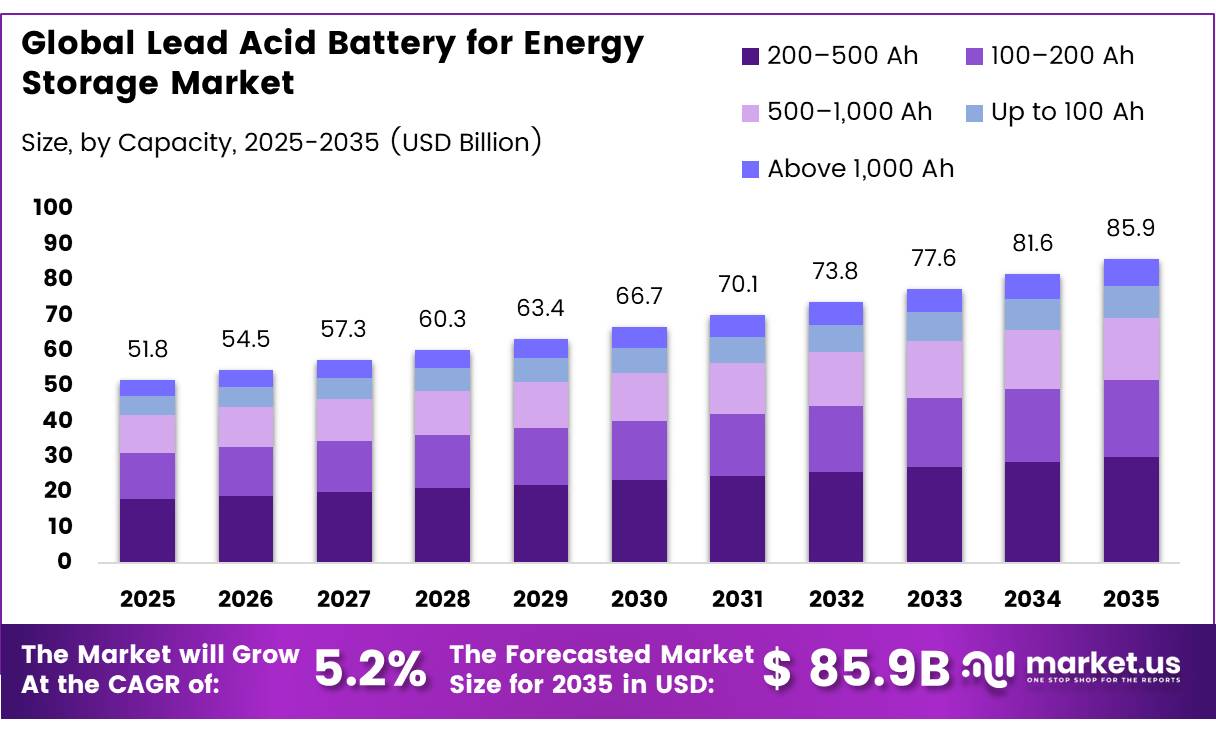
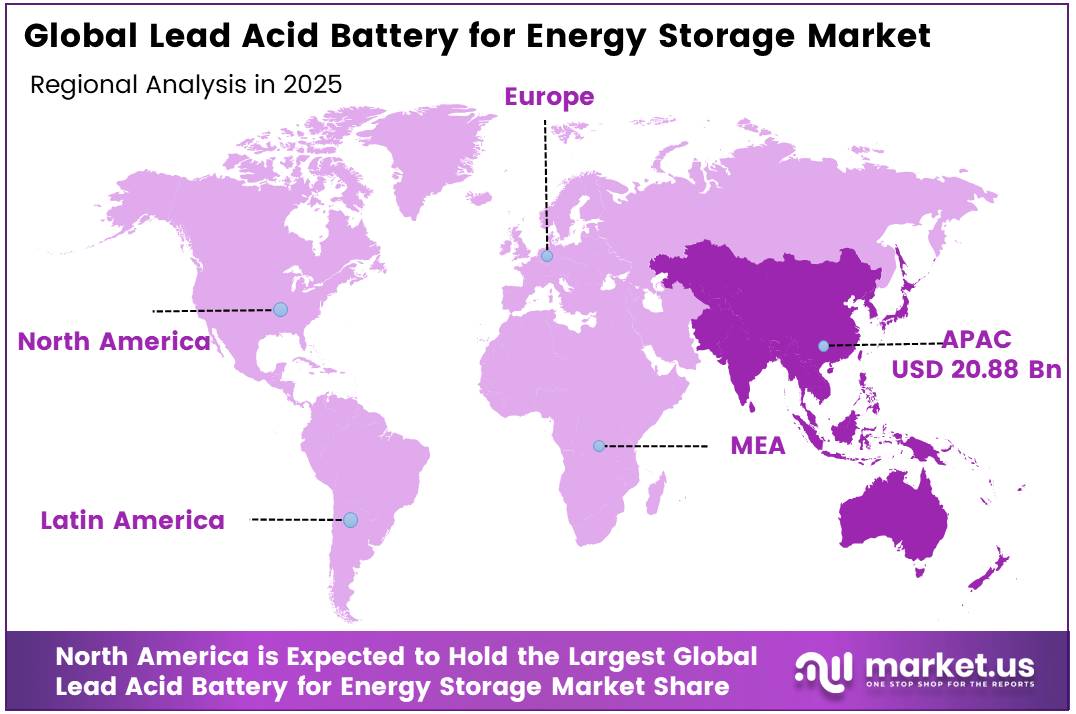
In 2025, the Global Lead Acid Battery for Energy Storage Market was valued at US$ 51.8 billion, and between 2026 and 2035, this market is estimated to register a CAGR of 5.2%, reaching about US$85.9 billion by 2035. In 2025, Asia Pacific led the market, achieving over 40.3% share with a revenue of US$ 20.88 Billion.
- According to the International Energy Agency (IEA), global battery storage additions reached 108 GW in 2025, around 40% higher than in 2024, as power grids require more storage to support the increasing use of solar and wind energy. The IEA also estimates that investment in battery storage for the power sector will reach USD 66 billion in 2025, reflecting strong demand for reliable energy storage systems.
Lead acid batteries continue to play an important role because they are cost-effective, dependable, and highly recyclable, making them widely used for stationary backup power and grid support. The Battery Council International states that more than 80% of telecom backup power systems rely on lead batteries, supporting mobile towers, emergency communication networks, and data centers. Looking ahead, the IEA projects that energy storage capacity must increase sixfold by 2030, with battery storage expanding to 1,200 GW to support the global renewable energy transition.
- In addition, according to OICA, global vehicle production increased from 92.7 million units in 2024 to 96.4 million units in 2025, with Asia Pacific producing the largest share. Since every conventional vehicle requires a lead acid starter battery, the region benefits from strong demand from both the automotive and energy storage sectors
Key Takeaways
- The global lead acid battery for energy storage market was valued at US$51.8 billion in 2025.
- The global market is projected to grow at a CAGR of 5.2% and is estimated to reach US$85.9 billion by 2035.
- On the basis of capacity, the 200–500 Ah segment dominated the global lead acid battery for energy storage market, constituting 35.1% of the total market share in 2025.
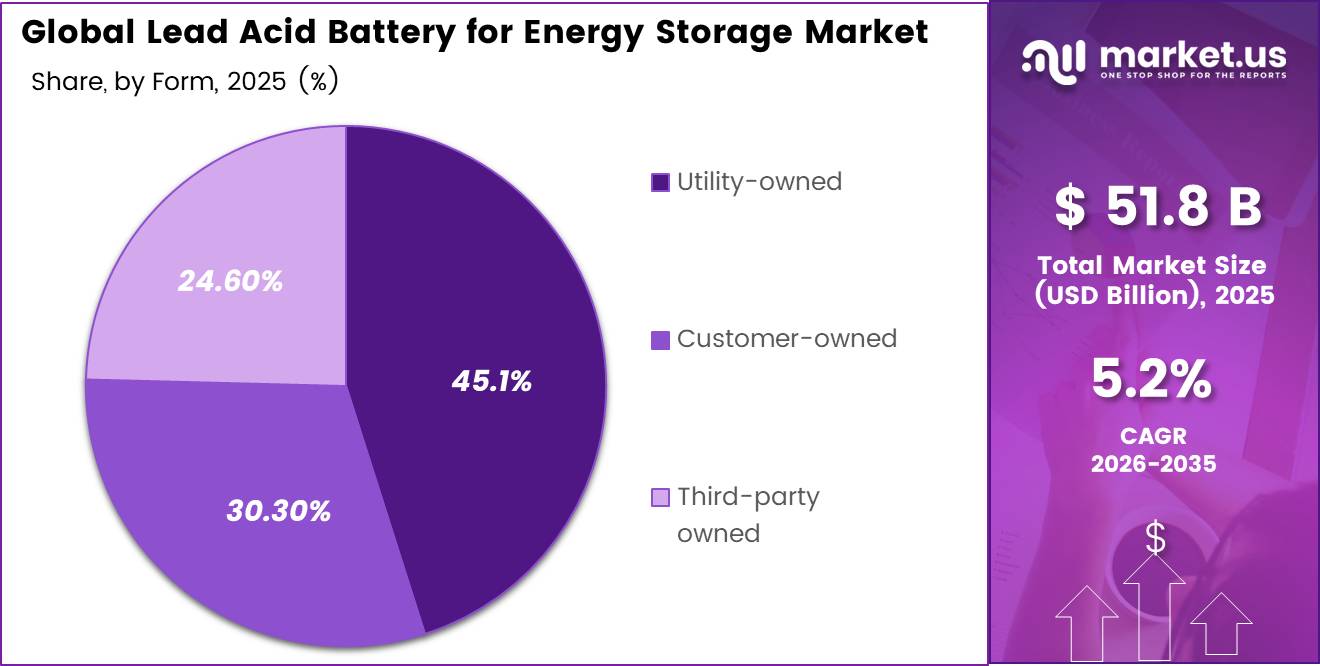
- Based on the form, the utility-owned segment dominated the lead acid battery for energy storage market, with a substantial market share of around 45.1% in 2025.
- Among the applications, utilities & grid storage held a major share in the global lead acid battery for energy storage market, accounting for 40.3% of the total market in 2025.
- In 2025, Asia Pacific was the most dominant region in the lead acid battery for energy storage market, accounting for 40.3% of the total global consumption.
By Capacity Analysis
200–500 Capacity Ah represents dominant Segment in the Market.
The 200–500 Ah capacity segment commands the largest market share with 35.1% because it occupies the optimal performance and cost intersection for the two highest-volume stationary application categories: utility substation backup power and commercial-scale UPS installations. Batteries in this capacity range deliver sufficient energy throughput for multi-hour backup duty cycles at telecom towers, data center auxiliary systems, and industrial facility emergency power, while remaining within the capital cost envelope that procurement managers for mid-market infrastructure projects can justify without multi-stage financing.
The sub-100 Ah capacity segment is the market’s fastest-growing size category, driven by the rapid expansion of household residential storage, portable off-grid power, and small-scale UPS applications across price-sensitive emerging markets in Asia, Africa, and Latin America. At this capacity range, lead acid batteries retain a compelling cost and familiarity advantage over lithium-ion alternatives for the rural electrification, solar home system, and small commercial backup segments, where total installed cost and local serviceability matter more than energy density or cycle life longevity.
By Form Analysis
Utility‑owned leads the Form segment.
Utility-owned energy storage configurations dominate the market with 45.1% because large-scale grid operators possess the balance sheet strength, regulatory cost-recovery mechanisms, and technical infrastructure to deploy, operate, and maintain battery storage systems at the scale required to meaningfully impact grid stability and renewable integration performance.
For instance, Southern Company’s grid modernization program which expanded its transmission and distribution upgrades across its Southeastern U.S. service territory through frameworks stretching from 2009 through its massive 2026 infrastructure funding rollout has maintained lead acid battery specifications for critical substation backup applications, reflecting the segment’s entrenched position in utility infrastructure where replacement decisions are driven by certified performance history rather than technology novelty.
The third-party owned segment is the market’s fastest-growing ownership model, driven by the emergence of energy-storage-as-a-service business models in which independent power producers, battery aggregators, and virtual power plant operators deploy and operate storage assets under long-term performance contracts with utility off takers and commercial energy consumers, eliminating the capital requirement barrier that has historically constrained behind-the-meter storage adoption among mid-market commercial and industrial customers.
By Application Analysis
Utilities & grid storage Are Most Widely Used.
The utilities and grid storage segment’s dominant position with 40.3% reflects both the scale of individual project deployments and the structural role of lead acid batteries in providing black-start capability, frequency regulation, and substation backup across aging grid infrastructure in both developed and developing economies. Grid operators procure battery storage at system-level scale, creating large individual contract values that dwarf residential or commercial deployment, and lead acid VRLA systems retain preferred-chemistry status in many utility specifications because their failure modes are well-characterized, their thermal behavior is predictable, and their recycling logistics are fully industrialized.
- The segment is further reinforced by the International Energy Agency’s projection that global grid-scale battery storage capacity must reach approximately 970 GW by 2030 under ambitious decarbonization scenarios, creating a structural long-duration procurement pipeline that no single battery chemistry can serve exclusively.
For instance, GS Yuasa Corporation’s March 2025 strategic agreement with a European utility provider to pilot advanced lead acid battery storage systems integrated with smart grid infrastructure illustrates the active competitive positioning of advanced lead acid technologies within utility-scale procurement processes that might otherwise default entirely to lithium-ion solutions.
The microgrid application segment is the market’s fastest-growing end-use category, propelled by accelerating investment in distributed energy infrastructure across markets where centralized grid extension is economically or technically impractical.
Key Market Segments
By Capacity
- 200–500 Ah
- 100–200 Ah
- 500–1,000 Ah
- Up to 100 Ah
- Above 1,000 Ah
By Form
- Utility‑owned
- Customer‑owned
- Third‑party owned
By Application
- Utilities & grid storage
- Industrial
- Household / residential storage
- Microgrid
- Military and defense
Driver Analysis
Long-duration storage cost window favors lead-acid in low-cycle backup use
The strongest near-term support for lead-acid stationary storage is not headline utility arbitrage but low-cycle, backup-heavy duty profiles where upfront capex and domestic recyclability matter more than maximum cycle life, and the U.S. Department of Energy’s long-duration storage assessment explicitly identified lead-acid among the chemistries with the greatest room for cost reduction, citing roughly a $0.31/kWh reduction in levelized cost of storage potential under innovation scenarios.
That matters because in backup, microgrid reserve, substation support, and telecom continuity applications, dispatch frequency is often materially below daily-cycling lithium use cases, so buyers optimize around installed cost, tolerance for float service, and replacement logistics rather than only round-trip efficiency. In practical market terms, this widens lead-acid’s 2026 addressable space in cost-sensitive energy storage tenders where project owners want bankable chemistry, lower fire-risk perception, and established service channels, supporting an estimated +1.4 percentage-point uplift to baseline CAGR rather than a market takeover
Drivers Impact Analysis
| Driver | (~) % Impact on CAGR Forecast | Geographic Relevance | Impact Timeline |
|---|---|---|---|
| Long-duration storage cost window favors lead-acid in low-cycle backup use | +1.4% | North America core, India, selected APAC and Africa corridors | Short term (≤ 2 years) |
| Grid resiliency and utility storage buildout expands stationary battery demand envelope | +1.8% | U.S., India, APAC corridors, South America spill-over | Short term (≤ 2 years) |
| Closed-loop recycling and high secondary lead recovery defend system economics | +1.6% | U.S. core, EU, India, Latin America spill-over | Medium term (2-4 years) |
| EU battery regulation rewards traceable recycled content and industrial-battery compliance | +1.2% | EU core, UK alignment spill-over, export-oriented APAC suppliers | Medium term (2-4 years) |
| Battery management, safety, and state-of-health rules improve bankability of stationary systems | +1.0% | EU, North America, advanced APAC markets | Short term (≤ 2 years) |
| Low-cost domestic backup and telecom resilience sustain non-lithium procurement niches | +1.3% | India, Southeast Asia, Africa, rural LATAM | Medium term (2-4 years) |
Restraint Analysis
Lead price volatility
Lead-acid storage economics remain exposed to commodity swings because lead still dominates cell bill-of-material cost, and USGS data show the lead-acid battery industry accounted for an estimated 85% of domestic lead consumption while the 2025 value of U.S. secondary lead output fell to about $2.4 billion, underscoring how producer economics can deteriorate even in a highly recycled chain; in practical project terms, a 10% to 15% move in refined lead pricing can lift finished stationary battery pack cost by roughly 4% to 7%, which is enough to push EPC bidders to widen contingency buffers by 100 to 200 basis points, delay distributor restocking cycles by one to two quarters, and compress gross margin by 150 to 300 basis points on fixed-price tenders, especially in India and import-linked APAC markets where FX pass-through and working-capital financing amplify the shock.
Restraint Impact Analysis
| Restraint | (~) % Impact on CAGR Forecast | Geographic Relevance | Impact Timeline |
|---|---|---|---|
| Lead price volatility | -1.4% | North America core, EU, India, APAC corridors | Short term (≤\leq≤ 2 years) |
| EU compliance burden | -1.1% | EU, UK-adjacent supply chains, export hubs in Asia | Medium term (2-4 years) |
| Lithium substitution | -2.0% | North America core, China, India, Australia, GCC | Medium term (2-4 years) |
| EPR cost pass-through | -0.8% | India, EU, selected U.S. states | Short term (≤\leq≤ 2 years) |
| Smelting and permit tightness | -0.9% | EU, North America, secondary-lead hubs in Asia | Medium term (2-4 years) |
| Capital efficiency gap | -1.2% | Utility-scale markets globally, especially U.S., India, EU | Long term (≥\geq≥ 4 years) |
Opportunity Analysis
Battery-as-a-service for C&I backup
India’s policy framework now scales energy storage obligations from 1% in 2023-24 to 4% by 2029-30, while government support includes viability-gap funding and broader storage-system recognition, creating a regulatory umbrella for storage adoption even though most current incentives are chemistry-agnostic and targeted at system deployment rather than specifically at lead-acid vendors.
That gap creates white space for PbA players to target the sub-500 kWh commercial segment with lease or uptime-pricing contracts where installed system cost can be 20% to 35% lower than premium chemistries, annualized customer bills can be smoothed into 36- to 60-month contracts, and refurbishment/redeployment can add 8% to 12% residual value capture; the result is a realistic pathway to 150 to 250 basis points of market growth upside for suppliers that shift from equipment vendors into fleet financiers and service operators, particularly in retail, clinics, schools, and small manufacturing sites that value predictable backup economics over energy density.
Opportunity Impact Analysis
| Opportunity | (~) % Potential CAGR Upside | Geographic Relevance | Execution Window |
|---|---|---|---|
| Telecom-microgrid bundling | +1.6% | APAC emerging markets, Africa, LATAM | Short term (≤ 2 years) |
| Battery-as-a-service for C&I backup | +1.3% | India, Southeast Asia, Middle East | Short term (≤ 2 years) |
| Utility LDES retrofit niche | +2.1% | North America core, EU, India | Medium term (2-4 years) |
| Circular recycling-margin stack | +1.1% | North America, EU | Medium term (2-4 years) |
| Data-center resilience blocks | +1.4% | U.S., Nordics, India | Medium term (2-4 years) |
| Roll-up of regional integrators | +1.8% | U.S., EU, APAC fragmented markets | Long term (≥ 4 years) |
Challenges Analysis
Short cycle-life economics
Lead acid batteries deployed for stationary energy storage typically deliver 1 500–2 500 deep cycles at 50–80% depth of discharge, versus 4 000–8 000 cycles for mainstream lithium-ion chemistries in grid storage, which structurally compresses economic lifetimes by 35–50% for many lead acid-based BESS assets and forces earlier reinvestment cycles for utilities and C&I users.
Government-aligned studies on energy storage roadmaps for power systems have highlighted that while upfront capex for lead acid can be 20–40% lower per kilowatt-hour installed, lifetime levelized cost per kilowatt-hour can be 15–30% higher once replacement frequency and typical round-trip efficiencies of 75–85% (versus 88–92% for lithium-ion) are accounted for, especially in daily cycling applications.
This performance economics mismatch manifests as a friction drag on project approvals and financing: grid planners often assign shorter depreciation schedules (8–10 years versus 12–15 years) and require higher reserve margins, which in turn reduces the number of bankable lead acid storage projects by several percentage points in tender pipelines, effectively trimming underlying growth by an estimated 1 percentage point CAGR even though absolute deployment continues.
To navigate this, lead acid manufacturers and integrators are increasingly forced into niche duty profiles such as low-cycle backup, limited daily cycling, or hybrid configurations requiring redesign of sizing rules (oversizing by 10–20% to protect cycle life), tighter warranties with specific cycle caps, and more sophisticated operations strategies that minimize high-depth cycles, meaning the sector must invest in advanced battery management, application-specific product lines, and differentiated performance guarantees simply to defend its existing share in the broader storage mix.
Challenges Impact Analysis
| Challenge | (~) % CAGR Friction Drag | Geographic Relevance | Mitigation Horizon |
|---|---|---|---|
| Short cycle-life economics | -1.0% | Global grid & C&I | Medium term (2-4 years) |
| Recycling & compliance load | -0.7% | North America, EU, India | Long term (≥ 4 years) |
| Supply chain volatility | -0.6% | Global, export-driven hubs | Medium term (2-4 years) |
| Tech competitiveness pressure | -1.1% | Global utility-scale | Long term (≥ 4 years) |
| O&M and reliability gaps | -0.5% | Emerging grids, microgrids | Short term (≤ 2 years) |
| Cyber–control integration risk | -0.4% | Advanced grid markets | Medium term (2-4 years) |
Geopolitical Impact Analysis
Critical mineral supply chain concentration is repricing lead acid’s cost advantage across global manufacturing corridors.
Lead-acid batteries remain central to stationary energy storage supporting grid backup, telecommunications, and data center resilience, yet this dependence is increasingly exposed to shifting geopolitical currents. Refined lead feeding storage-battery manufacturing into the United States stays import-reliant, with Canada supplying 32%, the Republic of Korea 16%, Mexico 14%, and Australia 11% of imports between 2020 and 2023, according to the U.S. Geological Survey. Even so, domestic mine production of recoverable lead rose by 10% in 2024 compared with the prior year, according to the U.S. Geological Survey, pointing to gradual efforts toward supply resilience.
Antimony, an alloying element vital to the grid plates used in stationary storage batteries, has become a flashpoint in trade relations. In December 2024, according to the U.S. Geological Survey, China banned all antimony exports to the United States, and by November 2025 antimony prices stood at $20.30 per pound, according to the U.S. Geological Survey, reflecting continued volatility.
In response, reshoring initiatives are gaining traction. In October 2025, a mining company in Idaho was conditionally awarded $80 million by the U.S. Department of War to reestablish domestic antimony supply, according to the U.S. Geological Survey, signaling a broader push to secure the mineral inputs underpinning lead-acid energy storage manufacturing.
Regional Analysis
Asia Pacific Held the Largest Share of the Global Lead Acid Battery for Energy Storage Market.
Asia Pacific’s market holds 40.3% market share, this dominance reflects the geographic concentration of both battery manufacturing capacity and the application ecosystems that sustain lead acid energy storage demand at scale. China alone accounts for the majority of global lead acid battery manufacturing output, reinforced by its dominance in secondary lead smelting, separator production, and grid-scale storage procurement under the National Energy Administration’s 30 GW storage capacity target.
India’s energy storage market is being structurally reshaped by the Ministry of New and Renewable Energy’s Viability Gap Funding scheme for battery energy storage systems, which allocated INR 37.4 billion across Phase I procurement tranches in 2024–2025, generating competitive tendering processes in which lead acid and advanced VRLA systems compete directly with lithium-ion alternatives on a total lifecycle cost basis.
Brazil’s installed renewable energy capacity surpassed 190 GW in 2024 per the Brazilian Electricity Regulatory Agency (ANEEL), creating grid balancing requirements that are pulling stationary battery storage procurement into previously underserved regional markets where lead acid’s cost accessibility and established local service infrastructure give it a structural advantage over lithium-ion alternatives in sub-utility-scale applications.
Key Regions and Countries Covered
- North America
- The US
- Canada
- Europe
- Germany
- France
- The UK
- Spain
- Italy
- Russia & CIS
- Rest of Europe
- APAC
- China
- Japan
- South Korea
- India
- ASEAN
- Rest of APAC
- Latin America
- Brazil
- Mexico
- Rest of Latin America
- Middle East & Africa
- GCC
- South Africa
- Rest of MEA
Key Players Analysis
Lead acid battery for energy storage manufacturer’s focus on strengthening technological differentiation, production scale efficiency, and supply chain integration to maintain competitiveness. A key priority is continuous technology innovation, including the development of lead-carbon hybrid formulations, advanced VRLA designs, and AI-integrated battery management systems that improve cycle life, charge acceptance, and remote performance monitoring for stationary grid and microgrid applications.
Companies further invest heavily in secondary lead recycling infrastructure and closed-loop supply chain development, as these deliver both regulatory compliance under evolving battery content mandates and structural cost advantages that protect margins against commodity lead price volatility.
Vertical integration with secondary lead smelters and separator manufacturers helps secure raw material stability and improve cost control amid tightening environmental regulations on primary lead sourcing. Strategic capacity expansion, particularly across Asia Pacific and Latin America, enables alignment with concentrated demand from renewable energy storage and telecom infrastructure ecosystems.
The Major Players In The Industry
- EnerSys
- Clarios LLC
- Exide Industries Ltd.
- East Penn Manufacturing Company
- GS Yuasa International Ltd.
- Amara Raja Energy & Mobility
- Leoch International Technology Ltd.
- Narada Power
- FIAMM Energy Technology S.p.A.
- HOPPECKE Batteries
- C&D Technologies, Inc.
- The Furukawa Battery Co., Ltd.
- Crown Battery Manufacturing Company
- Tianneng Group
- SEBANG Global Battery Co., Ltd.
- Other Key Players
Key Development
- In August 2025, Clarios agreed to acquire Ecobat’s battery recycling operations in Germany and Austria to strengthen its European closed‑loop supply supporting its lead‑acid and other battery businesses.
- In July 2025, Exide Industries announced at its annual general meeting that alongside heavy investment in lithium‑ion cells it is investing about ₹500 crore in its core lead‑acid battery operations and associated recycling business to support future growth in domestic and export markets
Report Scope
| Report Features | Description |
|---|---|
| Market Value (2025) | USD 51.8 Bn |
| Forecast Revenue (2035) | USD 85.9 Bn |
| CAGR (2026-2035) | 5.2% |
| Base Year for Estimation | 2025 |
| Historic Period | 2020-2024 |
| Forecast Period | 2026-2035 |
| Report Coverage | Revenue Forecast, Market Dynamics, Competitive Landscape, Recent Developments |
| Segments Covered | By Capacity (200–500 Ah, 100–200 Ah, 500–1,000 Ah, Up to 100 Ah, and Above 1,000 Ah), By Form (Utility-owned, Customer-owned, and Third-party owned), By Application (Utilities & grid storage, Industrial, Household / residential storage, Microgrid, and Military and defense) |
| Regional Analysis | North America – The US & Canada; Europe – Germany, France, The UK, Spain, Italy, Russia & CIS, Rest of Europe; APAC– China, Japan, South Korea, India, ASEAN & Rest of APAC; Latin America– Brazil, Mexico & Rest of Latin America; Middle East & Africa– GCC, South Africa, & Rest of MEA |
| Competitive Landscape | EnerSys Clarios LLC Exide Industries Ltd. East Penn Manufacturing Company GS Yuasa International Ltd. Amara Raja Energy & Mobility Leoch International Technology Ltd. Narada Power FIAMM Energy Technology S.p.A. HOPPECKE Batteries C&D Technologies, Inc. The Furukawa Battery Co., Ltd. Crown Battery Manufacturing Company Tianneng Group SEBANG Global Battery Co., Ltd. Others |
| Customization Scope | Customization for segments, region/country-level will be provided. Moreover, additional customization can be done based on the requirements. |
| Purchase Options | We have three licenses to opt for: Single User License, Multi-User License (Up to 5 Users), Corporate Use License (Unlimited Users and Printable PDF) |





































