Report Overview
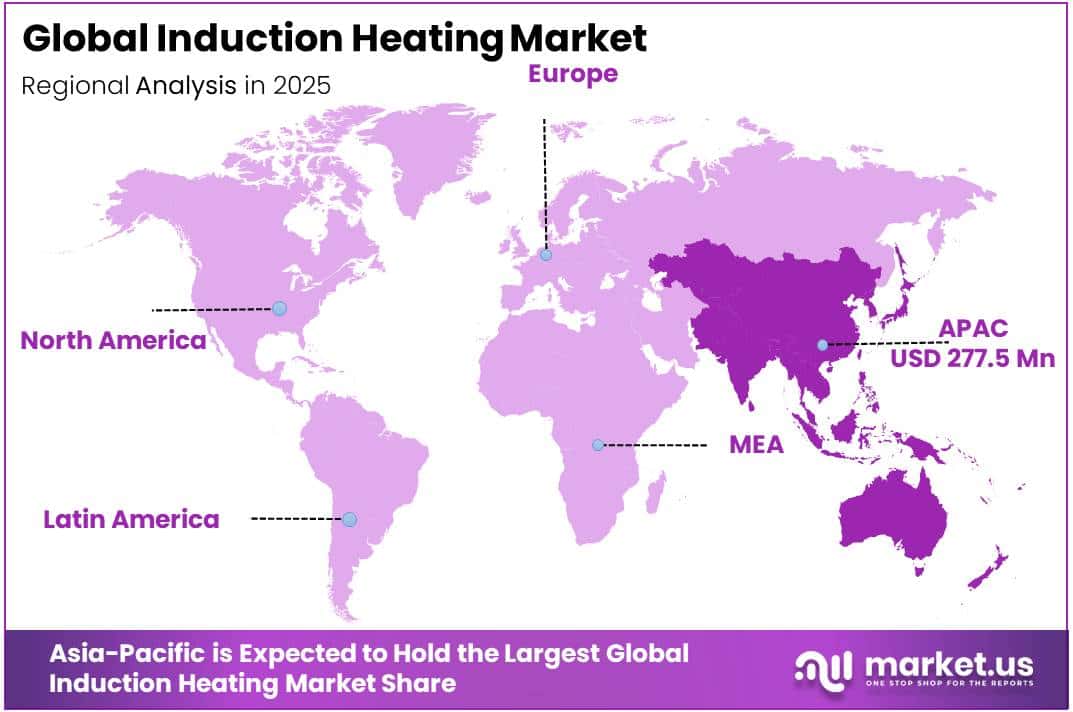
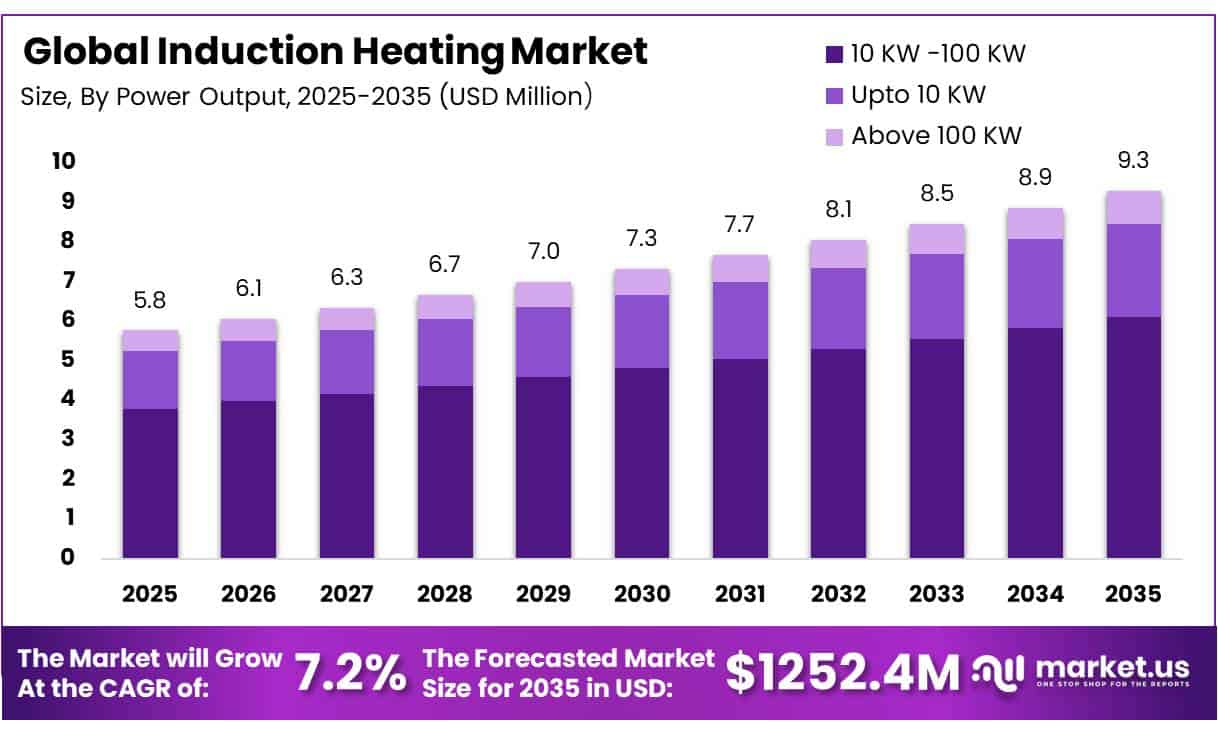
In 2025, the Induction Heating Market was valued at USD 622.8 Million, and between 2026 and 2035, this market is estimated to register a CAGR of 7.2%, reaching about USD 1252.4 Million by 2035. Asia-Pacific held a dominant market position, capturing more than a 44.56% share, holding USD 277.5 Billion in revenue.
The Induction Heating Market is part of the industrial heating and manufacturing equipment landscape. Induction heating uses electromagnetic energy to generate heat directly in electrically conductive materials, supporting processes such as metal treatment, melting, brazing, soldering. The technology fits the wider shift toward electrified industrial heat.
- The International Energy Agency (IEA) reported in 2025 that industry accounted for nearly 40% of global final energy demand, highlighting the scale of industrial energy use and the importance of efficient heating technologies.
Key Takeaways
- The Global Induction Heating Market was valued at USD 622.8 million in 2025.
- The global market is projected to grow at a CAGR of 7.2% and is estimated to reach USD 1,252.4 million by 2035.
- On the basis of type, Portable Induction Heating Systems dominated the market, constituting 54.56% of the total market share.
- Based on power output, 10 KW – 100 KW dominated the market, accounting for 65.67% of the total market share.
- Based on frequency, > 10-50 KHz dominated the market, accounting for 71.34% of the total market share.
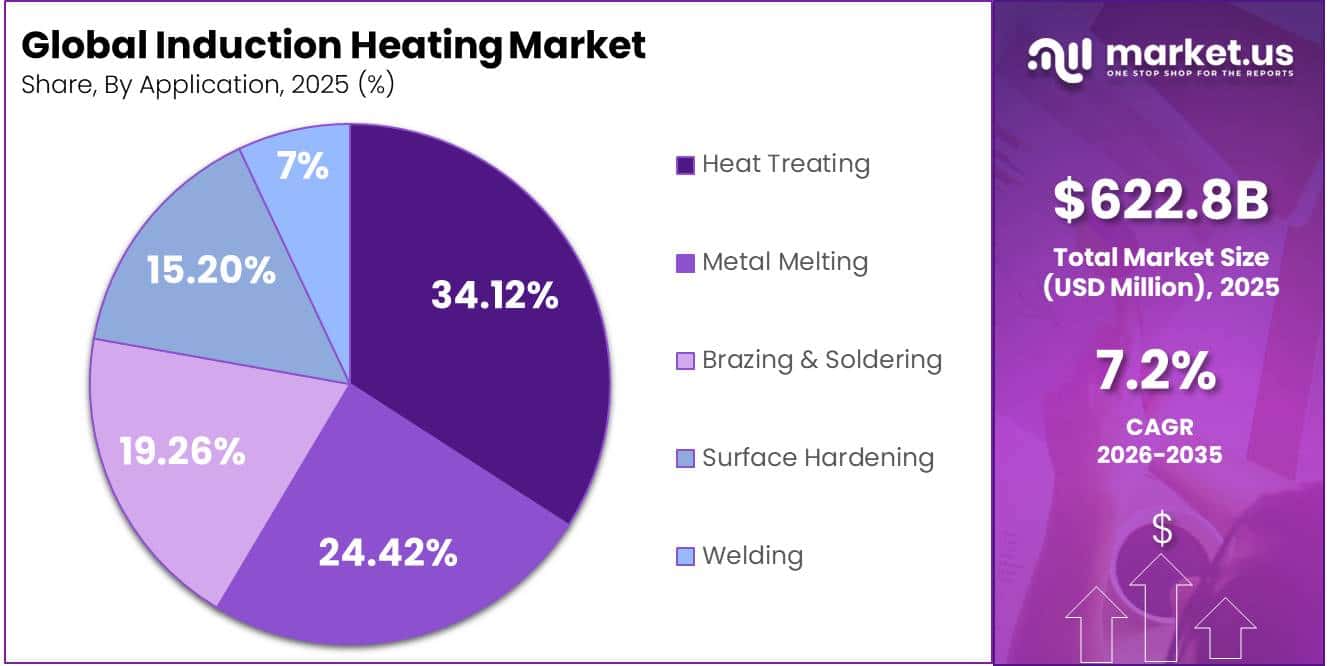
- Based on application, Heat Treating dominated the market, accounting for 34.12% of the total market share.
- Based on end-user, Manufacturing / Metal Processing dominated the market, accounting for 45.78% of the total market share.
- In 2025, Asia-Pacific was the most dominant region in the induction heating market, accounting for 44.56% of the global market.
The industrial scenario is being shaped by pressure to reduce fossil-fuel dependence while maintaining production. The IEA reported that around 70% of global industrial energy consumption comes from sectors relying on low-temperature heat and steam. It also noted that electricity use for industrial heat has increased over the past decade, supported by improving technology availability, cost competitiveness, and policy support. For induction heating suppliers, this environment creates opportunities to serve manufacturers seeking electrically powered and controllable heating solutions.
Driving factors include industrial electrification, process efficiency, energy security, and the need for lower-emission production. The IEA projects global industrial heat demand to expand 14% between 2025 and 2030, while renewable electricity is expected to provide nearly 80% of the growth in renewable industrial heat consumption. These trends can encourage manufacturers to consider electric process-heating technologies, including induction systems, particularly where direct and controlled heating can support production efficiency.
Government initiatives are supporting industrial heating innovation. In the United States, the Department of Energy (DOE) launched the Industrial Heat Shot with a goal of reducing industrial heating emissions by 85% and advancing electrification and other low-emission heating pathways. In 2026, the DOE continued funding research, development, and deployment programs focused on process heating, including electromagnetic heating technologies that can deliver heat directly to target materials. Such initiatives can support technology development, demonstrations, and adoption of efficient heating systems.
By Type
Portable Induction Heating Systems: 54.56% Share.
In 2025, Portable Induction Heating Systems held a dominant market position, capturing more than a 54.56% share of the Induction Heating Market by type. Their strong position reflects the practical value of portable systems in industrial heating operations where flexibility and ease of movement are important. These systems can be used across different work areas without requiring a fixed installation, making them suitable for varied manufacturing activities. Their portability also supports applications where heating is required at different locations within a production environment. The segment therefore maintained its leading position in 2025, supported by its operational flexibility and suitability for changing industrial requirements.
Fixed/Stationary Systems represented the growing segment within the Induction Heating Market by type. These systems are designed for dedicated industrial installations and are suited to production environments where induction heating is required at a consistent location. Their fixed setup supports integration into established manufacturing processes and production lines, particularly where heating operations are performed repeatedly. The segment is gaining attention as manufacturers seek reliable heating systems that can fit into structured production operations.
By Power Output
10 KW–100 KW dominates with 65.67% due to its suitability for industrial heating needs.
In 2025, 10 KW–100 KW held a dominant market position, capturing more than a 65.67% share of the Induction Heating Market by power output. This range is widely suited to industrial heating requirements where balanced power capacity is needed for regular production activities. Its position reflects the demand for induction heating systems that can support different manufacturing processes while maintaining practical power requirements. The segment remained the leading power-output category in 2025, supported by its suitability for industrial applications.
Up to 10 KW represented the growing segment of the Induction Heating Market by power output. These systems are suitable for applications where lower heating power is sufficient and where compact heating requirements are preferred. The segment is gaining attention as induction heating continues to be used across different production activities requiring controlled and lower-power heating.
By Frequency
>10–50 KHz dominates with 71.34% due to its broad industrial suitability
In 2025, >10–50 KHz held a dominant market position, capturing more than a 71.34% share of the Induction Heating Market by frequency. This frequency range is widely suited to industrial heating operations and supports applications where controlled and consistent induction heating is required. Its strong position reflects its suitability across different manufacturing processes, making it an important frequency range for industrial users. The segment maintained its leading position in 2025 due to its practical application across varied heating requirements.
1–10 KHz represented the growing segment of the Induction Heating Market by frequency. The segment is gaining attention for applications where lower-frequency induction heating is suitable for specific industrial requirements. Its growth reflects the continued use of different frequency ranges according to the heating needs of manufacturing operations.
By Application
Heat Treating dominates with 34.12% due to its wide use in industrial processing.
In 2025, Heat Treating held a dominant market position, capturing more than a 34.12% share of the Induction Heating Market by application. The segment benefits from the use of induction heating for controlled treatment of metal components and parts. Its strong position reflects the importance of heat treating in manufacturing operations where material properties and component performance need to be improved through controlled heating. The segment remained the leading application in 2025, supported by its established role in industrial processing.
Metal Melting represented the fastest-growing application segment in the Induction Heating Market. The segment is gaining momentum as induction heating provides a suitable method for heating metals during melting operations. Its growth reflects continued use of induction-based heating in industrial processes that require controlled metal melting.
By End -User
Manufacturing / Metal Processing dominates with 45.78% due to its broad industrial use.
In 2025, Manufacturing / Metal Processing held a dominant market position, capturing more than a 45.78% share of the Induction Heating Market by end-user. The segment benefits from the direct use of induction heating across manufacturing and metal-processing activities, where controlled heating is an important part of production operations. Its leading position reflects the broad application of induction heating within industrial processing environments. The segment remained the dominant end-user in 2025, supported by its established use across manufacturing activities.
Automotive represented the growing end-user segment of the Induction Heating Market. The segment is gaining attention as induction heating is used in automotive manufacturing and component-related processes. Its growth reflects the increasing application of induction-based heating within automotive production activities, where controlled and efficient heating is required.
Key Market Segments
By Type
- Portable Induction Heating Systems
- Fixed/Stationary Systems
By Power Output
- Upto 10 KW
- 10 KW -100 KW
- Above 100 KW
By Frequency
- 1-10 KHz
- >10-50 KHz
- >50 KHz
By Application
- Metal Melting
- Heat Treating
- Brazing & Soldering
- Surface Hardening
- Welding
By End -User
- Automotive
- Aerospace
- Electronics
- Manufacturing / Metal Processing
- Energy