


Report Overview
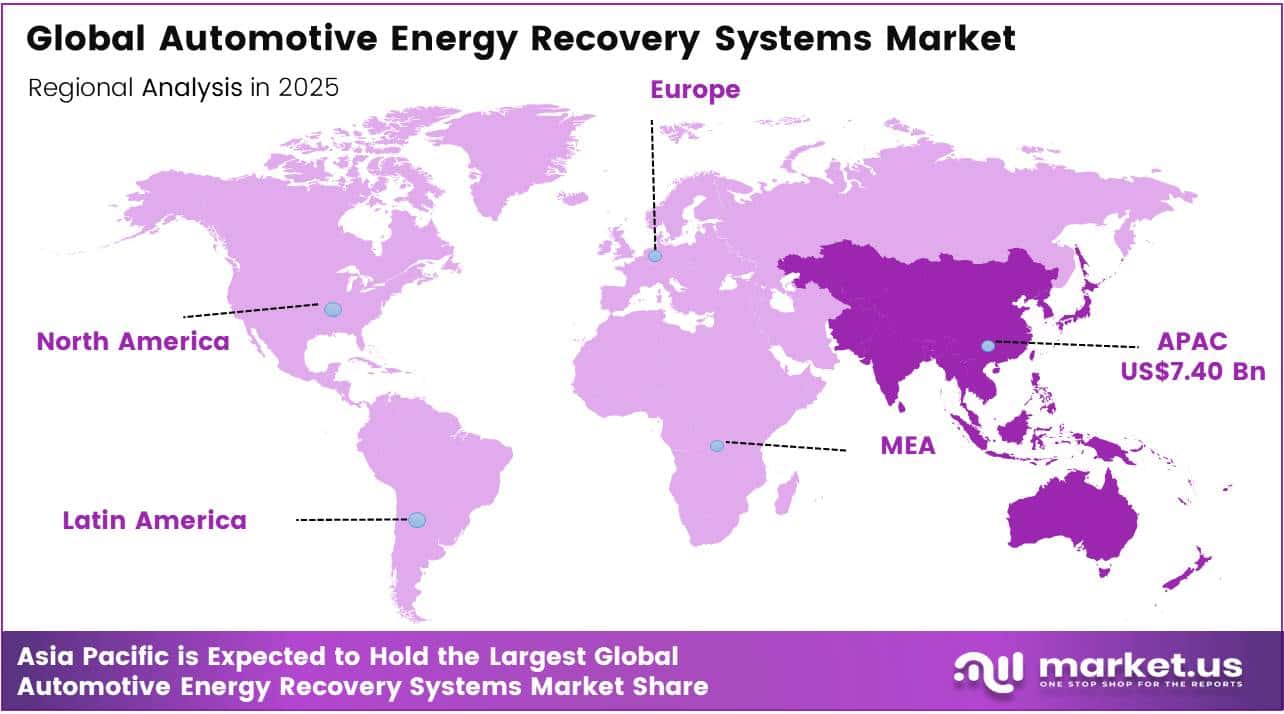
In 2025, the Global Automotive Energy Recovery Systems Market was valued at USD 21.3 billion, and between 2026 and 2035, this market is estimated to register a CAGR of 9.5%, reaching about USD 52.5 billion by 2035. In 2025, Asia Pacific held a dominant market position, capturing more than a 34.78% share, holding USD 7.40 Billion revenue.
Automotive energy recovery systems are becoming central to vehicle-efficiency strategies because they capture braking, exhaust, and thermal energy that would otherwise be lost. Technologies include regenerative braking, 48-volt mild-hybrid systems, electric turbo-compounding, thermoelectric generators, and exhaust-heat recovery.
- The U.S. Department of Energy reports that regenerative braking recovers about 22% of energy on the combined city-highway drive cycle, helping a typical electric vehicle achieve 87%–91% efficiency, compared with roughly 30% for a conventional gasoline vehicle.
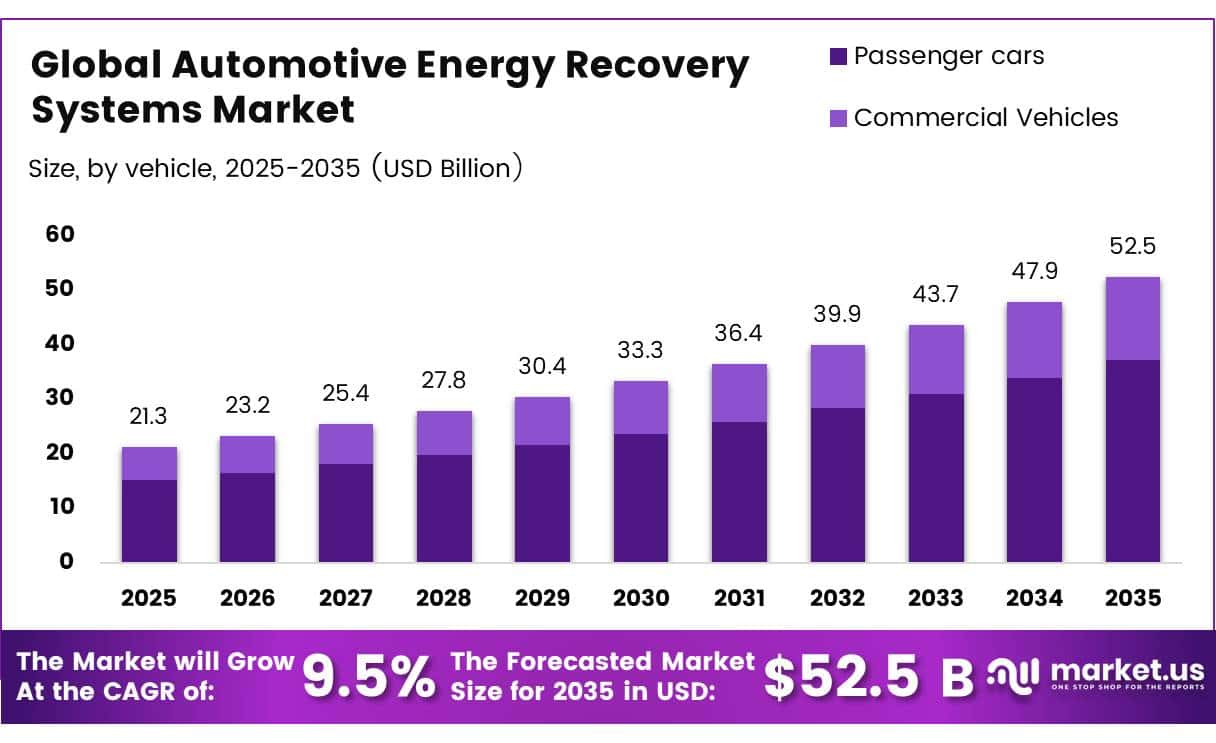
The industrial scenario is strengthening as electrified vehicle production expands. The International Energy Agency recorded 21 million electric-car sales in 2025, up more than 20%, with electric models representing 1 in 4 new cars. Global electric-car production approached 22 million units, increasing by over 25%, while approximately one-quarter of output was traded internationally. This scale supports demand for motors, inverters, brake-by-wire systems, power-control software, batteries, supercapacitors, and thermal-management components.
- Government regulation is another major driver. European Union standards require average new-car emissions of 93.6 g CO₂/km during 2025–2029, declining to 49.5 g CO₂/km during 2030–2034 and 0 g CO₂/km from 2035. Van targets fall from 153.9 g CO₂/km to 90.6 g CO₂/km before reaching zero.
Future opportunities remain strong in predictive regenerative braking, connected energy management, commercial fleets, and waste-heat conversion. The IEA expects 23 million electric-car sales in 2026, equal to 28% of global sales, while the worldwide EV fleet could exceed 450 million units by 2035, more than five times the 2025 level. This expansion will widen supplier opportunities across passenger cars, buses, trucks.
Key Takeaways
- The global Automotive Energy Recovery Systems market was valued at USD 21.3 billion in 2025.
- The global market is projected to grow at a CAGR of 9.5% and is estimated to reach USD 52.5 billion by 2035.
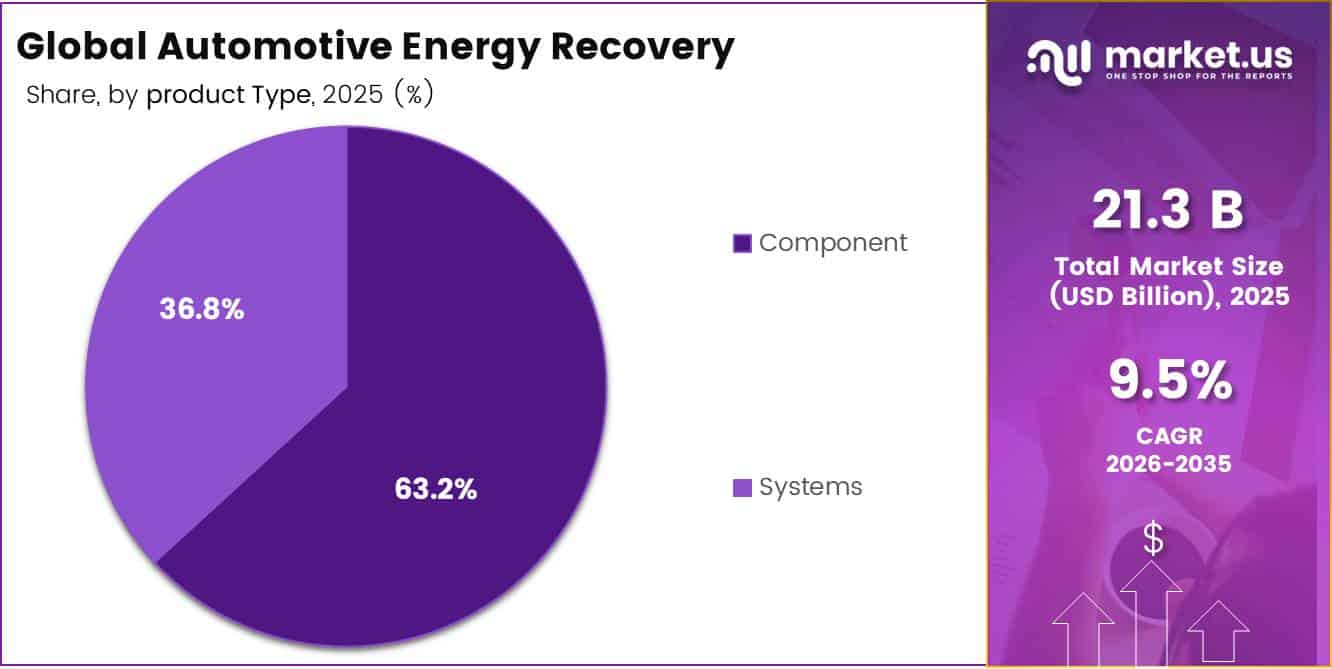
- On the basis of product type, the component dominated the market, constituting 63.20% of the total market share.
- Based on the vehicle, the passenger car dominated the Automotive Energy Recovery Systems market, with a substantial market share of around 71.0%.
- In 2025, the Asia Pacific was the most dominant region in the Automotive Energy Recovery Systems market, accounting for 34.78% of the total global consumption.
Product Type Analysis
Component represents dominant Segment in the Market.
Components held a dominant position in the Automotive Energy Recovery Systems Market, capturing more than a 63.20% share. Motor-generators, batteries, inverters, sensors, control units, and braking electronics are required individually across hybrid and electric powertrains, supporting high replacement and production demand. The U.S. Environmental Protection Agency reported that hybrids represented 15% of new vehicle production in model year 2024 and are projected to reach 19% in model year 2025. Average new-vehicle fuel economy also reached a record 27.2 miles per gallon, encouraging manufacturers to use more efficient power-management components.
Systems are expanding faster as automakers integrate regenerative braking, battery management, thermal recovery, and electronic controls into a single energy-management architecture. European Union regulations apply zero- and low-emission vehicle benchmarks of 25% for cars and 17% for vans during 2025–2029. Manufacturers exceeding their emissions targets may face a charge of €95 per g/km for every newly registered vehicle, strengthening demand for complete recovery systems that improve vehicle-wide efficiency.
Vehicle Analysis
Passenger Cars are a significant vehicle.
Passenger Cars held a dominant position in the Automotive Energy Recovery Systems Market, capturing more than a 71.00% share. Their leadership is supported by high production volumes and the widespread integration of regenerative braking, start-stop functions, motor-generators, and intelligent battery controls. The European Environment Agency recorded 10.8 million new passenger-car registrations across the EU, Norway, and Iceland in 2025. Fully electric cars represented 18.9% of registrations, while plug-in hybrids accounted for another 9.7%, expanding the installed base for braking-energy recovery and coordinated power-management technologies.
Commercial Vehicles are emerging as the faster-growing category as fleet operators seek lower fuel use, reduced emissions, and better efficiency during frequent braking and heavy-duty operation. In 2025, approximately 1.2 million new vans were registered across the same European markets. Fully electric vans reached 10.3% of registrations, rising from 6.2% a year earlier, while plug-in hybrids increased from 0.3% to 1.7%. This rapid electrification supports wider adoption of regenerative braking, thermal recovery, and integrated energy-management systems in delivery and service fleets.
Key Market Segments
By Product Type
- Systems
- Kinetic energy recovery systems (KERS)
- Regenerative braking systems
- Exhaust energy recovery systems (EERS)
- Suspension-based energy recovery systems
- Component
- Energy storage units
- Batteries
- Supercapacitors
- Flywheels
- Energy conversion units
- Electric motors/generators
- Hydraulic or pneumatic converters
- Control units
- Electronic control modules (ECM)
- Power management systems
By Vehicle
- Passenger cars
- Commercial Vehicles
Driver Analysis
Regulatory Emission Compliance Pressure
The European Union’s fleet-wide CO2 target of 93.6 g/km for cars over 2025-2029, with compliance now averaged across the 2025-2027 window under Regulation (EU) 2025/1214 rather than assessed annually, has restructured OEM investment timing rather than eliminated the underlying pressure to deploy energy-recovery hardware. This three-year averaging mechanism, adopted by the European Parliament and Council on 17 June 2025, gives manufacturers flexibility to bank overcompliance from early regen-braking rollouts against heavier-emitting model years, which is shifting capital allocation from emergency retrofit programs toward planned platform-wide integration of regenerative braking and waste-heat recovery modules by 2027.
Structurally, this converts energy recovery from a discretionary efficiency feature into a statutory compliance line item embedded in every new vehicle architecture homologated for EU sale, pushing Tier-1 suppliers such as Bosch and Continental to standardize recovery modules across trim levels rather than reserving them for premium SKUs. India’s parallel emission-tightening trajectory and China’s fleet-average fuel-consumption targets reinforce this same mechanism outside the EU, meaning suppliers now design once for a global compliance baseline rather than region-specific variants, compressing unit engineering costs by amortizing R&D over larger production runs.
Drivers Impact Analysis
| Driver | (~) % Impact on CAGR | Geographic Relevance | Impact Timeline |
|---|---|---|---|
| Tightening tailpipe CO2/CAFC compliance regimes forcing regen-braking and waste-heat recovery adoption | +2.2% | EU core, China Tier-1 cities, India BS-VI corridors | Medium term (2-4 years) |
| China’s Dual-Credit NEV/CAFC recalibration raising mandatory recovery-linked credit thresholds | +1.9% | APAC (China core), Southeast Asia spill-over | Short term (≤2 years) |
| 48V mild-hybrid architecture scaling reducing regen system Bill-of-Materials cost | +2.6% | EU core, North America, APAC | Short to Medium term |
| SiC power-electronics cost-down enabling higher-efficiency inverter-based recovery | +1.6% | North America, EU, APAC premium/EV segments | Medium term (2-4 years) |
| US federal fuel-economy deregulation creating divergent regional demand pull | -1.1% | North America core, indirect global supply chain | Short term (≤2 years) |
| Commercial/fleet electrification and brake-wear/TCO economics for regen systems | +1.4% | APAC (India, China), EU logistics corridors, South America spill-over | Long term (≥4 years) |
Restraint Analysis
High System BOM
Energy-recovery deployment remains constrained by a difficult mass-market unit-economics equation: regenerative architectures require a motor-generator, bidirectional inverter, higher-voltage battery buffering, brake-by-wire/blending controls, upgraded cooling, sensors, embedded software, and vehicle-specific calibration, while exhaust and thermal recovery add heat exchangers, valves, insulated pipework, pumps, turbo machinery, and packaging volume. Although average battery-pack prices fell 20% in 2024 to USD 115/kWh, lowering the cost of electrified powertrains, that reduction does not remove the incremental electronics, validation, and thermal-management bill of materials needed to recover energy reliably across real-world duty cycles.
The restraint is most acute in subcompact cars, entry SUVs, and light commercial vehicles, where OEMs cannot readily pass through a four-figure system premium without impairing affordability or residual values; procurement teams therefore prioritize recovery hardware with shared use cases—starter-generators, traction inverters, and e-axle controls while deferring standalone waste-heat or high-complexity kinetic-recovery modules. This produces margin compression at Tier-1 level, prolongs supplier amortization of tooling and software investment, and shifts product development toward modular 48V solutions rather than higher-capture architectures, reducing the addressable content per vehicle through 2028.
Restraint Impact Analysis
| Restraint | (~) % Impact on CAGR Forecast | Geographic Relevance | Impact Timeline |
|---|---|---|---|
| High system BOM | -2.1% | EU, North America, APAC mass market | Medium term (2-4 years) |
| Mineral supply concentration | -1.7% | China-linked supply chains, EU, US | Short term (≤ 2 years) |
| Integration and validation burden | -1.5% | Global OEM platforms | Medium term (2-4 years) |
| Tariffs and localization | -1.3% | EU-China, North America, APAC | Short term (≤ 2 years) |
| BEV mix cannibalizing exhaust recovery | -1.2% | China, EU, North America | Medium term (2-4 years) |
| Safety, durability and service risk | -1.0% | EU, North America, Japan | Long term (≥ 4 years) |
Opportunity Analysis
Fleet Energy-as-a-Service
The opportunity is strongest in high-utilization buses, urban delivery vehicles, refuse trucks, port drayage fleets, and regional freight vehicles, where frequent deceleration increases recuperation events and makes kilowatt-hour recovery measurable at vehicle level; China alone saw electric-truck sales more than double in 2025, reaching 9% of global truck sales, while one in four Chinese trucks sold was electric.
This is an opportunity rather than a baseline driver because it requires new data rights, telematics integration, fleet-finance partners, warranty-risk underwriting, and standardized measurement-and-verification protocols; a supplier converting even 10-15% of commercial-system shipments to managed-service contracts could potentially increase lifecycle revenue per installed system by 25-40% and lift portfolio CAGR by an estimated 2.2 percentage points.
Opportunity Impact Analysis
| Opportunity | (~) % Potential CAGR Upside | Geographic Relevance | Execution Window |
|---|---|---|---|
| Fleet energy-as-a-service | +2.2% | China, EU corridors, North America | Short term (≤ 2 years) |
| Brake-recovery software platform | +1.8% | EU, North America, Japan, China | Medium term (2-4 years) |
| E-truck recovery systems | +2.5% | China core, EU logistics, North America | Medium term (2-4 years) |
| 800V SiC bidirectional systems | +1.7% | China, EU, North America | Medium term (2-4 years) |
| Remanufacturing and core exchange | +1.3% | EU, North America, Japan | Long term (≥ 4 years) |
| Powertrain-control M&A roll-ups | +1.5% | EU, China, North America | Short term (≤ 2 years) |
Challenges Analysis
Multi-Domain Calibration Cycles
Automotive energy recovery systems increasingly require simultaneous optimization across motor torque, hydraulic braking, battery state of charge, inverter temperature, tire-road friction, vehicle mass, ADAS intervention, and thermal constraints, turning what was once a component validation task into a multi-controller vehicle-calibration program that can extend launch readiness by an internally modelled 6-12 months for a new platform.
The operational friction is amplified by a single global platform requiring validation across typically 20-40 vehicle variants, hot- and cold-weather duty cycles, front-, rear-, and all-wheel-drive layouts, battery ageing states, and loaded/unloaded commercial-vehicle conditions; every variant generates fresh software calibration, test-track, dynamometer, and functional-safety evidence. Suppliers must therefore move from isolated subsystem engineering to digital-twin simulation, reusable control libraries, hardware-in-the-loop testing, and shared brake-inverter-battery data models, because without a 30-50% reduction in calibration iterations, recovery content may remain technically approved but miss the production window of a vehicle program.
Challenges Impact Analysis
| Challenge | (~) % CAGR Friction Drag | Geographic Relevance | Mitigation Horizon |
|---|---|---|---|
| Multi-domain calibration cycles | -1.6% | EU, North America, Japan, China | Medium term (2-4 years) |
| Critical-material supply volatility | -1.4% | China-linked supply, EU, North America | Medium term (2-4 years) |
| Software compliance complexity | -1.3% | EU regulatory hubs, UK, Japan, Korea | Medium term (2-4 years) |
| Brake-emissions trade-off | -1.1% | EU core, UK, Japan | Long term (≥ 4 years) |
| Manufacturing yield instability | -1.0% | APAC factories, EU, North America | Medium term (2-4 years) |
| Service-skill capability gaps | -0.9% | APAC emerging markets, EU, North America | Long term (≥ 4 years) |
Geopolitical Impact Analysis
Geopolitical Tariffs and Raw-Material Policies Reshape Automotive Recovery Supply Chains
Trade policy is pushing automotive energy-recovery supply chains toward regional production. The U.S. Trade Representative raised tariffs on Chinese electric vehicles to 100% in 2024, while lithium-ion EV batteries, battery parts and selected critical minerals moved to 25%.
- Semiconductor tariffs rose to 50% in 2025, and duties on natural graphite and permanent magnets were scheduled at 25% from 2026. These measures affect batteries, motor-generators, inverters, sensors and regenerative-braking electronics. Manufacturers are qualifying alternative suppliers, increasing inventories and redesigning products around regionally available materials.
Europe is responding through industrial policy. The EU Critical Raw Materials Act sets 2030 goals covering 10% of annual strategic-material demand through domestic extraction, 40% through regional processing and 25% through recycling, while limiting dependence on any single non-EU supplier to 65%. In 2025, the European Commission designated 47 strategic projects across 13 member states and another 13 outside the Union. A second selection round attracted 161 applications, including 75 supporting the battery value chain and 21 focused on rare-earth materials for permanent magnets.
Regional Analysis
Asia Pacific Held the Largest Share of the Global Automotive Energy Recovery Systems Market.
Asia-Pacific held a dominant position in the Automotive Energy Recovery Systems Market, capturing more than a 34.78% share. Its leadership is closely tied to the region’s large automotive manufacturing base and rapid electrification.
- China’s Ministry of Industry and Information Technology reported automobile production of 34.531 million units and sales of 34.4 million units in 2025. New-energy vehicle output reached 16.626 million units, while sales rose to 16.49 million units, increasing by 29% and 28.2%, respectively. New-energy vehicles represented 47.9% of total new vehicle sales, creating strong demand for regenerative brakes, motor-generators, inverters, battery controls, and thermal-recovery components.
North America is emerging as the fastest-growing market as U.S. automakers expand electrified powertrains and energy-saving vehicle technologies. The U.S. Environmental Protection Agency recorded 14,799,239 light-duty vehicles produced for the American market in model year 2024. Battery-electric and plug-in hybrid vehicles represented almost 10% of production, with their combined share projected to reach 12% in model year 2025. EPA analysis also found that these vehicles improved average fleet fuel economy by 1.7 miles per gallon. This transition supports growing demand for regenerative braking units, motor-generators, power electronics, battery controls, and integrated thermal-energy recovery systems across the region.
Key Regions and Countries Covered
- North America
- The US
- Canada
- Europe
- Germany
- France
- The UK
- Spain
- Italy
- Russia & CIS
- Rest of Europe
- APAC
- China
- Japan
- South Korea
- India
- ASEAN
- Rest of APAC
- Latin America
- Brazil
- Mexico
- Rest of Latin America
- Middle East & Africa
- GCC
- South Africa
- Rest of MEA
Key Players Analysis
Automotive Energy Recovery Systems manufacturers focus on strengthening system efficiency, control precision, and vehicle-level integration to remain competitive. A major priority is continuous technology improvement, including advanced regenerative braking, exhaust heat recovery, kinetic energy storage, and intelligent power-management systems that reduce energy losses and improve overall vehicle performance.
Companies also invest heavily in compact motor-generators, high-efficiency inverters, lightweight components, and predictive software that can adjust energy recovery according to road conditions, battery status, and driving behaviour.
Close integration with automakers, battery suppliers, braking-system providers, and semiconductor manufacturers helps improve compatibility, shorten development cycles, and manage component costs. Strategic production expansion near major automotive manufacturing hubs allows suppliers to respond faster to demand from electric, hybrid, and commercial vehicle platforms.
Manufacturers further emphasize software calibration, functional safety, system durability, and compliance with vehicle efficiency standards to ensure reliable performance at scale. Long-term development agreements with global automakers, fleet operators, and Tier 1 suppliers also support customer retention, strengthen technical collaboration, and improve positioning in high-value passenger and commercial vehicle applications.
The Major Players In The Industry
- Autoliv Inc.
- BorgWarner Inc.
- Continental AG
- Cummins Inc.
- DENSO Corp.
- Gentherm Inc.
- Hitachi Ltd.
- Honeywell International Inc.
- Hyundai Motor Co.
- IHI Corp.
- Mitsubishi Motors Corp.
- Panasonic Holdings Corp.
- Rheinmetall AG
- Ricardo Plc
- Robert Bosch GmbH
- Other Key Players
Key Development
- In October 2025, DENSO Corporation unveiled a SiC inverter that cut power loss by 70% and reduced core-module size by about 30%, improving power density and vehicle energy efficiency for electrified powertrains.
- In November 2025, Hyundai Motor introduced the all-new NEXO with Smart Regenerative System; battery output doubled from 40 kW to 80 kW, total system output rose from 135 kW to 190 kW, and projected range reached 826 km.
Report Scope
| Report Features | Description |
|---|---|
| Market Value (2025) | USD 21.3 Bn |
| Forecast Revenue (2035) | USD 52.5 Bn |
| CAGR (2026-2035) | 9.5% |
| Base Year for Estimation | 2025 |
| Historic Period | 2020-2024 |
| Forecast Period | 2026-2035 |
| Report Coverage | Revenue Forecast, Market Dynamics, Competitive Landscape, Recent Developments |
| Segments Covered | By Product Type (Systems and Component), By Vehicle (Passenger cars and Commercial Vehicles). |
| Regional Analysis | North America – The US & Canada; Europe – Germany, France, The UK, Spain, Italy, Russia & CIS, Rest of Europe; APAC– China, Japan, South Korea, India, ASEAN & Rest of APAC; Latin America– Brazil, Mexico & Rest of Latin America; Middle East & Africa– GCC, South Africa, & Rest of MEA |
| Competitive Landscape | Autoliv Inc., BorgWarner Inc., Continental AG, Cummins Inc., DENSO Corp., Gentherm Inc., Hitachi Ltd., Honeywell International Inc., Hyundai Motor Co., IHI Corp., Mitsubishi Motors Corp., Panasonic Holdings Corp., Rheinmetall AG, Ricardo Plc, Robert Bosch GmbH, Other Key Players. |
| Customization Scope | Customization for segments, region/country-level will be provided. Moreover, additional customization can be done based on the requirements. |
| Purchase Options | We have three licenses to opt for: Single User License, Multi-User License (Up to 5 Users), Corporate Use License (Unlimited Users and Printable PDF) |





































