


Report Overview
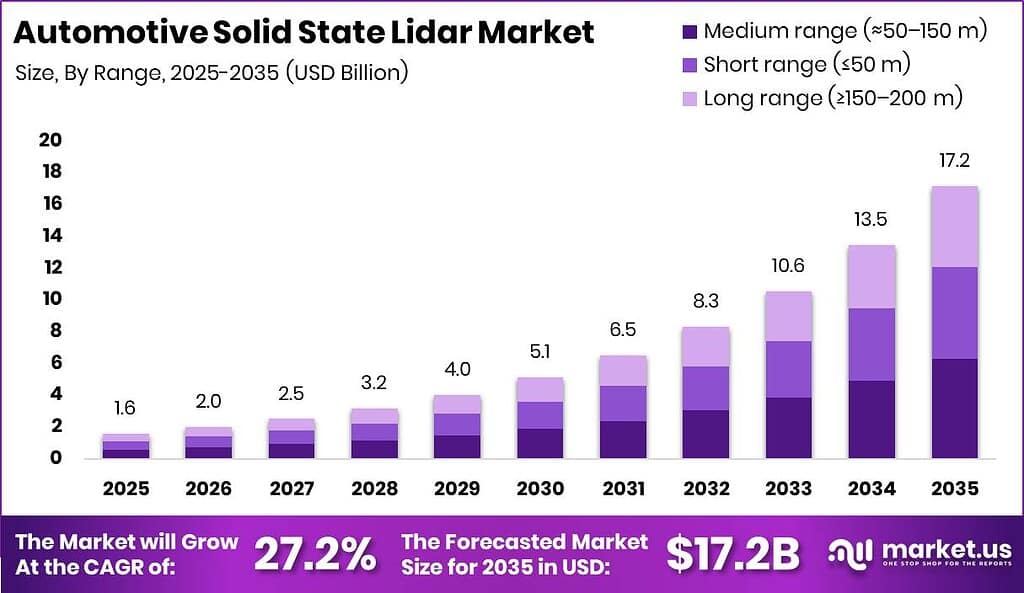
Global Automotive Solid State Lidar Market size is expected to be worth around USD 17.20 Billion by 2035 from USD 1.60 Billion in 2025, growing at a CAGR of 27.2% during the forecast period 2026 to 2035.
Therefore, the Automotive Solid State Lidar Market covers chip-scale and hybrid solid-state sensors that map vehicle surroundings without spinning assemblies. Product structure splits by technology type, detection range, application layer, and vehicle class. Buyers use these sensors to feed perception stacks that support collision avoidance and higher automation. Suppliers who lock multi-year OEM design wins convert this structure into durable volume.
Key Takeaways
- The Automotive Solid State Lidar market reaches USD 1.60 Billion in 2025 and is set to hit USD 17.20 Billion by 2035 at a CAGR of 27.2%.
- MEMS LiDAR leads technology type with a 35.6% share.
- Medium range (50 to 150 m) leads range with a 36.7% share.
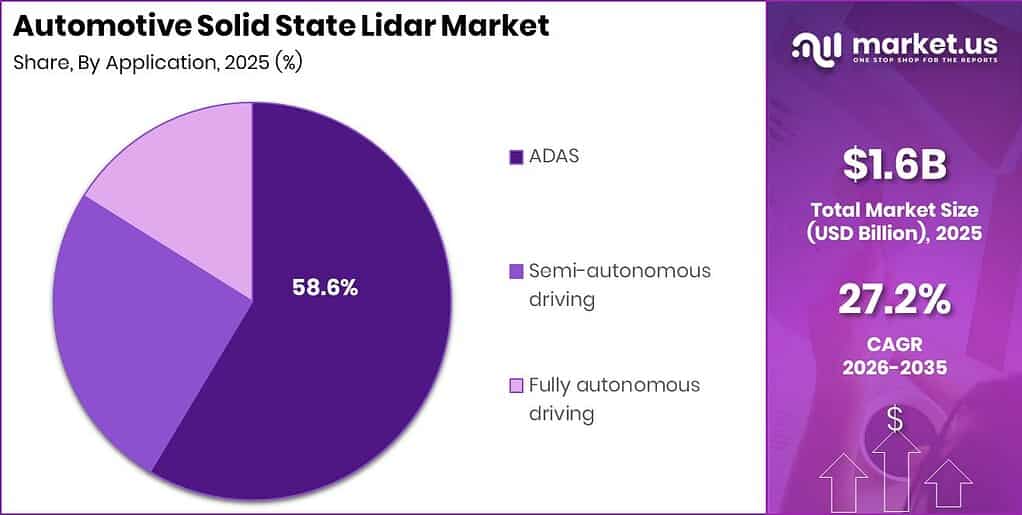
- ADAS leads application with a 58.6% share.
- Passenger Cars lead vehicle type with a 65.6% share.
- FMCW LiDAR, long range, fully autonomous driving, and robo-taxis with autonomous shuttles mark the fastest-growing lines.
As per our research, government safety rules and OEM platform costing now treat solid-state LiDAR as a baseline sensing input rather than a premium option. Chinese NEV makers and UNECE-aligned European programs pull higher-order collision avoidance into mid-tier trims. This means suppliers who finish automotive-grade qualification early capture multi-model awards before CapEx rivals catch up. End-use growth in intelligent passenger platforms therefore lifts unit demand for compact solid-state modules.
According to the China Association of Automobile Manufacturers, cited by Reuters, LiDAR technology was installed in only 3% of vehicles worldwide during 2025. This early base leaves a long runway for content growth as mandates tighten. In June 2025, Hesai expanded its supply agreement with BYD for more than 10 vehicle models scheduled for mass production beginning in 2026. Consequently, large EV platforms convert regulatory pressure into firm multi-year sensor pull-through.
Hesai reported shipping more than 1.6 million LiDAR units during 2025 and planned annual production capacity exceeding 4 million units for 2026. This scale lowers unit cost and supports wider ADAS fitment on high-volume cars. Hesai’s next-generation FTX solid-state blind-spot unit supports a maximum field of view of 180° × 140°, detects objects up to 30 meters at 10% reflectivity, and generates 492,000 points per second, or 2.5× its prior generation. As a result, blind-spot solid-state content rises with every ADAS-equipped passenger platform.
Technology Type Analysis
MEMS LiDAR dominates with 35.6% due to compact cost-efficient beam steering.
In 2025, MEMS LiDAR held a dominant market position in the By Technology Type segment of Automotive Solid State Lidar Market, with a 35.6% share. OICA data show global vehicle production reached about 96.4 million units in 2025, giving MEMS vendors a vast OEM pipeline. MEMS mirrors shrink package size and cut mechanical wear versus spinning units. Suppliers who industrialize automotive-grade MEMS fabs will win cost-sensitive ADAS awards first.
FMCW LiDAR grows fastest as velocity-native returns improve clutter rejection on highways. IEA figures show more than 13 million electric cars sold in China in 2025, a fleet that rewards precise Doppler-capable sensing. FMCW designs reduce interference risk in dense multi-LiDAR traffic. Investors who fund coherent silicon photonics lines position for the next OEM architecture cycle.
Flash LiDAR illuminates a full scene in one pulse and suits short-range and cabin-adjacent roles. A 2025 peer-reviewed SPAD flash design was validated on a 256 × 128 SPAD sensor array for real-time event-driven depth. This architecture cuts moving parts and aids reliability scoring. Vendors who pair flash arrays with low-latency readouts will lock blind-spot and near-field sockets.
Optical Phased Array LiDAR steers beams electronically without mirrors, targeting solid-state purity and long life. Corporate roadmaps stress chip-scale beam forming for harsh automotive duty cycles. OPA still trails MEMS on unit cost at volume. Players who close the yield gap on photonic arrays can unseat hybrid designs in later forecast years.
Range Analysis
Medium range (50 to 150 m) dominates with 36.7% due to balanced ADAS highway coverage.
In 2025, Medium range (50 to 150 m) held a dominant market position in the By Range segment of Automotive Solid State Lidar Market, with a 36.7% share. This band covers urban cut-in and moderate highway braking distances that define most L2-plus packages. OICA recorded roughly 96.4 million vehicles produced worldwide in 2025, anchoring medium-range volume. Suppliers who optimize SNR in this band capture the widest bill-of-materials share.
Short range (up to 50 m) supports parking, blind-spot, and low-speed urban fusion. Hesai’s FTX-class solid-state units target near-field work with wide vertical fields and high point rates near the bumper line. National fleet mix still favors dense city cycles where short-range content multiplies per vehicle. Vendors who sell multi-sensor short-range packs raise average selling content per car.
Long range (150 to 200 m and beyond) is the fastest-growing band as highway autonomy and high-speed AEB expand. Valeo’s SCALA Gen 3 provides 200-meter detection at 10% reflectivity, a 120° × 26° field of view, and up to 12.5 million points per echo per second. In May 2025, Luminar Technologies appointed Paul Ricci as Chief Executive Officer to drive automotive commercialization. Long-range winners will own premium and robotaxi perception stacks first.
Application Analysis
ADAS dominates with 58.6% due to mandatory safety feature pull-through.
In 2025, ADAS held a dominant market position in the By Application segment of Automotive Solid State Lidar Market, with a 58.6% share. Mandates in China and Europe push collision avoidance from option packs into standard trims. IEA data show China alone sold more than 13 million electric cars in 2025, many carrying advanced driver aids. Sensor vendors aligned to ADAS homologation cycles secure the largest near-term unit base.
Semi-autonomous driving adds highway pilot and traffic-jam functions that need denser point clouds and lower false positives. Global vehicle output near 96.4 million units in 2025 still leaves most platforms below full hands-off capability. Semi-auto programs extend design-win life beyond basic AEB. Suppliers who certify dual-use ADAS and Level 3 stacks raise lifetime revenue per OEM account.
Fully autonomous driving is the fastest-growing application as robotaxi and shuttle pilots scale selected cities. Fleet operators demand multi-sensor solid-state rings with high duty-cycle reliability. Early autonomy volumes remain small versus ADAS yet carry premium ASP. Firms that prove field reliability above 100,000 km between critical faults will lead autonomy RFQs.
Vehicle Type Analysis
Passenger Cars dominate with 65.6% due to high-volume OEM platform fitment.
In 2025, Passenger Cars held a dominant market position in the By Vehicle Type segment of Automotive Solid State Lidar Market, with a 65.6% share. Passenger platforms absorb the bulk of ADAS mandates and NEV feature races. OICA figures place world motor vehicle output near 96.4 million units in 2025, with passenger cars the majority share. Vendors who price for mid-tier trims unlock the largest absolute unit pool.
Commercial vehicles adopt solid-state LiDAR for fleet safety, highway trucking assist, and depot automation. Duty cycles stress thermal and vibration limits harder than passenger duty. IEA tracking of electrified commercial fleets shows rising sensor content on new energy trucks in China. Suppliers who harden automotive-grade housings for truck roofs win sticky fleet contracts.
Robo-taxis and autonomous shuttles form the fastest-growing vehicle class for multi-LiDAR fitment per platform. Each vehicle often carries several solid-state units for full surround coverage. Pilot cities in China and the United States concentrate early demand. Companies that offer fleet-grade service contracts convert hardware sales into recurring calibration revenue.
Key Market Segments
By Technology Type
- MEMS LiDAR
- FMCW LiDAR
- Flash LiDAR
- Optical Phased Array (OPA) LiDAR
By Range
- Medium range (50 to 150 m)
- Short range (up to 50 m)
- Long range (150 to 200 m and above)
By Application
- ADAS
- Semi-autonomous driving
- Fully autonomous driving
By Vehicle Type
- Passenger Cars
- Commercial vehicles
- Robo-taxis and autonomous shuttles
Regional Analysis
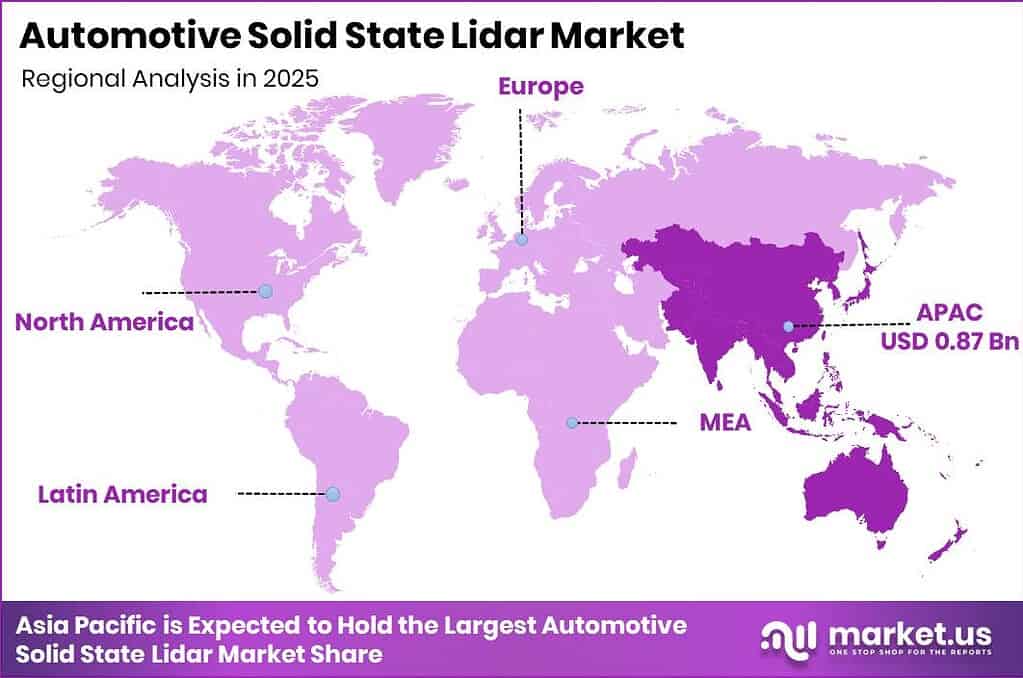
Asia Pacific leads Automotive Solid State Lidar Market deployment through Chinese NEV scale and domestic sensor industrialization
Asia Pacific sets the pace for solid-state LiDAR volume through Chinese NEV platforms and local Tier-1 capacity build-out. China Association of Automobile Manufacturers data show global vehicle LiDAR fitment still near the low single digits, so domestic standardization moves move the needle fastest. IEA counts more than 13 million electric cars sold in China in 2025, concentrating ADAS sensor demand. Suppliers with China OEM awards and local fabs convert this density into global cost leadership.
North America and Europe follow as Level 3 pilots and safety-rule timelines pull long-range and MEMS content onto premium and regulated trims. European countervailing duties on China-linked EV hardware raise landed costs and slow some import-heavy module paths. This signals a shift toward dual-sourcing and regional assembly. Vendors who qualify non-Chinese or multi-site supply chains protect European OEM timelines.
Latin America and Middle East and Africa remain earlier in the adoption curve, with selective premium imports and smart-mobility pilots. Global production near 96.4 million vehicles in 2025 still concentrates advanced sensing in mature and Chinese plants. Export-oriented module makers can seed these regions through CKD and fleet deals. Early local partnerships secure distribution before volume ramps.
Key Regions and Countries
North America
- US
- Canada
Europe
- Germany
- France
- The UK
- Spain
- Italy
- Rest of Europe
Asia Pacific
- China
- Japan
- South Korea
- India
- Australia
- Rest of APAC
Latin America
- Brazil
- Mexico
- Rest of Latin America
Middle East and Africa
- GCC
- South Africa
- Rest of MEA
Market Dynamics
Market Opportunity Analysis - Retrofit kits, robotaxi fleets, and tariff-light fabs open white-space growth paths.
Fully autonomous driving remains the fastest application line yet still trails ADAS share at 58.6%, leaving autonomy software and multi-sensor packs under-served outside pilot cities. Robotaxi and shuttle operators need surround solid-state rings with service contracts. New entrants who sell sensor-as-a-service rather than one-time hardware can lock fleet economics. This creates recurring revenue before private L4 ownership scales.
Robo-taxis and autonomous shuttles are the fastest vehicle class while passenger cars still hold 65.6%, so fleet channels stay relatively open. City pilots in China and the United States concentrate early multi-unit fitment. Suppliers who certify depot calibration workflows win sticky volume. Investors gain exposure to higher content per vehicle than single-sensor passenger trims.
Long-range sensing is the fastest range band while medium range holds 36.7%, so highway and premium autonomy stacks still invite specialists. Few vendors match both cost and 200 m-class performance at scale. Challengers who deliver automotive-grade long-range MEMS or FMCW modules can unseat incumbents on next-cycle platforms. This window favors focused photonics teams over broad catalog players.
FMCW remains the fastest technology line against MEMS at 35.6%, so coherent architectures are still under-penetrated in mass ADAS. Velocity-native returns improve interference handling in dense traffic. Startups and Tier-1s that close FMCW cost gaps capture the next architecture shift. Early design wins here compound as OEM software stacks standardize on Doppler-capable inputs.
Technology and Innovation Landscape - SPAD flash speed, thermal calibration, and ultra-dense solid-state arrays redefine perception edges
A 2025 SPAD flash LiDAR architecture achieved 2.4 μs readout latency using asynchronous pixel processing. Faster depth acquisition supports real-time automotive perception under tight compute budgets. Manufacturers who adopt event-driven readouts cut motion blur risk in urban scenes. Buyers gain cleaner fusion inputs without heavier mechanical complexity.
A 2026 calibration study found automotive flash solid-state LiDAR maintained projection errors below 0.2 pixels after a new intrinsic calibration method. Tighter calibration improves mapping trust for safety cases. Suppliers who ship factory calibration toolchains reduce OEM validation cost. This becomes a sales differentiator in multi-region homologation bids.
The same 2026 study reported temperature swings from 0°C to 80°C caused elastic parameter drift with negligible long-term aging in tested units. Intrinsic drift produced up to 130 mm translational detection error at a 25 m distance. Thermal compensation firmware therefore protects short-range accuracy. Investors should favor vendors with proven automotive thermal qualification data.
Hesai-class high-density solid-state products push point rates above 34 million per second and channel counts into the thousands. Density gains raise object classification confidence at distance. Competitors must match resolution or compete only on price in low-tier ADAS. Technology leadership here supports premium ASP retention as unit costs fall.
Drivers
Statutory ADAS mandates form the strongest near-term pull on solid-state LiDAR content. Regulators in China and the EU accelerated timelines that require higher-order collision avoidance on new passenger platforms. Chinese NEV makers standardized solid-state units across mid-tier trims that once reserved LiDAR for premium lines. European type-approval pressure pushed similar integration ahead of 2026 compliance checkpoints.
This regulatory pull compresses supplier gross margins by an estimated 3 to 5 percentage points as vendors absorb qualification costs while average selling prices fall. CapEx for wafer-level packaging lines moves forward from 2027 to 2028 plans into the current window. OEMs now embed LiDAR as a baseline unit-economics assumption across platform costing models. Investors who fund homologated capacity early capture the mandate-driven volume wave.
| Driver | (~) % Impact on CAGR Forecast | Geographic Relevance | Impact Timeline |
|---|---|---|---|
| Mandatory ADAS safety mandates | +4.1% | EU, China, South Korea | Short term (2 years or less) |
| OEM shift to flash/MEMS solid-state architectures | +3.4% | China, North America | Short term (2 years or less) |
| Chinese domestic EV LiDAR standardization | +2.8% | China | Short term (2 years or less) |
| Falling per-unit sensor cost curve | +2.2% | Global | Medium term (2 to 4 years) |
| Tier-1 supplier co-investment in fabs | +1.6% | Germany, Japan, South Korea | Medium term (2 to 4 years) |
| Robotaxi and L3 pilot program expansion | +1.3% | China, United States | Medium term (2 to 4 years) |
Restraints
European Commission countervailing duties on Chinese-built battery electric vehicles form the sharpest near-term brake. Duties finalized on 29 October 2024 range from 7.8% to 35.3%, with price-undertaking guidance published on 12 January 2026. Many cost-competitive solid-state LiDAR modules link to Chinese supply chains. Landed component costs rise by an estimated 8 to 15 percentage points depending on final terms.
European OEMs delay CapEx on integration lines and pivot toward non-Chinese sensor qualification. Requalification typically consumes 12 to 18 months of engineering validation time. This cycle suppresses near-term regional sales volume rather than only lowering the long-run ceiling. Suppliers with multi-region fabs reduce duty exposure and protect European design-win schedules.
| Restraint | (~) % Impact on CAGR Forecast | Geographic Relevance | Impact Timeline |
|---|---|---|---|
| EU countervailing duties on China-linked EV hardware | -2.6% | European Union | Short term (2 years or less) |
| Automotive-grade laser diode and chip scarcity | -2.1% | Global | Short term (2 years or less) |
| High capital cost for new fab lines amid elevated rates | -1.4% | North America, Europe | Short term (2 years or less) |
| OEM platform budget freezes on mid-tier trims | -1.0% | Global | Short term (2 years or less) |
Challenges
Absence of a harmonized global testing framework for solid-state LiDAR performance and sensor-fusion conformity remains the core structural friction. SAE and ISO working groups still flag unresolved interoperability gaps as volumes scale. OEMs across the EU, China, and North America run parallel homologation cycles for each region. Incremental validation time rises by an estimated 4 to 6 months per platform launch.
Divergent ISO 26262 interpretations force suppliers to hold multiple firmware and calibration variants at once. Studies linked to OECD manufacturing productivity indices associate this redundancy with a 2 to 3 percentage point operating-margin erosion for multi-region vendors. Convergence talks may need 4 or more years to set a common baseline. Firms that modularize software stacks cut variant cost while standards mature.
| Challenge | (~) % CAGR Friction Drag | Geographic Relevance | Mitigation Horizon |
|---|---|---|---|
| Lack of unified LiDAR performance standards | -1.8% | Global | Medium term (2 to 4 years) |
| Photonics and optical engineering talent deficit | -1.2% | United States, Europe | Long term (4 years or more) |
| Sensor fusion software integration complexity | -1.0% | Global | Medium term (2 to 4 years) |
| Thermal reliability at automotive-grade temperature ranges | -0.7% | Global | Medium term (2 to 4 years) |
| Legacy mechanical LiDAR installed base inertia | -0.5% | North America, Japan | Long term (4 years or more) |
Opportunities
Aftermarket retrofit LiDAR kits for existing fleets form the largest untapped white space beyond OEM-embedded fitment. The target is vehicles built before mandatory sensing rules, not new production lines. Channel, warranty, and calibration networks for post-sale installation do not yet exist at scale. Vehicles aged 3 to 8 years in national fleet data define a sizable addressable pool.
Aftermarket margins can run 6 to 9 percentage points above OEM-embedded contracts by skipping long qualification cycles. Per-unit installed cost could fall 15 to 20 percentage points over a 3-year scaling curve as calibration tooling standardizes. Early movers who build certified installer networks lock fleet and retail channels. This path creates a second revenue stream parallel to OEM awards.
| Opportunity | (~) % Potential CAGR Upside | Geographic Relevance | Execution Window |
|---|---|---|---|
| Retrofit LiDAR kits for aftermarket ADAS upgrades | +2.3% | North America, Europe | Medium term (2 to 4 years) |
| Robotaxi fleet sensor-as-a-service monetization | +2.0% | China, United States | Medium term (2 to 4 years) |
| Non-automotive adjacent vertical expansion (industrial, agri, drones) | +1.5% | Global | Long term (4 years or more) |
| Localized fab roll-ups in tariff-exempt regions | +1.1% | India, Southeast Asia | Long term (4 years or more) |
| Software-defined LiDAR-as-a-subscription data monetization | +0.9% | Global | Long term (4 years or more) |
Key Company Insights
Hesai Technology Co., Ltd. scales automotive solid-state output with the AT1440, offering 300-meter detection, more than 34 million points per second, and about 45× the point density of mainstream long-range units near 750,000 points per second. This density advantage strengthens OEM perception performance claims. High channel counts and fine angular resolution support premium ADAS and autonomy bids. Capacity expansion plans reinforce its volume leadership risk for smaller rivals.
RoboSense pushed its automotive-grade solid-state LiDAR portfolio at CES in January 2025, stressing next-generation MEMS sensors for ADAS and intelligent vehicles. MEMS positioning aligns with the largest technology share and cost-down path. Strong presence in intelligent vehicle programs deepens Chinese OEM relationships. Execution risk centers on matching global qualification depth as export rules tighten.
Key Players
- Hesai Technology Co., Ltd.
- RoboSense
- Luminar Technologies, Inc.
- Innoviz Technologies Ltd.
- LeddarTech Inc.
- Quanergy Systems, Inc.
- Ouster, Inc.
- Cepton, Inc.
- Aeva Technologies, Inc.
- Valeo S.A.
- Continental AG
- Huawei Technologies Co., Ltd.
- Seyond
- Innovusion Inc.
- Benewake
Recent Developments
- April 2025: Hesai launched the Infinity Eye automotive LiDAR solution with three configurations (Infinity Eye A, B, and C) for L2 to L4 applications, combining long-range and solid-state units for 360° perception.
- July 2025: Hesai appealed its U.S. Department of Defense designation while continuing global expansion after automotive LiDAR business growth.
- November 2025: Hesai announced construction of its first overseas manufacturing facility in Bangkok, Thailand, to raise automotive LiDAR output for global OEM customers.
Geopolitical Impact Analysis
Figures from European Commission trade policy show definitive countervailing duties on Chinese-built battery electric vehicles ranging from 7.8% to 35.3% after the 29 October 2024 decision. Because many solid-state LiDAR modules link to Chinese optical and assembly chains, landed sensing costs for European EV platforms rise sharply. This forces dual-sourcing of laser diodes and photonic packages. Tier-1s that relocate final test and pack assembly outside duty scope protect OEM launch dates.
Data from UNCTAD on maritime risk show seaborne trade growth stalling near 0.5% in 2025 while Red Sea rerouting scenarios still lift ship demand by about 3.5% to 4.5% when diversions persist. Longer transit stretches laser diode and SPAD chip lead times that feed automotive LiDAR fabs. As a result, safety-stock and multi-port routing costs enter module pricing. Buyers who dual-qualify Asian and regional photonics sources reduce schedule risk.
Report Scope
| Report Features | Description |
|---|---|
| Market Value (2025) | USD 1.60 Billion |
| Forecast Revenue (2035) | USD 17.20 Billion |
| CAGR (2026-2035) | 27.2% |
| Base Year for Estimation | 2025 |
| Historic Period | 2020-2024 |
| Forecast Period | 2026-2035 |
| Report Coverage | Revenue Forecast, Market Dynamics, Market Opportunity Analysis, Technology and Innovation Landscape, Competitive Landscape, Recent Developments |
| Segments Covered | By Technology Type (MEMS LiDAR, FMCW LiDAR, Flash LiDAR, Optical Phased Array (OPA) LiDAR), By Range (Medium range (50 to 150 m), Short range (up to 50 m), Long range (150 to 200 m and above)), By Application (ADAS, Semi-autonomous driving, Fully autonomous driving), By Vehicle Type (Passenger Cars, Commercial vehicles, Robo-taxis and autonomous shuttles) |
| Regional Analysis | North America (US and Canada), Europe (Germany, France, The UK, Spain, Italy, and Rest of Europe), Asia Pacific (China, Japan, South Korea, India, Australia, and Rest of APAC), Latin America (Brazil, Mexico, and Rest of Latin America), Middle East and Africa (GCC, South Africa, and Rest of MEA) |
| Competitive Landscape | Hesai Technology Co., Ltd., RoboSense, Luminar Technologies, Inc., Innoviz Technologies Ltd., LeddarTech Inc., Quanergy Systems, Inc., Ouster, Inc., Cepton, Inc., Aeva Technologies, Inc., Valeo S.A., Continental AG, Huawei Technologies Co., Ltd., Seyond, Innovusion Inc., Benewake |
| Customization Scope | Customization for segments, region / country-level will be provided. Additional customization can be done based on requirements. |
| Purchase Options | We have three licenses to opt for: Single User License | Multi-User License (Up to 5 Users) | Corporate Use License (Unlimited User and Printable PDF) |





































