


Report Overview
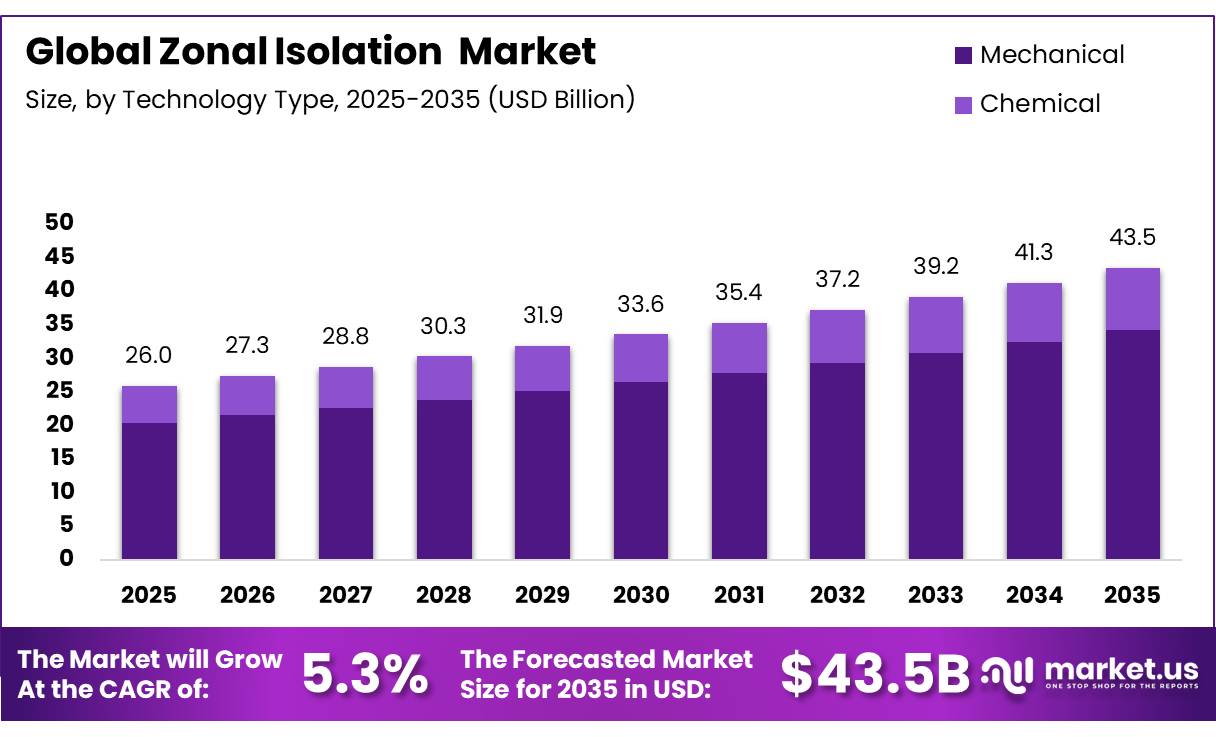
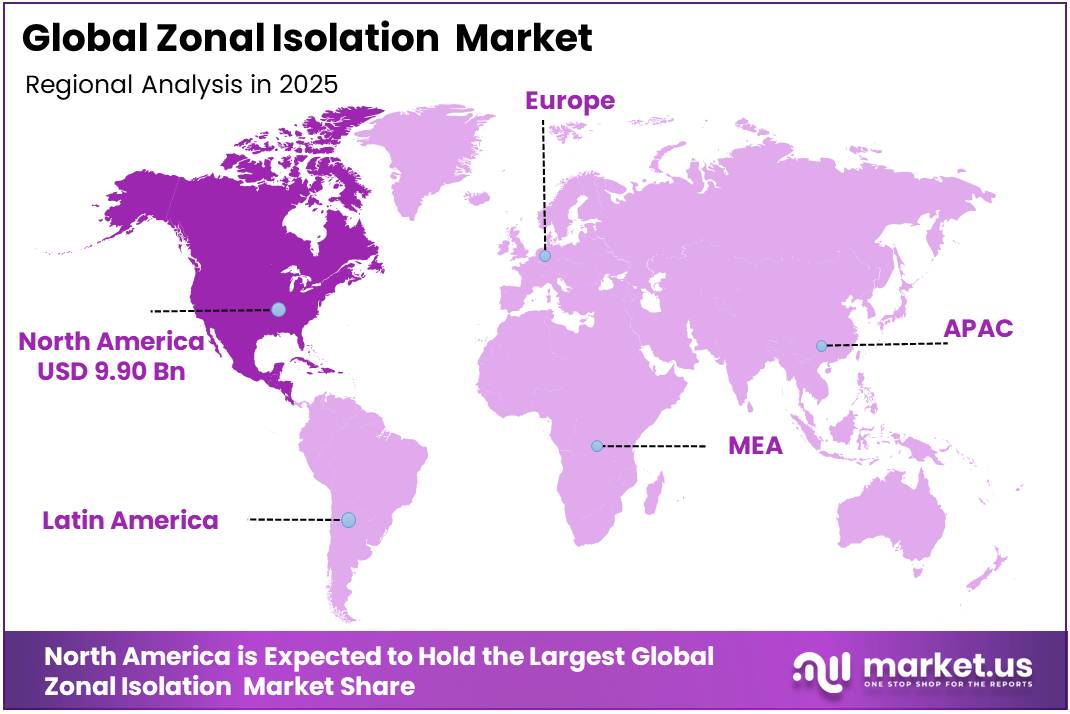
In 2025, the Global Zonal Isolation Market was valued at USD 26.0 billion, and between 2026 and 2035, this market is estimated to register a CAGR of 5.3%, reaching about USD 43.5 billion by 2035. North America held a dominant market position, capturing more than a 38.14% share, holding USD 9.90 billion in revenue.
The zonal isolation market covers mechanical and chemical systems used to separate subsurface formations, control fluid movement, protect casing integrity, and support drilling, completion, production, and abandonment. Demand is closely linked to upstream spending and the need to sustain mature fields.
- In June 2025, the International Energy Agency estimated global upstream oil and gas investment at just under 570 billion United States dollars, down around 4%, with 40% directed toward slowing production declines at existing fields.
Key Takeaways
- The global zonal isolation market was valued at USD 26.0 billion in 2025.
- The global market is projected to grow at a CAGR of 5.3% and is estimated to reach USD 43.5 billion by 2035.
- On the basis of technology, mechanical zonal isolation dominated the market, constituting 78.70% of the total market share.
- Based on the application, onshore operations dominated the zonal isolation market, with a substantial market share of around 70.40%.
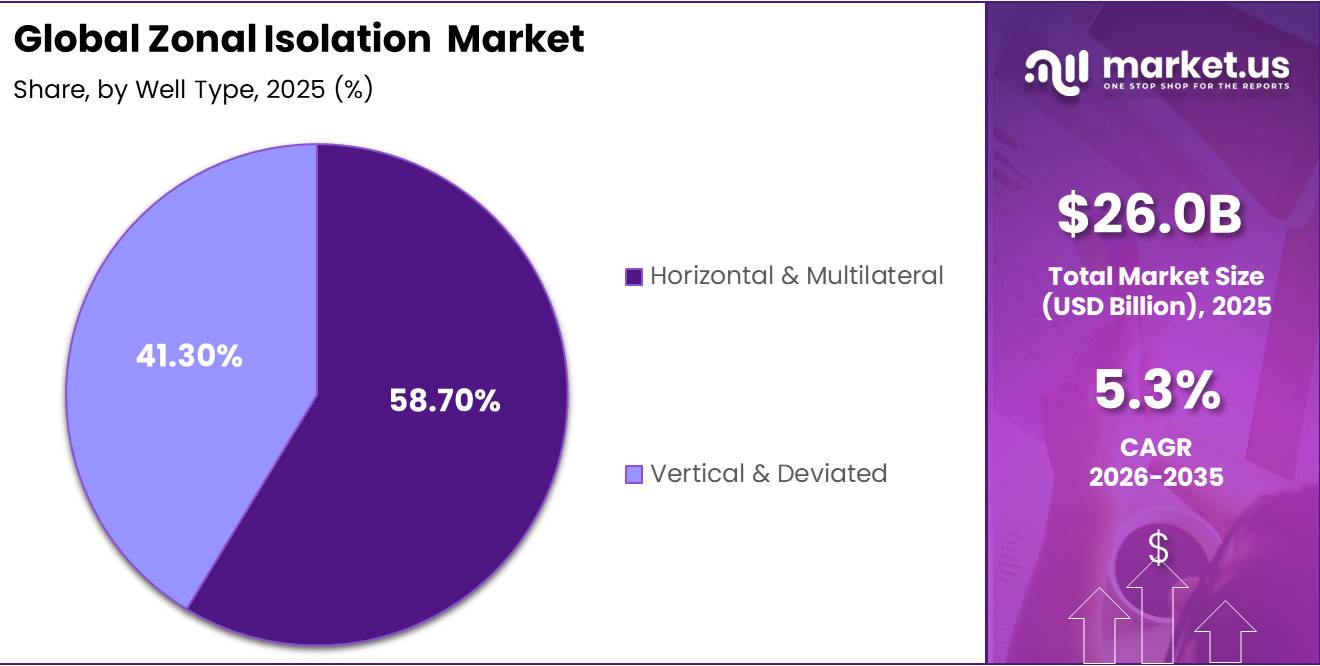
- Based on the well type, horizontal and multilateral wells led the market, comprising 58.70% of the total market.
- Among reservoir environments, unconventional reservoirs held a major share in the zonal isolation market, accounting for 45.60% of the market share.
- Among lifecycle stages, completion was the most considerable segment within the market, accounting for around 38.50% of the revenue.
- In 2025, North America was the most dominant region in the zonal isolation market, accounting for 38.14% of the total market share.
Current industry conditions favour reliable barriers that can perform across horizontal, multilateral, offshore, and high-pressure, high-temperature wells. In March 2026, the United States Energy Information Administration reported that United States crude oil production reached a record 13.6 million barrels per day in 2025, rising 3%. Lower 48 production excluding federal offshore areas accounted for 11.3 million barrels per day, reinforcing demand for completion tools, cementing systems, packers, bridge plugs, and remedial isolation services.
- The United Kingdom government reported a 2025 offshore decommissioning cost estimate of 44 billion British pounds, while well plug and abandonment represented around 50% of total decommissioning costs. This workload supports demand for permanent barrier materials, verification technologies, section milling, resin systems, and multiwell campaigns designed to reduce rig time, improve execution consistency, and limit future leakage risks.
Government initiatives are strengthening technical oversight. In September 2025, the United States Bureau of Safety and Environmental Enforcement awarded 492,600 United States dollars for a Pacific Coast offshore decommissioning study scheduled for completion in April 2026. The programme evaluates methods and cost estimates for offshore facilities, supporting financial assurance and responsible closure planning. Such measures create opportunities for qualified isolation providers offering auditable barrier design, placement, testing, monitoring, and abandonment documentation. They encourage standardized procedures, training, and coordination across projects.
Technology Analysis
Mechanical zonal isolation dominates with a 78.70% share because it provides dependable barriers across well conditions.
In 2025, Mechanical held a dominant market position, capturing more than a 78.70% share. Mechanical systems such as packers, bridge plugs, sliding sleeves, and casing devices remain used because they provide separation between zones. Their retrievability, pressure resistance, and compatibility with drilling, completion, production, and abandonment operations support adoption in conventional, unconventional, offshore, and high-pressure wells. These tools also help operators control water or gas movement and perform selective stimulation with certainty.
- For instance, in November 2025, according to Halliburton, the company launched LOGIX unit vitality, an artificial intelligence platform that monitors cementing equipment in real time and supports predictive maintenance, equipment readiness, and efficient cementing operations.
Chemical is the growing segment as operators increasingly use cement, resin, gels, and sealants to reach irregular pathways that mechanical tools may not fully isolate. Chemical solutions adapt to narrow channels, damaged cement sheaths, corrosive conditions, and well geometry. Their placement flexibility supports remedial work, permanent barriers, carbon storage wells, and ageing assets requiring durable fluid control.
Application Analysis
Onshore zonal isolation leads with a 70.40% share because land-based well activity supports deployment.
In 2025, Onshore held a dominant market position, capturing more than a 70.40% share. The segment benefited from drilling, completion, stimulation, production, and abandonment activity across conventional and unconventional fields. Easier site access, established service networks, lower mobilisation complexity, and faster equipment deployment support the use of packers, plugs, cement systems, and remedial barriers. Operators also favour onshore isolation solutions for selective production, water control, pressure management, and well integrity maintenance across mature assets.
- For instance, in August 2025, according to Baker Hughes, the company published a case study showing that its Set for Life cementing solutions maintained zonal isolation in challenging high-pressure, high-temperature offshore wells.
Offshore is the growing segment as deepwater projects require dependable barriers under high pressure, low seabed temperatures, corrosive fluids, and difficult well geometries. Demand is supported by complex completions, subsea tiebacks, mature-field interventions, and decommissioning programmes. Offshore operators increasingly require durable cement systems, advanced packers, digital placement modelling, and verification tools that reduce operational risk and protect long-term well integrity.
Well Type Analysis
Horizontal and multilateral wells lead with 58.70% due to broad reservoir contact and staged completion needs.
In 2025, Horizontal & Multilateral held a dominant market position, capturing more than a 58.70% share. These wells require dependable isolation across long lateral sections and multiple producing zones. Packers, sliding sleeves, cement systems, and bridge plugs help operators control stimulation stages, prevent unwanted fluid movement, and manage production from selected intervals. Their wider use in unconventional developments and complex reservoir drainage programs continues to support segment leadership.
- For instance, in November 2025, according to SLB, a field case documented the deployment of a dual-zone smart completion in an integrity-challenged Abu Dhabi well, enabling selective production, real-time zonal control, and improved management of separate reservoir intervals.
Vertical & Deviated is the growing segment. These wells remain important in mature fields, conventional reservoirs, offshore developments, and intervention programs where direct reservoir access or constrained surface locations shape the well path. Their varied angles create challenges for cement placement, casing centralization, and tool movement. Demand is therefore increasing for adaptable packers, placement modelling, expandable barriers, and verification systems that maintain isolation through curved sections and changing pressure conditions over the well lifecycle.
Reservoir Environment Analysis
Unconventional reservoirs lead with a 45.60% share due to complex stimulation and isolation requirements.
In 2025, Unconventional held a dominant market position, capturing more than a 45.60% share. Its leadership was supported by shale, tight oil, and tight gas development, where long well sections require dependable separation between stimulation and production zones. Mechanical packers, cement systems, plugs, and sleeves help prevent fluid communication, improve fracture placement, and protect well integrity. Repeated completion activity and complex reservoir conditions continue to support demand for durable, placed isolation systems.
- For instance, in November 2025, according to Weatherford, the company documented a managed-pressure operation in an over-pressured Canadian formation that maintained wellbore stability during casing and cementing, protected against fluid influx, and supported reliable zonal isolation.
High-Pressure, High-Temperature (HPHT) is the growing segment as operators increasingly develop deeper and more technically demanding reservoirs. Extreme pressure, heat, corrosive fluids, and narrow operating windows can weaken seals and cement barriers. These conditions raise demand for qualified packers, high-performance cement, expandable barriers, advanced modelling, and real-time verification. Stronger materials and improved placement methods help operators reduce leakage risks, maintain pressure integrity, and extend well life across challenging onshore and offshore environments.
Lifecycle Stage Analysis
Completion leads with a 38.50% share because reliable barriers are essential before production begins.
In 2025, Completion held a dominant market position, capturing more than a 38.50% share. This stage depends on effective isolation before a well enters production. Cement systems, packers, liner hangers, bridge plugs, and sleeves separate reservoir intervals, support selective stimulation, and prevent unwanted fluid movement. Operators place strong emphasis on barrier quality because weak isolation can reduce production control, create remedial work, and affect long-term well integrity across conventional, unconventional, onshore, and offshore projects.
- For instance, in March 2025, according to SLB, the company secured an integrated drilling contract for the Trion development offshore Mexico, covering directional drilling, cementing, drilling fluids, completion services, and other well-construction activities intended to improve well quality.
Drilling is the growing segment as deeper wells, difficult formations, and narrow pressure windows increase the need for early-stage isolation. During drilling, operators use cement plugs, casing barriers, lost-circulation treatments, and well-control systems to stabilize the borehole and separate troublesome zones. Greater use of managed-pressure drilling, real-time monitoring, and engineered fluids is improving barrier placement, reducing non-productive time, and preparing wells for safer completion and production over time.
Key Market Segments
By Technology
- Mechanical
- Chemical
By Application
- Onshore
- Offshore
By Well Type
- Horizontal & Multilateral
- Vertical & Deviated
By Reservoir Environment
- Unconventional
- High-Pressure, High-Temperature (HPHT)
- Conventional
By Lifecycle Stage
- Completion
- Drilling
- Production
- Abandonment (P&A)
Driver Analysis
Simul-Frac Shale Intensification and Rising Plug-Per-Pad Consumption
Multi-well simultaneous fracturing programs in the Permian Basin now stage up to eight horizontal wells concurrently, a completion architecture that has pushed single-pad barrier consumption toward roughly 300 composite plugs per pad, compressing per-stage drill-out times to under 15 minutes and structurally shifting unit economics from a “cost-per-tool” to a “cost-per-cycle-hour” model. Argentina’s Vaca Muerta play is on pace for approximately 28,040 fracturing stages in 2026, a roughly 20% increase over the 24,000 stages logged in 2025, with YPF alone contributing an estimated 13,600 stages as multi-well pad development supplants earlier exploratory drilling.
Field data from early 2026 shows monthly frac completions in Vaca Muerta already averaging 2,200-plus stages, with inter-stage turnaround compressed to roughly 10 minutes, reinforcing demand for rapidly drillable, dissolvable, or millable composite plugs rather than legacy cast-iron bridge plugs. China’s Sichuan shale gas basin is separately targeting roughly 6,000 new horizontal wells by 2030, each requiring an estimated 30 to 50 discrete isolation barriers, layering a second high-volume demand corridor onto the North American and South American base.
Drivers Impact Analysis
| Driver | (~) % Impact on CAGR | Geographic Relevance | Impact Timeline |
|---|---|---|---|
| Simul-frac shale intensification raising plug-per-pad consumption | +1.3% | North America (Permian core), Argentina (Vaca Muerta), China (Sichuan) | Medium term (2–4 years) |
| Deepwater and pre-salt completions demanding high-spec cement/packer systems | +0.9% | Brazil pre-salt, Guyana, Gulf of Mexico, West Africa | Long term (≥ 4 years) |
| Federal and EU methane/well-integrity compliance deadlines | +0.7% | EU core, US Gulf Coast, North Sea | Short term (≤ 2 years) |
| Enhanced geothermal systems scaling into commercial superhot-rock wells | +0.5% | US (Utah, Nevada, Oregon), Iceland | Long term (≥ 4 years) |
| Class VI CCS injection well permitting expansion | +0.6% | US (Louisiana, Texas, Kansas, Colorado), North Sea | Long term (≥ 4 years) |
| Crude price volatility and capital discipline moderating rig deployment | −0.8% | US shale basins, offshore deepwater programs | Short term (≤ 2 years) |
Restraint Analysis
Section 232 Steel and OCTG Tariff Cost Pass-Through
The April 6, 2026 proclamation restructuring Section 232 duties to apply to the full customs value of steel, aluminum, and copper derivatives—rather than only the metal content—has pushed effective tariff exposure on imported casing, tubing, and packer-body steel to a flat 50% on primary mill products and 25% on many derivative tool components, with non-compliant country-of-melt documentation triggering duty rates as high as 200%; this follows the June 2025 doubling of the baseline steel/aluminum tariff to 50%, which had already lifted the OCTG Pipe Logix benchmark to an average of USD 2,073 per short ton in May 2026 even as underlying hot-rolled coil spot prices softened toward USD 871–890 per short ton on weakening drilling demand, creating a widening and unpredictable spread between raw steel cost and finished tubular price that complicates isolation-tool bill-of-materials forecasting.
The practical effect on unit economics is a 15–20% embedded cost inflation on domestically-fabricated packers, bridge plugs, and liner hangers that rely on imported specialty steel grades, forcing suppliers to either absorb margin compression of an estimated 300–500 basis points or pass costs downstream to E&P operators already constrained by flat-to-declining capital budgets, while the parallel emergence of a 99%-recoverable manufacturing drawback mechanism for Trade Agreement Partner-sourced metal only partially offsets the duty burden for firms with the treasury bandwidth to manage complex customs documentation.
Restraint Impact Analysis
| Restraint | (~) % Impact on CAGR | Geographic Relevance | Impact Timeline |
|---|---|---|---|
| Section 232 steel/OCTG tariff cost pass-through | −1.4% | US core, Canada spill-over, UK/EU exporters | Short term (≤ 2 years) |
| Skilled completions-crew and technician shortage | −0.9% | North America (Permian, Bakken, Marcellus) | Medium term (2–4 years) |
| Data-center/AI power buildout crowding out OFS labor and equipment slots | −0.6% | US Gulf Coast, Texas, Georgia, Virginia | Short term (≤ 2 years) |
| Dissolvable/composite plug price commoditization compressing margins | −0.8% | Global, concentrated in North America and China | Medium term (2–4 years) |
| Capital discipline and M&A-driven consolidation curbing rig deployment | −1.0% | US shale basins, offshore deepwater | Short term (≤ 2 years) |
| Divergent regulatory compliance costs across EU vs. deregulating US | −0.4% | EU core, North Sea vs. US Gulf Coast | Long term (≥ 4 years) |
Opportunity Analysis
Enhanced Geothermal Systems (EGS) Adjacency Entry
EGS remains structurally distinct from the oil-and-gas baseline because openhole completions historically lacked reliable high-temperature packers, meaning current market sizing almost entirely excludes EGS as an addressable segment, yet emerging cemented-casing multistage designs now make cased-hole packers and bridge plugs technically viable for granite and hot dry rock formations, creating a genuine adjacent TAM expansion rather than an extension of existing drivers; with global EGS pilot and commercial pipeline capacity projected to exceed 5-8 GW by the early 2030s and each multistage EGS well requiring 8-15 isolation points compared to 3-5 in a typical unconventional oil well, unit isolation-tool consumption per well could rise by 60-80%, and early movers that qualify elastomers and metal-to-metal seals for sustained 250-300°C operation could command a 15-20% price premium versus standard oilfield packers, translating into an estimated incremental revenue pool of USD 600-850 million by 2031 for suppliers who invest now in high-temperature material qualification programs.
Opportunity Impact Analysis
| Opportunity | (~) % Potential CAGR | Geographic Relevance | Execution Window |
|---|---|---|---|
| CO₂ Sequestration (Class VI) Isolation-as-a-Service | +2.8% | North America core (Gulf Coast, Permian), EU emerging (UK North Sea) | Medium term (2-4 years) |
| Enhanced Geothermal Systems (EGS) Adjacency Entry | +2.2% | North America (Nevada, Utah), APAC emerging (Indonesia, Philippines) | Long term (≥4 years) |
| Digital Monitoring & Predictive-Integrity SaaS Layer | +1.9% | Global core operators, APAC emerging deployment | Short term (≤2 years) |
| Well Decommissioning & P&A Retrofit Isolation | +1.6% | North Sea (EU/UK), Gulf of Mexico, APAC (Malaysia, Australia) | Medium term (2-4 years) |
| Independent Packer/Tool Manufacturer Roll-Up (M&A) | +1.4% | North America fragmented base, EU niche players | Short term (≤2 years) |
| Chemical Isolation Licensing in Emerging Basins | +1.2% | Middle East, Latin America (Vaca Muerta), Sub-Saharan Africa | Medium term (2-4 years) |
Challenges Analysis
Skilled Drilling & Completions Talent Deficit
The root structural vulnerability traces to the 2015-2020 downturn, which triggered a 35-40% reduction in the globally mobile offshore workforce that has never been fully rebuilt despite the activity recovery since 2022, leaving U.S. oil and gas extraction employment at a 2026 low of roughly 114,500 workers even as production hits records; the resulting friction is quantifiable in vacancy duration, with specialized technical roles now taking 85-120 days to fill versus 65-85 days for general positions, a workforce where 48% of personnel are aged 45 or older against just 19% aged 25-34, and 67% of energy firms reporting talent shortages as a moderate-to-severe operational constraint, which for zonal isolation specifically means fewer experienced cementing engineers and toolpushers available to execute complex multistage barrier jobs, inflating day-rate costs for specialized crews by an estimated 8-14% and extending average job-execution timelines by 10-15%; the long-term corporate adjustment required is a structural pivot toward automation-assisted cementing units, remote real-time job monitoring to compress the experience curve for junior engineers, and formal apprenticeship pipelines, none of which fully resolve the deficit before 2030 given that only 33% of hiring managers are actively recruiting graduates today.
Challenges Impact Analysis
| Challenge | (~) % CAGR Friction | Geographic Relevance | Mitigation Horizon |
|---|---|---|---|
| Skilled Drilling & Completions Talent Deficit | -1.4% | North America (Permian, Gulf Coast), Offshore North Sea | Long term (≥4 years) |
| Cement Sheath & Barrier Failure Rates | -1.1% | Global core, HPHT basins (Gulf of Mexico, Middle East) | Medium term (2-4 years) |
| HPHT Material & Elastomer Performance Limits | -0.9% | Deepwater Gulf of Mexico, North Sea, Middle East HPHT | Long term (≥4 years) |
| Offshore Crew Rotation & Logistics Friction | -0.7% | North Sea, West Africa, APAC offshore corridors | Medium term (2-4 years) |
| Cyclic Stress Degradation in Storage/Steam Wells | -0.6% | North America UGS, California heavy oil, EU gas storage | Medium term (2-4 years) |
| Input Cost & Currency Volatility Exposure | -0.5% | Global, acute in emerging-market procurement (LatAm, APAC) | Short term (≤2 years) |
Geopolitical Impact Analysis
Geopolitical Realignment and Trade Disruption Reshaping Zonal Isolation Operations
Geopolitical tensions are reshaping the zonal isolation market through production policy changes, trade barriers, sanctions exposure, and transport disruption. These forces influence drilling budgets, equipment availability, and project schedules. Because isolation systems depend on steel-intensive packers, plugs, sleeves, and hardware, policy changes can affect procurement costs and supplier selection.
- In July 2025, eight Organization of the Petroleum Exporting Countries Plus members approved a production increase of 548 thousand barrels per day for August 2025. Flexible output decisions can alter operator cash flows and drilling schedules, creating uneven demand for cementing, completion, and remedial isolation services across producing regions.
Trade policy is also changing equipment economics. In June 2025, the United States increased tariffs on imported steel and aluminium articles from 25% to 50%. Higher duties can raise the landed cost of metal-based well tools, encourage domestic sourcing, and push service companies to qualify alternative manufacturers.
Logistics risks remain significant. UN Trade and Development reported that by May 2025, tonnage through the Suez Canal remained 70% below 2023 levels. Longer routes can delay tools, chemicals, and replacement parts used in offshore wells. These pressures encourage inventories, dual sourcing, local assembly, and longer procurement planning, although fragmented standards may extend qualification cycles.
Regional Analysis
North America dominates with a 38.14% share, driven by extensive drilling and well-integrity activity.
In 2025, North America held a dominant position in the zonal isolation market, capturing 38.14% of global revenue and generating USD 9.90 billion. The region benefits from extensive shale development, mature oilfields, horizontal drilling, offshore operations, and continuous well-integrity spending.
- In March 2026, the United States Energy Information Administration reported record 2025 crude production of 13.6 million barrels per day, while the Canada Energy Regulator recorded 5.35 million barrels per day. This activity supports demand for packers, plugs, cement systems, and remedial isolation services.
Europe is the fast-growing region, supported by offshore decommissioning, mature-field intervention, and stricter well-closure obligations. The United Kingdom government reported that more than 2,000 wells require plugging and abandonment over the next 10 years, while over 500 wells were already awaiting decommissioning. This backlog creates opportunities for permanent barriers, resin systems, section milling, verification tools, and coordinated multiwell campaigns across the North Sea and continental basins.
Key Regions and Countries Covered
- North America
- The US
- Canada
- Europe
- Germany
- France
- The UK
- Spain
- Italy
- Russia & CIS
- Rest of Europe
- APAC
- China
- Japan
- South Korea
- India
- ASEAN
- Rest of APAC
- Latin America
- Brazil
- Mexico
- Rest of Latin America
- Middle East & Africa
- GCC
- South Africa
- Rest of MEA
Key Players Analysis
Zonal isolation providers focus on strengthening tool reliability, barrier performance, service efficiency, and well-integrity expertise to remain competitive. A key priority is the development of advanced packers, bridge plugs, cementing systems, expandable barriers, and chemical sealants that can perform under high-pressure, high-temperature, offshore, and unconventional well conditions. Companies such as SLB, Halliburton Company, Baker Hughes Company, and Weatherford International plc maintain strong positions through broad completion portfolios, global service networks, digital monitoring capabilities, and long-term relationships with oil and gas operators.
Service providers also invest in automation, real-time downhole data, material qualification, and integrated well-construction solutions to improve placement accuracy and reduce operational risk. NOV Inc., Expro Group Holdings N.V., Welltec A/S, and Tendeka strengthen their market presence through specialized isolation technologies and intervention services. Strategic partnerships with drilling contractors, operators, and engineering companies support project access, while aftermarket support, field servicing, and customized barrier design improve customer retention across drilling, completion, production, and abandonment applications.
Market Key Players
- SLB
- Halliburton Company
- Baker Hughes Company
- Weatherford International plc
- NOV Inc.
- TechnipFMC plc
- Expro Group Holdings N.V.
- Tendeka
- Superior Energy Services, Inc.
- Welltec A/S
- TAM International, Inc.
- Packers Plus Energy Services Inc.
- Archer Limited
- Trican Well Service Ltd.
- Calfrac Well Services Ltd.
Key Development
- In September 2025, Expro Group Holdings N.V. completed the world’s first fully remote five-plug cementing operation in Saudi Arabia. The Generation-X Remote Plug Launcher and SkyHook system supported controlled cement placement and effective zonal isolation in a high-pressure gas well.
- In October 2025, Archer Limited completed its acquisition of Premium Oilfield Services, strengthening its fishing and plug-and-abandonment capabilities in the Gulf of America. Their combined customer base covers more than 80% of the region’s estimated USD 15 billion deepwater decommissioning expenditure through 2040.
- In January 2026, Welltec A/S introduced its Downhole Isolation business segment, combining annular, leak, and reservoir isolation solutions. The portfolio initially included TORDEN high-expansion retrievable bridge plugs and VALI medium-expansion retrievable multiset bridge plugs, with further product releases planned during 2026.
Report Scope
| Report Features | Description |
|---|---|
| Market Value (2025) | USD 26 Bn |
| Forecast Revenue (2035) | USD 43.5 Bn |
| CAGR (2026-2035) | 5.3% |
| Base Year for Estimation | 2025 |
| Historic Period | 2020-2024 |
| Forecast Period | 2026-2035 |
| Report Coverage | Revenue Forecast, Market Dynamics, Competitive Landscape, Recent Developments |
| Segments Covered | By Technology (Mechanical and Chemical), By Application (Onshore and Offshore), By Well Type (Horizontal & Multilateral and Vertical & Deviated), By Reservoir Environment (Unconventional, High-Pressure, High-Temperature (HPHT), and Conventional), By Lifecycle Stage (Drilling, Completion, Production, and Abandonment (P&A)) |
| Regional Analysis | North America – The US & Canada; Europe – Germany, France, The UK, Spain, Italy, Russia & CIS, Rest of Europe; APAC– China, Japan, South Korea, India, ASEAN & Rest of APAC; Latin America– Brazil, Mexico & Rest of Latin America; Middle East & Africa– GCC, South Africa, & Rest of MEA |
| Competitive Landscape | SLB, Halliburton Company, Baker Hughes Company, Weatherford International plc, NOV Inc., TechnipFMC plc, Expro Group Holdings N.V., Tendeka, Superior Energy Services, Inc., Welltec A/S, TAM International, Inc., Packers Plus Energy Services Inc., Archer Limited, Trican Well Service Ltd., and Calfrac Well Services Ltd. |
| Customization Scope | Customization for segments, region/country-level will be provided. Moreover, additional customization can be done based on the requirements. |
| Purchase Options | We have three licenses to opt for: Single User License, Multi-User License (Up to 5 Users), Corporate Use License (Unlimited Users and Printable PDF) |





































