


Report Overview
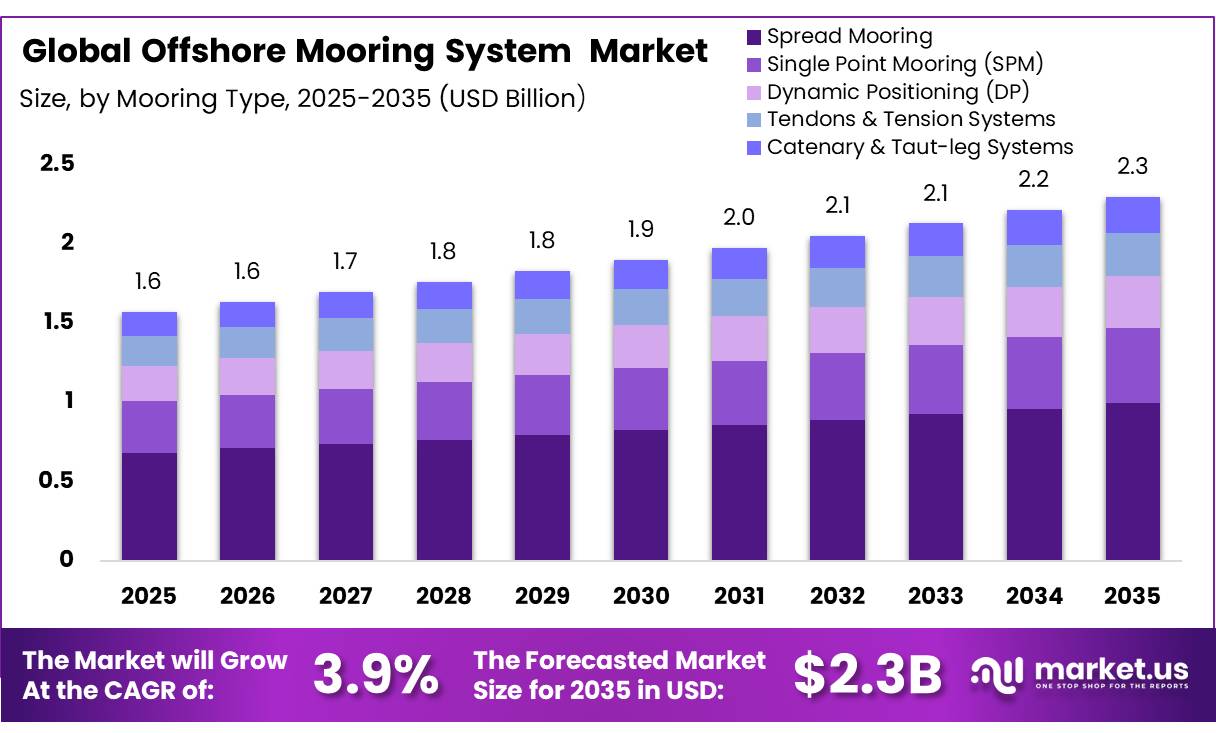
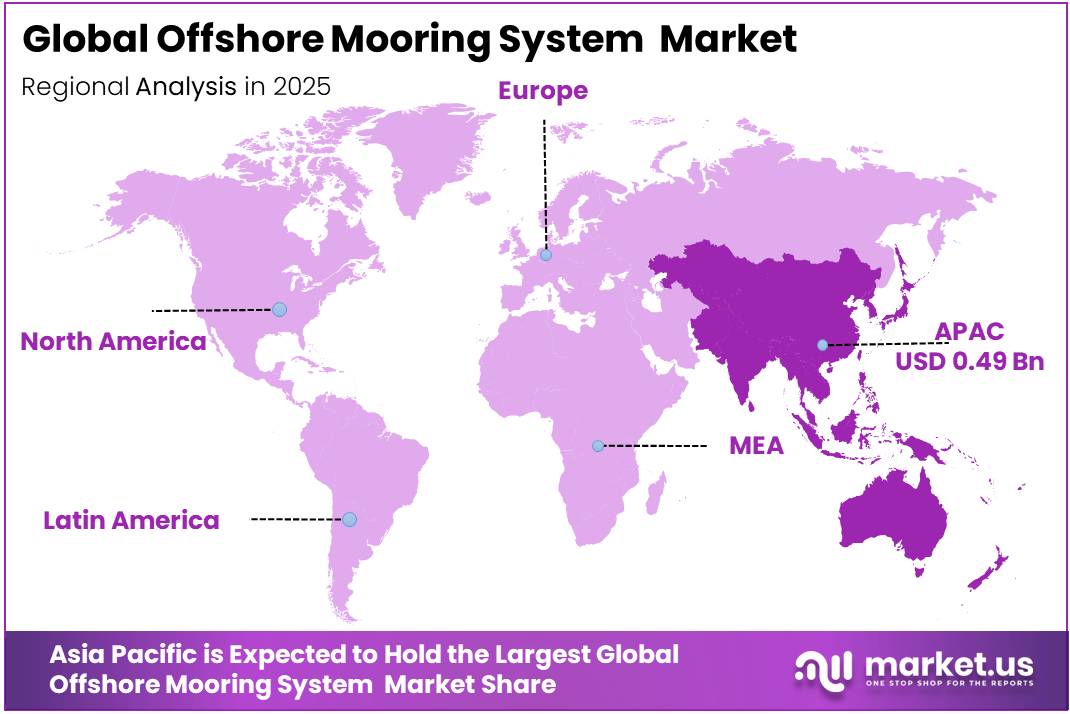
In 2025, the Global Offshore Mooring System Market was valued at USD 1.6 billion, and between 2026 and 2035, this market is estimated to register a CAGR of 3.9%, reaching about USD 2.3 billion by 2035. Asia Pacific held a dominant market position, capturing more than a 31.0% share, holding USD 0.49 billion in revenue.
The offshore mooring system industry supplies anchoring, chain, wire, synthetic rope, tendon, and control solutions that keep floating production units, drillships, semi-submersibles, liquefied natural gas facilities, and renewable-energy platforms positioned. Demand depends on water depth, seabed conditions, environmental loading, vessel motion, and operating life. As offshore developments move farther from shore, operators increasingly require corrosion-resistant materials, digital monitoring, redundancy, and designs that support safe installation, inspection, maintenance, and eventual recovery.
- The United States Energy Information Administration forecast Federal Offshore Gulf of America crude production at 80 million barrels per day in 2025 and 1.81 million barrels per day in 2026. It also expected 13 fields to begin production across those years, including developments using four new floating production units. These projects sustain requirements for mooring lines, anchors, connectors, tensioning equipment, engineering services, and integrity-management programs.
Key Takeaways
- The Global Offshore Mooring System Market was valued at USD 1.6 billion in 2025.
- The Global Market is projected to grow at a CAGR of 3.9% and is estimated to reach USD 2.3 billion by 2035.
- On the basis of mooring type, spread mooring dominated the market, constituting 43.40% of the total market share.
- Based on anchorage type, drag embedment anchors dominated the offshore mooring system market, with a substantial market share of around 48.40%.
- Based on water depth, deep water ranging from 400 to 1,500 meters led the market, comprising 45.20% of the total market share.
- Among the applications, Floating Production Storage & Offloading (FPSO) systems held a major share in the offshore mooring system market, accounting for 36.50% of the market share.
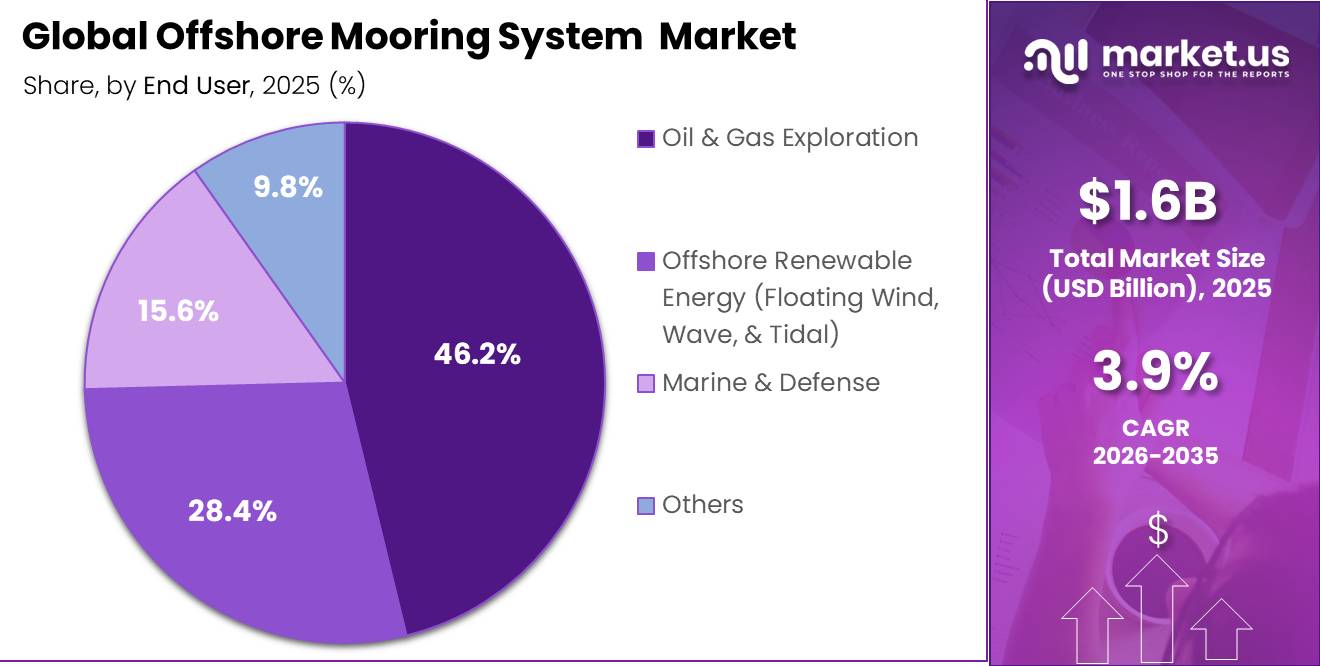
- Among the end-use industries, oil and gas exploration was the most considerable segment within the market, accounting for around 46.20% of the revenue.
- In 2025, Asia-Pacific was the most dominant region in the offshore mooring system market, accounting for 31.00% of the total global market share.
Floating wind creates another important demand pathway. Equinor’s Hywind Tampen has 94.6 megawatts of system capacity, uses 11 turbines, operates in water depths of 260 to 300 metres, and is installed on floating concrete spar structures with a shared anchoring system. Such projects demonstrate how proven offshore engineering can transfer into renewable power. Growth opportunities include standardized mooring packages, lower-weight synthetic lines, shared anchors, condition-monitoring sensors, robotic inspection, and port-based assembly solutions.
Government initiatives are expanding the addressable project pipeline. The United States Department of Energy aims to reduce floating offshore wind costs by more than 70% to 45 dollars per megawatt-hour by 2035. In October 2025, The Crown Estate advanced two Celtic Sea sites of up to 1.5 gigawatts each, within a 4.5-gigawatt leasing round that could support more than 5,000 jobs. These programs encourage investment in anchors, cables, installation vessels, ports, testing, and domestic manufacturing while strengthening supplier capability and long-term project bankability worldwide.
Mooring Type Analysis
Spread Mooring dominates with 43.40% due to reliable station-keeping across offshore production environments.
In 2025, Spread Mooring held a dominant market position, capturing more than a 43.40% share. Its leadership was supported by use across floating production, storage and offloading units, semi-submersibles, drillships, and offshore facilities requiring stable positioning. The system distributes mooring lines around the vessel, helping operators manage environmental loads, limit movement, and maintain safety. Its adaptable layout, proven engineering, and suitability for deepwater developments strengthen demand across offshore projects.
- For instance, in April 2025, according to MODEC, the company received a limited notice to proceed for the Hammerhead floating production, storage and offloading project, which is planned to use a SOFEC spread mooring system.
Single Point Mooring is the growing segment because it allows vessels to rotate around one connection point and align with changing wind, waves, and currents. Its transfer arrangement, reduced seabed footprint, and suitability for tanker loading support adoption in offshore terminals and floating production projects. Demand is rising as operators seek flexible systems that simplify installation, improve access, and support safe fluid transfer.
Anchorage Type Analysis
Drag Embedment Anchors dominate with 48.40% because proven holding performance supports reliable offshore station-keeping.
In 2025, Drag Embedment Anchors held a dominant market position, capturing more than a 48.40% share. Their leadership was supported by use in permanent mooring systems for floating production units, drilling rigs, semi-submersibles, and offshore platforms. These anchors penetrate the seabed as horizontal load is applied, creating strong resistance without requiring complex installation equipment. Their deployment, retrievability, cost efficiency, and compatibility with soil conditions make them suitable where installation speed and operational flexibility remain important.
- For instance, in August 2025, according to Acteon, Bruce Anchor supplied drag embedment anchors for the SHEN LAN TAN SUO rig, supporting an integrated mooring installation and use of advanced anchoring solutions offshore.
Suction Anchors are the growing segment as deepwater projects require high-capacity foundations with accurate placement and dependable vertical and horizontal load resistance. Their controlled installation, limited seabed disturbance, and suitability for soft clay conditions support adoption in floating production and offshore wind developments. Demand is further strengthened by larger floating structures requiring durable anchoring and long operating lives.
Water Depth Analysis
Deep Water dominates with 45.20% as offshore operators develop fields requiring high-capacity station-keeping.
In 2025, Deep Water (400 to 1,500 meters) held a dominant market position, capturing more than a 45.20% share. Its leadership was supported by expanding offshore production activity where floating production units, semi-submersibles, and drillships require dependable mooring performance under stronger currents, waves, and wind loads. Deep-water systems use engineered anchors, chains, wire ropes, and synthetic lines to control vessel movement and maintain operational safety. Their ability to support long-duration production, complex subsea infrastructure, and remote field development continues to strengthen adoption among offshore operators.
- For instance, in March 2025, according to Allseas, its anchor-positioned Sandpiper barge completed nearshore construction activities for the Darwin Pipeline Duplication project, demonstrating reliable positioning during challenging shallow-water operations.
Shallow Water (≤ 400 meters) is the fastest growing segment as operators develop nearshore oil, gas, and renewable-energy projects with comparatively easier installation and maintenance access. Growth is supported by lower vessel requirements, established anchoring methods, shorter project timelines, and rising demand for cost-efficient mooring solutions across coastal production facilities, terminals, and floating energy developments.
Application Analysis
Floating Production Storage & Offloading (FPSO) systems dominate with 36.50% through flexible offshore production solutions.
In 2025, Floating Production Storage & Offloading (FPSO) held a dominant market position, capturing more than a 36.50% share. Its leadership was supported by the ability to combine offshore production, processing, storage, and tanker loading within one floating facility. FPSO units suit remote fields where fixed platforms or long export pipelines may be less practical. Their flexible deployment, large storage capacity, and compatibility with deepwater developments strengthen demand. Mooring systems remain essential for controlling vessel movement, protecting risers, and maintaining safe operations under changing marine conditions.
- For instance, in March 2025, according to MODEC, Shell reached a final investment decision for the Gato do Mato FPSO project, while MODEC secured agreements covering the vessel and long-term operations.
Tension Leg Platforms (TLP) are the growing segment because their vertically tensioned tendons limit heave and support stable production in deeper waters. Their reduced vertical movement benefits well access, riser performance, and topside operations. Growing interest in compact deepwater facilities and long-life field developments is supporting wider adoption of reliable tendon and anchoring systems.
End Use Analysis
Oil and Gas Exploration dominates with 46.20% because field activity requires dependable long-term mooring support.
In 2025, Oil & Gas Exploration held a dominant market position, capturing more than a 46.20% share. Its leadership was supported by use of floating production units, drilling rigs, semi-submersibles, and offshore terminals across producing basins. These facilities depend on mooring systems to maintain position, protect risers and transfer lines, and support safe operations under changing wind, wave, and current conditions. Established engineering standards, experienced contractors, and long operating lives further strengthen demand from offshore exploration and production companies.
- For instance, in March 2026, according to the United Kingdom Government, up to 64 million funding support was announced for a Port Talbot offshore wind hub intended to strengthen infrastructure for floating projects in the Celtic Sea.
Offshore Renewable Energy (Floating Wind, Wave, & Tidal) is the growing segment as developers move into deeper waters where fixed foundations are less practical. Floating projects require anchors, chains, synthetic ropes, connectors, and monitoring systems. Expanding technology trials, port upgrades, and supply-chain investment are improving readiness and creating opportunities for reusable, lower-maintenance mooring designs.
Key Market Segments
Mooring Type
- Spread Mooring
- Single Point Mooring (SPM)
- Dynamic Positioning (DP)
- Tendons & Tension Systems
- Catenary & Taut-leg Systems
Anchorage Type
- Drag Embedment Anchors
- Suction Anchors
- Vertical Load Anchors
- Gravity Anchors
- Driven Piles
Water Depth
- Shallow Water (≤ 400 meters)
- Deep Water (400 to 1,500 meters)
- Ultra-deep Water (> 1,500 meters)
Application
- Floating Production Storage & Offloading (FPSO)
- Tension Leg Platforms (TLP)
- Semi-submersibles
- SPAR Platforms
- Floating Liquefied Natural Gas (FLNG)
- Drillships
End-Use Industry
- Oil & Gas Exploration
- Offshore Renewable Energy (Floating Wind, Wave, & Tidal)
Driver Analysis
Deepwater FPSO and floater backlog lift mooring demand
The clearest 2026 growth driver is the rising stock of floating production projects that require turret, spread, or hybrid mooring packages at first installation and then recurring inspection and replacement intervals. In 2025 the global FPSO fleet counted 185 active units, 12 idle units available for redeployment, and 23 units on order or under construction, which indicates a still-expanding installed base for anchors, chain, wire, connectors, and monitoring systems. This matters because each new floater creates a multi-layer revenue stack: front-end engineering, line design, anchor procurement, offshore installation, and long-tail integrity services.
Drivers Impact Analysis
| Driver | (~) % Impact on CAGR | Geographic Relevance | Impact Timeline |
|---|---|---|---|
| Deepwater FPSO and floater backlog lift mooring demand | +1.4% | Brazil core, West Africa core, Guyana-Suriname, SE Asia | Medium term (2-4 years) |
| Floating offshore wind scale-up expands new mooring use cases | +1.1% | EU Atlantic/North Sea, South Korea, Japan, US Pacific, Portugal | Medium term (2-4 years) |
| Shift into deeper and harsher waters raises line intensity per project | +0.9% | Brazil pre-salt, Gulf of America, Norway, UK, West Africa | Short term (≤ 2 years) |
| Integrity upgrades and brownfield replacement support recurring spend | +0.8% | North Sea, Gulf of America, Brazil, APAC mature offshore basins | Short term (≤ 2 years) |
| Synthetic rope and hybrid line adoption improves project economics | +0.7% | EU floating wind, Brazil, Norway, South Korea, Japan | Medium term (2-4 years) |
| Marine spatial planning and decarbonization targets unlock floating projects | +0.6% | EU, UK, East Asia, selective North America | Long term (≥ 4 years) |
Restraint Analysis
Upstream oil & gas capex volatility
The IEA indicates upstream oil investment around USD 570 billion in 2025 with scenarios that include a 6% drop relative to prior years if prices soften and demand expectations moderate, which translates into multiple deepwater projects being delayed or re-phased, each project typically requiring tens of millions of dollars in mooring engineering, chain, anchors, and installation spread costs.
For mooring suppliers, this volatility drives uneven order intake with periods where engineering teams and fabrication yards stand underutilized, while operators hold FIDs and re-bid tenders to capture lower day rates, elongating tender cycles by 6–18 months and creating revenue gaps.
Strategically, this restraint compresses margins because suppliers face pressure to lock in unit rates during tendering while their own input costs fluctuate, forcing risk-loaded quotes that either price them out or erode profitability when execution occurs under less favorable conditions, and in basins such as the Gulf of America and Brazil, where deepwater production accounts for a dominant share of offshore output, even a 10–15% pause in new floater sanctioning can remove a meaningful portion of annual mooring volume.
Restraint Impact Analysis
| Restraint | (~) % Impact on CAGR | Geographic Relevance | Impact Timeline |
|---|---|---|---|
| Upstream oil & gas capex volatility | -1.3% | Gulf of America, Brazil, West Africa, Middle East | Medium term (2-4 years) |
| Floating wind permitting & grid delays | -1.1% | EU North Sea/Atlantic, UK, East Asia, US West | Long term (≥ 4 years) |
| Mooring hardware supply chain bottlenecks | -0.9% | EU, East Asia, North America, emerging APAC | Short term (≤ 2 years) |
| Regulatory/classification uncertainty for new concepts | -0.8% | EU, UK, East Asia, select Americas | Medium term (2-4 years) |
| High installation & integrity lifecycle costs | -0.7% | Global deepwater basins, harsh environment regions | Medium term (2-4 years) |
| Environmental opposition & spatial-use conflicts | -0.6% | EU, UK, coastal North America, Japan, Korea | Long term (≥ 4 years) |
Opportunity Analysis
Service- and data-led mooring lifecycle platforms
This is an opportunity rather than a current driver because most offshore mooring revenues today are still booked on project-based hardware and installation contracts, with limited systematic monetization of data, digital monitoring, and outcome-based service models over the full 20–25 year asset life, yet the installed base of offshore floaters and renewable platforms is large and growing toward the 2035 horizon.
By building integrated lifecycle platforms combining structural-health monitoring, predictive analytics for line fatigue, remote integrity inspection, and performance-based maintenance contracts mooring specialists can convert current one-off project revenues into recurring ARR streams; for example, converting even 10–20% of existing FPSO and FOW mooring assets into subscription-based monitoring at USD 0.5–1 million per asset per year would create a multi‑billion‑dollar TAM that is largely uncaptured today.
With typical EBITDA margins on software and data services exceeding 25–35% compared with single‑digit to mid‑teens hardware margins, this pivot could realistically add more than a percentage point to sector CAGR as it scales, while simultaneously reducing customer OPEX by 5–10% through optimized inspection timing and failure avoidance, making the value proposition commercially viable for operators in North America, the North Sea, Brazil and mature APAC basins that are under pressure to extend asset life without disproportionate cost escalation.
Opportunity Impact Analysis
| Opportunity | (~) % Potential CAGR | Geographic Relevance | Execution Window |
|---|---|---|---|
| Service- and data-led mooring lifecycle platforms | +1.3% | North America core, EU North Sea, Brazil, APAC mature basins | Short term (≤ 2 years) |
| Dedicated mooring solutions for floating renewables | +1.2% | EU Atlantic/Med, UK, Japan, Korea, US West, emerging APAC | Medium term (2-4 years) |
| Shared mooring and multi-platform anchoring concepts | +1.0% | EU, UK, select APAC and Latin American offshore hubs | Medium term (2-4 years) |
| Elastic, hybrid, and low-impact mooring technologies | +0.9% | EU, North America, eco-sensitive Asia-Pacific corridors | Medium term (2-4 years) |
| Consolidation and M&A roll-up of fragmented suppliers | +0.8% | Global (EU, North America, APAC corridors, Brazil) | Long term (≥ 4 years) |
| Entry into adjacent vessel and nearshore mooring markets | +0.7% | Global ports, offshore logistics hubs, emerging APAC | Short term (≤ 2 years) |
Challenges Analysis
Vessel and offshore logistics bottlenecks
Vessel and logistics bottlenecks are a structural challenge because they do not prohibit projects entirely but slow execution and raise costs; analysis of offshore wind supply chains in 2024–2026 indicates that the rapid scaling of turbines to 15–25 MW has outpaced growth in the global Wind Turbine Installation Vessel (WTIV) fleet, leading to constrained vessel availability, postponed permitting and auctions, and delayed construction schedules.
Mooring campaigns compete for many of the same high‑end vessels—anchor‑handling tug supply vessels, heavy‑lift ships, and construction support units—so tight vessel supply can extend lead times by 6–12 months and inflate day rates by 20–30% in peak periods, increasing per‑project logistics costs and limiting the number of campaigns that can be executed annually.
Even if vessel and port infrastructure investments are underway, building or converting large installation vessels typically takes 2–4 years from order to delivery, which sets a medium‑term horizon for meaningful relief and means offshore mooring firms must continue to navigate slot scarcity, port congestion, multi‑port logistics chains, and complex global routing, with each additional day of vessel delay directly impacting project NPV and trimming achievable sector growth by around one percentage point relative to unconstrained logistics.
Challenges Impact Analysis
| Challenge | (~) % CAGR Friction | Geographic Relevance | Mitigation Horizon |
|---|---|---|---|
| Complex deepwater installation execution | -1.1% | Gulf of America, Brazil pre-salt, West Africa, APAC deepwater | Long term (≥ 4 years) |
| Vessel and offshore logistics bottlenecks | -1.0% | EU offshore hubs, North America, APAC corridors | Medium term (2-4 years) |
| Advanced mooring design & modeling complexity | -0.9% | Global deepwater, EU/UK engineering hubs, East Asia | Long term (≥ 4 years) |
| Evolving safety, SOLAS & class compliance burden | -0.8% | Global regulatory hubs, EU, North America, Asia-Pacific | Medium term (2-4 years) |
| Offshore & digital talent shortages | -0.8% | EU, North America, APAC, Middle East | Long term (≥ 4 years) |
| Fragmented supply-chain coordination & standards | -0.7% | EU offshore wind, APAC emerging markets, Latin America | Medium term (2-4 years) |
Geopolitical Impact Analysis
Geopolitical Realignment and Trade Disruptions Reshaping Offshore Mooring System Supply Chains
Current geopolitical tensions are reshaping the offshore mooring system market through shipping disruption, steel tariffs, uncertain offshore investment, and regional supply-chain policies. Mooring chains, anchors, tendons, connectors, and installation equipment depend on internationally distributed steel production, specialist fabrication, marine transport, and offshore vessels. Disruptions can affect procurement costs, delivery schedules, supplier qualification, and investment planning across oil, gas, and renewable-energy projects.
Maritime chokepoint instability has increased delivery risk for heavy mooring components. In September 2025, the United Nations Conference on Trade and Development reported that tonnage through the Suez Canal remained 70% below 2023 levels by May 2025, while global maritime trade growth was expected to slow to 0.5%. Longer routes increase freight, insurance, vessel demand, and working-capital requirements.
- Trade measures are also raising cost uncertainty. In June 2025, the United States increased Section 232 tariffs on steel and aluminium imports from 25% to 50%, effective June 4. Since mooring chains, piles, anchors, and platform structures are steel intensive, higher duties can encourage domestic sourcing while raising costs for projects dependent on imported components. The International Energy Agency expected upstream oil investment to fall 6% to around USD 420 billion in 2025.
These pressures are encouraging regional manufacturing and supply-chain security programs. In April 2025, Great British Energy announced an initial GBP 300 million investment to attract offshore wind manufacturing, including floating offshore platforms. Such policies create opportunities for localized anchor fabrication, mooring assembly, port infrastructure, and testing. However, regionalization may initially produce longer qualification cycles, uneven capacity, and higher compliance costs.
Regional Analysis
Asia-Pacific dominates with 31.00%, while North America records faster growth.
In 2025, Asia-Pacific held a dominant position in the Offshore Mooring System Market, accounting for 31.00% of global revenue and generating USD 0.49 billion. Regional growth was supported by offshore oil and gas developments, floating production facilities, and offshore wind projects across China, Japan, Australia, and Southeast Asia. These activities increased demand for anchors, chains, tendons, synthetic ropes, and monitoring equipment suited to varied seabed and water-depth conditions.
- For instance, in April 2026, according to China’s Belt and Road Portal, national offshore wind capacity exceeded 47 million kilowatts, while a 504,000-kilowatt project was operating 70 kilometres offshore in water depths of 52 to 56 metres.
North America is the fastest-growing region, supported by deepwater oil production, floating wind planning, port upgrades, and offshore supply-chain investment. Expanding projects in the Gulf of America and along the Atlantic coast are creating opportunities for mooring systems, installation services, digital monitoring, and component manufacturing.
Key Regions and Countries Covered
- North America
- The US
- Canada
- Europe
- Germany
- France
- The UK
- Spain
- Italy
- Russia & CIS
- Rest of Europe
- APAC
- China
- Japan
- South Korea
- India
- ASEAN
- Rest of APAC
- Latin America
- Brazil
- Mexico
- Rest of Latin America
- Middle East & Africa
- GCC
- South Africa
- Rest of MEA
Key Players Analysis
Offshore mooring system providers focus on engineering reliability, installation capability, and lifecycle service coverage to strengthen their competitive position. A major priority is the development of high-capacity anchors, corrosion-resistant chains, synthetic mooring lines, and condition-monitoring technologies that improve station-keeping performance in deep and ultra-deep waters. Companies also invest in simulation software, load-testing facilities, and modular designs that reduce offshore installation time and support floating production, drilling, and renewable-energy projects.
Competitive strength increasingly depends on access to specialized vessels, fabrication yards, ports, and experienced offshore engineering teams. Suppliers expand through long-term contracts with oil and gas operators, floating wind developers, shipyards, and engineering, procurement, and construction contractors. Regional manufacturing and service bases help reduce transport delays and improve project response times.
Market Key Players
- SBM Offshore N.V.
- MODEC, Inc.
- BW Offshore Limited
- Bluewater Energy Services B.V.
- Delmar Systems, Inc.
- InterMoor Inc.
- Aker Solutions ASA
- TechnipFMC plc
- NOV Inc.
- Trelleborg AB
- Balltec Ltd.
- Balmoral Comtec Ltd.
- Mampaey Offshore Industries B.V.
- Offspring International Limited
- KTL Offshore Pte Ltd.
Key Development
- In June 2026, MODEC announced that it would supply a SOFEC Internal Turret Mooring System for the Coral Norte Floating Liquefied Natural Gas project offshore Mozambique, supporting safe vessel weathervaning and reliable station-keeping under Rovuma Basin conditions.
- In February 2026, Acteon’s Intermoor secured a three-year, multimillion-dollar contract from Petrobras to provide stack-up mooring system services in Brazil. The work covers anchor and tether installation and retrieval for offshore assets operating in water depths ranging from 80 to 600 metres.
- In May 2026, SBM Offshore signed contracts with Petrobras for the SEAP-I and SEAP-II Floating Production Storage and Offloading units. Both facilities will use spread mooring systems at approximately 2,500 metres of water depth in the Sergipe-Alagoas Basin offshore Brazil.
Report Scope
| Report Features | Description |
|---|---|
| Market Value (2025) | USD 1.6 Bn |
| Forecast Revenue (2035) | USD 2.3 Bn |
| CAGR (2026-2035) | 3.9% |
| Base Year for Estimation | 2025 |
| Historic Period | 2020-2024 |
| Forecast Period | 2026-2035 |
| Report Coverage | Revenue Forecast, Market Dynamics, Competitive Landscape, Recent Developments |
| Segments Covered | By Mooring Type (Spread Mooring, Single Point Mooring (SPM), Dynamic Positioning (DP), Tendons & Tension Systems, and Catenary & Taut-leg Systems), By Anchorage Type (Drag Embedment Anchors, Suction Anchors, Vertical Load Anchors, Gravity Anchors, and Driven Piles), By Water Depth (Shallow Water (≤ 400 meters), Deep Water (400 to 1,500 meters), and Ultra-deep Water (> 1,500 meters)), By Application (Floating Production Storage & Offloading (FPSO), Tension Leg Platforms (TLP), Semi-submersibles, SPAR Platforms, Floating Liquefied Natural Gas (FLNG), and Drillships), By End-Use Industry (Oil & Gas Exploration and Offshore Renewable Energy (Floating Wind, Wave, & Tidal)) |
| Regional Analysis | North America – The US & Canada; Europe – Germany, France, The UK, Spain, Italy, Russia & CIS, Rest of Europe; APAC– China, Japan, South Korea, India, ASEAN & Rest of APAC; Latin America– Brazil, Mexico & Rest of Latin America; Middle East & Africa– GCC, South Africa, & Rest of MEA |
| Competitive Landscape | SBM Offshore N.V., MODEC, Inc., BW Offshore Limited, Bluewater Energy Services B.V., Delmar Systems, Inc., InterMoor Inc., Aker Solutions ASA, TechnipFMC plc, NOV Inc., Trelleborg AB, Balltec Ltd., Balmoral Comtec Ltd., Mampaey Offshore Industries B.V., Offspring International Limited, and KTL Offshore Pte Ltd. |
| Customization Scope | Customization for segments, region/country-level will be provided. Moreover, additional customization can be done based on the requirements. |
| Purchase Options | We have three licenses to opt for: Single User License, Multi-User License (Up to 5 Users), Corporate Use License (Unlimited Users and Printable PDF) |





































