


Report Overview
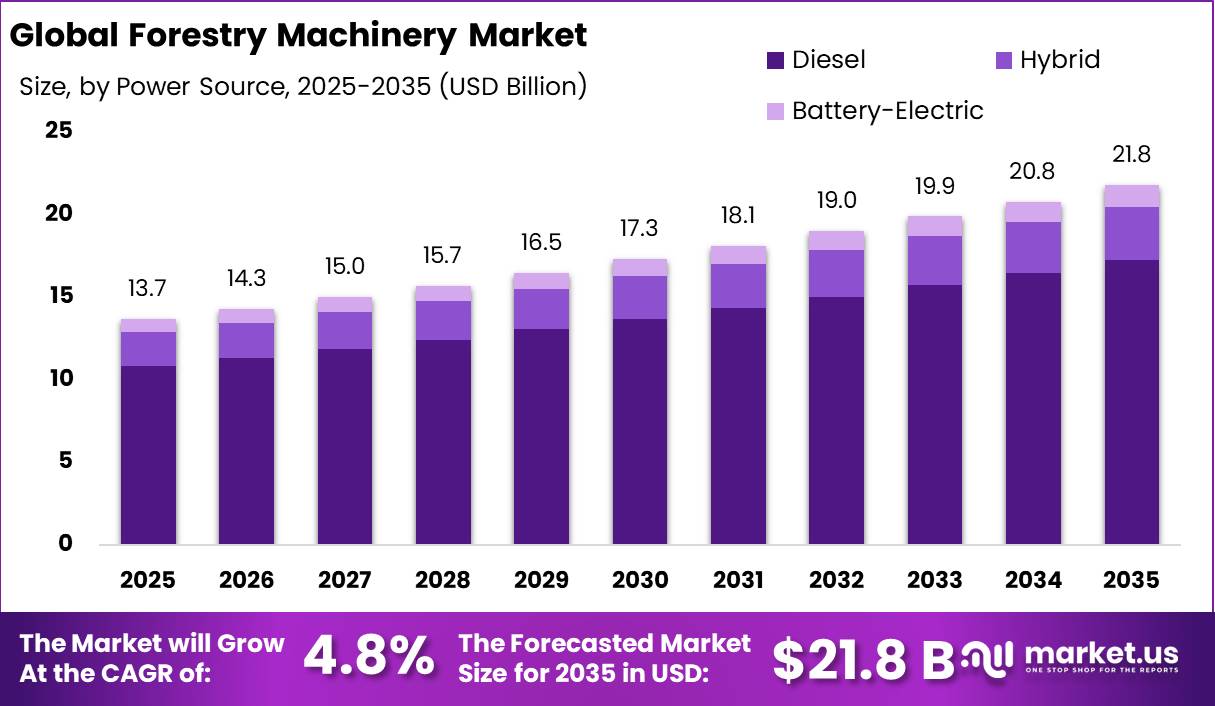
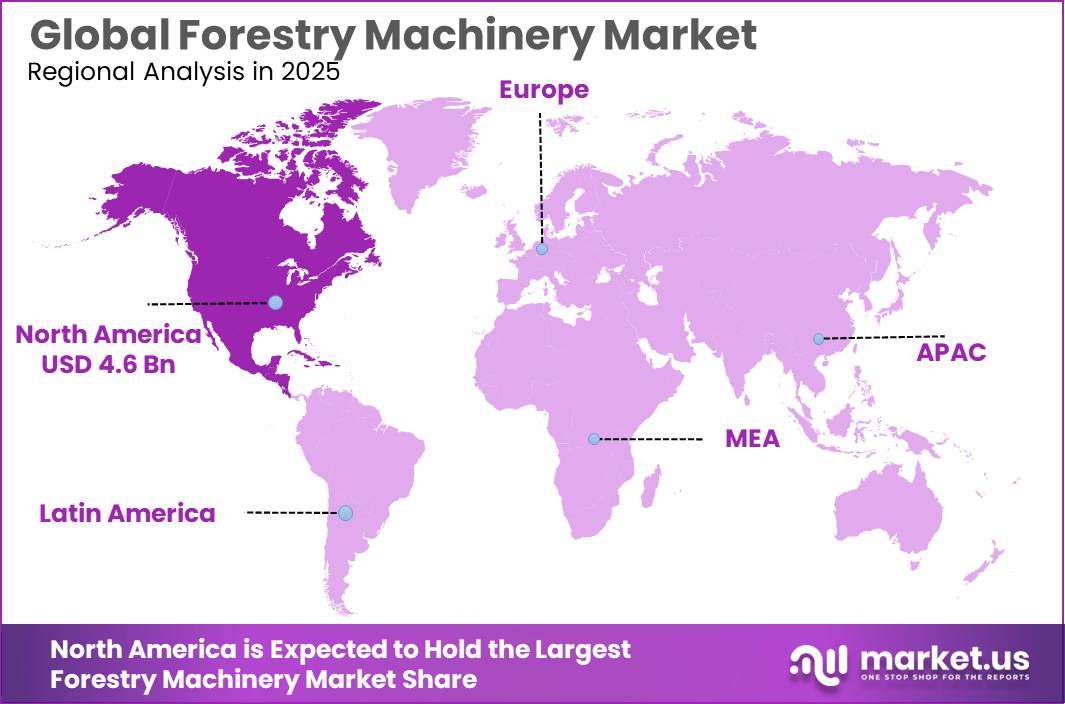
The Global Forestry Machinery Market size is expected to be worth around USD 21.8 Billion by 2035, from USD 13.7 Billion in 2025, growing at a CAGR of 4.8% during the forecast period from 2026 to 2035. In 2025, North America held a dominant market position, capturing more than a 34.1% share, holding USD 4.6 Billion revenue.
The forestry machinery industry covers harvesters, forwarders, skidders, feller bunchers, loaders, mulchers, and related digital systems used in timber harvesting, thinning, reforestation, road clearing, and biomass handling. Industrial demand is supported by the scale of the forest resource base: FAO reported that forests covered about 4.1 billion hectares, or 31% of global land area, in 2020, while the 2025 Global Forest Resources Assessment notes that deforestation is still occurring at nearly 11 million hectares per year.
Key Takeaways
- Forestry Machinery Market size is expected to be worth around USD 21.8 Billion by 2035, from USD 13.7 Billion in 2025, growing at a CAGR of 4.8%.
- Harvesters held a dominant market position, capturing more than a 37.8% share of the forestry machinery market.
- Diesel held a dominant market position, capturing more than a 79.2% share of the forestry machinery market.
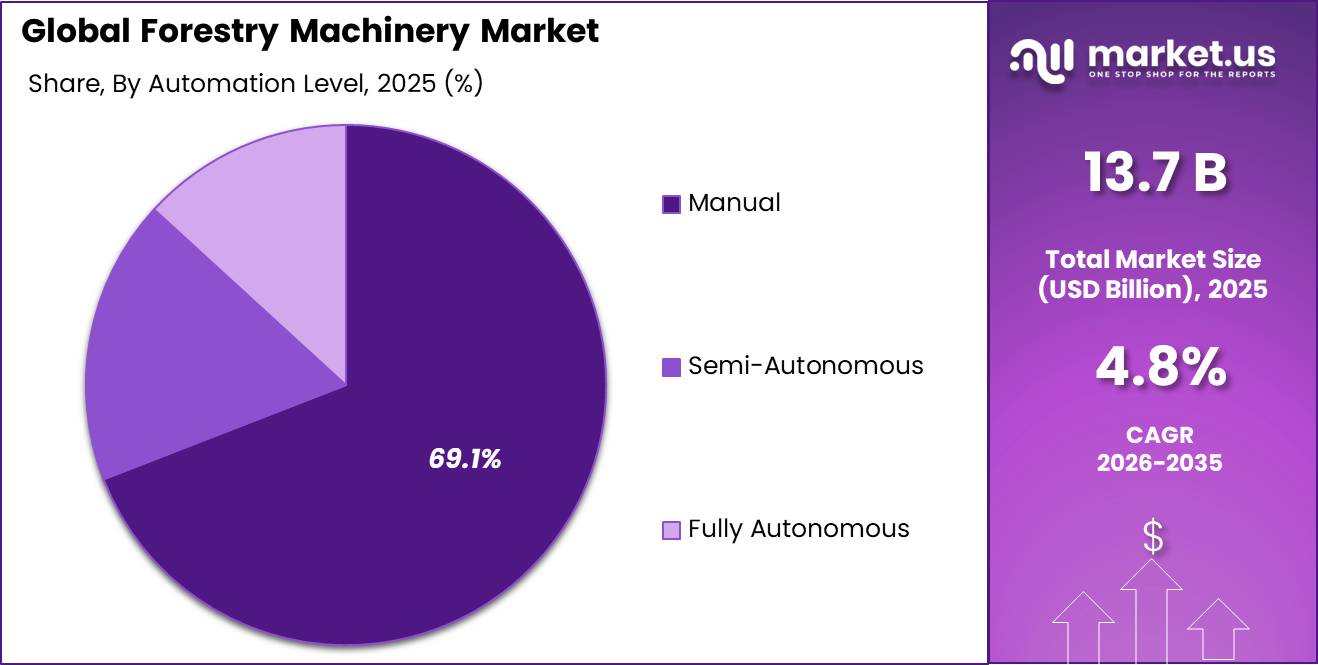
- Manual held a dominant market position, capturing more than a 69.1% share of the forestry machinery market.
- Contract Logging Firms held a dominant market position, capturing more than a 44.9% share of the forestry machinery market.
- North America emerged as the leading regional market in the forestry machinery industry, accounting for 34.1% of the global market and reaching a value of USD 4.6 billion.
The industrial scenario is increasingly shaped by productivity, labor shortages, safety, and digital fleet management. FAO noted that forests covered about 4.1 billion hectares in 2020, while more than 54% of global forests were concentrated in five countries, indicating strong equipment opportunities in large forest economies such as Russia, Brazil, Canada, the U.S., and China.
In Europe, the EU had about 160 million hectares of forests in 2020, and the EU Forest Strategy for 2030 supports forest protection, restoration, and sustainable management, indirectly strengthening demand for low-impact and precision forestry equipment.
Driving factors include timber demand, restoration programs, climate adaptation, and forest-fire recovery work. The UN Decade on Ecosystem Restoration aims to prevent, halt, and reverse ecosystem degradation during 2021–2030, while UNEP stated that restoring 350 million hectares of degraded land by 2030 could generate USD 9 trillion in ecosystem services and remove 13–26 gigatons of greenhouse gases. These initiatives indirectly support demand for site preparation, thinning, clearing, mulching, and replanting machinery.
Deere & Company remains a major participant through its construction and forestry platform. In fiscal 2025, Deere reported net income of USD 5.027 billion, compared with USD 7.100 billion in fiscal 2024, showing cyclical pressure but continued industrial scale. Its Construction & Forestry business faced lower volumes and pricing pressure in 2025, yet the segment remains strategically relevant because Deere identifies itself as a global producer of agricultural, construction, and forestry equipment.
By Machine Type Analysis
Harvesters dominate with 37.8% share, driven by growing demand for efficient and large-scale timber harvesting operations.
In 2025, Harvesters held a dominant market position, capturing more than a 37.8% share of the forestry machinery market by machine type. Their strong position was supported by the increasing need for faster and more efficient timber harvesting across commercial forestry operations. Harvesters are designed to perform multiple tasks, including cutting, delimbing, and processing trees, which helps reduce manual labor requirements and improve overall productivity. Forestry companies continued to prefer these machines because they can handle large volumes of timber while maintaining operational efficiency and reducing harvesting time.
By Power Source Analysis
Diesel dominates with 79.2% share, supported by its high power output and suitability for demanding forestry operations.
In 2025, Diesel held a dominant market position, capturing more than a 79.2% share of the forestry machinery market by power source. Its leading position was largely driven by the ability of diesel-powered equipment to deliver the high torque and reliable performance required for heavy-duty forestry activities. Machines used for logging, harvesting, forwarding, and land clearing often operate in remote forest locations where dependable power and long operating hours are essential, making diesel the preferred choice for operators.
By Automation Level Analysis
Manual forestry machinery dominates with 69.1% share, favored for its practicality, lower cost, and ease of operation across diverse forestry tasks.
In 2025, Manual held a dominant market position, capturing more than a 69.1% share of the forestry machinery market by automation level. The strong presence of manual machinery was mainly supported by its widespread use in small and medium-scale forestry operations, where affordability and operational simplicity remain key considerations. Many forestry contractors and landowners continued to rely on manually operated equipment because it requires lower initial investment and can be used effectively without advanced technical training.
By End User Analysis
Contract Logging Firms lead with 44.9% share, driven by their extensive use of forestry equipment for large-scale timber harvesting projects.
In 2025, Contract Logging Firms held a dominant market position, capturing more than a 44.9% share of the forestry machinery market by end user. Their leading position was supported by the growing demand for professional logging services across commercial forestry operations. These firms are responsible for carrying out harvesting, transportation, and site preparation activities on behalf of forest owners and timber companies, which creates a consistent need for a wide range of forestry machinery.
Key Market Segments
By Machine Type
- Skidders
- Forwarders
- Feller Bunchers
- Harvesters
- Swing Machines
- Loaders
- Others
By Power Source
- Diesel
- Hybrid
- Battery-Electric
By Automation Level
- Manual
- Semi-Autonomous
- Fully Autonomous
By End User
- Contract Logging Firms
- Forest Ownership Groups
- Pulp and Paper Companies
- Sawmills
Emerging Trends
Precision Forestry and Smart Technologies Are Becoming the New Industry Standard
One of the most important trends shaping the forestry machinery market is the growing use of precision forestry technologies. Forestry companies are increasingly adopting advanced equipment integrated with GPS, LiDAR, artificial intelligence, remote sensing, and real-time monitoring systems. These technologies help operators collect accurate forest data, improve harvesting efficiency, and reduce unnecessary damage to surrounding vegetation.
- According to the Food and Agriculture Organization (FAO), around 10 million hectares of forest are lost globally every year due to deforestation, creating a stronger need for better monitoring and sustainable forest management systems.
To address this challenge, governments and forestry agencies are investing in digital forest monitoring platforms and smart equipment that can improve decision-making in the field. Modern harvesters and forestry machines are now being equipped with sensors and mapping systems that allow operators to work with greater precision while improving productivity.
Artificial Intelligence and Automated Forest Management Are Gaining Momentum
Another major trend is the increasing use of artificial intelligence and automation in forest management activities. Forestry organizations are now using AI-powered tools to monitor forest health, identify illegal logging activities, predict wildfire risks, and improve resource planning. According to FAO forestry experts, many developing countries have moved from paper-based forest data collection to digital monitoring systems over the last decade, creating a foundation for large-scale AI adoption in forestry operations.
In addition, international restoration efforts targeting nearly 1 billion hectares of degraded land by 2030 are encouraging the use of intelligent machinery capable of supporting large-scale forest management projects. As governments continue promoting sustainable forestry practices and digital transformation, automated forestry equipment and AI-based monitoring systems are expected to become increasingly common across both public and private forestry operations.
Drivers
Rising Global Demand for Timber and Wood Products is Driving Forestry Machinery Adoption
One of the major factors supporting the growth of the forestry machinery market is the steady increase in global demand for timber, wood products, and forest-based materials. As construction, furniture manufacturing, paper production, and packaging industries continue to expand, the need for efficient forest harvesting operations has also increased.
- According to the Food and Agriculture Organization (FAO), global wood production has reached around 4 billion cubic meters per year, reflecting the large volume of forest resources required by industries worldwide.
In addition, FAO reported that global industrial roundwood removals totaled about 1.92 billion cubic meters in 2023, showing the significant scale of commercial forestry activities. To meet this growing demand while maintaining productivity, forestry companies are increasingly investing in advanced harvesters, forwarders, skidders, and other mechanized equipment that can improve harvesting speed and operational efficiency. These machines help reduce labor dependency and support large-scale timber extraction in a cost-effective manner.
Government Focus on Sustainable Forest Management Supports Equipment Demand
Government-led forest management programs and sustainability initiatives are also contributing to the demand for forestry machinery. According to FAO’s Global Forest Resources Assessment, forests cover approximately 4.06 billion hectares globally, representing about 31% of the world’s total land area. Managing such a vast forest area requires modern equipment that can support controlled harvesting, land maintenance, reforestation activities, and wildfire prevention efforts.
Governments are also investing in afforestation and forest restoration programs to protect biodiversity and strengthen climate resilience. As forestry departments and private operators work toward sustainable resource utilization, the adoption of advanced forestry machinery continues to grow. Equipment with improved fuel efficiency, better terrain handling, and enhanced monitoring systems is becoming increasingly important in supporting responsible forest management across both developed and emerging forestry regions.
Restraints
High Equipment Costs and Limited Access to Financing Restrict Machinery Adoption
One of the major factors limiting the growth of the forestry machinery market is the high cost associated with purchasing and maintaining advanced equipment. Modern forestry machines such as harvesters, forwarders, and skidders require substantial upfront investment, making them difficult to afford for small-scale forestry operators and independent contractors. In many forest-rich regions, forestry activities are carried out by small businesses that often face budget constraints and limited access to long-term financing.
According to the Food and Agriculture Organization (FAO), more than 90% of the world’s forests are either publicly owned or managed under government frameworks, leaving many private operators dependent on contracts and seasonal income. This can make large machinery investments financially challenging. In addition to acquisition costs, operators must also manage expenses related to fuel, maintenance, spare parts, and skilled labor. As a result, many forestry businesses continue to rely on older equipment or manual methods, slowing the adoption of advanced forestry machinery despite the operational benefits these machines provide.
Stricter Forest Protection Policies Reduce Large-Scale Harvesting Activities
Environmental regulations and sustainable forest management policies have become increasingly important across the world, creating another challenge for the forestry machinery market. Governments are implementing stricter controls on logging activities to protect biodiversity, reduce deforestation, and support climate goals. According to FAO’s Global Forest Resources Assessment, the world lost around 178 million hectares of forest between 1990 and 2020, prompting stronger conservation measures in many countries.
These regulations often limit harvesting volumes, restrict access to protected forest areas, and require extensive environmental assessments before logging operations can begin. While these initiatives are essential for long-term forest conservation, they can reduce the frequency and scale of commercial harvesting projects, directly affecting demand for forestry machinery. In some regions, operators must also comply with certification standards and sustainable harvesting practices, which can increase operating complexity and project costs.
Opportunity
Large-Scale Forest Restoration Programs Create New Opportunities for Forestry Machinery
One of the biggest growth opportunities for the forestry machinery market comes from the rising number of forest restoration and reforestation projects taking place around the world. Governments, environmental organizations, and international agencies are investing heavily in restoring degraded forest land to improve biodiversity, reduce carbon emissions, and strengthen climate resilience.
- According to the United Nations Environment Programme (UNEP) and the Food and Agriculture Organization (FAO), global restoration initiatives aim to restore 350 million hectares of degraded land by 2030.
This massive land restoration effort requires large-scale site preparation, land clearing, tree planting, and forest management activities, all of which depend on efficient forestry equipment. As restoration programs expand across Asia, Africa, Europe, and Latin America, demand for machinery such as mulchers, harvesters, forwarders, and site-preparation equipment is expected to increase steadily. The growing focus on sustainable forest development is creating long-term opportunities for machinery manufacturers that can provide reliable and environmentally responsible solutions for restoration projects.
Government-Led Forest Management and Carbon Reduction Goals Support Market Expansion
Another important opportunity comes from government programs focused on increasing forest cover and improving carbon absorption capacity. According to FAO assessments, global forests cover about 4.06 billion hectares, representing nearly 31% of the world’s total land area. Many countries are now introducing long-term forest conservation and afforestation strategies to protect these resources while meeting climate commitments.
These activities require modern forestry machinery capable of improving productivity while reducing environmental impact. The FAO and UN restoration initiatives have also highlighted efforts aimed at restoring over one billion hectares of ecosystems worldwide through long-term environmental programs. As forest management becomes more structured and technology-driven, forestry operators are increasingly investing in advanced equipment to support large-scale restoration, monitoring, and maintenance activities.
Regional Insights
North America Dominates the Forestry Machinery Market with 34.1% Share Valued at USD 4.6 Billion
North America emerged as the leading regional market in the forestry machinery industry, accounting for 34.1% of the global market and reaching a value of USD 4.6 billion. The region’s strong position is supported by its vast forest resources, highly mechanized logging operations, and well-established timber and wood processing industries. The United States and Canada continue to be major contributors to regional demand, driven by extensive commercial forestry activities and continuous investments in advanced harvesting equipment.
According to the Food and Agriculture Organization (FAO), North America possesses more than 750 million hectares of forest land, making it one of the largest forest-rich regions globally. This extensive forest coverage creates a consistent need for machinery used in harvesting, transportation, land clearing, and forest management operations.
The region also benefits from a high adoption rate of advanced forestry technologies, including GPS-guided harvesters, automated forwarding systems, and precision forestry equipment designed to improve productivity while reducing environmental impact. Government agencies and forest management organizations across North America continue to support sustainable forestry practices through conservation programs, reforestation initiatives, and responsible harvesting regulations.
Key Regions and Countries Insights
- North America
- US
- Canada
- Europe
- Germany
- France
- The UK
- Spain
- Italy
- Rest of Europe
- Asia Pacific
- China
- Japan
- South Korea
- India
- Australia
- Rest of APAC
- Latin America
- Brazil
- Mexico
- Rest of Latin America
- Middle East & Africa
- GCC
- South Africa
- Rest of MEA
Key Players Analysis
Deere & Company remains one of the largest global manufacturers of forestry, construction, and agricultural equipment, supported by advanced harvesting systems, skidders, feller bunchers, and digital fleet technologies. In fiscal 2025, the company reported worldwide net sales and revenues of US$45.684 billion, while net income reached US$5.027 billion. Deere continues to strengthen its precision forestry strategy through machine connectivity, automation, and data-driven operations.
Komatsu Ltd. is a leading supplier of forestry and heavy equipment, offering harvesters, forwarders, and mechanized logging solutions through its global distribution network. For the fiscal year ended March 2025, consolidated net sales totaled JPY 4,104.4 billion, representing a 6.2% increase, while operating income reached JPY 657.1 billion, up 8.2% year over year. The company is expanding smart forestry initiatives through digital monitoring, automation technologies, and low-emission machinery.
Caterpillar Inc. maintains a significant presence in the forestry machinery industry through its purpose-built forestry excavators, wheel skidders, track feller bunchers, and logging support equipment. The company operates in more than 190 countries through an extensive dealer network and focuses heavily on machine durability, fuel efficiency, and connected equipment services. Forestry operations increasingly utilize Caterpillar’s telematics platform to improve fleet utilization and maintenance planning.
Top Key Players Outlook
- Deere & Company
- Komatsu Ltd.
- Caterpillar Inc.
- Tigercat International Inc.
- Ponsse Plc
- Hitachi Ltd.
- Kubota Corporation
- Barko Hydraulics LLC
- Rottne Industri AB
- Kawasaki Heavy Industries, Ltd.
- Doosan Bobcat Inc.
Recent Industry Developments
For new product development in 2025/2026, Rottne introduced the Rottne H13F harvester, built for both thinning and final felling, with 18,600 kg–20,600 kg service weight, 164 kW / 220 hp engine output, 357 litres/min pump capacity, 200 kN tractive force, 10.3 m or 11.3 m crane reach, and up to 6 harvesting-head options. Its Rottne Connect telematics system is also fitted on all new machines, helping owners track machine data and reduce downtime.
For partnerships and agreements, Hitachi Construction Machinery continued working with dealers and regional partners, and its 2026 collaboration with ITOCHU highlighted finance-led equipment sales support in North America. For investment and expansion, FY2025 capital expenditure was forecast at ¥48.4 billion, while R&D expenses were forecast at ¥36.6 billion, supporting automation, electrification and connected machinery.
Report Scope
| Report Features | Description |
|---|---|
| Market Value (2025) | USD 13.7 Bn |
| Forecast Revenue (2035) | USD 21.8 Bn |
| CAGR (2026-2035) | 4.8% |
| Base Year for Estimation | 2025 |
| Historic Period | 2020-2024 |
| Forecast Period | 2026-2035 |
| Report Coverage | Revenue Forecast, Market Dynamics, Competitive Landscape, Recent Developments |
| Segments Covered | By Machine Type (Skidders, Forwarders, Feller Bunchers, Harvesters, Swing Machines, Loaders, Others), By Power Source (Diesel, Hybrid, Battery-Electric), By Automation Level (Manual, Semi-Autonomous, Fully Autonomous), By End User (Contract Logging Firms, Forest Ownership Groups, Pulp and Paper Companies, Sawmills) |
| Regional Analysis | North America – US, Canada; Europe – Germany, France, The UK, Spain, Italy, Rest of Europe; Asia Pacific – China, Japan, South Korea, India, Australia, Singapore, Rest of APAC; Latin America – Brazil, Mexico, Rest of Latin America; Middle East & Africa – GCC, South Africa, Rest of MEA |
| Competitive Landscape | Deere & Company, Komatsu Ltd., Caterpillar Inc., Tigercat International Inc., Ponsse Plc, Hitachi Ltd., Kubota Corporation, Barko Hydraulics LLC, Rottne Industri AB, Kawasaki Heavy Industries, Ltd., Doosan Bobcat Inc. |
| Customization Scope | Customization for segments, region/country-level will be provided. Moreover, additional customization can be done based on the requirements. |
| Purchase Options | We have three licenses to opt for: Single User License, Multi-User License (Up to 5 Users), Corporate Use License (Unlimited User and Printable PDF) |





































