


Report Overview
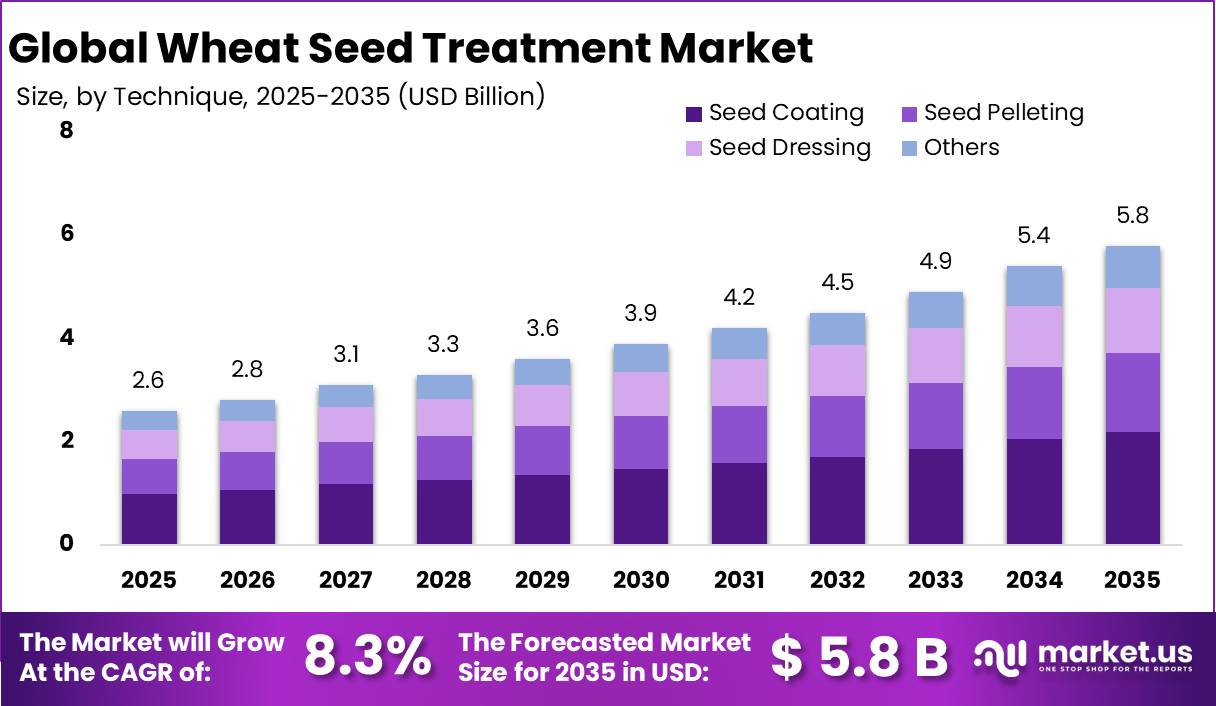
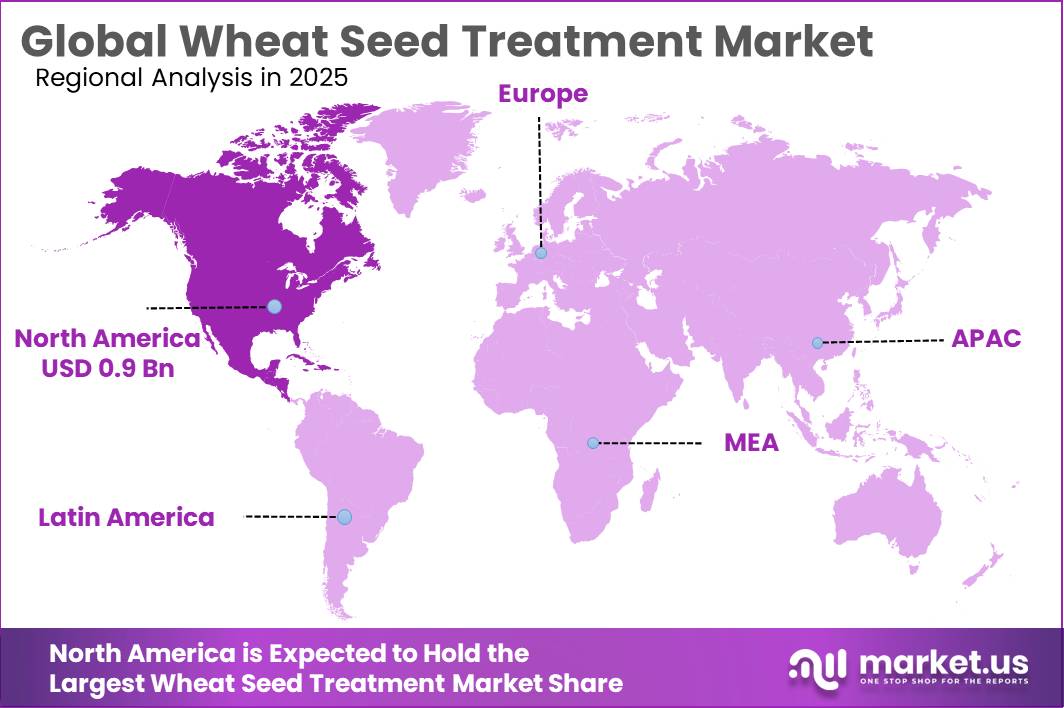
The Global Wheat Seed Treatment Market size is expected to be worth around USD 5.8 Billion by 2035, from USD 2.6 Billion in 2025, growing at a CAGR of 8.3% during the forecast period from 2026 to 2035. In 2025, North America held a dominant market position, capturing more than a 37.9% share, holding USD 0.9 Billion revenue.
Wheat seed treatment is positioned as a critical input within global cereal protection because wheat remains one of the world’s largest food crops, with USDA placing 2024/25 global wheat production at 799.31 million metric tons and a 10-year average of 778.55 million metric tons. Industrially, the segment is driven by fungicide, insecticide, biological and abiotic-stress seed-applied solutions that protect wheat at germination and early establishment stages, where soil-borne and seed-borne diseases can reduce plant population and yield quality.
Key Takeaways
- Wheat Seed Treatment Market size is expected to be worth around USD 5.8 Billion by 2035, from USD 2.6 Billion in 2025, growing at a CAGR of 8.3%.
- Seed Coating held a dominant market position, capturing more than a 37.8% share in the Wheat Seed Treatment Market.
- Seed Protection held a dominant market position, capturing more than a 72.7% share in the Wheat Seed Treatment Market.
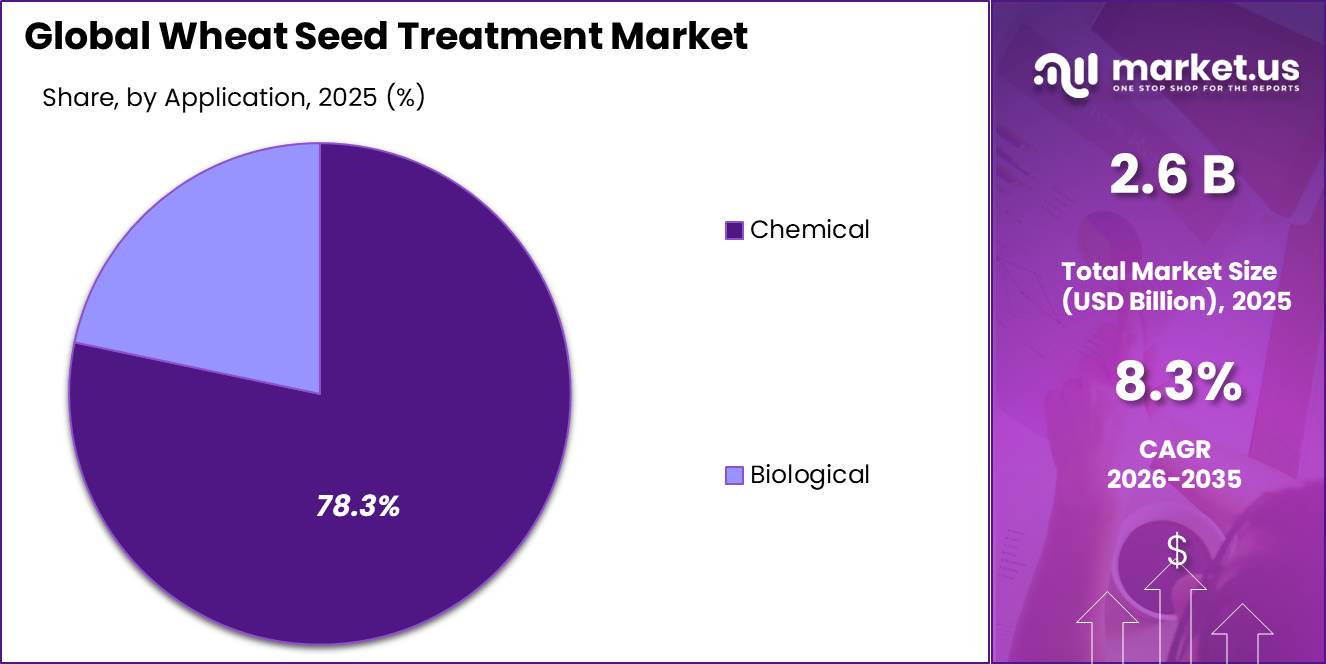
- Chemical held a dominant market position, capturing more than a 78.3% share in the Wheat Seed Treatment Market.
- North America held a dominant position in the Wheat Seed Treatment Market, accounting for 37.9% of the global market and reaching a value of USD 0.9 Billion.
The industrial scenario is supported by rising food-security pressure and expanding cereal output requirements. USDA’s December 2025 outlook forecast global wheat production at a record 837.8 million metric tons for 2025/26, while OECD-FAO projects wheat production to rise by 74 million tons to 874 million tons by 2034. This creates a steady base for seed treatment demand, especially in major wheat-producing regions outside India where growers are seeking better stand establishment, uniform germination and disease protection with lower field-level pesticide load.
Key demand drivers include disease-loss reduction, climate stress, resistance management, and higher-quality seed systems. A 2025 disease-loss assessment for the U.S. and Canada estimated wheat disease losses at 205.0 million bushels, worth about US$531.2 million, with disease reducing harvested wheat by 5.2% in surveyed U.S. states and 7.0% in Canadian provinces. Separately, global wheat fungal-disease risk studies indicate nearly 90% of wheat area is exposed to at least one major fungal disease, with recurring losses above 62 million tonnes annually.
Government and trusted institutional initiatives are shaping future adoption. The EU Farm-to-Fork pesticide agenda set a 50% reduction target by 2030 for chemical pesticide risk and more hazardous pesticide use, encouraging precision inputs and biological alternatives. In the U.S., EPA continues technical assessment of occupational exposure in seed-treatment operations, reflecting tighter scrutiny around treated seed handling and stewardship.
Syngenta Group remains highly relevant through its Seedcare and biologicals direction. In 2025, Syngenta reported Crop Protection sales of US$9.8 billion for the first 9 months of 2025, up 3%, while group sales reached US$20.9 billion.
By Technique Analysis
Seed Coating dominates with 37.8% due to its ability to improve seed protection and support uniform crop establishment.
In 2025, Seed Coating held a dominant market position, capturing more than a 37.8% share in the Wheat Seed Treatment Market by technique of seed coating. The strong position of this segment was supported by the increasing use of coated wheat seeds to improve early-stage crop performance and provide consistent protection during germination. Seed coating has become a widely adopted technique because it allows treatment materials to be applied directly and evenly on the seed surface without affecting seed handling or planting efficiency.
By Function Analysis
Seed Protection dominates with 72.7% as growers continue to prioritize early-stage crop defense and stronger seed performance.
In 2025, Seed Protection held a dominant market position, capturing more than a 72.7% share in the Wheat Seed Treatment Market by function of seed protection. The strong market presence of this segment was mainly driven by the increasing focus on protecting wheat seeds from diseases, fungal infections, and pest attacks during the initial stages of crop growth. Farmers continued to adopt seed protection solutions as an effective way to improve seed survival rates and support healthy crop establishment.
By Application Analysis
Chemical dominates with 78.3% as farmers continue to rely on proven seed treatment solutions for dependable crop protection.
In 2025, Chemical held a dominant market position, capturing more than a 78.3% share in the Wheat Seed Treatment Market by application. The segment maintained its leading position due to the continued use of chemical seed treatment solutions to protect wheat seeds against early-stage diseases, pests, and environmental stress. Farmers widely preferred chemical applications because they offer a practical and efficient way to safeguard seed quality before planting and support consistent crop establishment.
Key Market Segments
By Technique
- Seed Coating
- Seed Pelleting
- Seed Dressing
- Others
By Function
- Seed Protection
- Seed Enhancement
- Others
By Application
- Chemical
- Biological
Emerging Trends
Growing Shift Toward Biological and Precision Seed Treatment Technologies
One of the latest trends shaping the Wheat Seed Treatment Market is the movement toward biological seed treatments and precision-based application methods. Farmers are increasingly looking for solutions that protect wheat seeds while supporting sustainable farming practices and reducing unnecessary input use. Instead of relying only on conventional treatment methods, there is growing interest in combining biological ingredients, targeted application, and improved seed technologies.
Government-Led Sustainable Agriculture Programs are Encouraging Smarter Seed Use
Another noticeable trend in the Wheat Seed Treatment Market is stronger government support for sustainable agriculture and efficient resource management. Public agricultural programs are increasingly encouraging better seed quality, controlled input application, and improved crop resilience. These initiatives are helping create favorable conditions for advanced seed treatment practices.
- According to FAO and OECD agricultural outlook estimates, global cereal production is expected to continue expanding and may reach around 3.2 billion tonnes by 2034, while wheat production alone is projected to increase to approximately 874 million tonnes. Much of this future growth is expected to come through yield improvement rather than large increases in cultivated land.
Drivers
Rising Global Wheat Demand is Increasing the Need for Better Seed Protection
One of the major driving factors for the Wheat Seed Treatment Market is the continued rise in global wheat production and the growing pressure on farmers to secure crop output from the very beginning of the planting cycle. As wheat remains one of the most important staple crops worldwide, growers are focusing more on protecting seeds before sowing to improve crop establishment and reduce avoidable losses.
- According to the Food and Agriculture Organization (FAO), global wheat production was projected to reach around 796 million tonnes in 2025, showing continued demand for stable and efficient wheat cultivation systems. At the same time, India recorded wheat production of 117.9 million tonnes in 2025, reaching a record level supported by strong planting activity and improved yields.
Growing Focus on Reducing Crop Losses is Supporting Seed Treatment Adoption
Another important factor supporting the Wheat Seed Treatment Market is the increasing effort to reduce crop losses caused by diseases and biological stress. Farmers are shifting attention toward preventive approaches because losses during early crop development directly affect yield and profitability. Seed treatment is being used as an early protection method that supports stronger plant establishment before visible damage occurs.
Data referenced by agricultural industry sources using FAO estimates shows that nearly 20–40% of global crop yields are affected annually by seed-borne and soil-borne pests and diseases. This level of loss has encouraged wider use of preventive seed treatment practices instead of depending only on later-stage crop protection measures. In wheat farming, protecting the seed before planting can improve field uniformity and lower production risk. As weather variability and input costs continue to influence farm decisions, seed treatment remains an increasingly valuable tool for improving output reliability and supporting long-term productivity.
Restraints
Increasing Regulatory Pressure on Chemical Seed Treatments is Limiting Market Expansion
One of the major restraining factors for the Wheat Seed Treatment Market is the growing regulatory scrutiny around chemical-based seed treatment products. Governments and agricultural authorities are placing stricter controls on pesticide use due to concerns related to environmental impact, soil health, biodiversity, and safe food production. Since a large portion of wheat seed treatment still depends on chemical formulations, changing regulations are creating additional compliance requirements and slowing adoption in some regions.
According to the Food and Agriculture Organization (FAO), pesticide risk reduction has become a global priority, with countries adopting stronger lifecycle management rules covering product registration, usage, handling, and environmental safety. Regulatory frameworks are encouraging lower-risk alternatives and more controlled application practices. This creates added costs for manufacturers and increases the time required to introduce or expand seed treatment products. For wheat growers, especially smaller farming operations, compliance costs and changing product approvals can create uncertainty in treatment selection and usage decisions.
Rising Sustainability Targets and Reduced Dependency on Conventional Pesticides
Another challenge affecting the Wheat Seed Treatment Market is the increasing global focus on reducing dependence on agricultural chemicals. Governments and international organizations are encouraging farming systems that balance productivity with environmental protection, which is influencing purchasing and application decisions across seed treatment practices.
Recent government-backed policy actions highlight this shift. Under the global biodiversity framework adopted in 2022, countries agreed to work toward reducing overall risk from pesticides and highly hazardous chemicals by at least 50% by 2030. In parallel, national action plans are promoting integrated pest management and alternative crop protection methods. The UK government also reported that while global pesticide use increased by around 90% between 1990 and 2020, the UK achieved a near 60% decrease over the same period through changing practices and policy measures.
Opportunity
Expansion of Sustainable and Biological Seed Treatment Solutions Creates New Growth Potential
One of the major growth opportunities for the Wheat Seed Treatment Market is the increasing shift toward sustainable agriculture and biological seed treatment solutions. Farmers and governments are paying more attention to crop protection methods that improve productivity while reducing environmental pressure. This transition is opening new opportunities for seed treatment technologies that combine protection, better germination, and lower chemical dependency.
- According to the Food and Agriculture Organization (FAO), global cereal production reached approximately 2.85 billion tonnes in 2025, reflecting continued pressure on agricultural systems to maintain reliable output. Wheat remains one of the most important food crops supporting global food security.
Government Support for Quality Seeds and Higher Farm Productivity is Creating Long-Term Opportunity
Another important opportunity for the Wheat Seed Treatment Market comes from government initiatives that promote certified seeds and better agricultural productivity. Many countries are investing in programs that encourage the use of improved seed technologies to strengthen food security and support farmer incomes.
According to the Government of India, food grain production reached a record 353.96 million tonnes during 2024–25, supported by policy measures focused on seed quality, improved farming practices, and technology adoption. Wheat remained one of the key contributors to this growth. Public initiatives promoting quality seed distribution and efficient input use are creating favorable conditions for seed treatment adoption. Since treated seeds help improve early crop establishment and reduce avoidable losses, they fit well into long-term productivity goals.
Regional Insights
North America dominates the Wheat Seed Treatment Market with a 37.9% share, valued at USD 0.9 Billion
In 2025, North America held a dominant position in the Wheat Seed Treatment Market, accounting for 37.9% of the global market and reaching a value of USD 0.9 Billion. The region maintained its leadership due to the strong presence of commercial wheat farming, widespread adoption of advanced seed technologies, and higher awareness regarding crop protection practices. Farmers across the region continue to prioritize seed treatment as an effective way to improve crop establishment, manage disease pressure, and support stable wheat yields.
The United States remained the major contributor within North America because of its large-scale wheat cultivation and higher adoption of treated and certified seeds. According to agricultural statistics published by government and international agricultural sources, the U.S. continues to rank among the leading wheat-producing countries globally, with millions of hectares dedicated to wheat cultivation annually. The use of seed treatment has become a standard pre-sowing practice in many commercial farming operations as growers focus on reducing early-stage crop losses and improving productivity.
Key Regions and Countries Insights
- North America
- US
- Canada
- Europe
- Germany
- France
- The UK
- Spain
- Italy
- Rest of Europe
- Asia Pacific
- China
- Japan
- South Korea
- India
- Australia
- Rest of APAC
- Latin America
- Brazil
- Mexico
- Rest of Latin America
- Middle East & Africa
- GCC
- South Africa
- Rest of MEA
Key Players Analysis
UPL Limited continues to maintain a strong position in the wheat seed treatment market through its broad agricultural solutions portfolio and global distribution network. The company operates in more than 130 countries and serves growers across multiple crop categories. UPL invests consistently in seed treatment technologies designed to support crop protection and seed performance. The company reported annual revenue above USD 5 billion in recent financial reporting periods and continues to strengthen its agricultural input portfolio through product expansion and operational scale across key farming markets.
Syngenta Group remains one of the major participants in the wheat seed treatment market with strong capabilities in crop protection and seed technologies. The company has operations across more than 100 countries and supports millions of hectares of agricultural land globally. Syngenta reported annual sales exceeding USD 30 billion across its integrated agriculture businesses.
Bayer AG holds an important position in agricultural inputs through its crop science division, including seed treatment offerings for cereals and wheat cultivation. The company operates in over 80 countries and invests several billion dollars annually in research and development activities. Bayer generated annual revenue exceeding EUR 47 billion across business operations and continues to expand advanced seed technologies.
Top Key Players Outlook
- UPL Limited
- Syngenta Group
- Bayer AG
- BASF SE
- Corteva Agriscience
- Verdesian Life Sciences
- FMC Corporation
- Nufarm Ltd
- CERTIS BELCHIM
- Crystal Crop Protection Ltd.
Recent Industry Developments
In 2025, UPL Limited revenue of ₹466.4 Bn, up 8%, with growth supported by crop protection, seeds, and specialty chemicals, while EBITDA rose 47% to ₹81.2 Bn. In Partnership & Agreement, UPL’s earlier University of Arkansas agreement for Fenclorim-based seed treatment technology remained important for future product development. In Investment & Expansion, UPL continued capacity expansion in Brazil, where it holds about 10% market share and invests nearly USD 100 Mn yearly. No major 2025 wheat-specific merger or acquisition was publicly confirmed.
In 2025, Corteva Agriscience net sales of USD 17.4 Billion and operating EBITDA of USD 3.85 Billion, showing a strong global agriculture base. In New Product Development, Corteva’s seed treatment work continued under platforms such as LumiGEN, while its earlier Lumivia CPL seed treatment label expansion supported wheat, barley, lentil, and pulse growers. In Partnership & Agreement, Corteva announced a multi-million-dollar joint venture with Hexagon Bio in 2025 to develop nature-inspired crop protection tools.
Report Scope
| Report Features | Description |
|---|---|
| Market Value (2025) | USD 2.6 Bn |
| Forecast Revenue (2035) | USD 5.8 Bn |
| CAGR (2026-2035) | 8.3% |
| Base Year for Estimation | 2025 |
| Historic Period | 2020-2024 |
| Forecast Period | 2026-2035 |
| Report Coverage | Revenue Forecast, Market Dynamics, Competitive Landscape, Recent Developments |
| Segments Covered | By Technique (Seed Coating, Seed Pelleting, Seed Dressing, Others), By Function (Seed Protection, Seed Enhancement, Others), By Application (Chemical, Biological) |
| Regional Analysis | North America – US, Canada; Europe – Germany, France, The UK, Spain, Italy, Rest of Europe; Asia Pacific – China, Japan, South Korea, India, Australia, Singapore, Rest of APAC; Latin America – Brazil, Mexico, Rest of Latin America; Middle East & Africa – GCC, South Africa, Rest of MEA |
| Competitive Landscape | UPL Limited, Syngenta Group, Bayer AG, BASF SE, Corteva Agriscience, Verdesian Life Sciences, FMC Corporation, Nufarm Ltd, CERTIS BELCHIM, Crystal Crop Protection Ltd. |
| Customization Scope | Customization for segments, region/country-level will be provided. Moreover, additional customization can be done based on the requirements. |
| Purchase Options | We have three licenses to opt for: Single User License, Multi-User License (Up to 5 Users), Corporate Use License (Unlimited User and Printable PDF) |





































