


Report Overview
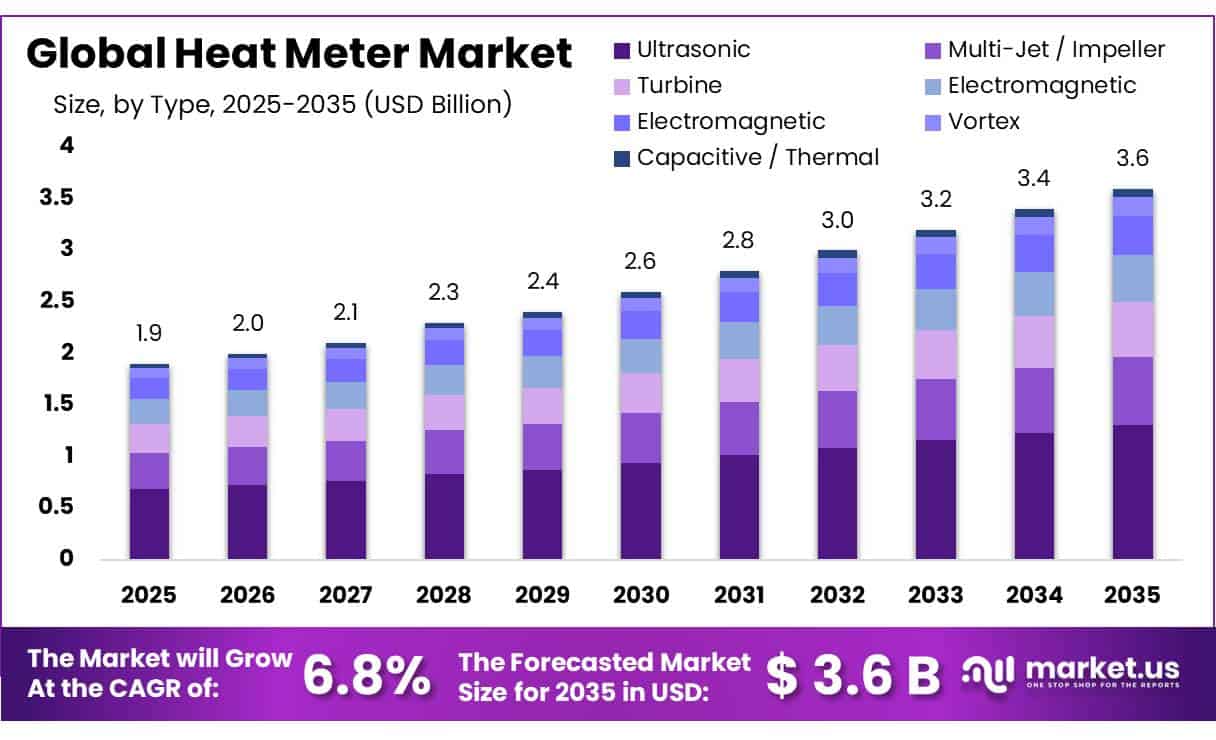
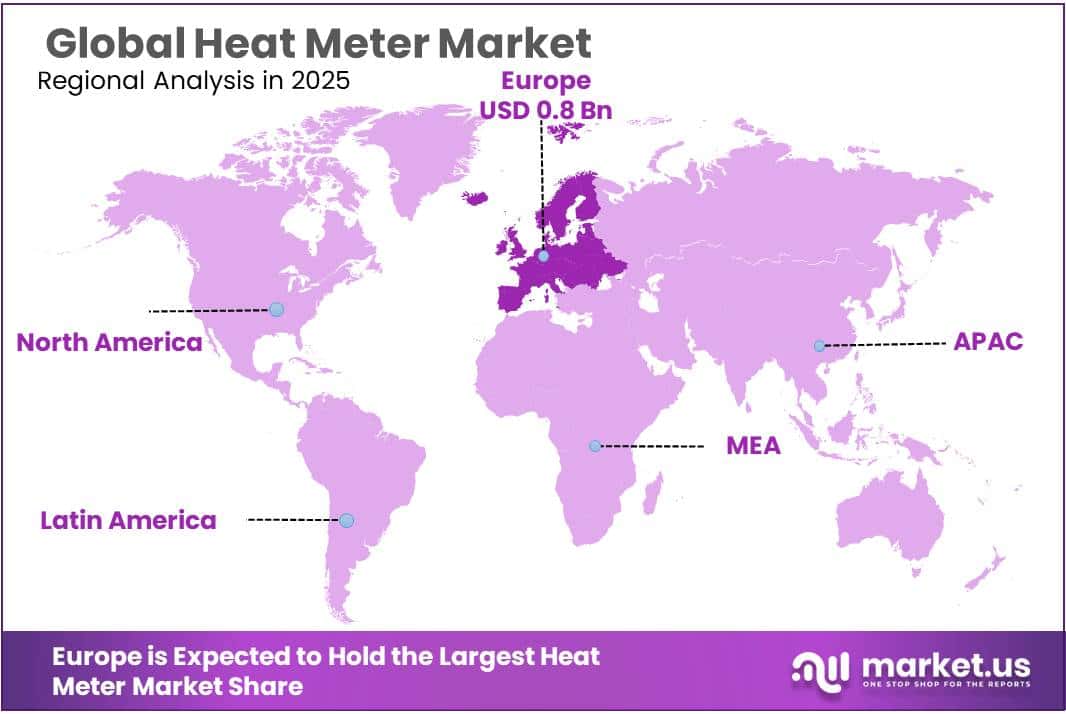
In 2025, the Global Heat Meter Market valued at USD 1.9 billion, and between 2026 and 2035, this market is estimated to register a CAGR of 6.8%, reaching about USD 3.6 billion by 2035. Europe held a dominant market position, capturing more than a 42.6% share, holding USD 0.8 billion in revenue.
Heat meters are becoming an important part of modern heating infrastructure because they measure thermal energy transferred through heating or cooling systems and support consumption-based billing, energy auditing, and system optimisation. Their use is expanding across district heating, apartment buildings, commercial properties, public facilities, and industrial sites where accurate heat-flow information is required.
- The International Energy Agency states that district heating currently supplies around 10% of global building heat demand, creating a sizeable installed base for thermal-energy measurement.
Key Takeaways
- Heat Meter Market valued at USD 1.9 billion, and between 2026 and 2035, this market is estimated to register a CAGR of 6.8%, reaching about USD 3.6 billion by 2035.
- Ultrasonic held a dominant market position, capturing more than a 36.2% share in the Heat Meter Market.
- Wireless held a dominant market position, capturing more than a 62.9% share in the Heat Meter Market.
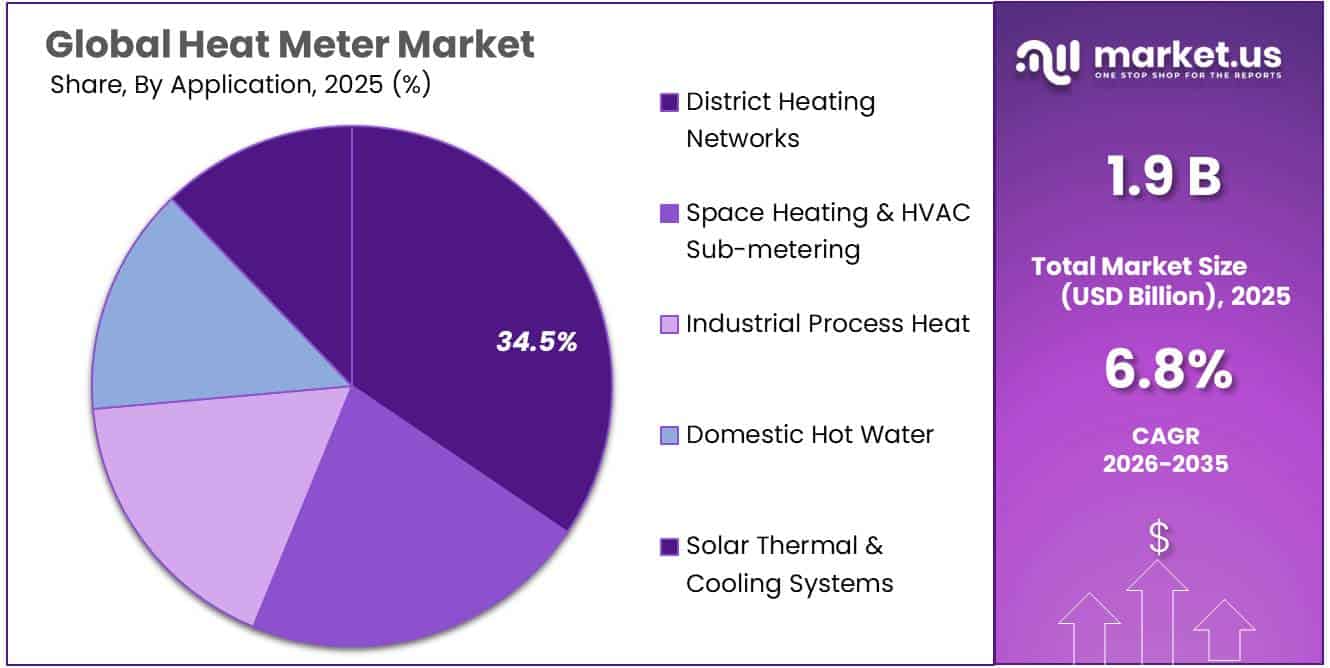
- District Heating Networks held a dominant market position, capturing more than a 34.5% share in the Heat Meter Market.
- Residential held a dominant market position, capturing more than a 48.2% share in the Heat Meter Market.
- Europe held the dominant position in the Heat Meter Market in 2025, accounting for 42.6% of the global market and approximately USD 0.80 billion.
The industrial scenario is supported by the large amount of energy used for heating. Eurostat reported that space heating represented 61.5% of EU household final energy consumption in 2024, while space and water heating together accounted for 77.1%. This concentration makes accurate metering valuable for identifying losses, allocating costs, and improving energy efficiency. In the chemical sector, Cefic states that around 25% to 50% of purchased natural gas can be used as feedstock, with the remainder largely used for generating steam and heat.
- The IEA expects the number of district-heating consumers to increase by around 8% by 2030, reaching approximately 650 million worldwide. It also estimates that more than 600 million people live in cities with substantial heating demand but no access to district heating. This provides a strong long-term opportunity for heat meters as networks, substations, smart buildings, and heat-interface systems expand.
Europe is also shifting toward cleaner and more digital heat infrastructure. Euroheat & Power reports around 440 TWh of European district-heating heat sales in 2024, while renewable energy and waste heat represented 46.2% of the energy mix. As networks integrate geothermal energy, large heat pumps, recovered industrial heat, and other low-carbon sources, heat meters become increasingly important for measuring delivered energy, balancing systems, controlling losses, and supporting transparent customer billing.
- Government policy is accelerating smart metering adoption. The EU Energy Efficiency Directive targets at least an 11.7% reduction in final energy consumption by 2030, while annual energy-saving obligations increase to 1.5% during 2026–2027 and 1.9% during 2028–2030. EU rules also require newly installed heat meters and heat cost allocators to be remotely readable, while existing non-remotely readable devices generally need upgrading or replacement by 1 January 2027 where cost-efficient.
Future opportunities are expected in smart-city projects, building renovation, district-energy expansion, industrial energy optimisation, and connected metering platforms. The UK government estimates heat-network investment potential at £60 billion to £80 billion by 2050, while heat networks could increase from less than 3% of the national heat market to 20%. This investment environment should support ultrasonic meters, wireless reading, real-time analytics, leak detection, predictive maintenance, and integration with utility billing and building-management systems.
By Type Analysis
Ultrasonic heat meters dominate with 36.2% share, supported by accurate and reliable thermal-energy measurement
In 2025, Ultrasonic held a dominant market position, capturing more than a 36.2% share in the Heat Meter Market by type. Ultrasonic heat meters are increasingly preferred because they measure water flow without relying on moving mechanical components, which helps reduce wear, pressure loss, and long-term maintenance requirements. Their strong accuracy also makes them suitable for district heating, communal heating, commercial buildings, and automated energy-management systems.
- In 2026, the UK Energy Technology List continued to require qualifying heat meters to comply with the BS EN 1434 series covering general requirements, pattern approval, and initial verification. Government support is also improving the environment for advanced heat-metering equipment. In 2026, the UK Heat Network Efficiency Scheme was operating as a £107 million grant-support programme aimed at improving existing district and communal heating networks.
Multi-Jet / Impeller heat meters continue to hold an important position in the Heat Meter Market because their mechanical measuring principle is well understood and suitable for many residential, commercial, and communal heating installations. Water passing through the meter rotates an impeller, allowing the device to calculate flow and combine it with temperature measurements to determine consumed thermal energy.
By Connectivity Analysis
Wireless heat meters dominate with 62.9% share as remote monitoring improves billing and network efficiency
In 2025, “Wireless” held a dominant market position, capturing more than a 62.9% share in the Heat Meter Market by connectivity. Wireless heat meters are widely preferred across district and communal heating systems because they allow operators to collect consumption information remotely without entering individual properties. This supports faster billing, regular monitoring and easier identification of unusual energy use. The growing heat-network base further supports wireless meter deployment.
- In February 2026, Ofgem reported that the UK had over 14,000 heat networks, supplying heating and hot water to approximately 480,000 consumers. The UK government also confirmed in 2026 that all heat networks in Great Britain became subject to Ofgem regulation, strengthening requirements around transparent billing and customer information.
Wired connectivity continues to maintain an important position in the Heat Meter Market, particularly across commercial buildings, industrial facilities, energy centres and large district-heating installations. Wired meters provide stable communication between individual measuring points, building-management systems and central billing platforms, making them suitable for fixed infrastructure where continuous data availability is important. Government-backed heat-network upgrades also support demand for reliable metering and data-capture equipment.
By Application Analysis
District Heating Networks dominate with 34.5% share as large heat networks require accurate consumption measurement
In 2025, “District Heating Networks” held a dominant market position, capturing more than a 34.5% share in the Heat Meter Market by application. District heating networks depend heavily on heat meters to measure thermal energy supplied to residential buildings, commercial properties and individual consumers. The meters support accurate billing, network balancing and better control of heat losses across centralized systems.
- In February 2026, Ofgem reported that the UK had more than 14,000 heat networks supplying heating and hot water to approximately 480,000 consumers. This large operating base creates continued demand for reliable heat-metering equipment as network operators improve billing transparency, efficiency and consumption monitoring.
Space Heating & HVAC Sub-metering is developing as an important application within the Heat Meter Market, supported by growing attention to building energy efficiency and detailed monitoring of heating and cooling consumption. Sub-metering allows property managers and facility operators to understand how thermal energy is used across individual floors, apartments, offices or HVAC zones instead of relying only on total building consumption.
- In June 2026, the European Commission reported that buildings were responsible for over 40% of Europe’s energy consumption and around one-third of energy-related greenhouse gas emissions. These figures highlight the need for more accurate monitoring of heating and HVAC systems, creating opportunities for heat meters that support energy audits, tenant-level billing and building-management systems.
By End-user Analysis
Residential dominates with 48.2% share as home heating upgrades increase the need for accurate energy measurement
In 2025, “Residential” held a dominant market position, capturing more than a 48.2% share in the Heat Meter Market by end-user. Residential buildings represent a major application area because heat meters allow households, landlords, and housing operators to measure actual thermal energy use and improve consumption-based billing. Demand is also supported by large-scale home heating and efficiency programs.
- In 2026, the UK government introduced the Warm Homes Plan with £15 billion in public investment to upgrade as many as 5 million homes, supporting cleaner heating, energy-efficiency improvements, and better household energy management. These upgrades can increase the need for accurate heat measurement, particularly in apartments, social housing, communal heating systems, and residential heat networks.
Commercial & Public Buildings are an important end-user segment of the Heat Meter Market as offices, hospitals, schools, government facilities, and other large buildings require better control of heating consumption and operating costs. Heat meters help facility operators compare energy use across different buildings or heating zones, detect inefficient performance, and support building-management systems.
- In June 2026, the UK government reported that the Public Sector Decarbonisation Scheme had allocated more than £3.4 billion to over 1,400 projects for decarbonising public-sector heating systems. The European Commission also requires EU countries to renovate 3% of buildings owned by public bodies every year to improve their energy performance. These measures support continued demand for heat meters in large commercial and public heating installations.
Key Market Segments
By Type
- Ultrasonic
- Multi-Jet / Impeller
- Turbine
- Electromagnetic
- Vane Wheel
- Vortex
- Capacitive / Thermal
By Connectivity
- Wireless
- Wired
By Application
- District Heating Networks
- Space Heating & HVAC Sub-metering
- Industrial Process Heat
- Domestic Hot Water
- Solar Thermal & Cooling Systems
By End-user
- Residential
- Commercial & Public Buildings
- Industrial
Driver Analysis
EU remote-read retrofit
The commercial effect is a mix shift away from basic mechanical replacement units toward ultrasonic meters with integrated radio, wired M-Bus, NB-IoT, LoRaWAN, or OMS-compatible communications, increasing electronics and software content per endpoint. For suppliers, the value pool shifts from one-off hardware sale to a recurring model that combines compliant meter supply, installation, remote data collection, exception alerts, billing-file generation, and lifecycle replacement.
The EU’s binding annual end-use energy-savings obligation also rises from 1.3% in 2024–2025 to 1.5% in 2026–2027, strengthening national incentives for measurable heating-energy reductions and auditable consumption data. This driver is particularly material in Central and Eastern Europe, the Nordics, Germany, Austria, France, and the Benelux region, where multi-dwelling buildings and district-heating networks provide dense, cost-efficient retrofit clusters.
Drivers Impact Analysis
| Driver | (~) % Impact on CAGR | Geographic Relevance | Impact Timeline |
|---|---|---|---|
| EU remote-read retrofit | +2.1 pp | EU, UK, Nordics, CEE | Short term (≤ 2 years) |
| District-heat decarbonisation | +1.6 pp | Europe core, China, Korea, N. America | Medium term (2-4 years) |
| Smart ultrasonic migration | +1.4 pp | EU, China, Japan, GCC | Medium term (2-4 years) |
| Consumption-based billing | +1.2 pp | EU, UK, China, CEE | Short term (≤ 2 years) |
| Heat-pump and waste-heat networks | +1.0 pp | Europe, China, N. America | Long term (≥ 4 years) |
| Building-energy data integration | +0.8 pp | North America, EU, GCC, APAC | Medium term (2-4 years) |
Restraint Analysis
Retrofit installation cost
The largest near-term restraint is that a heat-meter retrofit is rarely a simple device swap: the meter body may represent only 20–35% of installed project cost once isolation valves, pipe cutting, strainers, temperature sensors, communication modules, gateway hardware, commissioning, hydraulic rectification, tenant access, and billing-system integration are included.
In older multi-apartment stock, constrained risers, inaccessible pipework, missing shut-off valves, or poor system balancing can elevate the installed cost per dwelling by roughly 1.8–3.0 times versus a planned new-build installation, eroding the payback case where heat tariffs are regulated or household consumption is already low.
This constraint is acute in Europe’s aging building base: almost 75% of EU buildings are considered energy inefficient and more than 85% are expected to remain in use by 2050, meaning technically difficult legacy assets dominate the theoretical retrofit opportunity. Construction and field-service inflation compound the problem: EU hourly labour costs rose 3.6% year over year in Q1 2026, while the European Commission notes that construction costs have risen faster than general inflation because material and labour productivity improvements have not offset input inflation.
Restraint Impact Analysis
| Restraint | (~) % Impact on CAGR | Geographic Relevance | Impact Timeline |
|---|---|---|---|
| Retrofit installation cost | -1.9 pp | EU, UK, CEE, China cities | Short term (≤ 2 years) |
| Heat-network CapEx delays | -1.6 pp | EU, UK, N. America, APAC | Medium term (2-4 years) |
| Certification fragmentation | -1.2 pp | EU, UK, North America, GCC | Medium term (2-4 years) |
| Smart-component exposure | -0.9 pp | Europe, China, N. America | Short term (≤ 2 years) |
| Billing-data integration gaps | -0.8 pp | CEE, UK, N. America, APAC | Medium term (2-4 years) |
| Low-density project economics | -0.7 pp | North America, EU periphery, APAC | Long term (≥ 4 years) |
Opportunity Analysis
Metering-as-a-Service
The immediate white space is the 2026–2027 remote-reading conversion: Germany’s Heating Cost Ordinance requires legacy heat and hot-water consumption devices that are not remotely readable to be replaced by 31 December 2026, after which only remotely readable devices may be used; missed compliance can result in a 3% tenant rent reduction for the absence of remotely readable equipment and a further 3% reduction where monthly consumption information is missing or incomplete.
Instead of selling a €70–€180 device plus a one-time installation service, suppliers can offer a 8–12-year per-endpoint contract incorporating meter hardware, connectivity, gateway access, remote readings, billing-ready data, cybersecurity patches, and replacement assurance; an indicative €1.50–€4.00 monthly service fee converts a low-repeat hardware account into €144–€480 of contracted revenue per endpoint before installation.
For vendors, even a 15–25% conversion of new connected-meter deployments to subscription contracts could increase customer lifetime value by 2–4 times, lower customer-acquisition cost through property-manager portfolio contracts, and create a defensible installed-data base that competitors cannot displace through a lower device bid.
Opportunity Impact Analysis
| Opportunity | (~) % Potential CAGR | Geographic Relevance | Execution Window |
|---|---|---|---|
| Metering-as-a-Service | +1.8 pp | EU, UK, CEE, China | Short term (≤ 2 years) |
| Waste-heat settlement meters | +1.5 pp | EU core, Nordics, China, N. America | Medium term (2-4 years) |
| Thermal-network expansion | +1.3 pp | North America, EU, Japan, Korea | Long term (≥ 4 years) |
| Building-data SaaS | +1.2 pp | EU, GCC, N. America, APAC | Medium term (2-4 years) |
| Cooling-meter adjacency | +1.0 pp | GCC, India, SE Asia, U.S. | Medium term (2-4 years) |
| Service-provider roll-ups | +0.8 pp | EU, UK, North America | Short term (≤ 2 years) |
Challenges Analysis
Installer skills scarcity
Europe’s green transition could generate about 312,000 additional construction-sector jobs, while up to 45% of the renovation workforce requires targeted upskilling, implying that thermal-meter projects compete directly with heat-pump, insulation, electrical-upgrade, and broader renovation work for the same technicians.
For a 10,000-endpoint retrofit, an efficient crew of two can typically complete 6–10 technically straightforward installations per day but only 2–4 units per day in constrained risers or occupied dwellings; a 20% shortfall in trained crews can therefore extend a nominal 9–12-month deployment into 14–18 months, increasing equipment warehousing, financing, customer-service, and re-visit costs.
Challenges Impact Analysis
| Challenge | (~) % CAGR Friction | Geographic Relevance | Mitigation Horizon |
|---|---|---|---|
| Installer skills scarcity | -1.3 pp | EU, UK, North America | Medium term (2-4 years) |
| Low-temperature accuracy control | -1.1 pp | EU, China, Nordics, Korea | Long term (≥ 4 years) |
| Connected-device cyber upkeep | -0.9 pp | EU, UK, N. America, APAC | Medium term (2-4 years) |
| Data-quality reconciliation | -0.8 pp | EU, CEE, China, North America | Medium term (2-4 years) |
| Component lifecycle volatility | -0.7 pp | Europe, China, N. America | Short term (≤ 2 years) |
| Multi-party project coordination | -0.6 pp | EU, UK, North America, APAC | Long term (≥ 4 years) |
Geopolitical Impact Analysis
Russia–Ukraine War Accelerates Heat Meter Demand Through Energy-Security Measures
The ongoing Russia–Ukraine war continues to influence the Heat Meter market by keeping energy security, heating costs, and fuel diversification high on Europe’s policy agenda. In 2025, Russia supplied around 12% of total EU gas imports, down from 45% in 2021, as European countries reduced dependence on Russian energy. This shift is encouraging investment in district heating, building renovation, heat pumps, waste-heat recovery, and better monitoring of thermal consumption.
- The European Commission reported in 2026 that REPowerEU-backed measures are expected to improve energy efficiency across about 420 million square metres of residential buildings, covering roughly 4.7 million dwellings. These upgrades create additional opportunities for smart and remotely readable heat meters.
At the same time, geopolitical uncertainty can restrain the market through higher prices for metals, electronics, logistics, and energy-intensive manufacturing. The IEA noted that Russian pipeline gas deliveries to Europe fell by almost 120 billion cubic metres during 2022–2023. Consequently, energy resilience is becoming a stronger purchasing factor for heat-metering systems.
Regional Insights
Europe Leads the Heat Meter Market with 42.6% Share and USD 0.80 Billion Value
Europe held the dominant position in the Heat Meter Market in 2025, accounting for 42.6% of the global market and approximately USD 0.80 billion in revenue. The region benefits from established district-heating networks, strict building-efficiency policies, and growing adoption of smart energy monitoring.
- In June 2026, the European Commission reported that buildings were responsible for more than 40% of Europe’s energy consumption and around one-third of its energy-related greenhouse gas emissions. The IEA also reported in 2026 that Europe represented over 20% of global heat-pump sales, with sales recording double-digit growth in 2025.
Asia Pacific is positioned as the fastest-growing regional segment as cities modernize heating networks, electrify buildings, and introduce more accurate energy-monitoring systems. China remains an important growth centre because of its large building base, district-heating infrastructure, and strong domestic manufacturing capacity.
Key Regions and Countries Insights
- North America
- US
- Canada
- Europe
- Germany
- France
- The UK
- Spain
- Italy
- Rest of Europe
- Asia Pacific
- China
- Japan
- South Korea
- India
- Australia
- Rest of APAC
- Latin America
- Brazil
- Mexico
- Rest of Latin America
- Middle East & Africa
- GCC
- South Africa
- Rest of MEA
Key Players Analysis
Kamstrup A/S holds a strong position in heat and energy metering through its smart metering, ultrasonic measurement, and digital utility solutions. In 2025, the company generated DKK 3.5 billion in revenue, representing 15% growth, while EBIT reached DKK 651 million, increasing 153%. Order intake rose 36% to DKK 3.6 billion. Kamstrup also acquired Saint-Gobain’s IoT Solutions business in 2025, strengthening its connected-metering capabilities for heating, water, and utility infrastructure.
Diehl Metering GmbH is an established supplier of smart water and thermal-energy metering technologies, including ultrasonic heat meters for residential and district-heating applications. In 2025, Diehl Metering generated €520 million in sales and employed 1,904 people. The wider Diehl Group invested €502 million in R&D and €375 million in capital projects. Its SHARKY 775 ultrasonic heat meter supports a dynamic measuring range of up to 1:250 and MID accuracy classes 2 and 3.
Landis+Gyr Group AG has extensive experience in intelligent metering and thermal-energy measurement. In FY2025, continuing operations generated USD 1.166 billion in net revenue, while committed backlog stood at USD 3.893 billion and its connected-device base exceeded 180 million units. Its former EMEA operation recorded USD 750.7 million in revenue before being divested to AURELIUS for an enterprise value of USD 215 million, with the transaction completed in April 2026 and including the EMEA metering portfolio.
Top Key Players Outlook
- Kamstrup A/S
- Diehl Metering GmbH
- Landis+Gyr Group AG
- Itron Inc.
- Siemens AG
- Danfoss A/S
- Xylem Inc. (Sensus)
- ZENNER International GmbH & Co. KG
- Apator SA
- Sontex SA
- Badger Meter Inc.
- QUNDIS GmbH
- Engelmann Sensor GmbH
- Techem GmbH / ista International GmbH
- Wasion Holdings Limited
Recent Developments
- March 2026, Siemens announced an investment of around €200 million to build an AI-enabled Smart Infrastructure factory in Amberg, Germany, where approximately 2,400 Smart Infrastructure employees are based.
- In March 2026, Danfoss A/S also highlighted heat-pump solutions supporting capacities up to 3 MW and temperatures of 120°C, strengthening applications in industrial and district heating where thermal measurement is important.
Report Scope
| Report Features | Description |
|---|---|
| Market Value (2025) | USD 1.9 Bn |
| Forecast Revenue (2035) | USD 3.6 Bn |
| CAGR (2026-2035) | 6.8% |
| Base Year for Estimation | 2025 |
| Historic Period | 2020-2024 |
| Forecast Period | 2026-2035 |
| Report Coverage | Revenue Forecast, Market Dynamics, Competitive Landscape, Recent Developments |
| Segments Covered | By Type (Ultrasonic, Multi-Jet / Impeller, Turbine, Electromagnetic, Vane Wheel, Vortex, Capacitive / Thermal), By Connectivity (Wireless, Wired), By Application (District Heating Networks, Space Heating & HVAC Sub-metering, Industrial Process Heat, Domestic Hot Water, Solar Thermal & Cooling Systems), By End-user (Residential, Commercial & Public Buildings, Industrial) |
| Regional Analysis | North America – US, Canada; Europe – Germany, France, The UK, Spain, Italy, Rest of Europe; Asia Pacific – China, Japan, South Korea, India, Australia, Singapore, Rest of APAC; Latin America – Brazil, Mexico, Rest of Latin America; Middle East & Africa – GCC, South Africa, Rest of MEA |
| Competitive Landscape | Kamstrup A/S, Diehl Metering GmbH, Landis+Gyr Group AG, Itron Inc., Siemens AG, Danfoss A/S, Xylem Inc. (Sensus), ZENNER International GmbH & Co. KG, Apator SA, Sontex SA, Badger Meter Inc., QUNDIS GmbH, Engelmann Sensor GmbH, Techem GmbH / ista International GmbH, Wasion Holdings Limited |
| Customization Scope | Customization for segments, region/country-level will be provided. Moreover, additional customization can be done based on the requirements. |
| Purchase Options | We have three licenses to opt for: Single User License, Multi-User License (Up to 5 Users), Corporate Use License (Unlimited User and Printable PDF) |





































