


Report Overview
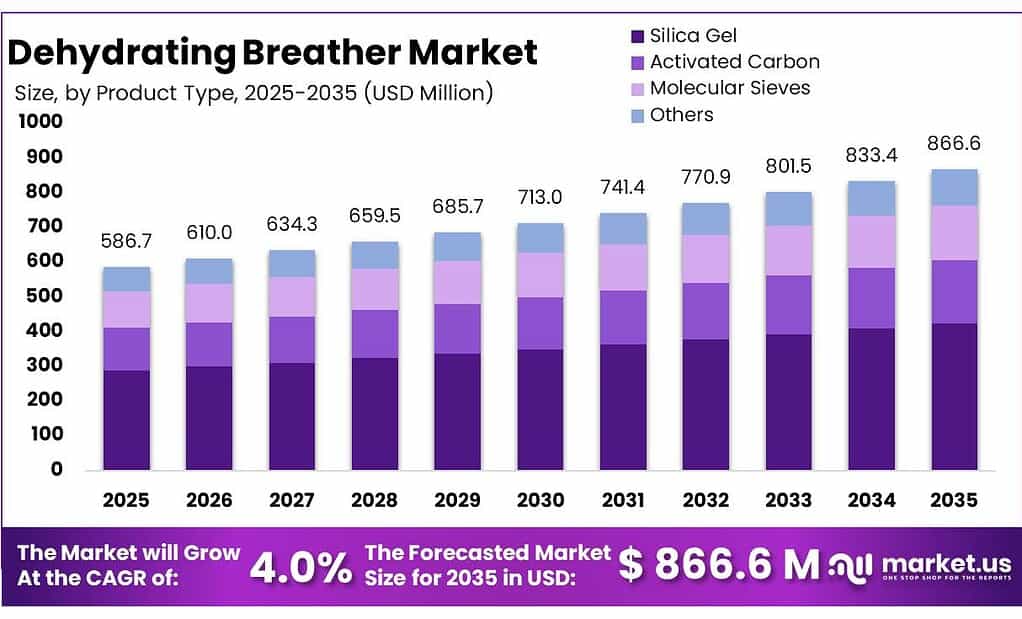
The Global Dehydrating Breather Market size is expected to be worth around USD 866.6 Million by 2035, from USD 586.7 Million in 2025, growing at a CAGR of 4.0% during the forecast period from 2026 to 2035. In 2025, Asia Pacific held a dominant market position, capturing more than a 43.4% share, holding USD 219.7 Million revenue.
A dehydrating breather is a moisture-control device fitted mainly on oil-filled transformers and related conservator-based equipment to keep incoming air dry, preserve dielectric strength, and reduce oxidation risk in insulating oil. In industrial terms, the category sits within the broader transformer accessories and asset-protection space, where demand is tied less to discretionary spending and more to grid reliability, utility refurbishment cycles, renewable integration, and the need to extend transformer service life.
The current operating backdrop is supportive: the International Energy Agency stated that investment in the electricity sector is set to reach USD 1.5 trillion in 2025, while annual grid investment needs to rise by about 50% from today’s roughly USD 400 billion level by 2030 to meet demand growth. That spending profile directly reinforces the installation base for transformers and, by extension, for dehydrating breathers and other moisture-management accessories.
The industrial scenario is being shaped by both new-build grid expansion and life-extension of existing fleets. The IEA’s 2025 transmission-grid work reported that procurement now takes 2–3 years for cables and up to 4 years for large power transformers, with average lead times for transformers and cables having almost doubled since 2021.
In practical market terms, this favors relatively low-cost protection components such as dehydrating breathers because utilities and industrial operators are under pressure to protect installed transformers longer, reduce moisture ingress, and avoid premature oil degradation while replacement units remain hard to secure. Electricity demand trends strengthen that logic further: the IEA indicated global electricity consumption is growing at close to 4% annually through 2027, and advanced economies accounted for almost 20% of global electricity-demand growth in 2025.
The main growth drivers are therefore asset reliability, grid modernization, renewable intermittency, and high-load applications such as data centers. Official U.S. and EU policy signals are also supportive. In the United States, the Department of Energy announced up to USD 3.46 billion for 58 grid-resilience projects across 44 states under GRIP, and later opened up to USD 3.9 billion more for Fiscal Years 2024–2025.
In Europe, the European Commission’s June 2025 grid guidance estimated investment needs of EUR 730 billion for distribution and EUR 477 billion for transmission by 2040. These initiatives do not fund breathers directly, but they enlarge the transformer population, encourage modernization, and improve the business case for accessories that reduce moisture-related maintenance and failure exposure.
Key Takeaways
- Dehydrating Breather Market size is expected to be worth around USD 866.6 Million by 2035, from USD 586.7 Million in 2025, growing at a CAGR of 4.0%.
- Conventional held a dominant market position, capturing more than a 59.7% share.
- Silica Gel held a dominant market position, capturing more than a 49.6% share.
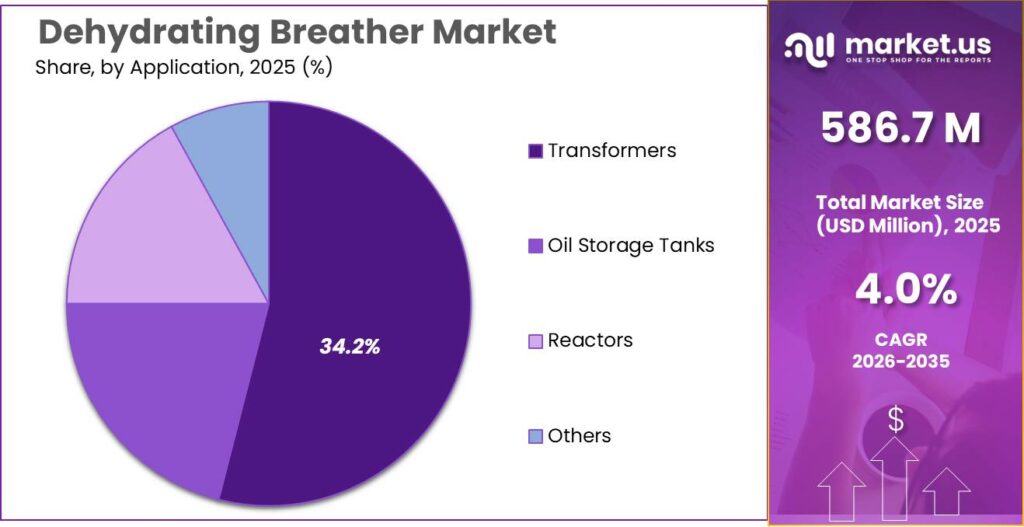
- Transformers held a dominant market position, capturing more than a 54.8% share.
- Transmission and Distribution held a dominant market position, capturing more than a 37.5% share.
By Type Analysis
Conventional dehydrating breathers lead the market with 59.7% share, supported by strong industrial preference and easy maintenance.
In 2025, Conventional held a dominant market position, capturing more than a 59.7% share. This strong position was mainly supported by its long-standing use across transformers and power distribution equipment, where reliability and simple working design remain key priorities. Many end users continued to prefer conventional models because they are easy to install, widely available, and familiar to maintenance teams, which helps reduce operational complexity. Their cost-effective nature also made them a practical choice for utilities and industrial facilities looking for dependable moisture control without shifting to more advanced systems.
By Product Type Analysis
Silica Gel dominates the dehydrating breather market with 49.6% share, driven by proven moisture absorption efficiency and wide transformer usage.
In 2025, Silica Gel held a dominant market position, capturing more than a 49.6% share. This leading share was largely supported by its strong moisture absorption capability, which makes it highly effective in protecting transformers and other oil-filled electrical equipment from humidity-related damage. The product remained the preferred choice across utilities and industrial applications because of its dependable performance, easy replacement cycle, and broad availability in the market. Its widespread use in both new installations and routine maintenance activities further strengthened demand during the year.
By Application Analysis
Transformers dominate the dehydrating breather market with 54.8% share, backed by critical moisture protection needs in power systems.
In 2025, Transformers held a dominant market position, capturing more than a 54.8% share. This leading share was mainly driven by the essential role dehydrating breathers play in protecting transformer oil and internal insulation from moisture contamination. Since transformers are widely used across transmission, distribution, and industrial power networks, the demand for reliable moisture control remained consistently high throughout 2025. Utilities and industrial operators continued to prioritize transformer protection to improve equipment lifespan, reduce maintenance risks, and avoid unexpected failures.
By End User Analysis
Transmission and Distribution leads the dehydrating breather market with 37.5% share, supported by rising grid reliability and transformer protection needs.
In 2025, Transmission and Distribution held a dominant market position, capturing more than a 37.5% share. This leadership was mainly supported by the large-scale use of transformers, switchgear, and other grid infrastructure that require continuous moisture protection for reliable performance. Power utilities continued to invest in strengthening transmission lines and distribution networks, which directly supported the demand for dehydrating breathers across substations and grid assets.
Key Market Segments
By Type
- Conventional
- Self-Dehydrating Breather
By Product Type
- Silica Gel
- Activated Carbon
- Molecular Sieves
- Others
By Application
- Transformers
- Oil Storage Tanks
- Reactors
- Others
By End User
- Power Generation
- Transmission and Distribution
- Manufacturing and Processing
- Renewable Energy
- Oil and Gas
- Others
Emerging Trends
IoT-Enabled Smart Monitoring is the Latest Trend Reshaping the Dehydrating Breather Market
One of the most visible latest trends in the dehydrating breather market is the shift toward IoT-enabled smart breathers with real-time moisture sensing. Utilities are increasingly moving away from manual silica gel inspection and adopting connected breather systems that continuously track humidity saturation, internal pressure, and transformer breathing cycles.
This trend is strongly supported by the wider condition-based monitoring movement in the power sector. According to the International Energy Agency, global electricity demand is projected to grow by 3.3% in 2025 and 3.7% in 2026, which is pushing utilities to improve transformer uptime and avoid unplanned failures.
Self-Regenerating and Low-Maintenance Breathers are Gaining Fast Adoption
Another major trend is the growing adoption of self-regenerating dehydrating breathers that reduce or eliminate routine silica gel replacement. Traditional breathers require regular inspection and desiccant change-outs, but utilities now prefer advanced systems that automatically regenerate the drying medium using internal heating or airflow management. This trend is growing because maintenance teams are under pressure to manage larger transformer fleets with fewer site visits.
A trusted industry technical paper on transformer moisture monitoring highlighted that continuous online moisture assessment significantly improves transformer lifespan and efficiency, reinforcing the demand for integrated low-maintenance breather solutions. At the same time, many government-supported transmission expansion projects are moving toward digital and unmanned substations, where self-regenerating breathers offer clear operational benefits.
Drivers
Rising Global Electricity Demand and Grid Expansion is Driving Dehydrating Breather Demand
One of the biggest growth drivers for the dehydrating breather market is the sharp rise in global electricity demand, which is directly increasing transformer installations and grid upgrades. The International Energy Agency stated that global electricity consumption is expected to grow at nearly 4% annually through 2027, supported by industrial growth, cooling demand, electric vehicles, and digital infrastructure expansion.
At the same time, governments in major economies are investing heavily in grid modernization, renewable energy connectivity, and replacement of aging transmission assets. These programs are increasing the use of oil-filled transformers in both urban and rural networks. Since dehydrating breathers help prevent moisture ingress, oxidation, and insulation failure, their role becomes more critical as grid infrastructure scales up.
Transformer Supply Backlogs and Infrastructure Upgrades are Supporting Replacement Demand
Another major factor supporting market growth is the rise in transformer replacement cycles and long equipment backlogs. According to the IEA, the order backlog for power transformers increased significantly between 2020 and 2024, reflecting strong demand from utilities and industrial power users. This growing backlog clearly shows how utilities worldwide are accelerating infrastructure upgrades, renewable grid connections, and replacement of aging assets.
In many countries, government-backed transmission expansion plans and renewable energy policies are also pushing utilities to improve asset reliability and reduce transformer downtime. Dehydrating breathers support this goal by extending transformer life and lowering maintenance risk caused by humidity exposure. In practical terms, every transformer replacement or refurbishment project creates a fresh opportunity for breather installation.
Restraints
High Maintenance Burden and Delayed Replacement Cycles are Restraining Market Growth
One major restraining factor for the dehydrating breather market is the high maintenance dependency of conventional silica gel breathers. In many utilities, these units still rely on manual inspection of silica gel color, periodic replacement, and field staff checks. When this process is delayed, moisture enters the transformer oil and directly affects insulation strength.
This issue becomes more serious because utilities often manage large fleets of transformers spread across remote networks. A single missed inspection can lead to saturated silica gel, oil contamination, and higher transformer servicing costs. Government utility guidance from India also highlights “worn-out breather” as one of the minor but practical causes of distribution transformer failure, showing how maintenance gaps directly create equipment risks.
Utility Downtime Risk and Long Transformer Repair Lead Times Limit Adoption Confidence
Another important restraint is the high cost impact of failures caused by poor breather upkeep, especially when transformer repair cycles are long. According to the Central Electricity Authority transformer maintenance manual, restoration of a transformer after major repair can take about 3 to 6 months, depending on the repair type. This long turnaround period makes utilities extremely cautious about maintenance errors linked to breathers, because even minor moisture-related issues can translate into prolonged downtime.
The challenge is not the breather itself, but the operational dependence it creates. If silica gel is not replaced on time, moisture contamination can degrade oil and paper insulation, eventually causing winding or insulation failures. Once a transformer trips, utilities face replacement logistics, workshop repair, revenue loss, and service interruptions. Government-backed distribution utility documents also note that repair and replacement lead time is usually quite high, which adds financial pressure on operators.
Opportunity
Smart Grid Modernization and Digital Breather Adoption Create Strong Growth Opportunity
One of the biggest growth opportunities for the dehydrating breather market is the rapid shift toward smart grid modernization and digital transformer monitoring. As utilities expand transmission infrastructure and upgrade substations, they are increasingly looking for intelligent moisture-control systems that reduce manual inspection work. The International Energy Agency noted that global electricity demand is expected to grow by 3.3% in 2025 and 3.7% in 2026, keeping pressure on utilities to improve transformer reliability and reduce unexpected failures.
Government-backed grid modernization programs across India, Europe, and North America are further supporting this opportunity. Utilities are moving toward predictive maintenance models where digital dehydrating breathers fit naturally into asset health platforms. Instead of depending on routine manual replacement, operators can monitor silica saturation and humidity levels remotely, helping reduce maintenance visits and improve transformer life. As more grids become automated and remote substations increase, demand for smart breathers is expected to rise faster than conventional systems.
Renewable Energy Grid Expansion Opens New Transformer Installation Demand
Another major growth opportunity is the fast expansion of renewable energy transmission networks, which is increasing transformer deployment worldwide. The IEA highlighted that global grid investment reached a critical growth phase in 2025 as electricity networks expanded to support rising renewable integration and growing power demand. Every solar farm, wind substation, and renewable pooling station depends on transformers that must be protected from moisture contamination, creating direct demand for dehydrating breathers.
Government initiatives focused on clean energy and transmission corridors are making this opportunity even stronger. Countries are investing in inter-state transmission systems, offshore wind evacuation lines, and renewable-rich substations, all of which require oil-filled transformers in harsh outdoor environments. These assets face continuous exposure to humidity and temperature swings, making breather performance critical for transformer health.
Regional Insights
Asia-Pacific Dominates the Dehydrating Breather Market with 43.4% Share Valued at USD 219.7 Mn
In 2025, Asia-Pacific held the leading position in the global dehydrating breather market, accounting for 43.4% of total revenue and reaching a value of USD 219.7 Mn. The region’s dominance is mainly supported by its strong transformer installation base, rapid transmission upgrades, and rising investments in utility infrastructure across China, India, Japan, South Korea, and Southeast Asia.
In addition, rising electricity consumption from manufacturing hubs, EV charging infrastructure, metro rail systems, and hyperscale data centers is further boosting demand for transformer protection components. Reuters also highlighted a USD 1.5 billion Asia-Pacific infrastructure partnership focused on power transmission and distribution projects, reinforcing long-term equipment demand in the region. 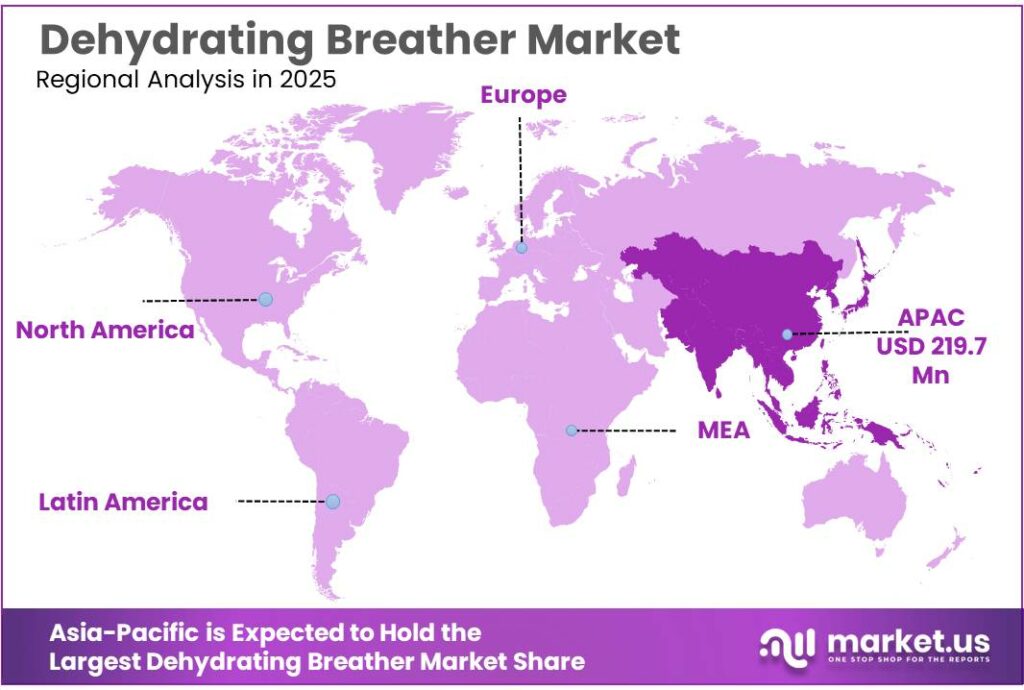
Key Regions and Countries Insights
- North America
- US
- Canada
- Europe
- Germany
- France
- The UK
- Spain
- Italy
- Rest of Europe
- Asia Pacific
- China
- Japan
- South Korea
- India
- Australia
- Rest of APAC
- Latin America
- Brazil
- Mexico
- Rest of Latin America
- Middle East & Africa
- GCC
- South Africa
- Rest of MEA
Key Players Analysis
AGM Container Controls Inc. holds a strong niche position through its durable transformer breather product line designed for harsh outdoor utility environments. The company offers multiple desiccant capacity options, including 11.02 lbs, 22.05 lbs, 31.97 lbs, 38.58 lbs, and 60.19 lbs, giving utilities flexibility based on transformer size and moisture load. Its products are especially valued for 180-degree visibility windows and low-maintenance valve systems, which improve field inspection efficiency.
Qualitrol Corporation holds a premium position in the dehydrating breather market through its strong focus on intelligent transformer monitoring. Its STB000 Series smart transformer breather is a major differentiator, offering maintenance-free operation with internal heater-based regeneration and digital moisture tracking. In 2025, the company benefited from rising adoption of online transformer condition monitoring, especially across utilities upgrading substations for predictive maintenance.
ABB Ltd. remains one of the most established players in the dehydrating breather market, supported by its strong transformer component portfolio and global utility reach. The company’s self-dehydrating breather systems are widely used in oil-filled transformers, helping reduce moisture ingress and extend insulation life. Its presence across more than 100 countries and deep integration with grid modernization projects strengthen its market position.
Top Key Players Outlook
- ABB Ltd.
- AGM Container Controls Inc.
- Des-Case Corporation
- Qualitrol Corporation
- Maschinenfabrik Reinhausen GmbH
- Hubbell Incorporated
- Eaton Corporation
- HYDAC International GmbH
- Christian Maier GmbH & Co. KG
Recent Industry Developments
In 2025, Qualitrol Corporation continued to strengthen its position in the dehydrating breather sector through its STB000 Series smart transformer breather, a maintenance-free and auto-regenerating solution built for oil-filled transformers and LTC conservators. The company’s numerical strength comes from its broad 3 core desiccant capacities of 1 kg, 2 kg, and 4 kg, covering transformer oil systems from 30,000 liters to 136,000 liters.
In 2025, Des-Case Corporation continued to hold a strong technical position in the dehydrating breather sector through its wide desiccant breather portfolio used in transformers, storage tanks, hydraulics, and industrial oil systems. The company’s strength comes from a product lineup of more than 10 breather variants, including Standard, VentGuard™, Extended®, HydroGuard®, Extreme Duty, ACM, KL, TDB, Rebuildable Steel, Connected, and High-Capacity breathers, giving it broad application coverage across utility and industrial environments.
Report Scope
| Report Features | Description |
|---|---|
| Market Value (2025) | USD 586.7 Mn |
| Forecast Revenue (2035) | USD 866.6 Mn |
| CAGR (2026-2035) | 4.0% |
| Base Year for Estimation | 2025 |
| Historic Period | 2020-2024 |
| Forecast Period | 2026-2035 |
| Report Coverage | Revenue Forecast, Market Dynamics, Competitive Landscape, Recent Developments |
| Segments Covered | By Type (Conventional, Self-Dehydrating Breather), By Product Type (Silica Gel, Activated Carbon, Molecular Sieves, Others, By Application, Transformers, Oil Storage Tanks, Reactors, Others, By End User, Power Generation, Transmission and Distribution, Manufacturing and Processing, Renewable Energy, Oil and Gas, Others) |
| Regional Analysis | North America – US, Canada; Europe – Germany, France, The UK, Spain, Italy, Rest of Europe; Asia Pacific – China, Japan, South Korea, India, Australia, Singapore, Rest of APAC; Latin America – Brazil, Mexico, Rest of Latin America; Middle East & Africa – GCC, South Africa, Rest of MEA |
| Competitive Landscape | ABB Ltd., AGM Container Controls Inc., Des-Case Corporation, Qualitrol Corporation, Maschinenfabrik Reinhausen GmbH, Hubbell Incorporated, Eaton Corporation, HYDAC International GmbH, Christian Maier GmbH & Co. KG |
| Customization Scope | Customization for segments, region/country-level will be provided. Moreover, additional customization can be done based on the requirements. |
| Purchase Options | We have three licenses to opt for: Single User License, Multi-User License (Up to 5 Users), Corporate Use License (Unlimited User and Printable PDF) |





































