


Report Overview
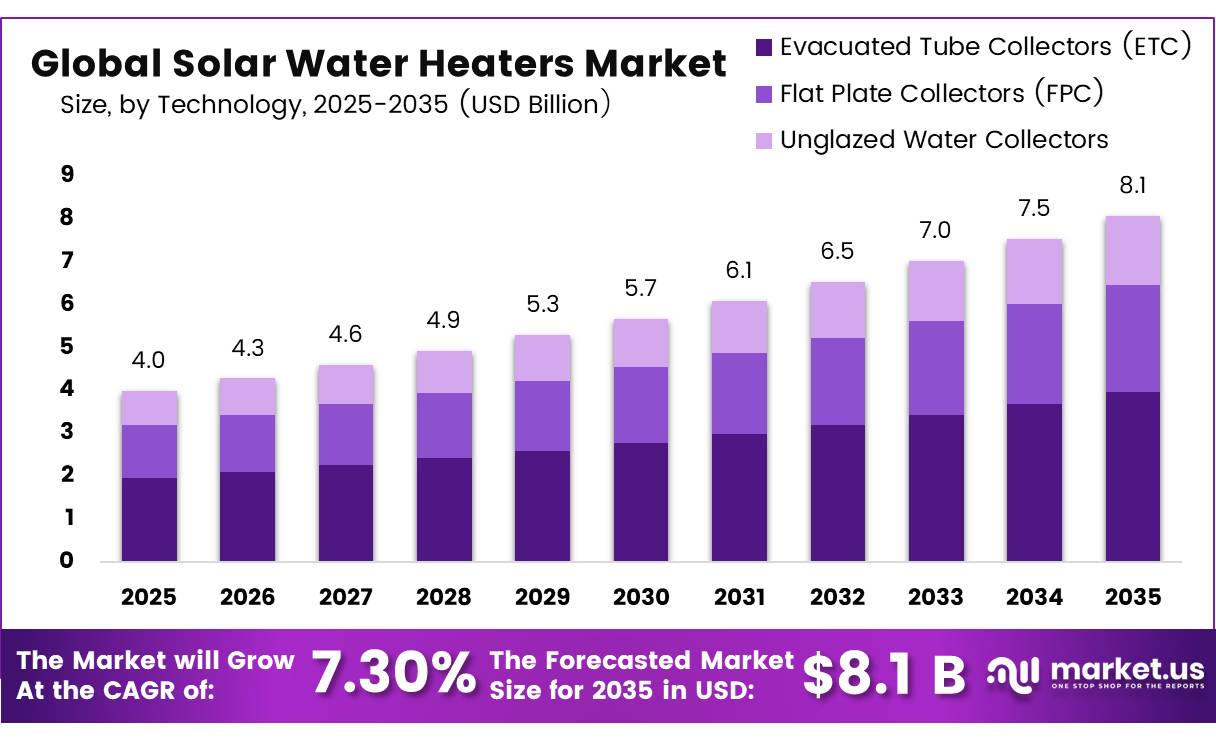
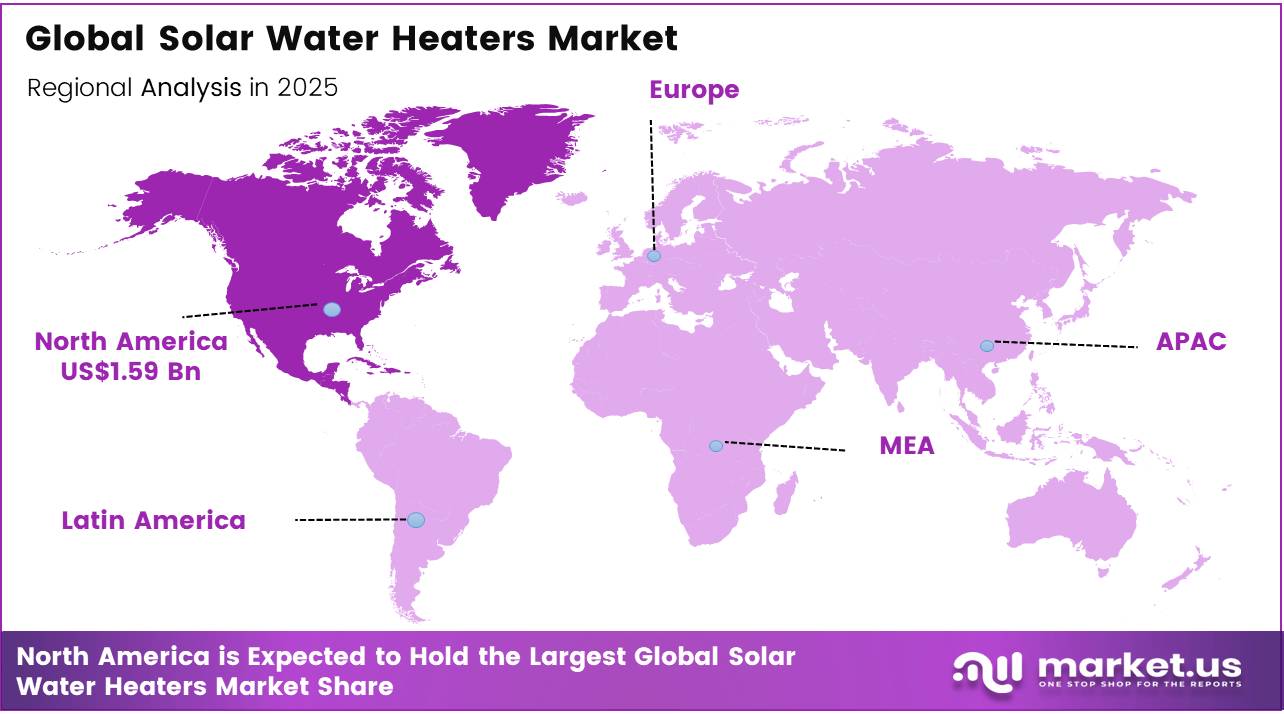
In 2025, the Global Solar Water Heaters Market was valued at USD 4.0 billion, and between 2026 and 2035, this market is estimated to register a CAGR of 8.1%, reaching about USD 7.3 billion by 2035. In 2025, North America held a dominant market position, capturing more than a 39.77% share, holding USD 1.59 Billion revenue.
Solar water heaters are becoming an important renewable energy solution for reducing dependence on conventional heating fuels and lowering residential, commercial, and industrial energy consumption. These systems use solar thermal collectors to capture sunlight and convert it into heat for water heating applications. They are widely used in households, hotels, hospitals, industrial facilities, and public buildings where hot water demand remains consistent.
- According to the International Energy Agency (IEA), solar PV capacity additions surpassed 600 GW in 2025, reflecting the broader expansion of solar technologies and strengthening the global renewable energy ecosystem.
Government initiatives and energy transition targets are supporting market development. The expansion of renewable energy capacity is encouraging wider adoption of solar thermal technologies for domestic and commercial heating applications. According to IRENA, global renewable power capacity reached 4,448 GW by the end of 2024, with solar energy accounting for a major share of new renewable additions. This growth in renewable infrastructure is creating a favorable environment for solar-based heating technologies.
Industry demand is strengthened by higher utility costs, building decarbonization policies, and reduced dependence on electric or gas-fired heaters. Water heating accounts for about 20% of household energy use. Solar thermal equipment can meet at least 50% of household water-heating needs, while a typical system can reduce conventional water-heating requirements by approximately 67%. These savings improve lifecycle economics in sunny regions and facilities with steady hot-water demand.
Future opportunities will emerge from hybrid solar-heat-pump systems, smart monitoring, thermal storage, district heating, and commercial retrofits. The IEA expects solar thermal heat consumption in buildings to rise 25%, adding 0.4 EJ. Government support remains important, as qualifying new and renovated U.S. federal buildings must meet 30% of hot-water demand through cost-effective solar equipment.
Key Takeaways
- The global Solar Water Heaters market was valued at USD 4.0 billion in 2025.
- The global market is projected to grow at a CAGR of 7.30% and is estimated to reach USD 8.1 billion by 2035.
- On the basis of technology, the Evacuated Tube Collectors (ETC) dominated the market, constituting 49.0% of the total market share.
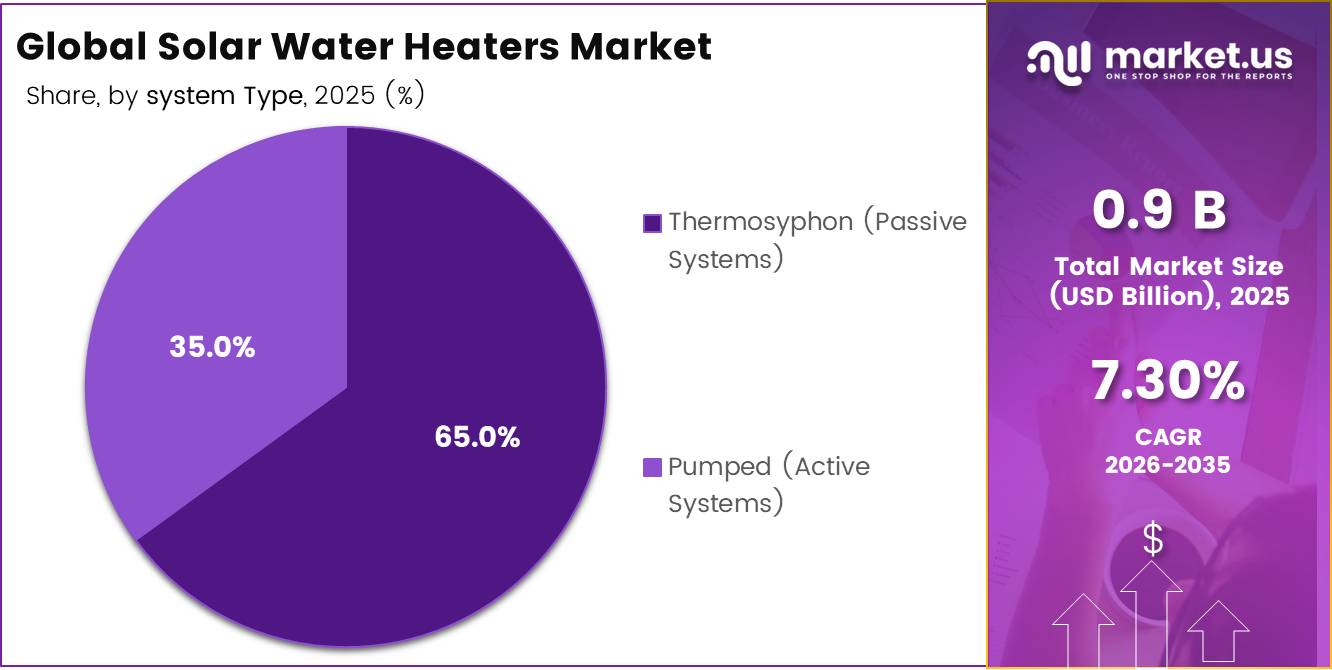
- Based on the System Type, the Thermosyphon (Passive Systems) dominated the Solar Water Heaters market, with a substantial market share of around 65.0%.
- Based on the application, Residential led the market, comprising 58.30% of the total market.
- Among the capacity, the Up to 300 Liters held a major share in the Solar Water Heaters market, 51.0% of the market share.
- In 2025, the North America was the most dominant region in the Solar Water Heaters market, accounting for 39.77% of the total global consumption.
Technology Analysis
Evacuated Tube Collectors (ETC) represents dominant Segment in the Market.
Evacuated Tube Collectors held the leading position with a 49.00% market share. Their vacuum-sealed glass tubes limit heat loss and help retain useful temperatures during cold weather, cloudy conditions, and periods of weak solar radiation. This makes the technology suitable for homes, hotels, hospitals, and commercial buildings requiring dependable hot water throughout the year. In heat-pipe designs, the internal working fluid can evaporate at approximately 25°C, carrying heat toward the system’s heat exchanger. Government guidance also recommends positioning solar collectors within 35° of south where possible to improve solar exposure.
Flat Plate Collectors are gaining demand because their simple structure supports easier roof integration, maintenance, and large-area installations. A UK government example indicates that an eligible system replacing electric water heating could save 12,000 kWh of energy and avoid 4,220 kgCO₂e annually, with an estimated six-year payback period. These operating benefits strengthen their use in residential and commercial retrofits.
System Type Analysis
Thermosyphon (Passive Systems) a significant system type.
Thermosyphon systems held the leading position with a 65.0% market share. Their storage tank sits above the collector, allowing heated water to rise naturally without a circulation pump or complex controls. This simple layout reduces mechanical failure points, keeps components together, and limits heat loss through long pipe runs. It is practical for homes and small commercial buildings in warm climates with reliable sunlight.
- Australian Government guidance notes that recommended collector angles vary from 17.5° in Darwin to 53° in Hobart, showing how installations can be adapted to local solar conditions while preserving dependable performance.
Pumped systems are the growing segment where roofs cannot support a full tank or ground-level servicing is preferred. A small pump circulates water between the tank and rooftop collectors, giving installers greater flexibility in apartments, hotels, hospitals, and retrofit projects. Water heating represents 23% of energy use in an average Australian home, while eligible Victorian households can receive up to $1,400 toward an approved solar hot-water system. Government guidance also permits collector orientation to deviate by 45° from true north without significant efficiency loss.
Application Analysis
Residential Are the Most Widely Used Application.
Residential applications held the leading position with a 58.30% market share, supported by the daily need for hot water in bathing, cleaning, and household activities. Solar water heaters help homeowners reduce dependence on conventional electric or gas systems by using rooftop collectors and insulated storage tanks.
- The U.S. Department of Energy states that water heating represents roughly 13% of residential energy use and utility costs. It also notes that simple solar water-heating systems may require maintenance only every 3–5 years. These operating benefits, combined with quieter performance and lower exposure to utility-price changes, strengthen residential adoption in sunny and moderate climate
Commercial demand is growing across hotels, restaurants, hospitals, laundries, and institutional buildings where hot-water consumption remains continuous. The U.S. Department of Energy reports that water heating accounts for 4% of commercial-building primary energy consumption. ENERGY STAR advises facilities using at least 600 gallons of hot water daily to consider efficient commercial water-heating technologies, while certified units can consume around 15% less energy than conventional equipment. Solar thermal systems can support these facilities by preheating water and reducing conventional heater workloads.
Capacity Analysis
Up to 300 Liters Held a Major Share of the Solar Water Heaters Market.
Up to 300-liter systems held the leading position with a 51.00% market share, supported by their suitability for apartments, small homes, and households with moderate daily hot-water needs. Their compact tanks are easier to install and generally require less roof or utility-room space than larger systems.
- Solar Victoria estimates that each person uses around 50 liters of hot water per day and recommends storage equal to roughly 1.5 days of demand. This sizing approach makes smaller systems practical for routine bathing, cleaning, and kitchen use without unnecessary storage losses.
300–600 Liters systems are gaining interest among larger households, guest properties, and small businesses requiring longer hot-water availability. Government guidance identifies replacement demand where existing water heaters are more than 10 years old. A solar water heater can reduce annual energy bills by approximately $190–$700 and lower carbon emissions by around 3 tonnes per year, improving the appeal of larger storage systems where water consumption is consistently high.
Key Market Segments
By Technology
- Evacuated Tube Collectors (ETC)
- Flat Plate Collectors (FPC)
- Unglazed Water Collectors
By System Type
- Thermosyphon (Passive Systems)
- Pumped (Active Systems)
By Application
- Residential
- Commercial
- Industrial
By Capacity
- Up to 300 Liters
- 300–600 Liters
- 600–900 Liters
- Above 900 Liters
Driver Analysis
Retail energy inflation sustaining hot-water savings economics
Solar water heater demand in 2026 is being reinforced by the fact that delivered electricity remains structurally expensive in many end markets, especially in Europe where household electricity averaged €28.96 per 100 kWh in the second half of 2025 and stayed well above pre-2022 crisis levels; in major markets the burden is materially higher, including Ireland at €40.42, Germany at €38.69, and Belgium at €34.99 per 100 kWh.
Because domestic hot water commonly represents a recurring thermal load every day of the year, these tariff levels shorten the replacement payback of electric geysers and resistance-based boilers, particularly for households with high occupancy or hospitality sites with high liters-per-day usage.
Strategically, this shifts the value proposition from “green premium hardware” to “bill-avoidance infrastructure,” allowing vendors to sell on monthly savings, financing compatibility, and avoided peak-hour consumption rather than only on collector efficiency. In practice, a household offsetting even 1,500 to 2,500 kWh-equivalent of water-heating demand annually sees far stronger economics under 2025–2026 tariff conditions than under pre-crisis utility pricing, which supports the estimated +1.6 percentage-point uplift to baseline CAGR in tariff-sensitive regions.
Drivers Impact Analysis
| Driver | (~) % Impact on CAGR Forecast | Geographic Relevance | Impact Timeline |
|---|---|---|---|
| Retail energy inflation sustaining hot-water savings economics | +1.6% | EU core, UK spill-over, urban APAC imports markets | Short term (≤ 2 years) |
| Subsidy-led appliance replacement and rooftop clean-energy support | +2.1% | China core, India core, selective North America | Short term (≤ 2 years) |
| Building decarbonization and solar-heat policy normalization | +1.4% | EU, Middle East, North Africa, parts of Latin America | Medium term (2-4 years) |
| System cost compression via scale, local assembly, and component standardization | +1.2% | China manufacturing base, India, MENA, ASEAN | Medium term (2-4 years) |
| Grid stress and distributed resilience pushing thermal load shifting | +0.9% | South Asia, MENA, Africa, island grids | Medium term (2-4 years) |
| Commercial and institutional decarbonization of low-temperature heat demand | +1.7% | China, Southern Europe, Gulf, hospitality corridors | Long term (≥ 4 years) |
Restraint Analysis
High upfront cost and payback sensitivity
In practice, when electric tariffs are volatile and the delivered residential price per 100 kWh moves in wide bands across EU member states and emerging markets, consumers anchor on visible equipment price rather than net-present-value calculations, which means a 30–40% higher ticket price can materially suppress conversion rates in the middle-income bands that represent the bulk of addressable volume.
Strategically, this high upfront cost compresses the ability of vendors to move to service-heavy, financed models because they must either absorb margin to offer discounts or rely on poorly developed consumer-credit ecosystems in many APAC and African markets, which justifies an estimated -2.0 percentage-point drag on otherwise achievable CAGR in price-sensitive geographies.
Restraint Impact Analysis
| Restraint | (~) % Impact on CAGR | Geographic Relevance | Impact Timeline |
|---|---|---|---|
| High upfront cost and payback sensitivity | -2.0% | Price-sensitive APAC, Africa, Latin America | Short term (≤ 2 years) |
| Fragmented supply chains and weak service networks | -1.5% | India, ASEAN, Africa secondary cities | Medium term (2-4 years) |
| Building code gaps and permitting frictions | -1.3% | North America, EU, emerging urban markets | Medium term (2-4 years) |
| Competition from cheap electric and gas heaters | -1.8% | North America core, EU, MENA cities | Short term (≤ 2 years) |
| Quality variance, non-standardization, and trust deficit | -1.4% | India, Latin America, Africa | Medium term (2-4 years) |
| Policy instability and incentive execution risk | -1.6% | India states, parts of APAC, LATAM | Long term (≥ 4 years) |
Opportunity Analysis
Heat-as-a-service contracts for commercial hot water
Commercial hot‑water loads in a typical 150–200 room hotel or medium hospital can exceed several hundred megawatt-hours of thermal demand annually, and if a service provider can deliver 40–60% of that via solar at an agreed tariff that sits 10–20% below the customer’s all‑in gas or electric alternative, the contractor can lock in 10–15 year revenue streams with gross margins in the 25–35% range once systems are amortized, creating utility-like cash-flow profiles rather than lumpy project income.
From a market perspective, even if only 10–15% of the large commercial and institutional stock in EU, GCC, and top Chinese provinces adopts such contracts by 2030–2035, this could shift several hundred million square meters of collector-equivalent opportunity into predictable annuity-type portfolios, enabling securitization and green bond financing and adding an estimated +2.2 percentage points to baseline CAGR through accelerated institutional uptake that is currently not embedded in most volume trajectories.
Opportunity Impact Analysis
| Opportunity | (~) % Potential CAGR | Geographic Relevance | Execution Window |
|---|---|---|---|
| Heat-as-a-service contracts for commercial hot water | +2.2% | EU, GCC, China tier-1 cities | Medium term (2-4 years) |
| PV-to-heat hybrid retrofits for electric geyser base | +1.9% | APAC emerging, Southern Africa, Latin America | Short term (≤ 2 years) |
| Industrial process-heat and district-hot-water segments | +2.5% | China, India, EU industrial clusters | Long term (≥ 4 years) |
| Digital O&M platforms and multi-brand service roll-ups | +1.6% | India, ASEAN, Latin America | Medium term (2-4 years) |
| Green finance, leasing, and thermal performance contracting | +1.8% | EU, India, MENA, credit-deep markets | Short term (≤ 2 years) |
| Strategic M&A roll-ups of fragmented regional OEMs/EPCs | +1.7% | APAC corridors, LATAM, Africa | Long term (≥ 4 years) |
Challenges Analysis
Volatile thermal BOM and metals input costs
Volatile bill‑of‑materials costs for collectors, tanks, and mounting systems present a persistent operational challenge rather than an absolute restraint, because manufacturers can still ship product but must continuously reprice SKUs and hedge exposure to metals and glass price swings that can add 10–20% to collector hardware costs in a single season, as seen in broader solar supply chain reports where high commodity prices and bottlenecks pushed solar panel prices up by around 20% during recent stress periods.
Evacuated tubes, absorber plates, frames, and storage tanks rely heavily on steel, aluminum, copper, glass, and insulation materials; for a mid‑scale solar water heater OEM with, say, 30–40% of ex‑factory cost tied to these inputs, a 15% rise in aluminum and steel prices and 10% logistics cost inflation can translate into a 5–7% increase in total unit cost if not offset by design optimization or procurement leverage, forcing list price revisions two to three times per year in volatile cycles.
This volatility complicates channel relationships—distributors hesitate to commit to large inventories, EPCs struggle to honor fixed‑price quotes beyond 60–90 days, and end‑users receive inconsistent pricing, all of which increases deal attrition and delays purchase decisions even though underlying demand remains; strategically, manufacturers must deploy multi‑sourcing for metals, long‑term contracts where possible, and modular design that can accommodate material substitutions without re‑certification, but the process of implementing such risk‑management practices over the next 2–4 years is expected to impose an ongoing -1.2 percentage‑point drag on otherwise attainable CAGR as margins, pricing stability, and bidding aggressiveness are continuously recalibrated.
Challenges Impact Analysis
| Challenge | (~) % CAGR Friction | Geographic Relevance | Mitigation Horizon |
|---|---|---|---|
| Volatile thermal BOM and metals input costs | -1.2% | Global, APAC and EU manufacturing hubs | Medium term (2-4 years) |
| Solar-skilled installer and supervisor shortage | -1.0% | North America, EU, emerging APAC corridors | Medium term (2-4 years) |
| Cross-border logistics and port congestion risk | -0.9% | APAC–EU and APAC–Africa trade lanes | Short term (≤ 2 years) |
| Data-light performance tracking and warranty risk | -0.8% | India, ASEAN, Latin America, Africa | Long term (≥ 4 years) |
| Fragmented standards and compliance fragmentation | -0.7% | EU regulatory hubs, India, MENA | Long term (≥ 4 years) |
| Rising competition for rooftop and structural space | -0.8% | Urban North America, EU, dense Asian cities | Medium term (2-4 years) |
Geopolitical Impact Analysis
Tariff Realignment and Energy-Security Policies Reshaping Solar Water Heater Supply Chains.
Trade policy is reshaping solar water heater manufacturing because collectors, storage tanks, frames, and mounting structures depend heavily on aluminum and steel. The United States raised tariffs on covered aluminum and steel imports to 50%, while qualifying United Kingdom products remained at 25%. Earlier policy also linked protection to achieving at least 80% domestic aluminum capacity utilization. For manufacturers, this creates pressure to localize sourcing, redesign products, negotiate regional supply contracts, and hold more inventory, potentially increasing equipment costs but strengthening domestic fabrication resilience overall.
- The European Union reduced Russia’s share of its gas imports from 45% to 12%, while overall gas demand fell about 19%. This shift encourages buildings to replace imported-fuel exposure with locally available renewable heat, including solar water heating.
Suppliers that combine domestic assembly, recyclable metals, thermal storage, and smart controls are better placed to serve public housing, hospitality, healthcare, and commercial retrofits. The result is a market increasingly shaped by both geopolitical risk reduction and long-term heating decarbonization.
Manufacturers are also reassessing supplier concentration, logistics routes, and component standardization. Companies with regional metal sourcing, local assembly partners, and flexible product designs are better positioned to manage tariff changes and shipping disruptions. Government procurement policies may further favor durable, energy-efficient systems with transparent supply chains, encouraging producers to strengthen compliance, after-sales service, and long-term maintenance capabilities.
Regional Analysis
North America Held the Largest Share of the Global Solar Water Heaters Market.
North America held the leading position with a 39.77% market share, supported by established housing infrastructure, high conventional water-heating costs, and growing interest in reducing household energy dependence. Solar water heaters are particularly suitable for detached homes, multifamily properties, hotels, and public buildings with steady hot-water demand.
- In June 2026, U.S. housing starts reached an annualized 1,427,000 units. This activity creates fresh opportunities to integrate solar thermal equipment during building design rather than through costlier later retrofits.
Europe is gaining momentum through building-renovation policies, local manufacturing capabilities, and efforts to replace fossil-fuel-based heating. The European Commission reported more than 3,000 MWth of solar thermal manufacturing capacity, an extra-European Union trade surplus of EUR 16 million, and French solar water-heater exports of around EUR 170 million. This industrial base supports wider deployment across homes, district-heating networks, hospitality facilities, and low-temperature industrial processes.
Key Regions and Countries Covered
- North America
- The US
- Canada
- Europe
- Germany
- France
- The UK
- Spain
- Italy
- Russia & CIS
- Rest of Europe
- APAC
- China
- Japan
- South Korea
- India
- ASEAN
- Rest of APAC
- Latin America
- Brazil
- Mexico
- Rest of Latin America
- Middle East & Africa
- GCC
- South Africa
- Rest of MEA
Key Players Analysis
Solar water heater manufacturers focus on improving thermal performance, production efficiency, and supply chain control to remain competitive. A major priority is continuous product innovation, including advanced absorber coatings, high-vacuum tubes, improved insulation, corrosion-resistant tanks, and intelligent controllers that strengthen heat retention and system reliability.
Closer integration with glass, copper, aluminum, and storage-tank suppliers helps stabilize material availability and manage cost fluctuations. Strategic production expansion in high-sunlight regions allows manufacturers to respond more quickly to local demand and reduce transportation expenses.
In addition, suppliers place greater emphasis on product certification, installation training, remote monitoring, and after-sales maintenance to build customer trust. Long-term partnerships with builders, hotels, hospitals, distributors, and government energy programs further improve market access, strengthen repeat demand, and support positioning in high-value solar thermal applications.
The Major Players In The Industry
- Himin Solar Energy Group Co., Ltd.
- Ariston Group N.V.
- Rheem Manufacturing Company
- O. Smith Corporation
- Bosch Thermotechnology
- Viessmann Climate Solutions
- V-Guard Industries Limited
- SUNRAIN Group Co., Ltd.
- GREENoneTEC Solarindustrie GmbH
- Apricus Solar Co., Ltd.
- Bradford White Corporation
- SunEarth, Inc.
- Alternate Energy Technologies, LLC
- EMMVEE Solar Systems Pvt. Ltd.
- SunTank
Key Development
- In May 2026, SUNRAIN Group, Ltd. reported that Indonesian partner Inti Solar had purchased nearly 80,000 solar water heaters across a 20-year partnership. The milestone demonstrates export demand and strengthens SUNRAIN’s position in overseas solar thermal distribution.
- In September 2025, Ariston Group N.V. announced a new Italian water-heater factory under a €500 million investment plan, while nearly 40% of its industrial output was produced in Italy, strengthening manufacturing scale, digitalization, and European supply resilience.
Report Scope
| Report Features | Description |
|---|---|
| Market Value (2025) | USD 4.0 Bn |
| Forecast Revenue (2035) | USD 8.1 Bn |
| CAGR (2026-2035) | 7.30% |
| Base Year for Estimation | 2025 |
| Historic Period | 2020-2024 |
| Forecast Period | 2026-2035 |
| Report Coverage | Revenue Forecast, Market Dynamics, Competitive Landscape, Recent Developments |
| Segments Covered | By Technology (Evacuated Tube Collectors (ETC), Flat Plate Collectors (FPC) and Unglazed Water Collectors), By System Type (Thermosyphon (Passive Systems) and Pumped (Active Systems)), By Application (Residential, Commercial and Industrial), By Capacity (Up to 300 Liters, 300–600 Liters, 600–900 Liters and Above 900 Liters) |
| Regional Analysis | North America – The US & Canada; Europe – Germany, France, The UK, Spain, Italy, Russia & CIS, Rest of Europe; APAC– China, Japan, South Korea, India, ASEAN & Rest of APAC; Latin America– Brazil, Mexico & Rest of Latin America; Middle East & Africa– GCC, South Africa, & Rest of MEA |
| Competitive Landscape | Himin Solar Energy Group Co., Ltd., Ariston Group N.V., Rheem Manufacturing Company, A. O. Smith Corporation, Bosch Thermotechnology, Viessmann Climate Solutions, V-Guard Industries Limited, SUNRAIN Group Co., Ltd., GREENoneTEC Solarindustrie GmbH, Apricus Solar Co., Ltd., Bradford White Corporation, SunEarth, Inc., Alternate Energy Technologies, LLC, EMMVEE Solar Systems Pvt. Ltd., SunTank. |
| Customization Scope | Customization for segments, region/country-level will be provided. Moreover, additional customization can be done based on the requirements. |
| Purchase Options | We have three licenses to opt for: Single User License, Multi-User License (Up to 5 Users), Corporate Use License (Unlimited Users and Printable PDF) |





































