


Report Overview
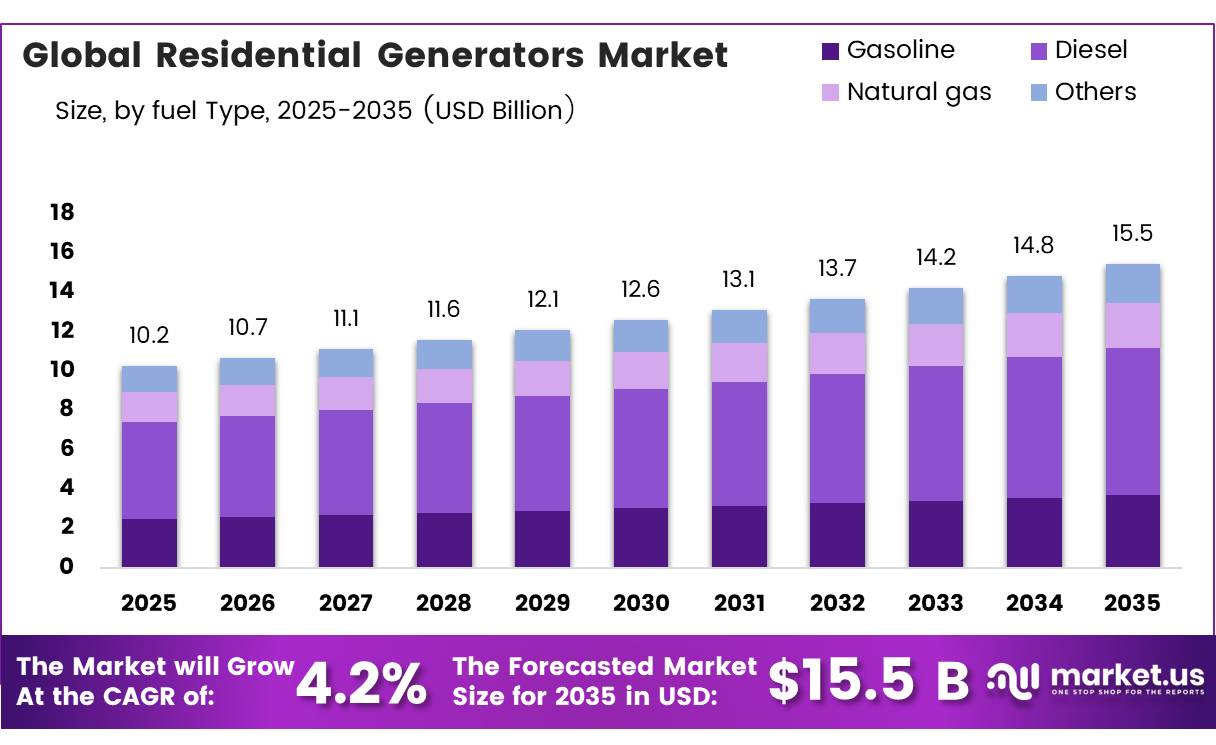
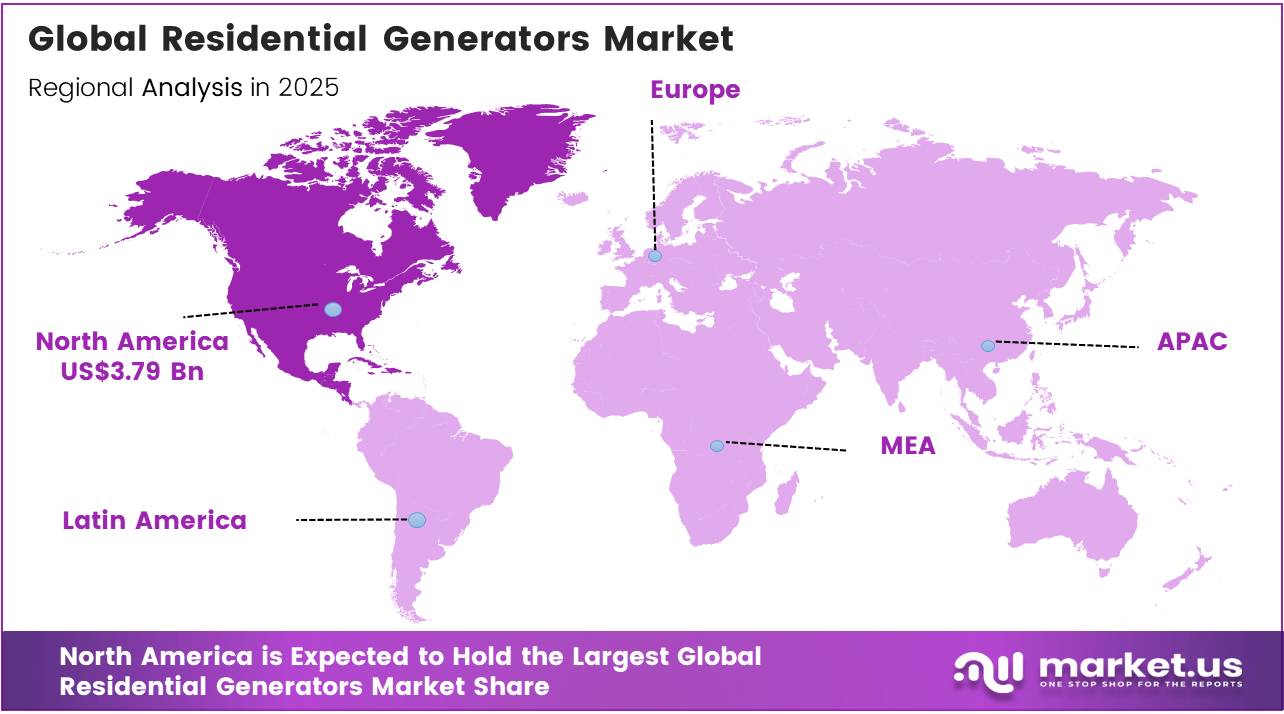
In 2025, the Global Residential Generators Market was valued at USD 10.2 billion, and between 2026 and 2035, this market is estimated to register a CAGR of 4.2%, reaching about USD 15.5 billion by 2035. In 2025, North America held a dominant market position, capturing more than a 37.0% share, holding USD 3.79 Billion revenue.
Residential generators provide temporary or automatic electricity when grid power fails, helping households keep essential appliances, lighting, heating, cooling, communication devices and water systems operating. Their role is expanding as severe weather, aging networks and home electrification increase outage risks, encouraging demand for reliable, fuel-efficient and appropriately sized backup solutions.
- The International Energy Agency reported that worldwide electricity demand increased 3% in 2025 and is forecast to grow 3.6% annually during 2026–2030. In the United States, customers experienced 11 hours of electricity interruptions in 2024, nearly twice the previous decade’s average, while major events caused 80% of outage hours.
Severe weather strengthens demand for portable, inverter, dual-fuel and automatic standby systems. NOAA recorded 27 U.S. billion-dollar disasters in 2024, producing USD 182.7 billion in damage and at least 568 deaths. Safety matters because the Consumer Product Safety Commission reports portable-generator carbon monoxide exposure causes nearly 100 U.S. deaths annually, encouraging shutoff sensors, quieter operation and ventilation guidance.
Future opportunities are emerging in hybrid generator-battery packages, smart transfer switches, remote diagnostics and solar-integrated backup systems. NERC’s 2025 assessment projected North American summer peak demand to rise 224 GW by 2035, 69% above its previous forecast. Government support strengthens resilience, the U.S. Department of Energy administers USD 10.5 billion through the GRIP program, supporting grid modernization and distributed-energy integration.
Key Takeaways
- The global Residential Generators market was valued at USD 10.2 billion in 2025.
- The global market is projected to grow at a CAGR of 4.2% and is estimated to reach USD 15.5 billion by 2035.
- On the basis of product type, the Portable generators dominated the market, constituting 56.7% of the total market share.
- Based on the fuel type, the Diesel dominated the Residential Generators market, with a substantial market share of around 48.2%.
- Among the Power Rating, the Below 3 kW-10 kW held a major share in the Residential Generators market, 42.1% of the market share.
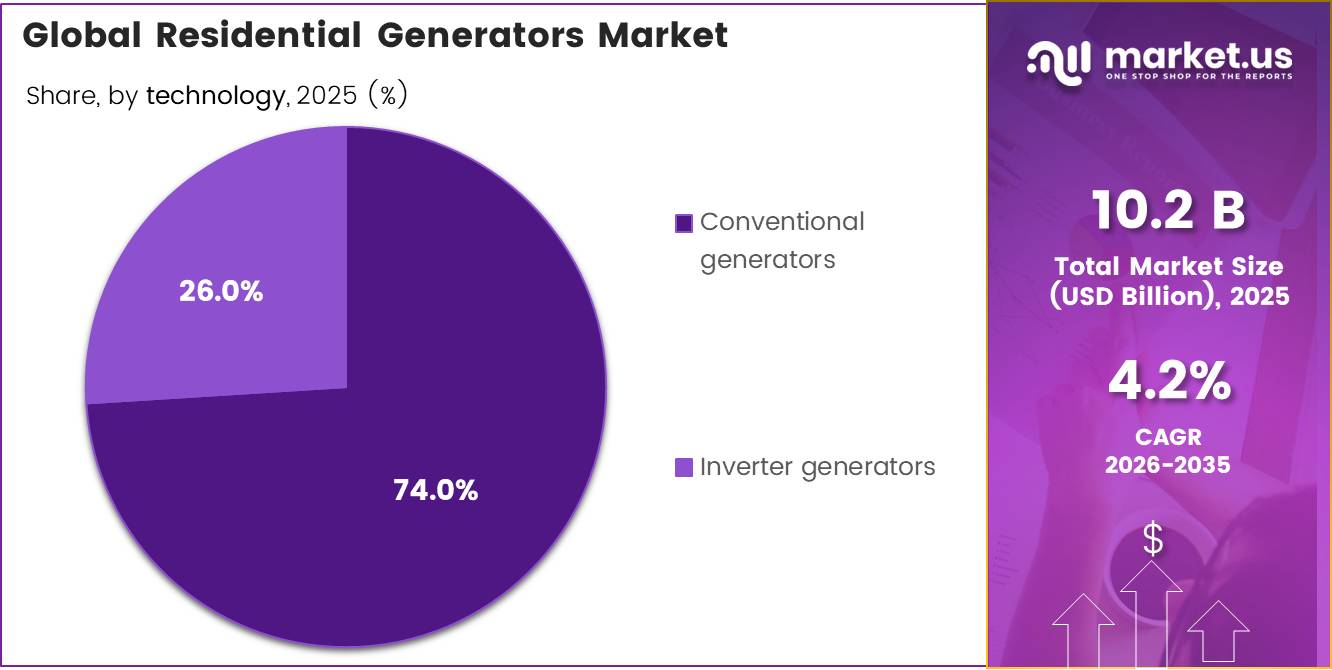
- Among the technologies, the Conventional generators is the most considerable within the market, accounting for around 74.0% of the revenue.
- Based on the Application, Emergency Backup led the market, comprising 60.8% of the total market.
- In 2025, the North America was the most dominant region in the Residential Generators market, accounting for 37.0% of the total global consumption.
Product Type Analysis
Portable generators represents dominant Segment in the Market.
Portable generators led the residential generators market in 2025 with a 56.7% share. Their flexible placement, lower commitment than permanent systems, and ability to power selected household loads make them practical during temporary outages. The U.S. Census Bureau estimated 145.3 million housing units in 2023, while 74% of occupied homes had central air conditioning, highlighting the growing number of electricity-dependent household systems.
- Residential users also consumed 1.51 trillion kWh in 2025, representing 37.3% of total U.S. electricity consumption. These conditions support demand for portable units with inverter controls, multiple fuel options, and safer operation.
Stationary generators are gaining traction among homeowners seeking automatic startup, whole-home coverage, and longer backup duration. The Census Bureau reported 82.9 million owner-occupied homes during 2019–2023, an 8.4% increase from 2014–2018, expanding the potential installation base. Growth is also supported by grid exposure, the U.S. Department of Energy states that the distribution network includes over 5.5 million line-miles and 180 million power poles, which account for most annual outages
Fuel Type Analysis
Diesel a significant fuel type.
Diesel remained the leading fuel type in the residential generators market, capturing more than a 48.20% share. Its high energy density supports longer operating periods, reliable load handling and reduced refuelling during extended power interruptions.
- The U.S. Department of Energy reports that low-sulfur diesel contains 128,488 Btu per gallon, while one diesel gallon provides around 113% of the energy contained in one gasoline-gallon equivalent. Diesel also has a flash point of approximately 165°F, supporting safer handling than more volatile liquid fuels.
Natural gas is emerging as the growing fuel segment because connected standby systems can operate without homeowners storing or manually refilling liquid fuel. The U.S. Energy Information Administration recorded 73,719,064 residential natural-gas consumers in 2024, compared with 73,275,155 in 2023.
Power Rating Analysis
Below 3 kW-10 kW Are the Most Widely Used power rating.
In 2025, the below 3 kW–10 kW segment held the leading position in the residential generators market, capturing more than a 42.1% share. This rating range suits households that mainly need refrigerators, lighting, communication devices, fans, pumps and selected heating equipment during an outage. Its balance of manageable fuel use, portability and sufficient essential-load coverage supports widespread adoption.
- The U.S. Energy Information Administration’s 2024 Residential Energy Consumption Survey covered 132.5 million occupied primary residences, while 42% of households used electricity as their main space-heating fuel, highlighting the expanding number of homes dependent on electrical equipment.
The 10–20 kW segment is growing as homeowners seek broader backup coverage for air conditioning, water pumps, kitchen appliances and home-working equipment. The U.S. Census Bureau recorded 1,005,000 single-family home completions in 2025, and 91% of owner-built homes included air conditioning. These power-intensive features create stronger demand for higher-capacity residential systems that can support several circuits simultaneously.
Technology Analysis
Conventional generators Held a Major Share of the Residential Generators Market.
In 2025, conventional generators led the residential generators market with a 74.0% share. Their simple mechanical design, higher power output, longer operating time and lower purchase cost make them practical for households needing dependable backup during prolonged outages.
- A Virginia Department of Health guide notes that conventional models generally run at a constant 3,600 rpm. California also requires portable generators rated at 19 kW or below to meet state emissions certification before being sold, encouraging cleaner engine designs without weakening performance.
Inverter generators are the growing segment as households increasingly prefer quieter, lighter and more fuel-efficient backup equipment. Unlike fixed-speed systems, their engines adjust speed according to the connected load, while cleaner electrical output better supports sensitive home electronics. For safe residential use, the U.S. Consumer Product Safety Commission recommends placing portable generators at least 20 feet from homes and directing exhaust away from openings
End Use Analysis
Residential Generators Are Mostly Utilized in the Automotive Sector.
Emergency Backup held the leading position in the residential generators market, capturing more than a 60.8% share. Households depend on these systems to maintain refrigeration, communication equipment, water pumps, medical devices, and heating or cooling during grid failures.
- In January 2026, the U.S. Department of Energy identified more than 35 GW of unused backup-generation capacity nationwide and stated that power outages cost Americans around USD 44 billion annually. This reliability pressure supports demand for automatic starting, transfer switches, longer runtime, and safer emergency operation.
Recreational and outdoor use is the growing application as camping, RV travel, and off-grid leisure increase the need for portable electricity. The National Park Service recorded 323,014,305 recreation visits, 1,386,749,187 visitor hours, and 13,016,577 overnight stays in 2025. This activity supports lighter and quieter generators for powering lights, cooking equipment, small appliances, and electronic devices away from grid connections.
Key Market Segments
By Product Type
- Portable generators
- Conventional portable generators
- Portable inverter generators
- Stationary generators
- Home standby generators
- Permanently installed prime-power generators
By Fuel Type
- Gasoline
- Diesel
- Natural gas
- Others
By Power Rating
- Below 3 kW-10 kW
- 10–20 kW
- Above 20 kW
By Technology
- Conventional generators
- Inverter generators
By Application
- Emergency Backup
- Recreational / Outdoor
- Others
Driver Analysis
Grid outage intensity and storm-linked resiliency buying
U.S. electricity customers experienced about 11 hours of interruption in 2024, almost double the prior decade’s annual average, and major events alone represented about 80% of outage hours; South Carolina was near 53 hours, while Hurricane Beryl left 2.6 million customers without power in Texas, Hurricane Helene affected 5.9 million customers across 10 states, and Hurricane Milton cut service to 3.4 million customers in Florida.
That reliability deterioration matters directly for residential generator conversion because home standby demand is highly event-triggered: Generac reported residential product sales fell 7% in 2025 to $2.27 billion after a softer outage year, then projected residential sales growth in the 10% range for 2026 assuming outage activity returns to its longer-term baseline.
The strategic implication is that storm frequency no longer acts only as a temporary sell-through catalyst; it is reshaping household capex priorities toward resiliency assets, especially in hurricane-prone U.S. regions where outage duration is long enough to justify a permanent standby system rather than a portable unit.
Drivers Impact Analysis
| Driver | (~) % Impact on CAGR Forecast | Geographic Relevance | Impact Timeline |
|---|---|---|---|
| Grid outage intensity and storm-linked resiliency buying | +2.4% | North America core; Caribbean spill-over; Japan coastal pockets | Short term (≤ 2 years) |
| Dealer-financed home standby adoption and insurance-led preparedness | +1.7% | U.S. South, Gulf Coast, Mid-Atlantic; Canada suburban belts | Short term (≤ 2 years) |
| Electrified homes raising backup power sizing needs | +1.5% | U.S. and Canada core; Western Europe selective | Medium term (2-4 years) |
| Natural gas network access improving permanent standby economics | +1.3% | U.S. suburban core; Canada urban fringe; limited EU niches | Medium term (2-4 years) |
| Emissions and efficiency regulation accelerating product replacement and premiumization | +1.1% | California core, U.S. regulated states, EU local compliance zones | Medium term (2-4 years) |
| Smart energy ecosystem integration with storage, ATS, and remote diagnostics | +0.9% | North America core; Australia and advanced APAC homes | Long term (≥ 4 years) |
Restraint Analysis
Stricter emissions controls and DG usage bans
Tightening emissions and air‑quality rules are structurally suppressing residential generator runtime and new installations in sensitive urban regions by making conventional diesel sets harder to operate, more expensive to retrofit, and more exposed to outright bans, as seen in India’s National Capital Region where the Commission for Air Quality Management has directed that diesel generators up to 800 kW must run in dual‑fuel mode with at least 70% gas and 30% diesel and be equipped with retrofit emission control devices capable of 70% particulate‑matter capture, with non‑compliant sets prohibited during GRAP ban periods except for narrowly defined emergency services.
For OEMs, Tier‑4‑like standards and local restrictions in U.S. non‑attainment areas and European clean‑air zones similarly raise engineering and certification costs, as Tier 4 diesel engines in the 19–56 kW band must meet combined NOx+HC limits near 4.7 g/kWh with particulate caps, which pushes manufacturers toward more expensive after‑treatment, advanced fuel systems, and in some cases a shift from high‑volume legacy platforms to lower‑volume compliant SKUs, compressing margins and slowing model refresh cycles for lower-income residential segments.
Restraint Impact Analysis
| Restraint | (~) % Impact on CAGR | Geographic Relevance | Impact Timeline |
|---|---|---|---|
| Stricter emissions controls and DG usage bans | -2.3% | India NCR; select EU cities; U.S. non-attainment zones | Medium term (2-4 years) |
| Rising equipment and install costs | -1.9% | North America core; EU; high-inflation APAC | Short term (≤ 2 years) |
| Fuel price volatility and diesel sentiment risk | -1.6% | North America; Europe; import-dependent APAC | Medium term (2-4 years) |
| Gas and grid constraints on standby deployments | -1.3% | India metros; gas-poor regions; dense EU cores | Medium term (2-4 years) |
| Supply chain and logistics disruptions | -1.1% | Global OEM supply corridors | Short term (≤ 2 years) |
| Policy preference for non-diesel backup and storage | -0.8% | EU; India NCR; advanced U.S. states | Long term (≥ 4 years) |
Opportunity Analysis
Hybrid generator + battery bundles
Hybrid generator‑plus‑battery bundles represent a clear white space because most current residential backup installations are either pure generators or standalone battery systems, yet the economics of combining a modest‑sized standby unit with 10–20 kWh of storage can unlock an untapped backup TAM in households that do not currently see a single‑technology solution as compelling.
With the broader generator‑sets market projected to nearly double from the low‑50‑billion range in 2026 to around 100 billion by 2035 and residential segments expected to grow faster than some industrial sub‑segments, even capturing 10–15% of new residential installations as hybrid bundles by 2030 could add 2–3 percentage points of incremental CAGR versus a generator‑only trajectory, especially in North America, Europe and Australia where rooftop solar and home batteries are rapidly diffusing.
Opportunity Impact Analysis
| Opportunity | (~) % Potential CAGR | Geographic Relevance | Execution Window |
|---|---|---|---|
| Hybrid generator + battery bundles | +2.4% | North America core; EU; Australia | Short term (≤ 2 years) |
| Grid-interactive, VPP-ready home gensets | +2.0% | U.S. peak-pricing states; EU flexibility markets | Medium term (2-4 years) |
| Subscription and “power-as-a-service” models | +1.8% | North America; APAC emerging markets | Medium term (2-4 years) |
| Mid-tier emerging markets expansion | +1.7% | APAC ex-China; Latin America; Africa | Long term (≥ 4 years) |
| Tiered low-emission and fuel-flex platforms | +1.5% | India NCR; EU cities; U.S. regulated states | Medium term (2-4 years) |
| Aftermarket digitization and remote O&M monetization | +1.3% | Global installed base corridors | Short term (≤ 2 years) |
Challenges Analysis
Skilled installer and electrician scarcity
European construction sectors alone are estimated to face a 2.1‑million‑worker deficit by 2026, with electricians and electrical fitters explicitly cited as among the hardest‑to‑fill trades across the eight largest markets and individual countries like Germany reporting more than 50,000 unfilled electrician vacancies in a single quarter of 2025, while North American markets echo similar shortages in both construction and energy transition projects.
This scarcity extends project lead times by weeks, increases install labor rates by mid‑single to low‑double‑digit percentages above general wage inflation, and forces OEMs and dealers to ration capacity across high‑value jobs, effectively capping the number of installs per year even when demand is strong; in turn, it introduces an estimated drag of roughly 1–2 percentage points on realizable CAGR relative to an unconstrained labor scenario.
Challenges Impact Analysis
| Challenge | (~) % CAGR Friction | Geographic Relevance | Mitigation Horizon |
|---|---|---|---|
| Skilled installer and electrician scarcity | -1.8% | North America core; EU regulatory hubs | Medium term (2-4 years) |
| Persistent equipment and input cost volatility | -1.6% | Global supply corridors | Medium term (2-4 years) |
| Logistics and long-lead equipment risk | -1.3% | EU, North America, APAC logistics corridors | Medium term (2-4 years) |
| Compliance and permitting complexity creep | -1.2% | EU regulatory hubs; India metros; U.S. suburban belts | Long term (≥ 4 years) |
| Technology substitution and customer confusion | -1.0% | North America core; EU; developed APAC | Long term (≥ 4 years) |
| Digital talent and cyber-resilience gap | -0.9% | Global OEM and dealer networks | Long term (≥ 4 years) |
Geopolitical Impact Analysis
Geopolitical Import Dependence and Critical-Mineral Concentration Reshaping Residential Generator Manufacturing.
Residential generator manufacturing remains exposed to global trade because engines, alternators, control boards and power-electronic components pass through international supply networks. The U.S. Census Bureau reported that goods imports reached USD 3.4 trillion in 2025, including a record USD 1.1 trillion in capital-goods imports. This sourcing scale leaves production schedules and component costs sensitive to trade restrictions, shipping disruption and currency volatility.
Mineral concentration creates an additional geopolitical risk. The U.S. Geological Survey reported that the country was 100% net-import reliant for 12 of 50 critical minerals and more than 50% reliant for another 28. China was the leading producer of 30 out of 44 critical minerals with sufficient data, increasing exposure to export controls and diplomatic disputes.
This environment is encouraging manufacturers to diversify suppliers, qualify regional alternatives and use interchangeable components. Such changes may raise near-term procurement costs, but they can reduce production interruptions and strengthen product availability during sudden residential backup-power demand.
Regional Analysis
North America Held the Largest Share of the Global Residential Generators Market.
North America held the leading position in the residential generators market, capturing more than a 37.0% share. Demand is supported by electricity-reliability concerns, widespread detached housing, severe seasonal conditions and growing dependence on connected household equipment.
- In March 2026, the U.S. Department of Energy announced approximately USD 1.9 billion for urgent transmission-grid upgrades. DOE also identified 154 GW of generation capacity in advanced development, although only 19 GW could operate continuously. This gap reinforces household interest in standby and portable generators that can maintain essential power when grid supply becomes constrained.
Asia-Pacific is the fastest-growing regional market as urban housing expands and consumers invest in household energy resilience. Australia’s Clean Energy Regulator reported that more than 193,000 batteries were installed during 2025, delivering 4.6 GWh of storage capacity, with over 98% installed by households. This rapid uptake shows strong regional demand for backup electricity and creates opportunities for generator-battery combinations, inverter models and compact systems designed for homes with rooftop solar.
Key Regions and Countries Covered
- North America
- The US
- Canada
- Europe
- Germany
- France
- The UK
- Spain
- Italy
- Russia & CIS
- Rest of Europe
- APAC
- China
- Japan
- South Korea
- India
- ASEAN
- Rest of APAC
- Latin America
- Brazil
- Mexico
- Rest of Latin America
- Middle East & Africa
- GCC
- South Africa
- Rest of MEA
Key Players Analysis
Residential generator manufacturers focus on improving product reliability, fuel flexibility, operating efficiency, and supply-chain resilience to remain competitive. A key priority is continuous technology development, including quieter engines, automatic transfer systems, inverter controls, remote monitoring, and carbon-monoxide shutdown features that improve safety and ease of use.
Companies also invest in modular product platforms that support multiple power ratings and fuel options, allowing faster production and broader household coverage. Closer coordination with engine suppliers, electronics providers, fuel-system specialists, and electrical contractors helps protect component availability and control costs during periods of material and logistics volatility. Manufacturing expansion near major housing and storm-prone markets enables faster delivery when outage-related demand rises.
In addition, producers place greater emphasis on emissions compliance, digital diagnostics, standardized installation, and after-sales service to build customer trust. Long-term relationships with distributors, retailers, utilities, and home-energy installers further strengthen market access, while hybrid generator-battery solutions help manufacturers position themselves in higher-value residential resilience applications.
The Major Players In The Industry
- Generac Holdings Inc.
- Honda Motor Co., Ltd.
- Cummins Inc.
- Rehlko (formerly Kohler Energy)
- Briggs & Stratton LLC
- Caterpillar Inc.
- Yamaha Motor Co., Ltd.
- Champion Power Equipment, Inc.
- Atlas Copco AB
- PRAMAC
- Westinghouse Electric Corporation
- DuroMax Power Equipment
- Kirloskar Oil Engines Limited
- HIMOINSA
- Wacker Neuson SE
Key Development
- In January 2025, Generac Holdings Inc. launched a redesigned air-cooled home standby range spanning 10–28 kW, led by a new 28 kW Electronic fuel and ignition controls improved motor-starting capability and reduced fuel use.
- In September 2025, Briggs & Stratton LLC partnered with EG4 to connect PowerProtect standby generators and SimpliPHI 6 batteries with 12KPV, 18KPV, FlexBOSS18 and FlexBOSS21 inverters, broadening hybrid backup choices for residential installers and homeowners.
Report Scope
| Report Features | Description |
|---|---|
| Market Value (2025) | USD 10.2 Bn |
| Forecast Revenue (2035) | USD 15.5 Bn |
| CAGR (2026-2035) | 4.2% |
| Base Year for Estimation | 2025 |
| Historic Period | 2020-2024 |
| Forecast Period | 2026-2035 |
| Report Coverage | Revenue Forecast, Market Dynamics, Competitive Landscape, Recent Developments |
| Segments Covered | By Product Type (Portable generators and Stationary generators), By Fuel Type (Gasoline, Diesel, Natural gas and Others), By power rating (Below 3 kW-10 kW, 10–20 kW and Above 20 kW), By Technology (Conventional generators and Inverter generators), By Application (Emergency Backup, Recreational / Outdoor and Others) |
| Regional Analysis | North America – The US & Canada; Europe – Germany, France, The UK, Spain, Italy, Russia & CIS, Rest of Europe; APAC– China, Japan, South Korea, India, ASEAN & Rest of APAC; Latin America– Brazil, Mexico & Rest of Latin America; Middle East & Africa– GCC, South Africa, & Rest of MEA |
| Competitive Landscape | Generac Holdings Inc., Honda Motor Co., Ltd., Cummins Inc., Rehlko (formerly Kohler Energy), Briggs & Stratton LLC, Caterpillar Inc., Yamaha Motor Co., Ltd., Champion Power Equipment, Inc., Atlas Copco AB, PRAMAC, Westinghouse Electric Corporation, DuroMax Power Equipment, Kirloskar Oil Engines Limited, HIMOINSA, Wacker Neuson SE. |
| Customization Scope | Customization for segments, region/country-level will be provided. Moreover, additional customization can be done based on the requirements. |
| Purchase Options | We have three licenses to opt for: Single User License, Multi-User License (Up to 5 Users), Corporate Use License (Unlimited Users and Printable PDF) |





































