


Report Overview
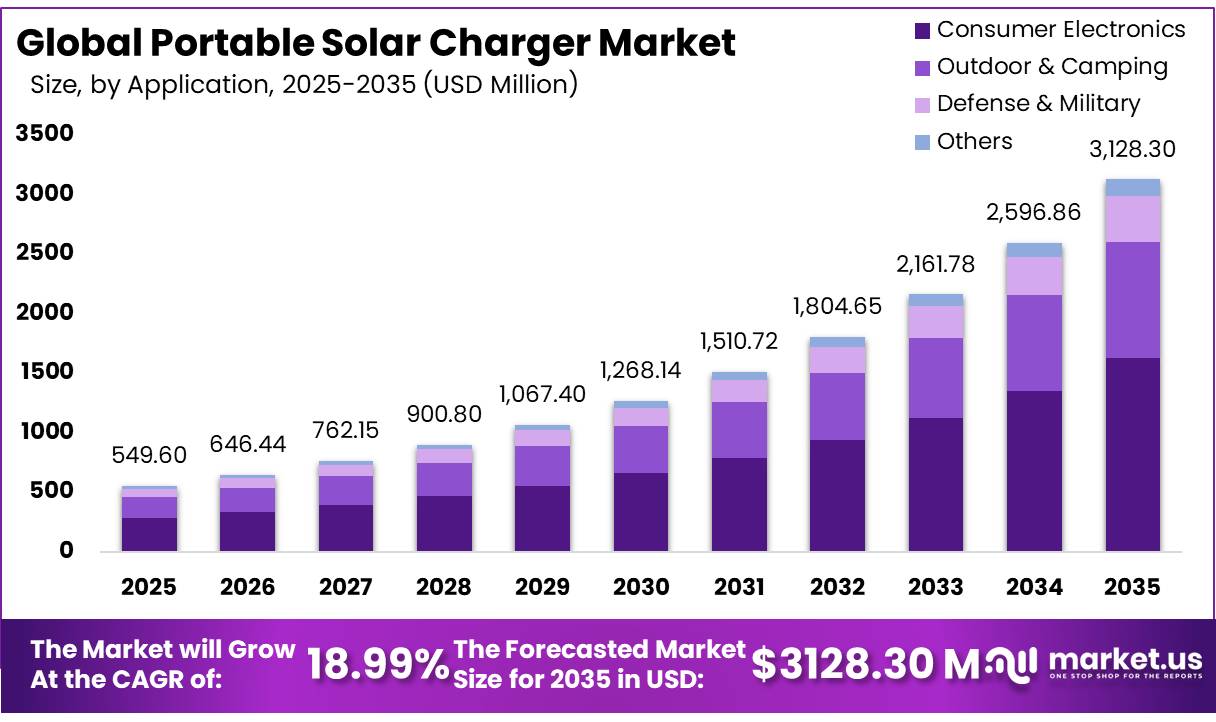
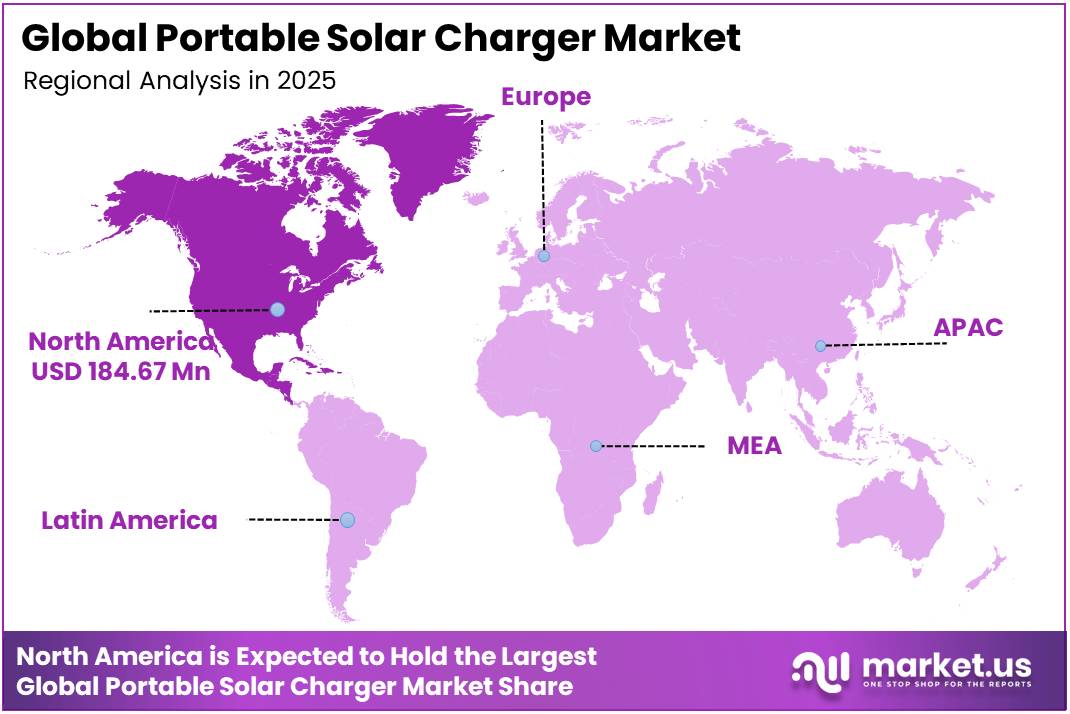
In 2025, the Global Portable Solar Charger Market was valued at USD 549.60 million, and between 2026 and 2035, this market is estimated to register a CAGR of 18.99%, reaching about USD 3128.30 million by 2035. North America led the market, achieving over 33.6% share with a revenue of USD 184.67 million.
The global portable solar charger market is the commercial industry built around compact, lightweight devices that capture sunlight through photovoltaic cells and convert it directly into usable electrical energy for charging smartphones, tablets, cameras, GPS systems, power banks, and a growing range of portable electronics, all without any connection to a fixed power supply.
- In March 2026, according to the International Renewable Energy Agency, global solar power capacity reached 2,392 GW at the end of 2025, accounting for approximately 46.5% of total renewable power capacity worldwide. This expanding solar base supports wider awareness, technical development, and commercial acceptance of photovoltaic products across both fixed and portable applications.
Key Takeaways
- The global portable solar charger market was valued at USD 549.60 million in 2025.
- The market is projected to grow at a CAGR of 18.99% and is estimated to reach USD 3128.30 million by 2035.
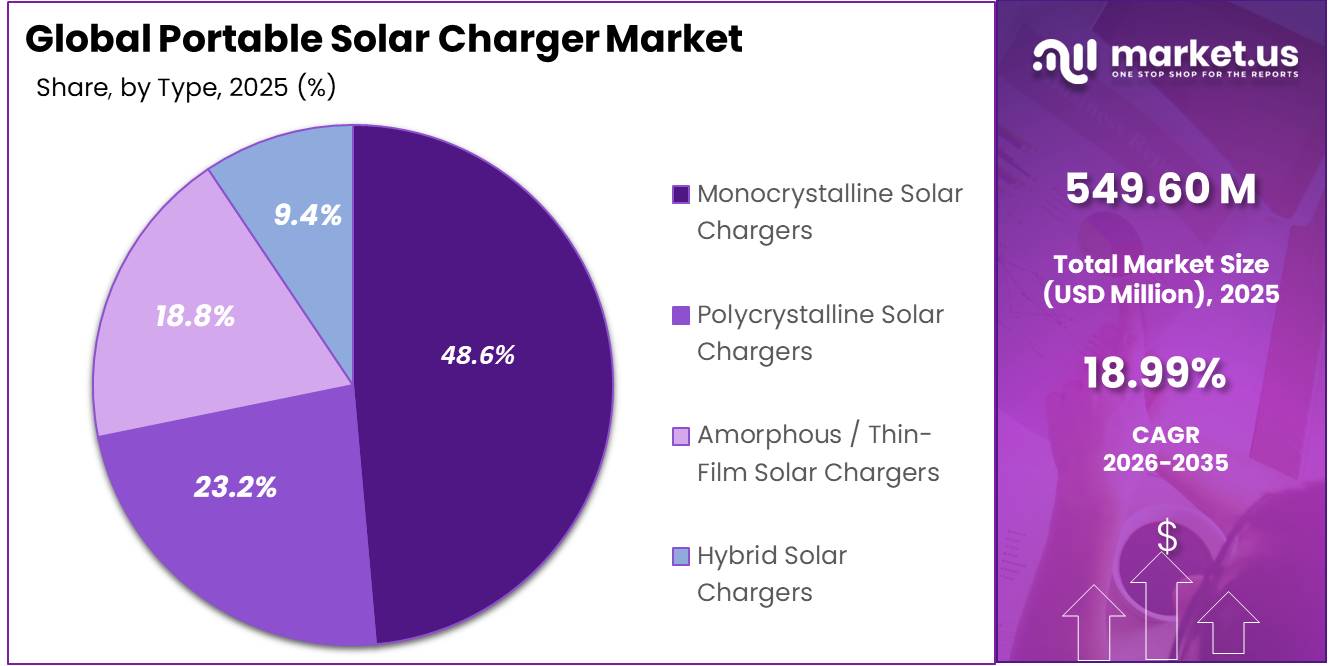
- On the basis of type, monocrystalline solar chargers dominated the market, constituting 48.6% of the total market share.
- Based on the application, consumer electronics dominated the portable solar charger market, with a substantial market share of around 52.2%.
- Based on the capacity, 10W to 50W dominated the portable solar charger market, with a substantial market share of around 44.8%.
- In 2025, North America was the most dominant region in the portable solar charger market, accounting for 33.6% of the total global consumption.
These devices work on a beautifully simple principle point a panel at the sky and get free, clean, renewable power wherever you are. What makes the market genuinely compelling is its dual value proposition portable solar chargers are both environmentally responsible and practically useful, delivering real charging capability in locations and situations where conventional power infrastructure is unavailable, unreliable, or simply not present.
- In June 2026, according to the World Bank-led Tracking SDG 7 report, approximately 655 million people still lacked access to electricity in 2024, while the global electricity access rate remained at 92%. This continuing access gap strengthens the practical role of decentralized solar products in remote communities, disaster-affected locations, and areas with weak grid reliability.
This combination has elevated the portable solar charger from a niche outdoor accessory into a fast-growing and commercially serious global industry, valued at several billion dollars and expanding at a strong double-digit pace across consumer, outdoor, defence, and emergency application segments worldwide.
- In April 2026, according to the International Energy Agency, global solar photovoltaic generation recorded an increase of approximately 600 TWh in 2025, reaching nearly 2,700 TWh and contributing more than 8% of total global electricity generation. The record expansion demonstrates the growing importance of solar technology within the wider electricity system.
The portable solar charger market continues to expand due to several interconnected factors that are driving demand across both consumer and institutional sectors. One of the primary growth drivers is the widespread adoption of portable electronic devices, with smartphones, smartwatches, wireless earbuds, tablets, and portable speakers becoming essential parts of daily life for billions of users worldwide and the demand for flexible, location-independent charging solutions is growing in direct proportion to that device ownership. Environmental awareness is changing purchasing behaviour at the same time, with consumers increasingly choosing solar-powered products because they want their everyday choices to reflect their values around sustainability and clean energy.
- In October 2025, according to the International Energy Agency, global renewable power capacity was projected to increase by approximately 4,600 GW between 2025 and 2030, with solar photovoltaic technology accounting for almost 80% of the expected expansion. This outlook creates a favourable technology and investment environment for smaller solar-powered consumer products, including portable charging equipment.
The global surge in outdoor recreation hiking, camping, overlanding, and off-grid travel has created a large and enthusiastic user base who depend on portable solar chargers for real power needs in real environments. And the growing recognition by defence agencies and emergency preparedness planners that off-grid energy independence is a strategic necessity is adding a powerful institutional demand layer on top of an already strong and expanding consumer market.
Type Analysis
Monocrystalline Solar Chargers Represent the Dominant Segment in the Market.
Monocrystalline solar chargers lead the portable solar charger technology segment with a 48.6% share, Its market leadership is primarily driven by its superior energy conversion efficiency. Monocrystalline panels are made from a single continuous crystal structure of silicon, which gives them the highest light-to-electricity conversion efficiency of any commercially available solar cell technology, typically ranging between eighteen and twenty-four percent under standard conditions.
In a portable charger where panel surface area is physically constrained by the need to keep the device compact and lightweight, that efficiency advantage translates directly into more power output from a smaller panel, which is exactly what every portable solar charger user needs.
- In October 2025, according to the IEA Photovoltaic Power Systems Programme, single-crystal silicon cells offered commercial conversion efficiencies of 20% to 25%, compared with approximately 18% to 21% for multicrystalline technology. The report also stated that single-crystal cells accounted for nearly 100% of the silicon PV module market, highlighting their strong commercial preference for applications requiring greater power output from limited panel space.
By Application Analysis
Consumer Electronics Represents the Dominant Application Segment in the Market.
Consumer electronics accounts for 52.2% of total portable solar charger application demand, making it the leading application segment. This leadership is driven by the rapid increase in the use of portable electronic devices worldwide. Smartphones have become an essential part of everyday life, supporting communication, navigation, digital payments, work, and entertainment. As a result, maintaining battery life has become a daily necessity, creating strong demand for reliable portable charging solutions.
Tablets, laptops, wireless earbuds, smartwatches, e-readers, cameras, and portable speakers all add to the daily charging burden that consumers are managing and portable solar chargers provide a flexible, clean, and cost-free way to keep all of these devices powered without being tethered to a wall outlet. As global smartphone penetration continues to grow particularly across Asia-Pacific and Latin America where first-time smartphone ownership is expanding rapidly the consumer electronics application base for portable solar chargers is growing in direct proportion.
- For instance, in June 2024, Yard Force (Sumec Group) launched the 100W Portable Solar Panel LX SPP10, a multi-device portable solar charger designed for reliable USB charging both indoors and outdoors, directly targeting the rapidly growing consumer electronics application segment with a product that bridges everyday household convenience and outdoor off-grid charging needs in a single versatile device.
The outdoor and camping segment is the fastest growing segment, experiencing particularly strong growth driven by the global post-pandemic surge in outdoor recreation, adventure tourism, and off-grid travel that has fundamentally and permanently elevated number of people engage with outdoor activities. Portable solar chargers have become as standard a piece of camping and hiking kit as a tent or a sleeping bag for serious outdoor enthusiasts who need reliable off-grid power for navigation devices, headlamps, satellite communicators, and cameras across multi-day expeditions far from conventional power infrastructure.
By Capacity Analysis
10W to 50W Represents the Dominant Capacity Segment in the Market.
The 10W to 50W capacity range leads the portable solar charger market with a 44.8% share and this dominance reflects the segment’s optimal positioning across the broadest range of real-world use cases. A portable solar charger in this power range delivers enough output to meaningfully charge a smartphone within two to four hours of direct sunlight, top up a tablet or camera battery over a full day’s outdoor use, and simultaneously supply multiple low-power devices through multiple USB ports making it genuinely practical for the everyday consumer and the serious outdoor user alike.
- In March 2026, according to the U.S. Army Center for Army Lessons Learned, tablets and smartphones typically required 5W to 15W while charging, handheld radio chargers used 10W to 30W, and optical-device chargers required 10W to 40W. These power requirements show why the 10W to 50W category can support several commonly used portable electronics while remaining suitable for lightweight and mobile charging systems.
The above 50W segment is the fastest growing capacity category driven by the expanding market for high-capacity portable power stations, RV and van-life solar charging systems, and professional outdoor and military applications where charging larger batteries, running power-hungry devices, or supplying multiple users simultaneously requires significantly higher solar input than the mid-range category can deliver.
Key Market Segments
By Type
- Monocrystalline Solar Chargers
- Polycrystalline Solar Chargers
- Amorphous / Thin-Film Solar Chargers
- Hybrid Solar Chargers
By Application
- Consumer Electronics
- Outdoor & Camping
- Defense & Military
- Others
By Capacity
- Up to 10W
- 10W – 50W
- Above 50W
Driver Analysis
Emergency backup charging demand from outage preparedness
U.S. government preparedness guidance explicitly tells households to keep a cell phone with chargers and a backup battery in emergency kits, while Ready.gov’s power-outage guidance says consumers should keep mobile phones charged before outages and plan alternative power sources to charge devices.
The addressable trigger set is also expanding: NOAA’s long-running billion-dollar disaster dataset was discontinued in 2025, but contemporaneous reporting on the final published cycle still showed 23 U.S. billion-dollar weather and climate disasters in 2025 causing $115 billion in damage, reinforcing sustained consumer attention to outage risk. In practice, this driver lifts unit velocity most in hurricane, wildfire, flood, and storm-prone regions where the use case is not “green gadget” discretionary demand but continuity of communications, lighting, GPS, and small electronics during 24- to 72-hour disruptions, which supports higher sell-through for 10–40 W foldable chargers and bundled solar-plus-power-bank kits.
Drivers Impact Analysis
| Driver | (~) % Impact on CAGR Forecast | Geographic Relevance | Impact Timeline |
|---|---|---|---|
| Emergency backup charging demand from outage preparedness | +2.2% | North America core, Caribbean spill-over, East Asia typhoon belts | Short term (≤ 2 years) |
| Lower PV input costs and higher module efficiency | +1.9% | APAC manufacturing hubs, EU, North America, India | Short term (≤ 2 years) |
| Air-travel compliant off-grid charging use cases | +1.3% | North America core, EU, ASEAN travel corridors, Middle East hubs | Short term (≤ 2 years) |
| Distributed solar awareness from record global PV deployment | +1.6% | China, EU, USA, India, Brazil, Pakistan spill-over | Medium term (2-4 years) |
| Public electrification gaps in remote and field settings | +1.4% | South Asia, Sub-Saharan Africa, LATAM rural corridors, disaster-response zones | Medium term (2-4 years) |
| Policy-led domestic solar manufacturing and procurement visibility | +1.1% | India core, USA selective, EU selective | Medium term (2-4 years) |
Restraint Analysis
Lithium air-travel limits
Portable solar chargers that integrate lithium-ion storage face an immediate commercial drag because U.S. aviation rules require spare lithium-ion batteries and power banks to travel in carry-on baggage only, cap most consumer batteries at 100 Wh without special approval, and subject larger 101–160 Wh units to airline approval with a two-spare limit, which directly constrains airport retail, cross-border parcel design, and premium-capacity SKU architecture.
For manufacturers selling foldable charger-plus-battery bundles, this pushes engineering toward lower-capacity packs, thicker protection circuitry, more labeling, and more consumer support overhead, typically raising bill of materials by an estimated 4–7% and reducing conversion on higher-capacity travel SKUs by roughly 8–12% in air-travel-heavy channels; the strategic effect is a modeled -2.1 percentage point drag on 2026 baseline CAGR in North America and other aviation-dependent markets because retailers favor compliance-safe sub-100 Wh configurations, depressing ASP expansion and delaying launch of higher-margin modular products.
Restraint Impact Analysis
| Restraint | (~) % Impact on CAGR Forecast | Geographic Relevance | Impact Timeline |
|---|---|---|---|
| Lithium air-travel limits | -2.1% | North America core, EU, APAC air corridors | Short term (≤ 2 years) |
| Solar input tariff volatility | -1.8% | U.S. import market, India, ASEAN-linked corridors | Medium term (2-4 years) |
| Compliance cost escalation | -1.4% | EU, North America, Japan, Korea | Medium term (2-4 years) |
| Battery safety failure risk | -1.2% | Global e-commerce and air-shipped markets | Short term (≤ 2 years) |
| Low irradiance seasonality | -1.0% | EU north, UK, Canada, Northeast U.S., Japan | Long term (≥ 4 years) |
| Grid-price competition from cheap USB power | -0.8% | Urban North America, EU, developed APAC | Long term (≥ 4 years) |
Opportunity Analysis
Off-grid public procurement
This is a future opportunity rather than a baseline driver because current growth assumptions typically capture consumer and retail-led adoption, not structured institutional demand generated by electrification programs, aid tenders, school-health outposts, and local-government accessory procurement tied to the last-mile energy-access agenda; World Bank and IEA-linked SDG7 tracking shows almost 92% of the world had electricity access in 2023, yet more than 666 million people still lacked access, with the vast majority concentrated in Sub-Saharan Africa and with decentralized solar systems, especially solar home systems, already proving scalable in major African markets.
The untapped upside sits in redesigning portable solar chargers as low-ticket, rapidly deployable adjunct products for teachers, community health workers, micro-retailers, and students rather than only as consumer gadgets, which opens procurement-led TAM that could reasonably exceed USD 250 million to USD 400 million by the early 2030s under conservative attachment assumptions of 2% to 4% against newly electrified or partially electrified households and institutions; because public or donor-led orders can cut customer-acquisition costs by 35% to 50%, improve inventory turns through batch tenders, and create local assembly incentives, successful execution could add about +2.1 percentage points to sector CAGR in Sub-Saharan Africa and South Asia over a 2-to-4-year window.
Opportunity Impact Analysis
| Opportunity | (~) % Potential CAGR Upside | Geographic Relevance | Execution Window |
|---|---|---|---|
| Disaster-prep retail bundles | +2.4% | North America core, Caribbean, Japan | Short term (≤ 2 years) |
| Off-grid public procurement | +2.1% | Sub-Saharan Africa, South Asia | Medium term (2-4 years) |
| Travel/outdoor premiumization | +1.7% | North America, EU, Australia, Japan | Short term (≤ 2 years) |
| B2B charging-as-a-service | +1.5% | EU, North America, GCC, island economies | Medium term (2-4 years) |
| Medical-resilience niche SKUs | +1.2% | U.S., EU, rural APAC, Africa | Medium term (2-4 years) |
| Roll-up of accessory brands | +1.9% | North America, EU, China-to-global | Long term (≥ 4 years) |
Challenges Analysis
Battery raw‑material tightness
Battery raw‑material tightness constitutes a structural friction for portable solar charger makers because the segment overwhelmingly relies on lithium‑ion packs in the 5,000–30,000 mAh band, directly exposed to the same lithium, nickel and graphite constraints affecting advanced batteries, with European Commission analysis projecting global demand for battery raw materials to rise 5× by 2030 and up to 14× by 2040 versus 2020 levels, with demand outstripping supply for most materials beyond 2029–2030 unless new investments emerge.
In practice, cell suppliers report 10–15% lead‑time elongation versus pre‑2020 baselines, with build‑to‑order cycles stretching from 45–60 days to 70–90 days and spot price premia of 6–10% on high‑energy‑density cells that portable chargers require to remain compact, which translates into working‑capital lock‑ups of an extra 20–40 days and inventory buffers of 1.5–2.0 months to avoid stock‑outs during peak outdoor seasons. These frictions trim potential market CAGR by an estimated 1.0–1.2 percentage points because brands either constrain SKU launches (reducing innovation throughput by 20–30%) or raise prices 4–7% on high‑capacity models, narrowing adoption among mass‑market users and delaying replacement cycles from 2–3 years to more than 3–4 years.
Challenges Impact Analysis
| Challenge | (~) % CAGR Friction Drag | Geographic Relevance | Mitigation Horizon |
|---|---|---|---|
| Volatile PV input costs | -1.4% | China-centric supply, global importers | Medium term (2-4 years) |
| Battery raw-material tightness | -1.2% | EU & North America demand hubs | Long term (≥ 4 years) |
| Distributed logistics & customs | -0.9% | APAC–EU–NA trade lanes | Medium term (2-4 years) |
| Standards & durability fragmentation | -0.8% | EU regulatory hubs, OECD markets | Medium term (2-4 years) |
| Design-to-talent capability gap | -0.7% | Emerging-market assemblers | Long term (≥ 4 years) |
| Grid-adjacent infrastructure limits | -0.6% | Rural Africa, South Asia, LATAM | Long term (≥ 4 years) |
Geopolitical Impact Analysis
Energy Security Policies and Supply Chain Concentration are Reshaping the Portable Solar Charger Industry
The portable solar charger market is more exposed to geopolitical developments than its consumer-facing positioning might suggest because the photovoltaic cells, semiconductor components, and battery storage systems that power these products are manufactured within global supply chains that are deeply affected by the trade policy shifts and geopolitical tensions reshaping international commerce.
The broader geopolitical push for energy security and domestic manufacturing resilience is simultaneously creating powerful policy tailwinds for the portable solar charger market. Governments across the US, EU, Japan, South Korea, and Australia are implementing industrial policy programmes that actively incentivise domestic solar technology manufacturing and the adoption of renewable energy products including portable solar chargers as part of national energy resilience strategies.
Throughout 2025, the US Inflation Reduction Act’s domestic manufacturing incentives continued to accelerate the buildout of American wafer and cell factories. While primarily aimed at grid infrastructure, this expansion has begun lowering the baseline domestic cost of specialized photovoltaic materials. This provides American portable solar charger brands with viable, long-term regional sourcing alternatives to mitigate escalating Chinese import tariffs.
Regional Analysis
North America Leads the Global Portable Solar Charger Market.
In 2025, North America dominated the global portable solar charger market, holding 33.6% of total global consumption a leadership position built on the region’s exceptionally high consumer electronics adoption rate, deeply established outdoor recreation culture, strong environmental awareness driving renewable energy product purchasing, and the most commercially mature portable solar charger retail ecosystem in the world.
The United States drives the overwhelming majority of this share home to some of the world’s most recognised portable solar charger brands and a consumer base that combines high disposable income, strong sustainability values, and an active outdoor lifestyle that creates consistent and high-value demand for portable solar charging products across every capacity range and application category.
Similarly, Canada contributes meaningfully through its own strong outdoor recreation culture and rapidly growing clean energy consumer preference particularly in British Columbia, Ontario, and Quebec where active lifestyle demographics and urban environmental consciousness combine to create strong retail demand for premium portable solar charger products. Strong government support for renewable energy adoption across the US and Canada including clean energy product incentives under the Inflation Reduction Act and equivalent Canadian programmes is providing additional structural demand support that reinforces North America’s market leadership through the forecast period.
Key Regions and Countries Covered
- North America
- The US
- Canada
- Europe
- Germany
- France
- The UK
- Spain
- Italy
- Russia & CIS
- Rest of Europe
- APAC
- China
- Japan
- South Korea
- India
- ASEAN
- Rest of APAC
- Latin America
- Brazil
- Mexico
- Rest of Latin America
- Middle East & Africa
- GCC
- South Africa
- Rest of MEA
Key Players Analysis
The global portable solar charger market presents a genuinely dynamic competitive landscape where large consumer electronics companies leverage their brand recognition, distribution infrastructure, and manufacturing scale alongside a vibrant ecosystem of dedicated portable energy and solar technology specialists who compete on product performance, innovation depth, and application-specific expertise.
The competitive dynamics are intensifying as the market matures and the performance gap between leading and mid-tier products narrows. Manufacturers are increasingly differentiating through ecosystem strategies developing families of complementary portable power products including solar chargers, high-capacity power stations, and smart home energy storage systems that are designed to work together seamlessly and create switching costs that retain customers across multiple product generations.
The Major Players In The Industry
- Anker Innovations Limited
- Goal Zero (NRG Energy)
- EcoFlow Inc.
- Renogy USA Inc.
- BigBlue Tech Corp
- RAVPower (Sunvalleytek)
- Voltaic Systems
- Allpowers Industrial International Ltd.
- BioLite Inc.
- Jackery Inc.
- Rockpals
- Xtorm (Telco Accessories B.V.)
- Other Key Players
Key Development
- In October 2025, BigBlue Tech Corp strengthened its portable solar charger business by introducing the SolarPowa P35, a 35W foldable charger with a 10-panel design, 25.4% solar conversion efficiency, 3 USB ports and a low weight of 0.7 kg. The product also offers IP68 panel protection and up to 25W USB-C fast charging, making it suitable for hiking, camping and emergency power needs.
- In June 2025, Anker Innovations Limited strengthened its position in the portable solar charger sector by launching the Anker SOLIX F3000 Portable Power Station. The unit offers 3,072 Wh of storage, 3,600 W output and 2,400 W solar input, allowing it to recharge through most rigid and portable solar panels. Buyers can expand its capacity to 12,288 Wh by connecting three additional batteries, making the system suitable for camping, off-grid living and emergency household power.
Report Scope
| Report Features | Description |
|---|---|
| Market Value (2025) | US$549.60 Mn |
| Forecast Revenue (2035) | US$3128.30 Mn |
| CAGR (2026-2035) | 18.99% |
| Base Year for Estimation | 2025 |
| Historic Period | 2020-2024 |
| Forecast Period | 2026-2035 |
| Report Coverage | Revenue Forecast, Market Dynamics, Competitive Landscape, Recent Developments |
| Segments Covered | By Type (Monocrystalline Solar Chargers, Polycrystalline Solar Chargers, Amorphous / Thin-Film Solar Chargers, and Hybrid Solar Chargers), By Application (Consumer Electronics, Outdoor and Camping, Defense and Military, and Others), By Capacity (Up to 10W, 10W to 50W, and Above 50W) |
| Regional Analysis | North America – The US & Canada; Europe – Germany, France, The UK, Spain, Italy, Russia & CIS, Rest of Europe; APAC– China, Japan, South Korea, India, ASEAN & Rest of APAC; Latin America– Brazil, Mexico & Rest of Latin America; Middle East & Africa– GCC, South Africa, & Rest of MEA |
| Competitive Landscape | Anker Innovations Limited, Goal Zero (NRG Energy), EcoFlow Inc., Renogy USA Inc., BigBlue Tech Corp, RAVPower (Sunvalleytek), Voltaic Systems, Allpowers Industrial International Ltd., BioLite Inc., ackery Inc., Rockpals Xtorm (Telco Accessories B.V.), Other Key Players |
| Customization Scope | Customization for segments, region/country-level will be provided. Moreover, additional customization can be done based on the requirements. |
| Purchase Options | We have three licenses to opt for: Single User License, Multi-User License (Up to 5 Users), Corporate Use License (Unlimited Users and Printable PDF) |





































