


Report Overview
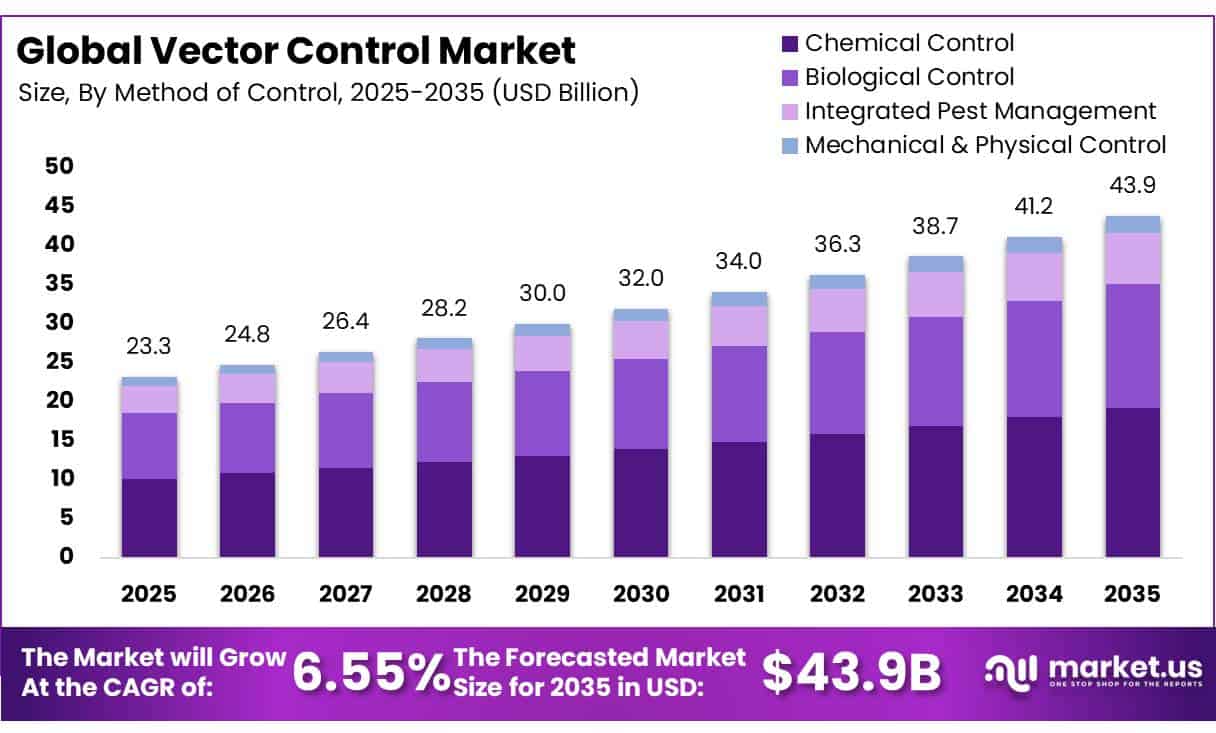
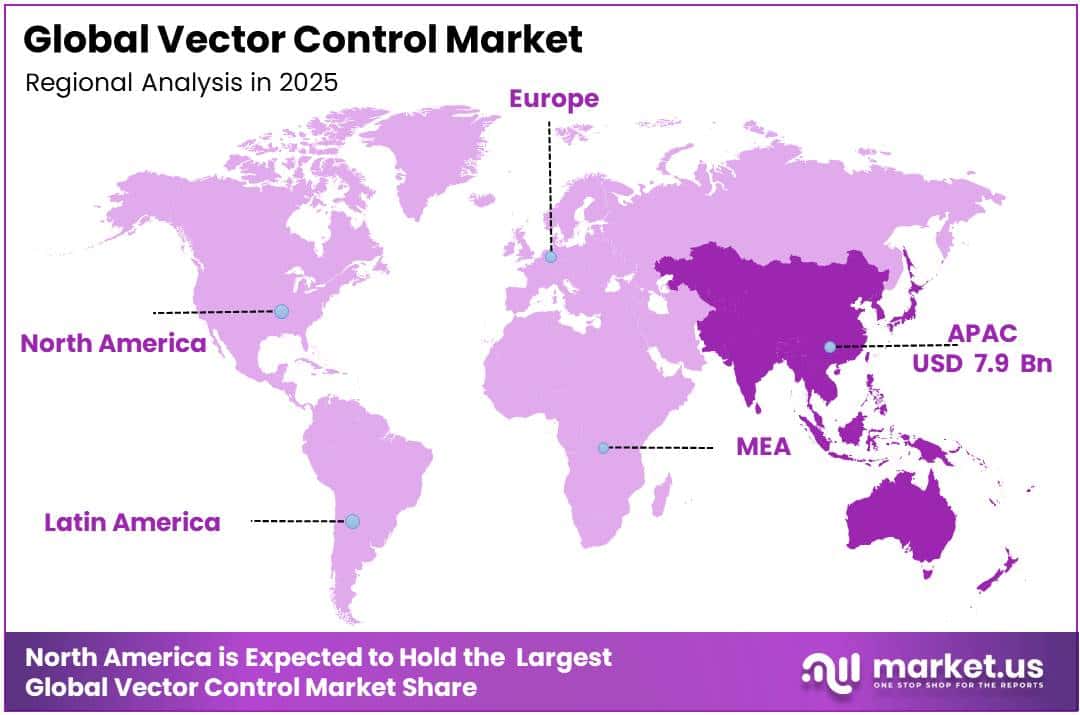
In 2025, the Global Vector Control Market was valued at USD 23.27 Billion, and between 2026 and 2035, this market is estimated to register a CAGR of 6.55%, reaching about USD 43.88 Billion by 2035. Asia-Pacific held a dominant market position, capturing more than a 34% share, holding USD 7.9 Billion in revenue.
Vector control encompasses the surveillance, prevention, and management of disease-transmitting organisms such as mosquitoes, ticks, and flies that spread pathogens responsible for malaria, dengue, Zika, and other illnesses.
- The World Health Organization (WHO) reports that more than 80% of the global population remains at risk of at least one vector-borne disease, with vectors collectively transmitting illnesses that claim over 700,000 lives annually, underscoring vector control as a cornerstone of global public health infrastructure.
Key Takeaways
- The Global Vector Control Market was valued at USD 23.27 billion in 2025.
- The global market is projected to grow at a CAGR of 6.55% and is estimated to reach USD 43.88 billion by 2035.
- On the basis of method of control, Chemical Control dominated the market, constituting 43.85% of the total market share.
- Based on the vector type, Insects (Mosquitoes, Flies, Ticks) dominated the market, accounting for 59.50% of the total market share.
- Based on the application, Public Health dominated the market, accounting for 38.50% of the total market share.
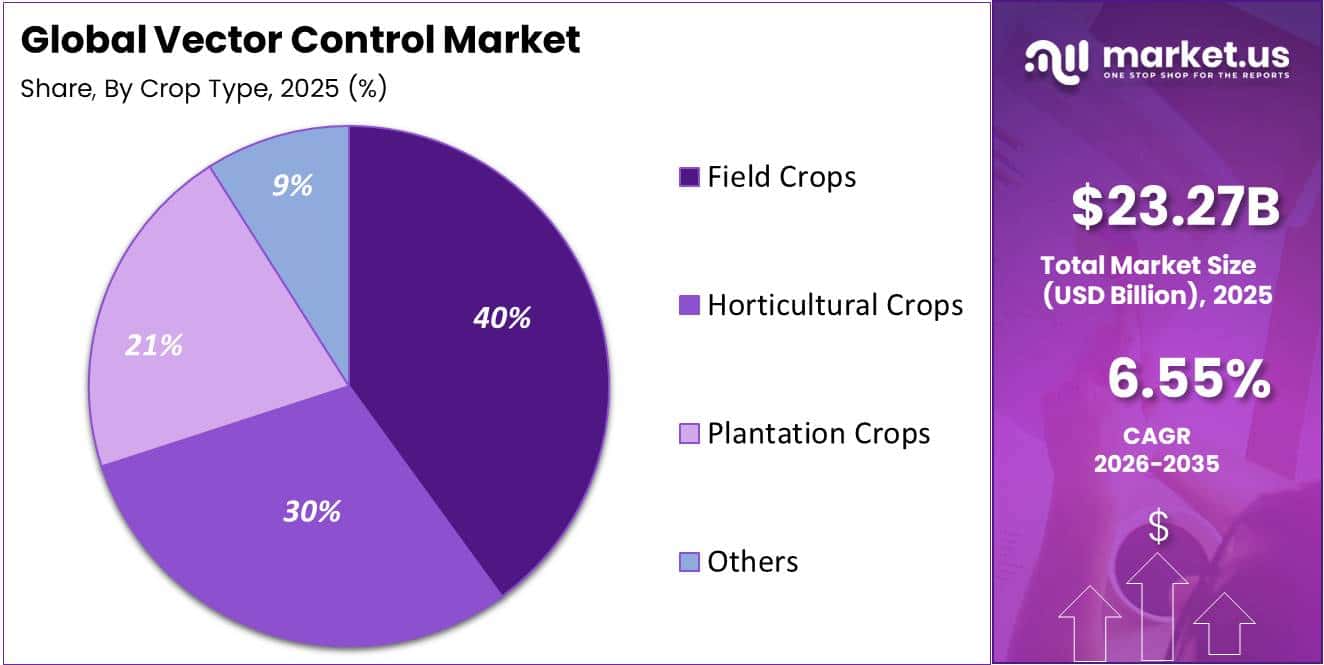
- Based on the crop type, Field Crops dominated the market, accounting for 40.0% of the total market share.
- In 2025, Asia Pacific was the most dominant region in the vector control market, accounting for 34.0% of the global market.
According to the WHO World Malaria Report 2025, global malaria cases reached an estimated 282 million in 2024, roughly 9 million more than the previous year, with 610,000 deaths recorded. In the United States, the Centers for Disease Control and Prevention (CDC) documented more than 1 million vector-borne disease cases reported between 2001 and 2023, with annual case counts more than doubling over this period, reflecting rising demand for vector surveillance and control activities.
Rising insecticide resistance among vector populations is a primary driver of innovation; the WHO’s World Malaria Report 2025 notes that Anopheles stephensi, an invasive malaria vector, has now spread across nine African countries. In response, the U.S. Environmental Protection Agency (EPA) registered a Wolbachia wAlbB strain product, WB1 Males, in April 2024 as a population-suppression tool for Aedes aegypti mosquitoes, opening growth opportunities in biological and genetic vector-control technologies as alternatives to chemical insecticides.
In December 2024, the EPA issued its first voucher under the Vector Expedited Review Voucher (VERV) Program, established under the Pesticide Registration Improvement Act of 2022, to expedite regulatory review of novel mosquito-control products and encourage industry investment in next-generation vector-control technologies. At the global level, WHO reports that malaria-endemic governments and international partners have committed to the 2024 Yaounde Declaration and the 2025 Big Push initiative, renewing political leadership and coordinated investment to reinvigorate vector-control programs worldwide.
By Method of Control
Chemical Control dominates with 43.85% due to its broad use in public health and agricultural vector management.
In 2025, Chemical Control held a dominant market position, capturing more than a 43.85% share of the vector control market. Its leading position was supported by the widespread use of insecticides, larvicides, and rodenticides in mosquito, fly, tick, and rodent control programs across public health, agriculture, and commercial settings. Government health authorities and vector control agencies continue to rely on chemical interventions because they provide rapid action during disease outbreaks and large-scale pest management campaigns.
In 2026, Biological Control emerged as the fastest-growing segment in the vector control market. Growth has been driven by increasing interest in environmentally responsible pest management approaches and the adoption of biological agents as part of integrated vector management programs. Public health organizations, agricultural agencies, and environmental authorities are encouraging sustainable vector control practices that reduce reliance on conventional chemicals while maintaining effective control of disease-carrying pests.
By Vector Type
Insects (Mosquitoes, Flies, Ticks) dominate with 59.50% as they remain the primary targets of public health vector control programs.
In 2025, Insects (Mosquitoes, Flies, Ticks) held a dominant market position, capturing more than a 59.50% share of the vector control market. Their leading position was supported by the continued focus of public health authorities on preventing the spread of vector-borne diseases transmitted by mosquitoes, flies, and ticks. National disease control programs and local vector management agencies regularly carry out surveillance, larval source management, and insect control activities to reduce disease risks in both urban and rural areas.
In 2026, Rodents (Rats, Mice) emerged as the fastest-growing segment in the vector control market. Growth has been supported by increasing attention to rodent-related disease prevention, food storage protection, and urban sanitation programs. Public health departments, municipal authorities, and food safety agencies continue to strengthen rodent monitoring and control measures in residential, commercial, and industrial environments.
By Application
Public Health dominates with 38.50% as disease prevention remains the top priority for vector control programs.
In 2025, Public Health held a dominant market position, capturing more than a 38.50% share of the vector control market. Its leadership was driven by the continued emphasis on preventing vector-borne diseases through organized mosquito, fly, tick, and rodent control programs. Public health authorities regularly conduct surveillance, source reduction, and vector management activities to protect communities and reduce disease transmission.
In 2026, Agriculture / Field Crops emerged as the fastest-growing application segment in the vector control market. Growth has been supported by increasing efforts to protect crops from pests and disease-carrying vectors that affect agricultural productivity. Agricultural authorities and extension services are encouraging integrated pest management practices that combine chemical, biological, and mechanical control methods for more effective and sustainable pest control.
By Crop Type
Field Crops dominate with 40% as large-scale farming continues to drive vector control demand.
In 2025, Field Crops held a dominant market position, capturing more than a 40% share of the vector control market. Their leading position was supported by the extensive cultivation of staple crops, where effective vector and pest management is essential to protect crop health and maintain stable agricultural production. Farmers and agricultural authorities continue to implement vector control measures to reduce the impact of insects and rodents that can damage crops and spread plant diseases.
In 2026, Horticultural Crops emerged as the fastest-growing segment in the vector control market. Growth has been driven by increasing cultivation of fruits, vegetables, flowers, and other high-value crops that require consistent protection from insects and other vectors. Agricultural agencies and crop protection programs are encouraging early pest monitoring and integrated management practices to improve crop quality and reduce production losses.
Key Market Segments
By Method of Control
- Chemical Control
- Biological Control
- Integrated Pest Management
- Mechanical & Physical Control
By Vector Type
- Insects (Mosquitoes, Flies, Ticks)
- Rodents (Rats, Mice)
- Others
By Application
- Public Health
- Agriculture / Field Crops
- Commercial & Industrial
- Residential
- Others
By Crop Type
- Field Crops
- Horticultural Crops
- Plantation Crops
- Others
Driver Analysis
Climate-Driven Vector Range Expansion Into Temperate Zones
Climate modeling published in 2025 projects that suitable habitat for the invasive urban malaria vector Anopheles stephensi could expand from roughly 13% of global dry land today to cover areas exposing up to 5.78 billion people by 2100, with Mediterranean countries such as Spain projected to see suitability coverage grow from 23.7% to as much as 47% of national territory. Heatwave-driven acceleration of the Anopheles life cycle within the 15.4-35°C optimal breeding window is already documented as compressing generational turnover times in southern Europe, effectively converting historically non-endemic regions into zones requiring standing vector-control infrastructure for the first time.
Strategically, this forces municipal and national health systems in North America, the EU, and East African highlands to transition from reactive, outbreak-triggered spraying contracts toward permanent, budgeted surveillance-and-control programs, creating a durable new addressable market for equipment manufacturers, biological control providers, and monitoring-network integrators that previously served only tropical endemic geographies.
Drivers Impact Analysis
| Driver | (~) % Impact on CAGR | Geographic Relevance | Impact Timeline |
|---|---|---|---|
| Record dengue and malaria disease burden pushing emergency procurement | +1.6% | South Asia, Latin America, Sub-Saharan Africa, ASEAN corridors | Short term (≤2 years) |
| Climate-driven vector range expansion into temperate zones | +1.1% | EU Mediterranean belt, North America southern states, East Africa highlands | Long term (≥4 years) |
| Pyrethroid and organophosphate resistance forcing product reformulation | +0.9% | APAC (India, Indonesia, Bangladesh), Latin America, West Africa | Medium term (2-4 years) |
| Global health funding volatility reshaping public procurement channels | -1.2% | Sub-Saharan Africa core, South Asia, Southeast Asia | Short term (≤2 years) |
| WHO prequalification of new intervention classes (spatial repellents, GM insects) | +1.4% | Sub-Saharan Africa, Latin America, US Gulf Coast, East Africa | Medium term (2-4 years) |
| AI/IoT-enabled smart surveillance and precision spraying adoption | +0.8% | North America, EU, India, Gulf urban municipalities | Medium term (2-4 years) |
| Tightening biocide and eco-toxicology regulations (EU BPR 528/2012-style frameworks) | -0.5% | EU core, North America, APAC emerging markets | Long term (≥4 years) |
Restraint Analysis
Donor-Funding Disruption
The largest near-term commercial restraint is the break in donor-backed malaria procurement, because public-sector vector control remains heavily dependent on external grants rather than predictable domestic health budgets: the United States supplied an average 37% of global malaria financing during 2010–2023, yet 2025 aid disruptions left more than 40% of planned insecticide-treated-net campaigns intended to reach 425 million people delayed or at risk, while nearly 30% of seasonal malaria chemoprevention campaigns covering 58 million children were off track.
More than half of the 64 malaria-endemic countries surveyed reported moderate or severe service disruption, implying that the restraint is not localized to one procurement channel but affects forecasting, warehousing, entomological surveillance, and last-mile deployment simultaneously. The modeled -1.5 percentage-point CAGR deduction therefore reflects lost volume conversion in Africa rather than a fall in disease-control need; suppliers with diversified municipal, household, livestock, and private pest-management revenue will be structurally better insulated than firms concentrated in Global Fund- and PMI-linked bulk contracts.
Restraint Impact Analysis
| Restraint | (~) % Impact on CAGR | Geographic Relevance | Impact Timeline |
|---|---|---|---|
| Donor-funding disruption | -1.5% | Sub-Saharan Africa, South Asia | Short term (≤ 2 years) |
| Insecticide resistance | -1.1% | APAC, Latin America, Africa | Medium term (2-4 years) |
| Biocide approval burden | -0.8% | EU core, North America, APAC | Long term (≥ 4 years) |
| Tender and delivery gaps | -0.9% | Africa, ASEAN, Latin America | Short term (≤ 2 years) |
| Freight and input-cost volatility | -0.5% | EU, Africa, Middle East, India | Short term (≤ 2 years) |
| Weak field capacity and QA | -0.7% | Africa, South Asia, ASEAN | Medium term (2-4 years) |
Opportunity Analysis
Outcome-Based City Contracts
The most immediate white space is the conversion of municipal vector-control procurement from annual product tenders into multi-year, outcome-based contracts combining surveillance, larval-source management, targeted application, community reporting, and independently auditable vector-density indicators; this is an opportunity rather than a current driver because most cities still purchase insecticide liters, fogging hours, or trap units separately and rarely pay for verified coverage or entomological performance. Drone-and-smartphone-supported larviciding has already demonstrated annualized costs of approximately USD 3.94 per person protected versus USD 3.69 for conventional delivery, indicating that digital field operations can reach cost parity while improving breeding-site mapping and traceability.
For an integrated contractor, bundling hardware, technicians, mapping, analytics, and treatment into a three-to-five-year service agreement can shift revenue visibility from seasonal purchase orders to contracted annual recurring revenue, lift gross-margin potential by an analyst-estimated 6–12 percentage points through route density and centralized operations, and reduce customer-acquisition cost by 25–40% when one municipal master agreement replaces repeated department-level bids.
Successfully creating standardized KPIs such as trap positivity, breeding-site closure rate, response time, and cost per protected resident could add an estimated 1.4 percentage points to market CAGR by monetizing operational accountability that is currently delivered informally or not measured.
Opportunity Impact Analysis
| Opportunity | (~) % Potential CAGR | Geographic Relevance | Execution Window |
|---|---|---|---|
| Outcome-based city contracts | +1.4% | India, ASEAN, Latin America, Gulf | Medium term (2-4 years) |
| Spatial-repellent subscriptions | +1.0% | Africa, South Asia, ASEAN | Short term (≤ 2 years) |
| Wolbachia platform scaling | +1.2% | Brazil, Mexico, India, ASEAN | Medium term (2-4 years) |
| NTD and One Health bundles | +0.8% | Africa, Latin America, South Asia | Medium term (2-4 years) |
| Climate-risk private accounts | +0.7% | EU, US, Gulf, East Asia | Long term (≥ 4 years) |
| Vector-intelligence SaaS | +1.1% | North America, EU, India, ASEAN | Medium term (2-4 years) |
Challenges Analysis
Entomology Workforce Erosion
A 2025 sector assessment identified waning human-resource expertise, insufficient laboratory infrastructure, limited refresher training, and overreliance on multipurpose contract workers with inadequate entomological training as recurring operational weaknesses; historical local-program data also show that nine programs operated with fewer than one vector-control full-time equivalent per 100,000 residents, while only one had approximately five FTEs per 100,000.
The commercial friction is material: incomplete site inspections, misapplied dose rates, poor resistance testing, and weak post-application monitoring increase cost per effective hectare by an analyst-estimated 15–25%, undermine customer confidence in premium technologies, and lengthen sales cycles because suppliers must embed training and technical-assistance costs within low-margin tenders.
The modeled -0.9 percentage-point drag reflects slower transition from commodity procurement to integrated vector management; mitigation requires four or more years of institutional career pathways, regional reference laboratories, operator certification, digital job aids, and supplier-funded training academies rather than one-off campaign workshops, consistent with WHO’s emphasis on national and subnational workforce development.
Challenges Impact Analysis
| Challenge | (~) % CAGR Friction | Geographic Relevance | Mitigation Horizon |
|---|---|---|---|
| Entomology workforce erosion | -0.9% | Africa, South Asia, ASEAN | Long term (≥ 4 years) |
| Fragmented surveillance data | -0.8% | APAC, Africa, Latin America | Medium term (2-4 years) |
| Seasonal last-mile execution | -0.7% | Africa, ASEAN, Latin America | Medium term (2-4 years) |
| Community adherence decay | -0.6% | South Asia, Africa, ASEAN | Long term (≥ 4 years) |
| Product-quality verification gaps | -0.5% | Africa, South Asia, Latin America | Medium term (2-4 years) |
| Multi-agency coordination failures | -0.6% | Urban APAC, Africa, EU periphery | Long term (≥ 4 years) |
Geopolitical Impact Analysis
Geopolitical Impact Analysis: Ongoing Conflicts Reshape Vector Control Priorities.
The ongoing conflicts in Eastern Europe and the Middle East have disrupted the global vector control market by affecting the movement of insecticides, rodenticides, spraying equipment, and other public health supplies. Damage to transport networks, longer shipping routes, and higher logistics costs have delayed deliveries to several regions that rely on imported vector control products. Conflict has also forced millions of people into temporary settlements where limited sanitation and standing water increase the risk of disease transmission.
- According to the World Health Organization (WHO), vector-borne diseases account for more than 17% of all infectious diseases and cause more than 700,000 deaths each year, reinforcing the importance of maintaining uninterrupted vector control programs during humanitarian emergencies.
In 2025 and 2026, governments and international aid organizations increased efforts to strengthen disease surveillance and emergency vector control in conflict-affected areas. The World Health Organization continues to promote Integrated Vector Management (IVM) as the recommended strategy for preventing outbreaks during emergencies, combining environmental management, biological methods, and responsible insecticide use. Growing investment in surveillance, rapid response programs, and emergency health operations has supported demand for vector control products and services despite ongoing geopolitical uncertainty.
Regional Analysis
Asia Pacific dominates the global Vector Control Market, accounting for an estimated 34% share and a valuation of approximately US$7.9 billion, a position supported by the region’s persistently high burden of mosquito-borne disease.
- The World Health Organization (WHO) reports that dengue is endemic in twenty-three countries across its Western Pacific Region alone, with Malaysia and Viet Nam recording 50,650 and 16,111 cases respectively as of April 2024, driving sustained government and municipal spending on mosquito surveillance, insecticide-treated interventions, and larviciding programs across Southeast and East Asian economies.
By comparison, the WHO’s Region of the Americas reported 7,517,060 suspected dengue cases, including 7,374 severe cases and 3,504 deaths, as of April 2024, more than triple the equivalent period in 2023, reflecting rapidly rising vector-control needs in Latin America even as the region trails Asia Pacific in overall market share. In North America, the Centers for Disease Control and Prevention (CDC) recorded over 1 million vector-borne disease cases in the United States between 2001 and 2023, underscoring steady institutional investment in surveillance infrastructure.
Key Regions and Countries
- North America
- The US
- Canada
- Europe
- Germany
- France
- The UK
- Spain
- Italy
- Russia & CIS
- Rest of Europe
- APAC
- China
- Japan
- South Korea
- India
- ASEAN
- Rest of APAC
- Latin America
- Brazil
- Mexico
- Rest of Latin America
- Middle East & Africa
- GCC
- South Africa
- Rest of MEA
Key Players Analysis
Companies operating in the vector control market compete by expanding product portfolios, improving treatment effectiveness, and strengthening integrated pest management capabilities across public health, agriculture, commercial, and residential applications. Leading participants such as Bayer AG, BASF SE, Syngenta Group, Sumitomo Chemical Co., Ltd., FMC Corporation, Neogen Corporation, Ecolab Inc., Rentokil Initial plc, Rollins, Inc., and Anticimex continue to invest in advanced insecticides, rodenticides, biological control products, and digital monitoring technologies.
Market participants are also strengthening their positions through service expansion, acquisitions, strategic partnerships, and wider geographic coverage. Companies including SenesTech, Inc., Bell Laboratories Inc., PelGar International, Liphatech, Inc., Environmental Science U.S. Inc., J.T. Eaton, ENSYSTEX, Impex Europa S.L., Abell Pest Control, BioGuard Pest Solutions, Spotta Ltd., Massey Services, Inc., Barefoot Mosquito & Pest Control, Pest Share, and Futura GmbH are increasing investments in smart monitoring systems, remote pest surveillance, and integrated pest management services to improve response times and operational efficiency.
The Major Players in The Industry
- Bayer AG
- BASF SE
- Neogen Corporation
- Ecolab Inc.
- Anticimex
- Syngenta Group
- Sumitomo Chemical Co., Ltd.
- FMC Corporation
- SenesTech, Inc.
- Futura GmbH
- Rentokil Initial plc
- Rollins, Inc.
- Environmental Science U.S. Inc.
- Bell Laboratories Inc.
- PelGar International
- Liphatech, Inc.
- C. Johnson & Son, Inc.
- T. Eaton
- Impex Europa S.L.
- ENSYSTEX
- Abell Pest Control
- BioGuard Pest Solutions
- Spotta Ltd.
- Massey Services, Inc.
- Barefoot Mosquito & Pest Control
- Pest Share
Key Development
- In January 2025, Sumitomo Chemical Co., Ltd. received a WHO Prequalification of Vector Control Products change assessment approval for its SumiLarv 2MR mosquito larvicide, expanding the approved application rate from one disc per 40 litres of water to one disc per up to 500 litres, with simulated field studies confirming sustained bioavailability against Aedes aegypti larvae for up to 420 days post-treatment.
- In April 2026, Rollins, Inc. acquired Romex Pest Control, a “top 40” pest management company per PCT 100 rankings employing over 200 teammates across four U.S. states, expanding Rollins’ vector and pest control brand portfolio, which includes its dedicated mosquito-control brand, MissQuito.
- In June 2026, Environmental Science U.S. LLC (Envu) launched the In2Care Certified Specialist program, a free training and certification offering for pest management professionals and lawn care operators built around its In2Care Mosquito Station, to support National Mosquito Control Awareness Week.
Report Scope
| Report Features | Description |
|---|---|
| Market Value (2025) | USD 23.27 Bn |
| Forecast Revenue (2035) | USD 43.88 Bn |
| CAGR (2026 2035) | 6.55% |
| Base Year for Estimation | 2025 |
| Historic Period | 2020-2024 |
| Forecast Period | 2026-2035 |
| Report Coverage | Revenue Forecast, Market Dynamics, Competitive Landscape, Recent Developments |
| Segments Covered | By Method of Control (Chemical Control, Biological Control, Integrated Pest Management, Mechanical & Physical Control), By Vector Type (Insects (Mosquitoes, Flies, Ticks), Rodents (Rats, Mice), Others), By Application (Public Health, Agriculture / Field Crops, Commercial & Industrial, Residential, Others), By Crop Type (Field Crops, Horticultural Crops, Plantation Crops, Others) |
| Regional Analysis | North America The US & Canada; Europe Germany, France, The UK, Spain, Italy, Russia & CIS, Rest of Europe; APAC China, Japan, South Korea, India, ASEAN & Rest of APAC; Latin America Brazil, Mexico & Rest of Latin America; Middle East & Africa GCC, South Africa, & Rest of MEA |
| Competitive Landscape | Bayer AG, BASF SE, Neogen Corporation, Ecolab Inc., Anticimex, Syngenta Group, Sumitomo Chemical Co., Ltd., FMC Corporation, SenesTech, Inc., Futura GmbH, Rentokil Initial plc, Rollins, Inc., Environmental Science U.S. Inc., Bell Laboratories Inc., PelGar International, Liphatech, Inc., S. C. Johnson & Son, Inc., J.T. Eaton, Impex Europa S.L., ENSYSTEX, Abell Pest Control, BioGuard Pest Solutions, Spotta Ltd., Massey Services, Inc., Barefoot Mosquito & Pest Control, and Pest Share |
| Customization Scope | Customization for segments, region/country level will be provided. Moreover, additional customization can be done based on the requirements. |
| Purchase Options | We have three licenses to opt for: Single User License, Multi User License (Up to 5 Users), Corporate Use License (Unlimited Users and Printable PDF) |





































