


Report Overview
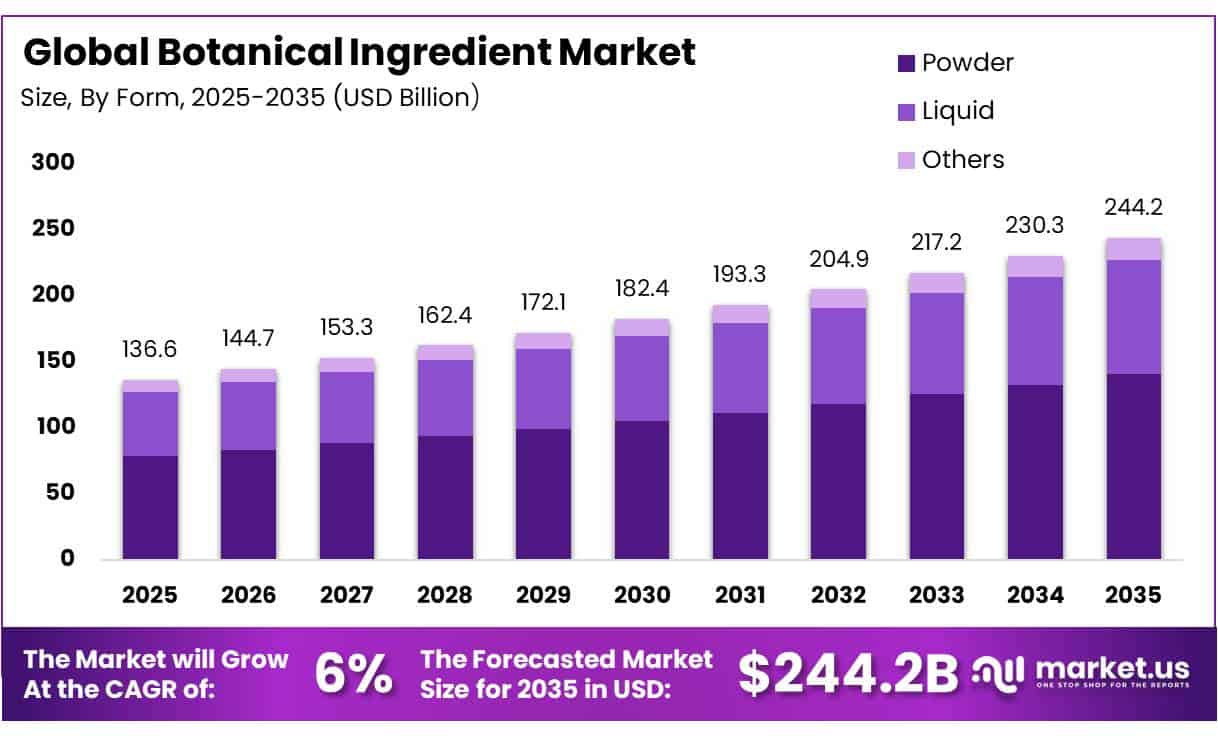
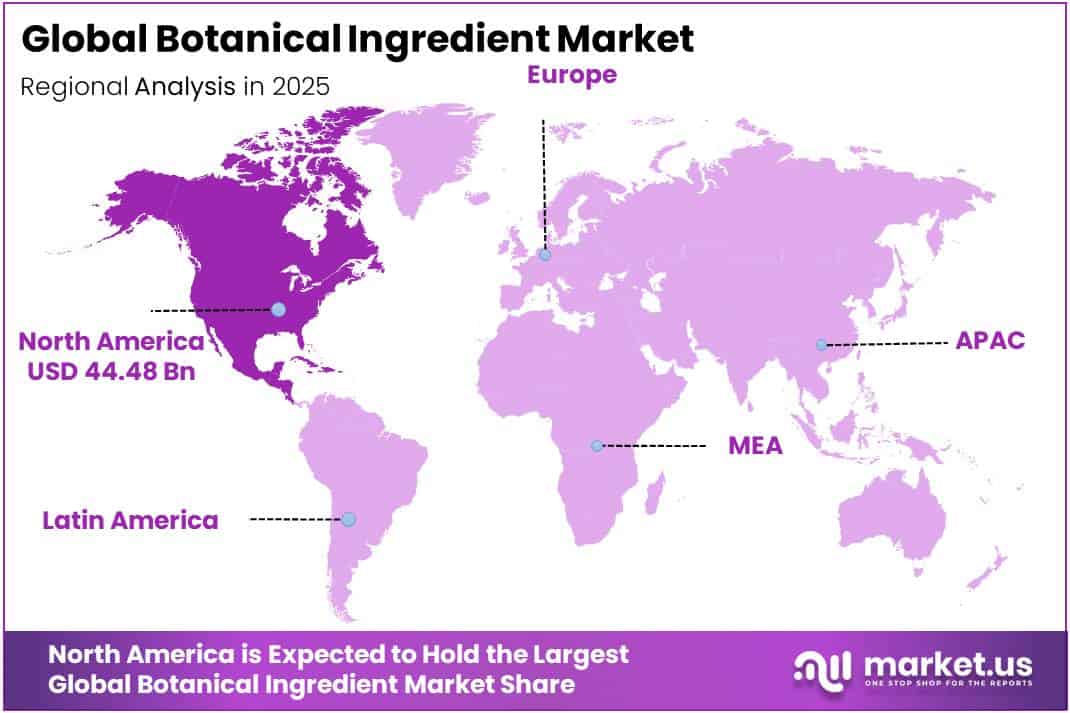
In 2025, the Botanical Ingredient Market was valued at USD 136.6 Billion, and between 2026 and 2035, this market is estimated to register a CAGR of 6%, reaching about USD 244.2 Billion by 2035. North America held a dominant market position, capturing more than a 32.56% share, holding USD 44.48 Billion in revenue.
The Botanical Ingredient Market is supported by the growing use of plant-derived materials across food, dietary supplements, cosmetics, and pharmaceutical products. The U.S. Food and Drug Administration (FDA) defines botanical drug products as products made from plant materials, algae, macroscopic fungi, or combinations of these sources. Botanical ingredients can be supplied in forms such as powders, liquids, tablets, capsules, and topical preparations, giving manufacturers flexibility across different applications.
In the European Union, the European Food Safety Authority (EFSA) also identifies botanicals as ingredients derived from plants, algae, fungi, or lichens that are widely available in food supplements.
- EFSA’s botanical safety work highlights the need to assess possible chemical and microbiological contamination and control concentrations of active substances. Its latest Compendium of Botanicals includes 2,701 plant species and 1,538 naturally occurring substances of potential concern for human health. These resources give food manufacturers, regulators, and safety assessors a structured basis for identifying potential hazards and evaluating botanical preparations before wider use.
Growth opportunities are emerging from the use of botanical ingredients in food supplements, functional foods, beverages, and pharmaceutical preparations. In the United States, the FDA states that dietary supplements may contain herbs and other botanicals and can be marketed in forms including powders and liquids. The pharmaceutical pathway also provides an opportunity for specialized botanical products. The FDA reports that four botanical products have fulfilled its definition of a botanical drug product and have been approved for marketing as prescription drugs.
Government initiatives are strengthening the industry’s focus on safety and product authenticity. The European Commission’s coordinated control plan examined 1,885 samples and conducted nearly 10,000 analyses of herbs and spices to assess authenticity. In pharmaceuticals, the European Commission provides a simplified registration pathway for traditional herbal medicinal products with at least 30 years of medicinal use, including 15 years in the European Union. These measures create opportunities for suppliers that can demonstrate consistent quality, reliable sourcing, safety, and regulatory compliance.
Key Takeaways
- The Global Botanical Ingredient Market was valued at USD 136.6 billion in 2025.
- The global market is projected to grow at a CAGR of 6.0% and is estimated to reach USD 244.2 billion by 2035.
- On the basis of form, Powder dominated the market, constituting 57.67% of the total market share.
- Based on the source, Seed and Nuts dominated the market, accounting for 34.34% of the total market share.
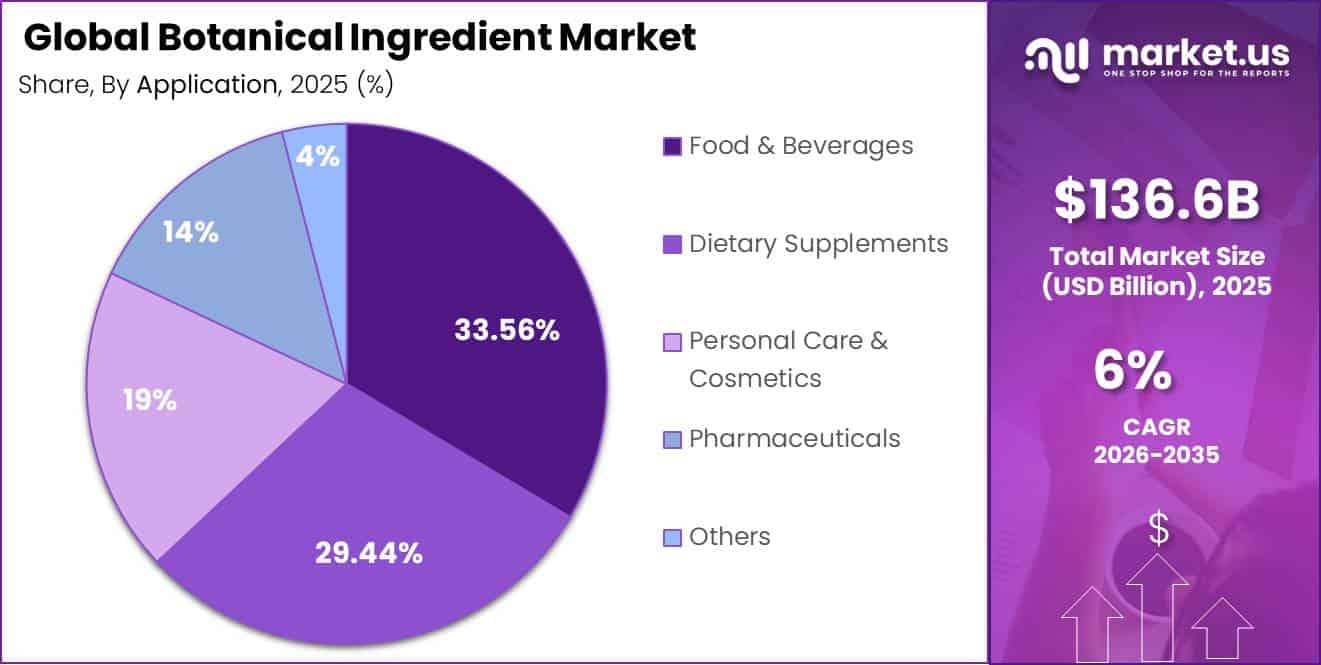
- Based on the application, Food & Beverages dominated the market, accounting for 33.56% of the total market share.
- In 2025, North America was the most dominant region in the botanical ingredient market, accounting for 32.56% of the global market.
By Form
Powder dominates with 57.67% due to its established use across botanical ingredient applications.
In 2025, Powder held a dominant market position, capturing more than a 57.67% share of the Botanical Ingredient Market by form. Powder-based botanical ingredients continue to hold a strong position because they offer a practical format for handling and use across different applications. Their established presence supports consistent demand from ingredient users that require botanical materials in a convenient and easy-to-process form. The segment’s 57.67% share in 2025 reflects its leading position within the form category.
Liquid is the growing segment of the Botanical Ingredient Market by form. In 2025 and 2026, liquid botanical ingredients are gaining attention as demand develops for botanical ingredients in liquid-based applications. The format provides flexibility for applications where ingredients need to be incorporated directly into liquid formulations. This growing interest is supporting the expansion of the liquid segment within the botanical ingredient market.
By Source
Seed and Nuts dominate with 34.34% due to their established use as botanical sources.
In 2025, Seed and Nuts held a dominant market position, capturing more than a 34.34% share of the Botanical Ingredient Market by source. Their strong position reflects their established role as a source of botanical ingredients used across different applications. The segment continued to represent the largest share among the identified botanical sources in 2025, supported by the continued use of seed- and nut-derived ingredients in formulations.
Leaves represent the growing segment of the Botanical Ingredient Market by source. In 2025 and 2026, growing interest in leaf-derived botanical ingredients is supporting the segment’s development. Their use in botanical formulations is contributing to increasing attention toward leaves as a source within the market.
By Application
Food & Beverages dominate with 33.56% due to broad use of botanical ingredients.
In 2025, Food & Beverages held a dominant market position, capturing more than a 33.56% share of the Botanical Ingredient Market by application. The segment’s leading position reflects the broad use of botanical ingredients in food and beverage formulations. Botanical ingredients are incorporated into different products within this application area, supporting their continued demand. With a 33.56% share in 2025, Food & Beverages remained the leading application segment.
Dietary Supplements represented the fastest-growing segment of the Botanical Ingredient Market by application. In 2025 and 2026, the segment continued to gain attention as botanical ingredients are increasingly used in supplement formulations. This growing application is supporting stronger demand for botanical ingredients within dietary supplement products.
Key Market Segments
By Form
- Powder
- Liquid
- Others
By Source
- Leaves
- Flowers
- Fruits & Berries
- Seed and Nuts
- Others
By Application
- Food & Beverages
- Food
- Bakery & Confectionery
- Sauces & Dressings
- Others
- Beverages
- Energy Drinks
- Sports Drinks
- Functional Juices
- Others
- Food
- Dietary Supplements
- Personal Care & Cosmetics
- Pharmaceuticals
- Others
Driver Analysis
Clean-label functional nutrition
The migration from conventional flavours, colours, sweeteners and fortification systems toward recognisable plant-derived inputs is the largest broad-based volume catalyst for botanical ingredients in 2026. Botanical-containing supplement launches increased at approximately 6% CAGR over the preceding five years, while food and beverage formulators increasingly use fruit, tea, spice, herb, algae and floral extracts to support “natural,” “plant-based,” antioxidant and wellness positioning.
The commercial impact is strongest where a botanical can perform more than one role for example, hibiscus supplying colour, acidity perception and antioxidant messaging, or green tea delivering flavour differentiation and polyphenol positioning because multifunctionality improves formulation economics despite botanical extracts often costing more per kilogram than commodity synthetic additives.
With more than 40% of beauty shoppers reportedly prioritising natural components, the adjacent consumer preference for familiar, minimally processed ingredients also supports cross-category food, beverage and personal-care demand; however, suppliers must substantiate claims and control colour, flavour and active-compound variability lot by lot to retain premium pricing.
Drivers Impact Analysis
| Driver | (~) % Impact on CAGR | Geographic Relevance | Impact Timeline |
|---|---|---|---|
| Clean-label functional nutrition | +1.4 pp | North America, EU, APAC urban | Medium term (2–4 years) |
| Preventive health & supplements | +1.2 pp | North America, India, China, GCC | Short term (≤ 2 years) |
| Natural beauty actives | +0.9 pp | EU, North America, Japan, South Korea | Medium term (2–4 years) |
| Standardized extracts & delivery tech | +0.8 pp | North America, EU, China, India | Medium term (2–4 years) |
| Traceable sustainable sourcing | +0.6 pp | EU core, North America, APAC exporters | Long term (≥ 4 years) |
| Regulatory quality & phytopharma | +0.5 pp | India, EU, North America, China | Long term (≥ 4 years) |
Restraint Analysis
Climate-led Crop Volatility
Botanical ingredient production is inherently exposed to weather, crop disease, irrigation constraints, soil degradation and seasonal harvesting windows because active-compound yield is determined not only by biomass volume but also by cultivar, location, harvest timing and post-harvest drying conditions; this means a 10–20% shortfall in usable herb availability can translate into a materially larger 15–30% increase in standardised-extract procurement cost when buyers must compete for material meeting marker-compound, pesticide and microbiological specifications.
For root- and rhizome-based inputs such as ashwagandha, turmeric and ginger, harvest cycles commonly require 6–12 months of agricultural lead time, while perennial and wild-collected materials can require multiple seasons to rebuild availability; consequently, ingredient manufacturers cannot correct a failed harvest through short-term capacity expansion.
The resulting response buffer inventories equivalent to 6–12 months of sales, dual-origin procurement, irrigation investment, contract farming and higher safety-stock financing raises working-capital needs and reduces the gross-margin advantage of conventional botanical supply, particularly for smaller extractors unable to pre-finance crop contracts or absorb spot-market price surges.
Restraint Impact Analysis
| Restraint | (~) % Impact on CAGR Forecast | Geographic Relevance | Impact Timeline |
|---|---|---|---|
| Climate-led crop volatility | -1.3 pp | India, China, Africa, EU importers | Short term (≤ 2 years) |
| Adulteration & contamination | -1.1 pp | India, China, North America, EU | Short term (≤ 2 years) |
| Fragmented regulation | -0.9 pp | EU, North America, India, China | Medium term (2–4 years) |
| Traceability compliance cost | -0.7 pp | EU core, APAC exporters, North America | Medium term (2–4 years) |
| Synthetic substitute pressure | -0.6 pp | North America, EU, East Asia | Medium term (2–4 years) |
| Freight and sourcing concentration | -0.5 pp | EU, North America, APAC corridors | Short term (≤ 2 years) |
Opportunity Analysis
Clinically backed bioactives
The principal white space is not another generic herbal powder or standardised extract, but a pharmaceutical-adjacent portfolio of botanicals with reproducible chemistry, human efficacy evidence and condition-specific formulation rights; this differs from the baseline wellness market because most current botanical volume remains sold through broad “natural” or traditional-use positioning rather than protected, clinically substantiated active ingredients.
A credible platform would select 5–10 botanicals with measurable biomarkers such as glucose response, sleep latency, stress scores, inflammatory markers, skin hydration or menopausal symptoms then invest roughly USD 1–5 million per lead ingredient across authentication, toxicology, bioavailability work and two or three controlled human studies, enabling ingredient pricing at an estimated 2–5× conventional standardised-extract levels.
The resulting opportunity is to monetise exclusive supply agreements, branded-ingredient licensing, clinical-data access fees and multi-year minimum-volume commitments rather than only kilograms sold; companies that achieve 50–100 basis points of gross-margin improvement per proprietary active can create an evidence moat that is difficult for raw-herb traders to replicate.
Opportunity Impact Analysis
| Opportunity | (~) % Potential CAGR Upside | Geographic Relevance | Execution Window |
|---|---|---|---|
| Clinically backed bioactives | +1.5 pp | North America, EU, India, Japan | Long term (≥ 4 years) |
| Precision-fermented botanicals | +1.2 pp | North America, EU, China, Singapore | Medium term (2–4 years) |
| Upcycled extract platforms | +0.9 pp | EU, North America, Brazil, India | Short term (≤ 2 years) |
| B2B evidence-as-a-service | +0.8 pp | North America core, EU, APAC | Medium term (2–4 years) |
| Emerging-market formulation hubs | +0.7 pp | GCC, ASEAN, Africa, Latin America | Medium term (2–4 years) |
| Farm-to-formula consolidation | +0.6 pp | India, China, Africa, Latin America | Long term (≥ 4 years) |
Challenges Analysis
Batch-quality variability
The most persistent operating challenge is that botanical composition is biologically variable before it reaches the extraction plant: genotype, chemotype, soil, altitude, weather, fertilisation, harvest age, plant part, drying method and storage conditions can alter both marker-compound concentration and sensory profile, while separate extraction batches add further process variability. Research confirms that raw-material variability and manufacturing processes cause batch-to-batch inconsistency in botanical drug products, and that climate, cultivation location, harvest timing and storage materially influence quality.
In commercial terms, a typical standardised extract programme may need to blend 3–10 incoming biomass lots to reach one target assay specification, with marker-content deviations of ±10–30% at raw-material stage potentially requiring higher extraction ratios, reprocessing, product overage or lot downgrading; this can absorb an estimated 3–8 percentage points of gross margin in high-specification nutraceutical and cosmetic-active lines.
Challenges Impact Analysis
| Challenge | (~) % CAGR Friction Drag | Geographic Relevance | Mitigation Horizon |
|---|---|---|---|
| Batch-quality variability | -1.0 pp | India, China, EU, North America | Medium term (2–4 years) |
| Fragmented supplier networks | -0.8 pp | India, Africa, Latin America, China | Long term (≥ 4 years) |
| Evidence-generation capability gap | -0.7 pp | North America, EU, India, Japan | Long term (≥ 4 years) |
| Post-harvest preservation losses | -0.6 pp | APAC sourcing, Africa, Latin America | Medium term (2–4 years) |
| Traceability data interoperability | -0.5 pp | EU importers, APAC exporters, North America | Medium term (2–4 years) |
| Wild-harvest biodiversity exposure | -0.5 pp | Africa, India, China, Latin America, EU | Long term (≥ 4 years) |
Geopolitical Impact Analysis
Geopolitical Impact on the Botanical Ingredient Market.
The ongoing Russia-Ukraine war and wider geopolitical tensions continue to affect the Botanical Ingredient Market mainly through shipping disruption, trade-route changes, and higher supply-chain uncertainty. In 2025, UN Trade and Development (UNCTAD) reported that global maritime trade was expected to grow by only 0.5%, while geopolitical rerouting had already pushed ton-miles up by 6% in 2024.
- By May 2025, vessel tonnage passing through the Suez Canal remained 70% below 2023 levels. For botanical ingredient suppliers, such disruptions can make the movement of plant-based raw materials and finished ingredients less predictable, particularly when shipments depend on international maritime routes.
The conflict also continues to influence agricultural commodity conditions. The Food and Agriculture Organization reported that the 2025 FAO Food Price Index averaged 127.2 points, which was 4.3% higher than the 2024 average, while renewed concerns over Black Sea export flows supported international wheat prices in December 2025. These conditions can add pressure to ingredient procurement and logistics costs where botanical inputs compete for agricultural supply. The impact is therefore less about a direct restriction on botanical ingredients and more about higher supply-chain risk, changing trade routes, and procurement uncertainty.
Regional Analysis
Regional Segmental Analysis: Botanical Ingredient Market.
North America held the dominant position in the Botanical Ingredient Market in 2025, accounting for 32.56% of the market and reaching a value of USD 44.48 billion, based on the supplied market data. The region benefits from an established food and consumer-products industry where botanical ingredients are used across different applications.
In the United States, the FDA recognizes herbs and other botanicals as dietary ingredients and also states that botanical products can be used in dietary supplements, foods, cosmetics, or other products depending on their intended use. This regulatory framework supports the continued use and development of botanical ingredients while requiring manufacturers to meet applicable safety and labeling requirements.
- The United States also has a significant organic food trade, which supports the broader ecosystem for plant-based and naturally sourced ingredients. According to the USDA Economic Research Service, the value of U.S. organic imports reached USD 5.7 billion in 2024, with imports helping meet domestic demand when local production is insufficient or when products are not available during certain periods.
The USDA also states that organic imports must meet USDA organic requirements or operate under an approved organic recognition arrangement. These factors support North America’s position as the leading regional market for botanical ingredients, particularly through established regulatory oversight, organized supply channels, and demand for plant-derived products.
Key Regions and Countries Covered
- North America
- The US
- Canada
- Europe
- Germany
- France
- The UK
- Spain
- Italy
- Russia & CIS
- Rest of Europe
- APAC
- China
- Japan
- South Korea
- India
- ASEAN
- Rest of APAC
- Latin America
- Brazil
- Mexico
- Rest of Latin America
- Middle East & Africa
- GCC
- South Africa
- Rest of MEA
Key Players Analysis
Botanical ingredient manufacturers focus on product quality, botanical sourcing, formulation flexibility, and consistent supply to strengthen their competitive position. Key players such as Indesso, Lipoid Kosmetik AG, International Flavors & Fragrances, Inc., Bell Flavors & Fragrances, Rutland Biodynamics Ltd., Prakruti Sources Pvt. Ltd., and Ambe Phytoextracts Pvt. Ltd. compete through broad botanical portfolios and different ingredient formats. Companies emphasize reliable sourcing of leaves, seeds, nuts, fruits, flowers, and other plant materials while improving extraction and processing capabilities.
Competitive positioning also depends on specialized botanical solutions, supply reliability, customization, and customer relationships. The Green Labs LLC, Berje, Inc., The Herbarie at Stoney Hill Farm, Inc., and other key players strengthen their presence by offering botanical extracts and ingredient solutions suited to specific product requirements. Companies are also focusing on quality control, traceability, formulation support, and consistent ingredient performance to meet customer expectations. Strong sourcing networks and the ability to provide ingredients for multiple end-use industries help companies reduce dependence on a single application and maintain broader market coverage.
The Major Players in The Industry
- Indesso
- Lipoid Kosmetic AG
- HollyFrontier Corporation
- International Flavors& Fragrances, Inc.
- Bell Flavors& Fragrances
- Rutland Biodynamics Ltd.
- Prakruti Sources Pvt. Ltd.
- Ltd.
- The Green Labs LLC
- Berje, Inc.
- The Herbarie at Stoney Hill Farm, Inc.
- Other Key Players
Key Development
- In May 2025, Indesso introduced ViaAyu™, a botanical active derived from Spilanthes acmella, at Indonesia Cosmetic Ingredients 2025. The ingredient was developed for skincare applications and received a Silver Award in the Rising Category at the event, highlighting Indesso’s focus on botanical innovation.
- In September 2025, IFF inaugurated its expanded LMR Naturals site in Grasse, France, following a €10 million The expansion increased the facility’s footprint by 75% to 4,687 square meters and added a pilot hall and experimental field to support the development of natural and botanical ingredients.
- In January 2026, Lipoid Kosmetik AG introduced Herbasol® Ferment, a botanical ingredient developed using fermentation-based processing. The company positioned the product around biotransformation and the development of new beneficial metabolites for cosmetic applications, strengthening its portfolio of plant-based ingredients.
Report Scope
| Report Features | Description |
|---|---|
| Market Value (2025) | USD 136.6 Bn |
| Forecast Revenue (2035) | USD 244.2 Bn |
| CAGR (2026 2035) | 6.0% |
| Base Year for Estimation | 2025 |
| Historic Period | 2020-2024 |
| Forecast Period | 2026-2035 |
| Report Coverage | Revenue Forecast, Market Dynamics, Competitive Landscape, Recent Developments |
| Segments Covered | By Form (Powder, Liquid, Others), By Source (Leaves, Flowers, Fruits & Berries, Seed and Nuts, Others), By Application (Food & Beverages (Food (Bakery & Confectionery, Sauces & Dressings, Others); Beverages (Energy Drinks, Sports Drinks, Functional Juices, Others)), Dietary Supplements, Personal Care & Cosmetics, Pharmaceuticals, Others) |
| Regional Analysis | North America The US & Canada; Europe Germany, France, The UK, Spain, Italy, Russia & CIS, Rest of Europe; APAC China, Japan, South Korea, India, ASEAN & Rest of APAC; Latin America Brazil, Mexico & Rest of Latin America; Middle East & Africa GCC, South Africa, & Rest of MEA |
| Competitive Landscape | Indesso, Lipoid Kosmetic AG, HollyFrontier Corporation, International Flavors & Fragrances, Inc., Bell Flavors & Fragrances, Rutland Biodynamics Ltd., Prakruti Sources Pvt. Ltd., AmbePhytoextracts Pvt. Ltd., The Green Labs LLC, Berje, Inc., The Herbarie at Stoney Hill Farm, Inc., and Other Key Players. |
| Customization Scope | Customization for segments, region/country level will be provided. Moreover, additional customization can be done based on the requirements. |
| Purchase Options | We have three licenses to opt for: Single User License, Multi User License (Up to 5 Users), Corporate Use License (Unlimited Users and Printable PDF) |





































