


Report Overview
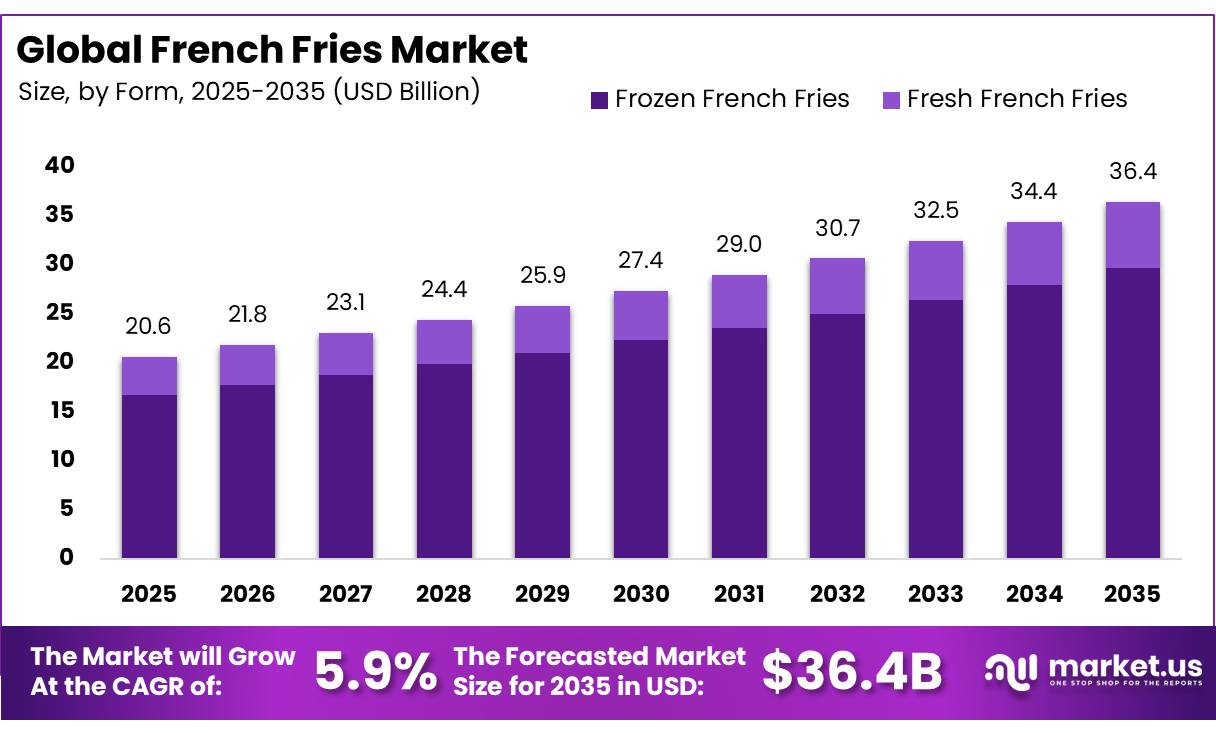
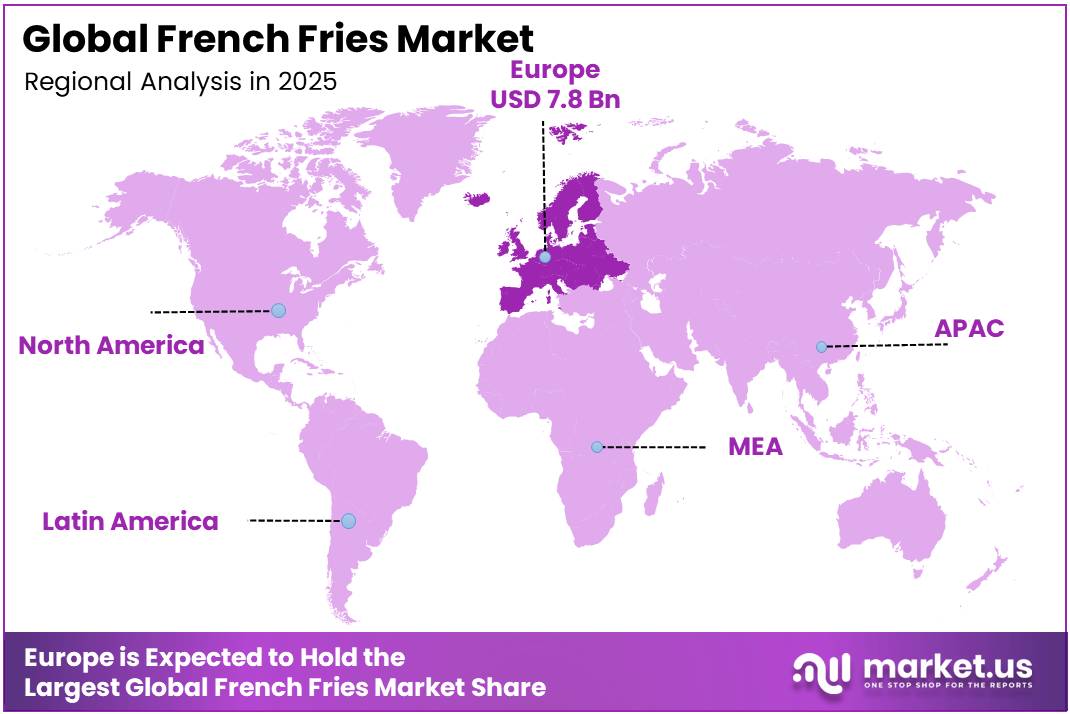
In 2025, the Global French Fries Market was valued at USD 20.6 billion, and between 2026 and 2035, this market is estimated to register a CAGR of 5.9%, reaching about USD 36.4 billion by 2035. Europe held a dominant market position, capturing more than a 37.89% share, holding USD 7.8 billion in revenue.
The French Fries Market includes fresh and frozen potato strips supplied to restaurants, quick-service outlets, supermarkets, and households. Its industrial structure connects potato farming, grading, cold storage, cutting, blanching, frying, freezing, packaging, and distribution.
- In September 2025, the United States Department of Agriculture reported that frozen potato products, mainly French fries, represented about 50% of potato availability and averaged 58 pounds per person, showing the category’s established consumption base.
Key Takeaways
- The global French Fries market was valued at USD 20.6 billion in 2025.
- The global market is projected to grow at a CAGR of 5.9% and is estimated to reach USD 36.4 billion by 2035.
- On the basis of form, frozen French fries dominated the market, constituting 81.45% of the total market share.
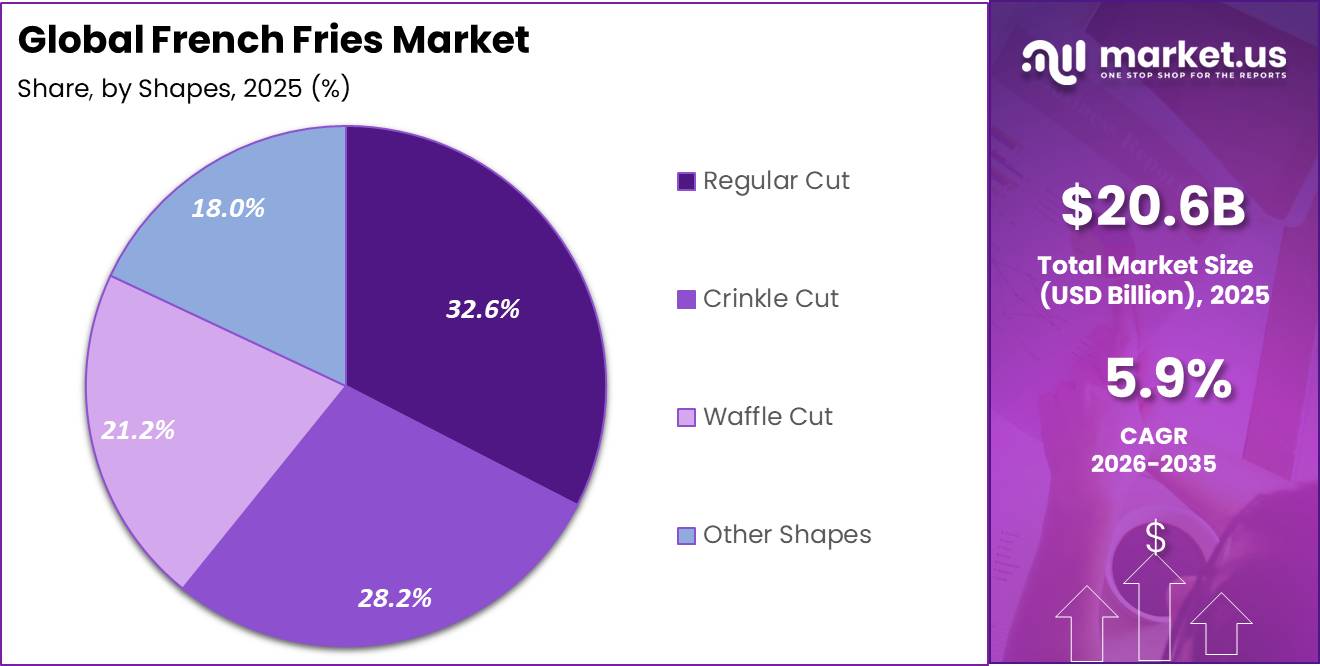
- Based on shape, regular cut French fries led the market, comprising 32.56% of the total market.
- Among the end users, retail held a major share in the French Fries Market, accounting for 62.34% of the market share.
- Europe was the most dominant region in the French Fries Market, accounting for 37.89% of the total market share.
Current industry conditions depend heavily on crop output, storage quality, edible-oil costs, energy use, and refrigerated logistics. In December 2025, the United States Department of Agriculture forecast domestic potato production at 412.1 million hundredweight, 2% below the previous year. Eurostat separately reported in October 2025 that the European Union harvested 50.8 million tonnes of potatoes in 2024, an annual increase of 5.5%, supporting regional processing capacity.
Demand is driven by foodservice recovery, convenient frozen formats, longer shelf life, portion consistency, and compatibility with ovens and air fryers. In June 2026, the United States Department of Agriculture stated that food-away-from-home spending reached USD 1.41 trillion in 2025 and represented 56.3% of total food expenditure. This spending pattern creates opportunities for coated fries, seasoned cuts, premium potato varieties, smaller retail packs, and products designed for faster preparation.
Government support and food-safety guidance continue shaping investment. The United States Department of Agriculture made approximately USD 72.9 million available through its Fiscal Year 2025 Specialty Crop Block Grant Program, which funds research, promotion, and competitiveness projects for specialty crops. The United States Food and Drug Administration also recommends soaking raw potato slices for 15 to 30 minutes, encouraging commercial processors to improve formulation and cooking controls while supporting preparation instructions, lighter frying practices, and consistent product quality across retail and foodservice channels across automated and manual lines in global commercial operations.
Form Analysis
Frozen French Fries dominate with 81.45% due to consistent quality, long shelf life, and foodservice convenience.
In 2025, Frozen French Fries held a dominant market position, capturing more than a 81.45% share. Their leadership was supported by strong demand from quick-service restaurants, hotels, cafés, institutional kitchens, and retail outlets. Frozen products help operators maintain uniform size, texture, cooking performance, and portion control. They also reduce preparation work, limit potato waste, simplify storage, and allow businesses to respond quickly. Improved freezing, coating, and packaging methods protect crispness and flavor throughout distribution.
- For instance, in October 2025, according to Lamb Weston, the company opened its Mar del Plata production facility in Argentina to strengthen frozen French fry supply for customers across Latin America.
Fresh French Fries are the growing segment as restaurants and specialty food outlets increasingly promote made-to-order meals, visible preparation, and locally sourced potatoes. The segment benefits from consumer interest in texture, distinctive potato varieties, customized cuts, and freshly cooked products. Its growth is supported by casual dining, food trucks, independent restaurants, and outlets that emphasize freshness and handcrafted preparation.
Shape Analysis
Regular Cut Dominates with 32.56% Due to Familiar Shape and Consistent Cooking
In 2025, Regular Cut held a dominant market position, capturing more than a 32.56% share. Its familiar shape, balanced thickness, even cooking, and suitability for dine-in, takeaway, and home preparation supported strong demand. Regular-cut fries are easy to portion, season, package, and pair with burgers, sandwiches, and other meals. Their broad availability across restaurants, quick-service chains, supermarkets, and frozen-food aisles further strengthened the segment’s leadership.
- For instance, in November 2025, according to Cavendish Farms, the company launched FlavourCrisp Crinkle Fries and Quick Crisp Crinkle Chips at major grocery retailers across Canada, expanding consumer choice within shaped frozen potato products.
Waffle Cut is the fastest-growing segment, supported by its distinctive lattice appearance, crisp edges, and ability to hold sauces, seasonings, and toppings. The shape offers strong visual appeal for restaurants and social-media-focused menus while providing a premium eating experience. Foodservice operators increasingly use waffle fries in loaded dishes, sharing platters, and side menus to create differentiation. Wider frozen retail availability, air-fryer compatibility, and consumer interest in restaurant-style products at home are also strengthening adoption across developed and emerging markets worldwide today.
End User Analysis
Retail Dominates with 62.34% Through Convenience and Strong Household Demand
In 2025, Retail held a dominant market position, capturing more than a 62.34% share. Its leadership was supported by household demand for convenient frozen foods, supermarket availability, easy storage, and compatibility with ovens and air fryers. Retail packs also allow consumers to choose cuts, seasonings, and portion sizes while preparing restaurant-style fries at home. Promotions, private-label ranges, and expanding online grocery services further strengthened product visibility and repeat purchases.
- For instance, in November 2025, according to McCain Foods, the company entered an agreement to acquire Penobscot McCrum, expanding its North American frozen potato products network and supporting customer access.
Foodservices are the growing segment, driven by demand from quick-service restaurants, cafés, hotels, catering businesses, and institutional kitchens. Operators value French fries because they are familiar, easy to prepare, simple to portion, and suitable for many menus. Growth is also supported by delivery platforms, takeaway meals, tourism activity, and menu innovation involving loaded fries, seasoned varieties, and premium cuts. Reliable frozen supply, consistent cooking performance, and faster kitchen service help foodservice businesses manage busy periods while maintaining taste, texture, and presentation.
Key Market Segments
By Form
- Fresh French Fries
- Frozen French Fries
By Shapes
- Regular Cut
- Crinkle Cut
- Waffle Cut
- Other Shapes
By End User
- Foodservices
- Retail
Driver Analysis
Quick-service restaurant expansion and menu-driven fries attachment rates
Quick-service restaurant (QSR) footprint expansion remains the single strongest driver because fries function as a near-default side item with attachment rates frequently exceeding 60–70% on combo orders, meaning every net-new QSR outlet materially adds recurring frozen-fry volume rather than one-off demand. Frozen potato products already command roughly 71% share of foodservice consumption within the broader frozen potato category, reflecting how deeply embedded fries are in fast-food and casual-dining formats across mature and emerging markets.
As chains continue unit growth in APAC, the Middle East, and parts of Latin America alongside steady same-store performance in North America and the EU, frozen-fry suppliers benefit from predictable, contract-based B2B volume rather than fragmented retail demand, which supports tighter working-capital cycles and higher-utilization processing runs.
Drivers Impact Analysis
| Driver | (~) % Impact on CAGR Forecast | Geographic Relevance | Impact Timeline |
|---|---|---|---|
| Quick-service restaurant expansion and menu-driven fries attachment rates | +2.1% | North America core, EU, APAC urban corridors, Middle East | Short term (≤ 2 years) |
| Retail frozen-food and air-fryer-optimized product innovation | +1.8% | North America, EU, APAC emerging retail | Short term (≤ 2 years) |
| Cold-chain and processing capacity expansion via M&A consolidation | +1.9% | North America, EU, South America spill-over, APAC | Medium term (2-4 years) |
| Urbanization and convenience-food adoption in emerging markets | +1.6% | India, Southeast Asia, Latin America, Africa | Medium term (2-4 years) |
| Private-label and foodservice B2B contract growth | +1.4% | North America, EU, APAC foodservice hubs | Short term (≤ 2 years) |
| Advanced freezing and shelf-life-extension technologies improving unit economics | +1.3% | North America, EU, APAC processing belts | Medium term (2-4 years) |
Restraint Analysis
Volatile potato acreage and raw tuber price compression
Volatile potato acreage and raw tuber price compression act as a restraint because processing plants depend on predictable, contract-based supply, yet market reports for 2026 indicate that US potato acreage is expected to decrease further under pressure from low free-market prices and shifting crop economics, tightening medium-term supply even as global demand for frozen fries continues to grow.
French fries manufacturing economics show raw material costs typically account for 60–70% of total production cost at plants designed for 10,000–20,000 MT per year, meaning even 10–15% swings in farm-gate potato prices materially alter gross margins and force processors to either raise downstream prices or absorb margin hits that can compress net profit from typical 10–15% levels into single digits. When acreage declines, processors also face a structural bottleneck: they must compete for limited tuber supply with fresh and other processed segments, potentially diverting volume away from fries and constraining sales growth despite robust demand, particularly in years where climatic events or disease reduce yields by high single-digit percentages.
Restraint Impact Analysis
| Restraint | (~) % Impact on CAGR | Geographic Relevance | Impact Timeline |
|---|---|---|---|
| Volatile potato acreage and raw tuber price compression | -2.2% | North America core, EU, APAC potato belts | Medium term (2-4 years) |
| Cold-chain and logistics cost shocks, including Middle East route disruptions | -2.0% | APAC logistics corridors, EU, Middle East, Africa | Short term (≤ 2 years) |
| Tight nutritional regulation and health-perception backlash on fried foods | -1.8% | EU regulatory hubs, North America, urban APAC | Long term (≥ 4 years) |
| High capital intensity and energy cost burden for processing plants | -1.7% | North America, EU, South America processing regions | Medium term (2-4 years) |
| Trade barriers, sanitary rules, and traceability mandates on frozen products | -1.5% | North America, EU, export-oriented APAC and LatAm | Medium term (2-4 years) |
| Intense price competition and margin erosion from private-label and regional players | -1.6% | North America core, EU retail, APAC emerging | Short term (≤ 2 years) |
Opportunity Analysis
QSR-driven fries innovation platforms and premiumization
Potatonewstoday commentary underscores that frozen potato products, especially fries, have become the fastest-growing and economically most significant category in the global potato value chain, yet innovation has been concentrated in coatings and cut types, with limited systematic use of rotating seasonal flavors, loaded-fries platforms, and regionalized offerings optimized for local taste profiles.
Strategically, QSRs and processors could create structured fries innovation programs—quarterly limited-time offers, cross-promotions with sauces and toppings, and tiered premium SKUs targeting per-ticket fry revenue uplift of 10–20% while defending core attachment rates; integrated digital menus and delivery apps can further monetize upsizing and add-on suggestions at low marginal CAC.
This is not a baseline driver today because many chains still emphasize burgers and core mains in innovation cycles, but by reallocating R&D and marketing budgets toward fries-centric innovation and premiumization, the category could capture incremental TAM within existing traffic, adding roughly 2 percentage points of CAGR upside through higher average check and margin expansion by 2030–2035.
Opportunity Impact Analysis
| Opportunity | (~) % Potential CAGR | Geographic Relevance | Execution Window |
|---|---|---|---|
| Health-optimized fries and portion-controlled formats | +2.1% | North America core, EU, urban APAC | Medium term (2-4 years) |
| QSR-driven fries innovation platforms and premiumization | +1.9% | North America, EU, APAC foodservice hubs | Short term (≤ 2 years) |
| Emerging-market frozen potato localization and India-scale expansion | +2.3% | India, Southeast Asia, Middle East, Africa | Long term (≥ 4 years) |
| Adjacent potato-snack portfolios and multi-format cross-selling | +1.7% | Global, especially EU and LatAm | Medium term (2-4 years) |
| Data-driven menu engineering and loyalty-based fries monetization | +1.5% | North America, EU, APAC QSR corridors | Short term (≤ 2 years) |
| Strategic processing and export capacity roll-ups in frozen potato | +1.6% | North America core, EU, APAC processing belts | Long term (≥ 4 years) |
Challenges Analysis
Rising multi-input cost stack across energy, oil, packaging, and freight
French fries manufacturing cost structures indicate utilities can account for around 15–20% of operational cost and raw materials for 60–70%, while packaging and freight add further layers, so a 10–20% increase in each input can compress margins significantly or force price increases that dampen demand in price-sensitive markets.
The friction is systemic rather than catastrophic: fries remain profitable, but margin buffers shrink and investment appetite for new plants or deep market entry is moderated, especially in regions with volatile energy tariffs and constrained freight capacity. Strategic responses—energy efficiency upgrades, long-term supply contracts, packaging optimization—take 2–4 years to materially shift cost curves, meaning this cost-stack inflation continues to drag potential CAGR by about 1.1 percentage points even as the market grows, reflecting unit economic penalties rather than immediate market freeze.
Challenges Impact Analysis
| Challenge | (~) % CAGR Friction | Geographic Relevance | Mitigation Horizon |
|---|---|---|---|
| Consistent processing-grade potato quality and year-round supply | -1.4% | North America core, EU regulatory hubs, APAC potato belts | Long term (≥ 4 years) |
| Frozen-food cold-chain capacity limits and complex logistics | -1.3% | APAC logistics corridors, Middle East, Africa, LatAm | Medium term (2-4 years) |
| Labor shortages in food manufacturing and foodservice operations | -1.2% | North America, EU, APAC urban hubs | Long term (≥ 4 years) |
| Rising multi-input cost stack across energy, oil, packaging, and freight | -1.1% | Global, with EU and APAC most exposed | Medium term (2-4 years) |
| Global trade volatility and frozen-food supply chain disruption risk | -1.0% | EU regulatory hubs, APAC sea lanes, Middle East | Medium term (2-4 years) |
| Technology and data gaps in potato supply chain visibility and planning | -0.9% | Global, especially emerging-market producers | Long term (≥ 4 years) |
Geopolitical Impact Analysis
Geopolitical Realignment and Trade Barriers Reshaping French Fries Supply Chains
Current geopolitical tensions are reshaping the French Fries Market through fertiliser trade restrictions, import dependence, currency volatility, and stronger competition among potato-exporting regions. Frozen fries rely on coordinated supplies of processing potatoes, edible oil, packaging, refrigeration, and transport. Trade-policy changes affecting these inputs can alter production costs, contract terms, and market access for processors and buyers.
In June 2025, the Council of the European Union adopted new tariffs on selected Russian and Belarusian agricultural goods and nitrogen-based fertilisers, effective by 1 July 2025. The affected fertiliser imports had previously exceeded 25% of European Union sector imports, reaching 3.6 million tonnes valued at EUR 1.28 billion. This policy supports supply diversification but may increase procurement uncertainty for European potato growers and processors.
- International potato trade is also becoming more competitive. In September 2025, Potatoes USA reported that total United States potato export volume declined 3.75% to 3.1 million metric tonnes, while export value decreased 0.8% to USD 2.3 billion. Frozen potatoes represented 49% of export volume, showing how strongly processors depend on stable foreign demand and predictable trade access.
These developments encourage French fry manufacturers to diversify fertiliser and potato suppliers, strengthen regional processing, secure longer purchasing contracts, and maintain cold-storage capacity. Companies with flexible sourcing and broad distribution networks are better positioned to absorb tariff changes and protect supply continuity.
Regional Analysis
Europe Dominates with a 37.89% Share and USD 7.80 Billion
In 2025, Europe held the dominant position in the French Fries Market, accounting for 37.89% of global revenue and generating USD 7.8 billion. Regional leadership reflects a mature frozen-food industry, established potato processing capacity, widespread quick-service restaurant networks, and strong household demand for convenient products. Germany, France, Belgium, and the Netherlands support the market through developed farming, cold storage, frying, freezing, and export infrastructure.
In September 2025, Eurostat reported that European Union retail sales volumes for food, drinks, and tobacco increased by 0.5% from the previous year, supporting packaged frozen-food purchases. Eurostat also reported that accommodation and food-service enterprises generated 20.4% of their turnover through web sales in 2024, highlighting the growing role of digital ordering and delivery. Demand opportunities remain strong in premium cuts, seasoned fries, air-fryer products, recyclable packaging, and private-label ranges.
Key Regions and Countries Covered
- North America
- The US
- Canada
- Europe
- Germany
- France
- The UK
- Spain
- Italy
- Russia & CIS
- Rest of Europe
- APAC
- China
- Japan
- South Korea
- India
- ASEAN
- Rest of APAC
- Latin America
- Brazil
- Mexico
- Rest of Latin America
- Middle East & Africa
- GCC
- South Africa
- Rest of MEA
Key Players Analysis
French fries manufacturers focus on strengthening product consistency, processing efficiency, and supply chain control to remain competitive. A key priority is continuous product innovation, including coated fries, seasoned varieties, specialty cuts, and air-fryer-ready formats that improve crispness, convenience, and menu differentiation. Companies such as McCain Foods Ltd., Lamb Weston Holdings Inc., J.R. Simplot Company, and Aviko B.V. continue investing in automated processing, cold storage, and production capacity to support large foodservice and retail customers.
Vertical integration with potato growers, edible oil suppliers, packaging producers, and logistics providers helps secure raw material availability and manage changing input costs. Strategic expansion across Europe, North America, and Asia Pacific enables manufacturers to serve quick-service restaurants, supermarkets, and institutional buyers more efficiently. Companies such as Cavendish Farms, Farm Frites International, Agristo NV, and Ore-Ida also emphasize quality control, sustainable farming, traceability, and long-term customer agreements to strengthen brand positioning and maintain reliable supply across high-volume market segments.
Market Key Players
- McCain Foods Ltd
- Lamb Weston Holdings Inc
- J.R. Simplot Company
- Aviko B.V. (Royal Cosun)
- Cavendish Farms
- Farm Frites International
- Agristo NV
- Agrarfrost Holding GmbH & Co. KG
- Ore-Ida (The Kraft Heinz Company)
- Conagra Brands (Alexia Foods)
- Nomad Foods (Birds Eye)
- Hyfun Foods
- Other Key Players
Key Development
- In January 2026, Lamb Weston announced plans to close its Munro plant and consolidate Latin American production at its modern Mar del Plata facility in Argentina, supporting improved manufacturing and capital efficiency.
- In February 2026, McCain Foods announced a 202-hectare Farm of the Future in North Yorkshire, developed with the University of Leeds to test regenerative potato farming and strengthen long-term raw material supply.
- In May 2026, Ore-Ida launched Dino and Star Tater Tots, marking its first introduction of new product shapes in nearly 20 years and expanding its frozen potato portfolio for families and younger consumers.
Report Scope
| Report Features | Description |
|---|---|
| Market Value (2025) | USD 20.6 Bn |
| Forecast Revenue (2035) | USD 36.4 Bn |
| CAGR (2026-2035) | 5.9% |
| Base Year for Estimation | 2025 |
| Historic Period | 2020-2024 |
| Forecast Period | 2026-2035 |
| Report Coverage | Revenue Forecast, Market Dynamics, Competitive Landscape, Recent Developments |
| Segments Covered | By Form (Fresh French Fries and Frozen French Fries), By Shapes (Regular Cut, Crinkle Cut, Waffle Cut, and Other Shapes), By End User (Foodservices and Retail) |
| Regional Analysis | North America – The US & Canada; Europe – Germany, France, The UK, Spain, Italy, Russia & CIS, Rest of Europe; APAC- China, Japan, South Korea, India, ASEAN & Rest of APAC; Latin America- Brazil, Mexico & Rest of Latin America; Middle East & Africa- GCC, South Africa, & Rest of MEA |
| Competitive Landscape | McCain Foods Ltd, Lamb Weston Holdings Inc, J.R. Simplot Company, Aviko B.V. (Royal Cosun), Cavendish Farms, Farm Frites International, Agristo NV, Agrarfrost Holding GmbH & Co. KG, Ore-Ida (The Kraft Heinz Company), Conagra Brands (Alexia Foods), Nomad Foods (Birds Eye), Hyfun Foods, and Other Key Players. |
| Customization Scope | Customization for segments, region/country-level will be provided. Moreover, additional customization can be done based on the requirements. |
| Purchase Options | We have three licenses to opt for: Single User License, Multi-User License (Up to 5 Users), Corporate Use License (Unlimited Users and Printable PDF) |





































