


Report Overview
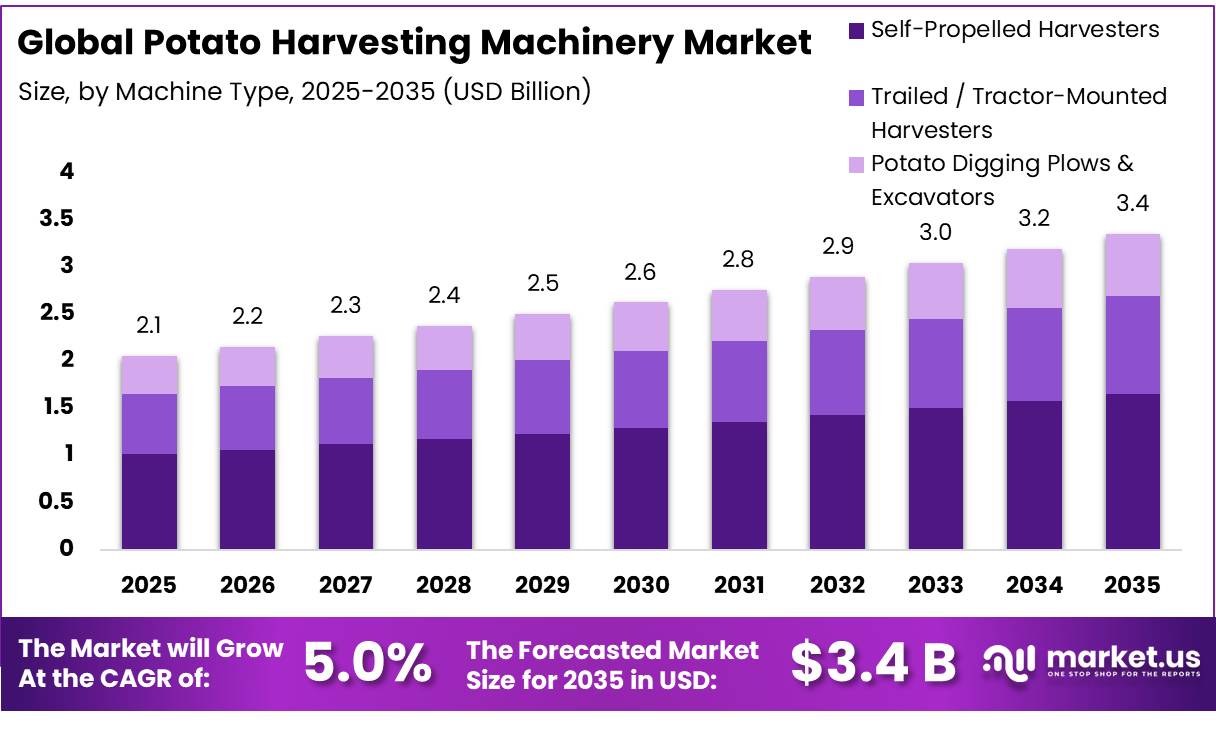
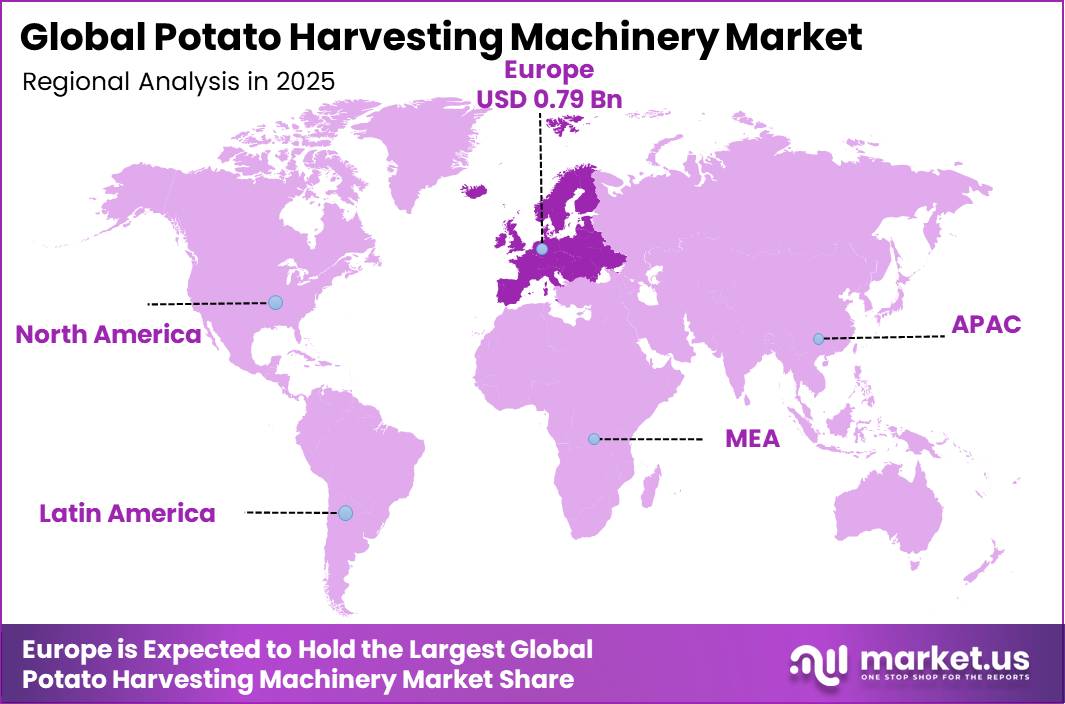
In 2025, the Global Potato Harvesting Machinery Market was valued at USD 2.1 billion, and between 2026 and 2035, this market is estimated to register a CAGR of 5.0%, reaching about USD 3.4 billion by 2035. In 2025, Europe led the market, achieving over 38.7% share with a revenue of USD 0.79 billion.
The potato harvesting machinery market includes diggers, windrowers, trailed and self-propelled harvesters, crop separators, cleaning tables and handling systems used to lift tubers quickly while limiting cuts, bruising and soil carryover. Its importance is tied to the scale of potato farming and the crop’s narrow harvesting window.
- In April 2025, the Food and Agriculture Organization reported that potatoes were cultivated in more than 100 countries and global production had reached a record 383 million tonnes in 2023. More than half of this output came from developing economies, showing the crop’s broad commercial and food-security role.
Key Takeaways
- The Global Potato Harvesting Machinery Market was valued at USD 2.1 billion in 2025.
- The market is projected to grow at a CAGR of 5.0% and is estimated to reach USD 3.4 billion by 2035.
- On the basis of machine type, self-propelled harvesters dominated the market, constituting 49.3% of the total market share.
- Based on the automation level, semi-automatic systems dominated the market, with a substantial market share of around 61.8%.
- Based on the farm scale and application, commercial and large farms led the market, comprising 68.5% of the total market.
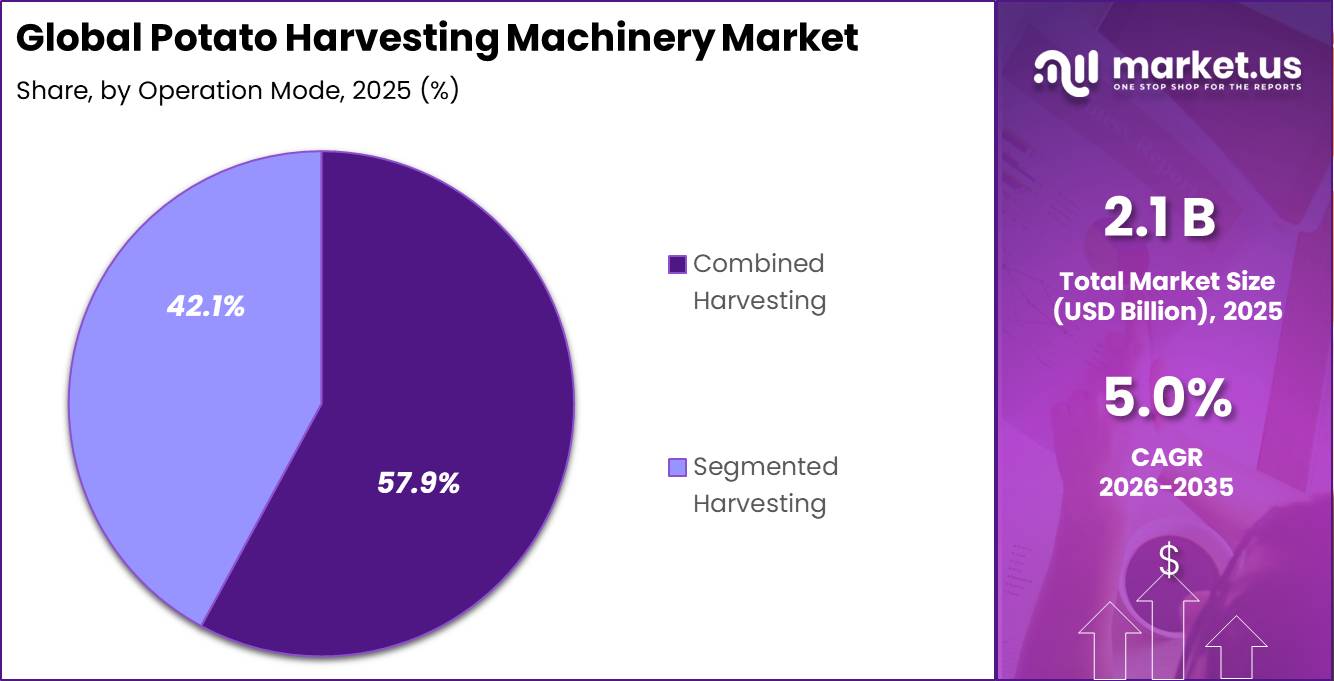
- On the basis of operation mode, combined harvesting dominated the market, constituting 57.9% of the total market share.
- In 2025, Europe was the most dominant region in the market, accounting for 38.7% of the total global consumption.
Eurostat reported in October 2025 that the European Union harvested 50.8 million tonnes of potatoes from about 1.4 million hectares in 2024, with output rising by 5.5%. In the United States, the USDA Economic Research Service estimated 2025 production at 412.1 million hundredweight, while average yield reached a record 461 hundredweight per acre despite a 3.5% decline in harvested area. USDA also stated that around two-thirds of potato sales went to processing, supporting demand for high-capacity machines that maintain steady tuber flow and processing quality.
- Statistics Canada recorded 125.8 million hundredweight of potatoes in 2025, while seeded area increased to 395,857 acres, its highest level since 2007. These conditions favour larger harvesters, multi-row systems, automated cleaning and improved transfer equipment, particularly where farms must supply processors on fixed schedules.
Operational pressure is also accelerating equipment replacement. The UK Department for Environment, Food and Rural Affairs reported potato production of 5.5 million tonnes in 2025, up 8.5%, from 127,000 hectares, while yields improved by 3.0% to 47.6 tonnes per hectare. Dry conditions required irrigation as often as every three days at about 25 millimetres per pass, adding pressure on labour and machinery and raising bruising risk during lifting. This supports demand for gentler webs, adjustable separators, better depth control, camera monitoring and real-time settings that respond to changing soil and crop conditions.
Future opportunities will increasingly come from automation, precision harvesting, lower crop damage and public support for farm modernization. More than 8,800 applicants received UK equipment grant offers worth over £68.4 million in 2025, while the 2026 equipment fund made £50 million available and allowed grants of £1,000 to £25,000 per theme. Across the EU, modernization investments are planned to reach almost 400,000 farms by 2027. Although U.S. tractor sales fell 14.8% and combine sales fell 4.3% in December 2025, CEMA’s European machinery business index improved from +4 to +9 points in November 2025. Near-term capital spending may remain selective, but demand for efficient, data-enabled and labour-saving potato harvesting systems remains favourable.
Machine Type Analysis
Self-propelled harvesters dominate with a 49.3% share due to faster, integrated harvesting.
In 2025, Self-Propelled Harvesters held a dominant market position, capturing more than a 49.3% share. These machines combine digging, soil separation, cleaning and crop collection within one operating unit, helping large farms complete harvesting within limited weather windows. Their high field capacity, reduced dependence on separate tractors and lower labour requirements support adoption in commercial potato-producing regions.
- In May 2025, the Canada Revenue Agency classified self-propelled mechanical vegetable harvesters as zero-rated farm equipment, meaning eligible purchases attract 0% GST/HST. This tax treatment lowers the effective acquisition cost of self-propelled harvesting machinery and supports its adoption among commercial potato growers.
Trailed / Tractor-Mounted Harvesters are the fastest-growing segment, supported by their lower purchase cost, simple maintenance and compatibility with tractors already available on farms. These machines provide smaller and medium-sized growers with an affordable route to mechanised harvesting without investing in a dedicated self-propelled unit. Their flexible configuration, easier transportation and suitability for fragmented fields are expected to strengthen adoption among farms seeking to improve harvesting speed while controlling machinery expenditure.
Automation Level Analysis
Semi-Automatic potato harvesting machinery leads with a 61.8% share due to its balanced cost, control and field flexibility.
In 2025, Semi-Automatic held a dominant market position, capturing more than a 61.8% share. These machines remain widely preferred because they mechanize digging, soil separation and crop movement while allowing operators to control speed, depth and sorting according to field conditions. Their position is supported by the large quantity of potatoes requiring timely harvesting. High production volumes and labor expenses encourage growers to use semi-automatic equipment that improves output without requiring the higher investment and technical support associated with fully autonomous machinery.
- In December 2025, the USDA estimated combined potato production in the United States and Canada at 538 million cwt. In May 2025, USDA NASS reported that farm operators paid all hired agricultural workers an average of US$19.52 per hour during the April 6–12, 2025 reference week, representing an increase of 3% from April 2024.
Fully Automated is the fastest growing segment in the potato harvesting machinery market. Growth is being supported by advances in sensors, artificial intelligence, machine vision, automatic steering and real-time crop monitoring. In November 2025, the European Commission started the AGROBOOST agricultural robotics project to test automation solutions across European farming activities. Fully automated potato harvesters can provide consistent digging depth, continuous crop flow and more accurate separation, making them increasingly attractive to large farms and professional contractors handling narrow harvesting windows
Farm Scale & Application Analysis
Commercial / Large Farms dominate with a 68.5% share as large acreage favors high-capacity harvesting machinery.
In 2025, Commercial / Large Farms held a dominant market position, capturing more than a 68.5% share. Large farming operations commonly use self-propelled and multi-row potato harvesters to cover wider fields within short harvesting windows. These machines also reduce dependence on manual labour and provide faster digging, cleaning, separation and unloading.
- In 2025, the UK government reported that potato cultivation area increased by 7.2% to 127 thousand hectares, while the volume of potato output rose by 8.7%. This expansion supports the need for high-capacity harvesters that can handle larger crop volumes without extending field time.
The Small to Medium Farms segment is the fastest-growing segment in 2025. These farms increasingly prefer tractor-mounted, trailed and semi-automatic potato harvesters that can operate with existing farm equipment. Such machines require lower investment than large self-propelled models while still reducing harvesting time, labour requirements and tuber damage. Rental services, agricultural contractors and cooperative equipment ownership are also helping smaller growers access modern machinery. Compact designs, easier maintenance and suitability for irregular or smaller fields are expected to strengthen adoption across this segment.
Operation Mode Analysis
Combined Harvesting leads with a 57.9% share as growers prioritize faster, single-pass potato collection
In 2025, Combined Harvesting held a dominant market position, capturing more than a 57.9% share. Combined harvesting remained widely preferred because it allows potato lifting, soil separation, cleaning and collection to be completed in one continuous operation. This approach is especially valuable across large commercial fields where growers must complete harvesting within limited weather windows. These operating conditions strengthened demand for high-capacity combined harvesters that reduce repeated field passes and simplify crop handling.
Segmented Harvesting is the fastest-growing segment in the Potato Harvesting Machinery Market. During 2025, its adoption was supported by farms requiring greater control over lifting, windrowing, drying and final collection activities. Unlike combined systems, segmented harvesting divides the process into separate field operations, allowing growers to adjust machinery use according to soil moisture, crop maturity and available labour. This method is increasingly suitable for smaller or irregular fields where large one-pass harvesters may be less practical.
Key Market Segments
By Machine Type
- Self-Propelled Harvesters
- Trailed / Tractor-Mounted Harvesters
- Potato Digging Plows & Excavators
By Automation Level
- Semi-Automatic
- Fully Automated
By Farm Scale & Application
- Commercial / Large Farms
- Small to Medium Farms
By Operation Mode
- Combined Harvesting
- Segmented Harvesting
Driver Analysis
Farm labor inflation and harvest window compression
USDA’s 2026 farm-sector income forecast shows U.S. cash labor expenses at $53.9 billion, up $1.2 billion or 2.2 percent from 2025, while total production expenses are forecast to rise to $477.7 billion from $473.1 billion in 2025. That matters for potato harvesters because potatoes are harvested in narrow weather-sensitive windows and delays convert quickly into field losses, bruising, and starch-quality downgrades, so even low-single-digit labor inflation disproportionately improves the payback case for self-propelled and high-capacity trailed harvesters.
USDA vegetable outlook materials also note harvesting and hauling cost inflation of roughly 10–20 percent across custom services in recent periods, reinforcing the business case for growers and contractors to internalize harvest capacity where acreage density is high. Strategically, this driver shifts customer buying logic from pure replacement to labor-substitution ROI, favoring machines with higher bunker capacity, gentler cleaning webs, fewer hand-sorting touchpoints, and telematics that reduce operator downtime in the U.S., Canada, Germany, France, the Netherlands, Belgium, and the U.K. official-statistics orbit.
Drivers Impact Analysis
| Driver | (~) % Impact on CAGR Forecast | Geographic Relevance | Impact Timeline |
|---|---|---|---|
| Farm labor inflation and harvest window compression | +1.4% | North America core, EU core | Short term (≤ 2 years) |
| Stable-to-rising potato output needs mechanized throughput | +1.1% | North America core, EU, APAC corridors | Short term (≤ 2 years) |
| Sustainable mechanization and precision-compliance upgrade cycle | +1.0% | EU core, North America spill-over, APAC corridors | Medium term (2-4 years) |
| Government farm support and capex resilience | +0.9% | North America core, EU, selected APAC | Short term (≤ 2 years) |
| Yield protection and tuber-loss reduction economics | +0.8% | EU, North America, South America spill-over | Medium term (2-4 years) |
| Emerging-market potato commercialisation and mechanization transfer | +0.7% | APAC corridors, Africa pilot markets, South America spill-over | Long term (≥ 4 years) |
Restraint Analysis
High machinery acquisition cost
Equipment affordability remains the most material structural restraint because agricultural machinery prices have stayed elevated rather than normalizing back to pre-inflation levels; the U.S. producer price index for agricultural machinery and equipment was 205.337 in December 2025 and 206.903 in April 2026, while EU producer prices for agricultural and forestry machinery reached 122.0 points in May 2026, indicating that the capital cost base embedded in harvesters, separators, conveyors, hydraulics, and electronic controls is still high.
For a potato harvester buyer, that means sticker prices remain burdened by elevated steel, engine-aftertreatment, hydraulics, and component costs, so even when crop volumes are stable the annualized ownership cost can rise by roughly 8% to 12% once interest, insurance, and parts inventories are included, which delays fleet renewal and narrows the addressable buyer pool to larger farms and contractors. This is modeled as a 1.9 percentage point deduction from baseline CAGR because higher acquisition cost does not merely reduce unit sales; it also shifts demand toward refurbished machines, lowers optional-technology attachment rates, and slows penetration in APAC expansion corridors where mechanization economics are more price elastic.
Restraint Impact Analysis
| Restraint | (~) % Impact on CAGR Forecast | Geographic Relevance | Impact Timeline |
|---|---|---|---|
| Potato price volatility | -1.4% | EU, North America core | Short term (≤ 2 years) |
| High machinery acquisition cost | -1.9% | North America core, EU, APAC corridors | Medium term (2-4 years) |
| Farm labor cost inflation | -1.1% | North America core, EU | Short term (≤ 2 years) |
| Emissions compliance burden | -0.8% | EU, North America core | Medium term (2-4 years) |
| Weak farm cash generation | -1.3% | EU, North America core, selected APAC | Medium term (2-4 years) |
| Parts and lead-time friction | -0.9% | EU, North America core, APAC corridors | Short term (≤ 2 years) |
Opportunity Analysis
Harvester-as-a-service
A large share of the next wave of upside sits not in selling more stand-alone machines into already mechanized large farms, but in monetizing underpenetrated access demand among fragmented growers that cannot absorb full-capex ownership economics; this is why it is an opportunity rather than a current driver. The EU still has 8.8 million agricultural holdings, with 62.8% below 5 hectares, and the long-run farm-structure trend remains one of fragmentation at the small end even as total farm counts decline, while India’s SMAM framework continues to support machinery access for economically weaker farmers rather than guaranteeing ownership purchases outright.
In potato specifically, the white space is strongest where production is meaningful but harvesting mechanization remains uneven: FAOSTAT shows China, India, Ukraine, the U.S., Russia, and Germany among the largest producing countries, implying a broad installed-demand base for contracted harvesting services rather than purely owned fleets. A service-led model could expand addressable demand by 12% to 18% versus equipment-only channels in small and mid-sized potato clusters, cut farmer upfront cash outlay by 70% to 90%, lift OEM lifetime revenue per machine by 1.3x to 1.6x through seasonal utilization, and add roughly +1.9 percentage points to market CAGR where financing, utilization pooling, and operator training are bundled into district-level harvesting networks.
Opportunity Impact Analysis
| Opportunity | (~) % Potential CAGR Upside | Geographic Relevance | Execution Window |
|---|---|---|---|
| Harvester-as-a-service | +1.9% | India, Eastern EU, APAC emerging | Short term (≤ 2 years) |
| Mid-size modular machines | +1.6% | EU, India, China | Short term (≤ 2 years) |
| Smart retrofit kits | +1.4% | North America core, EU | Medium term (2-4 years) |
| Processing-linked fleet deals | +1.8% | North America, NW Europe, China | Medium term (2-4 years) |
| M&A dealer roll-up | +1.2% | EU, India, Latin America | Medium term (2-4 years) |
| Adjacent root-crop platforms | +2.1% | EU, China, India, North America | Long term (≥ 4 years) |
Challenges Analysis
Chronic harvest labor tightness
Chronic harvest labor tightness depresses the attainable growth trajectory of potato harvesting machinery by forcing a complex re-optimization of farm labor–capital mixes rather than a straightforward substitution of labor with machines, with empirical signals from government and quasi‑public sources indicating that up to 70 percent of agricultural employers report structural labor shortages in peak seasons and that crop-support services employment in advanced markets has grown only about 17 percent over a 14‑year window, far below the growth in mechanization needs.
In North America and parts of the EU, visa-dependent seasonal labor pipelines add compliance frictions and cost volatility, increasing growers’ risk premiums on large capital purchases and trimming annual machinery investment by an estimated 5–10 percent versus unconstrained scenarios, which translates to roughly a 0.8 percentage point drag on the sector’s potential CAGR.
Strategically, manufacturers must respond by designing equipment operable by smaller crews cutting required operators per harvester by 30–40 percent through automation and telematics partnering with custom‑hiring or contractor models that pool labor across farms, and investing in operator‑training pipelines that can reduce startup learning times from several seasons to 1–2 seasons, thereby converting labor scarcity from an adoption brake into a mechanization catalyst over a 2–4‑year horizon.
Challenges Impact Analysis
| Challenge | (~) % CAGR Friction Drag | Geographic Relevance | Mitigation Horizon |
|---|---|---|---|
| Chronic harvest labor tightness | -0.8% | North America, EU core, Latin America belts | Medium term (2–4 years) |
| Uneven mechanization readiness | -0.7% | Sub-Saharan Africa, South Asia, Andean highlands | Long term (≥ 4 years) |
| Climate-driven yield volatility | -0.6% | EU temperate zones, East Africa highlands, South Asia | Long term (≥ 4 years) |
| Post-harvest loss economics | -0.5% | Emerging Asia, Africa smallholders, CIS | Medium term (2–4 years) |
| Capital and credit asymmetry | -0.6% | South Asia, Africa, Latin America mid-tier | Long term (≥ 4 years) |
| Tech-skills and service gaps | -0.4% | APAC growth hubs, EU periphery, Eastern Europe | Medium term (2–4 years) |
Geopolitical Impact Analysis
Geopolitical Impact on Potato Harvesting Machinery Market
The ongoing war situation, especially in Eastern Europe, has created noticeable pressure on the potato harvesting machinery market. Countries like Ukraine and Russia are important agricultural regions, and disruptions in these areas have affected both crop production and farm equipment demand. Due to uncertainty and reduced farming activities in conflict zones, the demand for new harvesting machinery has slowed in these regions.
At the same time, the war has disturbed global supply chains. Key raw materials such as steel and components used in agricultural machinery have seen price increases. This has raised manufacturing costs for equipment producers, leading to higher selling prices. In addition, fuel prices have remained volatile, increasing operational costs for farmers, which further delays machinery investments.
On the other hand, some regions in Europe and North America are witnessing a shift toward mechanization to compensate for labor shortages caused by migration and instability. Governments in these regions are also supporting local food production, indirectly boosting demand for efficient harvesting equipment. Overall, while the conflict has created short-term disruptions and cost pressures, it is also pushing the market toward modernization and regional supply chain adjustments in the long run.
Regional Analysis
Europe Dominates the Potato Harvesting Machinery Market.
Europe dominated the global Potato Harvesting Machinery Market, accounting for 38.7% of total market revenue in 2025, valued at approximately USD 0.79 billion. The region’s leadership is supported by its highly mechanized farming sector, large-scale commercial potato cultivation, and continuous investment in precision agriculture technologies. According to Eurostat, the European Union harvested more than 48 million tonnes of potatoes in 2024, with Germany, France, the Netherlands, Belgium, and Poland among the leading producers.
Asia-Pacific is projected to register the fastest growth in the Potato Harvesting Machinery Market during the forecast period, driven by expanding potato cultivation, rising farm mechanization, and increasing government support for agricultural modernization. According to the Food and Agriculture Organization (FAO), Asia contributes more than half of global potato production, with China remaining the world’s largest producer, followed by several rapidly expanding potato-growing economies.
Key Regions and Countries Covered
- North America
- The US
- Canada
- Europe
- Germany
- France
- The UK
- Spain
- Italy
- Russia & CIS
- Rest of Europe
- APAC
- China
- Japan
- South Korea
- India
- ASEAN
- Rest of APAC
- Latin America
- Brazil
- Mexico
- Rest of Latin America
- Middle East & Africa
- GCC
- South Africa
- Rest of MEA
Key Players Analysis
Spudnik Equipment Company LLC is a major North American supplier of potato harvesting and handling systems. Established from an innovation developed in 1958, the company joined the GRIMME Group in 2003 and now employs more than 500 people. Its harvesting range includes 2-row and 3-row AirSep harvesters, plus 4-row, 6-row and 8-row windrowers.
Oxbo International Corporation competes through high-capacity, self-propelled harvesting technology. Its AR-4BX is a 4-row potato harvester powered by a 550-hp Scania engine and equipped with a 14-ton bunker, a 4-metre transport width and Claas Terra Trac drives. Oxbo draws on more than 60 years of specialist harvesting experience and supports European and North American configurations.
Double L Global, Inc. has served the potato equipment industry since 1979, when 2 Idaho potato farmers founded the business. Its portfolio covers 2-row, 3-row and 4-row harvesters, alongside 2-row, 4-row and 6-row windrowers and 4-row, 6-row and 8-row planters. The company also supplies 15-ton, 30-ton and 50-ton Even Flow tubs.
ASA-LIFT A/S strengthens the market through specialized vegetable and root-crop harvesting engineering. Founded in 1936, the Danish company employs more than 120 people, supports over 14 vegetable crop types and operates facilities covering more than 52,000 square metres. GRIMME acquired a 70% stake in 2012 and the remaining 30% in 2020.
The Major Players in The Industry
- Grimme Group
- Dewulf Group
- AVR bv
- Spudnik Equipment Company LLC
- LOCKWOOD Manufacturing
- Oxbo International Corporation
- Standen Engineering Ltd.
- Double L Global, Inc.
- Allan Equipment Manufacturing Ltd.
- ASA-LIFT A/S
- Carlotti G&C S.r.l.
- Akpil
- Wühlmaus GmbH
- Abollo Agricultural Machinery
- Erisha Agritech Private Limited
- Other Key Players
Key Development
- In October 2025, Dewulf launched Level X in 3 packages, Bronze, Silver and Gold, combining IoT monitoring, camera systems and AI-based machine adjustments that can increase harvesting speed by up to 2 km/h.
- In October 2025, AVR bv launched its fifth-generation Puma self-propelled harvester with a 551 HP engine, 20% more cleaning surface, a 10-tonne bunker and unloading speeds improved by up to 50%. AVR planned a pre-production run of 15 machines during 2026, showing continued investment in high-capacity harvesting technology.
Report Scope
| Report Features | Description |
|---|---|
| Market Value (2025) | USD 2.1 Bn |
| Forecast Revenue (2035) | USD 3.4 Bn |
| CAGR (2026-2035) | 5.0% |
| Base Year for Estimation | 2025 |
| Historic Period | 2020-2024 |
| Forecast Period | 2026-2035 |
| Report Coverage | Revenue Forecast, Market Dynamics, Competitive Landscape, Recent Developments |
| Segments Covered | By Machine Type (Self-Propelled Harvesters, Trailed / Tractor-Mounted Harvesters, and Potato Digging Plows & Excavators), By Automation Level (Semi-Automatic and Fully Automated), By Farm Scale & Application (Commercial / Large Farms and Small to Medium Farms), By Operation Mode (Combined Harvesting and Segmented Harvesting) |
| Regional Analysis | North America – The US & Canada; Europe – Germany, France, The UK, Spain, Italy, Russia & CIS, Rest of Europe; APAC– China, Japan, South Korea, India, ASEAN & Rest of APAC; Latin America– Brazil, Mexico & Rest of Latin America; Middle East & Africa– GCC, South Africa, & Rest of MEA |
| Competitive Landscape | Grimme Group, Dewulf Group, AVR bv, Spudnik Equipment Company LLC, LOCKWOOD Manufacturing, Oxbo International Corporation, Standen Engineering Ltd., Double L Global, Inc., Allan Equipment Manufacturing Ltd., ASA-LIFT A/S, Carlotti G&C S.r.l., Akpil, Wühlmaus GmbH, Abollo Agricultural Machinery, Erisha Agritech Private Limited, Other Key Players. |
| Customization Scope | Customization for segments, region/country-level will be provided. Moreover, additional customization can be done based on the requirements. |
| Purchase Options | We have three licenses to opt for: Single User License, Multi-User License (Up to 5 Users), Corporate Use License (Unlimited Users and Printable PDF) |





































