


Report Overview
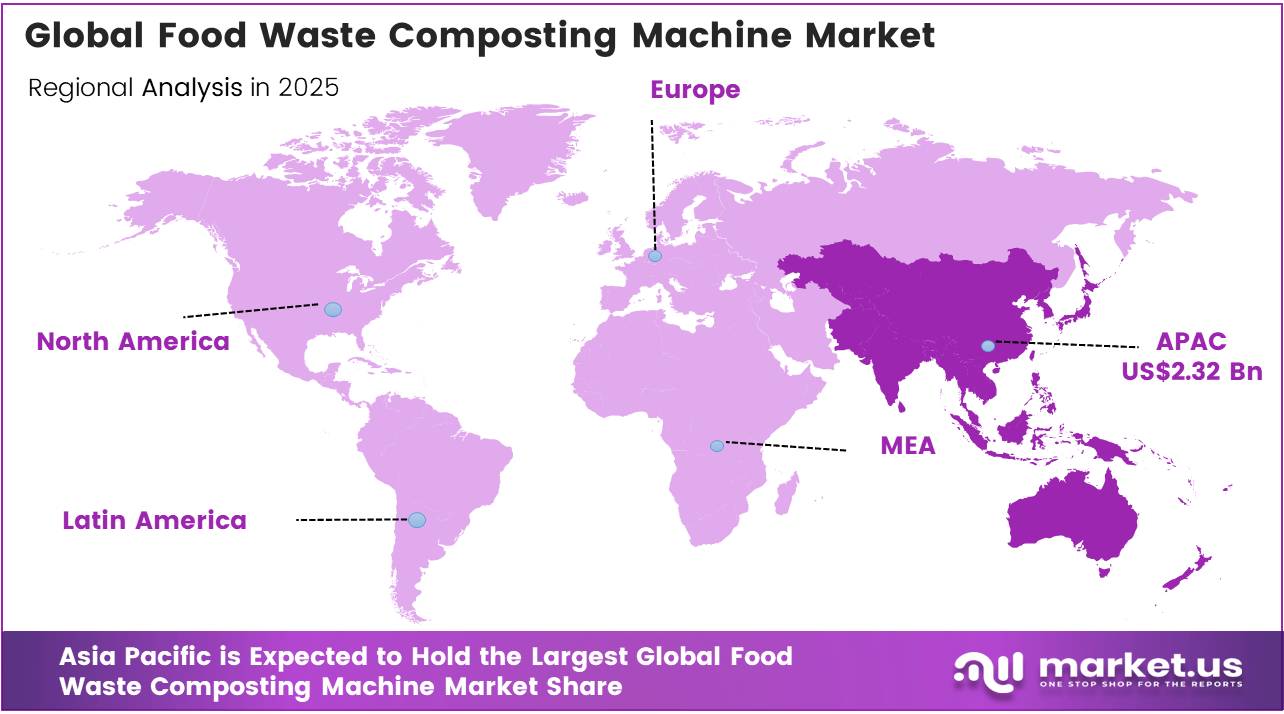
In 2025, the Global Food Waste Composting Machine Market was valued at USD 6.0 billion, and between 2026 and 2035, this market is estimated to register a CAGR of 8.4%, reaching about USD 13.4 billion by 2035. In 2025, Asia Pacific held a dominant market position, capturing more than a 38.6% share, holding USD 2.32 Billion revenue.
Food waste composting machines are becoming an important part of organic-waste management across food-processing plants, hotels, restaurants, supermarkets, institutional kitchens, and municipal systems. These machines use controlled aerobic treatment, supported by shredding, mixing, aeration, moisture control, temperature monitoring, and odor filtration, to reduce segregated food residues and convert them into a stabilized organic output.
- The United Nations Environment Programme estimated that 1.05 billion tonnes of food were wasted at household, food-service, and retail levels in 2022, equal to 132 kilograms per person and 19% of food available to consumers. Households generated 60% of this waste, food services accounted for 28%, and retail contributed 12%.
- The Food and Agriculture Organization also reports that 13.2% of food is lost after harvest and before retail, while food loss and waste are responsible for approximately 8% to 10% of global greenhouse-gas emissions. These figures create a large feedstock base for on-site and centralized composting systems, particularly where landfill restrictions and methane-reduction goals are tightening.
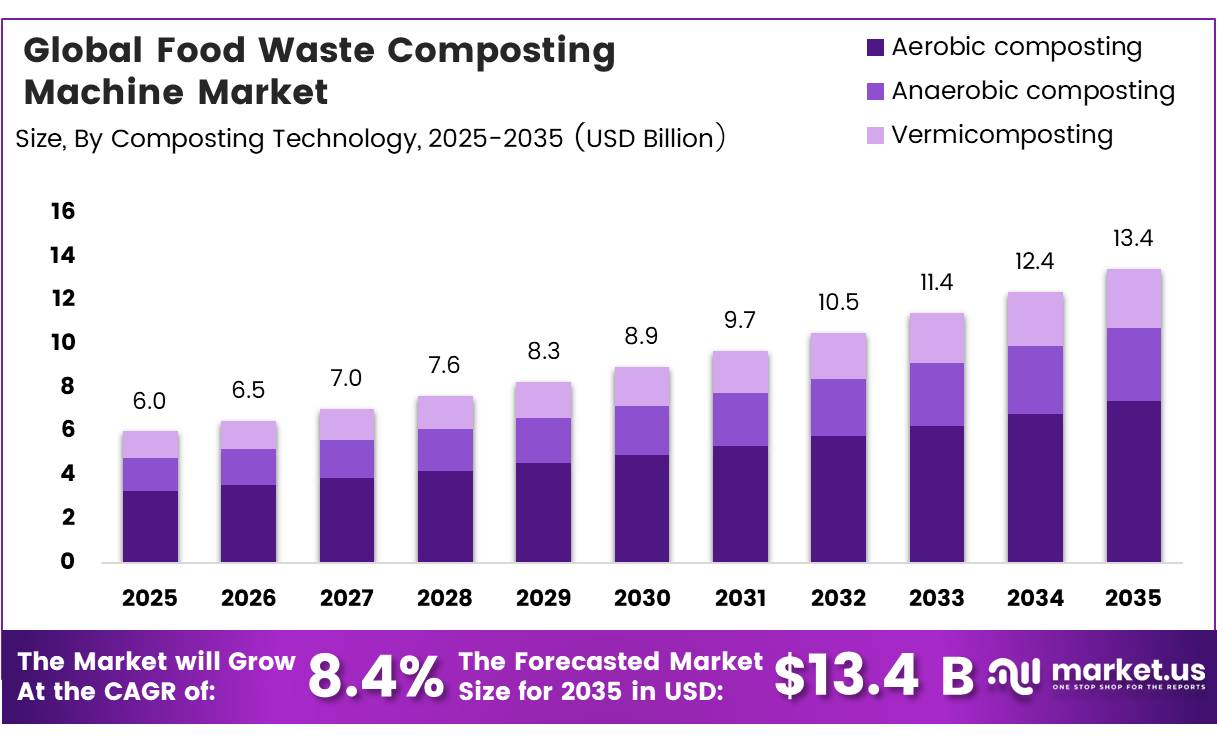
The food waste composting machine industry is gaining importance as governments strengthen organic-waste separation, landfill diversion, and circular-economy infrastructure. In January 2024, the U.S. Department of Agriculture announced USD 11.5 million for 38 cooperative agreements supporting composting and food-waste reduction projects across 23 states, with implementation through 2026. In September 2024, the U.S. Environmental Protection Agency announced USD 117 million through three funding opportunities for recycling infrastructure, food-waste prevention education, and composting.
Regulatory changes are increasing demand from restaurants, hotels, supermarkets, institutions, and food-processing facilities. From 31 March 2025, workplaces in England were required to separate food waste, while micro-firms with fewer than 10 full-time-equivalent employees received an extension until 31 March 2027. These rules support enclosed machines offering automated mixing, temperature regulation, moisture control, and odour management.
Future opportunities remain favourable for decentralized systems. From 31 March 2026, English waste collectors were required to collect food and garden waste separately from households. The government provided £340 million to help councils prepare. Official April 2026 data estimated England generated 58.4 million tonnes of residual waste and 26.1 million tonnes of municipal residual waste in 2024, reinforcing the need for organic-waste processing infrastructure.
Key Takeaways
- The global Food Waste Composting Machine market was valued at USD 6.0 billion in 2025.
- The global market is projected to grow at a CAGR of 8.4% and is estimated to reach USD 13.4 billion by 2035.
- On the basis of product type, the Automatic dominated the market, constituting 52.4% of the total market share.
- Based on the Composting Technology, the Aerobic composting dominated the Food Waste Composting Machine market, with a substantial market share of around 55.0%.
- Based on the capacity, 51to 500 kg/day led the market, comprising 45.0% of the total market.
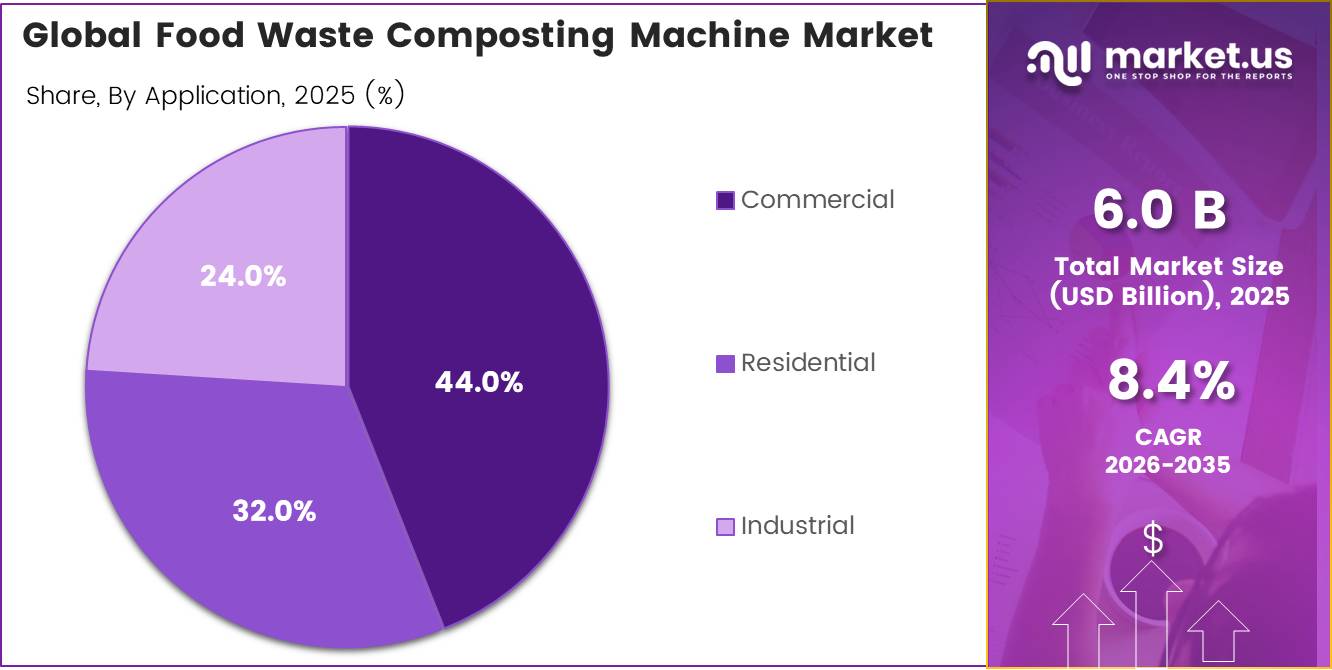
- Among the By Application, the Commercial held a major share in the Food Waste Composting Machine market, 44.0% of the market share.
- Among the Distribution Channel, the indirect sales is the most considerable within the market, accounting for around 58.0% of the revenue.
- In 2025, the Asia Pacific was the most dominant region in the Food Waste Composting Machine market, accounting for 38.60% of the total global consumption.
Product Type Analysis
Automatic represents dominant Segment in the Market.
Automatic food waste composting machines lead with a 52.40% market share. Their strength comes from enclosed processing, automatic mixing, temperature and moisture controls, faster handling, and lower dependence on continuous labour. These features suit municipalities, campuses, supermarkets, hotels, and large commercial kitchens. In December 2024, the USDA invested more than US$7.5 million through 26 Composting and Food Waste Reduction agreements supporting scalable landfill-diversion plans. This funding creates a favourable operating environment for higher-capacity, digitally controlled composting equipment.
Semi-automatic machines represent the growing category because they combine mechanical processing with operator control, providing a practical option for smaller food businesses and institutions. From 31 March 2025, workplaces in England were required to separate food waste, while micro-firms were given until 31 March 2027. In March 2024, the government also announced up to £295 million to introduce weekly household food-waste collections by 31 March 2026, supporting demand for flexible composting systems.
Composting Technology Analysis
Aerobic composting is a significant Composting Technology.
Aerobic composting leads the market with a 55.0% share, supported by its simple operating process, broad feedstock compatibility, and ability to produce usable compost without biogas-handling infrastructure. It is particularly suitable for municipalities, commercial kitchens, campuses, supermarkets, and food-processing facilities managing dry or mixed organic waste. California’s official organic-waste programme established a target to reduce landfill disposal of organic material by 75% in 2025, encouraging investment in aerated vessels, shredders, mixers, and temperature-controlled composting equipment.
Anaerobic composting is the growing technology, mainly because it can treat wet food waste while generating biogas and nutrient-rich digestate in a sealed system. The UK Government’s 2026 Farm Practices Survey showed that the proportion of farms processing waste, crops, or feedstocks through anaerobic digestion increased from 12% in 2024 and 13% in 2025 to 15% in 2026. This upward movement supports demand for compact digesters, feedstock pumps, gas-storage systems, and automated monitoring equipment.
Capacity Analysis
51to 500 kg/day Are the Most Widely Used Capacity.
The 51 to 500 kg/day segment leads with a 45.00% market share, as it offers a practical balance between processing capacity, operating cost, and space requirements. These machines suit supermarkets, hotels, institutional kitchens, campuses, and medium-sized food-processing sites that generate steady organic waste but do not require industrial-scale plants. In March 2025, the U.S. EPA’s Excess Food Opportunities Map identified more than 960,000 potential industrial, commercial, and institutional excess-food generators and over 15,000 potential recipients, highlighting a large decentralized base for mid-capacity composting equipment.
Machines processing above 501 kg/day represent the growing segment, supported by expanding citywide collection programmes and rising centralized waste volumes. In November 2025, New York City collected 5.9 million pounds of compostable material in one week, while Queens generated more than 61 million pounds during the programme’s first year. Such volumes encourage municipalities and large institutions to adopt higher-capacity systems with continuous feeding and automated monitoring.
Application Analysis
Commercial applications Held a Major Share of the Food Waste Composting Machine Market.
Commercial applications lead with a 44.00% market share, supported by steady food-waste generation from hotels, restaurants, supermarkets, institutional kitchens, and catering facilities. These users favour composting machines because on-site processing reduces storage pressure, collection frequency, odour, and dependence on landfill disposal.
January 2025, Washington State required businesses generating at least 4 cubic yards of food and yard waste per week within designated areas across 10 counties to arrange organics collection or approved treatment. The threshold is scheduled to fall to 96 gallons per week in 2026, widening demand for compact commercial composters.
Residential applications as households increasingly receive separate collection services and adopt compact, easy-to-operate composting units. Scottish government statistics published in October 2025 showed that households composted 363,000 tonnes of waste in 2024, rising by 1,300 tonnes from the previous year. This trend supports demand for smaller machines with simple controls and low maintenance.
End Use Analysis
Food Waste Composting Machines Are Mostly Utilized in the Automotive Sector.
Indirect sales lead the market with a 58.00% share, as composting machines often require site evaluation, capacity selection, installation, operator training, and after-sales maintenance. Distributors and channel partners help manufacturers serve municipalities, hotels, supermarkets, institutions, and food processors without maintaining large local service teams. In May 2026, U.S. merchant-wholesaler sales reached US$817.4 billion, increasing 18.1% from May 2025, showing the continuing importance of intermediary-led commercial distribution.
Online channels represent the growing segment, supported by easier product comparison, digital quotations, remote demonstrations, and improved access for smaller buyers. Customers can review machine capacity, energy use, dimensions, and service terms before contacting a supplier for installation. In the first quarter of 2026, U.S. e-commerce sales totalled US$302.3 billion, rising 9.7% from the same quarter of 2025. This wider shift toward digital purchasing creates room for manufacturers to generate leads and sell compact composting systems online.
Key Market Segments
By Product Type
- Automatic
- Semi-automatic
- Manual
By Composting Technology
- Aerobic composting
- Anaerobic composting
- Vermicomposting
By Capacity
- 51to 500 kg/day
- < 50 kg/day
- >501
By Application
- Commercial
- Residential
- Industrial
By Distribution Channel
- Direct sales
- Indirect sales
- Distributors and dealers
- Specialty retailers
- Online channels
Driver Analysis
EU Waste Framework Directive food waste targets
The revised EU Waste Framework Directive, published in the Official Journal on 26 September 2025 and entering into force on 16 October 2025, introduces the bloc’s first binding national targets for food waste reduction, requiring a 10 percent cut in food waste from processing and manufacturing and a 30 percent per-capita cut jointly across retail, food service, and households by 31 December 2030, measured against a 2021–2023 baseline.
The phased compliance calendar is unusually explicit for a market driver: member states must complete first compositional surveys of mixed municipal waste by 1 January 2026, designate competent authorities for food waste coordination by 17 January 2026, and transpose the Directive into national law by 17 June 2027, creating a rolling two-to-four-year window in which food service operators, retailers, and manufacturers must demonstrate measurable waste reduction rather than simply report volumes.
Drivers Impact Analysis
| Driver | (~) % Impact on CAGR Forecast | Geographic Relevance | Impact Timeline |
|---|---|---|---|
| Mandatory bulk-waste composting regulations | +2.2% | India, EU member states, US states (CA, MA, VT) | Short term (≤ 2 years) |
| EU Waste Framework Directive food waste targets | +1.5% | EU regulatory hubs, UK spill-over | Medium term (2-4 years) |
| IoT and smart sensor-enabled composting units | +1.4% | North America, EU, APAC urban corridors | Medium term (2-4 years) |
| Decentralized on-site processing for dense urban housing | +1.3% | APAC megacities, Gulf urban markets, North America multi-family | Short term (≤ 2 years) |
| Corporate ESG and hospitality sector adoption | +1.1% | North America core, EU, APAC hospitality hubs | Medium term (2-4 years) |
| Government subsidy and circular-economy financing programs | +1.0% | India, EU, Gulf states | Long term (≥ 4 years) |
Restraint Analysis
Patchy regulation enforcement and compliance fatigue
In India, for example, 2025 and 2026 advisories and blogs note that housing societies and hotels have been “mandated” to treat wet waste within premises, but in practice enforcement often ramps up episodically around inspections, media campaigns, or specific complaint clusters while periods of lax monitoring allow continued mixed‑waste dumping with limited penalty, creating a de facto option value to postponing capex.
In the EU, revised Waste Framework Directive food waste targets require a 10 percent manufacturing/processing reduction and 30 percent per‑capita cut by 2030, yet national transposition timelines and municipal capacity vary widely, meaning some operators face imminent audits while others see target enforcement as a distant risk.
Restraint Impact Analysis
| Restraint | (~) % Impact on CAGR Forecast | Geographic Relevance | Impact Timeline |
|---|---|---|---|
| High upfront capex and payback uncertainty | -2.0% | India, APAC corridors, LATAM | Medium term (2-4 years) |
| Patchy regulation enforcement and compliance fatigue | -1.4% | India, EU, select US states | Short term (≤ 2 years) |
| Operational complexity for SMEs and households | -1.3% | EU household, APAC SMEs | Long term (≥ 4 years) |
| Lack of standards and performance certification | -1.1% | Global emerging markets | Medium term (2-4 years) |
| Limited service networks and spare parts logistics | -1.2% | APAC corridors, Africa, secondary cities | Long term (≥ 4 years) |
| Competing low-cost disposal options | -1.0% | India, LATAM, Southeast Asia | Medium term (2-4 years) |
Opportunity Analysis
Community composting-as-a-service hubs
These hubs can deploy mid‑scale composters (e.g., 500–2,000 kg/day capacity) financed through cooperative or municipal funds and monetize both service fees (such as per‑kg or monthly subscriptions) and compost sales into local horticulture and urban farming, effectively converting fragmented small volumes from individual apartments into economically viable centralized operations without requiring every building to purchase its own machine.
If, by 2030, even 5–10 percent of urban organic waste in North American and EU cities is handled by community hubs charging a few currency units per household per month and achieving 70–80 percent utilization of composting capacity, the aggregated TAM could support recurring revenue streams similar in magnitude to current hardware sales, lifting category CAGR by roughly 1.5–2 percentage points through higher asset utilization, lower customer acquisition costs per user, and longer contract lifetimes compared with one‑time machine installs.
Opportunity Impact Analysis
| Opportunity | (~) % Potential CAGR Upside | Geographic Relevance | Execution Window |
|---|---|---|---|
| Community composting-as-a-service hubs | +1.8% | North America core, EU cities, India metros | Medium term (2-4 years) |
| Energy recovery and biogas-integrated composters | +1.7% | EU, APAC emerging markets, Gulf states | Long term (≥ 4 years) |
| Leasing, ESCO, and pay-per-kg models | +1.5% | India, APAC corridors, LATAM | Short term (≤ 2 years) |
| Municipal modular organics infrastructure | +1.6% | North America, EU regulatory hubs | Medium term (2-4 years) |
| Carbon and nutrient credit platforms | +1.4% | Global ESG-focused corporations | Long term (≥ 4 years) |
| Urban household micro-composters | +1.3% | EU household, North America cities, Japan | Long term (≥ 4 years) |
Challenges Analysis
Skilled operations and maintenance workforce gaps
Skilled operations and maintenance workforce gaps represent a structural challenge because composting machines sit at the intersection of food waste handling, microbiology, mechanical engineering, and digital monitoring, yet the broader food industry in 2026 is already grappling with labor shortages and leaner staff expectations across processing and hospitality. National Retail Federation data cited for 2025 show retailers hiring 265,000–365,000 seasonal workers versus 442,000 the prior year, highlighting a shrinking workforce even before considering specialized technical roles, while food‑processing commentary underscores difficulty in recruiting and retaining operators and maintenance staff for increasingly automated plants.
For composting, the skills gap manifests in inconsistent segregation discipline, improper feedstock loading, missed maintenance schedules, and sub‑optimal parameter settings that reduce throughput and compost quality; without adequately trained technicians and facility managers, sites experience standard deviation in daily processed volumes that can easily span 15–25 percent around planned capacity, undermining modeling and reporting.
Challenges Impact Analysis
| Challenge | (~) % CAGR Friction Drag | Geographic Relevance | Mitigation Horizon |
|---|---|---|---|
| Energy and electricity cost volatility | -1.0% | EU hubs, North America, APAC corridors | Medium term (2-4 years) |
| Equipment and component supply-chain unreliability | -1.1% | APAC logistics corridors, global OEMs | Medium term (2-4 years) |
| Skilled operations and maintenance workforce gaps | -0.9% | North America, EU, India | Long term (≥ 4 years) |
| Data integration and compliance reporting complexity | -0.8% | EU regulatory hubs, India traceability pilots | Long term (≥ 4 years) |
| Competitive pressure from waste-to-energy and centralized systems | -1.0% | EU, North America, high-capex cities | Long term (≥ 4 years) |
| Customer education and behavioral adherence risk | -0.9% | Global urban markets, SMEs, households | Medium term (2-4 years) |
Geopolitical Impact Analysis
Geopolitical Trade Barriers and Carbon Rules Reshaping Composting Machine Supply Chains.
Geopolitical trade measures are raising procurement risks for food waste composting machine manufacturers that depend on imported steel, aluminium, semiconductors, motors and control systems. In June 2025, the United States increased Section 232 tariffs on imported steel and aluminium from 25% to 50%. Separately, USTR scheduled a 50% tariff on Chinese semiconductors from 2025 and a 25% tariff on permanent magnets from 2026. These changes encourage manufacturers to source components closer to final assembly markets.
Carbon policy is also reshaping cross-border equipment supply. The European Union’s Carbon Border Adjustment Mechanism entered its definitive phase on 1 January 2026, covering six sectors, including iron, steel and aluminium. Importers bringing in more than 50 tonnes of covered goods must obtain authorised declarant status. This creates opportunities for regional fabrication, lower-carbon materials and modular equipment designs.
Regional Analysis
Asia Pacific Held the Largest Share of the Global Food Waste Composting Machine Market.
Asia-Pacific leads the food waste composting machine market with a 38.60% share, supported by expanding municipal organics collection, dense urban food-service activity, and public investment in composting infrastructure. Western Australia’s government reported that local authorities collected 1.47 million tonnes of household waste in 2023–24, of which 33% was recycled. It also identified the three-bin food-organics and garden-organics system as the best-performing kerbside recycling model, creating a practical need for shredding, aeration, mixing, and enclosed composting equipment.
Europe represents the growing regional market, encouraged by separate bio-waste collection, landfill-reduction policies, and stronger circular-economy targets. Eurostat reported in March 2026 that the European Union generated 517 kg of municipal waste per person in 2024 and recycled 248 kg per person, equal to a 48.1% recycling rate. Since the official recycling measure includes composting and anaerobic digestion, rising recovery levels support demand for automated food-waste processing systems across municipalities, institutions, hospitality businesses, and food-production sites
Key Regions and Countries Covered
- North America
- The US
- Canada
- Europe
- Germany
- France
- The UK
- Spain
- Italy
- Russia & CIS
- Rest of Europe
- APAC
- China
- Japan
- South Korea
- India
- ASEAN
- Rest of APAC
- Latin America
- Brazil
- Mexico
- Rest of Latin America
- Middle East & Africa
- GCC
- South Africa
- Rest of MEA
Key Players Analysis
Food waste composting machine manufacturers focus on improving processing reliability, operating efficiency, and service capability to remain competitive. A key priority is continuous equipment innovation, including automated mixing, temperature control, moisture regulation, odour management, and remote monitoring that improve compost quality and shorten treatment cycles. Companies also invest in modular machine designs that can serve restaurants, hotels, supermarkets, institutions, and industrial food-processing facilities with different waste volumes.
Integration with shredders, dewatering systems, conveyors, and digital sensors helps reduce manual handling and maintain stable operating conditions. Regional assembly and stronger supplier relationships support better control over stainless steel, motors, electronic components, and replacement parts during periods of supply disruption. Manufacturers further emphasize energy-efficient operation, compact installation, easy cleaning, and compliance with local waste-treatment standards.
The Major Players In The Industry
- Oklin International Ltd.
- Tidy Planet Limited
- Ridan Composting Limited
- Food Cycle Science Corporation (FoodCycler)
- Whirlpool Corporation
- Vitamix Corporation
- Smart Cara
- Bokashicycle, LLC
- ECEPL
- KCS Engineering
- Green Mountain Technologies, Inc.
- Compost Systems GmbH
- BioHiTech Global, Inc.
- Enviro World Corporation
- Exaco Trading Company
Key Development
- In September 2025, Food Cycle Science Corporation expanded FoodCycler’s program from over 200 Canadian municipalities into the United States. It reported more than 300,000 units sold and over 70,000 tons of waste diverted.
- In January 2026, Green Mountain Technologies reported 17 Earth Flow sites across 10 states and 3 countries during 2025. These installations added 6,200 tons of annual landfill-diversion capacity and removed more than 100,000 truck miles.
Report Scope
| Report Features | Description |
|---|---|
| Market Value (2025) | USD 6.0 Bn |
| Forecast Revenue (2035) | USD 13.4 Bn |
| CAGR (2026-2035) | 8.4% |
| Base Year for Estimation | 2025 |
| Historic Period | 2020-2024 |
| Forecast Period | 2026-2035 |
| Report Coverage | Revenue Forecast, Market Dynamics, Competitive Landscape, Recent Developments |
| Segments Covered | By Product Type (Automatic, Semi-automatic and Manual), By Composting Technology (Aerobic composting, Anaerobic composting and Vermicomposting), By Capacity (< 50 kg/day9,51to 500 kg/day and >501), By Application (Residential, Commercial and Industrial), By Distribution Channel (Direct sales, Indirect sales, Distributors and dealers, Specialty retailers and Online channels) |
| Regional Analysis | North America – The US & Canada; Europe – Germany, France, The UK, Spain, Italy, Russia & CIS, Rest of Europe; APAC– China, Japan, South Korea, India, ASEAN & Rest of APAC; Latin America– Brazil, Mexico & Rest of Latin America; Middle East & Africa– GCC, South Africa, & Rest of MEA |
| Competitive Landscape | Oklin International Ltd., Tidy Planet Limited, Ridan Composting Limited, Food Cycle Science Corporation (FoodCycler), Whirlpool Corporation, Vitamix Corporation, Smart Cara, Bokashicycle, LLC, ECEPL, KCS Engineering, Green Mountain Technologies, Inc., Compost Systems GmbH, BioHiTech Global, Inc., Enviro World Corporation, Exaco Trading Company. |
| Customization Scope | Customization for segments, region/country-level will be provided. Moreover, additional customization can be done based on the requirements. |
| Purchase Options | We have three licenses to opt for: Single User License, Multi-User License (Up to 5 Users), Corporate Use License (Unlimited Users and Printable PDF) |





































