


Report Overview
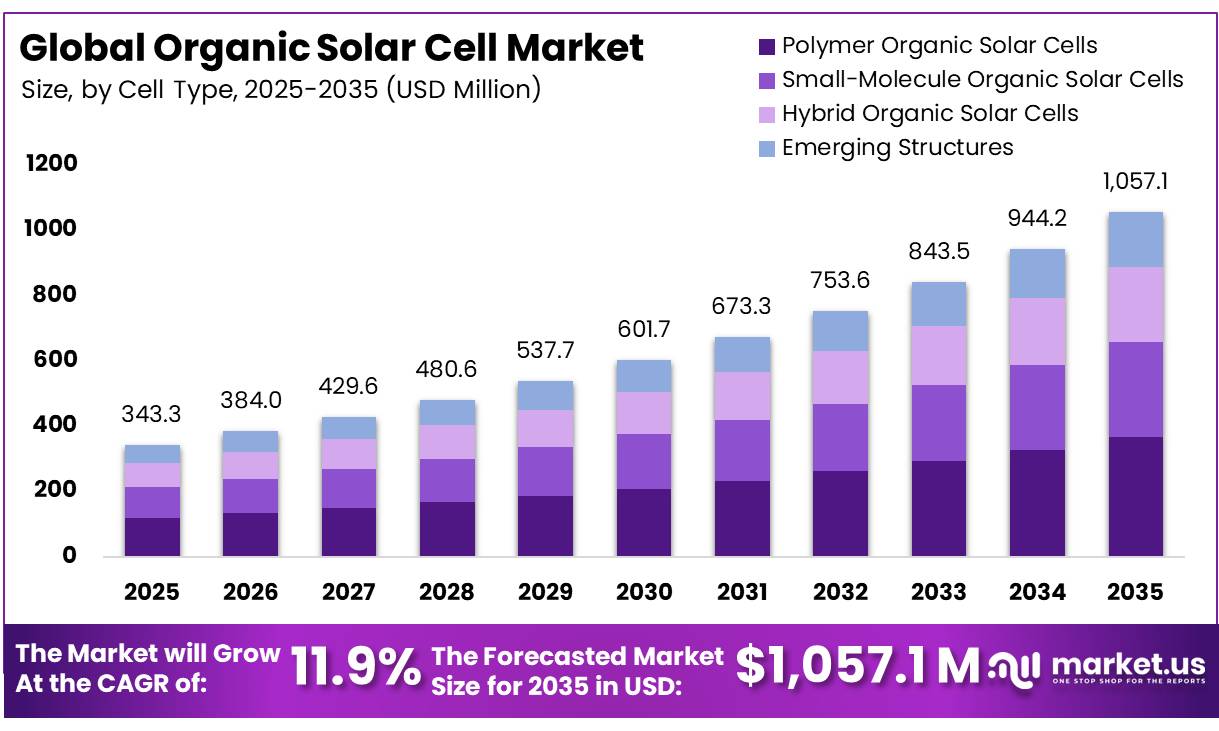
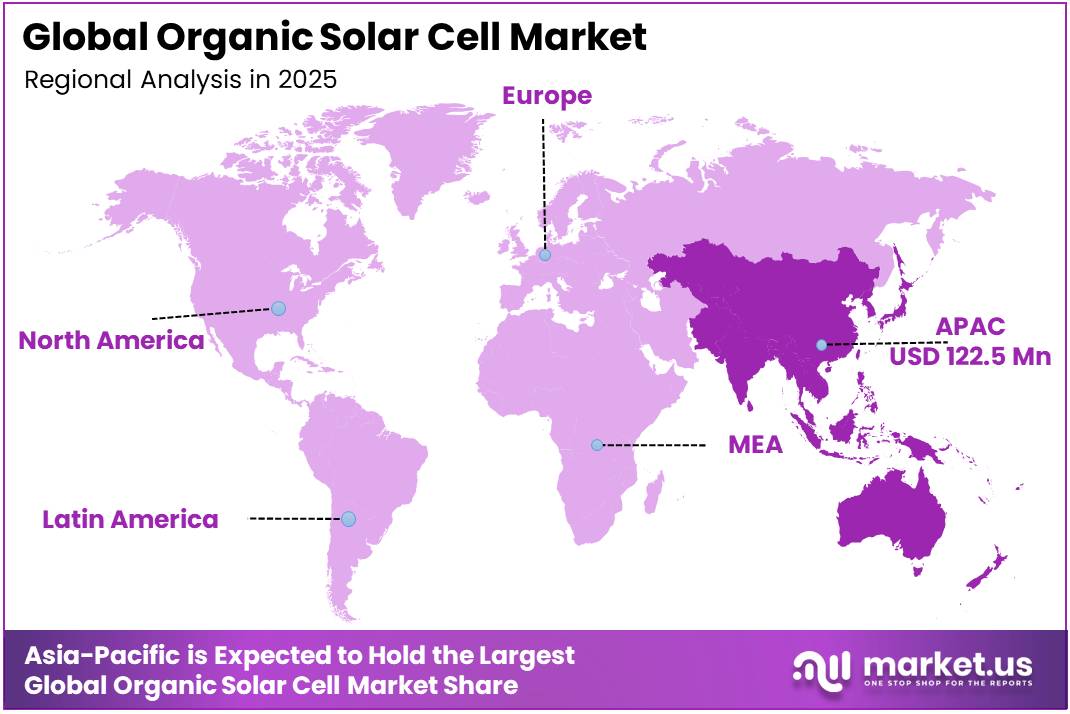
In 2025, the Global Organic Solar Cell Market was valued at USD 343.3 million, and between 2026 and 2035, this market is estimated to register a CAGR of 11.9%, reaching about USD 1,057.1 million by 2035. In 2025, Asia-Pacific led the market, achieving over 35.7% share with a revenue of USD 122.5 Million.
Organic solar cells, organic photovoltaics (OPV), convert sunlight through carbon-based semiconductor molecules or polymers. Unlike rigid modules, OPV films can be lightweight, flexible, semi-transparent and printable on thin substrates. These characteristics position the technology as a complementary form of solar generation rather than a direct replacement for crystalline silicon. Its strongest industrial value lies in surfaces where weight, shape or transparency matter, including façades, windows, vehicles, greenhouses and sensors.
- The International Energy Agency estimated that solar PV additions exceeded 600 GW in 2025, lifting cumulative capacity to around 2,800 GW. It also reported that 30 countries installed more than 1 GW during the year.
Key Takeaways
- The Global Organic Solar Cell Market was valued at USD 343.3 million in 2025.
- The market is projected to grow at a CAGR of 11.9% and is estimated to reach USD 1,057.1 million by 2035.
- On the basis of cell type, Polymer Organic Solar Cells dominated the market, constituting 34.7% of the total market share.
- Based on the application, Building-Integrated Photovoltaics (BIPV) dominated the market, with a substantial market share of around 30.1%.
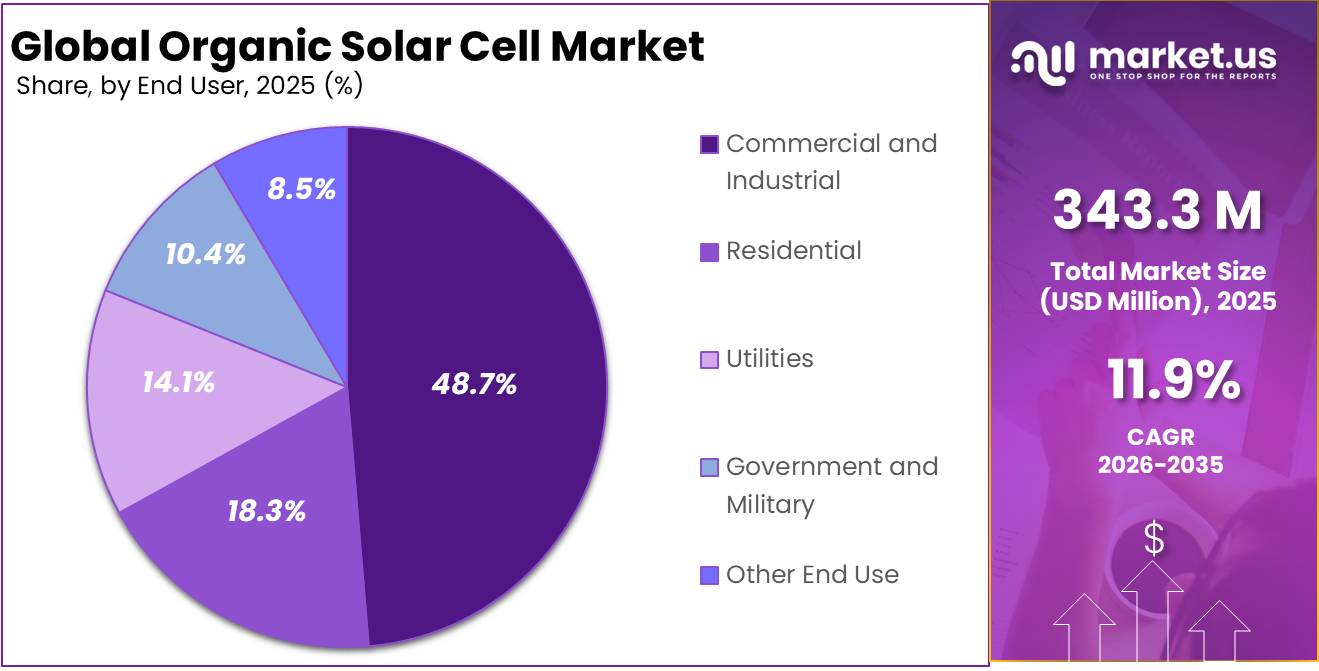
- Based on the end user, Commercial and Industrial led the market, comprising 48.7% of the total market.
- In 2025, Asia-Pacific was the most dominant region in the market, accounting for 35.7% of the total global consumption.
This expansion is strengthening supply chains, engineering skills and customer familiarity with photovoltaic systems, making it easier for printed solar films to enter targeted applications.
- The National Laboratory of the Rockies’ May 2026 chart records a 19.4% efficiency for an organic research cell and 19.1% for an organic tandem cell. These results show that OPV has moved beyond its earlier low-efficiency stage.
However, commercial expansion still depends on transferring small-cell performance to larger modules while controlling moisture, oxygen, heat and ultraviolet degradation. Encapsulation, manufacturing yield and stable field performance remain priorities.
- The European Commission’s Flex2Energy programme runs from January 2023 to December 2026 with a total cost of €21.12 million, including an EU contribution of €15.70 million. Its 48-month programme is developing roll-to-roll manufacturing and quality-control systems for integrated OPV products.
Demonstrations cover building façades and windows, greenhouse shading systems, and vehicle roofs or solar carports. By the end of 2025, the project had reviewed about 160 European and national regulatory documents and advanced prequalification testing. Future opportunities are expected to emerge in integrated applications rather than large solar farms. Building-integrated films could convert glass, curved façades and shaded areas into power-generating surfaces. Vehicle-integrated OPV could benefit from low weight and curved-panel conformity, while indoor OPV can power devices under artificial light.
- Over 2025–2030, the IEA expects distributed systems to represent 42% of global PV expansion. This decentralised trend creates a pathway for OPV, provided producers deliver certified durability, scalable output and competitive lifetime energy costs.
Cell Type Analysis
Polymer Organic Solar Cells Lead with a 34.7% Share
In 2025, Polymer Organic Solar Cells held a dominant market position, capturing more than a 34.7% share. The segment benefits from solution-based processing, lightweight construction and compatibility with flexible plastic substrates. These features support continuous printing methods and make polymer cells suitable for building surfaces, portable electronics, sensors and other applications where conventional rigid panels are less practical.
- In March 2025, a U.S. Department of Energy OSTI-listed study reported that a fluorinated polythiophene polymer solar cell achieved 7.21% efficiency, a 0.85 V open-circuit voltage and a 58.4% fill factor. This improved polymer structures can strengthen charge movement and cell performance, supporting their wider use in flexible electronics, portable devices and building-integrated solar products.
Hybrid Organic Solar Cells are the fastest-growing segment. Their growth is supported by the combination of organic absorber materials with higher-performing inorganic layers, particularly perovskites. This structure allows the cell to capture a broader part of the light spectrum while preserving some of the lightweight and flexible qualities associated with organic photovoltaics. Continued work on material stability, interface control and scalable coating is expected to support their use in high-efficiency flexible modules and integrated solar products.
Application Analysis
Building-Integrated Photovoltaics leads with a 30.1% share as buildings become active solar-power assets.
In 2025, Building-Integrated Photovoltaics (BIPV) held a dominant market position, capturing more than a 30.1% share. The segment benefits from the lightweight, flexible and visually adaptable nature of organic solar cells. These cells can be manufactured in transparent or coloured forms and incorporated into windows, façades, roofs and other building materials without requiring separate mounting structures.
- In January 2026, the European Commission’s Joint Research Centre estimated that the rooftops of 271 million buildings across the European Union could accommodate nearly 2.3 TWp of solar capacity and generate around 2,750 TWh of electricity annually.
This large usable surface area creates a strong long-term opportunity for flexible organic photovoltaic products in urban buildings. The U.S. Department of Energy also included durable and low-cost multi-use organic photovoltaics in its 2025 laboratory research programme, with work focused on efficiency, manufacturing and outdoor durability.
Automotive is the fastest-growing segment in the Organic Solar Cell Market by application. Organic photovoltaic materials are attractive for vehicles because they are lightweight, flexible and capable of following curved surfaces such as roofs, body panels and trailers. They can generate electricity while a vehicle is moving or parked, helping support battery charging, cabin electronics, ventilation and refrigeration equipment. The U.S. Department of Energy identifies commercial trucks, trailers, buses, recreational vehicles and local delivery fleets as promising areas for vehicle-integrated photovoltaics.
End User Analysis
Commercial and Industrial leads with a 48.7% share due to strong energy demand.
In 2025, Commercial and Industrial held a dominant market position, capturing more than a 48.7% share. The Commercial and Industrial segment benefited from the rising need for lightweight solar surfaces across offices, factories, warehouses, retail buildings and indoor electronic systems. Organic solar cells can be printed on flexible materials and adjusted for transparency, colour and different surface designs, making them suitable for windows, façades, curved structures and low-power equipment.
- In April 2026, the U.S. Energy Information Administration reported that commercial facilities consumed 1.49 trillion kWh of electricity during 2025, while industrial facilities consumed 1.04 trillion kWh.
Utilities is the fastest-growing segment in the Organic Solar Cell Market. Growth is supported by the wider expansion of solar generation, distributed power systems and utility programmes that encourage new photovoltaic technologies. Organic solar cells offer lightweight construction, flexible installation and lower-energy manufacturing potential, which may support applications where conventional rigid panels are difficult to install. Utilities are also exploring solar materials that can be integrated into infrastructure, temporary power systems and surfaces with weight or design restrictions.
Key Market Segments
By Cell Type
- Polymer Organic Solar Cells
- Small-Molecule Organic Solar Cells
- Hybrid Organic Solar Cells
- Emerging Structures
By Application
- Building-Integrated Photovoltaics (BIPV)
- Consumer Electronics
- Automotive
- Indoor Energy Harvesting
- Defense & Aerospace
By End User
- Commercial and Industrial
- Residential
- Utilities
- Government and Military
- Other End Use
Driver Analysis
DOE-backed OPV commercialization and pilot-line scale-up
The clearest 2026 demand-side and supply-side catalyst is direct public support for next-generation photovoltaics, especially where the U.S. Department of Energy is no longer framing organic photovoltaics only as academic research but as a pathway toward “large-scale domestic commercialization.” DOE’s Solar Energy Technologies Office continues to anchor solar cost-down targets at $0.02/kWh for utility-scale PV, $0.04/kWh for commercial systems, and $0.05/kWh for residential systems, which matters because OPV developers are not competing head-on with silicon on efficiency alone; they are competing on installed-use-case economics in surfaces where silicon is structurally suboptimal.
The 2024 announcement of $27 million across 10 selected solar manufacturing and dual-use projects, plus FY25 incubator pathways with awards of $1 million to $4 million and award negotiations extending into 2026, improves the probability that OPV firms can bridge the capital gap between lab validation and pre-commercial module manufacturing, a stage where underfunding historically delayed bankability and customer qualification.
Drivers Impact Analysis
| Driver | (~) % Impact on CAGR Forecast | Geographic Relevance | Impact Timeline |
|---|---|---|---|
| DOE-backed OPV commercialization and pilot-line scale-up | +2.4% | North America core, APAC | Short term (≤ 2 years) |
| BIPV façade and lightweight retrofit demand expansion | +2.1% | EU core, Japan/South Korea corridors, North America urban nodes | Medium term (2-4 years) |
| Carbon-footprint disclosure and recyclability compliance favoring low-material PV | +1.7% | EU core, UK alignment spill-over, premium export corridors in APAC | Short term (≤ 2 years) |
| Printable roll-to-roll manufacturing and lower balance-of-weight economics | +1.9% | APAC manufacturing core, EU specialty modules, North America pilot production | Medium term (2-4 years) |
| Transparent and semi-transparent PV adoption in glass-integrated applications | +1.5% | EU core, Middle East premium construction, East Asia smart-building clusters | Medium term (2-4 years) |
| Global solar policy momentum widening the addressable niche for non-silicon formats | +1.3% | Global, with EU and APAC strongest conversion | Long term (≥ 4 years) |
Restraint Analysis
Durability-bankability gap
DOE continues to identify stability and durability, scale efficiency, manufacturability, validation, and bankability as simultaneous hurdles before next-generation thin-film solar can become commercially competitive, which is the clearest public-sector signal that organic solar cells still face a financing-grade reliability deficit rather than a pure laboratory-efficiency problem.
In practical market terms, that pushes developers into higher qualification burn, longer outdoor testing cycles, and a slower transition from pilot procurement to framework agreements; for a typical organic module vendor, that can translate into 12-24 months of additional validation, 300-600 basis points higher cost of capital for early projects, and warranty reserve assumptions of 4-7% of revenue versus 1-3% for mature module classes, which together justify an estimated -2.4 percentage-point drag on 2026 baseline CAGR.
Restraint Impact Analysis
| Restraint | (~) % Impact on CAGR Forecast | Geographic Relevance | Impact Timeline |
|---|---|---|---|
| Durability-bankability gap | -2.4% | North America core, EU, Japan, Korea | Medium term (2-4 years) |
| Pilot-scale yield losses | -1.9% | EU, U.S., China, Korea | Short term (≤ 2 years) |
| Regulatory compliance burden | -1.3% | EU core, UK-aligned markets | Medium term (2-4 years) |
| Import-duty cost spillover | -1.1% | U.S. import channels, APAC export corridors | Short term (≤ 2 years) |
| Material concentration risk | -1.6% | China-linked supply chain, EU, India, U.S. | Medium term (2-4 years) |
| Financing and insurance friction | -1.8% | North America core, EU, Australia | Long term (≥ 4 years) |
Opportunity Analysis
Semi-transparent BIPV façades
The EU’s Energy Performance of Buildings Directive creates a timed conversion funnel new permit applications after May 2026 must optimize solar potential, new business buildings face installation requirements from 2027, and major renovations over 500 enter the mandate path from 2028 while the broader EU rooftop and building solar push implies 150–200 GW of rooftop-related deployment potential; even if organic solar captures only 0.15% to 0.25% of that envelope through semi-transparent façade glass, canopy skins, and shading systems, that still translates into roughly 225 MW to 500 MW of incremental addressable volume, which could be worth an estimated $0.4 billion to $0.9 billion at installed system values of $1.8/W to $2.2/W in design-led niches.
Certified organic-cell efficiency at 19.4% materially de-risks this adjacency because façade applications can tolerate lower absolute efficiency than rooftop silicon while valuing color, form factor, and low embodied weight, allowing gross-margin premiums of 800 to 1,500 basis points over standard flexible PV if developers bundle electricity generation with façade replacement budgets and green-building compliance economics.
Opportunity Impact Analysis
| Opportunity | (~) % Potential CAGR Upside | Geographic Relevance | Execution Window |
|---|---|---|---|
| Semi-transparent BIPV façades | +2.4% | EU core, Japan, premium APAC cities | Medium term (2-4 years) |
| Indoor IoT energy harvesting | +1.9% | North America core, EU, Japan, Korea | Short term (≤ 2 years) |
| Agrivoltaic films for greenhouses | +1.6% | EU South, Japan, MENA, APAC emerging | Medium term (2-4 years) |
| Roll-up M&A in specialty materials | +1.4% | EU, U.S., Korea, China | Short term (≤ 2 years) |
| Licensing + manufacturing-as-a-service | +1.7% | China, India, Southeast Asia, EU | Short term (≤ 2 years) |
| Carport and rooftop retrofit membranes | +1.3% | EU, North America, Gulf states | Long term (≥ 4 years) |
Challenges Analysis
Lifetime Validation Gap
Organic solar cells remain commercially challenged by a durability deficit versus incumbent silicon, which DOE describes as offering 25-year-plus module life while OPV has shorter operating lifetimes, and this gap compounds into a modeled 1.8 percentage-point CAGR friction because bankable deployment categories increasingly require evidence aligned with multi-month outdoor testing, accelerated stress protocols, and performance-loss thresholds that next-generation PV programs are formalizing through tests such as 1000-hour damp heat at 85°C/85% RH, 50 thermal cycles from -40°C to +85°C, 96-hour potential-induced degradation screening, and 6 months of continuous outdoor exposure with less than 3% overall loss for emerging PV validation frameworks.
For OPV suppliers, the issue is not a total inability to sell into niche indoor, portable, or semi-transparent applications, but a persistent inability to compress the credibility gap between laboratory stability claims, fielded degradation curves, and customer warranty expectations, which raises product qualification cycles by an estimated 9 to 15 months and forces firms to hold higher reserve provisions, overspec encapsulation stacks, and narrower launch geographies until statistically credible field-failure datasets reach at least low-thousands of module-equivalent operating days across multiple climates.
Challenges Impact Analysis
| Challenge | (~) % CAGR Friction Drag | Geographic Relevance | Mitigation Horizon |
|---|---|---|---|
| Lifetime Validation Gap | -1.8% | North America core, EU regulatory hubs, Japan/Korea advanced materials clusters | Long term (≥ 4 years) energy |
| Scale-Up Yield Instability | -1.4% | APAC manufacturing corridors, EU pilot lines, U.S. demonstration base | Medium term (2-4 years) energy |
| Encapsulation Barrier Dependence | -1.1% | Humid APAC markets, EU building-integrated niches, U.S. flexible electronics channels | Medium term (2-4 years) nrel |
| Electrode Material Volatility | -0.9% | EU regulatory hubs, East Asia coating supply chains, North America specialty inputs | Medium term (2-4 years) publications.jrc.europa |
| Bankability Data Scarcity | -1.3% | North America project finance, EU innovation programs, advanced procurement markets | Long term (≥ 4 years) energy |
| Pilot-Line Talent Bottleneck | -0.8% | Germany/France/Nordics, U.S. lab-to-fab clusters, South Korea/Japan device hubs | Medium term (2-4 years) energy |
Geopolitical Impact Analysis
Geopolitical Impact of Ongoing Global Conflicts on the Organic Solar Cell Market
The ongoing conflicts involving Russia-Ukraine and tensions in the Middle East have influenced the Organic Solar Cell market by disrupting global supply chains and increasing the cost of raw materials, transportation, and energy. Several materials used in organic photovoltaic production depend on globally connected chemical and electronics industries, making manufacturers vulnerable to delays in sourcing essential components.
At the same time, the geopolitical situation has strengthened the long-term outlook for the Organic Solar Cell market. Many countries are reducing dependence on imported fossil fuels and investing more heavily in renewable energy technologies to improve energy security. Governments across Europe, Asia-Pacific, and North America have expanded clean energy funding, research programs, and domestic manufacturing initiatives. Organic solar cells, known for their lightweight structure, flexibility, and suitability for portable and building-integrated applications, are benefiting from these policy shifts.
Regional Analysis
Asia Pacific Held the Largest Share of the Organic Solar Cell Market
Asia-Pacific dominated the global organic solar cell market in 2025, accounting for 35.7% of total market revenue, valued at approximately USD 122.5 million. The region’s leadership is supported by strong investments in renewable energy manufacturing, expanding electronics production, and government-backed clean energy programs. China, Japan, South Korea, and India remain the primary contributors due to their well-established photovoltaic supply chains and growing research activities in next-generation solar technologies.
- According to the International Energy Agency (IEA), China added more than 277 GW of solar photovoltaic capacity in 2024, maintaining its position as the world’s largest solar market.
Asia-Pacific is also projected to register the fastest growth during the forecast period as governments continue expanding renewable energy deployment and advanced solar research. Countries such as India, China, Vietnam, and Australia are increasing investments in clean energy manufacturing, while universities and technology institutes are accelerating commercialization of flexible photovoltaic technologies. According to the International Renewable Energy Agency (IRENA), Asia accounted for the largest share of newly installed renewable power capacity globally in 2024, reflecting strong momentum in solar investments.
Key Regions and Countries Covered
- North America
- The US
- Canada
- Europe
- Germany
- France
- The UK
- Spain
- Italy
- Russia & CIS
- Rest of Europe
- APAC
- China
- Japan
- South Korea
- India
- ASEAN
- Rest of APAC
- Latin America
- Brazil
- Mexico
- Rest of Latin America
- Middle East & Africa
- GCC
- South Africa
- Rest of MEA
Key Players Analysis
Henkel AG supports the organic solar cell value chain through adhesives, sealants, conductive interconnect materials, and encapsulation technologies rather than cell manufacturing. In 2025, Henkel’s Adhesive Technologies business generated €10.667 billion in sales, represented 52% of group revenue, and achieved a 16.7% adjusted operating margin, strengthening its capacity to serve advanced photovoltaic manufacturers globally today. InfinityPV ApS is a Danish specialist in roll-to-roll equipment, slot-die coating, testing systems, and materials used to develop flexible organic solar cells. In October 2025, it highlighted research achieving 13.5% efficiency for ITO-free devices and 11.5% for flexible PET modules.
Mitsubishi Chemical Group Corporation brings deep polymer, molecular-design, coating, and functional-material expertise to organic photovoltaics. The group began practical OPV development in 2008 and later reported an 11.7% conversion efficiency for an organic thin-film single cell, then described as a world record. NanoFlex Power Corporation is an intellectual-property-focused developer of small-molecule organic photovoltaic technologies for flexible modules, wireless sensors, and building-integrated systems. A 2019 U.S. SEC filing stated that the company had more than 20 years of thin-film OPV intellectual-property development.
The Major Players in The Industry
- Armor SA
- BASF SE
- BELECTRIC OPV GmbH
- DisaSolar SAS
- Draper Energy LLC
- Eight19 Ltd.
- Epishine AB
- FlexEnable Ltd.
- Heliatek GmbH
- Henkel AG
- InfinityPV ApS
- Mitsubishi Chemical Group Corporation
- NanoFlex Power Corporation
- Other Key Players
Key Development
- In February 2026, BASF formed a partnership with Xfloat and supplied Tinuvin 2730 ED for floating solar platforms designed to withstand harsh conditions for over 30 years; one Singapore project achieved a 28% improvement in electricity yield.
- In January 2025, Epishine AB and Nichicon launched the SCB-EpNi-2500-000400 self-charging module, combining Epishine’s flexible organic solar cells with an LTO battery for low-power IoT devices.
Report Scope
| Report Features | Description |
|---|---|
| Market Value (2025) | USD 343.3 Mn |
| Forecast Revenue (2035) | USD 1,057.1 Mn |
| CAGR (2026-2035) | 11.9% |
| Base Year for Estimation | 2025 |
| Historic Period | 2020-2024 |
| Forecast Period | 2026-2035 |
| Report Coverage | Revenue Forecast, Market Dynamics, Competitive Landscape, Recent Developments |
| Segments Covered | By Cell Type (Polymer Organic Solar Cells, Small-Molecule Organic Solar Cells, Hybrid Organic Solar Cells, and Emerging Structures), By Application (Building-Integrated Photovoltaics (BIPV), Consumer Electronics, Automotive, Indoor Energy Harvesting, and Defense & Aerospace), By End User (Commercial and Industrial, Residential, Utilities, Government and Military, and Other End Use) |
| Regional Analysis | North America – The US & Canada; Europe – Germany, France, The UK, Spain, Italy, Russia & CIS, Rest of Europe; APAC– China, Japan, South Korea, India, ASEAN & Rest of APAC; Latin America– Brazil, Mexico & Rest of Latin America; Middle East & Africa– GCC, South Africa, & Rest of MEA |
| Competitive Landscape | Armor SA, BASF SE, BELECTRIC OPV GmbH, DisaSolar SAS, Draper Energy LLC, Eight19 Ltd., Epishine AB, FlexEnable Ltd., Heliatek GmbH, Henkel AG, InfinityPV ApS, Mitsubishi Chemical Group Corporation, NanoFlex Power Corporation, and Other Key Players. |
| Customization Scope | Customization for segments, region/country-level will be provided. Moreover, additional customization can be done based on the requirements. |
| Purchase Options | We have three licenses to opt for: Single User License, Multi-User License (Up to 5 Users), Corporate Use License (Unlimited Users and Printable PDF) |





































