


Report Overview
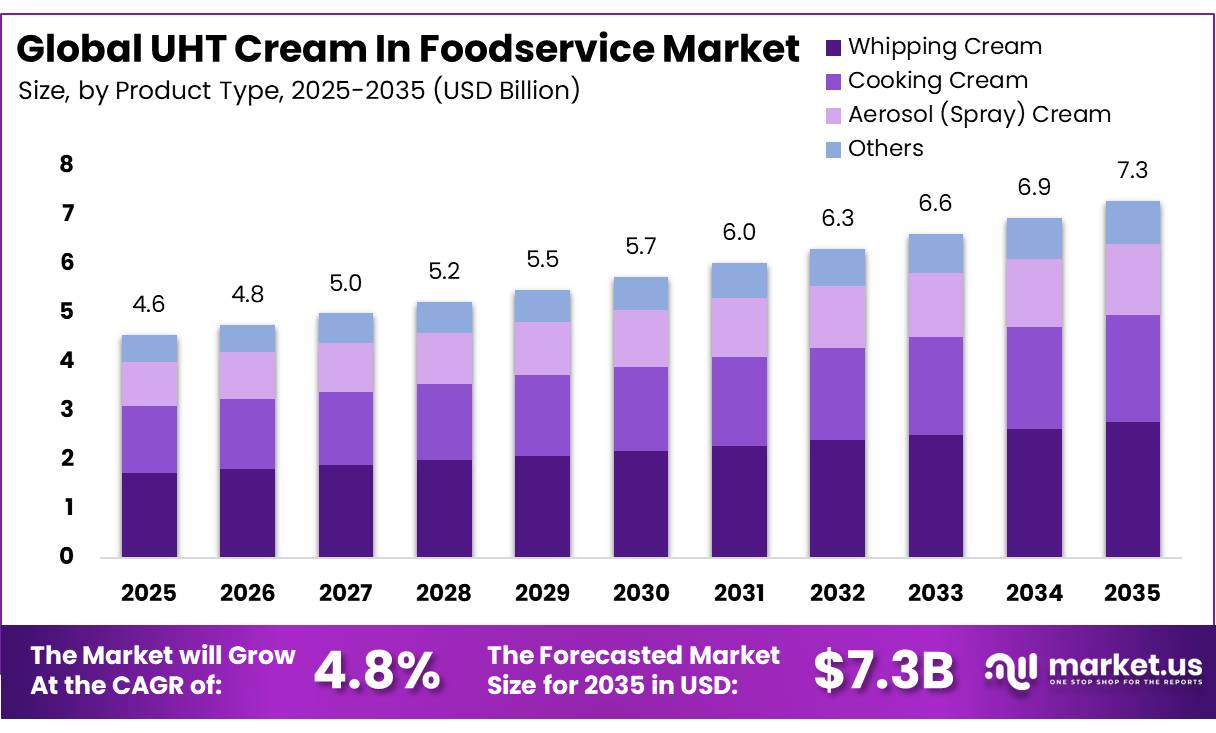
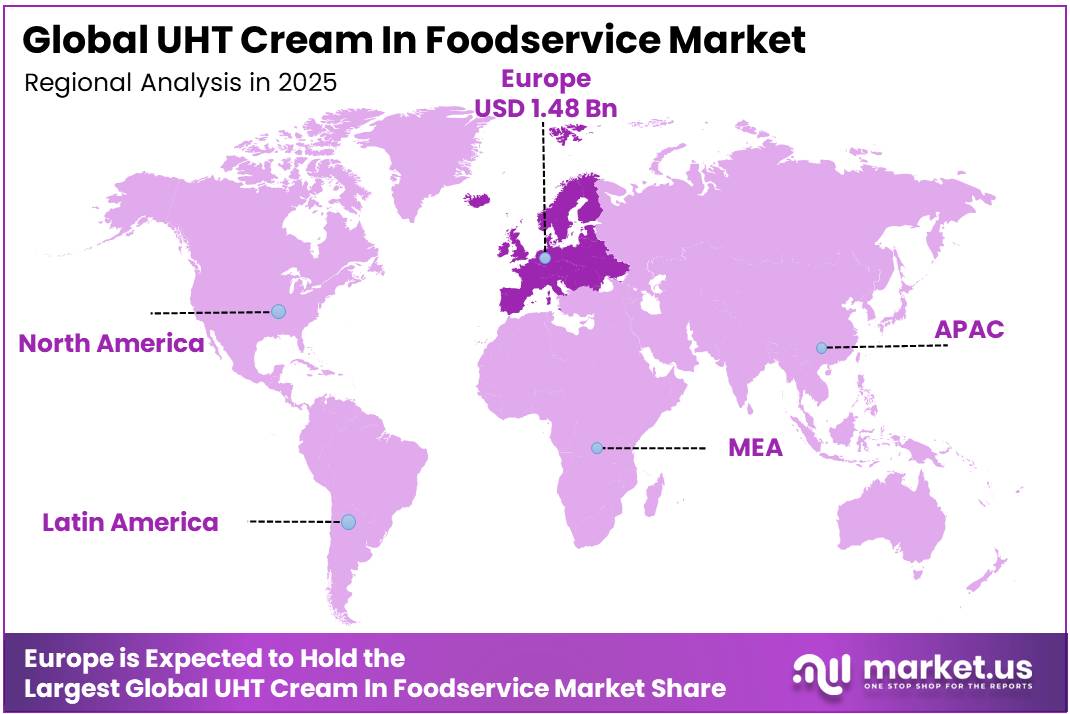
In 2025, the Global UHT Cream In Foodservice Market was valued at USD 4.6 billion, and between 2026 and 2035, this market is estimated to register a CAGR of 4.8%, reaching about USD 7.3 billion by 2035. Europe held a dominant market position, capturing more than a 32.50% share, holding USD 1.48 billion in revenue.
Ultra-High-Temperature cream is a heat-treated dairy or plant-based ingredient supplied to restaurants, bakeries, cafés, hotels, caterers, and institutional kitchens for whipping, cooking, desserts, and beverages. United States regulation defines ultra-pasteurized dairy products as thermally processed at or above 280°F for at least 2 seconds to extend refrigerated shelf life. This treatment supports centralized purchasing, easier inventory planning, reduced spoilage exposure, and consistent texture across high-volume foodservice operations requiring dependable cream availability.
- In November 2025, Eurostat reported that European Union dairies processed 8 million tonnes of whole milk during 2024. Cream fabrication generated 13.9 million tonnes of skimmed milk, indicating the significant scale of fat separation within regional dairy operations.
Key Takeaways
- The global UHT cream in foodservice market was valued at USD 4.6 billion in 2025.
- The global market is projected to grow at a CAGR of 4.8% and is estimated to reach USD 7.3 billion by 2035.
- On the basis of product type, whipping cream dominated the market, constituting 38.0% of the total market share.
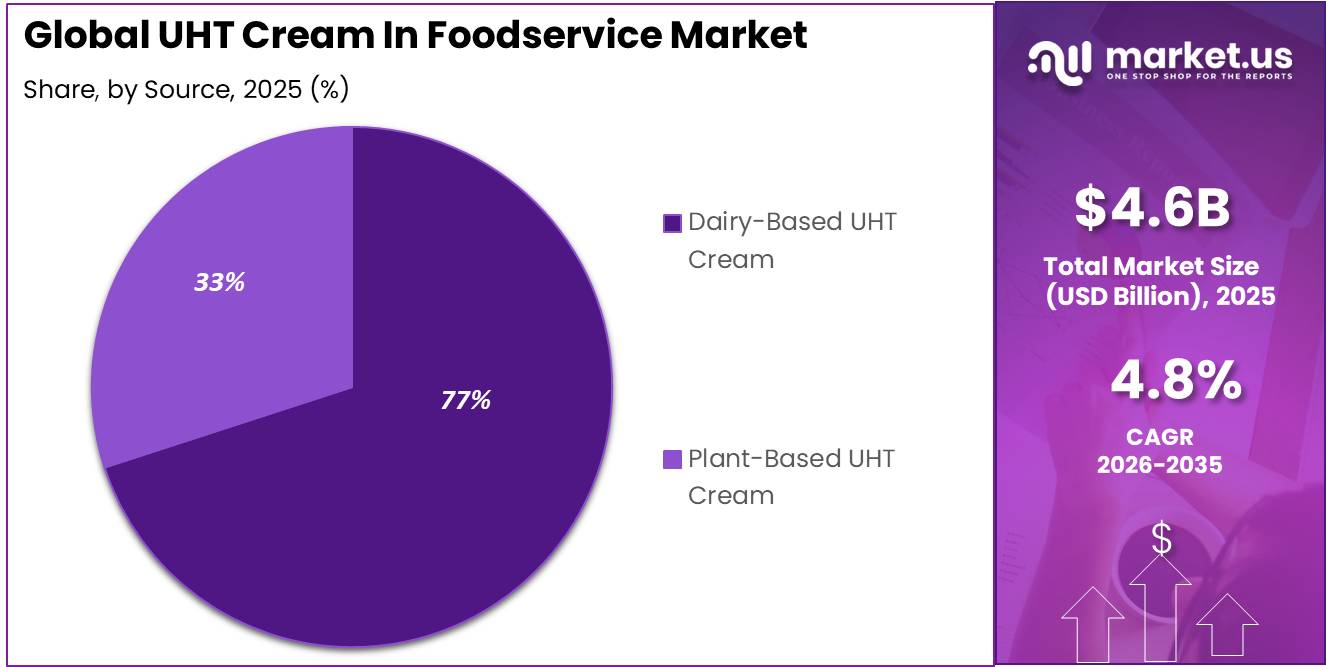
- Based on source, dairy-based UHT cream dominated the market, with a substantial market share of around 77.0%.
- Based on nature, conventional UHT cream led the market, comprising 91.0% of the total market share.
- Among applications, bakery and confectionery held a major share in the UHT cream in foodservice market, accounting for 39.0% of the market share.
- In 2025, Europe was the most dominant region in the UHT cream in foodservice market, accounting for 32.5% of the total market share.
Growth opportunities are emerging through organic products, plant-based formulations, resealable packaging, and creams designed for stable whipping or heat resistance. Government-backed finance is also supporting dairy innovation. In September 2025, the European Investment Bank provided Sodiaal with a €70 million Invest EU-guaranteed loan for research, development, and innovation programmes running from 2025 to 2028.
- In February 2026, the United Kingdom Department for Environment, Food and Rural Affairs reported that non-residential catering generated £45.2 billion in Gross Value Added during 2023. The same source recorded 1.938 million food and drink catering employees in 2025, highlighting a broad customer base for portion-controlled, stable, and labour-saving ingredients.
- In 2025, global milk production was projected to reach approximately 1,005 million tonnes, representing a 2.1% increase compared with the previous year, supporting greater availability of dairy ingredients for industrial applications.
Fonterra Co-operative Group Limited continues to focus on high-value dairy ingredients and business-to-business solutions. In 2025, Fonterra announced a strategic transaction with Groupe Lactalis involving the sale of Fonterra’s global consumer businesses and related foodservice and ingredients operations. The agreement involved a transaction value of NZ$3.845 billion and included Fonterra’s foodservice and ingredients activities across regions such as Oceania, Sri Lanka, and the Middle East and Africa.
Product Type Analysis
Whipping Cream dominates with 38.0% because its versatile texture supports broad foodservice use.
In 2025, Whipping Cream held a dominant market position, capturing more than a 38.0% share. Its leadership was supported by use in bakeries, cafés, hotels, restaurants, and catering kitchens. Foodservice operators favour it for cake decoration, pastry fillings, mousses, beverages, and plated desserts because it develops volume quickly and provides a smooth finish. Ultra-high-temperature processing also helps professional kitchens maintain dependable quality, simplify stock management, and reduce preparation pressure during busy service periods. Its ability to work across sweet and savoury menus further strengthened demand.
- For instance, in August 2025, according to Arla Foods, the company’s half-year report identified cooking cream as a leading contributor to the growth of its Puck brand.
Cooking Cream is expected to be a growing segment. Its expansion is supported by demand for convenient ingredients that perform consistently in sauces, soups, pasta dishes, curries, and prepared meals. Professional chefs value its pourability, heat tolerance, and ability to deliver richness without requiring lengthy preparation, supporting wider adoption across high-volume kitchens and institutional catering.
Source Analysis
Dairy-Based UHT Cream dominates with 77.0% because familiar performance and dependable supply support foodservice use.
In 2025, Dairy-Based UHT Cream held a dominant market position, capturing more than a 77.0% share. Its leadership was supported by established use across bakeries, cafés, hotels, restaurants, and institutional kitchens. Professional users value its familiar flavour, smooth mouthfeel, whipping ability, and compatibility with hot and cold recipes. Existing dairy-processing networks also support consistent sourcing, standardized quality, and dependable delivery for kitchens managing regular production schedules. These practical advantages help dairy-based products remain the preferred choice for sauces, desserts, beverages, fillings, and finishing applications.
- For instance, in February 2026, according to Arla Foods, its annual report stated that a new plant-based range strengthened a strategic brand by attracting younger consumers and widening its reach.
Plant-Based UHT Cream is expected to be a growing segment. Its expansion is supported by changing menu requirements, rising interest in dairy-free choices, and demand for versatile products suitable for cooking and whipping. Foodservice operators are evaluating plant-based creams to serve broader customer groups while maintaining reliable kitchen performance at scale.
Nature Analysis
Conventional dominates with 91.0% because established dairy supply chains support dependable foodservice purchasing.
In 2025, Conventional held a dominant market position, capturing more than a 91.0% share. Its leadership was supported by broad availability, familiar taste, standardized processing, and reliable performance in professional kitchens. Restaurants, bakeries, cafés, hotels, and caterers commonly select conventional cream because it fits routine purchasing systems and works consistently across sauces, fillings, beverages, toppings, and prepared desserts. Large dairy networks also help suppliers maintain regular production, stable specifications, and convenient pack formats for customers managing frequent orders and high-volume service.
- For instance, in January 2025, according to Organic Valley, the cooperative introduced organic oat creamers made with oats sourced directly from certified organic family farms, expanding its organic creamer portfolio.
Organic is expected to be a growing segment. Its expansion is supported by stronger menu differentiation, certified sourcing requirements, and customer interest in products produced under recognized farming standards. Foodservice operators can use organic cream to strengthen premium offerings, serve ingredient-conscious diners, and provide clearly identified choices across specialty cafés, bakeries, hospitality venues, and institutional menus.
Application Analysis
Bakery and Confectionery dominates with 39.0% because cream supports dependable finishing, filling, and preparation.
In 2025, Bakery and Confectionery held a dominant market position, capturing more than a 39.0% share. Its leadership was supported by regular use of UHT cream in cakes, pastries, muffins, fillings, ganache, and decorative toppings. Professional bakers value products that provide consistent whipping, smooth texture, and reliable performance during production schedules. Long shelf life also helps kitchens manage stock efficiently, reduce product losses, and maintain uniform results across outlets. These practical benefits keep UHT cream central to bakery and confectionery operations.
- For instance, in January 2025, according to Elle & Vire Professionnel, the company became the main partner of the Coupe du Monde de la Pâtisserie, strengthening its engagement with professional pastry chefs and high-end dessert preparation.
Desserts are expected to be a growing segment. Demand is supported by wider use of UHT cream in puddings, mousses, layered desserts, plated creations, and chilled preparations. Foodservice operators favour it for convenience, smooth mouthfeel, and ability to deliver stable results across recipes and service formats with consistent quality.
Key Market Segments
By Product Type
- Whipping Cream
- Cooking Cream
- Aerosol (Spray) Cream
- Others
By Source
- Dairy-Based UHT Cream
Plant-Based UHT Cream
By Nature
- Conventional
Organic
By Application
- Bakery and Confectionery
- Cakes
- Pastries
- Muffins
- Others
- Desserts
- Puddings
- Mousses
- Others
- Beverages
- Coffee
- Tea
- Others
- Others
Driver Analysis
Plant-Based and Lactose-Free UHT Cream Formats
Dairy-alternative cream formats are moving from retail shelves into foodservice menus as multi-unit operators respond to rising lactose-intolerance awareness and flexitarian menu demand, with plant-based packaging and ingredient markets tracking toward roughly USD 12 billion by 2029 from about USD 6.4 billion in 2024, a 13.4% CAGR reflecting broader capital flow into alternative-format food inputs. Within cream specifically, Asian foodservice markets have historically leaned on vegetable-oil-based non-dairy creams for cost and stability reasons, and this installed base is now migrating toward UHT-processed hybrid and fully plant-based formats that match dairy cream’s whip performance while extending ambient shelf life beyond six months.
This shift alters customer acquisition dynamics for cream suppliers: instead of competing purely on dairy-commodity price indices, UHT plant-based cream lines compete on formulation IP, requiring higher R&D intensity but commanding gross margins often 200-400 basis points above conventional dairy UHT cream due to perceived premiumization and reduced input-price volatility exposure to raw milk markets. The commercial trajectory favors multi-unit café and QSR adoption in North America, the EU, and APAC metro markets over a two-to-four-year horizon as formulation costs converge with dairy equivalents.
Drivers Impact Analysis
| Driver | (~) % Impact on CAGR Forecast | Geographic Relevance | Impact Timeline |
|---|---|---|---|
| QSR and cloud-kitchen network expansion raising bulk cream throughput | +1.6% | APAC core, North America, Middle East corridors | Medium term (2-4 years) |
| Cold-chain-bypass economics favoring UHT over pasteurized cream in emerging foodservice markets | +1.3% | South Asia, Sub-Saharan Africa, South America spill-over | Short term (≤2 years) |
| Bakery, café, and dessert-menu premiumization lifting whipping-grade UHT cream volumes | +1.1% | EU, North America, APAC urban centers | Medium term (2-4 years) |
| Packaging and shelf-life regulatory tightening (PPWR-style rules, aseptic carton mandates) | +0.7% | EU core, with APAC/North America follow-through | Long term (≥4 years) |
| Plant-based and lactose-free UHT cream formats entering multi-unit foodservice menus | +0.9% | North America, EU, APAC metros | Medium term (2-4 years) |
| Institutional catering and airline/rail catering standardization on aseptic dairy inputs | +0.5% | Middle East, APAC, EU | Long term (≥4 years) |
Restraint Analysis
Packaging, waste, and sustainability compliance costs
Regulatory and investor scrutiny on packaging waste, recyclability, and food-system sustainability is tightening markedly in the EU and increasingly in North America, with frameworks such as the EU’s Packaging and Packaging Waste Regulation and national extended producer responsibility regimes setting ambitious reuse and recycling targets that directly affect aseptic dairy cartons used for UHT cream. Under PPWR proposals, liquid food products above certain volume thresholds must meet specific reuse or recyclability criteria by late this decade, and while industry groups are lobbying for exemptions for UHT and plant-based liquids, processors still face rising compliance costs from 2025 onward due to requirements like higher recycled-content shares, mono-material structures, and stricter labeling for waste sorting.
Transitioning a typical 1-liter UHT cream carton line from conventional multi-material structures to advanced recyclable or bio-based formats can add an estimated 3–6% to packaging cost per unit, while additional documentation and auditing requirements can bring SG&A overhead up by 50–100 basis points for smaller suppliers.
Restraint Impact Analysis
| Restraint | (~) % Impact on CAGR Forecast | Geographic Relevance | Impact Timeline |
|---|---|---|---|
| Dairy fat price volatility and margin squeeze | -1.7% | EU, North America core, APAC corridors | Short term (≤ 2 years) |
| Limited cold-chain and warehousing reliability | -1.4% | South Asia, Sub-Saharan Africa, LATAM | Medium term (2-4 years) |
| Packaging, waste, and sustainability compliance costs | -1.2% | EU core, UK, increasingly North America | Long term (≥ 4 years) |
| Labor shortages and operational complexity in foodservice | -1.0% | North America, EU, urban APAC | Short term (≤ 2 years) |
| Slow adoption of plant-based and specialty UHT formats | -0.9% | EU, North America, APAC metros | Medium term (2-4 years) |
| Food safety, traceability and documentation burdens | -0.8% | Global multi-unit chains and institutional catering | Long term (≥ 4 years) |
Opportunity Analysis
Functional and fortified UHT cream for health-positioned menus
If suppliers develop UHT cream SKUs with, for example, 20–30% higher protein content, added prebiotic fibers, or vitamin fortification suitable for cold and hot applications, they unlock new positioning for cafés, fitness-focused QSR concepts, and hospital/airline catering: a mid-scale chain with 500 outlets could migrate 20–30% of its cream usage to functional SKUs and justify a 10–15% price premium while maintaining cost-per-serving thanks to lower portion sizes and higher perceived value, lifting gross margin per cream-based menu item by an estimated 200–300 basis points.
Assuming functional dairy maintains double-digit growth across categories and cream captures even 10–15% of that incremental TAM by 2030, this could translate into several hundred million dollars of additional foodservice cream revenue globally, with uplift concentrated in North America, the EU, and affluent APAC cities where consumers already pay for high-protein and “better-for-you” desserts. Crucially, this is not yet a baseline driver because most UHT cream SKUs sold today remain conventional, with functional claims largely absent from large foodservice tenders; the upside is contingent on targeted product development, regulatory-compliant health claims, and menu-engineering partnerships over the next two to four years.
Opportunity Impact Analysis
| Opportunity | (~) % Potential CAGR Upside | Geographic Relevance | Execution Window |
|---|---|---|---|
| Functional and fortified UHT cream for health-positioned menus | +1.6% | North America core, EU, urban APAC | Medium term (2-4 years) |
| Ready-to-use UHT dessert and beverage bases for QSR and cafés | +1.4% | APAC emerging markets, Middle East, LATAM | Short term (≤ 2 years) |
| Plant-based and hybrid UHT cream platforms for flexitarian demand | +1.3% | EU, North America, APAC metros | Medium term (2-4 years) |
| Foodservice-focused B2B digital cream procurement and analytics | +1.1% | Global multi-unit chains, North America, EU | Long term (≥ 4 years) |
| Region-specific flavor and format localization in UHT cream | +1.0% | APAC, Middle East, LATAM | Medium term (2-4 years) |
| Strategic M&A roll-ups of regional UHT cream processors | +0.9% | EU, APAC corridors, North America | Long term (≥ 4 years) |
Challenges Analysis
High UHT processing and energy intensity
UHT cream production is structurally more energy- and capital-intensive than conventional pasteurization, requiring sustained heating to around 135–150°C, rapid cooling, and aseptic filling under tightly controlled conditions, which elevates per-liter processing cost and exposes plants to energy price volatility and ESG scrutiny over the long term.
Typical UHT lines can process tens of thousands of liters per hour but demand high-pressure pumps, heat exchangers, and sterilization systems that push fixed CapEx into the multi‑million‑dollar range, and when electricity and gas costs spike by 20–30% as has occurred episodically in EU and other regions since 2022 energy can represent 10–15% of total production cost for cream, eroding margins by 150–250 basis points unless prices are raised.
Over the next four-plus years, processors will need to invest in heat‑recovery systems, renewable power sourcing, and process optimization to shave 10–20% off specific energy consumption and stabilize cost profiles; failure to do so risks UHT cream losing share to lower‑footprint alternatives or driving chains to rationalize cream‑heavy menus, keeping CAGR structurally below its unconstrained potential.
Challenges Impact Analysis
| Challenge | (~) % CAGR Friction Drag | Geographic Relevance | Mitigation Horizon |
|---|---|---|---|
| High UHT processing and energy intensity | -1.3% | EU regulatory hubs, North America core | Long term (≥ 4 years) |
| Skilled dairy and foodservice talent gaps | -1.1% | EU, Australia/NZ, North America | Medium term (2-4 years) |
| Complex multi-node cream logistics and inventory | -1.0% | APAC logistics corridors, LATAM, Middle East | Medium term (2-4 years) |
| Stringent and evolving food safety and labeling rules | -0.9% | EU regulatory hubs, global chains | Long term (≥ 4 years) |
| Digital traceability and data integration deficits | -0.8% | Global multi-unit foodservice networks | Medium term (2-4 years) |
| Capital-intensive aseptic capacity scaling | -0.7% | APAC emerging, LATAM, Africa | Long term (≥ 4 years) |
Geopolitical Impact Analysis
Trade Disputes and Shipping Volatility Reshaping UHT Cream Supply Networks.
Geopolitical tensions are reshaping the Ultra-High-Temperature cream in foodservice market through dairy trade investigations, shifting import policies, and uncertain access to international customers. In September 2024, the European Union challenged China’s anti-subsidy investigation covering liquid milk and cream containing more than 10% fat. The affected European Union dairy exports to China were valued at approximately EUR 513 million in 2023, representing around 30% of the region’s dairy exports to China.
Changes in international dairy flows are also affecting sourcing and pricing decisions. In November 2025, the Food and Agriculture Organization projected that global dairy trade, measured in milk equivalent, would decline by 0.8% during 2025. Reduced trade availability can increase competition for cream, milk fat, plant-based inputs, and aseptic products among foodservice suppliers serving import-dependent markets.
- In September 2025, the United Nations Trade and Development reported that seaborne trade volumes were expected to rise by only 0.5%, while geopolitical rerouting had increased ton-miles by nearly 6% during 2024. Longer routes can raise freight, insurance, refrigeration, and inventory costs for internationally traded UHT products.
These conditions are encouraging manufacturers and foodservice distributors to diversify dairy sourcing, establish regional packing capacity, maintain larger safety stocks, and develop relationships with multiple suppliers. Ultra-High-Temperature processing provides some protection through extended product life, but changing tariffs, trade disputes, port congestion, and transport costs continue to create procurement uncertainty across restaurants, bakeries, hotels, cafés, and institutional catering networks.
Regional Analysis
Europe leads with 32.50%, while Asia-Pacific records the fastest growth.
In 2025, Europe held a dominant position in the UHT cream in foodservice market, capturing more than a 32.50% share and generating USD 1.48 billion in revenue. Its leadership was supported by a mature dairy-processing base, strong bakery and café culture, and demand from restaurants, hotels, caterers, and institutional kitchens. Well-established distribution networks, reliable cream availability, and wide adoption across desserts, beverages, sauces, and pastry preparation further strengthened the region’s position.
Asia-Pacific is expected to be the fastest-growing regional segment. Growth is supported by expanding urban foodservice activity, rising café and bakery chains, increasing hotel and restaurant development, and wider adoption of convenient dairy ingredients. Demand for whipping cream, cooking cream, and plant-based alternatives is also rising as professional kitchens seek consistent quality, longer shelf life, and efficient preparation. These factors are expected to strengthen Asia-Pacific’s role within the market.
Key Regions and Countries Covered
- North America
- The US
- Canada
- Europe
- Germany
- France
- The UK
- Spain
- Italy
- Russia & CIS
- Rest of Europe
- APAC
- China
- Japan
- South Korea
- India
- ASEAN
- Rest of APAC
- Latin America
- Brazil
- Mexico
- Rest of Latin America
- Middle East & Africa
- GCC
- South Africa
- Rest of MEA
Key Players Analysis
The UHT cream in foodservice market has a competitive structure shaped by established dairy processors, specialist cream manufacturers, and professional foodservice ingredient suppliers. Companies compete through product consistency, whipping stability, heat resistance, flavour quality, packaging convenience, and dependable bulk supply. Leading participants are strengthening their position by offering application-specific cream products for bakeries, cafés, hotels, restaurants, catering companies, and institutional kitchens.
Key players are also focusing on aseptic processing, efficient manufacturing, cold-chain management, and packaging formats suited to professional kitchens. Strong relationships with distributors, bakery chains, hospitality groups, and foodservice wholesalers help suppliers secure recurring orders and improve regional coverage. Companies are expanding technical support for chefs and bakery professionals through recipe development, product demonstrations, and application testing.
Market Key Players
- Fonterra Co-operative Group Limited
- Groupe Lactalis
- Savencia Fromage & Dairy
- Royal FrieslandCampina N.V.
- Lakeland Dairies Co-operative Society Limited
- Arla Foods amba
- Nestlé S.A.
- Rich Products Corporation
- Almarai Company
- Saputo Inc.
- Uhrenholt A/S
- Hochwald Foods GmbH
- MEGGLE Group GmbH
- Ornua Co-operative Limited
- Gujarat Cooperative Milk Marketing Federation Limited
Key Development
- In 2025, Arla’s foodservice-focused brand Arla® Pro continued to support chefs and professional kitchens with a portfolio of more than 300 products available across over 100 countries, covering dairy solutions such as creams, milk, and culinary ingredients. The company reported that Arla® Pro achieved 7.4% volume-driven revenue growth in 2025, showing increasing demand from restaurants, hotels, catering companies, and food manufacturers for reliable dairy ingredients with consistent performance.
- Nestlé reported CHF 89.5 billion in total sales in 2025, demonstrating the company’s large-scale manufacturing and distribution strength across global food categories. The company continued investing in innovation, operational efficiency, and product portfolio development to respond to changing consumer and foodservice demand. Nestlé’s foodservice business benefits from its extensive global network, supported by more than 150 years of food industry experience and one of the largest food research and development networks globally.
- In 2025, Royal FrieslandCampina N.V. reported EUR 13.4 billion in revenue, EUR 507 million in operating profit, and EUR 328 million in net result, reflecting its strong operational base for continued investment in dairy processing and foodservice innovation. The company also processed 9.268 billion kg of member milk in 2025, supporting the availability of high-quality dairy ingredients for applications such as UHT cream production.
Report Scope
| Report Features | Description |
|---|---|
| Market Value (2025) | USD 4.6 Bn |
| Forecast Revenue (2035) | USD 7.3 Bn |
| CAGR (2026-2035) | 4.8% |
| Base Year for Estimation | 2025 |
| Historic Period | 2020-2024 |
| Forecast Period | 2026-2035 |
| Report Coverage | Revenue Forecast, Market Dynamics, Competitive Landscape, Recent Developments |
| Segments Covered | By Product Type (Whipping Cream, Cooking Cream, Aerosol (Spray) Cream, and Others), By Source (Dairy-Based UHT Cream and Plant-Based UHT Cream), By Nature (Conventional and Organic), By Application (Bakery and Confectionery (Cakes, Pastries, Muffins, and Others), Desserts (Puddings, Mousses, and Others), Beverages (Coffee, Tea, and Others), and Others) |
| Regional Analysis | North America – The US & Canada; Europe – Germany, France, The UK, Spain, Italy, Russia & CIS, Rest of Europe; APAC- China, Japan, South Korea, India, ASEAN & Rest of APAC; Latin America- Brazil, Mexico & Rest of Latin America; Middle East & Africa- GCC, South Africa, & Rest of MEA |
| Competitive Landscape | Fonterra Co-operative Group Limited, Groupe Lactalis, Savencia Fromage & Dairy, Royal FrieslandCampina N.V., Lakeland Dairies Co-operative Society Limited, Arla Foods amba, Nestlé S.A., Rich Products Corporation, Almarai Company, Saputo Inc., Uhrenholt A/S, Hochwald Foods GmbH, MEGGLE Group GmbH, Ornua Co-operative Limited, and Gujarat Cooperative Milk Marketing Federation Limited. |
| Customization Scope | Customization for segments, region/country-level will be provided. Moreover, additional customization can be done based on the requirements. |
| Purchase Options | We have three licenses to opt for: Single User License, Multi-User License (Up to 5 Users), Corporate Use License (Unlimited Users and Printable PDF) |





































