


Report Overview
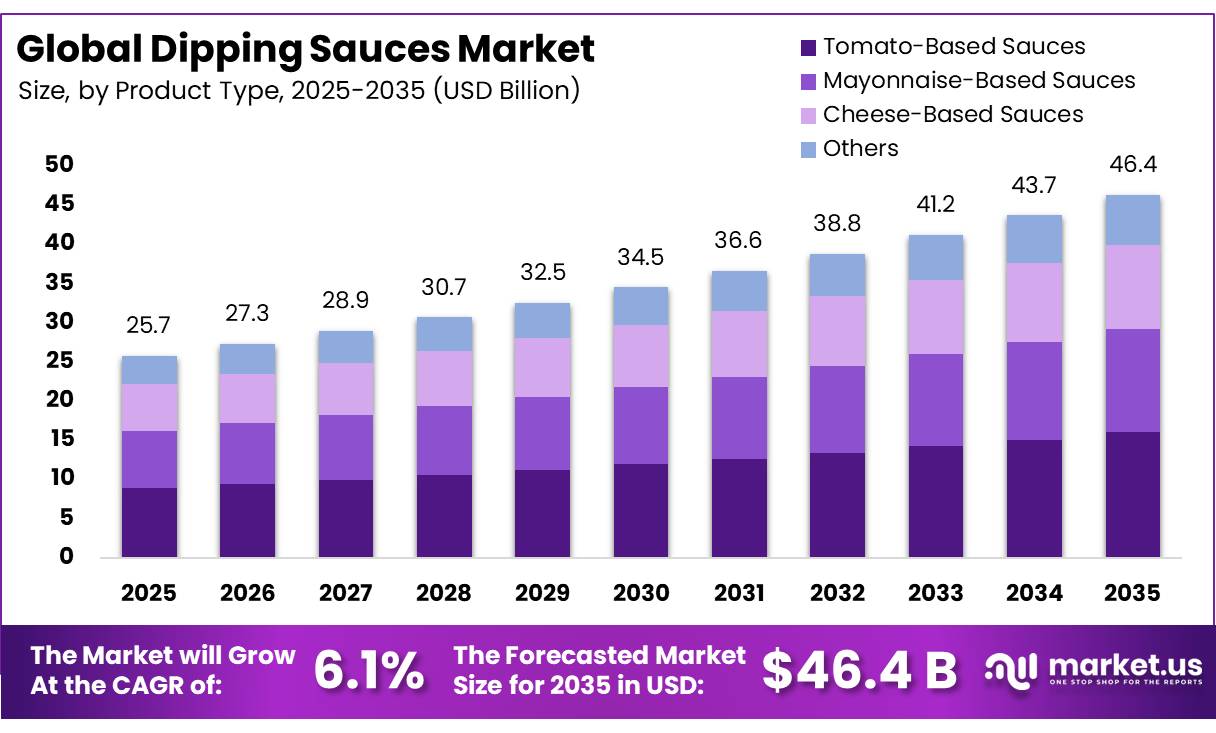
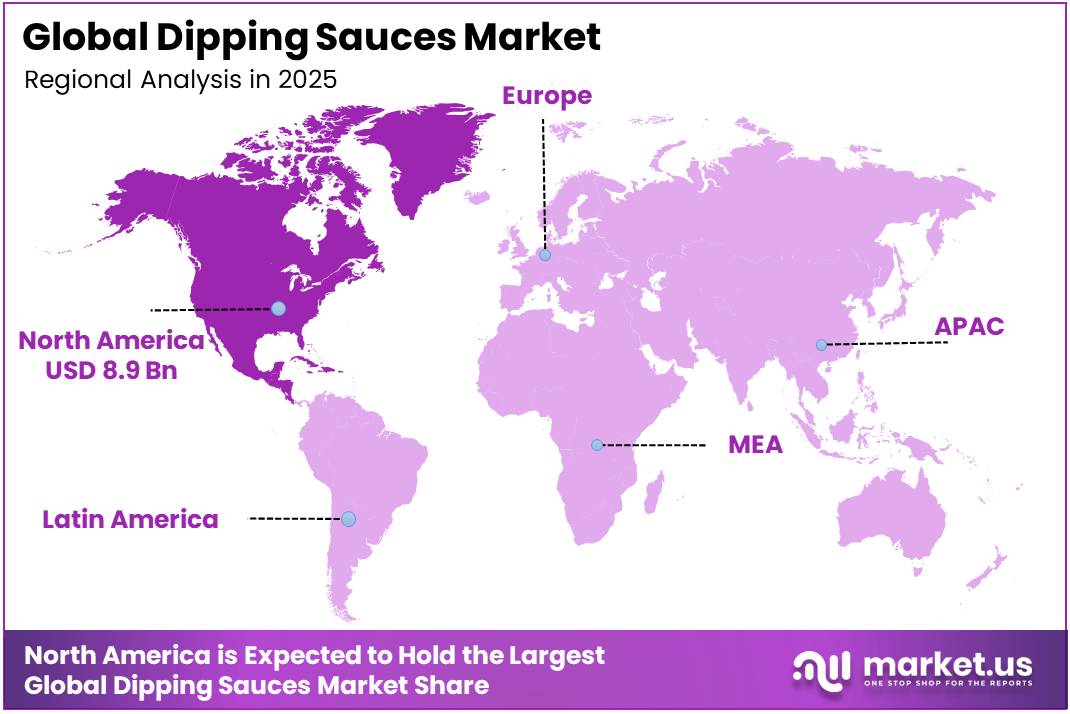
In 2025, the Global Dipping Sauces Market was valued at USD 25.7 billion, and between 2026 and 2035, this market is estimated to register a CAGR of 6.1%, reaching about USD 46.4 billion by 2035. In 2025, North America led the market, achieving over 34.5% share with a revenue of USD 8.9 Billion.
The dipping sauces industry covers products served with snacks, meat, seafood, vegetables, bakery items and quick-service meals, including ketchup-based, mayonnaise-based, mustard, barbecue, chilli, soy and cheese-style sauces. The category operates across packaged food manufacturing and foodservice because similar formulations are distributed through retail bottles, restaurant dispensers, portion cups and delivery meal packs. Product performance increasingly depends on strong flavour, convenient packaging, stable texture, food safety and compatibility with different cuisines. The industrial scenario remains favourable as eating outside the home and off-premise ordering create more sauce-consumption occasions.
- In June 2026, according to the USDA Economic Research Service, U.S. food-away-from-home expenditure reached USD 1.41 trillion in 2025 and represented 56.3% of total food spending.
- In February 2026, the National Restaurant Association projected U.S. restaurant industry sales of USD 1.55 trillion in 2026, with inflation-adjusted growth of 1.3%. These figures indicate a large commercial channel for portion packs, table sauces and customised accompaniments used in restaurants, takeaway meals and institutional catering.
Key Takeaways
- The Global Dipping Sauces Market was valued at USD 25.7 billion in 2025.
- The market is projected to grow at a CAGR of 6.1% and is estimated to reach USD 46.4 billion by 2035.
- On the basis of product type, Tomato-Based Sauces dominated the market, constituting 34.5% of the total market share.
- Based on the nature, Conventional dominated the market, with a substantial market share of around 88.5%.
- Based on the packaging type, Bottles led the market, comprising 50.2% of the total market.
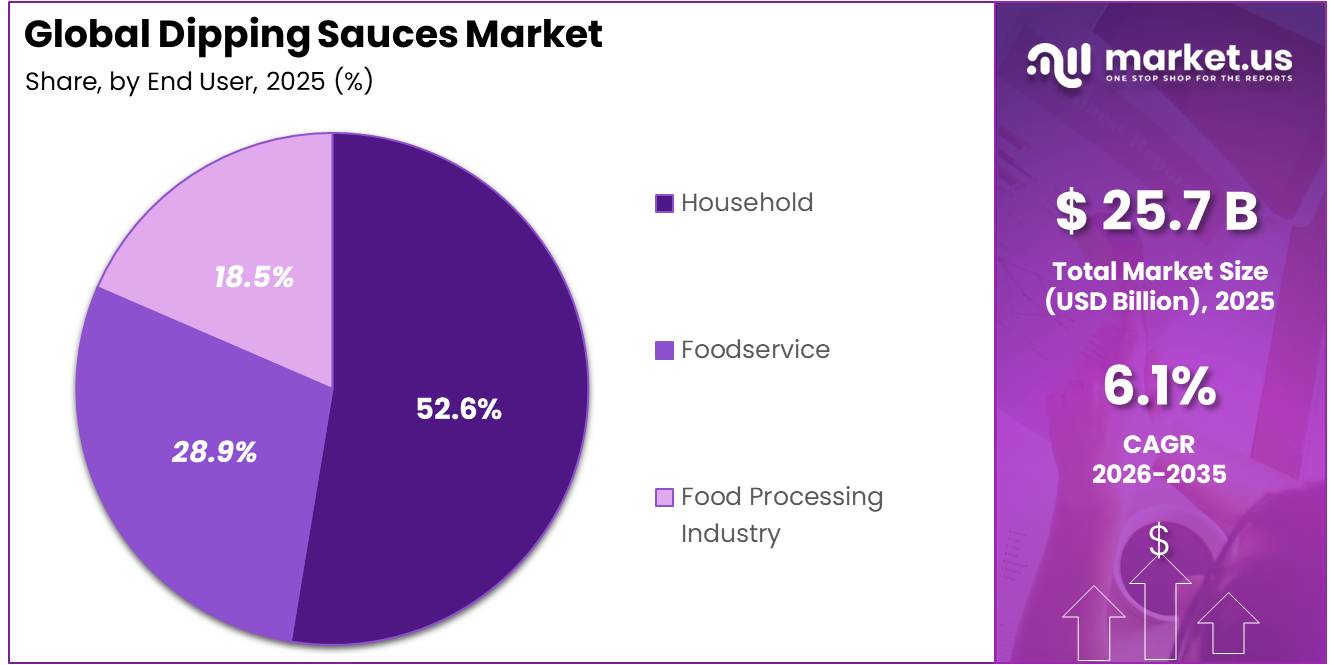
- On the basis of end user, Household dominated the market, constituting 52.6% of the total market share.
- Based on the distribution channel, Offline dominated the market, with a substantial market share of around 78.3%.
- In 2025, North America was the most dominant region in the market, accounting for 34.5% of the total global consumption.
Demand is being driven by convenience, menu experimentation and growing interest in globally inspired flavours. Dipping sauces allow manufacturers and restaurant operators to introduce product variety without redesigning the main food item, making limited-edition flavours, premium pairings and region-specific recipes commercially practical. Retail demand is also supported by home snacking and convenient meal preparation, while foodservice operators use sauces to differentiate fried foods, appetisers, sandwiches, meat alternatives and sharing platters. However, producers must manage fluctuating costs for edible oils, tomatoes, chillies, eggs, dairy ingredients, sugar and packaging while maintaining consistent viscosity, shelf life and taste.
- In August 2024, the U.S. Food and Drug Administration proposed Phase II voluntary sodium-reduction targets intended to lower average intake to approximately 2,750 milligrams per day. The combined Phase I and Phase II targets could reduce average sodium intake by approximately 20%, while more than 70% of U.S.
Sodium intake originates from sodium added during commercial food manufacturing and preparation. This development creates opportunities for reduced-sodium sauces, smaller controlled portions, cleaner labels and flavour systems using fermentation, herbs, acids and spices. Future growth opportunities will increasingly emerge from premium hot sauces, plant-based creamy dips, allergen-conscious recipes, refrigerated fresh products and recyclable portion packaging. Sustainability will also influence product design.
- According to the European Union’s Packaging and Packaging Waste Directive, Member States are required to recycle at least 65% by weight of all packaging waste by 31 December 2030. In addition, the Packaging and Packaging Waste Regulation, adopted in February 2025, requires packaging placed on the EU market to be designed for recycling, with recyclability performance requirements applying from 2030 year.
- In March 2024, UNEP reported 1.05 billion tonnes of global food waste, of which foodservice accounted for 28%. Manufacturers combining portion accuracy, extended shelf life, recyclable packs and distinctive flavours are therefore positioned for stronger retail and foodservice adoption.
Product Type Analysis
Tomato-Based Sauces Dominate with a 34.5% Share Due to Their Familiar Taste and Wide Food Applications.
In 2025, tomato-based sauces held a dominant market position, capturing more than a 34.5% share of the dipping sauces market. The segment remained widely preferred because tomato sauces offer a familiar sweet, tangy and mildly acidic taste that pairs well with fries, burgers, pizza, sandwiches, fried snacks and meat products. Their smooth texture, affordable ingredients and easy availability across retail and foodservice channels further supported demand. Manufacturers also used tomato bases to develop spicy, smoky, reduced-sugar and regionally inspired variants without changing the product’s core identity.
- In March 2026, according to the U.S. Department of Agriculture, California produced 11.6 million tons of processing tomatoes during 2025, compared with 11.1 million tons in the previous year. This reliable industrial tomato supply helped processors maintain consistent flavour, colour and product availability for ketchup and other tomato-based dipping sauces.
Mayonnaise-based sauces are the fastest-growing segment in the dipping sauces market. In 2025, the category gained stronger attention across quick-service restaurants, cafés, retail stores and home consumption because its creamy texture works well with fried foods, sandwiches, seafood, grilled meat and vegetable snacks. The neutral base also allows manufacturers to introduce garlic, chipotle, herb, mustard, chilli and barbecue combinations without requiring major changes in production methods.
Nature Analysis
Conventional Dipping Sauces Lead with an 88.5% Share Through Mass-Market Availability
In 2025, Conventional held a dominant market position, capturing more than an 88.5% share. Conventional dipping sauces remained widely used because manufacturers can produce them at scale, maintain consistent taste and supply them through restaurants, supermarkets and convenience stores at accessible prices.
- In April 2026, according to the U.S. Department of Agriculture’s Foreign Agricultural Service, Japan’s food-processing industry generated USD 174 billion in 2025, while ready-to-eat meals and take-home foods represented approximately 28% of industry sales. This extensive processed-food base supports regular demand for mayonnaise, ketchup, soy-based sauces and other conventional condiments commonly served with prepared meals.
Organic is the fastest-growing segment in the dipping sauces market. Its expansion is supported by rising demand for certified ingredients, cleaner product labels and sauces made with organically grown tomatoes, herbs, spices and oils.
- In March 2025, the U.S. Department of Agriculture required every organic agricultural shipment imported into the United States to carry an electronic National Organic Program import certificate, strengthening traceability across the organic supply chain. USDA rules also require products labelled “organic” to contain at least 95% certified organic ingredients, excluding salt and water.
These controls improve consumer confidence and encourage sauce producers to introduce verified organic ketchup, salsa, mayonnaise and specialty dipping products.
Packaging Type Analysis
Bottles dominate dipping sauce packaging with an 88.5% share.
In 2025, Bottles held a dominant market position, capturing more than an 88.5% share of the Dipping Sauces Market by packaging type. Glass bottles, plastic bottles, and squeeze bottles remained widely used because they provide dependable product protection, controlled dispensing, resealability, and convenient storage. Squeeze bottles were particularly suitable for ketchup, mayonnaise, mustard, and creamy dipping sauces, as they allowed consumers and foodservice operators to dispense the required quantity with less spillage. Glass bottles continued to support premium and specialty sauces, while lightweight plastic bottles offered lower transportation weight and better resistance to breakage.
- In July 2025, according to the European Commission, plastic bottles were subject to a 77% separate-collection target in 2025, while PET beverage bottles were required to contain 25% recycled plastic. These measures are encouraging sauce manufacturers to improve bottle recyclability and increase the use of recycled packaging materials.
Pouches are the fastest-growing segment in the Dipping Sauces Market by packaging type. Stand-up pouches and spout pouches are gaining acceptance because they require less packaging material, occupy limited storage space, and are convenient for refilling bottles or serving larger foodservice requirements. Their lightweight structure can reduce handling and transportation pressure compared with rigid packaging, while resealable spouts help protect sauces after opening. Stand-up formats also provide a broad printable surface that allows brands to display ingredients, flavour information, preparation guidance, and product claims clearly.
End User Analysis
Households dominate with a 52.6% share due to regular at-home consumption.
In 2025, Households held a dominant market position, capturing more than a 52.6% share. The segment benefited from frequent home cooking, family meals and the growing use of ready-to-serve sauces with snacks, fried foods, sandwiches and homemade fast-food dishes. Bottled and squeeze-pack sauces also offered households convenient storage, easy serving and longer usability after opening.
- In June 2026, according to the U.S. Department of Agriculture, U.S. food-at-home expenditure reached USD 1.10 trillion in 2025, showing the large spending base available for packaged foods consumed at home. This spending environment continued to support retail demand for ketchup, mayonnaise, barbecue sauce, mustard and other dipping varieties.
Foodservice is the fastest-growing segment in 2025. Its growth is supported by increasing sauce usage across quick-service restaurants, cafés, food trucks, casual dining outlets and institutional kitchens. Restaurants increasingly provide several dipping options with fried chicken, pizza, burgers, fries and other convenience meals to improve flavour and customer choice. The expansion of delivery and takeaway services is also raising demand for portion packs, sauce cups and bulk containers. Foodservice operators further use signature sauces to differentiate menus, encourage repeat purchases and create stronger brand recognition among consumers.
Distribution Channel Analysis
Offline distribution dominates with a 78.3% market share
In 2025, Offline held a dominant market position, capturing more than a 78.3% share of the Dipping Sauces Market. Supermarkets, hypermarkets, convenience stores and independent grocery outlets remained the preferred channels because they provided immediate product access, wider brand comparison and regular in-store promotions. Shelf displays also helped sauce manufacturers attract buyers through visible packaging, flavour varieties and bundled offers.
- In January 2026, according to Eurostat, retail trade volume increased by 2.3% across both the European Union and the euro area in November 2025 compared with November 2024, indicating continued consumer activity across physical retail networks.
Foodservice is the fastest-growing segment in the Dipping Sauces Market, supported by expanding demand from quick-service restaurants, cafés, catering operators and takeaway outlets. These businesses increasingly purchase sauces in bulk packs and portion-controlled formats to improve serving speed, maintain consistent taste and limit kitchen preparation work. Menu customisation is also encouraging operators to offer several dips with snacks, fried foods and ready-to-eat meals.
- In February 2026, according to Statistics Canada, annual sales of food services and drinking places reached CAD 101.4 billion in 2025, rising by 5.6% from 2024.
Key Market Segments
By Product Type
- Tomato-Based Sauces
- Mayonnaise-Based Sauces
- Cheese-Based Sauces
- Others
By Nature
- Conventional
- Organic
By Packaging Type
- Bottles
- Glass Bottles
- Plastic Bottles
- Squeeze Bottles
- Jars
- Pouches
- Stand-Up Pouches
- Spout Pouches
- Cans
- Others
By End User
- Household
- Foodservice
- Food Processing Industry
By Distribution Channel
- Offline
- Supermarkets and Hypermarkets
- Convenience Stores
- Others
- Online Retail
- Brand-Owned Websites
- E-Commerce Marketplaces
- Grocery Delivery Platforms
Driver Analysis
Sugar and agricultural cost easing improves pricing elasticity.
After the severe sugar inflation seen earlier in the decade, later government data indicate a more manageable cost environment even though volatility persists: Eurostat had recorded sugar prices up 61% year over year at the 2023 peak, while USDA’s 2025/26 sugar outlook pointed to U.S. sugar supply of 14.325 million short tons raw value in August 2025, with forward refined beet sugar prices around 40–42 cents per pound, and later December reporting still showed abundant though tighter supply dynamics. For sweetened dipping sauces such as barbecue, honey-mustard, sweet chili, teriyaki-style dips, and ketchup derivatives, this matters directly to contribution margin because sugar is one of the few high-volume ingredients that can swing formulation cost at scale, especially when combined with packaging resin, tomato solids, oil, and freight.
Drivers Impact Analysis
| Driver | (~) % Impact on CAGR Forecast | Geographic Relevance | Impact Timeline |
|---|---|---|---|
| Foodservice rebound lifts sauce attachment rates | +1.4% | North America core, EU urban clusters, APAC metros | Short term (≤ 2 years) |
| Flavor premiumization and cuisine diversification | +1.1% | North America, EU, APAC corridors, Middle East tourism hubs | Medium term (2–4 years) |
| Convenience retail and meal-kit usage support at-home dipping | +0.9% | North America core, EU, Japan, South Korea, Australia | Short term (≤ 2 years) |
| Sodium reduction and clean-label reformulation expand trade-up | +0.8% | U.S., Canada spill-over, EU, developed APAC | Medium term (2–4 years) |
| Sugar and agricultural cost easing improves pricing elasticity | +0.7% | U.S., Brazil-linked supply chains, EU importers, APAC processors | Short term (≤ 2 years) |
| Packaging sustainability and traceability reshape channel access | +0.6% | EU core, UK alignment risk, multinational export corridors | Long term (≥ 4 years) |
Restraint Analysis
Sodium and sugar reduction mandates
In the United States, FDA’s voluntary sodium reduction guidance seeks to bring average intake down by about 12%, from roughly 3,000 mg/day to around 2,750 mg/day over three‑year horizons, with 163 categories covered, including condiments and sauces, which translates into sodium target cuts of 10–25% in many ready‑to‑eat segments. This pushes manufacturers to run 2–3 parallel recipes per SKU, typically adding 3–5% to formulation costs and increasing sensory testing cycles from 6 to 9–12 months, which in turn delays new flavor launches by 1–2 seasonal cycles and constrains promotional velocity in high‑margin SKUs.
On a unit‑economics basis, a 15–20% sodium reduction accompanied by sweetener and preservative adjustments tends to lift direct ingredient costs by 4–6% per kilogram of finished sauce, while limiting list‑price increases to 2–3% in mature retail channels due to private label pressure, causing 50–100 basis points of gross margin compression in branded portfolios. Over a medium‑term 2–4‑year window, cumulative compliance and R&D spend can reach 1.0–1.5% of annual sales for larger players and 2–3% for smaller brands, resulting in deferred CapEx on capacity expansions and flavor innovation, and ultimately moderating category volume growth by roughly 0.8–1.5 percentage points versus a no‑reformulation scenario in regulated geographies.
Restraint Impact Analysis
| Restraint | (~) % Impact on CAGR Forecast | Geographic Relevance | Impact Timeline |
|---|---|---|---|
| Sodium and sugar reduction mandates | -1.2% | North America, EU core | Medium term (2–4 years) |
| Packaging waste and sustainability rules | -0.8% | EU, North America, select APAC | Long term (≥ 4 years) |
| Agricultural commodity price volatility | -1.0% | Global, APAC and LATAM weighted | Short to medium term (≤ 4 years) |
| Logistics and cold-chain inefficiencies | -0.7% | APAC corridors, emerging markets | Medium term (2–4 years) |
| Food additive and contaminant limits | -0.6% | EU, NA, parts of APAC | Medium to long term (≥ 3 years) |
| Informal processing and compliance gaps | -0.5% | South Asia, Africa, LATAM | Long term (≥ 4 years) |
Opportunity Analysis
Protein-enriched functional dips
If even 5–7% of regular dipping sauce buyers in North America, the EU, and East Asia transition to fortified SKUs with 3–5 grams of protein per serving, the incremental TAM could reach 2.0–2.5 billion USD by 2030, assuming an average price uplift of 15–20% and slightly higher margins of 3–4 percentage points due to value-added positioning versus standard recipes.
Customer acquisition costs can remain contained because functional dips ride existing distribution into retail and QSR channels, so the upside is largely a unit-economics play: higher average selling price per kilogram and an extra 1–1.5 units per purchase occasion driven by snack pairing, which combined could realistically add about 2.0 percentage points to baseline dipping sauce CAGR over 2026–2035 in the most developed markets. This is not yet a structural driver because regulatory definitions of “high protein” claims and nutrition labelling harmonization across regions are still being refined, and manufacturers need 2–4 years to adapt formulations, validate shelf life, and secure approvals, making it a medium-term, execution-dependent upside rather than embedded growth.
Opportunity Impact Analysis
| Opportunity | (~) % Potential CAGR Upside | Geographic Relevance | Execution Window |
|---|---|---|---|
| Protein-enriched functional dips | +2.0% | North America, EU, East Asia | Medium term (2-4 years) |
| Clean-label, low-sodium reformulation | +1.5% | EU, North America core | Medium term (2-4 years) |
| Private-label co-manufacturing & OEM | +2.2% | APAC emerging, Latin America | Short term (≤ 2 years) |
| Export-led ethnic flavor platforms | +1.8% | North America, EU, Middle East | Medium term (2-4 years) |
| Foodservice bundling & subscription models | +1.6% | North America, APAC urban | Short term (≤ 2 years) |
| Ready-to-cook kit integration | +1.4% | EU, APAC, North America | Long term (≥ 4 years) |
Challenges Analysis
Skilled processing & QA talent deficit
A typical midsize dipping sauce facility with 3–6 production lines requires 8–12 skilled process supervisors, 5–10 food technologists, and 10–15 QA technicians to maintain optimal throughput and quality; however, talent pipelines in many emerging markets deliver only 60–70% of that requirement, leading to vacancy rates of 15–25% and churn of 10–15% annually in critical roles.
This shortage lowers effective line utilization by 5–8 percentage points, increases batch deviation incidents by 20–30% and rework or downgrading rates by 2–3% of output, and slows the adoption of advanced automation, traceability, and R&D programs, as overburdened teams prioritize day‑to‑day firefighting over innovation; net effect is a CAGR friction drag of around -0.7 percentage points, as capacity is ramped more cautiously and new product rollouts are delayed by 6–12 months relative to technical feasibility.
Strategically, manufacturers respond by investing in in‑house academies (often training 50–100 workers per year), tightening retention packages, and collaborating with vocational and technical institutes, but the gestation for fully addressing skill deficits especially in regions where food tech education infrastructure is nascent is long term (≥ 4 years), since each cohort requires 12–24 months to reach full productivity and systemic alignment with evolving regulations and technologies.
Challenges Impact Analysis
| Challenge | (~) % CAGR Friction Drag | Geographic Relevance | Mitigation Horizon |
|---|---|---|---|
| Fragmented agri-inputs sourcing | -1.3% | South & Southeast Asia, Sub-Saharan Africa | Medium term (2–4 years) |
| Cold chain & storage gaps | -1.1% | India, ASEAN, Latin America | Long term (≥ 4 years) |
| Food safety & labeling compliance load | -0.9% | EU regulatory hubs, US, Vietnam | Medium term (2–4 years) |
| Trade & tariff volatility on key ingredients | -0.8% | North America core, EU, East Asia | Medium term (2–4 years) |
| Skilled processing & QA talent deficit | -0.7% | Emerging APAC, MENA, Eastern Europe | Long term (≥ 4 years) |
| Packaging sustainability & cost pressure | -1.0% | EU, UK, North America, urban APAC | Long term (≥ 4 years) |
Geopolitical Impact Analysis
Geopolitical Tensions and Supply Chain Disruptions Influence the Dipping Sauces Market
Ongoing geopolitical conflicts, particularly the Russia–Ukraine war and instability in the Middle East, continue to affect the global dipping sauces market by increasing production and distribution costs. Many dipping sauces rely on ingredients such as sunflower oil, tomatoes, vinegar, spices, sugar, and packaging materials sourced through international supply chains.
Despite these challenges, demand for dipping sauces has remained stable because they are widely consumed with ready-to-eat meals, snacks, and fast food. Manufacturers have responded by sourcing ingredients from alternative countries, expanding regional supplier networks, and reformulating products where necessary to reduce dependence on high-cost raw materials. Large food companies have also strengthened inventory planning and invested in local production facilities to improve supply security.
Although inflation has encouraged some consumers to shift toward private-label products, premium and innovative flavors continue to attract buyers in many developed markets. Overall, geopolitical uncertainty has created short-term cost pressures, but the dipping sauces market has shown resilience through supply chain diversification, operational flexibility, and steady consumer demand.
Regional Analysis
North America Held the Largest Share of the Global Dipping Sauces Market
North America accounted for the largest share of the global dipping sauces market, representing 34.5% of total revenue, valued at approximately USD 8.9 billion. The region’s leadership is supported by high consumption of convenience foods, quick-service restaurant (QSR) expansion, and growing demand for flavorful condiments across households and foodservice channels. According to the U.S. Department of Agriculture (USDA, 2025), U.S. consumers continued to increase spending on food away from home, strengthening demand for sauces served with fast food, snacks, and frozen products.
The National Restaurant Association (2025) reported that the U.S. restaurant industry was projected to exceed USD 1.5 trillion in sales, reinforcing strong demand for ketchup, barbecue, ranch, cheese, mustard, and spicy dipping sauces. Canada also contributed through rising retail sales of packaged condiments and increasing consumer preference for premium and clean-label sauce products. Product innovation, wide supermarket availability, and the presence of leading manufacturers further supported regional market dominance.
According to the Food and Agriculture Organization (FAO, 2024), Asia remains the world’s largest food-consuming region, while China’s National Bureau of Statistics (2025) reported continued growth in retail food and beverage sales. Rising disposable incomes, changing lifestyles, and greater acceptance of international cuisines are encouraging consumers to purchase mayonnaise, chili, soy-based, garlic, and cheese dipping sauces.
Key Regions and Countries Covered
- North America
- The US
- Canada
- Europe
- Germany
- France
- The UK
- Spain
- Italy
- Russia & CIS
- Rest of Europe
- APAC
- China
- Japan
- South Korea
- India
- ASEAN
- Rest of APAC
- Latin America
- Brazil
- Mexico
- Rest of Latin America
- Middle East & Africa
- GCC
- South Africa
- Rest of MEA
Key Players Analysis
Kikkoman Corporation is a major dipping sauces participant through soy sauce, tare, teriyaki and related seasoning products. In fiscal 2025, consolidated revenue reached ¥708.98 billion, increasing by 7.3%, while business profit rose 5.3% to ¥77.28 billion. Overseas food manufacturing and sales revenue increased 8.4% to ¥167.18 billion.
The Campbell’s Company participates in the dipping sauces market through brands such as Pace, Prego and Rao’s, supported by its Meals & Beverages division. In fiscal 2025, company net sales increased 6% to USD 10.3 billion, while adjusted EBIT reached USD 1.49 billion. It generated USD 1.1 billion in operating cash flow and returned USD 521 million to shareholders. Rao’s approached USD 1 billion in annual retail sales, strengthening Campbell’s premium sauce presence and supporting further portfolio expansion.
Hormel Foods Corporation competes in dipping sauces through brands such as Herdez, Wholly, House of Tsang and its customized foodservice solutions. In fiscal 2025, fourth-quarter net sales reached USD 3.2 billion, while the company projected fiscal 2026 sales of USD 12.2 billion to USD 12.5 billion. Its portfolio includes more than 30 established brands and reaches over 80 countries.
The Major Players in The Industry
- The Kraft Heinz Company
- Unilever PLC
- McCormick & Company, Incorporated
- Nestle SA
- Kikkoman Corporation
- Conagra Brands, Inc.
- The Campbell’s Company
- Hormel Foods Corporation
- Mizkan Holdings Co., Ltd.
- Lee Kum Kee Company Limited
- Ajinomoto Co., Inc.
- Kewpie Corporation
- PepsiCo, Inc.
- General Mills, Inc.
- Associated British Foods plc
- Other Key Players
Key Development
- In July 2025, Unilever PLC expanded Hellmann’s presence in the dipping sauces sector by continuing its partnership as the Official BBQ Partner of the UEFA Women’s EURO 2025. The campaign was positioned to reach an anticipated 500 million online viewers worldwide and featured six well-known ambassadors, including Alessia Russo, Alexia Putellas, Jule Brand, Manuela Zinsberger, Petr Čech and chef Akis Petretzikis.
- In February 2025, The Kraft Heinz Company expanded its dipping-sauce portfolio by launching 3 HEINZ Flavor Tour sauces, including Mexican-Inspired Street Corn, Korean-Inspired Sweet & Tangy BBQ, and Thai-Inspired Sweet Chili.
Report Scope
| Report Features | Description |
|---|---|
| Market Value (2025) | USD 25.7 Bn |
| Forecast Revenue (2035) | USD 46.4 Bn |
| CAGR (2026-2035) | 6.1% |
| Base Year for Estimation | 2025 |
| Historic Period | 2020-2024 |
| Forecast Period | 2026-2035 |
| Report Coverage | Revenue Forecast, Market Dynamics, Competitive Landscape, Recent Developments |
| Segments Covered | By Product Type (Tomato-Based Sauces, Mayonnaise-Based Sauces, Cheese-Based Sauces, and Others), By Nature (Conventional and Organic), By Packaging Type (Bottles, Jars, Pouches, Cans, and Others), By End User (Household, Foodservice, and Food Processing Industry), By Distribution Channel (Offline, Online Retail) |
| Regional Analysis | North America – The US & Canada; Europe – Germany, France, The UK, Spain, Italy, Russia & CIS, Rest of Europe; APAC– China, Japan, South Korea, India, ASEAN & Rest of APAC; Latin America– Brazil, Mexico & Rest of Latin America; Middle East & Africa– GCC, South Africa, & Rest of MEA |
| Competitive Landscape | The Kraft Heinz Company, Unilever PLC, McCormick & Company, Incorporated, Nestlé S.A., Kikkoman Corporation, Conagra Brands, Inc., The Campbell’s Company, Hormel Foods Corporation, Mizkan Holdings Co., Ltd., Lee Kum Kee Company Limited, Ajinomoto Co., Inc., Kewpie Corporation, PepsiCo, Inc., General Mills, Inc., Associated British Foods plc, and Other Key Players |
| Customization Scope | Customization for segments, region/country-level will be provided. Moreover, additional customization can be done based on the requirements. |
| Purchase Options | We have three licenses to opt for: Single User License, Multi-User License (Up to 5 Users), Corporate Use License (Unlimited Users and Printable PDF) |





































