


Report Overview
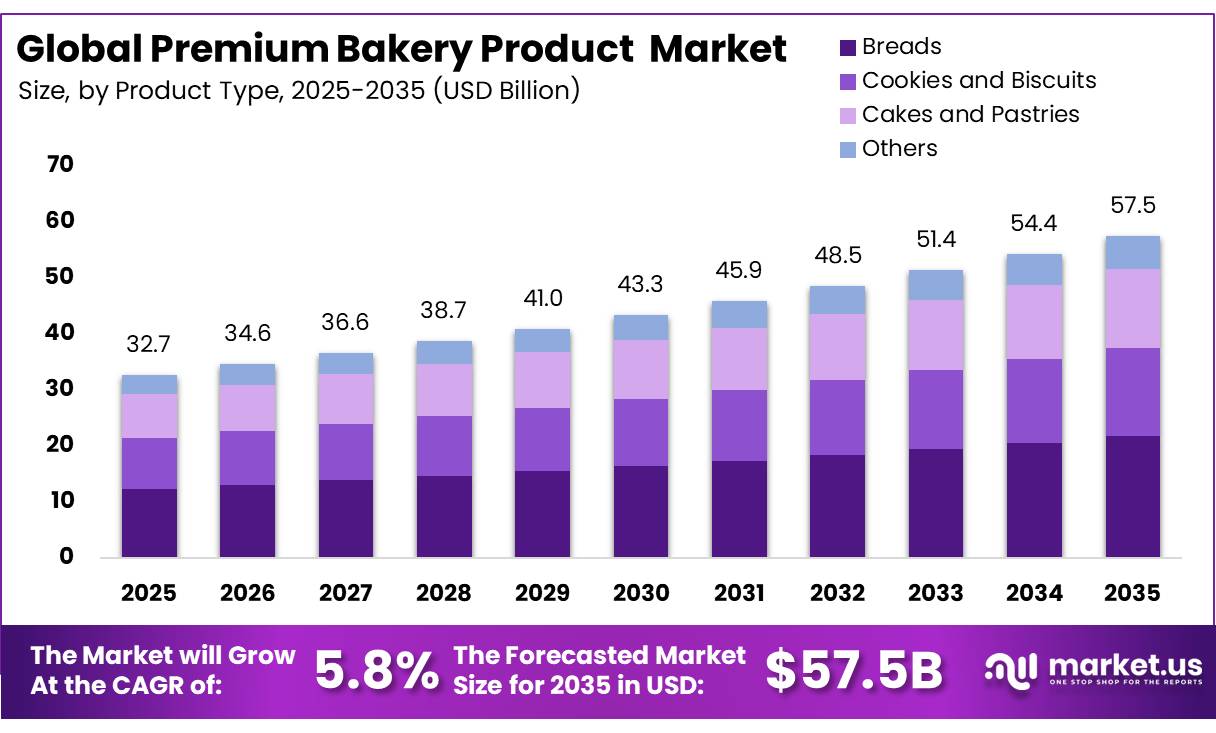
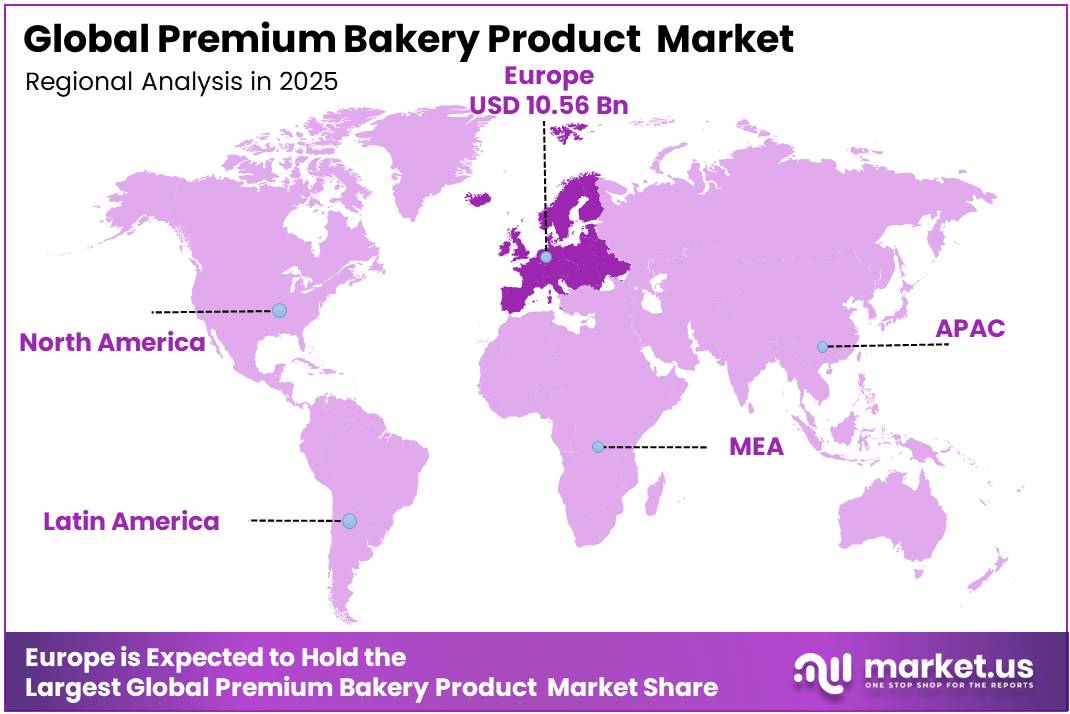
In 2025, the Global Premium Bakery Product Market was valued at USD 32.7 billion, and between 2026 and 2035, this market is estimated to register a CAGR of 5.8%, reaching about USD 57.5 billion by 2035. Europe held a dominant market position, capturing more than a 32.34% share, holding USD 10.56 billion in revenue.
The Premium Bakery Product Market covers higher-value breads, cookies, biscuits, cakes, pastries, and specialty products sold fresh or frozen through retail and foodservice channels. Premium positioning is built around superior ingredients, artisanal methods, attractive presentation, dietary claims, and convenience.
- A January 2026 United States Department of Agriculture report estimated China’s baked-food retail market at USD 50 billion to USD 83 billion in 2025 and recorded more than 338,000 bakery outlets by April 2025.
Key Takeaways
- The global Premium Bakery Product market was valued at USD 32.7 billion in 2025.
- The global market is projected to grow at a CAGR of 5.8% and is estimated to reach USD 57.5 billion by 2035.
- On the basis of form, fresh bakery products dominated the market, constituting 62.12% of the total market share.
- Based on product type, breads led the Premium Bakery Product Market, comprising 37.80% of the total market.
- Based on category, conventional bakery products dominated the market, accounting for 72.34% of the total market share.
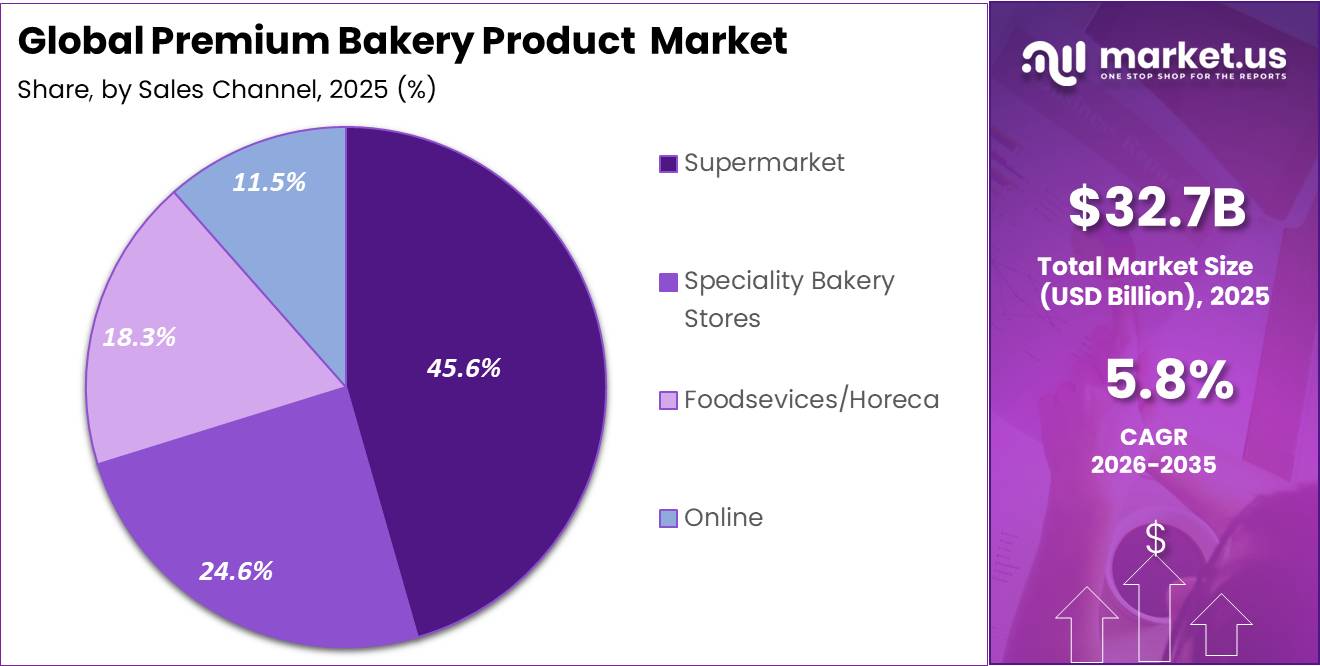
- Among the sales channels, supermarkets held a major share in the Premium Bakery Product Market, accounting for 45.56% of the market share.
- Europe was the most dominant region in the Premium Bakery Product Market, accounting for 32.34% of the total market share.
Industry performance depends on reliable flour, dairy, cocoa, sugar, fats, energy, skilled labour, and temperature-controlled distribution. In September 2025, the United States Department of Agriculture reported national wheat production of 1.98 billion bushels from 37.2 million harvested acres, with an average yield of 53.3 bushels per acre. This supply base supports industrial bakeries, although premium producers remain exposed to ingredient quality differences, commodity prices, packaging expenses, and seasonal demand.
Growth is driven by consumers seeking indulgence, craftsmanship, cleaner labels, portion variety, gifting formats, and products suited to home consumption or café occasions. The same agriculture report placed annual baked-food consumption in China at 7 to 8 kilograms per person, compared with 40 kilograms in the United States and 25 kilograms in Japan. This gap highlights expansion potential for premium breads, pastries, frozen dough, gluten-free recipes, and locally adapted flavours.
Government initiatives are also shaping investment and product standards. In January 2026, the United States Food and Drug Administration opened a 60-day information request on gluten disclosure and cross-contact, with comments due by April 22, 2026. In England, Maidstone Borough Council’s 2025 to 2026 Rural England Prosperity Fund offered food and drink producers capital grants from GBP 500 to GBP 15,000, required at least 20% matching finance, and specifically listed new commercial bakery ovens as eligible equipment. This support can improve automation, efficiency, capacity, safety, and rural competitiveness.
Form Analysis
Fresh bakery products lead with 62.12% as consumers favor quality, convenience, and immediate freshness.
In 2025, Fresh held a dominant market position, capturing more than a 62.12% share. The segment benefits from strong demand for artisan bread, cakes, pastries, cookies, and other premium items prepared for same-day or near-term consumption. Shoppers often associate freshness with better taste, softer texture, richer aroma, and higher product quality, allowing bakeries and retailers to charge premium prices. Fresh products also gain support from in-store bakeries, specialty cafés, hotel kitchens, and local bakery chains that introduce seasonal flavors and attractive offerings. Their availability and close connection with everyday purchasing habits continue to strengthen segment leadership.
- For instance, in March 2025, according to Vandemoortele, the company announced its intention to combine with Délifrance, bringing together complementary frozen bakery portfolios and broader customer reach.
Frozen is the growing segment as foodservice operators and retailers increasingly seek longer shelf life, consistent quality, easier inventory control, and reduced preparation time. Growth is supported by improved freezing methods, premium ready-to-bake ranges, and demand from cafés, restaurants, supermarkets, and convenience stores.
Product Type Analysis
Breads dominate with 37.80% as everyday demand supports premium recipes, artisan quality, and frequent purchases.
In 2025, Breads held a dominant market position, capturing more than a 37.80% share. Premium bread remains widely purchased because it combines daily usefulness with higher-quality ingredients, distinctive flavors, and improved texture. Artisan loaves, sourdough, seeded bread, brioche, and clean-label varieties attract consumers seeking both indulgence and better ingredient choices. Bakeries, cafés, supermarkets, and foodservice outlets also maintain broad bread assortments because these products suit breakfast, sandwiches, side dishes, and at-home meals. Product freshness, local preparation, attractive packaging, and regular flavor innovation further strengthen the segment’s leading position.
- For instance, in June 2025, according to pladis, McVitie’s launched Pink Digestives Raspberry & Cream Flavour, extending its biscuit range with a colorful, indulgent product designed to refresh consumer interest.
Cookies and Biscuits is the fastest-growing segment, supported by demand for premium snacking, portion-friendly formats, gifting products, and convenient treats. Growth is also encouraged by new fillings, coated varieties, natural ingredients, seasonal editions, and improved packaging that helps brands serve both everyday and special-occasion consumption across markets.
Category Analysis
Conventional products dominate with 72.34% as familiar recipes, availability, and dependable taste sustain demand.
In 2025, Conventional held a dominant market position, capturing more than a 72.34% share. Its leadership reflects the availability of traditional bread, cakes, pastries, cookies, and premium baked goods made with standard wheat flour, dairy ingredients, sugar, and familiar flavor combinations. These products appeal to a consumer base because they offer trusted taste, soft texture, appearance, and convenient access through supermarkets, cafés, artisan bakeries, hotels, and foodservice outlets. Producers also benefit from established recipes, reliable ingredient sourcing, efficient manufacturing, and easier product expansion across seasonal and indulgent ranges.
- For instance, in April 2026, according to King Arthur Baking Company, the company expanded its gluten-free portfolio with new roll and bun mix and double chocolate chip cookie mix, supporting premium baking at home.
Gluten-Free is the fastest-growing segment as consumers steadily seek bakery products suited to dietary needs without losing taste or texture. Better flour blends, improved recipes, cleaner labels, wider retail placement, and premium innovation are helping the category gain acceptance among health-conscious shoppers and households.
Sales Channels Analysis
Supermarkets dominate with 45.56% as wide product choice, convenient access, and trusted retail visibility support regular premium bakery purchases.
In 2025, Supermarket held a dominant market position, capturing more than a 45.56% share. The channel remains strong because shoppers can compare artisan breads, cakes, pastries, cookies, and packaged premium products during grocery visits. Supermarkets also provide attractive displays, reliable product availability, private-label selections, seasonal ranges, and convenient promotions. Their broad store networks and established cold-chain systems help maintain freshness while supporting both daily purchases and special occasions. Easy access, familiar brands, and one-stop shopping continue to strengthen the channel’s leadership across urban markets.
- For instance, in November 2025, according to Panera Bread, the company introduced its Panera RISE transformation strategy to improve guest experience, modernize bakery-cafés, and support renewed growth.
Speciality Bakery Stores is the fastest-growing segment as consumers increasingly value handcrafted products, fresh preparation, unique flavors, and personalized service. These outlets benefit from premium positioning, local identity, limited-edition menus, customized cakes, and strong customer engagement, making them popular destinations for indulgent purchases, gifting, celebrations, and premium everyday bakery experiences.
Key Market Segments
By Form
- Fresh
- Frozen
By Product Type
- Breads
- Cookies and Biscuits
- Cakes and Pastries
- Others
By Category
- Conventional
- Gluten-Free
By Sales Channels
- Foodsevices/Horeca
- Speciality Bakery Stores
- Supermarket
- Online
Driver Analysis
Rising disposable incomes and urban lifestyle shifts expanding premium bakery wallet share
Rising disposable incomes and urban lifestyle shifts are a core driver because premium bakery products rely on consumers trading up from basic bread and commoditized packaged cakes to higher-priced, experience-led offerings; global bakery reports note that rising disposable incomes, rapid urbanization, and higher living standards are central to bakery market expansion, and premium segments typically grow faster than the 3–7% baseline for the total category.
Urban consumers allocate more spend to out-of-home food, convenience snacks, and indulgence, with premium bakery formats often priced 1.5–3.0 times above mass-market equivalents yet achieving sustained demand in metropolitan clusters. Strategically, this driver shifts business models toward high-ASP SKUs, flagship urban outlets, and curated in-store experiences rather than purely volume-driven factory bread, allowing operators to target gross margins above 40% in premium lines versus 20–25% in commodity products, and to build cross-sell paths into beverages and savory items.
Drivers Impact Analysis
| Driver | (~) % Impact on CAGR | Geographic Relevance | Impact Timeline |
|---|---|---|---|
| Rising disposable incomes and urban lifestyle shifts expanding premium bakery wallet share | +2.2% | North America core, EU, India metros, APAC urban corridors | Medium term (2-4 years) |
| Clean-label, organic, and health-positioned formulations enabling premium pricing | +2.0% | EU regulatory hubs, North America, affluent APAC | Short term (≤ 2 years) |
| Artisanal and craft bakery formats capturing value from commoditized mass bakery | +1.9% | EU, North America, Middle East, India tier-1 cities | Medium term (2-4 years) |
| E-commerce and D2C bakery platforms scaling reach of premium products | +1.8% | North America, EU, India, Southeast Asia | Short term (≤ 2 years) |
| Premium café chains and QSR bakery menus driving steady B2B volume | +1.6% | Global, with EU and APAC foodservice hubs | Medium term (2-4 years) |
| Product innovation in gluten-free, high-protein, and low-sugar premium bakery lines | +1.7% | North America, EU, health-conscious APAC, GCC | Long term (≥ 4 years) |
Restraint Analysis
High input cost and margin compression for premium ingredients
High input cost and margin compression for premium ingredients is a structural restraint because premium bakery relies on higher-quality flours, butters, chocolates, nuts, and inclusions whose prices have been inflated by global commodity and energy cycles since 2022, while consumers’ willingness to pay has not always kept pace with cost spikes. Premium flour and butter can be 20–40% more expensive than standard inputs, specialty chocolate and nuts often face double-digit import tariffs and FX exposure, and energy-intensive processes like long fermentation and in-store baking raise utility usage per unit.
When cost-of-goods-sold rises 10–20% across multiple input lines simultaneously, many bakeries are forced either to raise retail prices and risk demand attrition or compress gross margins from aspirational 40–50% levels toward the high-20s/low-30s, weakening cash generation. This restraint often delays capex in new premium lines, slows geographic expansion, and pushes some players back into hybrid portfolios mixing premium with more commoditized products, directly subtracting roughly 2 percentage points from achievable premium bakery CAGR until input inflation stabilizes or more efficient sourcing and hedging are widely deployed.
Restraint Impact Analysis
| Restraint | (~) % Impact on CAGR | Geographic Relevance | Impact Timeline |
|---|---|---|---|
| High input cost and margin compression for premium ingredients | -2.2% | EU, North America core, APAC import-dependent markets | Medium term (2-4 years) |
| Price sensitivity and limited affordability beyond affluent urban segments | -2.0% | India, Southeast Asia, Latin America, Africa | Short term (≤ 2 years) |
| Short shelf life and cold-chain dependence for fresh premium products | -1.8% | EU, North America, APAC urban corridors | Medium term (2-4 years) |
| Regulatory and labelling complexity for health and organic claims | -1.6% | EU regulatory hubs, North America, developed APAC | Medium term (2-4 years) |
| Capacity and skill constraints in artisanal and craft production | -1.5% | EU, North America, Middle East, India metros | Long term (≥ 4 years) |
| Intense competition from mass bakery and private label down-trading | -1.7% | Global, especially EU retail and North America | Short term (≤ 2 years) |
Opportunity Analysis
Clean-label ingredient platforms and co-branded premium bakery collaborations
Clean-label baking is driven by consumers seeking short, understandable ingredient lists and absence of artificial additives, and the clean-label bakery ingredients market is itself forecast to grow toward USD 74 billion by 2030 with APAC posting double-digit CAGRs, signaling that large ingredient companies are heavily investing.
Strategically, premium bakery brands could partner with these ingredient players to co-develop lines labelled explicitly with “powered by” or “crafted with” clean-label ingredients, securing technical support for reformulation while benefiting from ingredient-brand halo effects and joint marketing budgets; this enables premium pricing uplift of 10–20% and higher retailer acceptance in health-focused channels.
Opportunity Impact Analysis
| Opportunity | (~) % Potential CAGR | Geographic Relevance | Execution Window |
|---|---|---|---|
| Clean-label ingredient platforms and co-branded premium bakery collaborations | +2.2% | EU, North America core, APAC fast-growing clean-label | Medium term (2-4 years) |
| Health-function bakery (gut-health, protein, and functional claims) as a new premium pillar | +2.0% | EU regulatory hubs, North America, urban APAC | Long term (≥ 4 years) |
| D2C subscription and gifting models for premium bakery assortments | +1.9% | North America, EU, India metros, GCC | Medium term (2-4 years) |
| Regional and ethnic premium bakery concepts scaled across global cities | +1.8% | EU, North America, APAC cosmopolitan hubs | Long term (≥ 4 years) |
| Digital loyalty ecosystems and data-driven personalization in premium bakery retail | +1.6% | North America core, EU, APAC urban corridors | Short term (≤ 2 years) |
| Strategic M&A and roll-ups creating multi-brand premium bakery platforms | +1.7% | Global, with EU and North America integration hubs | Long term (≥ 4 years) |
Challenges Analysis
Automation–skills gap in premium bakery production
Automation–skills gap in premium bakery production is a medium-term challenge because bakery manufacturing is increasingly automated sheeters, proofers, ovens, slicing and packaging lines yet the skills required to configure, maintain, and optimize this equipment are in short supply, especially in premium plants that balance mechanization with artisanal finishes. Industry coverage for 2026 explicitly states that automation’s promise is faltering as new skills demands and training gaps limit the productivity gains manufacturers expected, and workforce studies report that 78% of baking companies face shortages in engineering and maintenance roles.
This gap means line speeds, changeover times, and uptime fall below design targets, with some plants operating at 80–85% of theoretical capacity due to constraints in technical staff, thereby increasing fixed cost per unit and slowing scale. Premium bakery operations are particularly affected because high-variety product mixes require frequent reconfiguration and fine-tuning; under-skilled teams may limit SKU rotation or under-utilize advanced features to avoid downtime, dampening innovation throughput.
Long-term mitigation demands structured training programs, partnerships with equipment OEMs, and improved career pathways for technical roles over 2–4 years; until then, the automation–skills mismatch imposes about 1.2 percentage points of friction on potential CAGR by restraining productivity and expansion without shutting plants down.
Challenges Impact Analysis
| Challenge | (~) % CAGR Friction Drag | Geographic Relevance | Mitigation Horizon |
|---|---|---|---|
| Fragmented artisanal supply chains and inventory control limits | -1.3% | EU, North America core, India metros, APAC urban hubs | Long term (≥ 4 years) |
| Automation–skills gap in premium bakery production | -1.2% | North America, EU regulatory hubs, APAC processing corridors | Medium term (2-4 years) |
| Rising health scrutiny and sugar-content concerns in indulgent categories | -1.1% | EU, North America, developed APAC | Long term (≥ 4 years) |
| Cost, waste, and complexity from expanding premium product portfolios | -1.0% | Global, especially EU and North America multi-brand chains | Medium term (2-4 years) |
| Workforce shortages in artisan, engineering, and maintenance roles | -1.2% | North America core, EU, APAC industrial belts | Long term (≥ 4 years) |
| Data and systems gaps between craft operations and scalable control frameworks | -0.9% | Global, with emerging-market bakeries most exposed | Medium term (2-4 years) |
Geopolitical Impact Analysis
Trade Tensions and Shipping Disruptions Reshaping Premium Bakery Product Supply Chains.
Current geopolitical tensions are reshaping the premium bakery product market through ingredient costs, changing trade routes, tariff actions, and regional sourcing. In January 2026, the Food and Agriculture Organization reported that its food price index averaged 127.2 points in 2025, rising 4.3% from the previous year as higher dairy and vegetable oil prices outweighed weaker cereal and sugar quotations. This directly affects premium recipes using butter, cream, oils, flour, and specialty fillings.
Shipping instability around the Red Sea and other routes has increased uncertainty for imported cocoa, nuts, fruit preparations, packaging materials, and bakery equipment. In September 2025, UN Trade and Development projected seaborne trade growth of only 0.5% for the year and warned that container, bulk, and tanker freight rates remained elevated and volatile. Longer routes raise freight, insurance, inventory, and working-capital requirements for producers.
- In March 2025, China announced an additional 15% tariff on wheat imported from the United States and a 10% tariff on dairy products, showing how retaliatory measures can alter agricultural trade flows and supplier competitiveness.
These conditions are encouraging bakery companies to diversify suppliers, increase local procurement, reformulate products, and maintain safety stocks. However, European Union deforestation rules applying to large and medium operators from December 2026 may increase cocoa documentation and sourcing complexity for chocolate-based bakery products.
Regional Analysis
Europe dominates with 32.34% as established bakery traditions and premium retail networks sustain demand.
In 2025, Europe held a dominant position in the Premium Bakery Product Market, capturing more than a 32.34% share and generating USD 10.56 billion. The region benefits from rooted bread and pastry consumption, strong artisan bakery networks, supermarket channels, and demand for premium, clean-label, organic, and gluten-free products.
- In January 2025, FoodDrinkEurope reported that the European Union food and drink industry generated EUR 1.2 trillion in turnover, employed 4.7 million people, and created EUR 250 billion in value added. This manufacturing base supports ingredient sourcing, product innovation, packaging development, and efficient bakery distribution across European economies.
Asia Pacific is emerging as an expanding region, supported by urbanization, disposable incomes, café culture, modern retail growth, and increasing interest in Western-style breads, cakes, cookies, and pastries. Local flavor innovation and expanding cold-chain infrastructure are strengthening premium bakery availability.
Key Regions and Countries Covered
- North America
- The US
- Canada
- Europe
- Germany
- France
- The UK
- Spain
- Italy
- Russia & CIS
- Rest of Europe
- APAC
- China
- Japan
- South Korea
- India
- ASEAN
- Rest of APAC
- Latin America
- Brazil
- Mexico
- Rest of Latin America
- Middle East & Africa
- GCC
- South Africa
- Rest of MEA
Key Players Analysis
Premium bakery product manufacturers focus on brand strength, product quality, distribution reach, and continuous recipe innovation to maintain competitive positioning. Major companies such as Grupo Bimbo, Mondelez International, Yamazaki Baking, Flowers Foods, and Associated British Foods benefit from established retail networks, broad product portfolios, and strong consumer recognition. A key priority is the development of artisan-style breads, premium cookies, indulgent pastries, clean-label products, and convenient packaged formats that meet changing consumer preferences.
Companies also invest in automated production lines, bakery capacity expansion, sustainable packaging, and regional distribution centers to improve operational efficiency and product freshness. Barilla and Finsbury Food Group strengthen their market presence through premium positioning, seasonal launches, and partnerships with retailers and foodservice customers.
Market Key Players
- Grupo Bimbo SAB de CV
- Mondelez International Inc.
- Britannia Industries Ltd.
- Associated British Foods plc
- Finsbury Food Group plc
- Yamazaki Baking Co. Ltd.
- Flowers Foods Inc.
- La Brea Bakery
- Barilla G. e R. Fratelli SpA
- Apollonia Poilane
- Other Key Players
Key Development
- In July 2026, Yamazaki Baking Co. Ltd. launched four limited-edition Stamina Lunch Pack products through a collaboration with New Japan Pro-Wrestling. The products used fillings inspired by wrestlers’ preferred energy foods, strengthening the company’s seasonal and experience-led bakery portfolio.
- In May 2026, Barilla Group opened applications for its Good Food Makers 2026 innovation program. The initiative builds on engagement with more than 1,100 startups across over 50 countries and 26 pilot projects, supporting new food technologies, ingredients, manufacturing methods, and consumer solutions.
- In January 2026, Finsbury Food Group launched Little Big Cake, described as the United Kingdom’s first supermarket cake-only bento box. The 740-gram red velvet cake and cupcake assortment was introduced exclusively through Tesco for an initial 12-week period, expanding Finsbury’s premium celebration range.
Report Scope
| Report Features | Description |
|---|---|
| Market Value (2025) | USD 32.7 Bn |
| Forecast Revenue (2035) | USD 57.5 Bn |
| CAGR (2026-2035) | 5.8% |
| Base Year for Estimation | 2025 |
| Historic Period | 2020-2024 |
| Forecast Period | 2026-2035 |
| Report Coverage | Revenue Forecast, Market Dynamics, Competitive Landscape, Recent Developments |
| Segments Covered | By Form (Fresh and Frozen), By Product Type (Breads, Cookies and Biscuits, Cakes and Pastries, and Others), By Category (Conventional and Gluten-Free), By Sales Channel (Foodservices/Horeca, Specialty Bakery Stores, Supermarkets, and Online) |
| Regional Analysis | North America – The US & Canada; Europe – Germany, France, The UK, Spain, Italy, Russia & CIS, Rest of Europe; APAC- China, Japan, South Korea, India, ASEAN & Rest of APAC; Latin America- Brazil, Mexico & Rest of Latin America; Middle East & Africa- GCC, South Africa, & Rest of MEA |
| Competitive Landscape | Grupo Bimbo SAB de CV, Mondelez International Inc., Britannia Industries Ltd., Associated British Foods plc, Finsbury Food Group plc, Yamazaki Baking Co. Ltd., Flowers Foods Inc., La Brea Bakery, Barilla G. e R. Fratelli SpA, Apollonia Poilane, and other key players. |
| Customization Scope | Customization for segments, region/country-level will be provided. Moreover, additional customization can be done based on the requirements. |
| Purchase Options | We have three licenses to opt for: Single User License, Multi-User License (Up to 5 Users), Corporate Use License (Unlimited Users and Printable PDF) |





































