


Report Overview
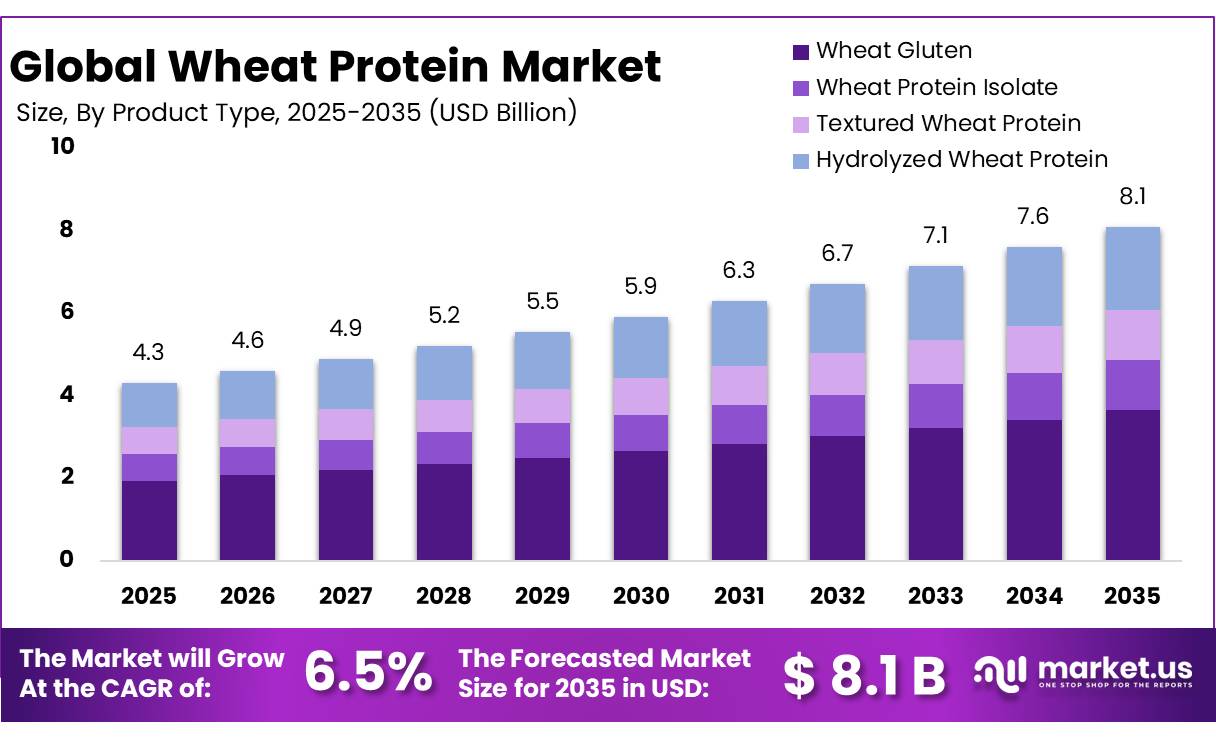
The Global Wheat Protein Market size is expected to be worth around USD 8.10 Billion by 2035 from USD 6.5 Billion in 2025, growing at a CAGR of 4.31% during the forecast period from 2025 to 2035.
Wheat protein is a plant-based food ingredient mainly produced by separating protein from wheat or wheat flour after removing starch and other carbohydrates. In food processing, it is used as vital wheat gluten, devitalized wheat gluten, and soluble wheat protein. Codex defines vital and devitalized wheat gluten as products with 80% or more crude protein, while soluble wheat protein must contain 60% or more crude protein on a dry-weight basis. This makes wheat protein a high-function ingredient for bakery, meat alternatives, pasta, snacks, nutritional foods, and protein-enriched formulations.
- FAO reported in July 2026 that global wheat production for 2026 was forecast at 806.5 million tonnes, though 4.3% lower year-on-year, while world wheat utilization was forecast at 802.5 million tonnes. This stable large-volume raw material base supports wheat protein processors, especially in regions with strong milling, starch, bakery, and plant-based food industries.
Key Takeaways
- The global wheat protein market was valued at USD 4.31 billion in 2025.
- The global market is projected to grow at a CAGR of 6.5% and to reach USD 8.10 billion by 2035.
- wheat gluten dominated the wheat protein market, constituting 45% Share.
- 75% protein concentration hold the largest share at 58.2%.
- Dry form dominates the wheat protein market with a 67.8% share.
- Bakery & snacks segment leads the wheat protein market with a 45.0% share.
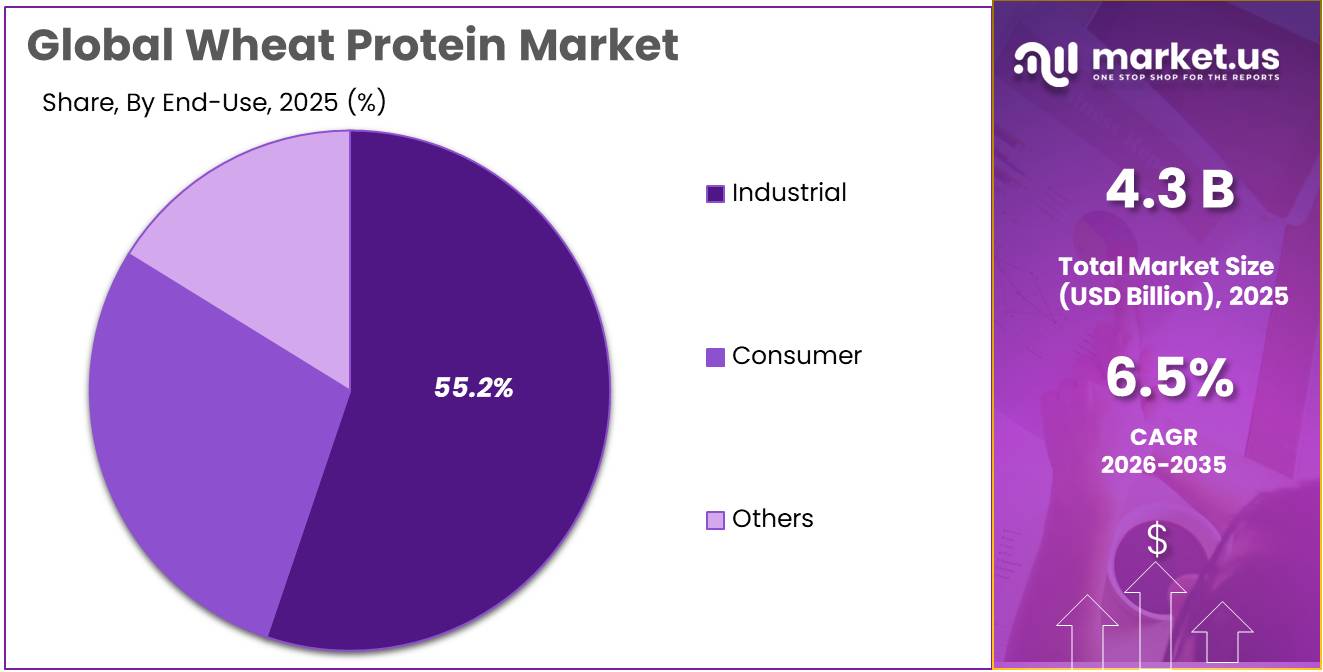
- Industrial segment dominates the wheat protein market with a 55.2% share.
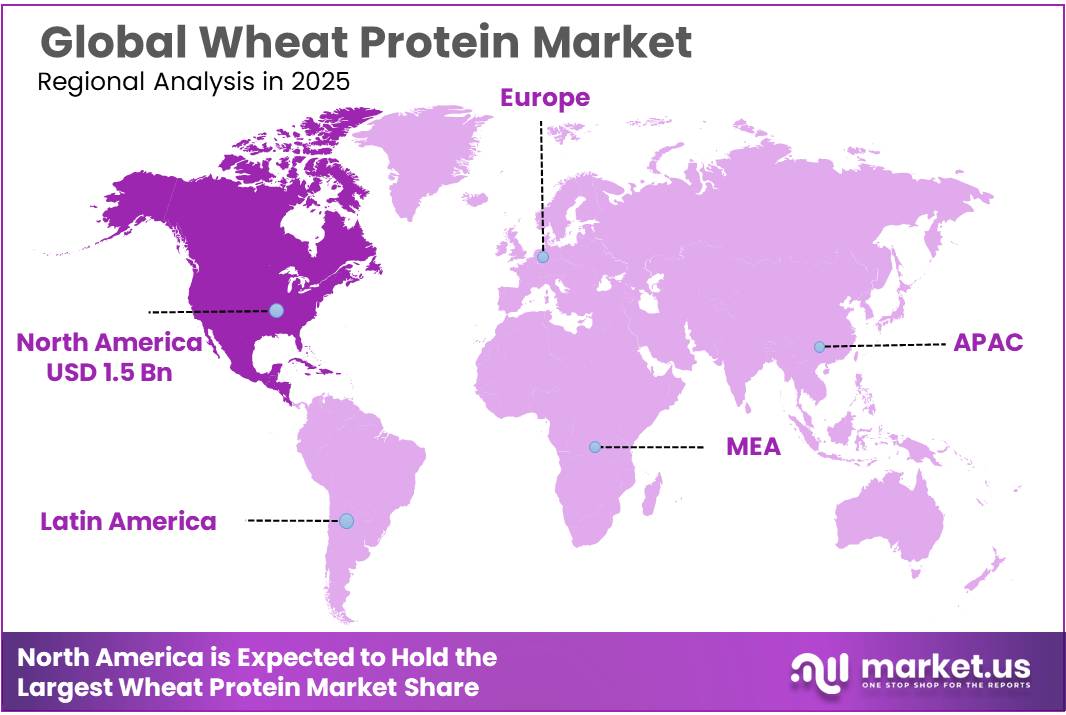
- North America dominated the global wheat protein market, accounting for nearly 35.0%.
Government and policy support is also helping the wider plant-protein value chain. The European Commission’s Protein Action Plan aims to strengthen food security and protein supply resilience; it notes that the EU produces 67 million tonnes of plant-based protein but uses about 80 million tonnes for feed, food, and industrial purposes. It also targets raising EU-origin protein from oilseeds and protein crops used as feed from 25.8% to 35% by 2035, which signals broader policy support for plant-protein processing infrastructure.
- In December 2025, ADM also entered a definitive agreement with Planters Cotton Oil Mill to launch a cottonseed joint venture, while its 2025 filings recorded USD 372 million in revaluation losses mainly tied to alternative-protein investments.
Product Type Analysis
Wheat Gluten Dominance and Hydrolyzed Wheat Protein Expansion
The wheat protein market is strongly led by wheat gluten, which accounts for 45.0% share, driven by its extensive use in bakery applications where its viscoelastic properties improve dough strength, elasticity, and overall product structure. Its dominance is reinforced by large-scale industrial bakery production systems that rely on consistent functional performance, particularly in processed bread, pastries, and snack formulations where texture stability is critical.
Hydrolyzed wheat protein is emerging as the fastest-growing product type, supported by rising demand from high-functionality applications in nutritional foods and personal care formulations. Its improved solubility, absorption characteristics, and functional versatility make it increasingly suitable for protein-enriched beverages, sports nutrition products, and cosmetic formulations.
Protein Concentration Analysis
58.2% Protein Dominance and High-Purity Segment Growth
Products with 75% protein concentration hold the largest share at 58.2%, primarily due to their balanced cost-to-performance ratio, making them suitable for mainstream bakery, snack, and processed food applications. Food manufacturers prefer this concentration level as it delivers functional protein benefits without significantly increasing formulation costs, ensuring scalability across industrial production systems.
The 80%–95% protein concentration segment is the fastest growing, driven by increasing demand for high-performance nutrition products such as sports supplements, protein-enriched beverages, and clinical nutrition formulations. This shift reflects a growing preference among health-focused consumers for high-purity protein ingredients with enhanced nutritional density, prompting manufacturers to invest in advanced extraction and purification technologies.
Form Analysis
Dry Form Dominance and Liquid Form Expansion
The dry form dominates the wheat protein market with a 67.8% share, largely due to its stability, ease of storage, and compatibility with large-scale industrial food processing systems. Dry wheat
protein is widely used in bakery and snack manufacturing, where it can be easily blended into flour systems without affecting production efficiency or shelf-life stability.
The liquid form is the fastest-growing segment, supported by increasing adoption in ready-to-use food formulations and beverage applications. Its ease of integration into protein drinks, nutritional shakes, and processed food systems reduces preparation time and improves manufacturing efficiency, making it attractive for companies focusing on convenience-driven product development.
Application Analysis
Bakery & Snacks Dominance and Meat Analogues Growth
The bakery & snacks segment leads the wheat protein market with a 45.0% share, driven by the extensive use of wheat gluten and isolates to improve texture, elasticity, and structural integrity in baked goods. Industrial bakery manufacturers rely heavily on wheat protein to maintain consistency in large-scale production of bread, biscuits, and packaged snacks.
The meat analogues & processed meat segment is the fastest-growing application, supported by rising demand for plant-based protein alternatives. Textured wheat protein is increasingly used in burgers, sausages, and ready meals due to its fibrous structure that closely mimics meat texture, aligning with the expansion of flexitarian and vegetarian dietary trends across global markets.
End-Use Analysis
Industrial Dominance and Consumer Segment Growth
The industrial segment dominates the wheat protein market with a 55.2% share, as large-scale food manufacturers utilize wheat protein extensively in bakery processing, packaged foods, and ingredient manufacturing systems. Its functional properties and cost efficiency make it a core input in industrial food production chains.
The consumer segment is the fastest-growing, driven by increasing demand for packaged high-protein foods and functional nutrition products. Rising health awareness and dietary shifts toward plant-based protein consumption are accelerating adoption among end consumers, particularly in ready-to-eat and convenience food categories.
Key Market Segments
By Product Type
- Wheat Gluten
- Wheat Protein Isolate
- Textured Wheat Protein
- Hydrolyzed Wheat Protein
By Protein Concentration
- 75% Protein
- 80% and 95% Protein
By Form
- Dry
- Liquid
By Application
- Bakery & Snacks
- Meat Analogues & Processed Meat
- Nutritional Bars & Drinks
- Pet Food & Aquafeed
- Cosmetics & Personal Care
By End-Use
- Industrial
- Consumer
Driver Analysis
Plant-protein menu expansion lifting wheat protein inclusion in formulated foods
The European Commission in 2026 formally moved from discussion to a Protein Action Plan, aiming to raise the EU share of protein from oilseeds and protein crops used in feed from 25.8% to 35% by 2035, while also supporting storage, processing infrastructure, local sourcing, origin labelling, and public procurement for sustainable proteins; that policy architecture improves the commercialization environment for wheat-derived proteins even though the headline target is broader than wheat itself.
Strategically, this driver adds about +1.4 percentage points to forward CAGR because it expands the number of viable end uses at once: meat analogues, high-protein bakery, hybrid convenience foods, and texture systems for prepared foods; the effect is strongest in North America and Europe, then diffuses into urban APAC where premium protein products are scaling through modern retail and foodservice.
Drivers Impact Analysis
| Driver | (~) % Impact on CAGR Forecast | Geographic Relevance | Impact Timeline |
|---|---|---|---|
| Plant-protein menu expansion lifting wheat protein inclusion in formulated foods | +1.4% | North America core, EU core, APAC urban corridors | Medium term (2-4 years) |
| Bakery protein fortification and texture optimization supporting vital wheat gluten use | +1.1% | EU, North America, China, Southeast Asia | Short term (≤ 2 years) |
| Large global wheat output and better raw-material availability improving processor economics | +0.9% | Europe processing hubs, North America, China, export-linked APAC | Short term (≤ 2 years) |
| EU protein-system policy support strengthening regional plant-protein value chains | +0.8% | EU core, UK spill-over, CEE corridors | Medium term (2-4 years) |
| Foodservice and convenience demand increasing need for binders, elasticity and moisture retention | +0.7% | North America, EU, Japan, South Korea, Tier-1 APAC cities | Short term (≤ 2 years) |
| Feed and pet-food protein optimization widening non-food offtake for wheat protein fractions | +0.6% | EU, North America, selected APAC feed markets | Medium term (2-4 years) |
Restraint Analysis
Wheat crop tightness
USDA’s 2026 outlook shows the clearest upstream restraint because U.S. all-wheat production is projected at 1,561 million bushels in May and 1,543 million bushels in June, while ending stocks fall to 762 million and then 744 million bushels, or roughly 18–20 percent below the prior year, with winter wheat production described as the smallest since 1965/66 and total U.S. output at the lowest level since 1972/73; for wheat-protein manufacturers that depend on consistent gluten yields, this means less flexibility in procurement, tighter protein-grade wheat allocation, and a higher probability that food millers prioritize core flour contracts over specialty fractionation, which can push plant utilization down by an estimated 4–7 percentage points during poor crop quarters and raise working-capital requirements as processors hold 20–35 more days of grain cover to protect throughput, ultimately delaying line debottlenecking and trimming roughly 1.4 percentage points from a normalized market CAGR assumption.
Restraint Impact Analysis
| Restraint | (~) % Impact on CAGR Forecast | Geographic Relevance | Impact Timeline |
|---|---|---|---|
| Wheat crop tightness | -1.4% | North America core, EU, export corridors | Short term (≤ 2 years) |
| Raw material inflation | -1.1% | North America, EU, APAC importers | Short term (≤ 2 years) |
| Softer food-use of wheat | -0.8% | North America core, developed EU | Medium term (2-4 years) |
| Trade contraction risk | -0.9% | APAC corridors, MENA import lanes, Americas | Medium term (2-4 years) |
| Allergen and gluten labeling friction | -0.7% | U.S., EU, premium packaged-food markets | Medium term (2-4 years) |
| Compliance and residue risk | -0.6% | EU, export-dependent processors | Medium term (2-4 years) |
Opportunity Analysis
Aquafeed protein substitution
The commercial upside is meaningful because even partial substitution into premium aquafeed formulations can add a 10% to 20% volume layer for select producers, improve plant utilization by 5 to 8 points through off-season balancing versus food demand, and lower customer raw-material volatility where fishmeal prices spike, making a +1.3 percentage point CAGR uplift realistic in North America, Europe, Chile, Norway, and major APAC aquaculture hubs if suppliers build technical sales capability and certify application performance over the next two to four years
Opportunity Impact Analysis
| Opportunity | (~) % Potential CAGR Upside | Geographic Relevance | Execution Window |
|---|---|---|---|
| Premium meat analog texturates | +1.8% | North America core, EU, APAC urban | Short term (≤ 2 years) |
| Aquafeed protein substitution | +1.3% | North America, EU, Chile, Norway, APAC aquaculture | Medium term (2-4 years) |
| Pet nutrition functional proteins | +1.1% | North America core, EU, Japan, South Korea | Short term (≤ 2 years) |
| EU-localized protein supply chains | +1.6% | EU core, Eastern Europe | Medium term (2-4 years) |
| India and Southeast Asia value unlock | +1.9% | India, Thailand, Vietnam, Indonesia | Medium term (2-4 years) |
| Hydrolysates and specialty B2B systems | +1.4% | North America, EU, APAC developed | Long term (≥ 4 years) |
Challenges Analysis
Quality & functionality variability
Even when volume is adequate, wheat protein quality and functional performance show significant batch‑to‑batch dispersion often 5–10% variability in parameters such as water absorption, viscoelasticity, and texturizing performance which creates friction in downstream bakery, meat analog, and nutrition applications that are calibrated to tight performance windows. Differences in wheat varieties across major producing regions mean exporters and formulators must manage at least 10–15 distinct quality profiles, each with its own gluten strength and processing behavior, leading to additional in‑plant blending steps and up to 20–30 minutes of extra production time per batch for functional alignment.
This adds 2–3% to overall production cycle times, imposes 3–5% yield loss in some complex formulations due to off‑spec batches, and can raise quality‑control and laboratory testing loads by 25–35%, translating into incremental opex equivalent to 0.7 percentage points of CAGR drag as smaller processors delay new product launches or restrict geographic rollout until stability is proven.
Strategically, firms must deploy more granular origin‑segmented procurement, invest in inline rheology and protein‑function testing, and build digital formulation libraries that map each wheat protein lot into specific application envelopes, backed by stricter supplier QA programs referencing government variety and grade standards; while these steps can normalize functionality over a 2–4‑year horizon, they require capital for analytics equipment, training of specialized QC staff, and close integration with public agronomic data, keeping friction non‑terminal but structurally persistent through 2026.
Challenges Impact Analysis
| Challenge | (~) % CAGR Friction Drag | Geographic Relevance | Mitigation Horizon |
|---|---|---|---|
| Climate-linked crop volatility | -1.0% | EU grain belt, North America plains, India core | Long term (≥ 4 years) |
| Quality & functionality variability | -0.7% | EU food hubs, North America processing, APAC exporters | Medium term (2-4 years) |
| Logistics & trade cost pressure | -0.8% | Global export corridors, EU–UK, US–APAC lanes | Medium term (2-4 years) |
| Competing plant proteins & reformulation load | -0.5% | North America premium brands, EU alt-protein, APAC urban | Long term (≥ 4 years) |
| Regulatory & labeling complexity | -0.4% | EU regulatory hubs, North America, selected APAC | Long term (≥ 4 years) |
| Technical & talent bottlenecks in protein processing | -0.6% | EU specialty ingredients, North America, China coastal | Medium term (2-4 years) |
Geopolitical Impact Analysis
Geopolitical Impact Analysis of the Global Wheat Protein Market
The global wheat protein market is significantly influenced by geopolitical factors, particularly trade policies, agricultural regulations, and supply chain stability. Major wheat-producing regions such as North America, Europe, and Asia-Pacific play a crucial role in determining global supply and pricing. Trade tensions between key economies can impact the export and import of wheat-based ingredients, affecting production costs for manufacturers. Additionally, export restrictions or tariffs on wheat from countries like Russia, Ukraine, and India can disrupt raw material availability in the global market.
Furthermore, geopolitical conflicts and climate-related disruptions in major wheat-growing regions may lead to supply shortages, influencing the production of wheat protein ingredients. However, growing international cooperation and trade agreements are helping stabilize supply chains. The increasing demand for plant-based proteins is also encouraging countries to secure strategic agricultural partnerships, ensuring steady availability and reducing dependency on limited suppliers in the global wheat protein industry.
Regional Analysis
In 2025, North America dominated the global wheat protein market, accounting for nearly 35.0% of the total market share, driven by the rapid expansion of the food processing industry and increasing demand for plant-based protein ingredients. The region benefits from a large consumer base, rising disposable income, and growing awareness regarding high-protein and functional food products.
Similarly, Japan and South Korea contribute significantly through advanced food manufacturing technologies and increasing demand for clean-label and protein-enriched products. Emerging economies such as India, Thailand, Indonesia, and Vietnam are also witnessing substantial market growth due to urbanization, changing dietary habits, and increasing investments in the food and beverage industry, making Asia Pacific the key production and consumption hub for wheat protein globally.
Key Regions and Countries
- North America
- The US
- Canada
- Europe
- Germany
- France
- The UK
- Spain
- Italy
- Russia & CIS
- Rest of Europe
- APAC
- China
- Japan
- South Korea
- India
- ASEAN
- Rest of APAC
- Latin America
- Brazil
- Mexico
- Rest of Latin America
- Middle East & Africa
- GCC
- South Africa
- Rest of MEA
Key Players Analysis
The global wheat protein market is moderately consolidated, with a mix of large multinational corporations and regional manufacturers holding significant shares. Key players such as Cargill Inc, MGP Ingredients, Roquette Frères, Manildra Group, and Crespel & Deiters GmbH & Co. KG dominate the market due to their strong production capacities, extensive distribution networks, and continuous product innovation.
These companies collectively account for a major portion of global supply, particularly in food and beverage applications. Their focus on expanding plant-based protein portfolios and improving functional wheat protein ingredients strengthens their market position. Additionally, emerging players like Agridient Inc, AB Amilina, Kroener Staerke, and Crop Energies AG are increasing their presence through capacity expansion and regional partnerships, intensifying competition and driving innovation across the global wheat protein industry
The Major Players in The Industry
- Cargill, Incorporated
- Archer Daniels Midland Company
- Tereos
- Kerry Group
- Roquette Frères
- Manildra Group
- MGP Ingredients
- PureField Ingredients
- Ardent Mills LLC
- Anhui Ante Food
- Anhui Ruifuxiang
- Shandong Qufeng Food Technology
- Z & F Sungold Corporation
- AB Amilina
- Pioneer Industries Limited
Key Development
- June, 2025 – Roquette Frères Launched its first textured wheat protein, NUTRALYS® T WHEAT 600L, expanding its wheat protein portfolio to support plant-based meat and high-protein food applications.
- May, 2025 – GoodMills Innovation Introduced VITATEX® Wheat Fava Flakes SVP Pro, a co-texturized wheat and fava protein ingredient designed to improve texture and structure in meat alternative products.
Report Scope
| Report Features | Description |
|---|---|
| Market Value (2025) | USD 4.31 Bn |
| Forecast Revenue (2035) | USD 8.10 Bn |
| CAGR (2026-2035) | 6.5% |
| Base Year for Estimation | 2025 |
| Historic Period | 2020-2024 |
| Forecast Period | 2025-2035 |
| Report Coverage | Revenue Forecast, Market Dynamics, Competitive Landscape, Recent Developments |
| Segments Covered | By Product Type (Wheat Gluten, Wheat Protein Isolate, Textured Wheat Protein, and Hydrolyzed Wheat Protein), By Form (Dry, Liquid), By Protein Concentration (75% Protein Concentration, 80% and 95% Protein Concentration), By Application(Bakery & Snacks, Meat Analogues & Processed Meat, Nutritional Bars & Drinks, Pet Food & Aquafeed, Cosmetics & Personal Care), By End-Use (Industrial, Consumer), By Region and Companies – Industry Segment Outlook, Market Assessment, Competition Scenario, Trends, and Forecast 2025-2035 |
| Regional Analysis | North America – The US & Canada; Europe – Germany, France, The UK, Spain, Italy, Russia & CIS, Rest of Europe; APAC– China, Japan, South Korea, India, ASEAN & Rest of APAC; Latin America– Brazil, Mexico & Rest of Latin America; Middle East & Africa– GCC, South Africa, & Rest of MEA |
| Competitive Landscape | Cargill, Incorporated, Archer Daniels Midland Company, Tereos, Kerry Group, Roquette Frères, Manildra Group, MGP Ingredients, PureField Ingredients, Ardent Mills LLC, Anhui Ante Food, Anhui Ruifuxiang, Shandong Qufeng Food Technology, Z & F Sungold Corporation, AB Amilina, Pioneer Industries Limited |
| Customization Scope | Customization for segments, region/country-level will be provided. Moreover, additional customization can be done based on the requirements. |
| Purchase Options | We have three licenses to opt for: Single User License, Multi-User License (Up to 5 Users), Corporate Use License (Unlimited Users and Printable PDF) |





































