


Report Overview
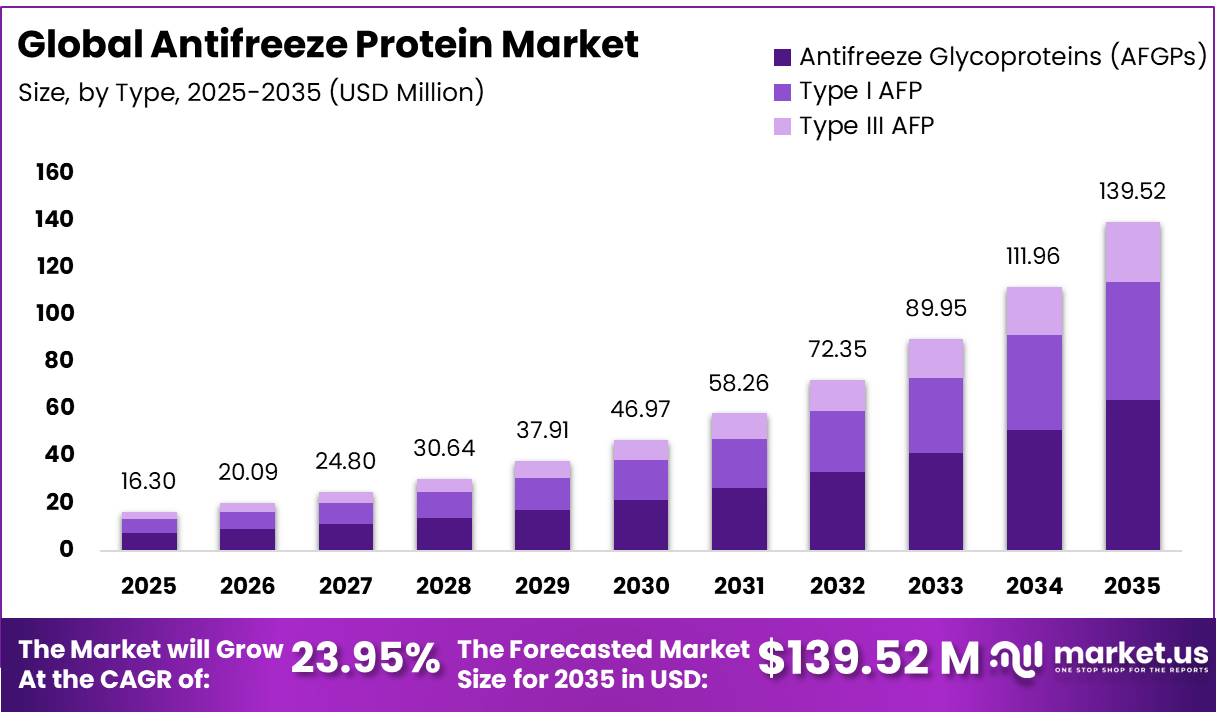
In 2025, the Global Antifreeze Protein Market was valued at USD 16.30 Million, and between 2026 and 2035, this market is estimated to register a CAGR of 23.95%, reaching about USD 139.52 Million by 2035. In 2025, North America led the market, achieving over 44.9% share with a revenue of USD 7.3 Million.
Antifreeze proteins, also called ice-binding or ice-structuring proteins, attach to ice surfaces and slow crystal growth and recrystallization. In foods, they can protect texture, moisture, appearance, and quality during freezing, storage, transport, and temperature changes. Their relevance lies in ice cream, frozen desserts, seafood, meat, bakery dough, fruits, vegetables, and prepared meals, where large ice crystals can damage cells and create grainy or dry products. Scientific evidence shows that these proteins can work at much lower concentrations than conventional freezing-point depressants, supporting targeted formulation systems.
- According to the U.S. Food and Drug Administration (FDA), as of 2023, ice-structuring protein preparations are permitted for use in frozen novelty products at levels up to 0.01% by weight and in frozen-meal sauces at up to 50 mg/kg.
Key Takeaways
- The Global Antifreeze Protein Market was valued at USD 16.30 Million in 2025.
- The market is projected to grow at a CAGR of 23.95% and is estimated to reach USD 139.52 Million by 2035.
- On the basis of type, Antifreeze Glycoproteins (AFGPs) dominated the market, constituting 45.9% of the total market share.
- Based on the source, Fish-Derived proteins dominated the market, with a substantial market share of around 46.8%.
- Based on the form, Liquid led the market, comprising 65.8% of the total market.
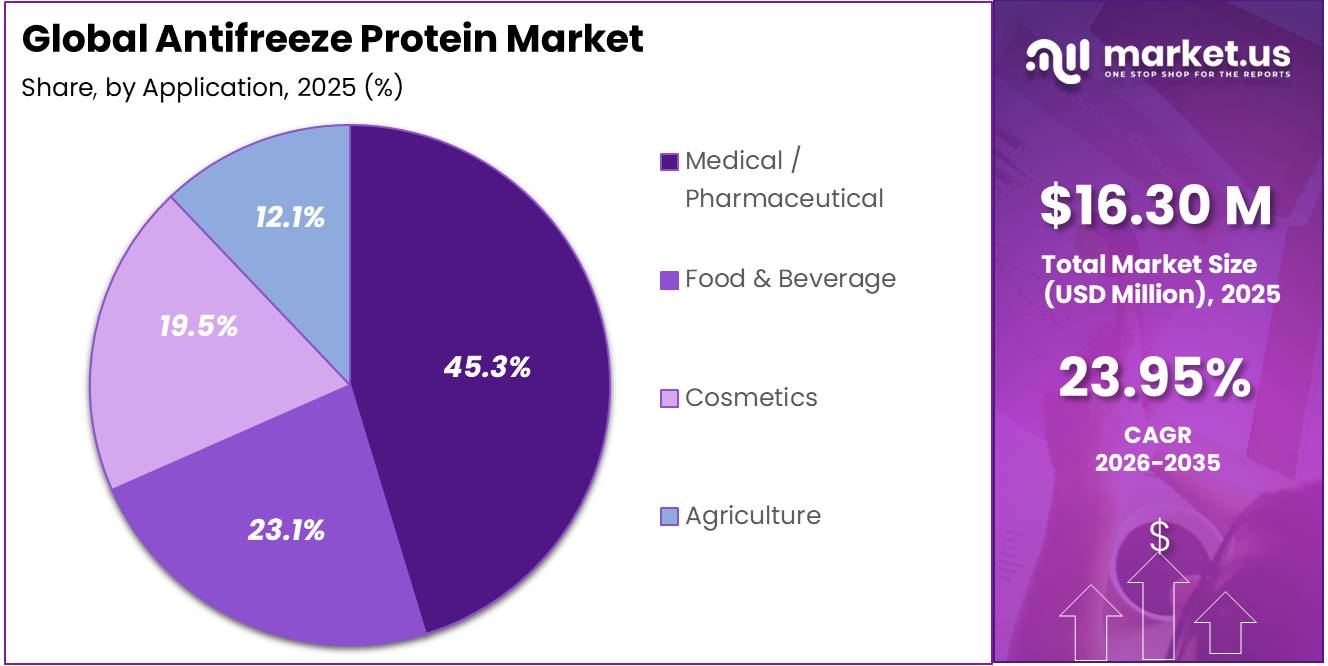
- On the basis of application, Medical / Pharmaceutical dominated the market, constituting 45.3% of the total market share.
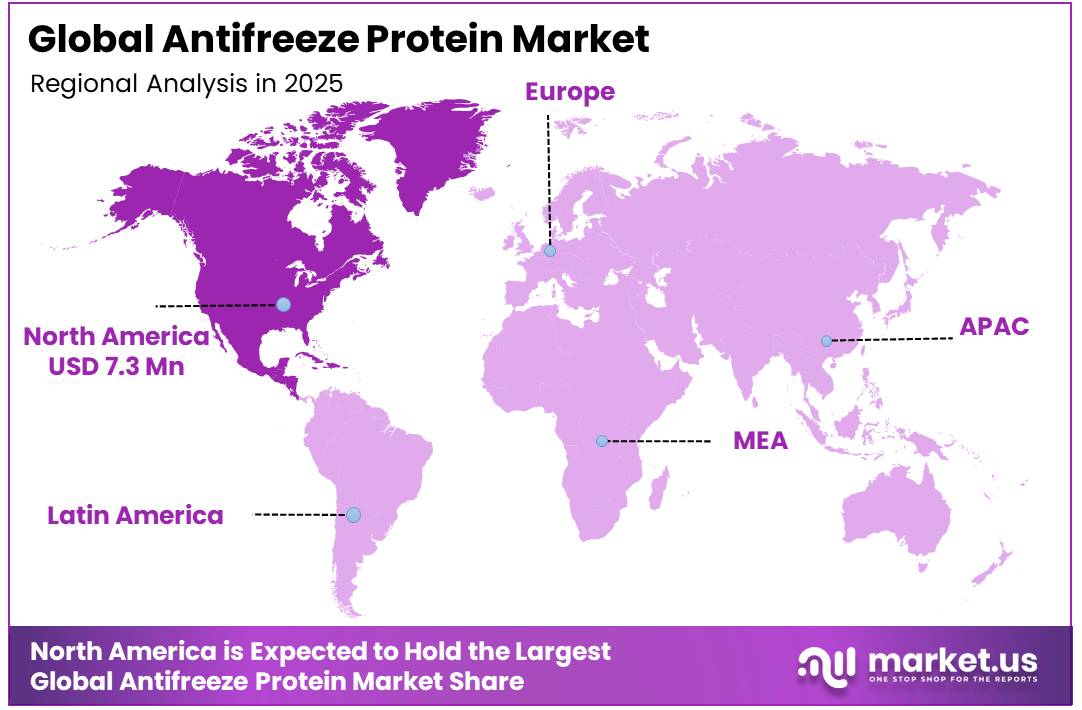
- In 2025, North America was the most dominant region in the market, accounting for 44.9% of the total global consumption.
These approved usage levels enable manufacturers to improve texture and freeze thaw stability with relatively low inclusion rates, while still requiring compliance with fermentation and purification standards, product stability validation, safety assessments, and applicable labeling regulations.
- According to the U.S. Department of Agriculture (USDA), in its Dairy Products 2025 Summary published in April 2026, the United States produced 845 million gallons of regular ice cream, 381 million gallons of low-fat ice cream, 25.0 million gallons of sherbet, and 34.1 million gallons of frozen yogurt during 2025.
This large-scale frozen dessert production highlights a substantial application base for ice-structuring proteins and other recrystallization-control ingredients that help improve texture, stability, and product quality during frozen storage.
- In June 2024, the Food and Agriculture Organization reported that global aquaculture output reached 130.9 million tonnes in 2022, including 94.4 million tonnes of aquatic animals valued at USD 313 billion.
As frozen fish and shellfish move through international supply chains, processors need technologies that limit drip loss, protein damage, dehydration, and texture deterioration after thawing. Antifreeze proteins derived from fish, plants, fungi, or precision-fermented microorganisms could support premium frozen seafood, surimi, ready meals, and high-protein products, provided that supply consistency and regulatory acceptance improve.
- In March 2024, UNEP estimated that 1.05 billion tonnes of food were wasted in 2022, equal to 132 kilograms per person. Food loss and waste generated 8–10% of annual global greenhouse-gas emissions, while the economic cost was approximately USD 1 trillion. These pressures align antifreeze-protein development with Sustainable Development Goal 12.3, which targets a 50% reduction in food waste by 2030, encouraging investment in shelf-life, cold-chain, and quality-preservation technologies.
Future opportunities are expected in precision fermentation, plant-based frozen foods, low-sugar desserts, frozen beverages, and protein-rich convenience products. European Commission research has shown that millimolar antifreeze-protein concentrations can reduce freezing temperature by several degrees, while similar effects from salt require molar concentrations. highlighted machine-learning work on antifreeze-protein-inspired materials. Commercial expansion will depend on lower production costs, standardized testing, consumer-friendly sourcing, and approvals covering broader food categories.
Type Analysis
Antifreeze Glycoproteins lead with a 45.9% share due to strong ice-control performance.
In 2025, Antifreeze Glycoproteins (AFGPs) held a dominant market position, capturing more than a 45.9% share. The segment’s leadership was supported by its strong ability to control ice-crystal growth and reduce ice recrystallization, making it suitable for frozen foods, biomedical preservation, pharmaceuticals and cold-storage applications.
- In November 2025, a study available through the U.S. National Institutes of Health’s PubMed Central examined three AFGP model sequences and found that each predominantly maintained a polyproline-II-like structure, with populations exceeding 70%. The research also identified AFGPs as some of the most effective ice-recrystallization-inhibiting agents.
Type III AFP is the fastest-growing segment, supported by increasing research into cell preservation, reproductive biotechnology and other biomedical freezing applications. Its relatively compact structure, compatibility with biological systems and performance at low concentrations make it attractive for developing advanced cryoprotective formulations. The results indicate that carefully controlled Type III AFP concentrations can improve preservation performance, supporting its growing development for sensitive biological materials.
Source Analysis
Fish-derived antifreeze proteins lead with a 46.8% share due to their strong ice-control performance.
In 2025, the Fish-derived segment held a dominant market position, capturing more than a 46.8% share. Fish-derived antifreeze proteins continued to lead because they provide strong thermal-hysteresis activity and effectively control ice-crystal growth.
- In January 2025, according to research indexed by the U.S. National Library of Medicine, a cod-collagen antifreeze peptide recorded thermal-hysteresis activity of 2.60°C at a concentration of 10 mg/mL, compared with 1.90°C and 2.27°C for the other tested cod-peptide fractions. Another January 2025 study reported that antifreeze peptides obtained from Evynnis japonica fish scales delivered four times greater surimi-protection efficiency than traditional cryoprotectants.
These peptides kept 63.60% of ice crystals below 600 µm², while three purified peptide sequences improved antifreeze activity by 21.75% and increased thermal-hysteresis activity by 1°C. These measurable performance benefits support the wider adoption of fish-derived proteins in frozen foods, seafood processing and biological preservation.
Plants are the fastest-growing segment in the antifreeze protein market. In 2025, interest in plant-derived proteins increased as food, agriculture and biotechnology companies looked for scalable and more sustainable alternatives to proteins obtained directly from marine organisms. Plants exposed to freezing conditions naturally activate protein-based defence systems that limit ice-crystal growth and protect cell membranes from cold damage. Plant sources may also offer easier cultivation, wider raw-material availability and better acceptance in vegetarian and plant-based product formulations.
Form Analysis
Liquid Form Leads with a 65.8% Share Due to Easy Mixing and Accurate Dosing
In 2025, Liquid held a dominant market position, capturing more than a 65.8% share. Its leadership was supported by its ready-to-use nature and easy dispersion in water-based formulations. Food processors, biotechnology laboratories, pharmaceutical producers, and cosmetic manufacturers can add liquid antifreeze proteins directly into formulations without a separate reconstitution step. This simplifies dosing, supports even protein distribution, and lowers preparation time during large-scale processing.
- In August 2025, research indexed by the U.S. National Library of Medicine reported that antifreeze polypeptides protected model protein therapeutics through more than 8 freeze-thaw cycles, showing their value in liquid biological formulations exposed to repeated temperature changes.
Solid is the fastest-growing segment in the antifreeze protein market. The segment is gaining attention because powdered and freeze-dried products are easier to package, transport, measure, and store before use. Solid formulations can also reduce leakage risks and allow manufacturers to prepare different concentrations according to the needs of frozen foods, laboratory media, cosmetic products, or biological samples. Growth is further supported by research into stable synthetic antifreeze polypeptides that work at low concentrations and can be reconstituted for specific applications.
Application Analysis
Medical / Pharmaceutical leads the Antifreeze Protein Market with a 45.3% share.
In 2025, Medical / Pharmaceutical held a dominant market position, capturing more than a 45.3% share. The segment benefits from the growing study of antifreeze proteins in cell, tissue, sperm, blood, and organ cryopreservation. These proteins can control ice-crystal formation during freezing and help protect biological materials from structural damage during storage and thawing.
- In April 2025, a study indexed by the U.S. National Library of Medicine reported that recombinant snow flea antifreeze protein supported a 67.6% cell-recovery rate after cryopreservation, highlighting its potential as a protective ingredient in biomedical storage systems.
- In 2025, the U.S. FDA also approved 46 novel drugs, reflecting continued pharmaceutical research and the need for reliable technologies that preserve sensitive cells, proteins, biological samples, and therapeutic materials.
These developments are encouraging pharmaceutical laboratories and biotechnology companies to examine antifreeze proteins as lower-toxicity cryoprotective materials for regenerative medicine, fertility treatment, drug research, and transplant-related applications.
Cosmetics is the fastest-growing segment in the Antifreeze Protein Market. Its growth is supported by increasing interest in cold-protection skincare, anti-ageing formulations, moisturizers, serums, and products designed for consumers exposed to dry or low-temperature conditions. Antifreeze proteins can help regulate ice formation and protect biological structures from cold-related stress, making them attractive for advanced skin-protection research. Cosmetic manufacturers are also exploring biotechnology-derived ingredients that can improve product differentiation while supporting hydration, skin-barrier care, and premium formulation claims.
Key Market Segments
By Type
- Antifreeze Glycoproteins (AFGPs)
- Type I AFP
- Type III AFP
By Source
- Fish-Derived
- Insects
- Plants
- Microorganisms
By Form
- Liquid
- Solid
By Application
- Medical / Pharmaceutical
- Food & Beverage
- Cosmetics
- Agriculture
Driver Analysis
Cryopreservation scale-up in cell, tissue, and organ workflows
Cryopreservation is the highest-value demand driver because antifreeze proteins directly address ice recrystallization, a core failure mode in cells, tissues, embryos, and emerging organ-preservation systems, which raises their commercial relevance well beyond niche research reagents. On the clinical side, recent organ-preservation research documented lung preservation at 10°C for up to 24 hours without negative short-term outcomes, showing that every extra hour of viable logistics creates economic value in procurement radius, scheduling flexibility, and wastage reduction; antifreeze proteins fit this model by improving post-thaw viability and reducing dependence on harsher cryoprotectant loading, which can lower failure rates in high-value cell therapy lots where one lost batch can erase margins.
For CAGR modeling, that supports an estimated +2.4 percentage-point uplift because biobanks, IVF, regenerative medicine labs, and advanced therapy manufacturers buy on performance per preserved dose rather than raw ingredient cost, allowing AFP suppliers to move toward premium formulation, licensing, and application-specific co-development business models.
Drivers Impact Analysis
| Driver | (~) % Impact on CAGR Forecast | Geographic Relevance | Impact Timeline |
|---|---|---|---|
| Cryopreservation scale-up in cell, tissue, and organ workflows | +2.4% | North America core, EU, East Asia advanced biotech hubs | Medium term (2-4 years) |
| Frozen food quality optimization and cold-chain loss control | +1.9% | North America core, EU, Japan, South Korea, China premium food corridors | Short term (≤ 2 years) |
| Crop frost resilience and agri-biological deployment | +1.4% | North America specialty crops, EU horticulture belts, China and Oceania spill-over | Medium term (2-4 years) |
| Public R&D funding and translational commercialization pipeline | +1.2% | U.S. core, EU research clusters, Canada, Japan | Medium term (2-4 years) |
| Food safety, shelf-life, and frozen product compliance intensity | +1.0% | U.S., EU, export-oriented APAC processors | Short term (≤ 2 years) |
| PFAS and persistent-chemical substitution in low-temperature materials systems | +0.8% | U.S. and EU regulatory core, selective APAC advanced materials markets | Long term (≥ 4 years) |
Restraint Analysis
Complex biotech food‑use approvals
Complex biotech food-use approvals act as a structural drag on antifreeze protein market expansion by elongating regulatory review cycles for novel proteins and delaying commercial scaling of AFP-enhanced food, nutraceutical, and biopharma formulations, particularly in the United States, Canada, the EU, and Japan. In the United States, the FDA’s Food Code and GRAS notification framework demand toxicology, exposure, and production-process data that can cost AFP developers USD 3–7 million per submission, with typical pre-market consultation and GRAS evaluation stretching 18–30 months, creating a regulatory “burn rate” where compliance spending exceeds 8–10 percent of total R&D budgets for mid-size ingredient players.
OECD’s Working Party on the Harmonisation of Regulatory Oversight in Biotechnology has been working toward alignment on risk assessment principles, but as of its 2025 meeting, AFPs and ISPs still fall under broader biotechnology guidance rather than a dedicated streamlined category, meaning companies face overlapping national biotech laws and food-additive codes that can reduce effective launch velocity by 25–35 percent versus conventional emulsifiers or stabilisers. Quantitatively, extended approval cycles reduce the annualised conversion of pilot projects into revenue-generating SKUs by roughly 3–4 percentage points, translating into a CAGR headwind of about 2.8 percentage points for the 2026–2030 horizon as pipelines slip and marketing authorisations cluster later in the forecast period.
Restraint Impact Analysis
| Restraint | (~) % Impact on CAGR Forecast | Geographic Relevance | Impact Timeline |
|---|---|---|---|
| Complex biotech food-use approvals | -2.8% | North America, EU core, Japan | Medium term (2–4 years) |
| High-cost extraction & fermentation | -2.3% | North America, EU, APAC corridors | Medium term (2–4 years) |
| Limited approved use cases | -1.9% | North America core, EU, ANZ | Short term (≤ 2 years) |
| Allergen & labeling risk management | -1.5% | EU, North America, East Asia | Short term (≤ 2 years) |
| Genome-editing & GMO policy uncertainty | -1.4% | EU, ASEAN, China, India | Long term (≥ 4 years) |
| Cold-chain & application integration frictions | -1.2% | Emerging APAC, LATAM, MEA | Medium term (2–4 years) |
Opportunity Analysis
Aquaculture cryoprotection platforms
Aquaculture production has reached roughly 130.9 million tonnes in 2022, with aquaculture accounting for about 51% of aquatic animal output and projected to drive 85% of incremental fisheries/aquaculture growth to around 118 million tonnes by 2034, creating a multi‑hundred‑billion‑dollar supply chain where cold storage and transport losses remain significant. By developing AFP‑enabled cryoprotective coatings for high‑value species and integrating them with cold‑chain logistics, producers could realistically reduce loss and downgrade rates during storage and transport by 3–5 percentage points on volume segments that account for over USD 300 billion in first‑sale value, improving effective yield by 2–3% and enabling pricing premiums of 5–7% on “quality‑preserved” product lines.
If AFP usage scales to just 10–15% of aquaculture volume in FAO‑identified top‑10 producing countries, incremental demand for AFP formulations could add roughly USD 40–60 million above a baseline AFP market of tens of millions by 2035, translating into about 3.0 percentage points of CAGR upside versus current trajectories primarily driven by food, cosmetic and medical use cases. Execution risk is moderate, as regulatory frameworks for food contact substances and additives already exist at FAO/OECD‑FAO countries, but success hinges on proving net margin uplift at farm and processor level (e.g., 100–200 basis‑point margin expansion via reduced spoilage and improved grade recovery).
Opportunity Impact Analysis
| Opportunity | (~) % Potential CAGR Upside | Geographic Relevance | Execution Window |
|---|---|---|---|
| Aquaculture cryoprotection platforms | +3.0% | Asia, EU, North America coastal | Medium term (2–4 years) |
| Regulated food texture and cold-chain enhancers | +2.2% | North America core, EU, high-income APAC | Short term (≤ 2 years) |
| Cryo-biologics and cell therapy logistics | +2.8% | North America, EU, Japan, South Korea | Medium term (2–4 years) |
| Climate-resilient horticulture and seeds | +1.9% | OECD agriculture, China, India | Long term (≥ 4 years) |
| Advanced frozen dessert and novel foods | +1.6% | North America, EU, urban APAC | Short–Medium term (≤ 3 years) |
| Licensing model for ISP regulatory assets | +1.5% | Global, especially emerging APAC/LatAm | Medium term (2–4 years) |
Challenges Analysis
Complex GRAS/allergen compliance
The FDA’s stated intent to require formal GRAS notices for all new substances claimed as GRAS from 2026 onward effectively converts what was previously an optional disclosure path into a mandatory pre‑market documentation process, adding 9–15 months of regulatory lead time, typical dossier volumes of 300–600 pages, and incremental compliance spending of an estimated 4–6% of R&D budgets per AFP product line for smaller innovators. At the same time, public EFSA opinions on ice structuring proteins, while supportive of safety at low inclusion rates (≤0.01% in ice cream), codify expectations around production-process transparency, source organism specification, and exposure modeling that must be replicated for next‑generation AFPs and new food matrices, further extending EU review cycles and increasing the need for statistically robust allergen and exposure datasets.
As US regulators expand work on allergen thresholds and front‑of‑pack labeling, companies must integrate multi‑country toxicology, allergenicity, and consumption simulation models, often running 50,000–100,000 Monte Carlo iterations per scenario, to demonstrate low risk across sub‑populations. This combination of documentation intensity, multi‑jurisdiction alignment, and evolving expectations around protein safety standards realistically trims potential market CAGR by about 1.4 percentage points because even well‑funded AFP developers face slower SKU rollouts, delayed geographic expansion, and higher per‑launch compliance overhead, forcing strategic shifts toward centralized regulatory centers of excellence, early engagement with authorities, and co‑development with large food and pharma partners that can amortize compliance workloads over multiple platforms.
Challenges Impact Analysis
| Challenge | (~) % CAGR Friction Drag | Geographic Relevance | Mitigation Horizon |
|---|---|---|---|
| Complex GRAS/allergen compliance | -1.4% | North America, EU regulatory hubs | Medium term (2-4 years) |
| High bioprocess cost intensity | -1.8% | North America core, East Asia biotech belts | Long term (≥ 4 years) |
| Biomanufacturing talent gap | -1.2% | US, EU, East Asia bioclusters | Long term (≥ 4 years) |
| Cold-chain and logistics fragility | -0.9% | APAC logistics corridors, LATAM export nodes | Medium term (2-4 years) |
| Regulatory data & labeling burden | -1.0% | US, EU, selected OECD food markets | Medium term (2-4 years) |
| Demand uncertainty in novel uses | -0.8% | Global early-adopter food & pharma hubs | Short term (≤ 2 years) |
Geopolitical Impact Analysis
Geopolitical Tensions and Supply Chain Shifts Influence the Antifreeze Protein Market.
Recent geopolitical conflicts, including the Russia–Ukraine war and continued instability in the Middle East, have created uncertainty across global supply chains, influencing the antifreeze protein market. Although antifreeze proteins are specialty biological ingredients rather than bulk commodities, their production depends on stable access to research materials, laboratory chemicals, cold-chain logistics, and advanced bioprocessing equipment.
At the same time, companies have adjusted sourcing strategies to reduce dependence on a single region. Manufacturers are expanding supplier networks, increasing regional production, and investing in local biotechnology capabilities to improve supply security. Demand from the food industry remains steady because antifreeze proteins continue to improve frozen food quality, while pharmaceutical and life science applications also support long-term market demand.
North America and Western Europe have remained comparatively resilient due to their established biotechnology infrastructure and stronger domestic production capacity. Meanwhile, several Asian countries are strengthening research investments and manufacturing facilities to capture future opportunities. Despite temporary disruptions caused by geopolitical tensions, continued innovation, diversified supply chains, and rising adoption across multiple industries are expected to support the antifreeze protein market’s stable growth over the coming years.
Regional Analysis
North America Dominates the Antifreeze Protein Market
North America accounted for the largest share of the global antifreeze protein market, representing 44.9% of total revenue, valued at approximately USD 7.3 million. The region’s leadership is supported by its advanced biotechnology sector, strong research ecosystem, and high adoption of specialty proteins across food, pharmaceutical, and life science applications. The United States remains the primary contributor due to extensive investment in protein engineering, biopharmaceutical research, and frozen food innovation.
Asia-Pacific is projected to record the fastest growth in the antifreeze protein market during the forecast period, supported by expanding biotechnology investments, rising frozen food consumption, and increasing pharmaceutical manufacturing. China, Japan, South Korea, and Singapore are strengthening research capabilities in recombinant proteins, synthetic biology, and industrial biotechnology, encouraging wider commercialization of antifreeze protein applications. Growing urbanization, higher disposable incomes, and expanding demand for premium frozen foods are also encouraging manufacturers to adopt advanced food preservation ingredients.
Key Regions and Countries Covered
- North America
- The US
- Canada
- Europe
- Germany
- France
- The UK
- Spain
- Italy
- Russia & CIS
- Rest of Europe
- APAC
- China
- Japan
- South Korea
- India
- ASEAN
- Rest of APAC
- Latin America
- Brazil
- Mexico
- Rest of Latin America
- Middle East & Africa
- GCC
- South Africa
- Rest of MEA
Key Players Analysis
Sirona Biochem Corp. has participated in glycoprotein-mimetic and cell-preservation research, giving it adjacent relevance to antifreeze-protein applications. Its January 2024 loan balance stood at CAD 540,000, with CAD 11,178.08 in accrued interest. However, financial pressure led to a cease-trade order on March 7, 2025, followed by the closure and liquidation of its TFChem laboratory subsidiary in August 2025, limiting near-term research and commercialization capacity across operations.
- ProtoKinetix, Inc. is directly focused on synthetic anti-freeze glycoproteins, marketed under its AAGP brand, for protecting cells, tissues, and organs from stress. In 2024, ProtoKinetix spent USD 99,625 on research and development, recorded USD 364,188 in operating expenses and net loss, and generated no revenue.
AquaBounty Technologies, Inc. is linked to antifreeze-protein science through AquAdvantage salmon, which uses a promoter derived from an edible cold-water fish protein gene to regulate growth-hormone expression. The technology has supported claims of approximately 70% more annual salmon output and 25% better feed conversion than conventional production.
- In 2025, AquaBounty recorded a USD 18.5 million net loss, including a USD 14.4 million impairment, while asset sales generated USD 7.1 million. Its role today is technology-based rather than commercial antifreeze-protein supply. Parent company BRAIN Biotech fully acquired Biocatalysts in 2023 after initially purchasing 65.55% for GBP 11.8 million in 2018. In fiscal 2024/25, the wider group generated EUR 49.6 million in revenue, employed 281 people, and held 35 active patent families currently worldwide.
The Major Players in The Industry
- Unilever PLC
- Kaneka Corporation
- Nichirei Corporation
- A/F Protein Inc.
- Sirona Biochem Corp.
- ProtoKinetix, Inc.
- AquaBounty Technologies, Inc.
- Biocatalysts Ltd.
- Novozymes A/S
- Croda International Plc
Key Development
- In December 2025, Unilever PLC completed the demerger of The Magnum Ice Cream Company, a business valued at approximately €8.4 billion, while retaining a 19.85% ownership stake. The transaction separated Unilever’s global ice cream operations into an independent company, giving the business greater flexibility to manage product development, manufacturing, cold-chain distribution, and brand investment.
- In May 2025, Nichirei Corporation signed a merger agreement combining Nichirei Foods and Nichirei Fresh from April 1, 2026; the companies generated FY2025 sales of ¥241.081 billion and ¥123.103 billion, respectively. The merger is expected to bring frozen-food manufacturing, processed-food development, marine products, meat products, procurement, and sales activities under a more unified management structure.
Report Scope
| Report Features | Description |
|---|---|
| Market Value (2025) | USD 16.30 Bn |
| Forecast Revenue (2035) | USD 139.52 Bn |
| CAGR (2026-2035) | 23.95% |
| Base Year for Estimation | 2025 |
| Historic Period | 2020-2024 |
| Forecast Period | 2026-2035 |
| Report Coverage | Revenue Forecast, Market Dynamics, Competitive Landscape, Recent Developments |
| Segments Covered | By Type (Antifreeze Glycoproteins (AFGPs), Type I AFP, and Type III AFP), By Source (Fish-Derived, Insects, Plants, and Microorganisms), By Form (Liquid and Solid), By Application (Medical / Pharmaceutical, Food & Beverage, Cosmetics, and Agriculture) |
| Regional Analysis | North America – The US & Canada; Europe – Germany, France, The UK, Spain, Italy, Russia & CIS, Rest of Europe; APAC– China, Japan, South Korea, India, ASEAN & Rest of APAC; Latin America– Brazil, Mexico & Rest of Latin America; Middle East & Africa– GCC, South Africa, & Rest of MEA |
| Competitive Landscape | Unilever PLC, Kaneka Corporation, Nichirei Corporation, A/F Protein Inc., Sirona Biochem Corp., ProtoKinetix, Inc., AquaBounty Technologies, Inc., Biocatalysts Ltd., Novozymes A/S, Croda International Plc |
| Customization Scope | Customization for segments, region/country-level will be provided. Moreover, additional customization can be done based on the requirements. |
| Purchase Options | We have three licenses to opt for: Single User License, Multi-User License (Up to 5 Users), Corporate Use License (Unlimited Users and Printable PDF) |





































