


Report Overview
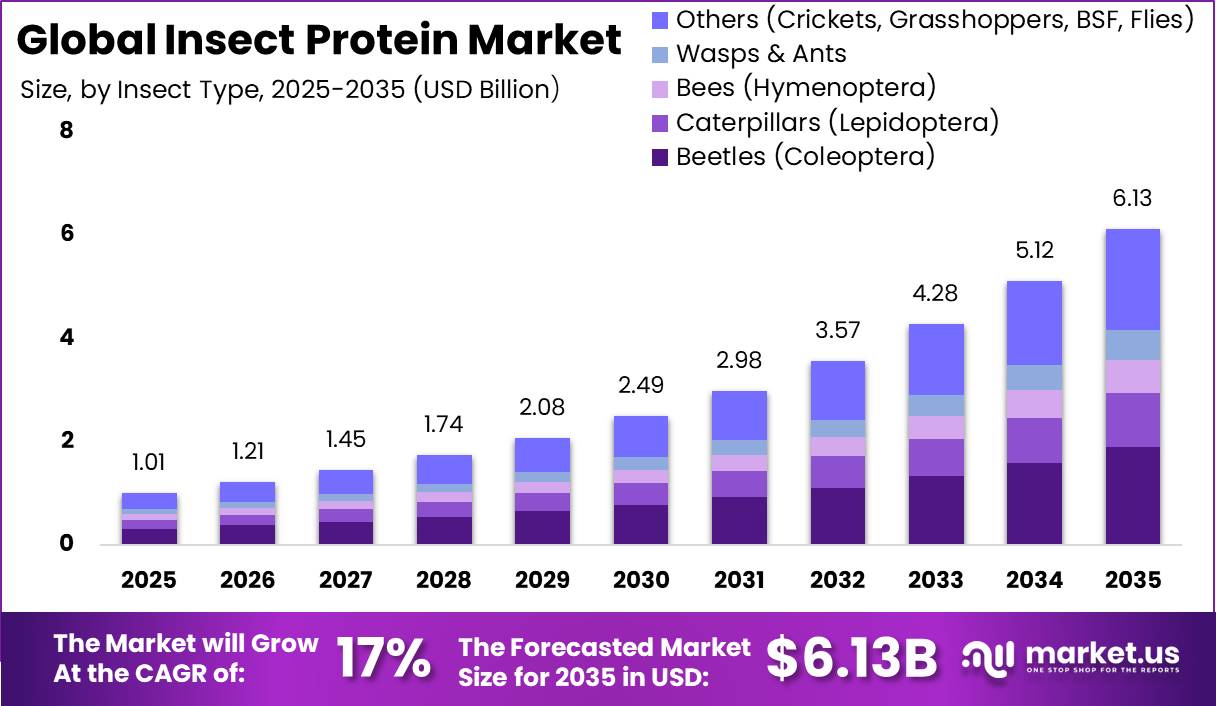
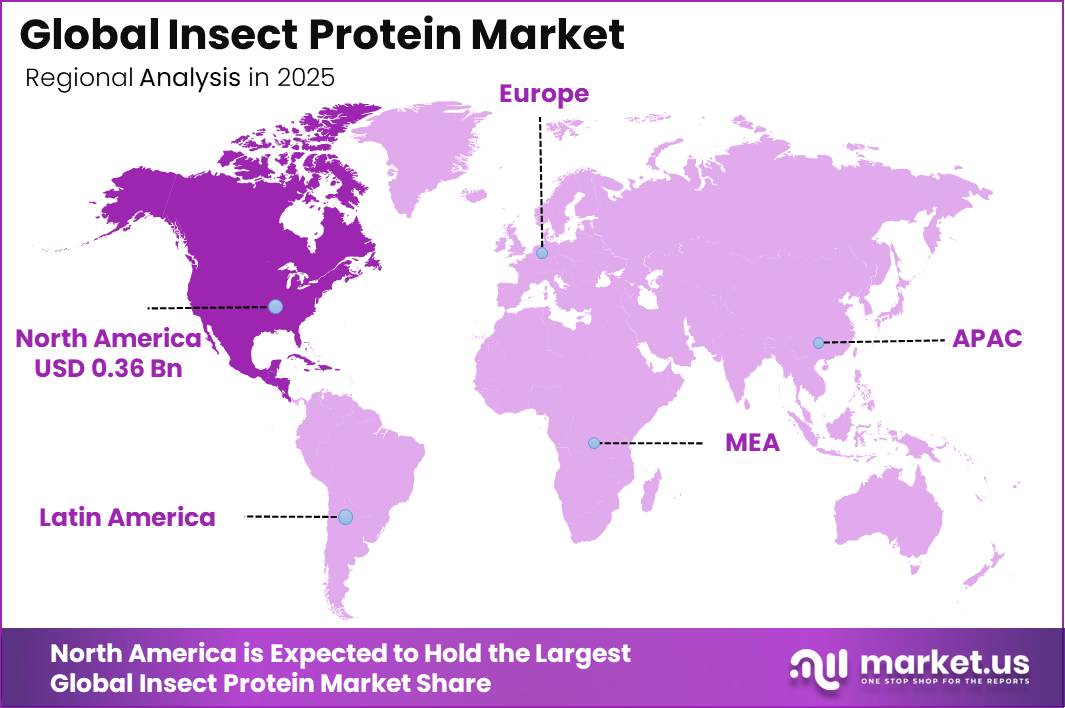
The Global Insect Protein Market was valued at approximately US$ 1.01 billion in 2025, and between 2026 and 2035, this market is estimated to register a CAGR of 17.0%, reaching nearly US$ 6.13 billion by 2035. North America held a dominant market position, capturing more than a 35.5% share, holding USD 0.36 billion in revenue.
The insect protein market comprises protein ingredients derived from insects such as beetles, caterpillars, bees, wasps, ants, crickets, and black soldier flies, which are increasingly being utilized in food products, animal nutrition formulations, and pharmaceutical applications. Insect protein offers several advantages, including high nutritional value, efficient feed conversion rates, and comparatively lower environmental footprints than traditional livestock production systems.
Activities related to production and commercialization are becoming more centralized in North America and Europe owing to higher investments in sustainable food technologies, favorable regulations, and greater awareness among consumers about alternative proteins. In the estimation of the United Nations, the world population is expected to touch 9.7 billion by the year 2050, thus placing immense stress on existing systems of food production, thereby adding impetus to the need for sustainable sources of protein.
From a policy perspective, UNIDO’s Member States adopted The Riyadh Declaration in November 2025, establishing a binding multilateral framework that calls for stronger cooperation between governments, businesses, and civil society to ensure industrialization advances greener economies and fair opportunities. UNIDO further notes that coordinated policy action could increase manufacturing value added in developing countries by approximately 60%
Key Takeaways
- The global insect protein market was valued at approximately US$ 1.01 billion in 2025.
- The global insect protein market is projected to grow at a CAGR of 17.0% and is estimated to reach nearly US$ 6.13 billion by 2035.
- On the basis of insect type, the Beetles (Coleoptera) segment dominated the market, constituting approximately 31.0% of the total market share.
- Based on form, the Whole Insect segment dominated the insect protein market, accounting for around 64.5% of the total market share.
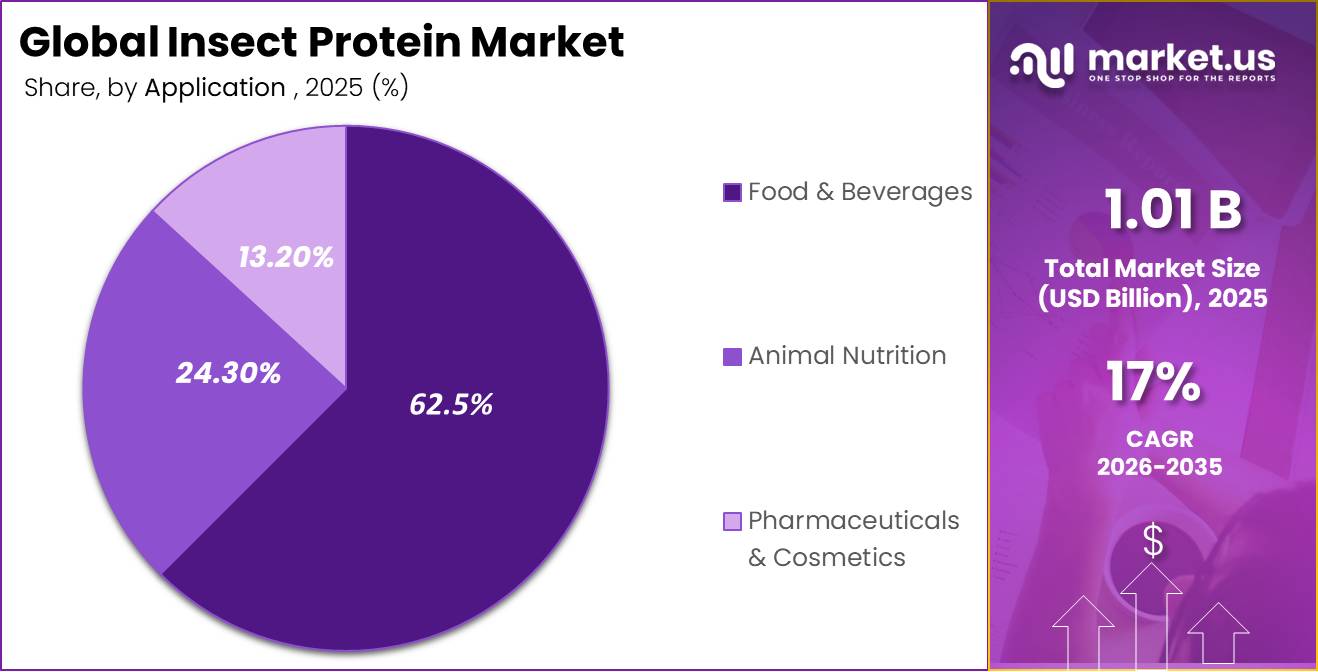
- Based on application, the Food & Beverages segment led the market, comprising approximately 62.5% of the total market share.
- In 2025, North America was the most dominant region in the insect protein market, accounting for approximately 35.5% of the total global market share.
Insect Type Analysis
Beetles (Coleoptera) Represent the Dominant Segment in the Insect Protein Market
Beetles (Coleoptera) are among the major contributors to the world’s insect protein industry, making up 31.0% of the industry because of the high protein levels they offer, short breeding periods, and their wide application in the production of both food and feed.
The escalating need for environmentally friendly alternative sources of protein, along with the commercial production of insect farms, is leading to a faster growth rate in the manufacture and consumption of beetle proteins on a global scale. There have been developments in the area of automation of insect farms, artificial breeding programs, as well as better efficiency levels regarding feed conversion, facilitating larger and more affordable manufacturing processes.
Form Analysis
Whole Insect Represents the Dominant Segment in the Insect Protein Market
Whole Insect is considered the key player among all the segments of the global insect protein market due to its extensive use for different purposes such as animal nutrition, fish feed, poultry feed, and pet food. The segment accounts for around 64.5% of total market shares due to the cost-effectiveness of whole insect and easy processing of whole insects into insect-based products that are rich in protein, lipids, vitamins, and minerals.
The global adoption of whole insect-based feed ingredients, like black soldier flies, mealworms, and crickets, is rapidly growing due to rising demand for sustainable alternatives and pressures on traditional protein sources. Their high feed conversion efficiency and cultivation from organic waste, along with increasing investments, enhance scalability in livestock and aquaculture.
Application Analysis
Food and Beverages Constitute the Leading Segment in the Insect Protein Market
The Food & Beverages segment is the largest among those forming the global insect protein market, taking up a huge share of around 62.5% of the total market. This is because there is a growing demand for nutritious and protein-based components used in food products. There is an increased application of insect proteins in bars, bakery items, snack items, pasta, sports nutrition, and other nutritional supplements.
The demand from consumers for alternative proteins and sustainable foods accounts for the rise in utilization of insect proteins globally. The issues around food security, along with the pressure exerted by livestock farms, are pushing firms to explore the production of insect proteins. Approvals in North America and Europe are enabling the process.
Key Market Segments
Insect Type
- Beetles (Coleoptera)
- Caterpillars (Lepidoptera)
- Bees (Hymenoptera)
- Wasps & Ants
- Others (Crickets, Grasshoppers, BSF, Flies)
By Form
- Whole Insect
- Powder
By Application
- Food & Beverages
- Animal Nutrition
- Pharmaceuticals & Cosmetics
Market Dynamics
Drivers
| Driver | (~) % Impact on CAGR | Geographic Relevance | Impact Timeline |
|---|---|---|---|
| Regulatory Unlocking of Feed Markets (EU & North America) | +4.5% | EU, United States, Canada | Short term (≤ 2 years) |
| Structural Fishmeal Supply Deficit in Aquaculture | +3.2% | Global — Asia-Pacific, Europe, Latin America | Short term (≤ 2 years) |
| Corporate ESG & Net-Zero Procurement Mandates | +2.8% | Europe, North America, Japan | Short term (≤ 2 years) |
| Automation-Driven Production Cost Reduction | +2.5% | EU, United States, Southeast Asia | Medium term (2–4 years) |
| Government Alternative Protein Programme Support | +2.0% | India, Singapore, Netherlands, Canada | Medium term (2–4 years) |
| Rising Consumer Protein Demand in Emerging Economies | +2.0% | India, Southeast Asia, Sub-Saharan Africa | Medium term (2–4 years) |
Regulatory Unlocking of Feed Markets (EU & North America)
The single most commercially consequential active driver is the sequential removal of statutory feed-use prohibitions in the two largest regulated protein markets globally. EU Regulation 2021/1372 opened processed insect proteins (PAPs) to poultry and pig rations effective September 2021, and a March 2025 extension broadened that authorization to cover aquaculture alongside both livestock species subject to mandatory traceability protocols, effectively clearing insect meal for use across the full EU animal nutrition value chain.
In the United States, the Association of American Feed Control Officials (AAFCO) finalized ingredient definitions for dried black soldier fly larvae in broiler, layer, and swine diets in August 2024 at inclusion rates up to 10% of complete feed, removing the final federal barrier following a two-year safety review that confirmed no mycotoxin accumulation or heavy metal bioconcentration.
The strategic commercial impact is a shift from spot-market price volatility toward revenue predictability sufficient to underpin the large-scale CapEx commitments industrial facilities running upward of several tens of millions of euros per site that are necessary to drive per-unit cost down toward price parity with fishmeal, currently benchmarked at USD 1,200 to USD 1,800 per metric ton.
Restraints
| Restraint | (~) % Impact on CAGR | Geographic Relevance | Impact Timeline |
|---|---|---|---|
| Persistent Price Premium Over Conventional Protein Sources | -3.5% | Global — most acute in Asia-Pacific & Latin America | Short term (≤ 2 years) |
| Consumer Psychological Rejection in Western Human-Food Segment | -2.8% | Western Europe, United States, Australia | Medium term (2–4 years) |
| Venture Capital & Growth Equity Contraction in Alternative Protein | -2.2% | Global — most acute for early-stage EU & US producers | Short term (≤ 2 years) |
| EU Novel Food Authorisation Bottleneck for Human Consumption | -1.8% | European Union | Short term (≤ 2 years) |
| Ruminant Feed Ban & Substrate Restriction Rules | -1.5% | European Union, United Kingdom | Long term (≥ 4 years) |
Persistent Price Premium Over Conventional Protein Sources
Insect protein meal currently trades at a 30% to 60% premium over soybean meal and a 10% to 25% premium over fishmeal on a per-ton protein-equivalent basis, making it structurally ineligible for cost-sensitive, high-volume feed rations in price-driven markets, the segments that constitute the overwhelming majority of global compound feed volume.
This premium is rooted in the capital structure of insect farming: a single commercial-scale facility carries annual operating costs between approximately USD 203,000 and USD 610,000 for a smaller unit, scaling non-linearly to hundreds of millions of euros for industrial sites, with energy, labor, and climate-controlled housing representing the three largest cost line items.
Although technological innovation has reduced production costs by an estimated 40% since 2020 through vertical farming layouts and automation, the breakeven cost trajectory still requires insect meal to reach the fishmeal price band of USD 1,200 to USD 1,800 per metric ton before mainstream aquaculture and poultry integrators operating on single-digit gross margins can justify inclusion beyond formulation trials.
Challenges
| Challenge | (~) % CAGR Friction Drag | Geographic Relevance | Mitigation Horizon |
|---|---|---|---|
| Allergen Detection & Labeling Gaps | -2.5% | EU, United States, Southeast Asia | Medium term (2–4 years) |
| Substrate Sourcing & Quality Inconsistency | -2.0% | Global — most acute in Sub-Saharan Africa & South Asia | Medium term (2–4 years) |
| Skilled Workforce & Technical Talent Deficit | -1.8% | Global — developing-market producers | Long term (≥ 4 years) |
| Geopolitical Tariff & Supply Chain Volatility | -1.5% | Global — US-China, EU trade corridors | Short term (≤ 2 years) |
| Energy Intensity of Climate-Controlled Rearing | -1.5% | Global — temperate and high-cost-energy markets | Long term (≥ 4 years) |
Allergen Detection & Labeling Gaps
Insect proteins share structural homology with shellfish and dust mite allergens, specifically tropomyosin, arginine kinase, larval cuticle proteins, and paramyosin, meaning sensitized individuals face cross-reactive immunoglobulin E (IgE)-mediated responses without any prior direct insect exposure. The operational severity of this challenge is compounded by two reinforcing failures.
Survey data indicate that approximately 50% of commercial insect-containing products either contain unlisted species or omit required allergen warnings, despite EU Novel Food Regulation mandating both Latin and common-name species disclosure alongside explicit crustacean and dust mite cross-reactivity statements.
Current detection methodologies rely on bioinformatics amino acid identity thresholds of greater than 35% across at least 80 amino acids, pepsin-resistance assays, and ELISA immunoblotting, none of which has been standardized across jurisdictions for insect protein matrices as of the grounding window.
Opportunities
| Opportunity | (~) % Potential CAGR | Geographic Relevance | Execution Window |
|---|---|---|---|
| Integrated Circular Bioconversion & Waste-to-Protein Platforms | +3.8% | EU, Southeast Asia, Sub-Saharan Africa | Medium term (2–4 years) |
| Premium Insect-Based Pet & Companion Animal Nutrition | +2.5% | North America, Western Europe, Japan | Short term (≤ 2 years) |
| Chitin-Derived Nutraceutical & Pharmaceutical Inputs | +2.0% | United States, EU, South Korea, Japan | Long term (≥ 4 years) |
| Contract Manufacturing for Novel Food Ingredient Brands | +1.8% | EU, United States, Singapore | Medium term (2–4 years) |
| South & Southeast Asia Aquaculture Feed Localisation | +2.2% | India, Vietnam, Indonesia, Bangladesh | Medium term (2–4 years) |
Integrated Circular Bioconversion & Waste-to-Protein Platforms
This opportunity is explicitly future and untapped rather than a current driver: while insect bioconversion of organic waste is technically established, the monetization architecture that captures value from both the protein output and the waste-processing service charges municipal, agri-food, and food manufacturing clients a gate fee or tipping fee for organic waste intake.
Insect bioconversion platforms can convert up to 90% of food-waste biomass into protein-rich larvae and nutrient-dense frass, and life cycle assessments confirm that insect protein production generates approximately 75% fewer greenhouse gas emissions than conventional fishmeal production, qualifying integrated waste-to-protein operations for EU Emissions Trading System credits when co-located with registered waste management infrastructure.
Geopolitical Impact Analysis
Current Worldwide Conflicts and Supply Chain Interruptions Impacting the Insect Protein Industry
The geopolitical problems, such as the Russia-Ukraine conflict, which is still going on, as well as rising conflicts between different economies in terms of trade, have affected the worldwide insect protein industry because of supply chain management problems, high costs of energy, and lack of food security. The geopolitical situation in the world has led to volatility in the markets of grains, soy, and fish meal.
- In February 2022, the Food and Agriculture Organization (FAO) and the United Nations indicated that the conflict between Russia and Ukraine has greatly disturbed global agricultural commodity markets, especially grain and feed supply chains, heightening worries about long-term food security and the availability of sustainable protein.
Also, the state of war has led to higher costs of transportation, fuel, and operation in the food processing and agricultural sectors worldwide. With the fact that industrial insect farming requires climate control, automated breeding technology, and feed substrates, it is apparent that there are higher costs of energy and logistics for some companies in this field.
Regional Analysis
North America Held the Largest Share of the Global Insect Protein Market
North America dominated the global market for insect protein, accounting for about 35.5% of the total market share in 2025. North America dominates the regional market as a result of rising investment in innovative technologies of protein production, rising consumer awareness about sustainable nutrition practices, and use of insect proteins in food and pet food.
Rising advancements in food technology infrastructure, rising support from startups, and growing commercialization efforts of insect protein producers in the region drive growth of the regional market. Furthermore, rising demand for sustainable pet food and aquaculture feed is propelling growth in the US and Canada.
In Europe, the insect protein market had a share of roughly 28.4% of the total insect protein market worldwide, supported by regulatory policies, sustainability initiatives, and the principles of the circular economy.
Key Regions and Countries Covered in this Report
- North America
- The US
- Canada
- Europe
- Germany
- France
- The UK
- Spain
- Italy
- Russia & CIS
- Rest of Europe
- APAC
- China
- Japan
- South Korea
- India
- ASEAN
- Rest of APAC
- Latin America
- Brazil
- Mexico
- Rest of Latin America
- Middle East & Africa
- GCC
- South Africa
- Rest of MEA
Key Players Analysis
There is an evident mid-level fragmentation of the worldwide insect protein market that exists owing to the existence of several new biotech companies, sustainable food businesses, and large-scale insect farms competing with one another on the basis of their manufacturing capability, farming technology, quality of protein, sustainability practices, and product diversification.
There has been a growing emphasis on developing more efficient farming techniques, optimizing feed efficiency, improving protein extraction technology, and forming strategic collaborations by market players. Insects are becoming increasingly popular for protein products due to partnerships between the producers of insect proteins, food producers, aquaculture companies, and pet food companies that aim at commercializing their products in the market.
The increasing number of regulatory approvals of insects as edible components, sustainability-driven innovation within the food sector, and demand for environmentally friendly protein solutions will lead to intense competition in the coming years.
Major Players in the Industry
- Ÿnsect SAS
- InnovaFeed SAS
- Protix B.V.
- AgriProtein (Insect Technology Group)
- Enterra Feed Corporation
- EnviroFlight LLC
- Aspire Food Group
- Entomo Farms
- Nutrition Technologies
- Hexafly
- Beta Hatch Inc.
- Hargol FoodTech
- Haocheng Mealworms Inc.
- JR Unique Foods Ltd.
- Global Bugs Asia Co. Ltd.
Key Development
- In February 2025, Ÿnsect SAS announced the expansion of its industrial-scale insect protein production capabilities to strengthen sustainable protein supply for aquaculture, pet food, and agricultural applications across Europe and North America.
- In September 2024, InnovaFeed SAS expanded its strategic partnerships with animal nutrition and aquaculture companies to accelerate commercialization of black soldier fly-based protein ingredients for sustainable feed applications.
- In June 2024, Protix B.V. increased investments in automated insect farming technologies and circular economy production systems to enhance production efficiency and support growing global demand for alternative protein solutions.
Report Scope
| Report Features | Description |
|---|---|
| Market Value (2025) | USD 1.01 Bn |
| Forecast Revenue (2035) | USD 6.13 Bn |
| CAGR (2026-2035) | 17.0% |
| Base Year for Estimation | 2025 |
| Historic Period | 2020-2024 |
| Forecast Period | 2026-2035 |
| Report Coverage | Revenue Forecast, Market Dynamics, Competitive Landscape, Recent Developments |
| Segments Covered | By Insect Type (Beetles (Coleoptera), Caterpillars (Lepidoptera), Bees (Hymenoptera), Wasps & Ants, and Others (Crickets, Grasshoppers, BSF, Flies)), By Form (Whole Insect and Powder), By Application (Food & Beverages, Animal Nutrition, Pharmaceuticals & Cosmetics) |
| Regional Analysis | North America – The US & Canada; Europe – Germany, France, The UK, Spain, Italy, Russia & CIS, Rest of Europe; APAC- China, Japan, South Korea, India, ASEAN & Rest of APAC; Latin America- Brazil, Mexico & Rest of Latin America; Middle East & Africa- GCC, South Africa, & Rest of MEA |
| Competitive Landscape | Ÿnsect SAS, InnovaFeed SAS, Protix B.V., AgriProtein (Insect Technology Group), Enterra Feed Corporation, EnviroFlight LLC, Aspire Food Group, Entomo Farms, Nutrition Technologies, Hexafly, Beta Hatch Inc., Hargol FoodTech, Haocheng Mealworms Inc., JR Unique Foods Ltd., Global Bugs Asia Co. Ltd. |
| Customization Scope | Customization for segments and region/country-level will be provided. Moreover, additional customization can be done based on the requirements. |
| Purchase Options | We have three licenses to opt for: Single User License, Multi-User License (Up to 5 Users), Corporate Use License (Unlimited Users and Printable PDF) |





































