


Report Overview
In 2025, the US Meat Slicer Market was valued at USD 344.0 million, and between 2026 and 2035, this market is estimated to register a CAGR of 5.9%, reaching about USD 602.7 million by 2035.
The U.S. meat slicer market is shaped by strong demand from commercial food service establishments, supported by growing emphasis on operational efficiency, portion control, and food safety compliance. Commercial users such as restaurants, delis, and HoReCa operators represent the dominant end-user base due to high-volume processing needs and consistent utilization requirements. Product adoption is increasingly skewed toward larger blade sizes, particularly above 12 inches, reflecting a preference for higher cutting capacity and improved throughput.
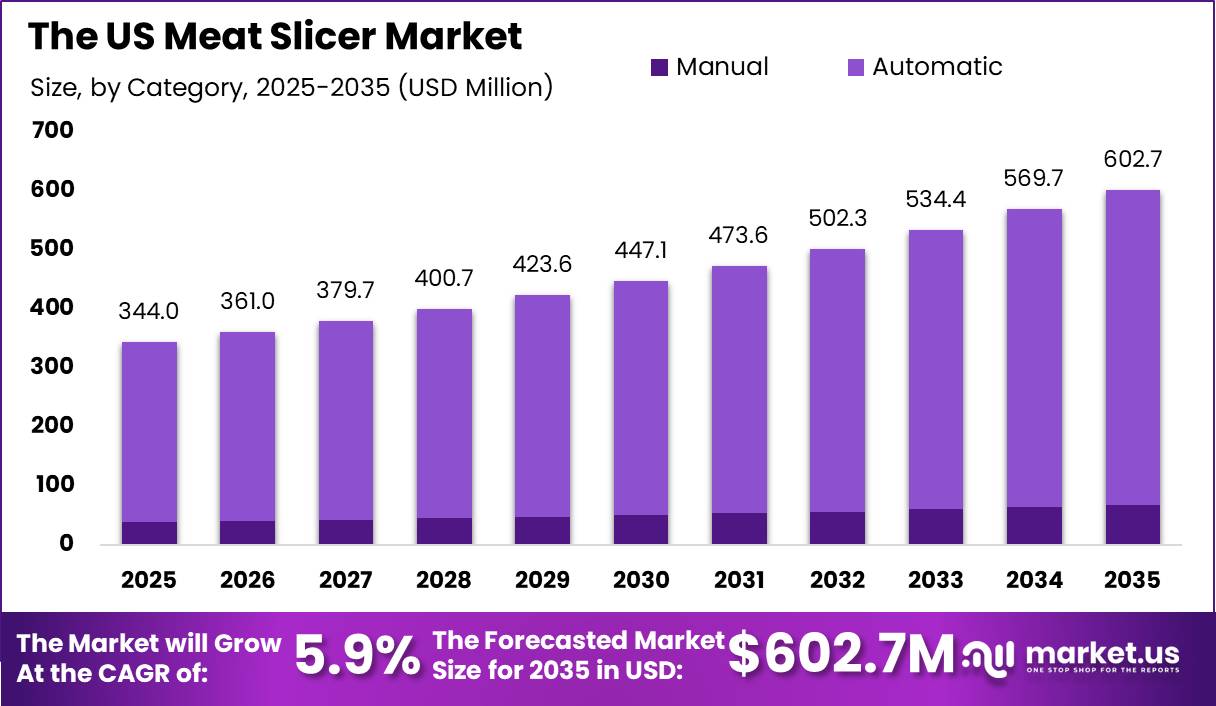
The market is further characterized by a strong shift toward automated solutions, with automatic slicers accounting for the overwhelming majority of usage, driven by productivity gains and reduced manual effort. Distribution is highly concentrated through direct sales channels, enabling manufacturers to offer customized solutions and technical support.
Key market dynamics include rising demand for precision slicing to minimize food waste, increasing integration of smart and energy-efficient technologies, and expansion into residential and premium kitchen segments. However, high upfront costs and ongoing maintenance requirements continue to restrain wider adoption, particularly among smaller operators.
Key Takeaways
- The US meat slicer market was valued at USD 344.0 million in 2025.
- The US meat slicer market is projected to grow at a CAGR of 5.9% and is estimated to reach USD 602.7 million by 2035.
- On the basis of category, automatic meat slicers dominated the market, constituting 88.8% of the total market share.
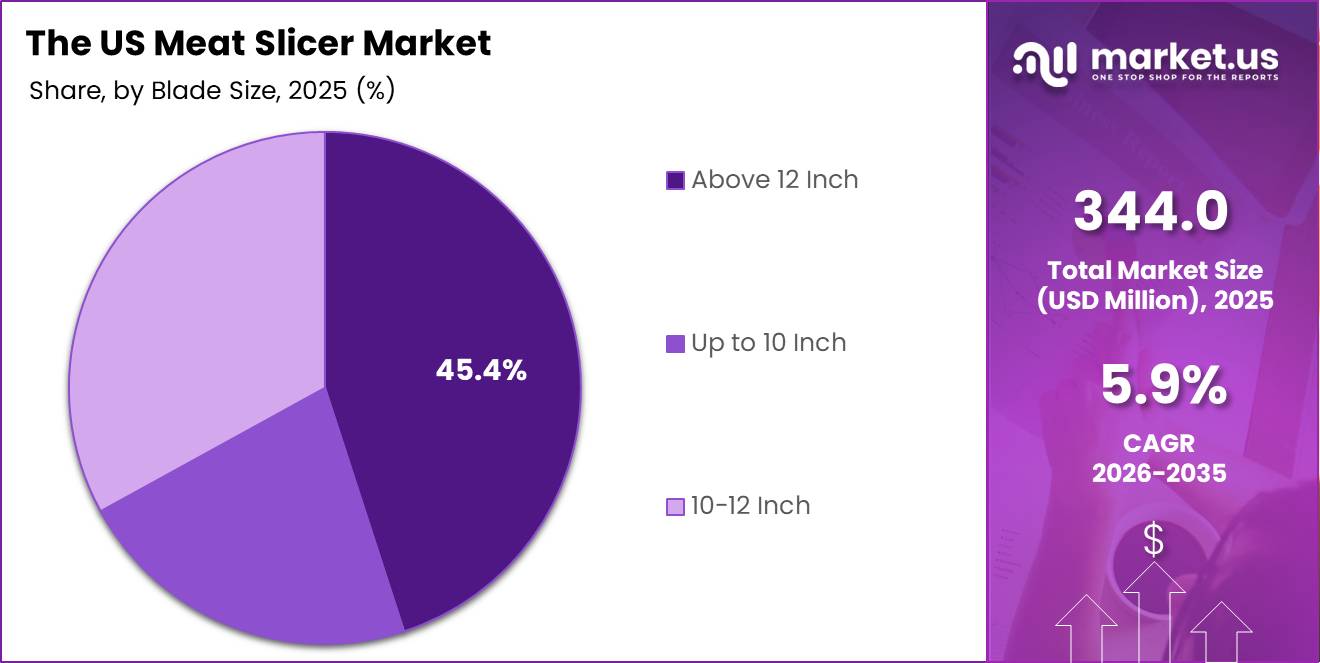
- Based on the blade size, above 12-inch meat slicers led the market, comprising 45.4% of the total market.
- Among the end-users of meat slicers, commercial users held a major share of the market, accounting for around 58.2% of the revenue.
Category Analysis
Automatic Meat Slicers Are a Prominent Segment in the Market.
The automatic segment constitutes the dominant share of the overall distribution, accounting for 88.8% of the total. This significant proportion highlights a strong preference for automation, driven by its efficiency, consistency, and ability to handle high volumes with minimal human intervention. The widespread adoption of automatic processes suggests that organizations are prioritizing speed, scalability, and cost optimization in their operations.
Furthermore, the dominance of the automatic segment may reflect advancements in technology, improved system reliability, and increased confidence in automated solutions. It indicates a shift away from manual methods, which, at 11.2%, represent a comparatively small portion and may be limited to tasks requiring human judgment, customization, or oversight. The strong presence of the automatic segment underscores its critical role in enhancing productivity and operational effectiveness, positioning it as the key driver within the category.
Blade Size Analysis
Above 12-Inch Meat Slicers Dominated the Market.
The above 12-inch blade size segment emerges as the dominant category, accounting for 45.4% of the overall share. This leadership position reflects a strong market preference for larger blade sizes, primarily driven by their superior cutting capacity, efficiency, and suitability for heavy-duty applications. Blades above 12 inches are typically favored in industrial and commercial settings where precision, speed, and the ability to handle larger materials are critical.
The segment’s prominence further indicates a shift toward high-performance tools that enhance productivity and reduce operational time. Compared to smaller blade categories, this segment offers greater versatility for demanding tasks, reinforcing its widespread adoption. The dominance of the above 12-inch segment underscores its importance as a key contributor to performance-driven usage.
End-User Analysis
Commercial Users Held a Major Share of the Meat Slicer Market.
The commercial segment dominates the end-user category, accounting for 58.2% of the overall share. This strong presence is driven by extensive demand from establishments such as HoReCa, delis, and butcher shops, where consistent performance, efficiency, and high throughput are essential. Commercial users typically require reliable and durable equipment capable of handling continuous operations, which significantly contributes to the segment’s leading position.
The prominence of this segment further reflects the growing food service industry and increasing consumer demand for processed and ready-to-serve products. Compared to residential and industrial applications, the commercial segment benefits from higher usage frequency and operational scale. Its dominance underscores its critical role in driving market demand and sustaining growth across the category.
Distribution Channel Analysis
Meat Slicers Are Mostly Sold Through Direct Sales.
The direct sales segment dominates the distribution channel landscape, accounting for 83.8% of the total share. This substantial lead highlights a strong preference for direct engagement between manufacturers and end-users, enabling better control over pricing, product customization, and after-sales service. Direct sales channels facilitate stronger customer relationships, allowing companies to better understand client requirements and deliver tailored solutions.
Additionally, this approach enhances transparency and ensures consistent brand positioning, which is particularly important for high-value or specialized products. The dominance of direct sales reflects the need for technical support and personalized consultation during the purchasing process. The segment’s leading position underscores its effectiveness in driving customer satisfaction, loyalty, and sustained business growth.
Key Market Segments
By Category
- Manual
- Automatic
- Single-Blade
- Multi-Blade
By Blade Size
- Up to 10 Inches
- 10-12 Inch
- Above 12 Inch
By End-User
- Commercial
- HoReCa
- Manual
- Automatic
- Delis & Butcher Shops
- Manual
- Automatic
- Others
- Manual
- Automatic
- Residential
- Manual
- Automatic
- Industrial
- HoReCa
By Distribution Channel
- Direct Sales
- Indirect Sales
- Online Sales
- Company Websites
- E-commerce Platforms
- Offline Sales
- Supermarkets & Hypermarkets
- Specialty Stores
- Others
Drivers
Rising Demand for Precision and Efficiency in Food Service Drives the US Meat Slicer Market.
Operational inefficiencies and waste reduction imperatives are materially driving demand for precision-oriented equipment in the U.S. food service sector. The United States Department of Agriculture estimates that 30-40% of the U.S. food supply is lost or wasted, equivalent to approximately 133 billion pounds annually at retail and consumer levels. This scale of loss has led to formal federal targets, including a 50% reduction in food waste by 2030, reinforcing operational accountability across food handling environments.
Within commercial food service, where high-throughput preparation is routine, minimizing trimming loss and ensuring consistent portion sizes are directly aligned with these policy objectives. Precision slicing reduces variability in portion weight and improves yield from raw meat inputs, supporting waste minimization. Concurrently, federal inspection activity, covering 7,100 establishments and billions of meat and poultry units annually, underscores the scale and standardization pressures in regulated food processing environments. The waste levels and regulatory oversight create a measurable incentive for adopting efficient, precision-driven slicing technologies.
Restraints
High Initial Investment and Maintenance Costs May Limit Market Adoption.
High upfront and lifecycle costs present a measurable constraint on meat slicer adoption, particularly among small and mid-scale food service operators. Equipment acquisition alone spans a wide range, with commercial-grade slicers typically priced high, alongside additional expenditures for blades, safety equipment, and dedicated workstations. These costs are compounded by recurring maintenance requirements, including professional servicing every 3-6 months, as well as periodic replacement of components such as belts and bearings.
Additionally, regulatory sanitation standards further intensify cost pressures. The U.S. Food and Drug Administration emphasizes that slicers must be regularly cleaned and maintained to prevent contamination, with failure linked to foodborne illness outbreaks and mandatory equipment downtime. Similarly, federal guidance requires that all food-contact surfaces be cleaned and sanitized as frequently as necessary, increasing labor and material costs. These capital, compliance, and maintenance burdens elevate the total cost of ownership, constraining broader adoption despite operational benefits.
Opportunity
Growing Demand from Home and Premium Kitchen Segments Enhances Market Potential
Rising household engagement in meal preparation is expanding the addressable base for compact and premium-grade meat slicers in the United States. According to the U.S. Energy Information Administration, 79% of households prepared at least one hot meal daily in 2020, indicating sustained, routine kitchen utilization. This is reinforced by nationally representative health survey data (NHANES), which report that Americans cook an average of five dinners per week, with 49% preparing meals 6-7 times weekly.
Similarly, consumer behavior shows a strong preference for self-prepared meals over ready-made options, alongside prioritization of flavor and preparation control. These patterns support incremental demand for specialized kitchen tools that enable consistency and customization, including slicing equipment for deli meats, charcuterie, and portion control.
The convergence of high-frequency home cooking and preference for self-preparation creates a structurally favorable environment for household adoption of smaller, user-oriented meat slicers, particularly in premium kitchen setups emphasizing control, quality, and repeatability.
Trends
Integration of Smart and Energy-Efficient Technologies.
The U.S. meat slicer market is increasingly characterized by the adoption of smart, connected, and energy-efficient technologies aimed at improving operational precision and resource efficiency. Industry developments indicate growing incorporation of IoT-enabled monitoring systems, predictive maintenance functions, and digital control interfaces that allow operators to track performance metrics and optimize slicing parameters in real time. These systems support reduced downtime and improved consistency in high-volume food service environments, where efficiency and hygiene compliance are critical.
Energy efficiency has further emerged as a parallel design priority, with manufacturers introducing energy-saving motors, optimized blade systems, and low-power idle modes to reduce electricity consumption without compromising cutting performance. This aligns with broader sustainability-driven procurement behavior across food service operations, where equipment selection increasingly considers lifecycle energy use.
Additionally, advanced slicers integrate programmable thickness settings, touch-based digital controls, and self-monitoring maintenance alerts, enhancing repeatability and reducing operator dependency. These innovations reflect a structural shift toward intelligent kitchen equipment that combines productivity enhancement with operational sustainability in commercial food preparation systems.
Geopolitical Impact Analysis
Geopolitical Frictions and Supply Chain Realignment Pressures in the U.S. Meat Slicer Market.
Escalating geopolitical tensions, particularly U.S.-China trade frictions and broader tariff realignments, are exerting cost and supply-side pressures on the meat slicer market through upstream manufacturing dependencies. U.S. tariff adjustments, including broad-based import duties reaching elevated levels across multiple trading partners, have increased input costs for industrial machinery that relies on imported stainless steel, aluminum, and precision-engineered components. Average U.S. tariff rates have risen significantly from pre-tension baselines, contributing to higher landed costs for manufactured goods and intermediate inputs.
Steel and metal tariffs, including elevated duties on key industrial materials, have particularly affected fabrication-intensive equipment categories. Given that meat slicers depend on corrosion-resistant steel blades and housings, price volatility in global steel markets directly translates to production costs and procurement planning uncertainty.
Simultaneously, supply chain reconfiguration toward China-plus-one sourcing and nearshoring strategies has created temporary component shortages and extended lead times for precision motors and electronic control systems used in advanced slicers.
In the downstream food service sector, these disruptions coincide with regulatory and operational demand for consistent equipment availability, amplifying inventory buffering and procurement cycle extensions among U.S. commercial kitchens. The geopolitical tensions are reshaping cost structures, sourcing geography, and supply reliability across the meat slicer value chain without direct demand stimulation.
Key Players Analysis
Manufacturers in the U.S. meat slicer market put emphasis on continuous product innovation, including the development of automated, semi-automated, and IoT-enabled slicers that enhance precision, safety, and operational efficiency. Companies further invest in energy-efficient and durable designs to align with commercial kitchen requirements for lower operating costs and longer equipment lifecycles.
Another important strategy is after-sales service and maintenance support, where firms offer installation, training, spare parts availability, and rapid servicing to build long-term customer relationships. Manufacturers additionally pursue distribution expansion through B2B channels, partnering with food service chains, retailers, and equipment distributors to improve market penetration.
The Major Players in The Industry
- Illinois Tool Works Inc
- The Middleby Corporation
- Van Berkel International S.r.l.
- Univex Corporation
- The Vollrath Co., L.L.C.
- GEA Group Aktiengesellschaft
- JBT Marel Corporation
- Skyfood Equipment LLC.
- Grasselli S.p.A.
- KitchenWare Station LLC
- Bizerba SE & Co. KG
- Ross Industries, Inc.
- Biro Manufacturing Company
- Sirman S.p.A.
- Multivac
- Other Key Players
Key Developments
- In October 2025, Multivac launched a Compact Series targeted at start-up and scaling businesses, featuring machines for packaging, processing, and slicing. A key part of the range is the S 300 Slicer, designed as a compact, cost-effective solution for slicing food products.
Report Scope
| Report Features | Description |
|---|---|
| Market Value (2025) | US$344.0 Mn |
| Forecast Revenue (2035) | US$602.7 Mn |
| CAGR (2026-2035) | 5.9% |
| Base Year for Estimation | 2025 |
| Historic Period | 2020-2024 |
| Forecast Period | 2026-2035 |
| Report Coverage | Revenue Forecast, Market Dynamics, Competitive Landscape, Recent Developments |
| Segments Covered | By Category (Manual and Automatic), By Blade Size (Up to 10 Inch, 10-12 Inch, and Above 12 Inch), By End-User (Commercial, Residential, and Industrial), By Distribution Channel (Direct Sales and Indirect Sales) |
| Competitive Landscape | Illinois Tool Works Inc., The Middleby Corporation, Van Berkel International S.r.l., Univex Corporation, The Vollrath Co., L.L.C., GEA Group Aktiengesellschaft, JBT Marel Corporation, Skyfood Equipment LLC., Grasselli S.p.A., KitchenWare Station LLC, Bizerba SE & Co. KG, Ross Industries, Inc., Biro Manufacturing Company, Sirman S.p.A., and Other Players. |
| Customization Scope | Customization for segments, region/country-level will be provided. Moreover, additional customization can be done based on the requirements. |
| Purchase Options | We have three licenses to opt for: Single User License, Multi-User License (Up to 5 Users), Corporate Use License (Unlimited Users and Printable PDF) |





































