


Report Overview
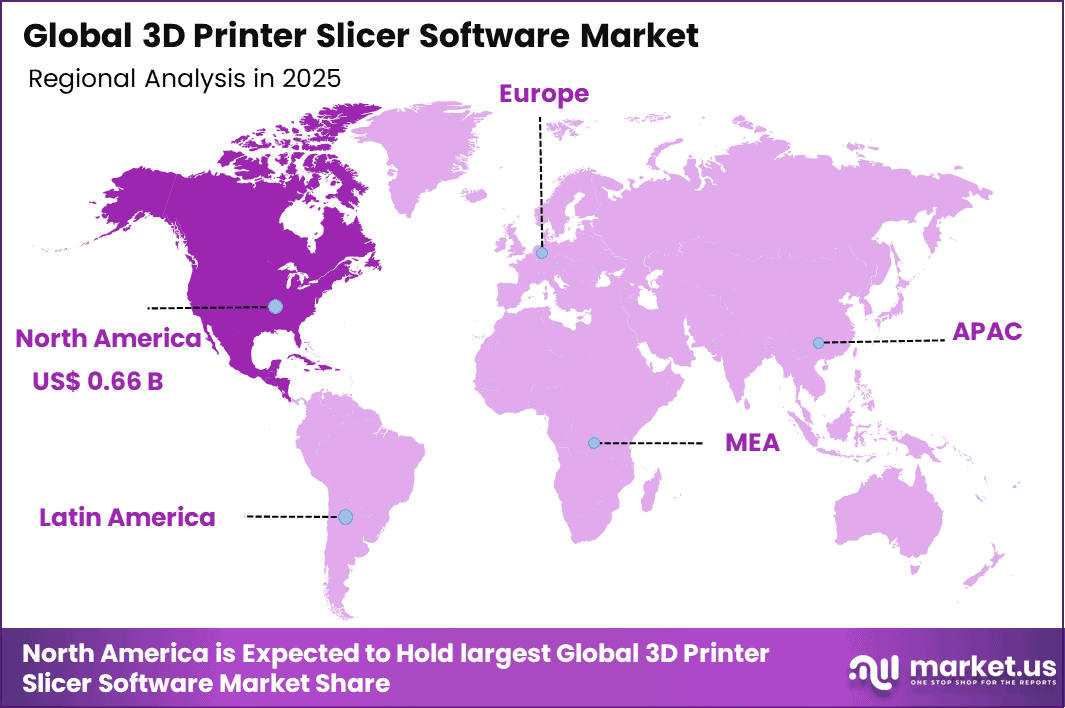
The Global 3D Printer Slicer Software Market generated USD 1.8 billion in 2025 and is predicted to register growth from USD 2.2 billion in 2026 to about USD 10.8 billion by 2035, recording a CAGR of 19.40% throughout the forecast span. In 2025, North America held a dominant market position, capturing more than a 36.6% share, holding USD 0.66 Billion revenue.
Top Market Takeaways
- Software commands 65.8% market share, delivering layer-by-layer toolpath generation, support structure optimization, and print simulation for complex geometries.
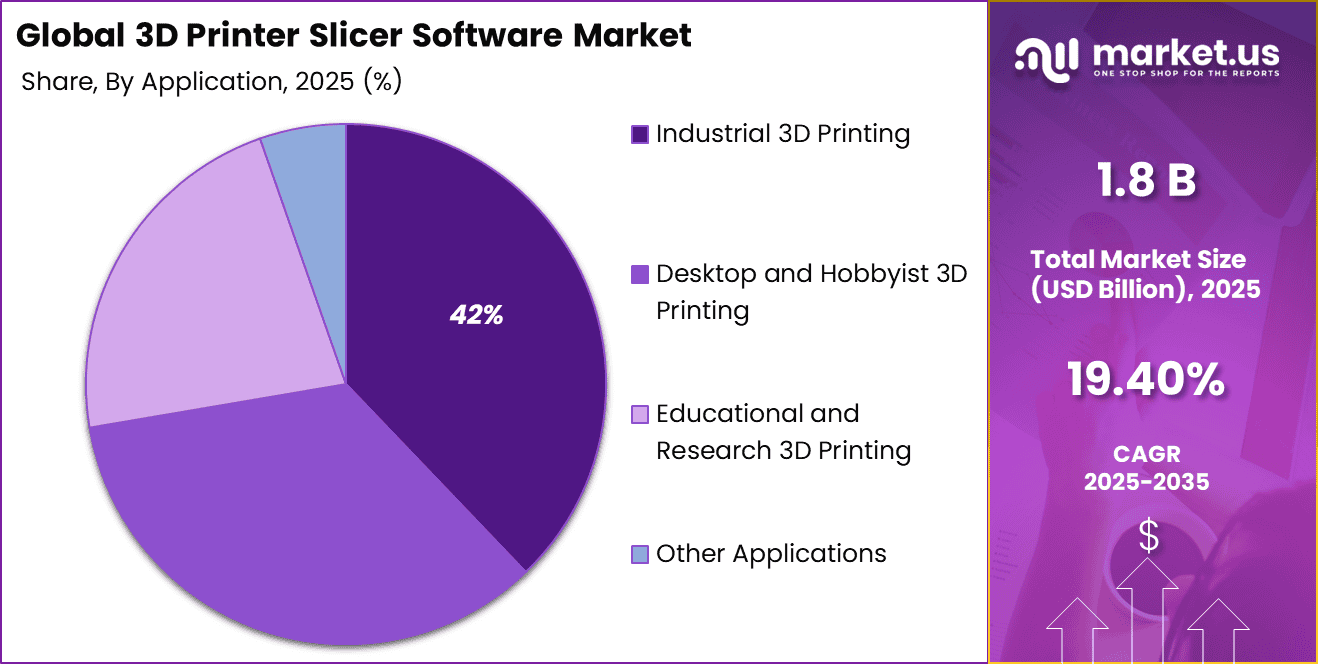
- Industrial 3D printing applications capture 42.4%, enabling production-grade metal and polymer parts with automated nesting, infill patterns, and multi-material support.
- Aerospace and defense end-users hold 30.5%, leveraging slicers for lightweight lattice structures, conformal cooling channels, and flight-certified component certification.
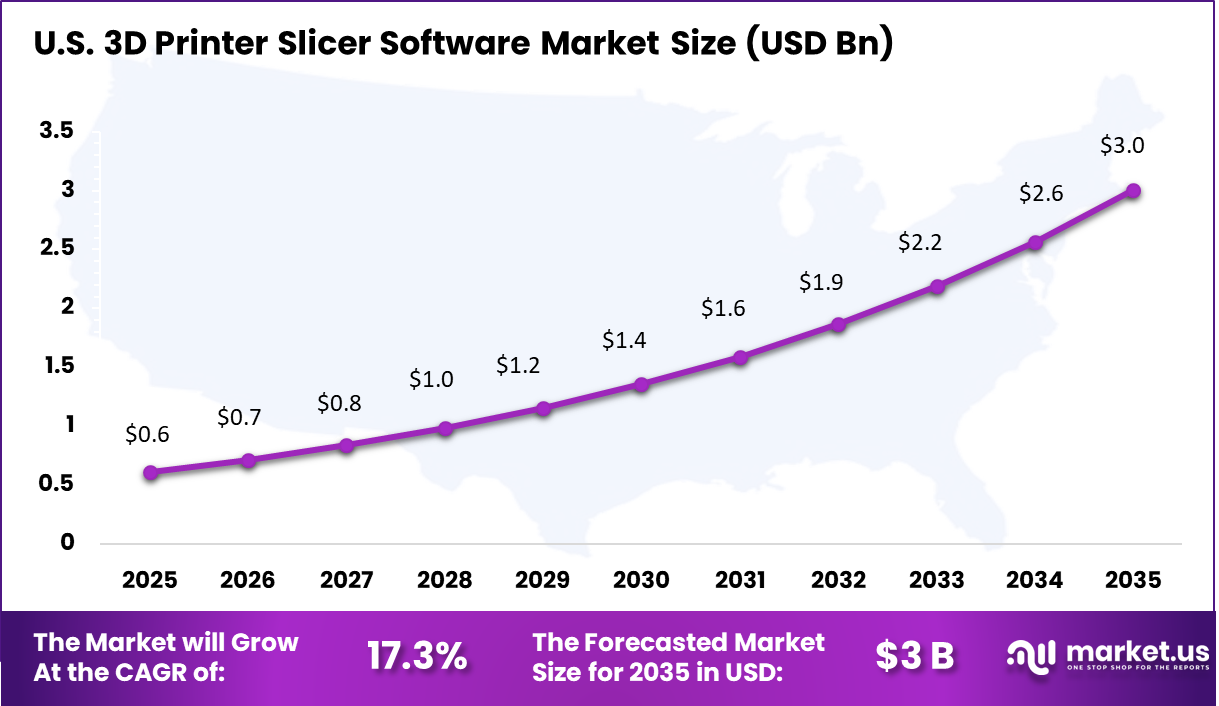
- North America drives 36.6% global value, with U.S. market at USD 0.61 billion and 17.3% CAGR, fueled by DoD additive manufacturing initiatives and commercial aerospace recovery.
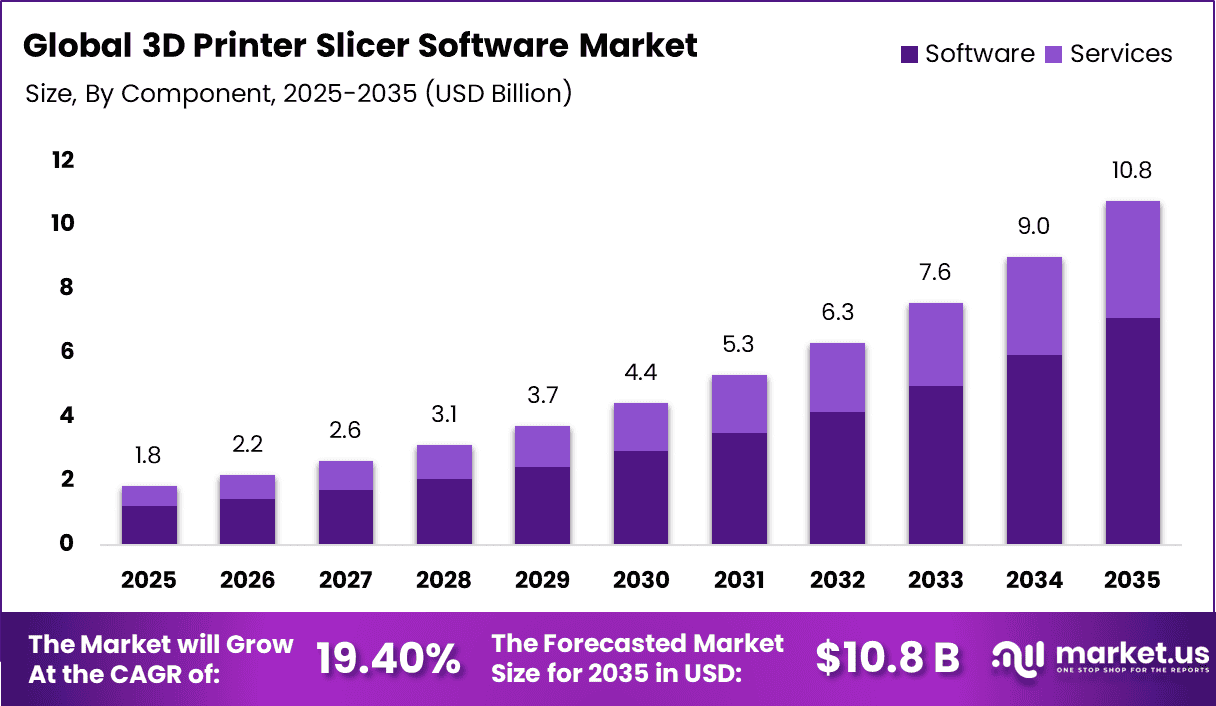
3D printer slicer software is a key tool in the additive manufacturing process, used to convert digital 3D models into instructions that a printer can follow. It breaks down a design into thin layers and defines how each layer should be printed, including parameters such as speed, temperature, and material flow.
This software acts as a bridge between design and production, making it essential for achieving accurate and high quality prints. As 3D printing expands across industries such as manufacturing, healthcare, and education, slicer software is becoming more advanced and easier to use, supporting both beginners and professional users.
One of the main driving factors is the growing adoption of 3D printing for rapid prototyping and small scale production. Companies are using this technology to shorten product development cycles and reduce dependency on traditional manufacturing methods. Slicer software plays a critical role in improving print quality and reducing material waste, which makes it an important focus area for users.
In addition, advancements in printing materials and multi material capabilities are increasing the need for software that can handle complex designs and optimize printing settings. The rise of desktop 3D printers and wider access to design tools is also encouraging more users to adopt slicer software.
Demand for 3D printer slicer software is increasing as users seek better control over their printing processes. There is a strong preference for software that offers customization, allowing users to fine tune settings based on their specific requirements. Ease of use is also important, especially for new users who want simple interfaces and guided workflows.
At the same time, professional users are looking for advanced features such as simulation, error detection, and integration with design platforms. The demand is growing across industries that rely on precise and efficient production, and as 3D printing continues to evolve, the need for reliable and user friendly slicing solutions is expected to rise steadily.
Drivers Impact Analysis
| Key Driver | Impact on CAGR Forecast (~%) | Geographic Relevance | Impact Timeline | Additional Insight |
|---|---|---|---|---|
| Rising adoption of 3D printing across industries | +4.6% | North America, Europe, Asia Pacific | Medium to long term | Industrial demand boosts slicer usage |
| Increasing demand for customized and rapid prototyping | +4.2% | Global | Medium term | Custom designs require advanced slicing tools |
| Growth in additive manufacturing technologies | +3.8% | Global | Medium to long term | Expanding applications support software demand |
| Advancements in multi-material and multi-color printing | +3.3% | Developed markets | Medium term | Complex prints need advanced slicing capabilities |
| Increasing use in education and small-scale manufacturing | +2.9% | Global | Short to medium term | Wider adoption expands user base |
Restraints Impact Analysis
| Key Restraint | Impact on CAGR Forecast (~%) | Geographic Relevance | Impact Timeline | Additional Insight |
|---|---|---|---|---|
| High learning curve for advanced slicer software | -2.8% | Global | Short to medium term | Complexity limits new user adoption |
| Compatibility issues across different 3D printers | -2.4% | Global | Medium term | Lack of standardization creates challenges |
| Limited awareness in emerging markets | -2.1% | Developing regions | Medium term | Adoption remains slower |
| Performance limitations in low-end hardware systems | -1.7% | Global | Medium term | Hardware constraints affect usability |
| Dependence on continuous software updates and support | -1.5% | Global | Long term | Maintenance requirements increase burden |
By Component Analysis
The software segment accounted for 65.8% of the market share, reflecting its central role in converting digital models into printable instructions for 3D printers. This dominance is supported by the need for precise slicing, layer optimization, and print path generation to ensure high-quality output. Software solutions enable users to control parameters such as speed, temperature, and material usage, which directly impact printing accuracy and efficiency.
Another factor driving this segment is the increasing complexity of 3D designs used across industries. Advanced slicer software offers simulation, error detection, and customization features that improve print success rates. The ability to integrate with different printer types and materials further strengthens its importance in modern 3D printing workflows.
By Application Analysis
The industrial 3D printing segment held 42% share, driven by the growing use of additive manufacturing in production environments. Industries are adopting 3D printing for prototyping, tooling, and end-use parts, which requires reliable slicing software to manage complex designs. These applications demand high precision and consistency, making advanced slicing solutions essential.
In addition, the shift toward digital manufacturing and on-demand production has increased the need for efficient print preparation tools. Slicer software helps optimize material usage and reduce production time, supporting cost-effective operations. This has encouraged wider adoption in industrial settings where performance and accuracy are critical.
By End-User Analysis
The aerospace and defense segment captured 30.5% of the market, driven by the need for lightweight, high-performance components produced through advanced manufacturing methods. Organizations in this sector rely on 3D printing to create complex geometries that are difficult to achieve with traditional techniques. Slicer software plays a key role in ensuring precision and structural integrity of printed parts.
Furthermore, strict quality and safety standards in aerospace and defense require highly reliable production processes. Advanced slicing tools help maintain consistency and reduce the risk of defects during printing. This supports the adoption of 3D printing technologies and strengthens the demand for specialized slicer software in this segment.
Investor Type Impact Analysis
| Investor Type | Growth Sensitivity | Risk Exposure | Geographic Focus | Investment Outlook |
|---|---|---|---|---|
| Venture capital firms | High | High | US, Europe | Investing in 3D printing software startups |
| Private equity firms | Moderate to high | Moderate | North America and Europe | Scaling additive manufacturing software firms |
| Corporate investors | High | Moderate | Global | Strategic focus on manufacturing digitalization |
| Institutional investors | Moderate | Low to moderate | Developed markets | Prefer stable industrial software companies |
| Government and public funding bodies | Moderate to high | Low | Global | Supporting innovation in advanced manufacturing |
Technology Enablement Analysis
| Technology | Impact on CAGR Forecast (~%) | Geographic Relevance | Impact Timeline | Additional Insight |
|---|---|---|---|---|
| AI-based slicing optimization | +4.5% | US, Europe, China | Medium to long term | Improves print efficiency |
| Cloud-based slicing platforms | +4.0% | Global | Short to medium term | Enables remote access and scalability |
| Integration with CAD and design software | +3.6% | Global | Medium term | Streamlines design-to-print workflow |
| Real-time simulation and error detection | +3.2% | Developed markets | Medium to long term | Reduces print failures |
| Support for advanced materials and printing techniques | +2.8% | Global | Long term | Expands application scope |
Key Challenges
- Compatibility issues with different 3D printers and file formats.
- Complex software settings that are difficult for beginners to understand.
- Limited standardization across slicer software and hardware systems.
- High learning curve for advanced features and customization.
- Performance issues with large or complex 3D models.
- Integration challenges with design and CAD software.
- Frequent software updates causing workflow disruptions.
- Lack of skilled users for advanced slicing techniques.
- Risk of printing errors due to incorrect slicing settings.
- Limited support and documentation for some software tools.
Emerging Trends
The 3D printer slicer software market is evolving toward more intelligent and user friendly solutions that simplify the printing process while improving output quality. One key emerging trend is the integration of AI driven optimization features that automatically adjust print settings such as layer height, speed, and support structures based on the model design. This is reducing the need for manual tuning and helping users achieve consistent results.
Another important trend is the shift toward cloud connected slicer platforms, allowing users to prepare, manage, and monitor print jobs remotely across multiple devices. There is also growing adoption of real time simulation tools that preview the printing process before execution, helping identify errors and material usage in advance. In addition, support for a wider range of materials and advanced printing techniques is expanding, making slicer software more adaptable to industrial and specialized applications. The move toward open ecosystems is also encouraging compatibility with different printer types, improving flexibility for users.
Growth Factors
The growth of this market is driven by the increasing adoption of 3D printing across industries such as manufacturing, healthcare, and education. As more users enter the space, there is a strong need for software that can simplify complex workflows and reduce the learning curve. The demand for higher precision and better print quality is also pushing the use of advanced slicing tools that offer fine control over print parameters.
Another major factor is the rise of customized production, where businesses rely on 3D printing for prototyping and small batch manufacturing, requiring efficient and reliable software support. The expansion of desktop and industrial 3D printers is further supporting this demand, as each system requires optimized slicing for best performance. Additionally, the growing focus on reducing material waste and improving production efficiency is encouraging users to adopt slicer software that can optimize designs and minimize errors during the printing process.
Key Market Segments
By Component
- Software
- On-Premises
- Cloud-based
- Services
By Application
- Industrial 3D Printing
- Desktop and Hobbyist 3D Printing
- Educational and Research 3D Printing
- Other Applications
By End-User
- Healthcare
- Automotive
- Aerospace and Defense
- Construction
- Other End-Users
Regional Analysis
North America accounted for 36.6% of the 3D Printer Slicer Software market, supported by strong adoption of additive manufacturing across industrial and commercial applications. The region benefits from advanced manufacturing infrastructure and early integration of digital design tools, which has increased the demand for efficient slicing software.
Companies are focusing on improving print accuracy, reducing material waste, and optimizing production workflows, which is driving the use of advanced slicer solutions. In addition, growing use of 3D printing in sectors such as aerospace, healthcare, and automotive is strengthening the need for high-performance software that can handle complex designs and production requirements.
The U.S. market reached USD 0.61 Billion and is projected to grow at a CAGR of 17.3%, driven by rising demand for rapid prototyping and customized manufacturing. Businesses are increasingly adopting slicer software to streamline design-to-production processes and improve operational efficiency.
The expansion of desktop and industrial 3D printing, along with growing interest in on-demand manufacturing, is further supporting market growth. Continuous advancements in software capabilities, including automation and integration with design platforms, are expected to sustain strong demand for slicer solutions in the US over the coming years.
Key Regions and Countries
- North America
- US
- Canada
- Europe
- Germany
- France
- The UK
- Spain
- Italy
- Russia
- Netherlands
- Rest of Europe
- Asia Pacific
- China
- Japan
- South Korea
- India
- Australia
- Singapore
- Thailand
- Vietnam
- Rest of APAC
- Latin America
- Brazil
- Mexico
- Rest of Latin America
- Middle East & Africa
- South Africa
- Saudi Arabia
- UAE
- Rest of MEA
Competitive Analysis
The competitive landscape of the 3D Printer Slicer Software Market includes a mix of established 3D printing companies and independent software developers. Companies such as Autodesk Inc., Ultimaker B.V., Prusa Research A.S., Formlabs Inc., and Markforged Inc. focus on providing integrated slicer software that works closely with their own 3D printers.
These players emphasize ease of use, high print accuracy, and seamless hardware-software compatibility. Their strong presence in both professional and industrial segments helps them maintain a leading position, especially where reliability and precision are important.
At the same time, independent and emerging players such as Bambulab Limited, MatterHackers Inc., Raise3D Technologies Inc., BigRep GmbH, Simplify3D LLC, Mango3D SAS, AstroPrint, BuildBee Pty Ltd., SelfCAD Inc., and Repetier focus on flexible and feature-rich slicer solutions that support multiple printer brands.
Companies like Zhejiang Flashforge 3D Technology Co. Ltd., Anycubic Technology Co. Ltd., Zmorph S.A, Anker Innovations Co. Ltd., and Shenzhen CBD Technology Co. Ltd. also offer bundled software to support their growing user base. Competition in this market is driven by user-friendly interfaces, advanced slicing features, cloud integration, and the ability to support a wide range of materials and printing technologies.
Top Key Players in the Market
- Autodesk Inc.
- Bambulab Limited
- Ultimaker B.V.
- Prusa Research A.S.
- Roboze S.p.A
- MatterHackers Inc.
- Zhejiang Flashforge 3D Technology Co. Ltd.
- Raise3D Technologies Inc.
- BigRep GmbH
- Repetier
- Zmorph S.A
- Anker Innovations Co. Ltd.
- Anycubic Technology Co. Ltd.
- AstroPrint
- BuildBee Pty Ltd.
- Shenzhen CBD Technology Co. Ltd.
- SelfCAD Inc.
- Simplify3D LLC
- Mango3D SAS
- Formlabs Inc.
- Markforged Inc.
- Other Key Players
Future Outlook
The future outlook for the 3D Printer Slicer Software Market looks strong as 3D printing adoption continues to grow across industries like manufacturing, healthcare, and education. The market is expected to expand with increasing demand for software that can improve print quality, reduce material waste, and simplify the printing process. More user-friendly and automated slicer tools are anticipated to attract both beginners and professionals. In the coming years, integration of AI and cloud-based features is expected to enhance design optimization and remote printing, making slicer software an important part of the 3D printing ecosystem.
Recent Developments
March, 2026 – Autodesk Netfabb 2026 launches AI topology optimization generating organic lattice structures 30% lighter for metal aerospace parts. Cloud simulation validates thermal stresses pre-slicing while Fusion 360 CAD-to-slicer pipeline cuts design iterations 50%. Simulation-based infill patterns boost mechanical performance.
February, 2026 – Bambu Studio 1.9 adds 16-color AMS 2.0 filament switching with zero waste purge towers. Input shaper eliminates ghosting at 500mm/s speeds while AI detects spaghetti failures mid-print. X1 Carbon ecosystem dominates consumer multi-color printing market.
Report Scope
| Report Features | Description |
|---|---|
| Market Value (2025) | USD 1.8 Billion |
| Forecast Revenue (2035) | USD 10.8 Billion |
| CAGR(2025-2035) | 19.40% |
| Base Year for Estimation | 2024 |
| Historic Period | 2020-2024 |
| Forecast Period | 2025-2035 |
| Report Coverage | Revenue forecast, AI impact on Market trends, Share Insights, Company ranking, competitive landscape, Recent Developments, Market Dynamics and Emerging Trends |
| Segments Covered | By Component (Software (On-Premises, Cloud-based), Services), By Application (Industrial 3D Printing, Desktop and Hobbyist 3D Printing, Educational and Research 3D Printing, Other Applications), By End-User (Healthcare, Automotive, Aerospace and Defense, Construction, Other End-Users) |
| Regional Analysis | North America – US, Canada; Europe – Germany, France, The UK, Spain, Italy, Russia, Netherlands, Rest of Europe; Asia Pacific – China, Japan, South Korea, India, New Zealand, Singapore, Thailand, Vietnam, Rest of Latin America; Latin America – Brazil, Mexico, Rest of Latin America; Middle East & Africa – South Africa, Saudi Arabia, UAE, Rest of MEA |
| Competitive Landscape | Autodesk Inc., Bambulab Limited, Ultimaker B.V., Prusa Research A.S., Roboze S.p.A, MatterHackers Inc., Zhejiang Flashforge 3D Technology Co. Ltd., Raise3D Technologies Inc., BigRep GmbH, Repetier, Zmorph S.A, Anker Innovations Co. Ltd., Anycubic Technology Co. Ltd., AstroPrint, BuildBee Pty Ltd., Shenzhen CBD Technology Co. Ltd., SelfCAD Inc., Simplify3D LLC, Mango3D SAS, Formlabs Inc., Markforged Inc., Other Key Players |
| Customization Scope | Customization for segments, region/country-level will be provided. Moreover, additional customization can be done based on the requirements. |
| Purchase Options | We have three license to opt for: Single User License, Multi-User License (Up to 5 Users), Corporate Use License (Unlimited User and Printable PDF) |





























