


Report Overview
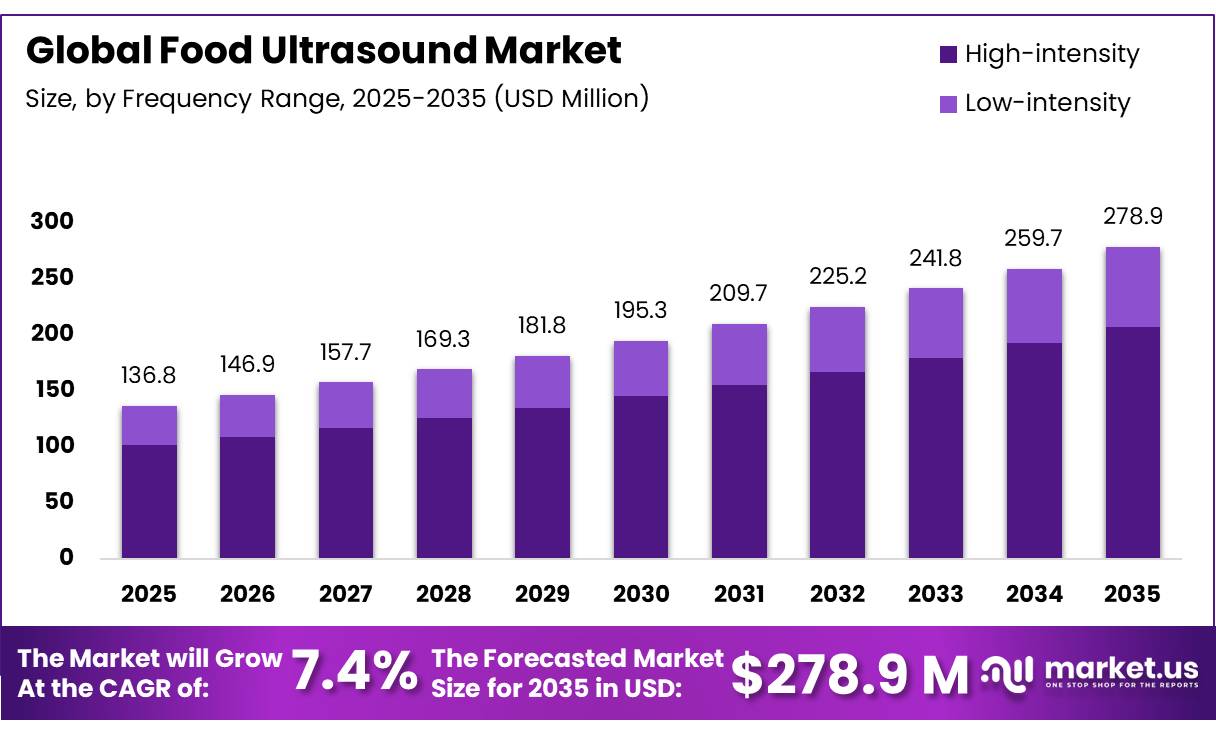
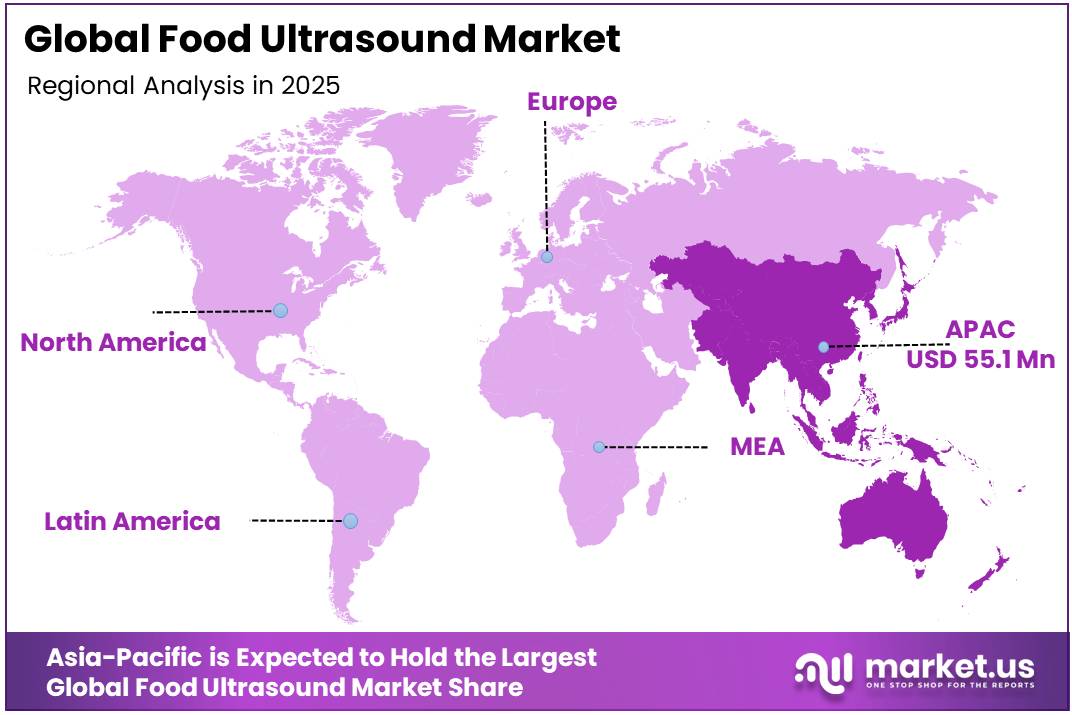
In 2025, the Global Food Ultrasound Market was valued at USD 136.8 Million, and between 2026 and 2035, this market is estimated to register a CAGR of 7.4%, reaching about USD 278.9 Million by 2035. In 2025, Asia-Pacific led the market, achieving over 40.2% share with a revenue of USD 55.1 Million.
Food ultrasound refers to the use of high-frequency sound waves for processing, testing and improving food products. Unlike conventional heating, high-intensity ultrasound creates microscopic bubbles in liquids through acoustic cavitation. Their rapid formation and collapse generate mechanical forces that can support extraction, emulsification, homogenization, tenderization, crystallization, drying and microbial control. The technology is increasingly evaluated as a cleaner processing method because it can operate at comparatively low temperatures, helping manufacturers protect flavour, colour, nutrients and heat-sensitive ingredients.
- A 2025 comparative study described ultrasound-assisted extraction within a frequency range of 20 to 100 kilohertz, highlighting its ability to disrupt plant cells and improve the recovery of valuable food compounds.
Key Takeaways
- The Global Food Ultrasound Market was valued at USD 136.8 Million in 2025.
- The market is projected to grow at a CAGR of 7.4% and is estimated to reach USD 278.9 Million by 2035.
- On the basis of frequency range, high-intensity dominated the market, constituting 74.3% of the total market share.
- Based on the food product, beverages dominated the market, with a substantial market share of around 34.6%.
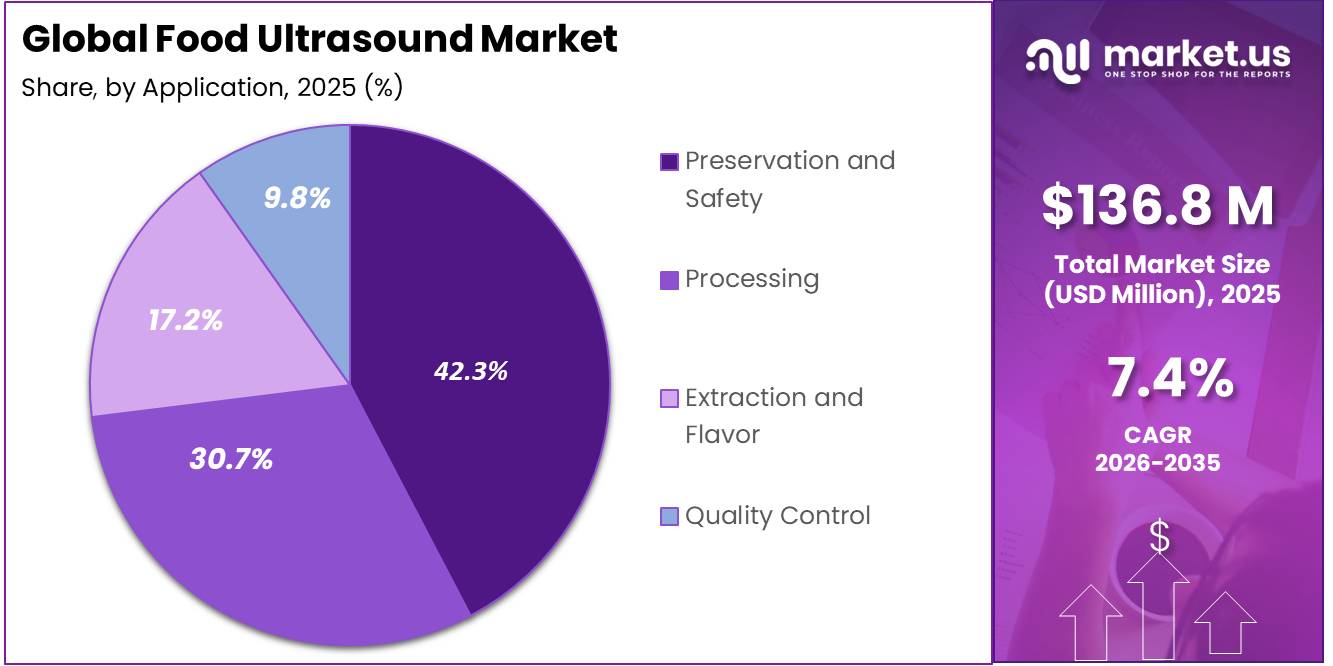
- Based on the application, preservation and safety led the market, comprising 42.3% of the total market.
- In 2025, Asia-Pacific was the most dominant region in the market, accounting for 40.2% of the total global consumption.
European Commission research published in July 2025 also assessed ultrasound-bath extraction of oils from pomegranate and citrus seeds to improve fatty-acid and bioactive profiles. These developments indicate that ultrasound is moving beyond laboratory preservation studies toward ingredient recovery, waste valorization and cleaner extraction systems.
- In June 2026, the World Health Organization reported that contaminated food causes approximately 866 million illnesses, 1.52 million deaths and 57.1 million disability-adjusted life years annually. Children below five years account for 29% of the global health burden and around 143,000 deaths. The organization also estimated that unsafe food produces nearly USD 310 billion in annual productivity losses and medical costs.
Meanwhile, the U.S. Centers for Disease Control and Prevention reported in July 2026 that it typically coordinates between 17 and 36 multistate foodborne-illness investigations every week. These pressures encourage food processors to evaluate ultrasound alongside mild heat, pressure and other preservation treatments.
- FAO reported in September 2025 that 13.3% of global food production, equivalent to approximately 1.31 billion tonnes, is lost between harvesting and retail. Losses reached 23% in Sub-Saharan Africa, compared with about 10% in North America and Europe.
- According to the FAO’s 2025 report The State of Food Security and Nutrition in the World (SOFI 2025), an estimated 673 million people experienced hunger in 2024, while 2.6 billion people were unable to afford a healthy diet in 2024.
Ultrasound-assisted extraction can help manufacturers recover proteins, oils, antioxidants, flavours and natural colour compounds from fruit skins, seeds and other processing residues, improving raw-material utilization. Future growth opportunities are expected in continuous-flow reactors, automated quality assessment and low-temperature beverage production.
- In June 2026, researchers at the University of New South Wales (UNSW Sydney) demonstrated an ultrasound-assisted coffee extraction technique that produced coffee at room temperature in 2–3 minutes while using approximately 75% less energy than conventional espresso preparation.
Frequency Range Analysis
High-intensity ultrasound dominates through stronger processing performance.
In 2025, High-intensity held a dominant market position, capturing more than a 74.3% share of the Food Ultrasound Market by frequency range. Its leadership was supported by its ability to generate strong cavitation forces that improve extraction, emulsification, mixing, microbial control and ingredient functionality. High-intensity systems are increasingly suitable for beverages, dairy products, plant proteins, oils and fresh produce processing.
- In July 2026, the U.S. Department of Agriculture reported an active food research project using high-intensity ultrasound across pH levels from 3 to 10 to extract functional oleosomes from sorghum. The project, running from May 2024 to May 2027, is assessing their use in protein beverages, yoghurt-like products, tofu alternatives and chocolate. This wider application range strengthens the segment’s position in industrial food processing.
Low-intensity is the fastest-growing segment in the Food Ultrasound Market by frequency range. Its growth is linked to rising demand for non-destructive testing methods that inspect food without changing its structure, flavour or nutritional quality. Food manufacturers can use low-intensity ultrasound to measure firmness, composition, ripeness, particle distribution and internal defects during processing. In 2025 and 2026, interest in real-time quality control continued to rise as producers sought faster and less wasteful inspection systems. Unlike high-intensity treatment, low-intensity ultrasound mainly supports sensing and process monitoring, making it suitable for meat, dairy, fruit, beverages and packaged foods.
Food Product Analysis
Beverages dominate with a 34.6% share due to broad liquid-processing applications
In 2025, Beverages held a dominant market position, capturing more than a 34.6% share. Beverages remained the leading food product segment because ultrasound systems can support extraction, mixing, emulsification, filtration, degassing and microbial control without relying on prolonged high-temperature treatment. The technology is increasingly useful for juice, tea, coffee, dairy drinks and functional beverages, where manufacturers need consistent flavour, colour and nutrient retention. Large processing volumes also support equipment adoption.
- In May 2025, the Food and Agriculture Organization estimated that global tea production reached around 7.3 million tonnes, while international tea imports totalled approximately 2.0 million tonnes. These volumes highlight the scale of beverage materials that require efficient extraction and quality-controlled processing.
Meat is the fastest growing segment in the food ultrasound market. In 2026, interest in ultrasound processing continued to increase because the technology can improve tenderisation, brining, marination, thawing and moisture distribution across meat products. Acoustic waves can help salt, flavouring and curing ingredients move more evenly through muscle tissue, reducing processing time while supporting consistent texture. The segment is also benefiting from growing demand for minimally processed products and production methods that can improve yield without exposing meat to excessive heat.
Application Analysis
Preservation and Safety dominates with a 42.3% share as producers focus on controlling contamination and extending shelf life.
In 2025, Preservation and Safety held a dominant market position, capturing more than a 42.3% share. Preservation and Safety remained the leading application because high-intensity ultrasound can support microbial control, improve product stability and extend usable shelf life with limited heat exposure. The need for stronger preservation systems was highlighted in October 2025, when the U.S. Department of Agriculture reported the recall of approximately 4,874,815 pounds of ready-to-eat frozen chicken products due to possible contamination with foreign material. Such large recalls encourage food manufacturers to explore ultrasound-assisted preservation alongside established safety controls, particularly for processed meat, dairy, beverages and ready-to-eat products.
Processing is the fastest growing segment in the Food Ultrasound Market. Its growth is supported by the increasing use of ultrasound for extraction, emulsification, mixing, tenderisation, crystallisation and process-time reduction. The technology can help processors achieve more uniform results while lowering dependence on prolonged thermal treatment.
Key Market Segments
By Frequency Range
- High-intensity
- Low-intensity
By Food Product
- Meat
- Beverages
- Dairy
- Bakery
- Fruit and Vegetables
By Application
- Preservation and Safety
- Processing
- Extraction and Flavor
- Quality Control
Driver Analysis
Resource efficiency under 2030 sustainability programs
Sustainability programs are converting resource efficiency from a branding issue into an operating KPI, which supports longer-horizon ultrasound adoption. USDA and EPA’s U.S. 2030 goal seeks to cut food loss and waste by 50 percent, and EPA’s updated framework tracks food-waste disposal pathways with a 2030 target of reducing managed food waste to 164 pounds per person from a 2016 baseline of 328 pounds. In Europe, food-waste regulation is now tied directly to legal reduction targets, pushing manufacturers to document waste prevention more rigorously and increasing the appeal of process equipment that can reduce losses, stabilize quality, or improve conversion efficiency.
For ultrasound vendors, the strategic implication is that sales increasingly hinge on quantified resource-efficiency cases yield per batch, lower rework, reduced spoilage exposure, and sometimes energy or water co-benefits rather than on generic innovation claims; that broadens adoption beyond early technical users and supports a longer-cycle +1.5 point CAGR contribution as 2030 programs tighten procurement and reporting standards.
Drivers Impact Analysis
| Driver | (~) % Impact on CAGR Forecast | Geographic Relevance | Impact Timeline |
|---|---|---|---|
| Clean-label yield gains from non-thermal processing | +2.1% | North America core, EU, APAC export corridors | Short term (≤\\leq≤ 2 years) |
| Food waste reduction mandates and loss economics | +1.8% | EU core, North America core, selective APAC | Medium term (2-4 years) |
| HACCP and hygiene validation for process intensification | +1.4% | Global regulated food manufacturing, EU, U.S., India | Short term (≤\\leq≤ 2 years) |
| Pressure on ultra-processed food reformulation and milder processing | +1.2% | U.S. core, EU spill-over, premium APAC urban markets | Medium term (2-4 years) |
| Export compliance and Codex-aligned modernization in emerging processors | +1.6% | India, Southeast Asia, Latin America, Middle East export hubs | Medium term (2-4 years) |
| Resource efficiency under 2030 sustainability programs | +1.5% | EU core, North America, Australia, advanced APAC | Long term (≥\\geq≥ 4 years) |
Restraint Analysis
Regulatory and compliance complexity
Regulatory and compliance complexity acts as a structural restraint because food ultrasound systems now sit at the intersection of food safety, equipment safety, and in some jurisdictions broader medical-device style oversight frameworks that were originally designed for diagnostic ultrasound, resulting in multi-layer approval and documentation cycles that stretch deployment timelines by 12–24 months in regulated markets. In the US, the full implementation of FSMA 204 traceability requirements from 2026 forces food processors to demonstrate that any new in-line inspection or processing technologies integrate with traceability logs and do not create data gaps, adding additional validation steps and software audits costing USD 50,000–150,000 per facility for integration and testing.
In India and other emerging markets, stricter oversight of ultrasound equipment under the Drugs and Cosmetics Act and device registration frameworks means importers must obtain CDSCO approvals, certifications, and detailed technical dossiers, often incurring compliance costs equivalent to 5–8% of equipment value plus 3–6 months of regulatory lead time, which discourages smaller processors from participating and concentrates adoption among large, well-capitalized players. On top of this, food safety authorities and standard-setting bodies frequently update permissible process parameters, validation protocols, and HACCP documentation expectations every 2–3 years, requiring periodic revalidation of ultrasound processing conditions and adding ongoing compliance overhead of several FTEs per large plant, which in turn pushes some operators to delay or scale back ultrasound projects, shaving roughly 1–1.5 percentage points off potential CAGR relative to a simpler regulatory landscape.
Restraint Impact Analysis
| Restraint | (~) % Impact on CAGR Forecast | Geographic Relevance | Impact Timeline |
|---|---|---|---|
| High CapEx and ROI uncertainty | -1.6% | North America core, EU, APAC corridors | Medium term (2-4 years) |
| Regulatory and compliance complexity | -1.2% | US, EU, India, China | Long term (≥ 4 years) |
| Limited skilled technical workforce | -0.9% | EU, APAC, LatAm | Medium term (2-4 years) |
| Supply chain and component bottlenecks | -1.0% | Global manufacturing hubs | Short term (≤ 2 years) |
| Conservative adoption by large processors | -0.8% | North America, EU, emerging APAC | Long term (≥ 4 years) |
| Data integration and validation burden | -0.7% | US, EU, India | Medium term (2-4 years) |
Opportunity Analysis
Low‑cost ultrasound systems for SMEs in emerging markets
Government‑linked reviews of non‑thermal processing stress its potential for sustainable food systems but also note the higher capital intensity and complexity of many technologies, which has limited diffusion beyond top‑tier plants and high‑value categories. By engineering ruggedized, modular ultrasound units with lower power ratings, simplified controls, and standardized recipes for specific local products such as fruit juices, spices, and ready‑to‑eat staples vendors could cut entry‑level system prices by 40–60% relative to high‑end lines, bringing CAPEX into the 50,000–150,000 USD range and opening up a new volume segment of tens of thousands of SME‑scale facilities across India, Southeast Asia, Latin America and North Africa.
Assuming even 3–5% penetration of this long‑tail over a decade, incremental TAM unlocked could exceed 0.6–1.0 billion USD by 2035, supporting an additional 2.3 percentage points of CAGR above baseline due to the sheer unit volume and follow‑on service, spare parts, and consumables revenue. This upside is not reflected in current baseline forecasts because most commercialization roadmaps and reference installations cited in technical and policy literature involve larger processors and export‑oriented players, and there is little evidence yet of standardized low‑cost ultrasound product lines or bundled financing programs tailored specifically to SMEs in emerging markets, which will likely require coordinated efforts with development banks and public food‑safety programs over a ≥4‑year execution window.
Opportunity Impact Analysis
| Opportunity | (~) % Potential CAGR Upside | Geographic Relevance | Execution Window |
|---|---|---|---|
| Ultrasound-ready compliance for stricter hygiene rules | +2.0% | North America, EU, East Asia | Medium term (2–4 years) |
| Integration into smart, data-rich food factories | +1.8% | North America, EU, China, Japan | Medium term (2–4 years) |
| Ultrasound-enabled clean label and nutrient retention | +1.5% | North America, EU, APAC emerging | Medium term (2–4 years) |
| Low-cost ultrasound systems for SMEs in emerging markets | +2.3% | APAC emerging, Latin America, MENA | Long term (≥ 4 years) |
| Ultrasound-based non-destructive quality services | +1.2% | Global export hubs | Short term (≤ 2 years) |
| Ultrasound-assisted sustainable reformulation (water, energy cuts) | +1.0% | EU, North America, East Asia | Long term (≥ 4 years) |
Challenges Analysis
Limited technical talent pool
Food ultrasound systems sit at the junction of acoustic physics, food microbiology, and industrial automation, yet the global pool of professionals who combine process engineering experience with hands‑on ultrasound expertise remains thin, with realistic estimates suggesting fewer than 3,000–5,000 engineers and scientists worldwide possessing direct commissioning or optimization experience on industrial‑scale ultrasound lines, versus several hundred thousand practitioners in conventional thermal or mechanical processing, creating persistent human‑capital bottlenecks that impose roughly a 1.2 percentage point drag on achievable CAGR.
In practice, this talent scarcity manifests as extended commissioning times pilot validation for new lines often runs 6–9 months versus 3–4 months for established technologies and slower troubleshooting cycles, where mean time to root‑cause complex process deviations involving cavitation intensity, temperature profiles, and microbial kill curves may stretch to 5–10 working days compared with 2–3 days on mature platforms, thereby depressing overall line availability by 2–4 percentage points.
Training throughput is also constrained: leading regions may graduate only 50–100 post‑graduates per year with direct food ultrasound or advanced non‑thermal processing specializations, while in emerging markets most upskilling relies on short courses of 3–5 days with limited hands‑on modules, resulting in a skills gap where at least 30–40% of installed capacity operates below optimal parameter envelopes, costing processors 1–2% in avoidable energy or consumables per tonne and marginally eroding margins.
To navigate this friction, industry players intensify collaboration with public research programs and strategic research and innovation agendas in food safety and processing such as European FSOLab initiatives co‑fund industrial PhD tracks, and deploy global centers of excellence that support multiple plants from a centralized analytics and remote‑diagnostics hub, thereby gradually increasing the effective talent radius per expert from 1–2 sites to 4–6 sites, but the long formation time of such experts (5–8 years from graduate entry to plant‑level authority) locks this challenge into a long‑term mitigation trajectory
Challenges Impact Analysis
| Challenge | (~) % CAGR Friction Drag | Geographic Relevance | Mitigation Horizon |
|---|---|---|---|
| High-cost Capex stack | -1.4% | North America, EU hubs, APAC industrial | Long term (≥ 4 years) |
| Limited technical talent pool | -1.2% | EU research clusters, North America, Asia R&D | Long term (≥ 4 years) |
| Slow standards & validation cycles | -1.0% | EU regulatory hubs, North America core | Medium term (2-4 years) |
| Fragmented digital integration | -0.9% | APAC logistics, emerging markets, global multinationals | Medium term (2-4 years) |
| Supply chain & maintenance inertia | -0.8% | Global installed base, APAC corridors | Medium term (2-4 years) |
| Adoption gap in MSMEs | -1.1% | India, South Asia, Latin America MSME segment | Long term (≥ 4 years) |
Geopolitical Impact Analysis
Geopolitical Tensions and Supply Chain Disruptions Shaping the Food Ultrasound Market
Recent geopolitical conflicts, including the Russia–Ukraine war and ongoing tensions in the Middle East, have influenced the Food Ultrasound market by affecting equipment manufacturing, component availability, and international trade. Food ultrasound systems depend on electronic components, precision sensors, semiconductors, stainless steel, and specialized industrial materials that are sourced through global supply networks.
At the same time, these geopolitical challenges have encouraged food manufacturers to strengthen domestic production capabilities and improve processing efficiency. Many companies are investing in non-thermal technologies such as food ultrasound to reduce waste, improve product quality, extend shelf life, and optimize energy use. Governments in North America, Europe, and Asia-Pacific are also supporting food security initiatives and modernization of food processing facilities to reduce dependence on imported food products. As supply chains become more regionalized, demand for advanced processing equipment is expected to remain steady.
Regional Analysis
Asia Pacific Held the Largest Share of the Global Food Ultrasound Market.
Asia-Pacific dominated the Food Ultrasound market in 2025, accounting for 40.2% of the global market, with an estimated value of USD 55.1 million. The region benefits from rapid expansion of the food processing industry, rising investment in food quality technologies, and increasing demand for safe and minimally processed food products.
According to the Food and Agriculture Organization (FAO), Asia produces over 50% of the world’s agricultural output, creating strong demand for advanced food processing solutions. China remains the world’s largest food manufacturing hub, while Japan continues to invest in automated food production technologies to address labor shortages.
North America is projected to register the fastest growth in the Food Ultrasound market during the forecast period due to increasing focus on clean-label products, food safety compliance, and advanced processing technologies. The United States leads regional demand with widespread adoption of ultrasound for microbial reduction, quality testing, extraction of natural ingredients, and shelf-life enhancement.
- According to the U.S. Department of Agriculture (USDA), the U.S. food and beverage manufacturing sector generated shipments exceeding USD 1.1 trillion in recent years, creating significant opportunities for innovative food processing equipment. Canada is also expanding investments in food innovation and sustainable processing technologies through government-backed research initiatives.
Key Regions and Countries Covered
- North America
- The US
- Canada
- Europe
- Germany
- France
- The UK
- Spain
- Italy
- Russia & CIS
- Rest of Europe
- APAC
- China
- Japan
- South Korea
- India
- ASEAN
- Rest of APAC
- Latin America
- Brazil
- Mexico
- Rest of Latin America
- Middle East & Africa
- GCC
- South Africa
- Rest of MEA
Key Players Analysis
CHEERSONIC strengthens its food-ultrasound position through automated and manual systems for slicing cakes, cheese, pastries, pizza and frozen products. Established in 2014, the company’s HFM2300 cutter operates at 20 kHz and processes products from approximately -15°C to ambient temperature. The company also provides ultrasonic spraying systems operating between 25 kHz and 180 kHz for controlled coating applications.
Dukane IAS maintains a strong role in food ultrasound through industrial cutting and portioning systems designed for cheese, confectionery, bakery and layered products. Its equipment operates at 20 kHz, 30 kHz, 35 kHz and 40 kHz, allowing processors to select frequencies for different product textures and production speeds.
Esaote’s connection to the food-ultrasound sector is primarily through veterinary and food-production imaging rather than high-power food processing. Esaote has more than 30 years of veterinary imaging experience. By September 2025, the group employed approximately 1,300 people, operated through 15 subsidiaries and maintained distribution coverage across more than 100 countries, supporting broad access to ultrasound, MRI and medical-information technologies.
The Major Players in The Industry
- Analogic Corp.
- Buhler AG
- CHEERSONIC Ultrasonic Equipment Co. Ltd.
- Dukane IAS LLC
- Elliptical Design Ltd.
- Emerson Electric Co.
- Esaote Spa
- FUJIFILM Corp.
- Hielscher Ultrasonics GmbH
- Hitachi Ltd.
- Industrial Sonomechanics LLC
- Koninklijke Philips N.V.
- Marchant Schmidt Inc.
- Nikkei Inc.
- Perkin Elmer Inc.
- Rinco Ultrasonics AG
- Other Key Players
Key Development
- In June 2026, Bühler confirmed the acquisition of 2 German businesses, endeco GmbH and endeco Protein and Food, after a partnership that began in 2022. The deal expanded its plant-engineering work in 3 areas, including starch, dairy and plant proteins. Bühler’s Grains & Food division generated CHF 2.164 billion in sales and CHF 2.147 billion in orders. The group employed 12,090 people and invested CHF 131 million, or 4.8% of turnover, in R&D.
- In April 2026, Analogic entered a major partnership and business-combination agreement with Leidos Security Enterprise Solutions. Leidos agreed to contribute approximately 1,500 employees and operations expected to generate USD 625 million in 2026 revenue, while retaining a 41.5% ownership interest in the combined company.
Report Scope
| Report Features | Description |
|---|---|
| Market Value (2025) | USD 136.8 Mn |
| Forecast Revenue (2035) | USD 278.9 Mn |
| CAGR (2026-2035) | 7.4% |
| Base Year for Estimation | 2025 |
| Historic Period | 2020-2024 |
| Forecast Period | 2026-2035 |
| Report Coverage | Revenue Forecast, Market Dynamics, Competitive Landscape, Recent Developments |
| Segments Covered | By Frequency Range (High-intensity and Low-intensity), By Food Product (Meat, Beverages, Dairy, Bakery, and Fruit and Vegetables), By Application (Preservation and Safety, Processing, Extraction and Flavor, and Quality Control) |
| Regional Analysis | North America – The US & Canada; Europe – Germany, France, The UK, Spain, Italy, Russia & CIS, Rest of Europe; APAC– China, Japan, South Korea, India, ASEAN & Rest of APAC; Latin America– Brazil, Mexico & Rest of Latin America; Middle East & Africa– GCC, South Africa, & Rest of MEA |
| Competitive Landscape | Analogic Corp., Buhler AG, CHEERSONIC Ultrasonic Equipment Co. Ltd., Dukane IAS LLC, Elliptical Design Ltd., Emerson Electric Co., Esaote Spa, FUJIFILM Corp., Hielscher Ultrasonics GmbH, Hitachi Ltd., Industrial Sonomechanics LLC, Koninklijke Philips N.V., Marchant Schmidt Inc., Nikkei Inc., Perkin Elmer Inc., Rinco Ultrasonics AG, and Other Key Players. |
| Customization Scope | Customization for segments, region/country-level will be provided. Moreover, additional customization can be done based on the requirements. |
| Purchase Options | We have three licenses to opt for: Single User License, Multi-User License (Up to 5 Users), Corporate Use License (Unlimited Users and Printable PDF) |





































