


Report Overview
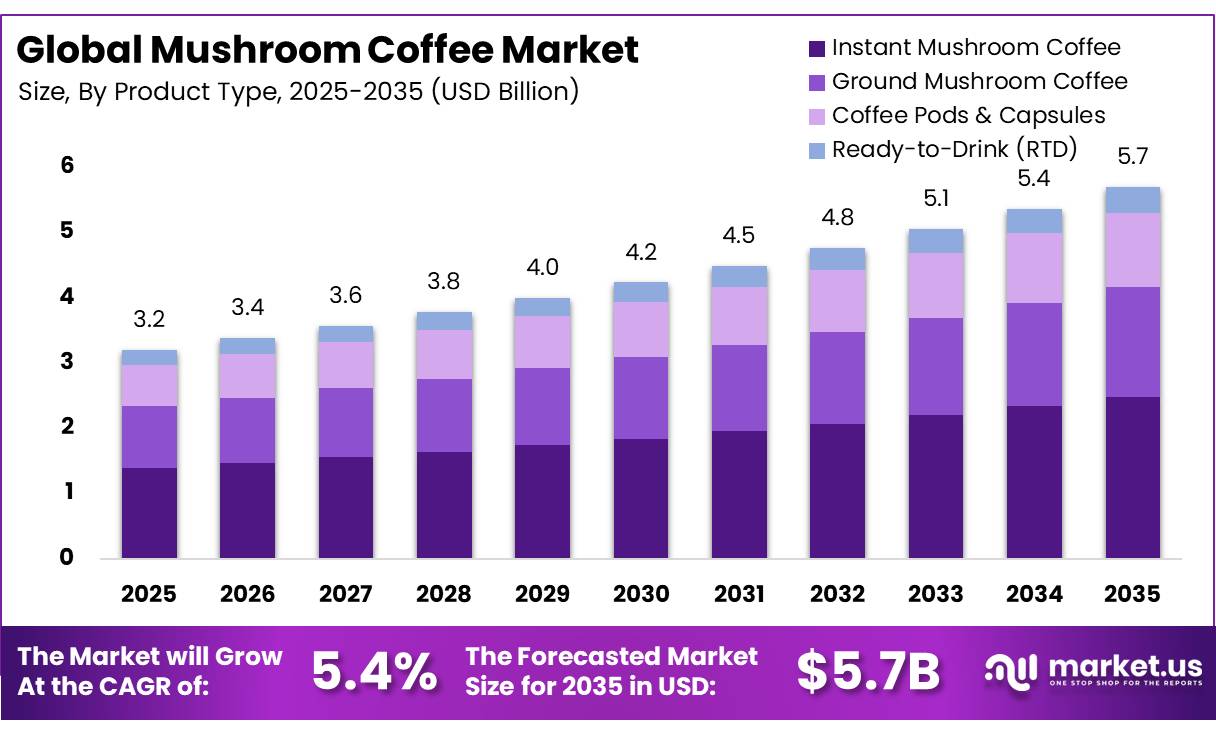
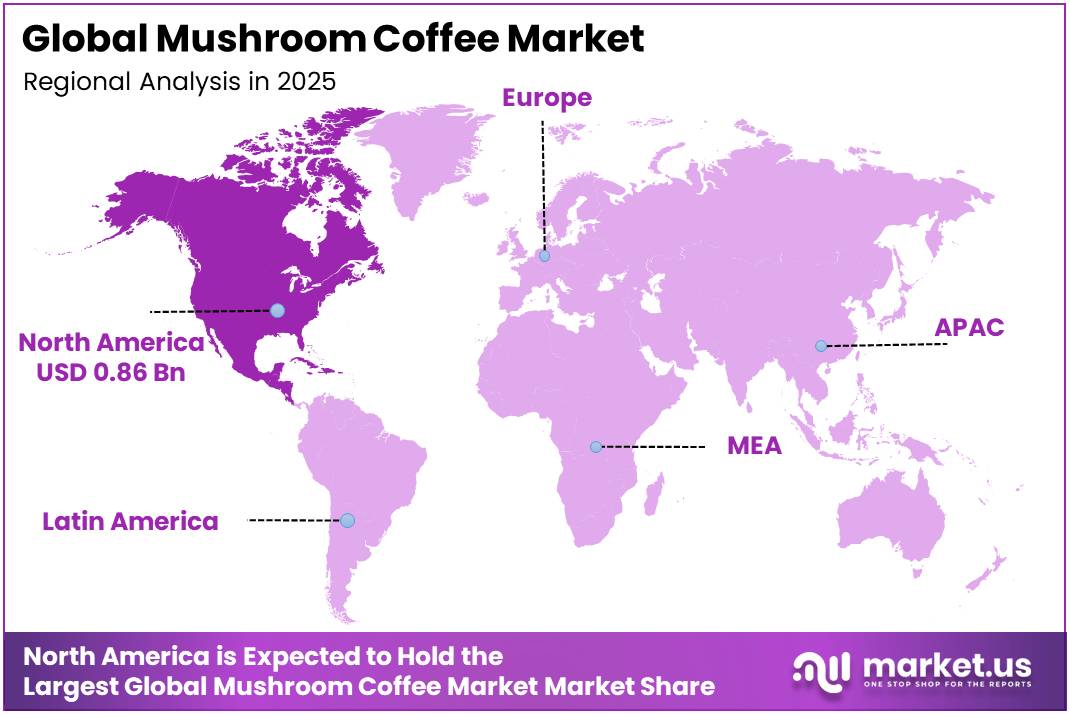
Global Mushroom Coffee Market was valued at USD 3.2 Billion in 2025, size is expected to be worth around USD 5.7 Billion by 2035, At a CAGR of 5.4%. North America held a dominant market position, capturing more than a 26.8% share, holding USD 0.86 billion in revenue.
Mushroom coffee, a blend of roasted coffee and medicinal mushroom extracts such as lion’s mane, chaga, reishi, and cordyceps, has moved from a niche health product into a recognized segment of the functional beverage industry. It is positioned around reduced caffeine sensitivity, added immune support, and cognitive benefits, appealing to consumers who still want their coffee ritual but with a gentler effect on the body.
- This shift sits within a much larger coffee economy, where the U.S. Department of Agriculture estimated world coffee production at 174.855 million 60 kg bags for 2024/25, with global consumption projected to reach 168.1 million bags, a rise of 3 percent.
The organic and functional food landscape, which mushroom coffee belongs to, is showing measurable strength. The U.S. Department of Agriculture’s Economic Research Service reported that organic food sales reached 65.4 billion dollars in 2024, with the share of organic food sold online climbing from 2% in 2012 to 6.7% in 2024. Within this, beverages remain a key innovation driver, supported by ingredients like mushrooms appearing across low sugar and wellness focused drink formats.
Government oversight is also shaping how this category grows. The USDA’s Strengthening Organic Enforcement regulation now requires stricter end to end traceability for organic certified products, including coffee, rewarding brands with verified supply chains. Meanwhile in Europe, the European Food Safety Authority’s updated novel food guidance took effect in February 2025, tightening scientific data requirements for new mushroom based ingredients entering EU markets.
Looking forward, supply side investment is reinforcing long term opportunity. Puerto Rico’s Café del Futuro project, backed by 15 million dollars in USDA funding, has distributed 325,000 trees to 190 coffee producers since February 2024, reflecting how public investment is strengthening the raw material base that functional coffee categories, including mushroom coffee, will depend on for sustained expansion.
Key Takeaways
- The global mushroom coffee market was valued at USD 3.2 billion in 2025.
- The global market is projected to grow at a CAGR of 4% during 2026 2035 and is estimated to reach USD 5.7 billion by 2035.
- On the basis of product type, Instant Mushroom Coffee dominated the market, constituting 43.5% of the total market share.
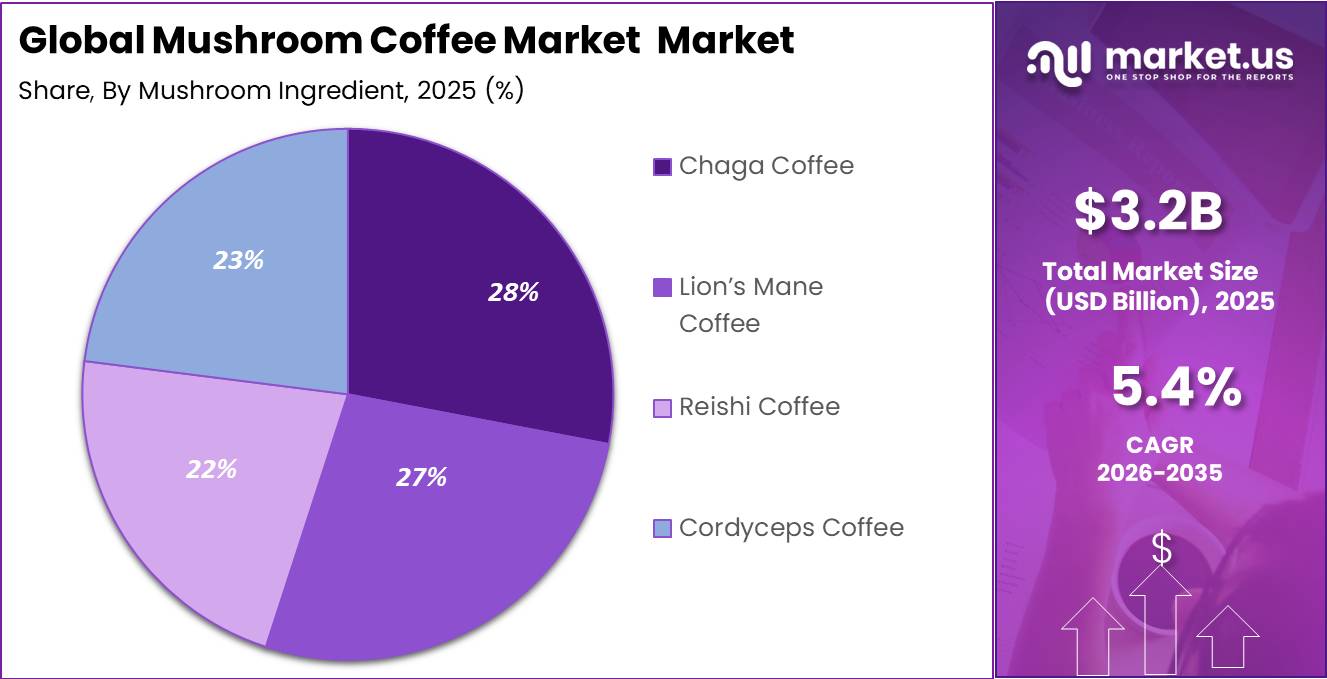
- Based on the mushroom ingredient, Chaga Coffee led the market, accounting for 28.0% of the total market share.
- Based on the distribution channel, Supermarkets & Hypermarkets dominated the market, holding 57.5% of the total market share.
- In 2025, North America was the dominant region in the mushroom coffee market, accounting for 26.8% of the total global market share.
By Product Type
Instant Mushroom Coffee dominates with 43.5% due to its convenience and easy daily use.
In 2025, Instant Mushroom Coffee held a dominant market position, capturing more than a 43.5% share of the global mushroom coffee market. Its leading position was supported by strong consumer preference for products that are quick to prepare and fit easily into busy lifestyles. The format requires minimal preparation, making it a practical option for regular consumption at home, work, or while traveling. Its wide acceptance across different consumer groups also contributed to its larger market share, helping it remain the preferred product type in 2025.
Ground Mushroom Coffee is the fastest growing segment and continued to attract consumers looking for a more traditional coffee preparation experience. This segment is expected to witness steady growth as more coffee drinkers prefer freshly brewed beverages over instant alternatives. Its appeal among consumers who value brewing methods and richer coffee experiences is likely to support its continued expansion in the coming years while maintaining its position as an important product segment within the mushroom coffee market.
By Mushroom Ingredient
Chaga Coffee dominates with 28.0% due to its strong consumer acceptance.
In 2025, Chaga Coffee held a dominant market position, capturing more than a 28.0% share of the global mushroom coffee market. Its leading position reflected steady consumer preference for mushroom coffee products made with well established functional mushroom ingredients. The segment benefited from broad product availability across different retail formats and growing inclusion in premium coffee blends. Manufacturers continued to feature chaga as a key ingredient in their product portfolios, helping the segment maintain a strong presence throughout 2025.
Lion’s Mane Coffee emerged as the fastest growing segment in 2025, supported by increasing consumer interest in mushroom based coffee made with a wider variety of functional ingredients. Beverage manufacturers continued expanding their product offerings by introducing new lion’s mane coffee blends across online platforms, specialty stores, and supermarkets. Growing awareness of premium mushroom coffee products encouraged more consumers to explore different ingredient options beyond traditional formulations.
By Distribution Channel
Supermarkets & Hypermarkets dominate with 57.5% due to their broad product accessibility.
In 2025, Supermarkets & Hypermarkets held a dominant market position, capturing more than a 57.5% share of the global mushroom coffee market. Their leading position was supported by strong consumer preference for purchasing food and beverage products through large retail stores that offer a wide range of brands in one location. The availability of mushroom coffee alongside conventional coffee products improved product visibility and encouraged trial purchases. Regular promotional activities, convenient shopping experiences, and established retail networks also helped supermarkets and hypermarkets maintain their dominant share throughout 2025.
Health & Wellness Stores represented the fastest growing distribution channel in 2025 as more consumers looked for specialty retail outlets offering functional food and beverage products. These stores continued to attract buyers seeking premium and wellness focused products while providing a dedicated shopping environment for health conscious consumers. Manufacturers also strengthened their presence in this channel by expanding product availability and introducing a broader selection of mushroom coffee formulations.
Key Market Segments
Product Type
- Ground Mushroom Coffee
- Coffee Pods & Capsules
- Ready to Drink (RTD)
Mushroom Ingredient
- Lion’s Mane Coffee
- Reishi Coffee
- Chaga Coffee
- Cordyceps Coffee
Distribution Channel
- Supermarkets & Hypermarkets
- Health & Wellness Stores
- E Commerce
Driver Analysis
Specialty coffee premiumization and café-channel experimentation
Specialty coffee consumers are accustomed to paying significant premiums for single-origin beans, alternative brewing methods, and flavored or functional add‑ons, and mushroom coffee can slot into this pattern as a limited-run, seasonal, or permanent specialty offering, often priced 20–50 percent higher than standard lattes or drip coffee while adding minimal incremental cost in the form of mushroom extract or powder.
Chains and independent cafés can use mushroom-based drinks to signal innovation and tap into wellness trends, rotating SKUs like lion’s mane lattes or reishi mochas and cross-promoting with retail packs or RTD formats; this channel also acts as a discovery and trial platform, lowering customer acquisition cost for DTC or retail packs. At scale, even modest adoption by large chains rolling mushroom coffee options across hundreds or thousands of outlets for part of the year can translate into tens of millions of incremental servings annually, with revenue leverage disproportionate to volume because of higher price points and margin contributions from add‑on toppings and upsells.
Strategically, this driver encourages brands to build foodservice-specific SKUs and to negotiate co‑branding or white-label arrangements with cafés, thereby diversifying revenue beyond pure retail; the resulting channel-expansion and premiumization dynamics justify around +1.9 percentage points of incremental CAGR, especially in North America, Europe, developed APAC, and emerging café markets in the Middle East.
Drivers Impact Analysis
| Driver | (~) % Impact on CAGR | Geographic Relevance | Impact Timeline |
|---|---|---|---|
| Health-conscious shift to functional beverages and adaptogens | +2.2% | North America core, EU, APAC urban corridors | Medium term (2-4 years) |
| Specialty coffee premiumization and café-channel experimentation | +1.9% | North America, EU, developed APAC, Middle East | Short term (≤ 2 years) |
| Mainstream retail, DTC and e-commerce expansion of mushroom coffee brands | +1.7% | North America, EU, online-first markets | Short term (≤ 2 years) |
| Innovation in formulations (nootropics, RTD, low-caffeine) | +1.6% | North America, EU, East Asia | Medium term (2-4 years) |
| Supply-side scaling of mushroom extract production and processing | +1.3% | China, Eastern Europe, Latin America, global | Long term (≥ 4 years) |
| Regulatory clarification around functional claims and labeling | +1.1% | EU regulatory hubs, North America, Asia | Long term (≥ 4 years) |
Restraint Analysis
Premium pricing versus mass coffee and supplements
Mushroom coffee SKUs often retail at price points 30–80 percent above regular ground coffee on a per‑cup basis once mushroom extracts and branding are included, and when coffee-commodity prices spike—as noted in global supply-chain coverage where Arabica prices peaked well above recent five‑year averages due to droughts and frosts in Brazil—roasters and brands must either pass through further increases or absorb margin compression, both of which limit promotional intensity and slow trial.
At the same time, consumers already spending on capsules or powders for mushrooms and other adaptogens may resist paying a second “functional premium” for coffee, seeing mushroom coffee as duplicative, especially under inflationary conditions where household food and beverage budgets are squeezed; this drives down conversion rates from awareness to regular usage and keeps purchase frequency lower than for standard coffee.
Strategically, brands must experiment with price-pack architectures, bundling with other products, and tiered offerings, but until those models balance affordability with margins, premium pricing acts as a structural brake, reducing the potential CAGR by an estimated 2.2 percentage points in North America, Europe, and urban APAC markets where consumers are price-sensitive yet have many competing functional and specialty-beverage options.
Restraint Impact Analysis
| Restraint | (~) % Impact on CAGR | Geographic Relevance | Impact Timeline |
|---|---|---|---|
| Premium pricing versus mass coffee and supplements | -2.2% | North America, EU, urban APAC | Short term (≤ 2 years) |
| Regulatory uncertainty on health claims and novel foods | -1.9% | EU regulatory hubs, North America, Asia | Medium term (2-4 years) |
| Coffee and mushroom supply-chain and price volatility | -1.8% | APAC corridors, Latin America, global coffee belt | Short term (≤ 2 years) |
| Extract quality inconsistency and formulation failures | -1.6% | India, APAC emerging, online DTC | Medium term (2-4 years) |
| Consumer skepticism, safety concerns and limited clinical proof | -1.4% | North America, EU, Asia | Long term (≥ 4 years) |
| Brand fragmentation and white-label commoditization | -1.2% | Global, especially online marketplaces | Medium term (2-4 years) |
Opportunity Analysis
RTD and instant functional coffee extensions
Extending mushroom coffee into cold-brew cans, nitro formats, shelf-stable lattes, and premium instant sticks allows brands to tap into incremental dayparts—afternoon pick‑me‑ups, on‑the‑go consumption, gym and office occasions—potentially increasing average weekly servings per user by 20–30 percent compared with a pure morning hot-drink use case; simultaneously, RTD price points per unit can be 2–3 times higher than a hot cup brewed at home, lifting revenue per kilogram of coffee and mushroom extract used. Functional-beverage analyses highlight younger demographics, particularly Millennials and Gen Z, as key drivers of functional RTD adoption, and mushroom coffee can piggyback on the same channels that already distribute energy and protein drinks.
Strategically, this opportunity requires capex or co‑packing partnerships for aseptic or canned lines, formulation work on stability and flavor, and distribution relationships in RTD-heavy channels, but successful execution could add around 2.3 percentage points of CAGR upside by 2035 as mushroom coffee expands from a niche brewed product into a broader functional coffee platform in North America, Europe, and urban APAC.
Opportunity Impact Analysis
| Opportunity | (~) % Potential CAGR Upside | Geographic Relevance | Execution Window |
|---|---|---|---|
| RTD and instant functional coffee extensions | +2.3% | North America, EU, urban APAC | Medium term (2-4 years) |
| Personalized and data-driven mushroom coffee nutrition | +2.0% | North America core, EU, developed APAC | Long term (≥ 4 years) |
| Emerging-market localization and sachetization | +1.9% | India, ASEAN, LatAm, Africa | Medium term (2-4 years) |
| Cross-category partnerships with gyms, employers and healthcare | +1.7% | North America, EU, urban APAC | Long term (≥ 4 years) |
| White-label and B2B ingredient platforms | +1.5% | EU, North America, APAC corridors | Medium term (2-4 years) |
| M&A roll-ups and brand portfolio consolidation | +1.3% | Global, especially fragmented online markets | Long term (≥ 4 years) |
Challenges Analysis
Coffee and mushroom logistics fragility
Mushroom coffee inherits all the vulnerabilities of conventional coffee—climate impacts on yields in Brazil, Colombia, and Vietnam; political and macro instability in producing countries; and shipping bottlenecks—and adds another layer via medicinal mushroom supply from specialized producers in China, Eastern Europe, and other regions, where extraction plants and processors can themselves face energy, logistics, or regulatory shocks.
Private-label sourcing guides indicate wide spreads in B2B pricing—from under 20 USD per kilogram for basic factory-direct to triple-digit levels for premium white-label programs—highlighting how transport, certification, and value-added services magnify cost and complexity along the chain. For brands, this volatility means carrying more safety stock, engaging in multi-sourcing, and accepting occasional reformulation when particular species or grades are delayed, all of which increase operating expenses and complicate forecasting; for retailers and e‑commerce platforms, inconsistent availability erodes shelf or listing reliability and can discourage aggressive promotion.
Strategically, building resilient logistics—through regional warehousing, buffer inventory, and long-term contracts—requires working capital and sophisticated supply-chain management that smaller brands often lack; until these capabilities are more widely deployed, logistics fragility imposes about a 1.4 percentage point friction drag on maximum CAGR by limiting the pace and reliability of global distribution across APAC corridors, Latin America, and the wider coffee belt.
Challenges Impact Analysis
| Challenge | (~) % CAGR Friction Drag | Geographic Relevance | Mitigation Horizon |
|---|---|---|---|
| Low awareness and category confusion | -1.8% | North America, EU, APAC urban | Long term (≥ 4 years) |
| Café and barista integration complexity | -1.5% | North America core, EU, developed APAC | Medium term (2-4 years) |
| Coffee and mushroom logistics fragility | -1.4% | APAC logistics corridors, global coffee belt | Medium term (2-4 years) |
| Quality assurance and certification overhead | -1.3% | EU regulatory hubs, India, North America | Long term (≥ 4 years) |
| Flavor acceptance and repeat-usage risk | -1.2% | Global, strongest in mass coffee segments | Long term (≥ 4 years) |
| Circularity and sustainability execution gaps | -1.0% | EU, North America, specialty coffee hubs | Long term (≥ 4 years) |
Geopolitical Impact Analysis
Ongoing Geopolitical Conflicts Reshape Mushroom Coffee Supply Chains.
The ongoing geopolitical conflicts, particularly in Eastern Europe and the Middle East, have created new challenges for the mushroom coffee market by affecting global trade, transportation, and raw material movement. Although mushroom coffee is not directly linked to defense related industries, the market depends on stable international supply chains for coffee beans, mushroom extracts, packaging materials, and other ingredients. Higher shipping costs, longer delivery times, and changing trade routes have increased operational pressure on manufacturers and distributors. Companies that rely on imported ingredients have faced greater uncertainty while planning production and inventory.
At the same time, businesses have started adjusting their sourcing strategies to reduce the risk of future disruptions. Many producers are expanding their supplier networks, building larger inventories of essential ingredients, and increasing regional sourcing wherever possible. These changes are helping companies maintain product availability despite global uncertainty. Consumers have continued to purchase functional beverages, but some have become more price conscious because of inflation and higher living costs linked to geopolitical tensions. Even with these short term challenges, demand for mushroom coffee remains stable as interest in wellness focused beverages continues to grow.
Regional Analysis
Mushroom Coffee Market: Regional Overview, North America.
North America stands as the dominating region in the global mushroom coffee market, commanding a share of 26.8%, valued at approximately USD 0.86 billion. This leadership position reflects the region’s well established specialty coffee culture combined with a steady consumer shift toward functional, low jitter beverages built around medicinal mushrooms such as lion’s mane, reishi, chaga, and cordyceps. These ingredients are increasingly marketed as a gentler alternative to conventional caffeine heavy drinks, appealing to consumers who want their coffee ritual paired with cognitive and immune support benefits.
Regulatory developments in the United States are actively shaping how this category matures across the region. The USDA’s Agricultural Marketing Service finalized a rule on December 2024, amending organic regulations to clarify standards for organic mushrooms, covering substrate composition, spawn sourcing, and composting requirements, originally scheduled to take effect February 2025.
That effective date was subsequently delayed to March 2025, with the compliance deadline for organic operations pushed to March 2027. The regulatory landscape remains unsettled, however, as USDA proposed in May 2025 to rescind the rule entirely, opening a public comment period that closed June 2025.
Key Regions and Countries
- North America
- The US
- Canada
- Europe
- Germany
- France
- The UK
- Spain
- Italy
- Russia & CIS
- Rest of Europe
- APAC
- China
- Japan
- South Korea
- India
- ASEAN
- Rest of APAC
- Latin America
- Brazil
- Mexico
- Rest of Latin America
- Middle East & Africa
- GCC
- South Africa
- Rest of MEA
Key Players Analysis
Manufacturers in the mushroom coffee market are focusing on product quality, ingredient sourcing, and portfolio expansion to strengthen their competitive position. Companies continue to introduce blends featuring functional mushrooms such as chaga, lion’s mane, reishi, and cordyceps while offering products in instant, ground, and ready to drink formats to meet changing consumer preferences.
- According to the USDA National Agricultural Statistics Service, the value of mushroom sales reached US$1.09 billion during the 2023 to 2024 production season, highlighting the strong commercial foundation supporting mushroom based food and beverage products. This stable supply of cultivated mushrooms enables manufacturers to maintain consistent production while developing new functional coffee formulations.
Leading companies are also strengthening their distribution networks through supermarkets, specialty retailers, and online platforms to improve product availability and brand visibility. Strategic partnerships with mushroom growers, coffee suppliers, and ingredient processors help maintain quality standards and ensure reliable raw material procurement. Businesses continue investing in attractive packaging, transparent labeling, and compliance with food safety regulations to build long term customer trust.
The National Coffee Association reported that 67% of American adults consumed coffee every day in 2024, reflecting a large and established consumer base for premium coffee products. These strategies are helping manufacturers differentiate their offerings while expanding their presence in the growing functional beverage industry.
The Major Players in the Industry
- RYZE
- Mushroom Cups International
- Real Mushrooms
- Four Sigmatic.
- Laird Superfood
- Rheal
- Om Mushroom Superfood
- NeuRoast
- DIRTEA
- La Republica Superfoods
Key Development
- March 2026: Laird Superfood, Inc. (NYSE American: LSF) reported fiscal year 2025 net sales of USD 49.9 million, reflecting 15% year-over-year growth, driven by wholesale channel expansion across grocery and club retail. The company simultaneously completed the acquisition of Navitas Organics for USD 5 million, funded by a USD 50.0 million Series A Convertible Preferred Stock private placement from affiliates of Nexus Capital Management, establishing Laird Superfood as a scaled multi-brand superfood platform.
- February 2025: Four Sigmatic announced plans to launch 11 new functional products by summer 2025, expanding its portfolio across mushroom coffees, lattes, teas, and wellness beverages to strengthen its position in the functional coffee category.
- January 2026: RYZE announced its first national retail launch at Target, introducing 3 Target-exclusive Coffee Latte flavors alongside its core Mushroom Coffee lineup. Coffee Bags and Sticks deliver 2,000 mg of SUPER6 organic mushroom blend per serving across 6 mushroom varieties including Lion’s Mane, Cordyceps, Reishi, Turkey Tail, Shiitake, and King Trumpet, with approximately 50 mg caffeine (Medium Roast) and 90 mg caffeine (Dark Roast) per serving. All products are vegan, gluten-free, made with organic ingredients, and contain zero added sugar.
- June 2025: Laird Superfood partnered with Bluestone Lane to introduce mushroom performance coffee beverages across more than 50 café locations in the United States, expanding the retail availability of its functional mushroom coffee offerings.
Report Scope
| Report Features | Description |
|---|---|
| Market Value (2025) | US$3.2 Bn |
| Forecast Revenue (2035) | US$5.7 Bn |
| CAGR (2026 2035) | 5.4% |
| Base Year for Estimation | 2025 |
| Historic Period | 2020 2024 |
| Forecast Period | 2026 2035 |
| Report Coverage | Revenue Forecast, Market Dynamics, Competitive Landscape, Recent Developments |
| Segments Covered | By Product Type (Instant Mushroom Coffee, Ground Mushroom Coffee, Coffee Pods & Capsules, and Ready to Drink (RTD)), By Mushroom Ingredient (Lion’s Mane Coffee, Reishi Coffee, Chaga Coffee, and Cordyceps Coffee), By Distribution Channel (Supermarkets & Hypermarkets, Health & Wellness Stores, and E Commerce) |
| Regional Analysis | North America – The US & Canada; Europe – Germany, France, The UK, Spain, Italy, Russia & CIS, Rest of Europe; APAC China, Japan, South Korea, India, ASEAN & Rest of APAC; Latin America Brazil, Mexico & Rest of Latin America; Middle East & Africa GCC, South Africa, & Rest of MEA |
| Competitive Landscape | RYZE, Mushroom Cups International, Real Mushrooms, Four Sigmatic, Laird Superfood, Rheal, Om Mushroom Superfood, NeuRoast, DIRTEA, and La Republica Superfoods. |
| Customization Scope | Customization for segments, region/country level will be provided. Moreover, additional customization can be done based on the requirements. |
| Purchase Options | We have three licenses to opt for: Single User License, Multi User License (Up to 5 Users), Corporate Use License (Unlimited Users and Printable PDF) |





































