


Report Overview
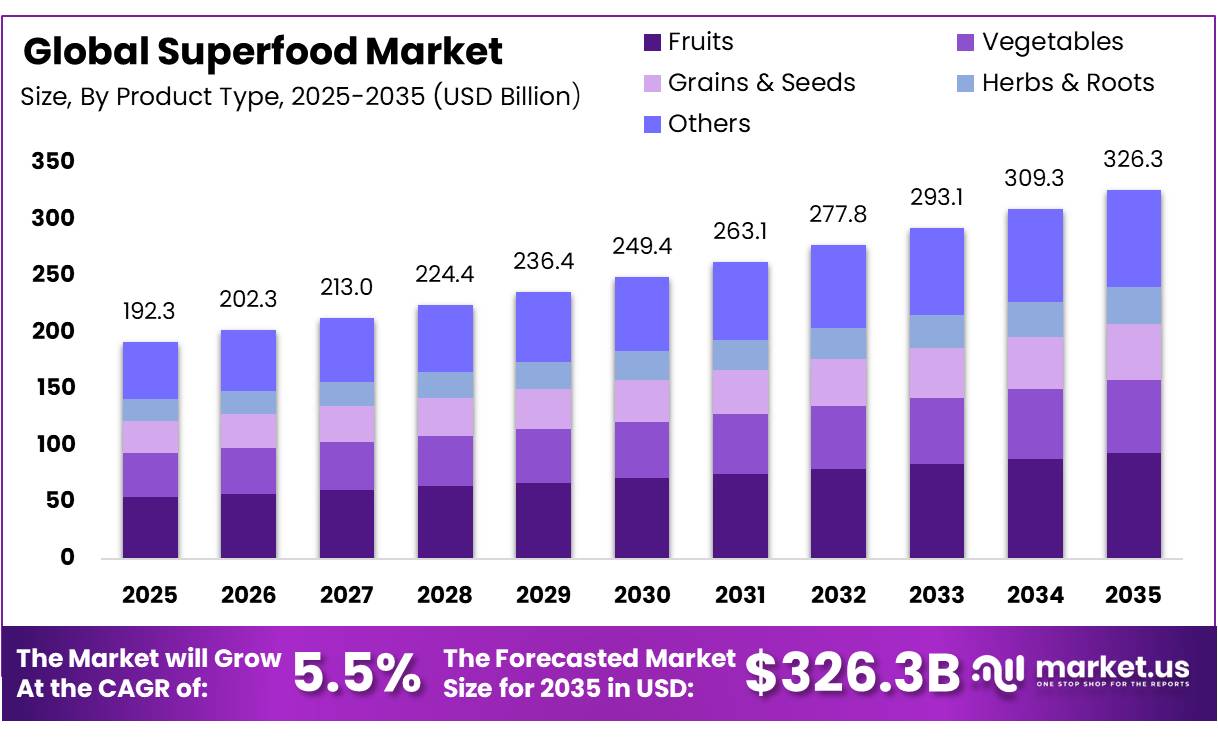
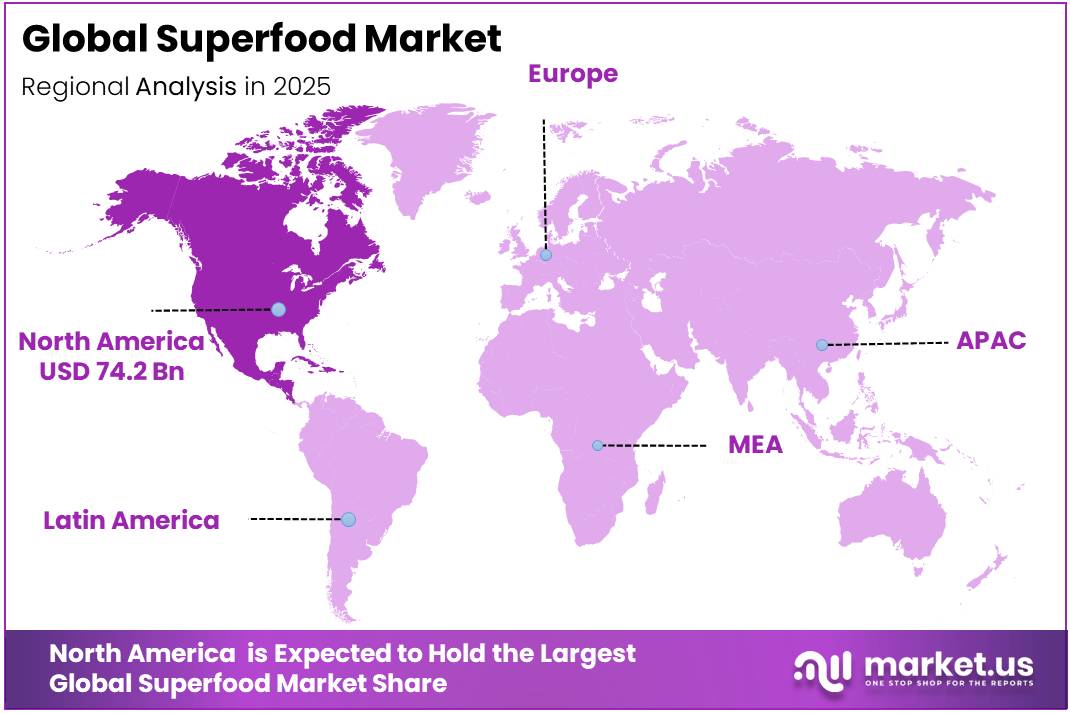
In 2025, the Global Superfood Market was valued at USD 192.3 billion, and between 2026 and 2035, this market is estimated to register a CAGR of 5.5%, reaching about USD 326.3 billion by 2035. North America held a dominant market position, capturing more than a 38.60% share, holding USD 74.2 billion in revenue.
The global superfoods market has emerged as a critical segment within the food and nutrition industry, driven by a worsening global burden of diet-linked chronic illness. According to the World Health Organization (WHO), noncommunicable diseases (NCDs) killed at least 43 million people in 2021, equivalent to 75% of non-pandemic-related deaths globally.
- Cardiovascular diseases accounted for at least 19 million of those deaths, followed by cancers at 10 million, chronic respiratory diseases at 4 million, and diabetes at over 2 million. Unhealthy diets are formally identified by the WHO alongside tobacco use, physical inactivity, and harmful alcohol use as a primary behavioural risk factor driving NCD deaths, establishing a direct and sustained demand base for nutrient-dense food categories including superfoods.
Key Takeaways
- The global superfood market was valued at US$ 192.3 billion in 2025.
- The global superfood market is projected to grow at a CAGR of 5.5% and is estimated to reach US$ 326.3 billion by 2035.
- On the basis of product type, fruits dominated the market, constituting 28.60% of the total market share.
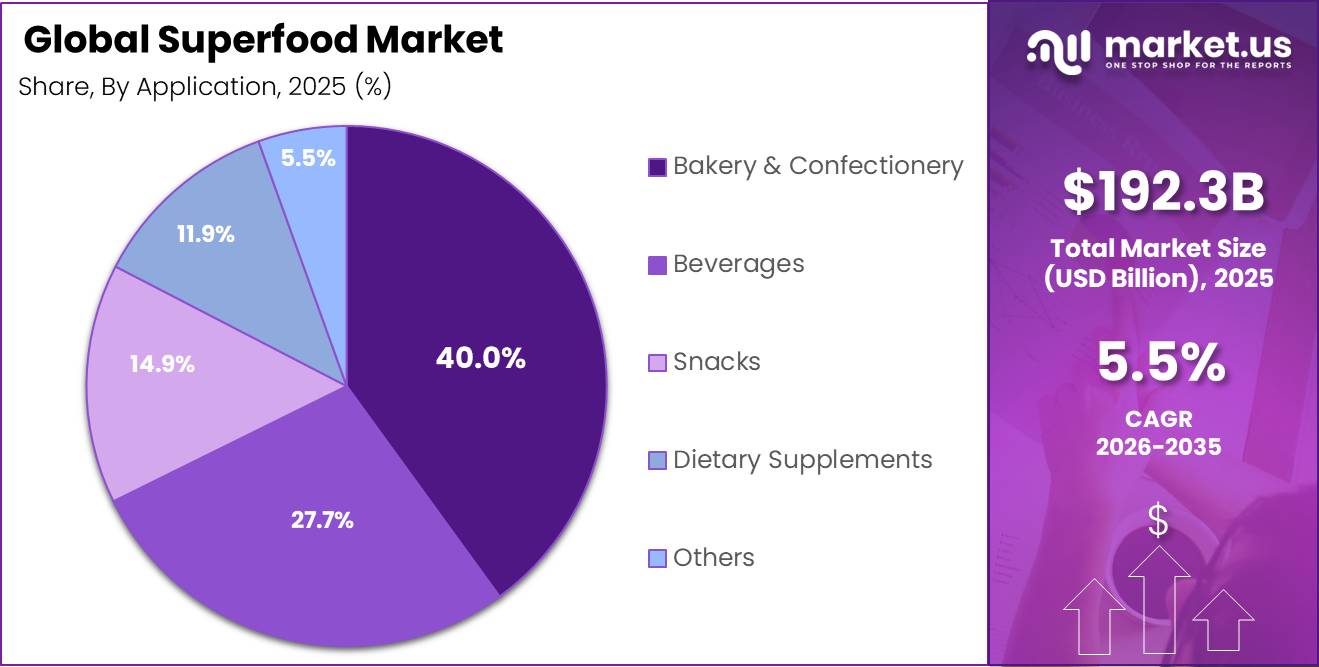
- Based on the application, bakery & confectionery dominated the market, accounting for 40.0% of the total market share.
- Based on the distribution channel, supermarkets & hypermarkets dominated the market, holding 63.4% of the total market share.
- In 2025, North America was the dominant region in the superfood market, accounting for 38.60% of the total global market.
The industrial scenario reflects a sector transitioning from niche wellness into mainstream food retail and dietary supplement channels globally. Of all NCD deaths, 73% occur in low- and middle-income countries, and 82% of premature NCD deaths among people below 70 years of age are also concentrated in these markets, per the WHO NCD Fact Sheet. These figures signal that superfoods demand is not limited to high-income markets but extends across a broad and expanding global consumer base. The four key NCD disease groups, cardiovascular diseases, cancers, chronic respiratory diseases, and diabetes, collectively account for 80% of all premature NCD deaths, reinforcing the scale of dietary intervention required and the commercial opportunity for preventive nutrition products.
On the regulatory front, the U.S. Food and Drug Administration (FDA) finalized an updated definition of the “healthy” nutrient content claim on December 19, 2024, marking its first revision since 1994. Under the updated criteria, nutrient-dense foods including avocados, nuts, seeds, higher-fat fish such as salmon, and olive oil now automatically qualify to use the “healthy” label claim on food packaging, a direct policy benefit for superfood producers. The FDA noted that in the current marketplace, approximately 5% of foods carry the “healthy” label, underscoring significant room for growth as more products reformulate to meet the updated standards.
- From a government initiative standpoint, the U.S. Department of Agriculture (USDA) and the U.S. Department of Health and Human Services (HHS) jointly released the Dietary Guidelines for Americans 2025–2030 on January 7, 2026, describing it as the most significant reset of federal nutrition policy in decades. The guidelines explicitly state that more than 70% of American adults are overweight or obese, and that nearly 1 in 3 adolescents has prediabetes.
The guidelines prioritize whole, nutrient-dense foods including vegetables, fruits, whole grains, nuts, seeds, seafood, and healthy fats as the foundation of healthy eating patterns, providing structural federal policy support that directly benefits superfood producers and reinforces long-term commercial growth opportunities globally.
By Product Type
Fruits dominates with 28.60% share due to strong consumer preference for naturally nutrient rich foods.
In 2025, Fruits held a dominant market position, capturing more than a 28.60% share of the global superfood market. The segment remained ahead because fruits are widely recognized as natural sources of vitamins, minerals, fiber, and antioxidants, making them a regular part of daily diets across many countries. Public nutrition guidance issued by government bodies continued to encourage higher fruit intake as part of healthy eating patterns, supporting consistent demand for fresh, frozen, dried, and minimally processed fruit products.
The Grains & Seeds segment is projected to be the fastest growing segment during the forecast period. Rising interest in whole food nutrition and plant based eating has increased the use of grains and seeds in everyday meals and packaged foods. The government dietary recommendations continued to promote whole grains as part of a healthy diet, encouraging consumers to include nutrient dense grain and seed products in their daily food choices.
By Application
Bakery & Confectionery dominates with 40.00% share due to its broad use of superfood ingredients in everyday food products.
In 2025, Bakery & Confectionery held a dominant market position, capturing more than a 40.00% share of the global superfood market. The segment maintained its leading position because superfood ingredients such as fruits, grains, seeds, and plant based powders are widely used in baked products, breakfast items, cereal bars, cookies, and healthier confectionery options. Consumers continued to look for food products that combine convenience with better nutrition, encouraging manufacturers to include natural and nutrient rich ingredients in bakery formulations.
The Beverages segment is projected to be the fastest growing segment during the forecast period. The demand for beverages made with fruits, herbs, seeds, and other natural ingredients continued to increase as consumers preferred drinks with simple ingredient lists and added nutritional value. Public health guidance continued to encourage healthier beverage choices, supporting the development of superfood based juices, smoothies, functional drinks, and plant based beverages.
By Distribution Channel
Supermarkets & Hypermarkets dominate with 63.40% share due to their wide product selection and strong consumer reach.
In 2025, Supermarkets & Hypermarkets held a dominant market position, capturing more than a 63.40% share of the global superfood market. The segment remained the leading distribution channel because it offers consumers easy access to a wide variety of fresh, packaged, and organic superfood products under one roof. Large retail stores continued to expand their healthy food sections, making superfoods more visible and convenient for everyday shopping. Government food safety authorities also maintained strict labeling and food safety standards for products sold through organized retail, helping strengthen consumer confidence in purchasing superfoods from supermarkets and hypermarkets.
The Online Stores segment is projected to be the fastest growing segment during the forecast period. The online grocery shopping continued to expand as consumers increasingly preferred the convenience of home delivery, wider product availability, and easy price comparison. Government agencies responsible for consumer protection and food safety continued to strengthen regulations for e commerce food sales, improving transparency and consumer trust in online purchases.
Key Market Segments
By Product Type
- Fruits
- Vegetables
- Grains & Seeds
- Herbs & Roots
- Others
By Application
- Bakery & Confectionery
- Beverages
- Snacks
- Dietary Supplements
- Others
By Distribution Channel
- Supermarkets & Hypermarkets
- Online Stores
- Convenience Stores
- Specialty Stores
- Others
Driver Analysis
Preventive nutrition demand
Preventive nutrition is the largest near-term demand catalyst because consumers increasingly connect daily food purchases with metabolic health, energy management, immunity, digestive wellness, and healthy ageing rather than treating nutrition as an occasional supplement purchase. The demand foundation is structurally large: noncommunicable diseases caused at least 43 million deaths globally in 2021, equivalent to 75% of non-pandemic-related deaths, while cardiovascular diseases alone accounted for at least 19 million deaths; WHO also estimates that 31% of adults were insufficiently active in 2022 and that 1 in 7 people lived with obesity in 2024.
Commercially, the category shifts from low-frequency “wellness discovery” purchases toward repeatable meal occasions: breakfast blends, daily seeds, fortified snacks, protein powders, and functional beverages. Manufacturers can capture higher lifetime value by converting one-off ingredient purchases into 20–30 serving packs, subscriptions, or multipack routines, but value creation depends on making the health proposition tangible through nutrition panels, serving-level protein and fibre content, credible ingredient disclosure, and taste parity with mainstream alternatives.
Drivers Impact Analysis
| Driver | (~) % Impact on CAGR | Geographic Relevance | Impact Timeline |
|---|---|---|---|
| Preventive nutrition demand | +1.7 pp | North America, EU, APAC, GCC | Short term (≤ 2 years) |
| Functional beverages and convenience formats | +1.4 pp | North America, APAC, urban Europe | Short term (≤ 2 years) |
| Plant protein and clean-label reformulation | +1.1 pp | EU, North America, India, Australia | Medium term (2–4 years) |
| E-commerce and quick-commerce access | +1.0 pp | India, China, Southeast Asia, North America | Short term (≤ 2 years) |
| Traceability, claim substantiation and quality systems | +0.7 pp | EU, North America, export corridors | Medium term (2–4 years) |
| Localized sourcing and regenerative supply chains | +0.6 pp | Latin America, Africa, India, EU | Long term (≥ 4 years) |
Restraint Analysis
Premium-price elasticity
Superfoods remain discretionary in many household food budgets because the retail premium is often created by import dependence, small-lot processing, certification, packaging, and trade margins rather than by a commensurate daily-use benefit visible to consumers. A 200–250 g pouch of imported chia, berries, protein powder, or specialty seed blend can represent 10–25 servings, but the per-serving price frequently exceeds that of locally available pulses, oats, peanuts, millets, seasonal fruit, and conventional breakfast staples by 2–5 times; this limits penetration when real disposable-income growth slows or food inflation rises.
The FAO Food Price Index averaged 131.1 points in July 2026—1.0% higher year on year while the cereal component was 6.9% above its July 2025 level, reinforcing sensitivity in markets where food represents a large share of household expenditure. Manufacturers therefore face a difficult mix decision between protecting gross margin through premium packs and pursuing scale with sachets, locally sourced blends, and lower-cost formats; failure to establish a credible price-per-serving proposition can reduce baseline CAGR by an estimated 1.6 percentage points in price-sensitive regions.
Restraint Impact Analysis
| Restraint | (~) % Impact on CAGR | Geographic Relevance | Impact Timeline |
|---|---|---|---|
| Premium-price elasticity | -1.6 pp | India, LATAM, Africa, EU value tiers | Short term (≤ 2 years) |
| Crop and input volatility | -1.3 pp | APAC, Latin America, Africa, import markets | Short term (≤ 2 years) |
| Claims and regulatory fragmentation | -1.1 pp | EU, North America, India, China | Medium term (2–4 years) |
| Traceability and contamination risk | -0.9 pp | North America, EU, export corridors | Medium term (2–4 years) |
| Low awareness and trust dilution | -0.8 pp | India Tier-2/3, Africa, LATAM | Medium term (2–4 years) |
| Channel margin and fulfillment pressure | -0.7 pp | India, North America, Southeast Asia | Short term (≤ 2 years) |
Opportunity Analysis
Personalized nutrition subscriptions
The strategic pivot is to combine dietary preferences, food-frequency questionnaires, allergy exclusions, fitness goals, optionally validated laboratory or wearable inputs, and repeat-purchase behavior into 30-day or 60-day nutrition protocols: for example, low-added-sugar breakfast blends, high-fibre gut-health bundles, plant-protein packs, or age-specific micronutrient-forward food systems.
Digital-health research increasingly frames personalized nutrition around health, lifestyle, behavioral, metabolic, microbiome, and genetic information, but a commercially viable food model does not require expensive genetic testing for every consumer; a ₹500–₹1,500 or $8–$25 onboarding assessment, followed by a 15–25% premium over standard packs, can generate sufficiently differentiated recommendations when linked to periodic reordering.
A successful model can lift annual revenue per active customer by 1.5–2.5 times, raise gross-margin potential by 300–700 basis points through direct-to-consumer mix, and reduce churn by embedding progress tracking, replenishment reminders, recipes, coaching, and product rotation; however, companies must avoid unsubstantiated therapeutic claims and collect health data under applicable privacy rules.
Opportunity Impact Analysis
| Opportunity | (~) % Potential CAGR | Geographic Relevance | Execution Window |
|---|---|---|---|
| Personalized nutrition subscriptions | +1.8 pp | North America, EU, India metros, GCC | Medium term (2–4 years) |
| Mainstream FMCG ingredient licensing | +1.6 pp | North America, EU, APAC | Medium term (2–4 years) |
| Institutional nutrition contracts | +1.4 pp | North America, EU, GCC, urban APAC | Short term (≤ 2 years) |
| Local-crop processing platforms | +1.3 pp | India, Africa, Southeast Asia, LATAM | Long term (≥ 4 years) |
| Upcycled nutrition ingredients | +0.9 pp | EU, North America, Japan, Australia | Medium term (2–4 years) |
| Ingredient-platform M&A roll-ups | +0.8 pp | North America, EU, India, LATAM | Medium term (2–4 years) |
Challenges Analysis
Climate-linked crop variability
Superfood supply chains are structurally exposed to climate variability because many high-value inputs—berries, cacao, coffee, chia, quinoa, nuts, seeds, tropical fruits, algae, and botanicals—depend on localized rainfall, temperature, harvest windows, post-harvest drying capacity, and smallholder production systems, so sales do not stop but planning accuracy deteriorates year after year. A 10–20% harvest shortfall can translate into a 15–35% landed-cost increase where a single ingredient accounts for 25–45% of finished-product cost of goods sold, while moisture variation of only 1–3 percentage points can affect drying yield, shelf life, milling behavior, microbiological risk, and freight weight.
The operational effect is recurring working-capital inflation: brand owners often need to carry 45–90 days of safety inventory for imported ingredients rather than 20–30 days, raising cash tied up in inventory by roughly 50–200% and increasing expiry, oxidation, and storage-loss exposure. The industry response requires multi-origin procurement, indexed supplier contracts, weather-risk mapping, localized buffer processing, crop insurance, and ingredient substitution protocols pre-cleared by regulatory and quality teams; food-supply-chain analysis in 2026 increasingly identifies climate events, geopolitical risk, currency swings, and changing demand as interconnected resilience risks rather than isolated disruptions.
Challenges Impact Analysis
| Challenge | (~) % CAGR Friction | Geographic Relevance | Mitigation Horizon |
|---|---|---|---|
| Climate-linked crop variability | -1.2 pp | LATAM, Africa, APAC import routes | Long term (≥ 4 years) |
| Fragmented supplier traceability | -1.0 pp | EU, North America, APAC corridors | Medium term (2–4 years) |
| Processing skills shortages | -0.8 pp | North America, EU, India, Australia | Medium term (2–4 years) |
| Demand-forecasting inaccuracies | -0.7 pp | E-commerce markets, urban APAC, North America | Short term (≤ 2 years) |
| Multi-SKU manufacturing complexity | -0.6 pp | North America, EU, India | Medium term (2–4 years) |
| Sustainability data integration | -0.5 pp | EU regulatory hubs, export suppliers | Long term (≥ 4 years) |
Geopolitical Impact Analysis
Ongoing Russia-Ukraine Conflict and Its Influence on the Superfood Market.
The continuing Russia-Ukraine conflict has indirectly affected the global superfood market by disrupting agricultural trade, raising transportation costs, and creating uncertainty across food supply chains. Although most superfoods are sourced from regions in South America, Africa, and Asia, higher freight charges, longer shipping routes, and volatility in agricultural inputs have increased production and distribution costs.
- Before the conflict, Ukraine supplied food to nearly 400 million people through its agricultural exports, making any disruption significant for global food trade and logistics. The Food and Agriculture Organization (FAO) also notes that agricultural production and exports from Ukraine remain below pre-war levels because of damaged infrastructure, labour shortages, and transport constraints.
For superfood manufacturers and exporters, these conditions have encouraged broader sourcing strategies and greater investment in supply chain resilience. Companies are reducing dependence on single-origin sourcing by expanding procurement from multiple producing countries, especially for products such as chia, moringa, turmeric, and plant-based powders. Businesses are also increasing inventory planning and strengthening relationships with regional suppliers to reduce delivery risks.
Regional Analysis
North America dominated the Superfood Market with a 38.60% share, valued at USD 74.2 Billion.
In 2025, North America held a dominant position in the global superfood market, accounting for 38.60% of the total market, with a market value of USD 74.2 billion. The region’s leadership is supported by strong consumer demand for nutritious foods, a well-developed retail network, and broad availability of fresh and packaged superfood products. The United States and Canada continue to encourage healthier eating through national dietary guidance that promotes regular consumption of fruits, vegetables, whole grains, legumes, nuts, and seeds as part of balanced diets.
The U.S. Food and Drug Administration (FDA) continues to regulate nutrition labeling and supports transparent food information for packaged foods, while the U.S. Department of Agriculture (USDA) promotes healthy dietary patterns through its nutrition programs and dietary guidance.
- In Canada, Health Canada continues to reinforce healthy eating recommendations through Canada’s Food Guide, which encourages greater intake of plant-based foods and nutrient-rich ingredients. According to the USDA Economic Research Service, total U.S. food expenditures reached USD 2.51 trillion in 2025, reflecting continued consumer spending on food products across retail and foodservice channels.
This strong food purchasing environment, combined with increasing preference for nutrient-dense foods and continued government support for healthy diets, has helped maintain North America’s leading position in the global superfood market. Ongoing product innovation, organized retail expansion, and consumer interest in healthier food choices are expected to support the region’s market strength in the coming years.
Key Regions and Countries Covered
- North America
- The US
- Canada
- Europe
- Germany
- France
- The UK
- Spain
- Italy
- Russia & CIS
- Rest of Europe
- APAC
- China
- Japan
- South Korea
- India
- ASEAN
- Rest of APAC
- Latin America
- Brazil
- Mexico
- Rest of Latin America
- Middle East & Africa
- GCC
- South Africa
- Rest of MEA
Key Players Analysis
The superfood market is shaped by companies that focus on product quality, ingredient sourcing, and strong brand positioning to stay competitive. Leading players such as Del Monte Foods, Sunfood, Navitas Organics, Amazing Grass, Nutiva, Garden of Life, and Laird Superfood continue to expand their portfolios with organic, plant-based, and nutrient-rich products that match changing consumer preferences. Brands are introducing new blends, powders, snacks, and functional beverages while using clean-label formulations to attract health-conscious buyers.
Competition is also driven by wider distribution, digital sales, and strategic partnerships. Companies including Aduna, Barlean’s, Raw Nutritional, Nature Superfoods, Suncore Foods, OMG! Organic Meets Good, Healthy Truth, and Terrasoul Superfoods are increasing their presence through e-commerce platforms, specialty health stores, supermarkets, and direct-to-consumer channels.
Investments in attractive packaging, marketing campaigns, and influencer collaborations help improve product visibility and customer engagement. Many brands are also expanding into international markets through retail partnerships and distribution agreements while maintaining strict quality standards and food safety certifications.
Market Key Players
- Del Monte Foods
- Sunfood
- Navitas Organics
- Amazing Grass
- Nutiva
- Garden of Life
- Laird Superfood
- Aduna
- Barlean’s
- Raw Nutritional
- Nature Superfoods
- Suncore Foods
- OMG! Organic Meets Good
- Healthy Truth
- Terrasoul Superfoods
Key Development
- In March 2026, Laird Superfood completed the acquisition of Navitas Organics (Navitas LLC) for $38.5 million in cash, funded through a $50.0 million Series a Convertible Preferred Stock placement to affiliates of Nexus Capital Management, LP, uniting two organic superfood brands under a single functional nutrition platform.
- In March 2026, Fresh Del Monte Produce completed the acquisition of select Del Monte Foods Corporation II Inc. assets for approximately $285 million, reuniting the Del Monte brand under a single owner for the first time in nearly four decades, integrating shelf stable packaged and refrigerated product lines across operations in the U.S., Mexico, and Venezuela.
- In April 2026, Laird Superfood announced the acquisition of Terrasoul Superfoods, LLC for $48 million in cash plus an earnout of up to $5 million, funded through a $60 million Series a Convertible Preferred Stock placement to affiliates of Nexus Capital Management, LP, adding a vertically integrated superfoods brand spanning nuts, seeds, dried fruits, and functional beverage mix ins.
Report Scope
| Report Features | Description |
|---|---|
| Market Value (2025) | USD 192.3 Bn |
| Forecast Revenue (2035) | USD 326.3 Bn |
| CAGR (2026 2035) | 5.5% |
| Base Year for Estimation | 2025 |
| Historic Period | 2020 2024 |
| Forecast Period | 2026 2035 |
| Report Coverage | Revenue Forecast, Market Dynamics, Competitive Landscape, Recent Developments |
| Segments Covered | By Product Type (Fruits, Vegetables, Grains & Seeds, Herbs & Roots, and Others), By Application (Bakery & Confectionery, Beverages, Snacks, Dietary Supplements, and Others), By Distribution Channel (Supermarkets & Hypermarkets, Online Stores, Convenience Stores, Specialty Stores, and Others) |
| Regional Analysis | North America – The US & Canada; Europe – Germany, France, The UK, Spain, Italy, Russia & CIS, Rest of Europe; APAC China, Japan, South Korea, India, ASEAN & Rest of APAC; Latin America Brazil, Mexico & Rest of Latin America; Middle East & Africa GCC, South Africa, & Rest of MEA |
| Competitive Landscape | Del Monte Foods, Sunfood, Navitas Organics, Amazing Grass, Nutiva, Garden of Life, Laird Superfood, Aduna, Barlean’s, Raw Nutritional, Nature Superfoods, Suncore Foods, OMG! Organic Meets Good, Healthy Truth, Terrasoul Superfoods, and Other Players. |
| Customization Scope | Customization for segments, region/country level will be provided. Moreover, additional customization can be done based on the requirements. |
| Purchase Options | We have three licenses to opt for: Single User License, Multi User License (Up to 5 Users), Corporate Use License (Unlimited Users and Printable PDF) |





































