


Report Overview
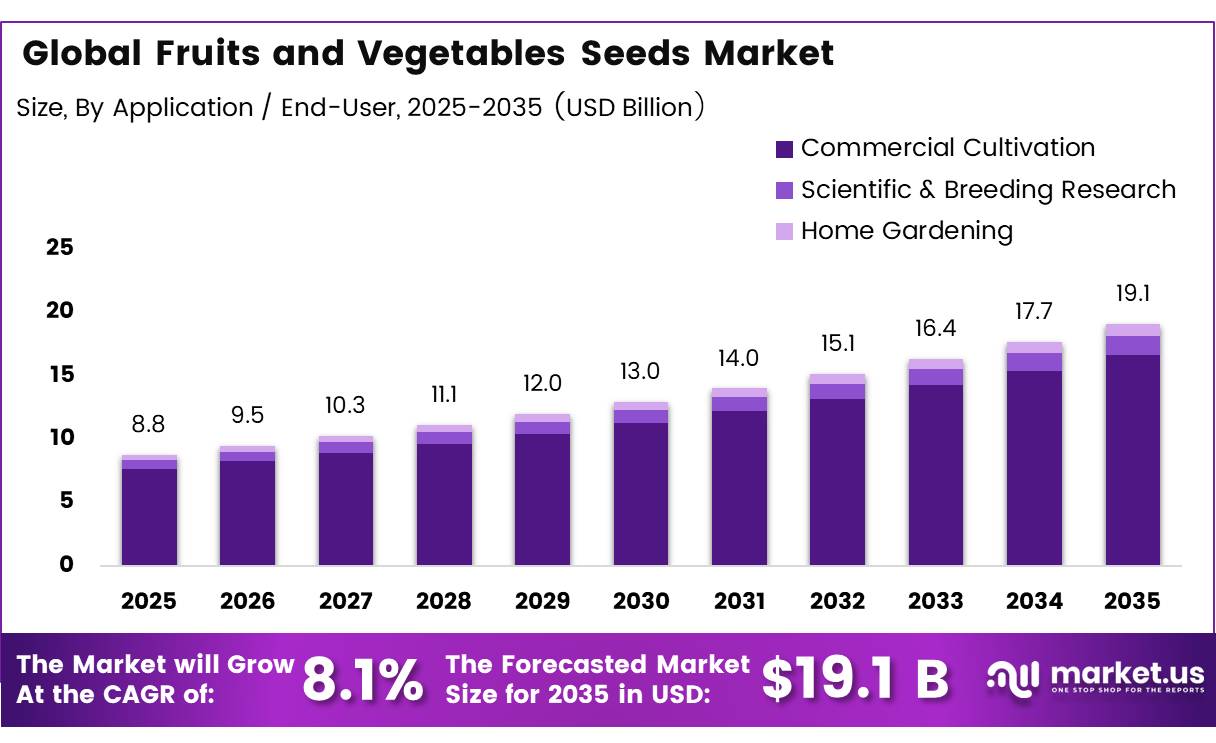
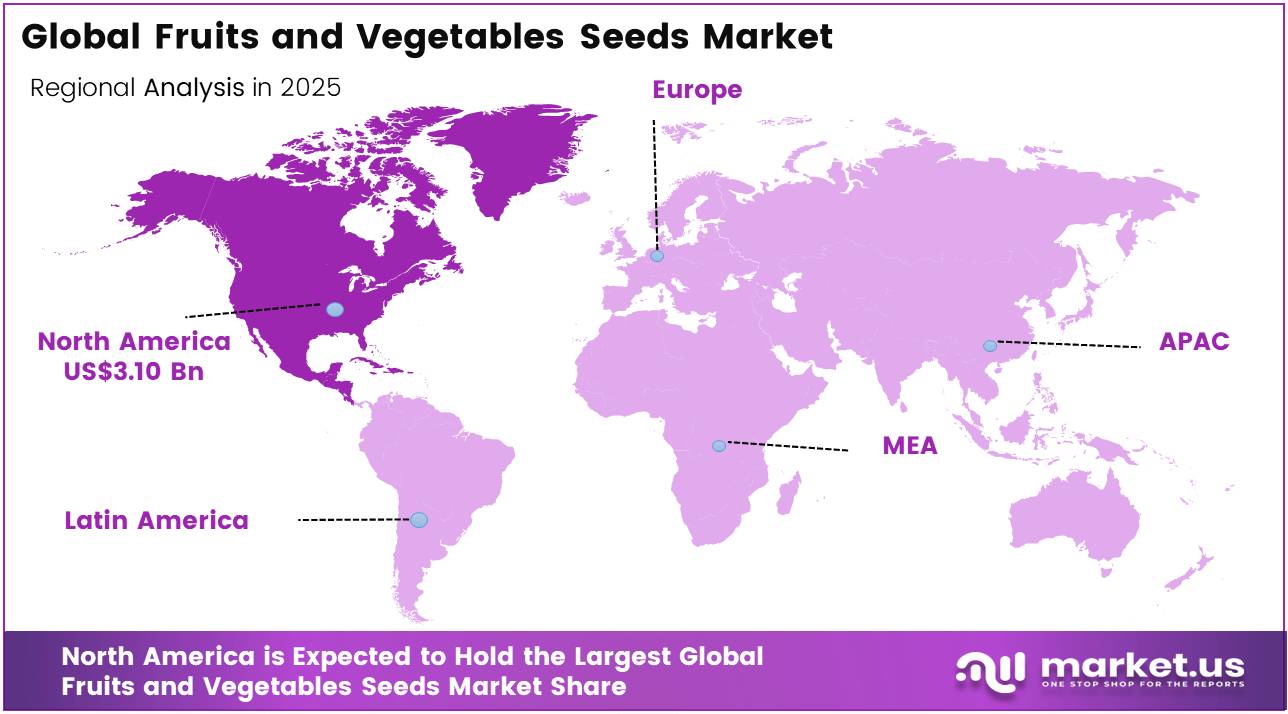
In 2025, the Global Fruits and Vegetables Seeds Market was valued at USD 8.8 billion, and between 2026 and 2035, this market is estimated to register a CAGR of 8.1%, reaching about USD 19.1 billion by 2035. In 2025, North America held a dominant market position, capturing more than a 35.30% share, holding USD 3.10 Billion revenue.
The fruits and vegetables seeds industry is supported by expanding produce cultivation, hybrid replacement, and demand for uniform crop quality. FAO reported that global fruit and vegetable production reached 2.1 billion tonnes, increased by 1% annually, while total primary crop production stood at 9.9 billion tonnes. This large cultivation base sustains recurring demand for high-germination seeds with improved yield, shelf life, disease resistance, and crop consistency across commercial farming regions.
Government support is strengthening research, seed development, and grower competitiveness. In September 2025, USDA awarded USD 72.9 million through the Specialty Crop Block Grant Program across 56 states and territories, covering 586 projects. The initiative specifically supports the development of improved seed varieties, specialty crop research, pest management, food safety, and distribution efficiency, encouraging growers to adopt better fruit and vegetable genetics.
Future opportunities will emerge from climate-resilient breeding, protected cultivation, and precision agriculture. OECD-FAO projects global agricultural production value to rise 14%, reaching USD 3.96 trillion by 2034, while 83% of crop production growth is expected to result from yield improvements. These conditions should increase investment in heat-tolerant, drought-resistant, disease-resistant, greenhouse-specific varieties, biological seed treatments, faster breeding technologies, and regional seed customization.
Key Takeaways
- The global Fruits and Vegetables Seeds market was valued at USD 8.8 billion in 2025.
- The global market is projected to grow at a CAGR of 19.1% and is estimated to reach USD 19.1 billion by 2035.
- On the basis of battery type, the Solanaceae dominated the market, constituting 41.7% of the total market share.
- Based on the trait, the Conventional Seeds dominated the Fruits and Vegetables Seeds market, with a substantial market share of around 94.2%.
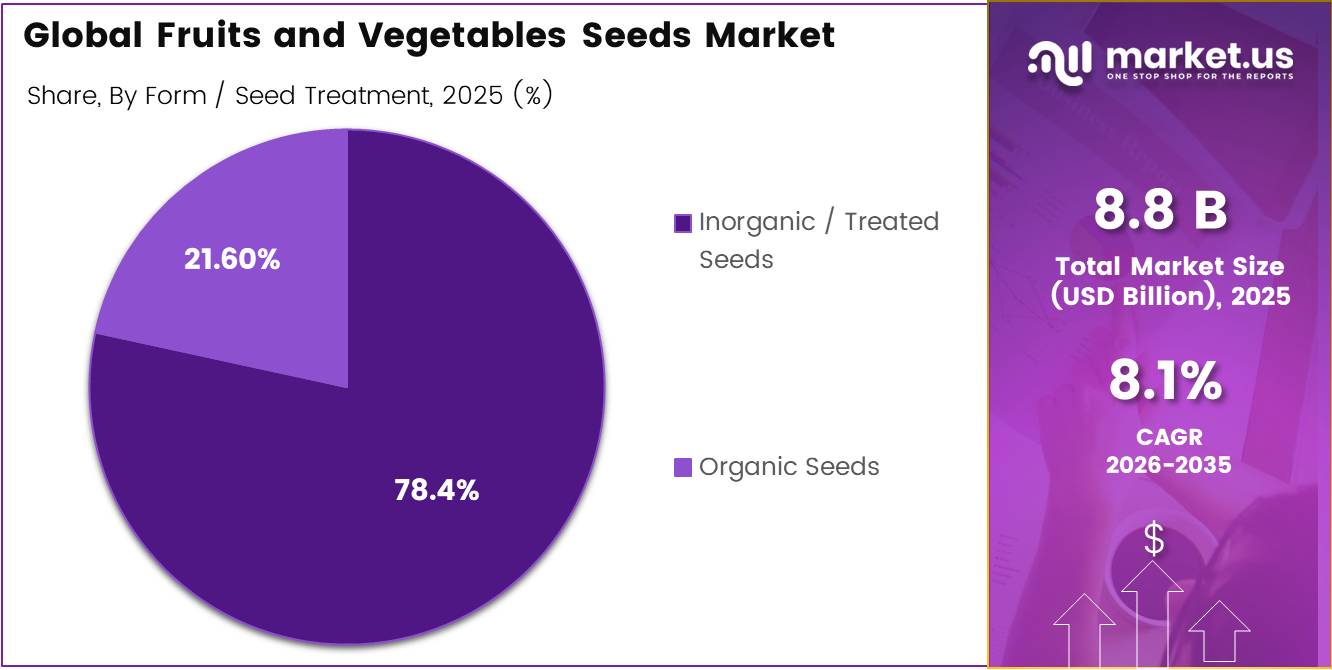
- Based on the By Form / Seed Treatment, Inorganic / Treated Seeds led the market, comprising 78.4% of the total market.
- Among the Application / End-User, the Commercial Cultivation held a major share in the Fruits and Vegetables Seeds market, 87.0% of the market share.
- In 2025, the Asia Pacific was the most dominant region in the Fruits and Vegetables Seeds market, accounting for 35.30% of the total global consumption.
Type Analysis
Solanaceae represents dominant Segment in the Market.
Solanaceae leads with a 41.70% share due to strong commercial demand for tomato, pepper, and eggplant seeds. The segment benefits from frequent hybrid-seed replacement, protected cultivation, processing demand, and breeding for disease and heat resistance. USDA forecast California’s processing tomato production at 11.0 million tons, with an average yield of 55.0 tons per acre. This large production base encourages investment in seeds offering uniform maturity, firm fruit, longer shelf life, and suitability for mechanical harvesting.
Cucurbit is the growing segment, supported by steady consumption of cucumbers, squash, pumpkins, melons, and other protected-cultivation crops. USDA recorded Florida cucumber production at 3.485 million cwt, with productivity of 205 cwt per acre and a production value of USD 61.072 million. These conditions create opportunities for mildew-resistant, virus-tolerant, high-yielding, and greenhouse-adapted cucurbit seed varieties
Trait Analysis
Conventional Seeds a significant trait.
Conventional Seeds lead with a 94.20% share, supported by familiar cultivation practices, broad varietal availability, lower regulatory complexity, and dependable grower acceptance. USDA reported vegetable and melon production estimates for 28 crops, while sweet corn and tomatoes were the 2 largest crops by harvested area. This wide production base keeps demand strong for conventional hybrid and open-pollinated seeds offering uniform germination, disease resistance, storage quality, and dependable field performance.
Genetically Modified and Biotech Seeds are the growing segment, driven by interest in faster breeding, pest resistance, climate tolerance, and reduced crop losses. FDA identifies 5 fresh produce categories available in GMO varieties, including potatoes, squash, apples, papayas, and pink pineapples. USDA restored 3 biotechnology regulatory processes during 2025, while herbicide-tolerant soybean seed adoption reached 96%, showing wider farmer confidence in biotech genetics and supporting future opportunities in specialized fruit and vegetable varieties.
Form / Seed Treatment Analysis
Inorganic / Treated Seeds Are the Most Widely Used Form / Seed Treatment.
Inorganic and treated seeds lead with a 78.40% market share, supported by their reliable germination, seedling protection, planting accuracy, and suitability for large commercial farms. USDA reported that U.S. tomato cultivation covered 261,900 harvested acres, produced 235.532 million cwt, and generated USD 1.966 billion in utilized production. This production scale encourages growers to select treated seeds that support uniform crop establishment and reduce early-stage production risks.
Organic seeds are the growing segment, supported by expanding certification assistance, farmer training, and public investment in organic crop systems. In November 2025, USDA’s NIFA invested USD 6.4 million across 7 Organic Transitions Program awards. USDA’s Transition to Organic Partnership Program is also investing up to USD 100 million over 5 years, improving technical support and creating stronger opportunities for certified organic fruit and vegetable seeds.
Application / End-User Analysis
Commercial Cultivation Held a Major Share of the Fruits and Vegetables Seeds Market.
Commercial Cultivation leads with an 87.00% market share, supported by recurring seed purchases, large planting areas, consistent quality requirements, and demand for high-yield varieties. USDA reported that California strawberry cultivation covered 45,000 harvested acres, produced 27.7 million cwt, and generated USD 3.68 billion in production value. This commercial scale strengthens demand for fruit and vegetable seeds offering uniform germination, predictable maturity, disease resistance, and better harvesting performance.
Scientific and Breeding Research is the growing segment, driven by climate pressure, crop diseases, and the need for stronger seed genetics. In May 2025, USDA’s NIFA invested nearly USD 23 million in 14 citrus research projects, including 1 coordinated project using gene editing to accelerate non-transgenic, disease-tolerant varieties. Such public research funding supports faster breeding, genomic selection, improved seed traits, and more resilient commercial varieties.
Key Market Segments
By Type
- Solanaceae
- Tomato
- Pepper (Bell & Chili)
- Eggplant
- Cucurbit
- Cucumber
- Melon & Watermelon
- Squash & Pumpkin
- Brassica
- Cabbage
- Broccoli & Cauliflower
- Kale & Brussels Sprouts
- Root & Bulb
- Onion & Shallot
- Carrot & Radish
- Garlic & Leek
- Leafy Vegetables
- Lettuce
- Spinach
- Celery
- Fruits & Other Crops
- Berries (Strawberry, Blueberry)
- Sweet Corn
- Okra
By Trait
- Conventional Seeds
- Non-Hybrid (Open-Pollinated/Heirloom)
- Hybrid (F1 Hybrids)
- Genetically Modified (GM) / Biotech Seeds
- Insect Resistant
- Herbicide Tolerant
- Stacked Traits
By Form / Seed Treatment
- Organic Seeds
- Inorganic / Treated Seeds
By Application / End-User
- Commercial Cultivation
- Fresh Market Growers
- Processing Industry (Canning, Freezing, Juicing)
- Scientific & Breeding Research
- Academic Institutes
- Private R&D Labs
- Home Gardening
- Retail Consumers
Driver Analysis
EU New Genomic Techniques deregulation unlocking gene-edited vegetable seeds
The new regulation entered into force on July 16, 2026, and will be fully applied by July 17, 2028, establishing a two-tier classification system in which Category 1 NGT plants, defined as those with small targeted genetic changes such as substitutions or insertions of fewer than 20 nucleotides, deletions, or other changes achievable through traditional breeding, are now treated like conventionally bred plants and exempted entirely from GMO regulations, while Category 2 NGT plants continue to face full risk assessment and authorization procedures as GMOs.
This deregulation strategically transforms the addressable innovation pipeline for European vegetable seed breeders, allowing companies to pursue precision trait editing for disease resistance, shelf-life extension, and climate tolerance using the same faster, lower-cost development pathway already available to competitors in the Americas and parts of Asia, effectively removing a multi-year competitive disadvantage; breeders can now expect development-to-market timelines for Category 1 edited varieties to compress meaningfully compared with the traditional 8-12 year conventional breeding cycle, though full commercial benefit will phase in gradually as the two-year implementation runway to 2028 plays out and companies build edited-variety pipelines.
Drivers Impact Analysis
| Driver | (~) % Impact on CAGR Forecast | Geographic Relevance | Impact Timeline |
|---|---|---|---|
| Accelerating hybrid seed penetration replacing open-pollinated varieties | +1.8% | APAC core (India, China, SE Asia), Latin America | Medium term (2-4 years) |
| EU New Genomic Techniques deregulation unlocking gene-edited vegetable seeds | +1.5% | EU core, spillover to UK, Switzerland | Long term (≥ 4 years) |
| Protected cultivation and greenhouse expansion lifting specialty seed demand | +1.3% | APAC core, EU, Middle East, North America | Medium term (2-4 years) |
| Climate-resilient breeding responding to erratic weather and heat stress | +1.2% | APAC, Africa, Latin America, South Asia | Short term (≤ 2 years) |
| Government-backed genome-editing regulatory streamlining in emerging economies | +1.0% | India, Argentina, Pakistan, APAC emerging | Medium term (2-4 years) |
| Rising commercial horticulture and cash-crop diversification among smallholders | +0.8% | India, Southeast Asia, Sub-Saharan Africa | Long term (≥ 4 years) |
Restraint Analysis
Statutory price control provisions under India’s Seeds Bill
India’s draft Seeds Bill, 2025, introduced in the ongoing budget session, represents a direct structural restraint on seed company pricing power because it explicitly grants the government authority to impose price control mechanisms during emergencies, cases of monopolization, or profiteering, extending a regulatory precedent already established for Bt cotton, where the government fixed ceiling prices via notification under the Essential Commodities Act 1955, setting the bar price for a 475-gram cotton seed packet at Rs 635 for BGI and Rs 901 for BGII for the 2025-26 fiscal year.
Commentary on the draft bill has specifically flagged that it avoids establishing a statutory compensation system for farmers while simultaneously leaving broader seed price escalation largely unregulated in normal conditions, but the discretionary price-control trigger itself introduces material uncertainty for hybrid vegetable seed companies operating in India, since any future extension of price ceilings to high-value hybrid vegetable categories, following the cotton precedent, could compress per-packet margins by an estimated 15-25% based on the gap observed between unregulated hybrid vegetable seed pricing and the government-mandated cotton seed ceiling structure.
For multinational and domestic seed companies alike, this restraint forces conservative pricing strategies and delays premium product launches in India, since companies must now factor regulatory intervention risk into R&D payback models for new hybrid and gene-edited vegetable varieties, potentially extending investment payback periods by 1-2 years in categories perceived as politically sensitive to farmer input costs.
Restraint Impact Analysis
| Restraint | (~) % Impact on CAGR Forecast | Geographic Relevance | Impact Timeline |
|---|---|---|---|
| Statutory price control provisions under India’s Seeds Bill | -1.5% | India core, APAC spill-over on precedent risk | Medium term (2-4 years) |
| Counterfeit and spurious seed penetration eroding brand trust | -1.4% | India, Sub-Saharan Africa, Southeast Asia | Short term (≤ 2 years) |
| Seed patent litigation and antitrust scrutiny | -1.0% | North America core, EU | Medium term (2-4 years) |
| Climate-driven seed production and quality losses | -1.2% | APAC, Africa, Latin America production belts | Short term (≤ 2 years) |
| Regulatory fragmentation on gene-edited seed acceptance | -0.9% | EU (non-aligned states), APAC mixed-adoption markets | Long term (≥ 4 years) |
| Rising input and multiplication cost inflation | -0.8% | Global, India, EU parent-seed production zones | Short term (≤ 2 years) |
Opportunity Analysis
Blockchain-based seed authentication as a monetized trust service
Blockchain seed traceability systems assign blockchain-stamped QR codes to every seed bag at the conditioning plant, linked to lot ID, germination test results, and variety certification, enabling farmers to verify authenticity, purity, and quality before purchase, a capability increasingly being deployed across India’s broader agricultural supply chain under government-backed initiatives including the Digital Agriculture Mission’s roughly INR 14,000 crore digital public infrastructure investment and the Farmer ID programme targeting 11 crore farmers by 2026-27.
The commercial white space lies in seed companies converting this traceability infrastructure from a pure compliance cost into a premium-tier product offering, where farmers pay a small verified-authenticity premium, potentially 3-5% above standard hybrid seed pricing, in exchange for blockchain-verified purity guarantees, crop insurance eligibility tied to verified seed sourcing, and downstream export certification support for high-value horticultural exports; this differs fundamentally from the counterfeit-mitigation restraint discussed elsewhere because it reframes traceability from a defensive necessity into an active monetization layer and brand-differentiation tool, most immediately actionable in India, Sub-Saharan Africa, and Southeast Asia where counterfeit exposure is highest and willingness to pay for verified authenticity is emerging fastest.
Opportunity Impact Analysis
| Opportunity | (~) % Potential CAGR Upside | Geographic Relevance | Execution Window |
|---|---|---|---|
| Vertical farming-specific seed variety development | +1.8% | APAC core (India, China, Japan), North America, EU | Medium term (2-4 years) |
| Blockchain-based seed authentication as a monetized trust service | +1.4% | India, Sub-Saharan Africa, Southeast Asia | Short term (≤ 2 years) |
| Direct-to-farmer digital seed commerce bypassing dealer networks | +1.3% | India (Tier 2/3), Southeast Asia, Africa | Medium term (2-4 years) |
| Precision agriculture-linked variety recommendation and data monetization | +1.1% | North America, EU, APAC commercial farms | Long term (≥ 4 years) |
| M&A roll-up of fragmented regional and domestic seed producers | +1.0% | India, Southeast Asia, Latin America | Medium term (2-4 years) |
| Seed-as-a-Service subscription bundling agronomy and inputs | +0.8% | North America, EU, APAC commercial horticulture | Long term (≥ 4 years) |
Challenges Analysis
Chronic plant breeder talent shortage
Research conducted across three continents by CSIRO in Australia, Lincoln University in New Zealand, and McGill University in Canada found in 2024 that a lack of scientists specialized in plant breeding could lead to dire food security implications globally, with the shortage most acute in public-sector breeding programs at universities and research institutes, as private agribusiness salaries increasingly draw talent away from academic training pipelines that are responsible for producing the next generation of breeders.
For seed companies, this translates into extended variety development timelines, with internal breeding-capacity modeling suggesting that understaffed breeding teams can experience 15-25% longer time-to-market for new hybrid releases compared with fully staffed programs, directly slowing the pace at which companies can respond to emerging climate-resilience and gene-editing opportunities discussed elsewhere in this framework.
Challenges Impact Analysis
| Challenge | (~) % CAGR Friction Drag | Geographic Relevance | Mitigation Horizon |
|---|---|---|---|
| Chronic plant breeder talent shortage | -1.3% | Global public breeding sector, APAC, Australia | Long term (≥ 4 years) |
| Pollinator decline threatening hybrid seed production | -1.1% | Global, EU, North America, APAC | Long term (≥ 4 years) |
| Cold-chain and germplasm storage infrastructure gaps | -1.0% | India, Sub-Saharan Africa, Southeast Asia | Medium term (2-4 years) |
| Groundwater depletion constraining seed production irrigation | -0.9% | India (Punjab-Haryana belt), North America, APAC | Long term (≥ 4 years) |
| Last-mile agrodealer network fragmentation | -0.8% | Sub-Saharan Africa, South Asia, rural APAC | Medium term (2-4 years) |
| Variety trial and regulatory dossier data-management complexity | -0.7% | EU, North America, APAC multi-market registrants | Medium term (2-4 years) |
Geopolitical Impact Analysis
Geopolitical tension is pushing fruit and vegetable seed companies to diversify production, storage, and export routes. USDA reported that U.S. planting-seed exports reached USD 1.6 billion and 607,927 metric tons in 2025. Although these figures cover the wider planting-seed trade, they show how strongly seed availability depends on cross-border movement.
Tariff disputes, sanctions, port disruption, and bilateral trade changes can therefore delay seasonal deliveries, encouraging suppliers to maintain regional inventories and qualify alternative production locations.
Regulatory separation is adding further cost to seed movement. Under current British plant-health rules, regulated seed exports require inspections costing at least £127.60, while a phytosanitary certificate costs £25.52 and each laboratory sample costs £33.56. Non-EU plant consignments must also be notified at least 4 working hours before arrival by air or roll-on/roll-off freight, or 1 working day before other shipments. These controls support biosecurity but increase documentation, testing, and delivery risk for smaller seed suppliers.
Regional Analysis
North America Held the Largest Share of the Global Fruits and Vegetables Seeds Market.
North America leads with a 35.30% market share, supported by large-scale vegetable cultivation, strong hybrid-seed adoption, advanced breeding programs, and established distribution networks. Statistics Canada reported that regional fruit and vegetable farm-gate value reached a record CAD 3.4 billion, increasing 11.3% annually. Vegetable production also rose 8.0%, strengthening demand for high-germination seeds that provide uniform growth, disease tolerance, and dependable yields for commercial farms.
Asia Pacific is the growing market, driven by expanding horticultural acreage, protected cultivation, rising produce exports, and investment in climate-resilient crop varieties. Australia’s Department of Agriculture forecast horticulture production value to reach a record AUD 19.2 billion in 2025–26. Horticulture exports were projected to increase 8% to AUD 4.7 billion, supported by robust overseas demand. This outlook creates greater opportunities for heat-tolerant, high-yielding, greenhouse-compatible, and locally adapted fruit and vegetable seeds.
Key Regions and Countries Covered
- North America
- The US
- Canada
- Europe
- Germany
- France
- The UK
- Spain
- Italy
- Russia & CIS
- Rest of Europe
- APAC
- China
- Japan
- South Korea
- India
- ASEAN
- Rest of APAC
- Latin America
- Brazil
- Mexico
- Rest of Latin America
- Middle East & Africa
- GCC
- South Africa
- Rest of MEA
Key Players Analysis
Fruits and Vegetables Seeds manufacturers focus on strengthening genetic differentiation, breeding efficiency, and supply chain integration to maintain competitiveness. A key priority is continuous varietal innovation, including the development of hybrid, disease-resistant, climate-tolerant, and high-yield seeds that improve crop uniformity, shelf life, and field performance.
Vertical integration with contract growers, seed processors, and distribution partners helps secure foundation seed availability and improve quality control amid weather-related production risks. Strategic multiplication and processing expansion, particularly across major horticultural regions, enables closer alignment with concentrated demand from commercial growers and protected-cultivation farms.
The Major Players In The Industry
- Bayer AG
- Syngenta Group
- BASF SE
- Groupe Limagrain
- Corteva, Inc.
- KWS SAAT SE & Co. KGaA
- Rijk Zwaan Zaadteelt en Zaadhandel B.V.
- Sakata Seed Corporation
- Takii & Co., Ltd.
- Enza Zaden
- Bejo Zaden B.V.
- East-West Seed
- UPL Limited
- Longping High-Tech
- NongWoo Bio Co., Ltd.
Key Development
- In June 2025 Enza Zaden, opened a 2-hectare R&D expansion in Enkhuizen, including a 1-hectare high-tech greenhouse dedicated to cucumber breeding, an energy center, and 936 solar panels, strengthening vegetable-seed innovation and sustainable capacity.
- In August 2025 Syngenta Group, opened a new Seed Health Lab in the Netherlands and formed a collaboration with Azura Group to test tomato varieties using sensor data, bringing decisions closer to growers.
Report Scope
| Report Features | Description |
|---|---|
| Market Value (2025) | USD 8.8 Bn |
| Forecast Revenue (2035) | USD 19.1 Bn |
| CAGR (2026-2035) | 8.1% |
| Base Year for Estimation | 2025 |
| Historic Period | 2020-2024 |
| Forecast Period | 2026-2035 |
| Report Coverage | Revenue Forecast, Market Dynamics, Competitive Landscape, Recent Developments |
| Segments Covered | By Type (Solanaceae, Cucurbit, Brassica, Root & Bulb, Leafy Vegetables and Fruits & Other Crops), By Trait (Conventional Seeds and Genetically Modified (GM) / Biotech Seeds), By Form / Seed Treatment (Organic Seeds and Inorganic / Treated Seeds), By Application / End-User( Commercial Cultivation, Scientific & Breeding Research and Home Gardening), By Technology (Dry Fruits and Vegetables Seeds and Wet Fruits and Vegetables Seeds), By End Use (Automotive, Consumer electronics, Industrial, and Others) |
| Regional Analysis | North America – The US & Canada; Europe – Germany, France, The UK, Spain, Italy, Russia & CIS, Rest of Europe; APAC– China, Japan, South Korea, India, ASEAN & Rest of APAC; Latin America– Brazil, Mexico & Rest of Latin America; Middle East & Africa– GCC, South Africa, & Rest of MEA |
| Competitive Landscape | Bayer AG — Crop Science, Syngenta Group, BASF SE — Nunhems, Groupe Limagrain, Corteva, Inc., KWS SAAT SE & Co. KGaA, Rijk Zwaan Zaadteelt en Zaadhandel B.V., Sakata Seed Corporation, Takii & Co., Ltd., Enza Zaden, Bejo Zaden B.V., East-West Seed, UPL Limited — Advanta Seeds, Longping High-Tech, NongWoo Bio Co., Ltd. |
| Customization Scope | Customization for segments, region/country-level will be provided. Moreover, additional customization can be done based on the requirements. |
| Purchase Options | We have three licenses to opt for: Single User License, Multi-User License (Up to 5 Users), Corporate Use License (Unlimited Users and Printable PDF) |





































