


Report Overview
The Global Seed Grain Cleaning Grading Machine Market size is expected to be worth around USD 3.9 Billion by 2035, from USD 2.5 Billion in 2025, growing at a CAGR of 4.6% during the forecast period from 2026 to 2035. In 2025, North America held a dominant market position, capturing more than a 39.3% share, holding USD 2.7 Billion revenue.
A seed grain cleaning and grading machine is a specialized agricultural tool used to remove impurities and sort seeds based on physical properties such as size, weight, and density. Its primary purpose is to ensure seed purity and uniformity, which directly improves germination rates and overall crop yields. The seed grain cleaning and grading machine market is shaped by the convergence of global food security demands, regulatory compliance, and technological innovation.
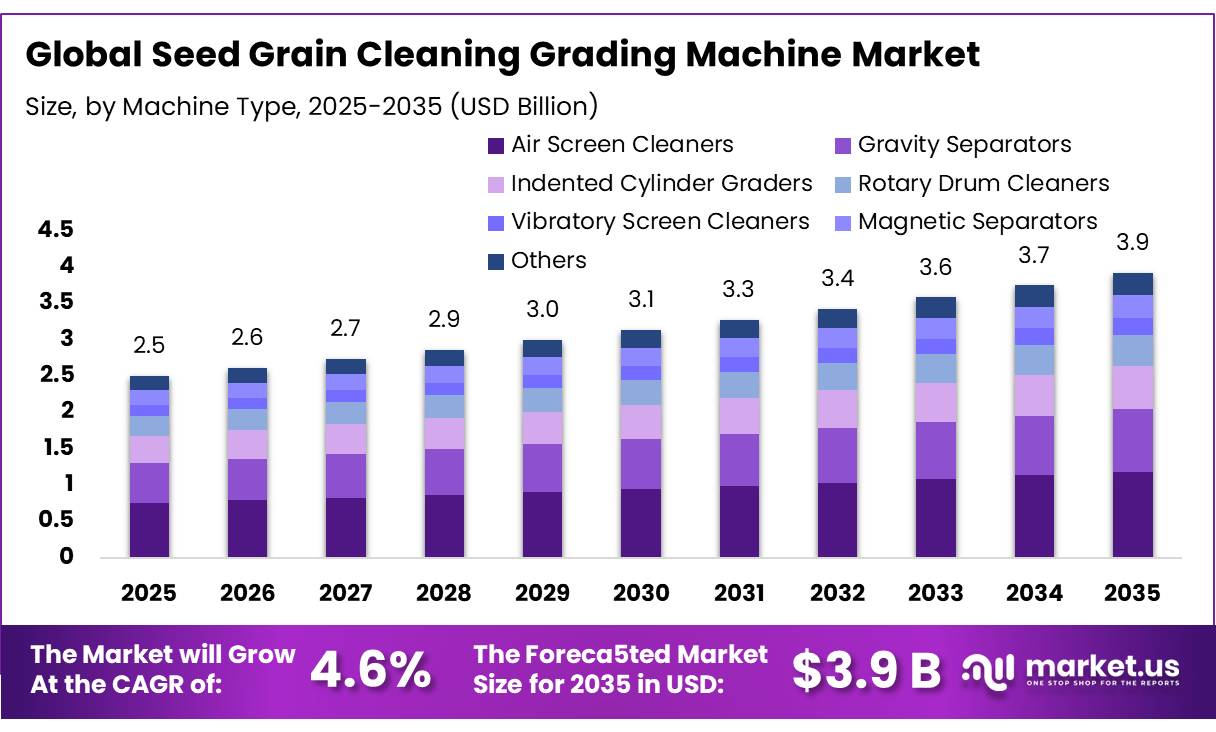
Mechanized cleaning and grading are essential, particularly in cereals and grains, which dominate both production and formal seed certification programs. Medium-capacity, air screen cleaners are the most widely deployed due to their operational flexibility, high throughput, and suitability for diverse crops, whereas specialized machines or high-capacity units are limited by infrastructure and input constraints.
Adoption is further driven by government initiatives that mandate seed processing standards, provide funding for mechanization, and reinforce certification frameworks. Technological trends such as AI-enabled optical sorting and automation enhance precision, reduce labor requirements, and integrate quality monitoring into processing workflows. Distribution predominantly occurs through dealers and distributors, who provide installation, maintenance, and training support, ensuring reliable operation under diverse agro-climatic conditions.
Key Takeaways
- The global seed grain cleaning and grading machine market was valued at USD 2.5 billion in 2025.
- The global seed grain cleaning and grading machine market is projected to grow at a CAGR of 4.6% and is estimated to reach USD 3.9 billion by 2035.
- On the basis of types of seed grain cleaning grading machine, air screen cleaners dominated the market, constituting 30.2% of the total market share.
- Based on the capacity, the medium capacity seed grain cleaning grading machine dominated the market, with a substantial market share of around 45.6%.
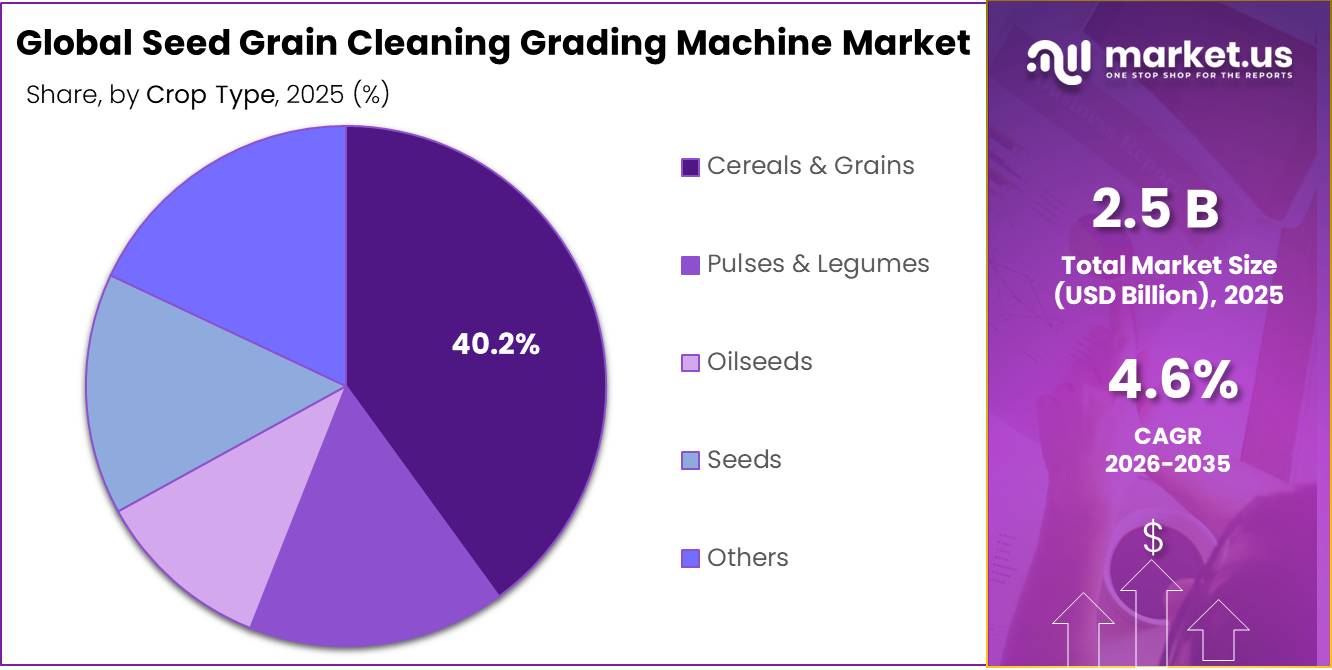
- Based on the crop type, cereals & grains led the market, comprising 40.2% of the total market.
- Among the operations, grading of seed grains held a major share in the market, 26.7% of the market share.
- Among the distribution channels, dealer/distributor is the most considerable within the market, accounting for around 45.6% of the revenue.
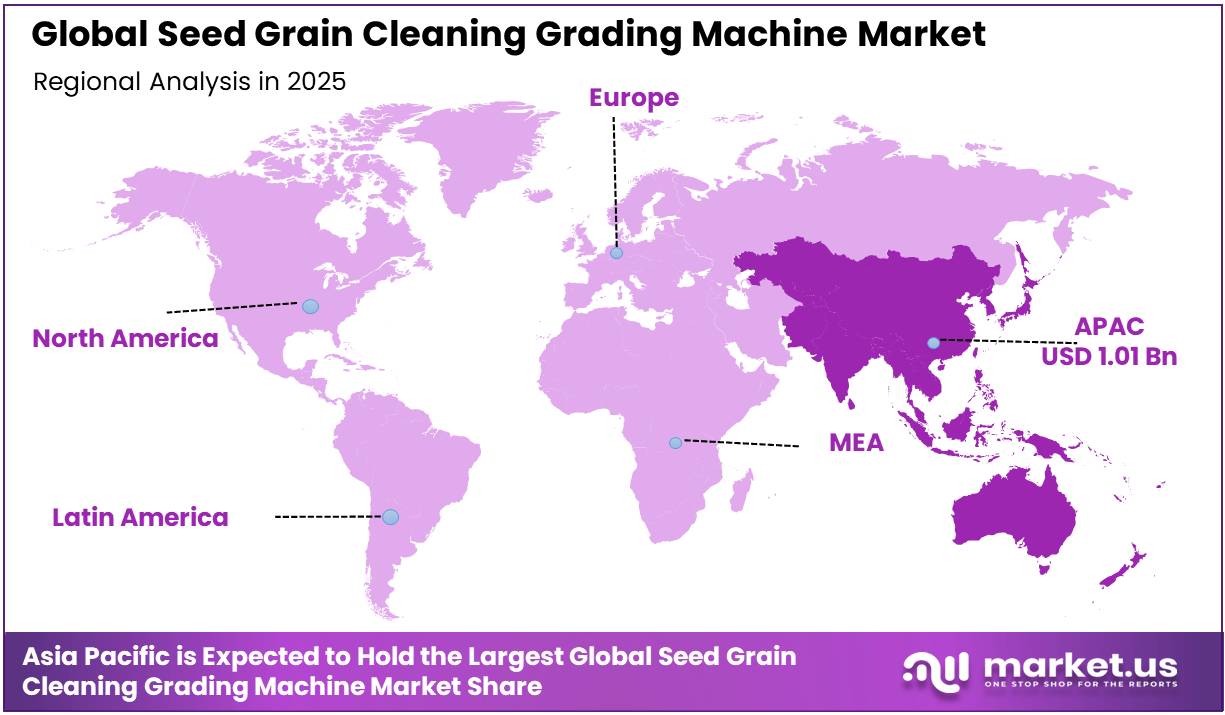
- In 2025, the Asia Pacific was the most dominant region in the seed grain cleaning and grading machine market, accounting for 40.5% of the total global consumption.
Product Type Analysis
Air Screen Cleaners are a Prominent Segment in the Market.
The market is segmented based on types of seed grain cleaning grading machines into air screen cleaners, gravity separators, indented cylinder graders, rotary drum cleaners, vibratory screen cleaners, magnetic separators, and others. The air screen cleaners led the market, comprising 30.2% of the market share, as they provide multi-stage, general-purpose cleaning in a single system, combining screening and aspiration. This allows removal of a broad spectrum of impurities, such as dust, chaff, broken seeds, and oversized or undersized particles, making them suitable as the primary processing step across most crops.
In contrast, machines such as gravity separators or indented cylinder graders perform narrow, secondary functions and require pre-cleaned material for effective operation. Air screen cleaners further offer higher throughput and simpler operation, with fewer calibration variables compared to precision equipment. They are additionally more adaptable to different seed types through interchangeable screens, and require lower technical skill for operation and maintenance.
Capacity Analysis
Medium-Capacity Seed Grain Cleaning and Grading Machines Dominated the Market.
On the basis of capacity, the seed grain cleaning grading machine market is segmented into low capacity, medium capacity, and high capacity. The medium capacity seed grain cleaning grading machines dominated the market, comprising 45.6% of the market share, as they align with the operational scale of most seed systems, balancing throughput, cost, and infrastructure requirements. Medium-capacity systems provide sufficient throughput for cooperative societies, regional seed processors, and public-sector facilities, while maintaining manageable energy consumption and space requirements.
Low-capacity units often lack the processing speed needed during peak post-harvest periods, creating bottlenecks in seed conditioning and certification workflows. In contrast, high-capacity machines require continuous large-volume input, stable power supply, and advanced handling infrastructure, which are not consistently available in many production regions.
Crop Type Analysis
Seed Grain Cleaning Grading Machines Are Most Widely Utilized for Cereals & Grains.
The cereals & grains dominated the seed grain cleaning grading machine market, with a notable market share of 40.2%, as these crops constitute the largest volumes in global and regional agriculture and require standardized post-harvest handling to ensure uniformity, germination, and purity. Cereals such as rice, wheat, and maize produce large, relatively uniform seeds that are compatible with common cleaning, grading, and sizing mechanisms such as air-screen or vibrating systems.
In contrast, pulses, legumes, and oilseeds often have smaller, irregularly shaped, or fragile seeds, which require specialized handling to avoid damage, making standard machines less effective. Additionally, cereals dominate formal seed certification programs and institutional processing, creating consistent, high-throughput demand for mechanized cleaning and grading. This combination of volume, uniformity, and regulatory requirements makes cereals and grains the primary application for these machines.
Operation Analysis
Grading of Seed Grains Held a Major Share of the Market.
Based on the operation, the seed grain cleaning grading machine market is segmented into pre-cleaning, fine cleaning, grading, sorting, and others. Among the operations, 26.7% of the seed grain cleaning grading machines consumed globally are for grading, as uniform seed size and weight directly determine seed quality, germination consistency, and certification compliance. Grading ensures that seeds of similar dimensions are separated, facilitating even planting, mechanical sowing, and standardized packaging, which are essential in formal seed systems.
Pre-cleaning, fine cleaning, and sorting are often either preparatory or specialized operations, typically performed as auxiliary steps using simpler or targeted equipment. While these operations remove dust, debris, or foreign materials, they do not directly influence seed uniformity to the degree that grading does.
Distribution Channel Analysis
Seed Grain Cleaning Grading Machines Are Mostly Sold Through Dealers/Distributors.
Among the distribution channels, 45.6% of the total global consumption of seed grain cleaning and grading machines is sold through dealers/distributors, as these channels provide localized expertise, after-sales support, and installation services critical for complex agricultural equipment. Dealers can offer on-site demonstrations, training, and calibration, ensuring machines operate correctly under varying crop types and regional conditions.
Direct sales or online channels are less effective as buyers often require hands-on guidance for setup, adjustment, and integration with existing seed processing lines, which cannot be adequately provided remotely. Furthermore, agricultural buyers, particularly cooperatives, seed associations, and regional processors, prefer trusted intermediaries who understand local agronomic conditions, government regulations, and operational constraints, making dealer/distributor networks the most reliable and practical channel for machine deployment.
Key Market Segments
By Machine Type
- Air Screen Cleaners
- Gravity Separators
- Indented Cylinder Graders
- Rotary Drum Cleaners
- Vibratory Screen Cleaners
- Magnetic Separators
- Others
By Capacity
- Low Capacity
- Medium Capacity
- High Capacity
By Crop Type
- Cereals & Grains
- Pulses & Legumes
- Oilseeds
- Seeds
- Others
By Operation
- Pre-Cleaning
- Fine Cleaning
- Grading
- Sorting
- Others
By Distribution Channel
- Direct Sales
- Dealer / Distributor
- Online Sales
Drivers
Surge in Quality Standards Drives the Seed Grain Cleaning Grading Machine Market.
Rising global food security pressures and tightening seed quality regulations are structurally reinforcing demand for seed grain cleaning and grading machinery. The Food and Agriculture Organization estimates that global food production must increase by about 60% by 2050 to feed over 9 billion people, making high-quality seed a critical productivity lever.
According to a study, 25-33% of global grain output is lost annually during storage and handling, linked to contamination, impurities, and poor conditioning, issues directly addressed by cleaning and grading processes. Additionally, regulatory regimes further institutionalize this demand. Government seed laws mandate certification, field inspection, and processing-plant controls, with cleaning and grading explicitly required to remove contaminants before certification.
The quality parameters, such as uniform size, low inert matter, and absence of damaged seed, are formally defined and achievable primarily through mechanized processing. The convergence of quantified food loss risks, production expansion targets, and enforceable quality standards creates a non-discretionary, compliance-driven demand base for seed cleaning and grading technologies.
Restraints
High Initial Investment and Infrastructure Constraints Pose Challenges to the Seed Grain Cleaning and Grading Machine Market.
High initial investment and infrastructure deficits constitute binding constraints on the adoption of seed grain cleaning and grading machinery, particularly in developing agricultural systems. Establishing a seed processing facility requires capital-intensive inputs, including land acquisition, civil works, and specialized machinery, including cleaning, sorting, grading, and testing, with machinery forming the largest portion of capital expenditure.
Furthermore, infrastructure requirements are equally stringent. Processing plants must ensure reliable electricity, water supply, transport access, storage, and waste management systems, alongside compliance with environmental and zoning regulations, conditions often unevenly available in rural production zones.
Similarly, the high costs of formal seed certification limit adoption, particularly among smallholders, reinforcing reliance on informal seed systems with minimal mechanized processing. The high upfront capital intensity, coupled with infrastructure and logistics deficiencies, structurally restricts scalable deployment of advanced seed cleaning and grading technologies.
Opportunity
Government Initiatives Create Opportunities in the Seed Grain Cleaning and Grading Machine Market.
Government-led interventions in seed systems are a measurable demand catalyst for seed grain cleaning and grading machinery, primarily through capacity creation, regulatory enforcement, and institutional procurement. The public programs explicitly finance processing infrastructure. For instance, a FAO-Ministry of Agriculture project allocated about US$100,000 for seed processing equipment, drying systems, and testing laboratories, directly supporting mechanized cleaning and grading capabilities within national seed systems.
Similarly, FAO reports 897 seed-sector projects implemented over a decade, many focused on strengthening quality control, certification, and processing capacity, core functions requiring standardized cleaning and grading operations. Moreover, national seed policies further institutionalize processing demand. Government frameworks mandate that certified seed undergo cleaning, grading, drying, and contaminant removal before market release, embedding machinery use into compliance workflows.
Additionally, governments establish dedicated certification agencies and regional inspection networks, expanding enforcement coverage and standardization. The public investment, mandated processing standards, and institutional scaling create a policy-driven, non-discretionary demand base for seed cleaning and grading equipment.
Trends
Integration of Artificial Intelligence and Automation.
The integration of artificial intelligence (AI) and automation is a measurable technological shift in seed grain cleaning and grading machinery, primarily through optical sorting and sensor-based systems. Optical sorters deploy high-resolution cameras, lasers, and machine-vision algorithms to analyze seed attributes, such as color, shape, and texture, in real time, replacing manual inspection processes.
The controlled testing of AI-enabled optical sorting in seed processing shows that each 1% increase in impurity can lead to about 0.70% loss of good seeds, underscoring the precision-efficiency trade-off that advanced algorithms aim to optimize. Automation further enables scale and labor substitution, as AI sorting systems operate continuously and can replace multiple manual sorting lines while reducing labor requirements in processing environments.
The systems integrate multispectral imaging, CCD sensors, and real-time decision software, enabling detection of subtle defects and foreign materials at high throughput. This transition reflects a broader shift toward intelligent agriculture, where automated seed conditioning stations integrate cleaning, grading, and quality analytics into unified, data-driven processing workflows.
Geopolitical Impact Analysis
Geopolitical Tensions Have Led to Increased Prices of Agricultural Products.
The geopolitical tensions, particularly the Russia-Ukraine conflict, are exerting measurable, multi-channel impacts on the seed grain cleaning and grading machine market through supply disruptions, input shortages, and infrastructure stress. The global grain supply shocks were significant, as Russia and Ukraine together accounted for major shares of traded staples, including maize and sunflower oil exports, making disruptions systemically important for downstream seed and grain systems.
Additionally, geopolitical instability has led to volatility in iron ore and steel prices. Since steel is a primary component of cleaning and grading machines, fluctuations in global trade routes directly impact manufacturing costs. In the European Union, the European Commission notes that energy price spikes, a direct result of geopolitical shifts, have increased the operational costs of high-capacity cleaning plants, affecting the feasibility of new machinery installations.
These disruptions increase the need for localized, resilient seed processing, including cleaning and grading, while simultaneously constraining machinery deployment through supply-chain fragmentation and infrastructure bottlenecks.
Regional Analysis
Asia Pacific Held the Largest Share of the Global Seed Grain Cleaning Grading Machine Market.
In 2025, the Asia Pacific dominated the global seed grain cleaning and grading machine market, holding about 40.5% of the total global consumption, due to its scale of agricultural production, seed demand intensity, and institutionalized seed systems. The region dominates global crop production. According to a report by the FAO, Asia produces approximately 90% of the world’s rice, a seed-intensive crop requiring standardized processing before sowing, directly increasing demand for cleaning and grading infrastructure.
Additionally, seed trade and usage volumes are quantitatively large in the region, reflecting high throughput requirements for seed conditioning and quality control systems. Similarly, major producers such as India and China account for significant shares of seed output across crops, indicating concentrated processing demand. The high production volumes, large-scale seed flows, and intensifying quality requirements establish Asia Pacific as the primary demand center for seed cleaning and grading machinery.
Key Regions and Countries
- North America
- The US
- Canada
- Europe
- Germany
- France
- The UK
- Spain
- Italy
- Russia & CIS
- Rest of Europe
- APAC
- China
- Japan
- South Korea
- India
- ASEAN
- Rest of APAC
- Latin America
- Brazil
- Mexico
- Rest of Latin America
- Middle East & Africa
- GCC
- South Africa
- Rest of MEA
Key Players Analysis
Manufacturers of seed grain cleaning and grading machines focus on technology differentiation, operational efficiency, and compliance alignment. A primary strategy is the integration of advanced automation, including optical sorting, sensor-based impurity detection, and AI-enabled grading systems, which improve accuracy and reduce manual intervention. Companies further invest in modular and scalable equipment designs to serve both smallholder cooperatives and large industrial processors.
Another key activity is alignment with government seed certification frameworks, ensuring machines meet prescribed standards for purity, germination quality, and contaminant removal. Manufacturers further emphasize after-sales service networks, operator training, and maintenance support to ensure consistent machine performance in diverse agro-climatic conditions.
The Major Players in The Industry
- AGI Milltec (AG Growth International)
- Bühler Group
- PETKUS Technologie GmbH
- Cimbria (part of AGCO)
- Westrup A/S
- Alvan Blanch
- Agrosaw
- ArrowCorp Inc.
- Lushan Win Tone Machinery
- SYNMEC International Trading
- Zhengzhou VOS Machinery Equipment
- Seedburo Equipment Co.
- Crippen Manufacturing
- Kongskilde Industries
- Other Key Players
Key Development
- In August 2025, Kongskilde Industries introduced the KDC 5000, a grain cleaner expanding its KDC range. Building on the KDC 4000 PLUS, it offers dependable performance with a simpler, efficient design for producers needing effective cleaning technology.
- In October 2025, Cimbria expanded its presence in Africa with new partnerships in Angola and Mozambique.
Report Scope
| Report Features | Description |
|---|---|
| Market Value (2025) | US$2.5 Bn |
| Forecast Revenue (2035) | US$3.9 Bn |
| CAGR (2026-2035) | 4.6% |
| Base Year for Estimation | 2025 |
| Historic Period | 2020-2024 |
| Forecast Period | 2026-2035 |
| Report Coverage | Revenue Forecast, Market Dynamics, Competitive Landscape, Recent Developments |
| Segments Covered | By Machine Type (Air Screen Cleaners, Gravity Separators, Indented Cylinder Graders, Rotary Drum Cleaners, Vibratory Screen Cleaners, Magnetic Separators, and Others), By Capacity (Low Capacity, Medium Capacity, and High Capacity), By Crop Type (Cereals & Grains, Pulses & Legumes, Oilseeds, Seeds, and Others), By Operation (Pre-Cleaning, Fine Cleaning, Grading, Sorting, and Others), By Distribution Channel (Direct Sales, Dealer / Distributor, and Online Sales) |
| Regional Analysis | North America – The US & Canada; Europe – Germany, France, The UK, Spain, Italy, Russia & CIS, Rest of Europe; APAC– China, Japan, South Korea, India, ASEAN & Rest of APAC; Latin America– Brazil, Mexico & Rest of Latin America; Middle East & Africa– GCC, South Africa, & Rest of MEA |
| Competitive Landscape | AGI Milltec (AG Growth International), Bühler Group, PETKUS Technologie GmbH, Cimbria (part of AGCO), Westrup A/S, Alvan Blanch, Agrosaw, ArrowCorp Inc., Lushan Win Tone Machinery, SYNMEC International Trading, Zhengzhou VOS Machinery Equipment, Seedburo Equipment Co., Crippen Manufacturing, Kongskilde Industries, and Other Players. |
| Customization Scope | Customization for segments, region/country-level will be provided. Moreover, additional customization can be done based on the requirements. |
| Purchase Options | We have three licenses to opt for: Single User License, Multi-User License (Up to 5 Users), Corporate Use License (Unlimited Users and Printable PDF) |





































